Alignment and Enhanced Multi-Higgs Production
Pith reviewed 2026-06-29 06:57 UTC · model grok-4.3
The pith
In extended scalar sectors near alignment, multi-Higgs final states become the leading discovery channels for new physics at the LHC.
A machine-rendered reading of the paper's core claim, the machinery that carries it, and where it could break.
Core claim
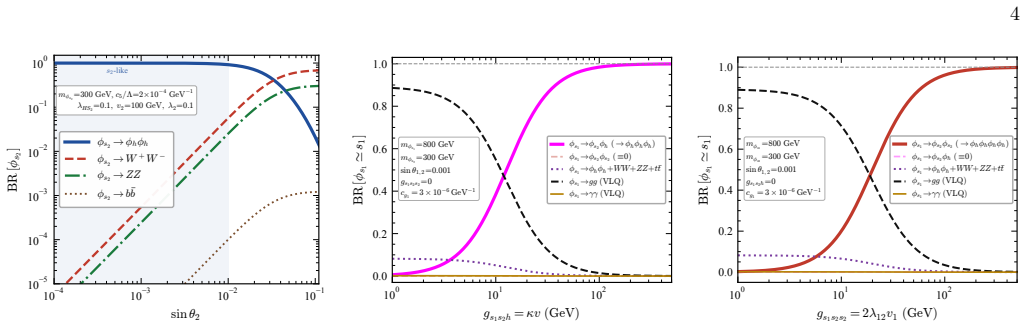
Contrary to conventional expectations, in a class of extended scalar-sector scenarios, final states with two, three, or four Higgs bosons constitute the leading discovery channels for new physics at the LHC. Higher-dimensional interactions together with suppressed Higgs-scalar mixing near the alignment limit reorganize the decay patterns of new scalar states, suppressing conventional modes while enhancing multi-Higgs final states. This is realized in a single-scalar extension of the Standard Model, where higher-dimensional operators suppress two-body decays while preserving higher-multiplicity couplings, and in a two-singlet scenario with simpler operator structure via cascade decays. In bot
What carries the argument
Higher-dimensional operators that suppress two-body decays while preserving couplings to higher-multiplicity Higgs final states, acting near the alignment limit.
If this is right
- New scalar states produced via gluon fusion yield potentially observable rates for multi-Higgs production at the LHC.
- Triple-Higgs and quadruple-Higgs signatures become the dominant discovery channels in the described scenarios.
- Single-scalar and two-singlet realizations produce identical final states but are distinguishable through their kinematic features.
- Conventional two-body decay modes are suppressed, shifting the focus of new physics searches to higher-multiplicity Higgs final states.
Where Pith is reading between the lines
- LHC analyses may need to expand searches to include higher Higgs multiplicities to capture signals that standard two-body searches would miss.
- Kinematic differences between realizations could serve as a diagnostic for the underlying operator structure if a signal appears.
- Similar decay reorganizations might occur in other scalar extensions, suggesting a broader class of models where multi-Higgs channels dominate.
Load-bearing premise
Higher-dimensional interactions together with suppressed Higgs-scalar mixing near the alignment limit can reorganize decay patterns to suppress conventional two-body modes while enhancing multi-Higgs final states.
What would settle it
Absence of enhanced rates for triple- or quadruple-Higgs production with the predicted kinematic distributions in LHC data at the luminosities where the models predict observability would show that the decay reorganization does not occur.
Figures
read the original abstract
Contrary to conventional expectations, we identify a class of extended scalar-sector scenarios in which final states with two, three, or four Higgs bosons constitute the leading discovery channels for new physics at the LHC. In these scenarios, higher-dimensional interactions, together with suppressed Higgs-scalar mixing near the alignment limit, reorganize the decay patterns of new scalar states, suppressing conventional modes while enhancing multi-Higgs final states. We illustrate the emergence of dominant triple- and quadruple-Higgs signatures in two representative realizations: a single-scalar extension of the Standard Model, where higher-dimensional operators suppress conventional two-body decays while preserving couplings to higher-multiplicity Higgs final states; and a two-singlet scenario, where similar signatures arise through cascade decays with a simpler operator structure. In both cases, the new scalar states can be produced via gluon fusion, yielding potentially observable rates for multi-Higgs production at the LHC. Although both realizations lead to identical final states, they exhibit distinct kinematic features reflecting their underlying topologies, providing a direct handle on the dynamics.
Editorial analysis
A structured set of objections, weighed in public.
Referee Report
Summary. The paper claims that in extended scalar sectors, higher-dimensional operators combined with suppressed Higgs-scalar mixing near the alignment limit can reorganize decays so that multi-Higgs final states (two, three, or four Higgs bosons) become the leading LHC discovery channels for new physics, rather than conventional two-body modes. This is illustrated in a single-scalar SM extension (where operators suppress two-body decays but preserve higher-multiplicity couplings) and a two-singlet model (via cascades), with production via gluon fusion yielding observable rates; the two realizations produce identical final states but differ in kinematics.
Significance. If the production rates remain viable while decays are reorganized as described, the result would shift LHC BSM search priorities toward multi-Higgs signatures and provide a new handle on scalar dynamics via kinematics. The manuscript offers no machine-checked proofs, parameter-free derivations, or explicit rate calculations, so the significance remains conditional on quantitative validation of the production-decay separation.
major comments (1)
- [Abstract] Abstract (paragraph 1) and the skeptic note on production: the central claim requires gluon-fusion production of the new scalars to remain observable while mixing is suppressed enough for higher-dimensional operators to dominate decays. No operator matching, effective ggS vertex calculation, or cross-section estimate is provided to demonstrate that the mixing suppression does not reduce the production rate below threshold by the same factor; this is load-bearing for the assertion that multi-Higgs states constitute leading channels.
minor comments (1)
- [Abstract] The abstract refers to 'two representative realizations' but provides no section numbers, equations, or parameter choices for the single-scalar or two-singlet cases, making it impossible to assess the operator structure or kinematic distinctions.
Simulated Author's Rebuttal
We thank the referee for the careful review and for identifying the critical assumption regarding gluon-fusion production rates near the alignment limit. We agree that this point is load-bearing for the central claim and will strengthen the manuscript accordingly.
read point-by-point responses
-
Referee: [Abstract] Abstract (paragraph 1) and the skeptic note on production: the central claim requires gluon-fusion production of the new scalars to remain observable while mixing is suppressed enough for higher-dimensional operators to dominate decays. No operator matching, effective ggS vertex calculation, or cross-section estimate is provided to demonstrate that the mixing suppression does not reduce the production rate below threshold by the same factor; this is load-bearing for the assertion that multi-Higgs states constitute leading channels.
Authors: We agree that the manuscript does not contain explicit operator matching, an effective ggS vertex calculation, or numerical cross-section estimates, and that this constitutes a genuine gap for the claim that multi-Higgs final states become leading channels. In the single-scalar extension the ggS coupling proceeds through mixing with the SM Higgs and is therefore suppressed by the same small mixing angle that suppresses two-body decays; the two-singlet cascade realization may evade this suppression through different topologies. The current text only states that production yields "potentially observable rates" without quantitative support. We will add a dedicated subsection with leading-order effective-field-theory matching to the gluon-fusion vertex and sample parton-level cross sections (for representative mixing angles and cutoff scales) to demonstrate that viable parameter space exists where multi-Higgs rates remain above background thresholds. revision: yes
Circularity Check
No circularity: claims rest on model-building assumptions without self-referential derivations or fitted predictions.
full rationale
The abstract and description outline a class of extended scalar scenarios where higher-dimensional operators and alignment suppress two-body decays while enhancing multi-Higgs modes, with production via gluon fusion. No equations, parameter fits, or derivation chains are provided in the available text. No step reduces a prediction to a fitted input by construction, invokes self-citation for uniqueness, or renames a known result. The central claim is a qualitative reorganization of decay patterns under stated assumptions, which remains independent of any internal loop. This is the expected non-finding for a model-identification paper lacking explicit derivations.
Axiom & Free-Parameter Ledger
Reference graph
Works this paper leans on
-
[1]
G. Aadet al.(ATLAS), Phys. Lett. B716, 1 (2012), arXiv:1207.7214 [hep-ex]
work page internal anchor Pith review Pith/arXiv arXiv 2012
-
[2]
Observation of a new boson at a mass of 125 GeV with the CMS experiment at the LHC
S. Chatrchyanet al.(CMS), Phys. Lett. B716, 30 (2012), arXiv:1207.7235 [hep-ex]
work page internal anchor Pith review Pith/arXiv arXiv 2012
-
[3]
Higgs Physics at the HL-LHC and HE-LHC
M. Cepedaet al., CERN Yellow Rep. Monogr.7, 221 (2019), arXiv:1902.00134 [hep-ph]
work page internal anchor Pith review Pith/arXiv arXiv 2019
-
[4]
J. Alisonet al., Rev. Phys.5, 100045 (2020), arXiv:1910.00012 [hep-ph]
-
[5]
H. Al Aliet al., Rept. Prog. Phys.85, 084201 (2022), arXiv:2103.14043 [hep-ph]
-
[6]
J. de Blas, J. Gu, and Z. Liu, Phys. Rev. D106, 073007 (2022), arXiv:2203.04324 [hep-ph]
-
[7]
M. Forslund and P. Meade, JHEP01, 182 (2024), arXiv:2308.02633 [hep-ph]
-
[8]
A global view on the Higgs self-coupling at lepton colliders
S. Di Vita, G. Durieux, C. Grojean, J. Gu, Z. Liu, G. Panico, M. Riembau, and T. Vantalon, JHEP02, 178 (2018), arXiv:1711.03978 [hep-ph]
work page internal anchor Pith review Pith/arXiv arXiv 2018
-
[9]
Measurement of Higgs couplings and self-coupling at the ILC
J. Tian and K. Fujii (ILD), PoSEPS-HEP2013, 316 (2013), arXiv:1311.6528 [hep-ph]
work page internal anchor Pith review Pith/arXiv arXiv 2013
-
[10]
Improved Formalism for Precision Higgs Coupling Fits
T. Barklow, K. Fujii, S. Jung, R. Karl, J. List, T. Ogawa, M. E. Peskin, and J. Tian, Phys. Rev. D97, 053003 (2018), arXiv:1708.08912 [hep-ph]
work page internal anchor Pith review Pith/arXiv arXiv 2018
-
[11]
Higgs physics at the Future Circular Collider
D. d’Enterria, PoSICHEP2016, 434 (2017), arXiv:1701.02663 [hep-ex]
work page internal anchor Pith review Pith/arXiv arXiv 2017
-
[12]
M. Forslund and P. Meade, JHEP08, 185 (2022), arXiv:2203.09425 [hep-ph]
- [13]
-
[14]
F. Maltoni, G. Ventura, and E. Vryonidou, JHEP12, 183 (2024), arXiv:2406.06670 [hep-ph]
-
[15]
G. Aadet al.(ATLAS), Phys. Rev. Lett.133, 101801 (2024), arXiv:2406.09971 [hep-ex]
-
[16]
A. Tumasyanet al.(CMS), Phys. Rev. Lett.129, 081802 (2022), arXiv:2202.09617 [hep-ex]
-
[17]
G. Aadet al.(ATLAS), Phys. Rev. Lett.132, 231801 (2024), arXiv:2311.15956 [hep-ex]
-
[18]
A. Hayrapetyanet al.(CMS), Phys. Rept.1115, 368 (2025), arXiv:2403.16926 [hep-ex]
-
[19]
A. Tumasyanet al.(CMS), Phys. Rev. Lett.131, 041803 (2023), arXiv:2205.06667 [hep-ex]
- [20]
-
[21]
Aadet al.(CMS, ATLAS), (2026), arXiv:2602.23991 [hep-ex]
G. Aadet al.(CMS, ATLAS), (2026), arXiv:2602.23991 [hep-ex]
-
[22]
Collaboration (CMS),Projection of CMS experimental reach on HH production at HL-LHC, Tech
C. Collaboration (CMS),Projection of CMS experimental reach on HH production at HL-LHC, Tech. Rep. (CERN, Geneva, 2025)
2025
-
[23]
Tumasyanet al.(CMS), JHEP02, 040 (2025), arXiv:2407.13872 [hep-ex]
A. Tumasyanet al.(CMS), JHEP02, 040 (2025), arXiv:2407.13872 [hep-ex]
-
[24]
G. Aadet al.(ATLAS), Phys. Lett. B800, 135103 (2020), arXiv:1906.02025 [hep-ex]
-
[25]
Aadet al.(ATLAS), JHEP07, 040 (2023), arXiv:2209.10910 [hep-ex]
G. Aadet al.(ATLAS), JHEP07, 040 (2023), arXiv:2209.10910 [hep-ex]
-
[26]
M. Aaboudet al.(ATLAS), Phys. Rev. Lett.121, 191801 (2018), [Erratum: Phys.Rev.Lett. 122, 089901 (2019)], arXiv:1808.00336 [hep-ex]
work page internal anchor Pith review Pith/arXiv arXiv 2018
-
[27]
G. Aadet al.(ATLAS), Phys. Rev. D105, 092002 (2022), arXiv:2202.07288 [hep-ex]
-
[28]
G. Aadet al.(ATLAS), Phys. Rev. D106, 052001 (2022), arXiv:2112.11876 [hep-ex]
-
[29]
Aadet al.(ATLAS, CMS), (2025), arXiv:2504.00672 [hep-ex]
G. Aadet al.(ATLAS, CMS), (2025), arXiv:2504.00672 [hep-ex]
-
[30]
Hayrapetyanet al.(CMS), JHEP12, 178 (2025), arXiv:2508.11494 [hep-ex]
A. Hayrapetyanet al.(CMS), JHEP12, 178 (2025), arXiv:2508.11494 [hep-ex]
-
[31]
A. M. Sirunyanet al.(CMS), JHEP01, 054 (2018), arXiv:1708.04188 [hep-ex]
work page internal anchor Pith review Pith/arXiv arXiv 2018
-
[32]
CMS Collaboration,Search for nonresonant triple Higgs boson production in the six b-quark final state in proton- proton collisions at 13 TeV, Tech. Rep. CMS-PAS-HIG- 24-012 (CERN, 2025)
2025
-
[33]
G. Aadet al.(ATLAS), Phys. Rev. D111, 032006 (2025), arXiv:2411.02040 [hep-ex]. [34]Search for triple Higgs production in Run2 data of CMS using 4b2gamma final state., Tech. Rep. (CERN, Geneva, 2025)
-
[34]
H. Abouabidet al., Eur. Phys. J. C84, 1183 (2024), arXiv:2407.03015 [hep-ph]
-
[35]
J. M. Cornwall, D. N. Levin, and G. Tiktopoulos, Phys. Rev. D10, 1145 (1974), [Erratum: Phys.Rev.D 11, 972 (1975)]
1974
-
[36]
B. W. Lee, C. Quigg, and H. B. Thacker, Phys. Rev. D 16, 1519 (1977)
1977
-
[37]
C. E. Vayonakis, Lett. Nuovo Cim.17, 383 (1976)
1976
-
[38]
M. S. Chanowitz and M. K. Gaillard, Nucl. Phys. B261, 379 (1985)
1985
-
[39]
H. G. J. Veltman, Phys. Rev. D41, 2294 (1990)
1990
-
[40]
A. Papaefstathiou, T. Robens, and G. Tetlalmatzi- Xolocotzi, JHEP05, 193 (2021), arXiv:2101.00037 [hep- ph]
-
[41]
A. Papaefstathiou and G. Tetlalmatzi-Xolocotzi, (2025), arXiv:2501.14866 [hep-ph]
-
[42]
G. Aadet al.(ATLAS), Eur. Phys. J. C80, 1165 (2020), arXiv:2004.14636 [hep-ex]
- [43]
-
[44]
C.-Y. Chen, S. Dawson, and E. Furlan, Phys. Rev. D 96, 015006 (2017), arXiv:1703.06134 [hep-ph]
work page internal anchor Pith review Pith/arXiv arXiv 2017
-
[45]
On the Alignment Limit of the NMSSM Higgs Sector
M. Carena, H. E. Haber, I. Low, N. R. Shah, and 11 C. E. M. Wagner, Phys. Rev. D93, 035013 (2016), arXiv:1510.09137 [hep-ph]
work page internal anchor Pith review Pith/arXiv arXiv 2016
-
[46]
Handbook of LHC Higgs Cross Sections: 4. Deciphering the Nature of the Higgs Sector
D. de Florianet al.(LHC Higgs Cross Section Work- ing Group), CERN Yellow Rep. Monogr.2, 1 (2017), arXiv:1610.07922 [hep-ph]
work page internal anchor Pith review Pith/arXiv arXiv 2017
-
[47]
J. Alwall, R. Frederix, S. Frixione, V. Hirschi, F. Maltoni, O. Mattelaer, H. S. Shao, T. Stelzer, P. Torrielli, and M. Zaro, JHEP07, 079 (2014), arXiv:1405.0301 [hep- ph]
work page internal anchor Pith review Pith/arXiv arXiv 2014
-
[48]
J. M. Butterworth, A. R. Davison, M. Rubin, and G. P. Salam, in34th International Conference on High Energy Physics(2008) arXiv:0810.0409 [hep-ph]
work page internal anchor Pith review Pith/arXiv arXiv 2008
- [49]
-
[50]
Radovic, M
A. Radovic, M. Williams, D. Rousseau, M. Kagan, D. Bonacorsi, A. Himmel, A. Aurisano, K. Terao, and T. Wongjirad, Nature560, 41 (2018)
2018
-
[51]
P. Li, Z. Liu, and L.-T. Wang, (2026), arXiv:2604.14284 [hep-ph]
work page internal anchor Pith review Pith/arXiv arXiv 2026
-
[52]
A. Hayrapetyanet al.(CMS), Phys. Rev. D110, 072012 (2024), arXiv:2405.05071 [hep-ex]
-
[53]
Aadet al.(ATLAS), JHEP05, 075 (2025), arXiv:2411.07143 [hep-ex]
G. Aadet al.(ATLAS), JHEP05, 075 (2025), arXiv:2411.07143 [hep-ex]
-
[54]
R. Benbrik, M. Boukidi, M. Ech-chaouy, S. Moretti, K. Salime, and Q.-S. Yan, JHEP03, 020 (2025), arXiv:2412.01761 [hep-ph]
-
[55]
Oropeza Barrera (CMS), PoSLHCP2024, 011 (2025)
C. Oropeza Barrera (CMS), PoSLHCP2024, 011 (2025)
2025
discussion (0)
Sign in with ORCID, Apple, or X to comment. Anyone can read and Pith papers without signing in.