REVIEW 1 major objections 2 minor 7 references
Reviewed by Pith at T0; open to challenge.
T0 means a machine referee read the full paper against a public rubric. The mark states how deep the mechanical check went, never who wrote it. the ladder, T0–T4 →
T0 review · grok-4.3
Post-training of vision-language models improves reasoning more than perception because of token imbalance in SFT and reward coupling in RL.
2026-06-29 07:36 UTC pith:3LOHOJXS
load-bearing objection The paper gives a clean diagnostic for why post-training helps reasoning more than perception in VLMs and shows workable fixes on synthetic tasks. the 1 major comments →
On Asymmetric Optimization of Reasoning and Perception in Vision-Language Model Post-Training
The pith
A machine-rendered reading of the paper's core claim, the machinery that carries it, and where it could break.
Core claim
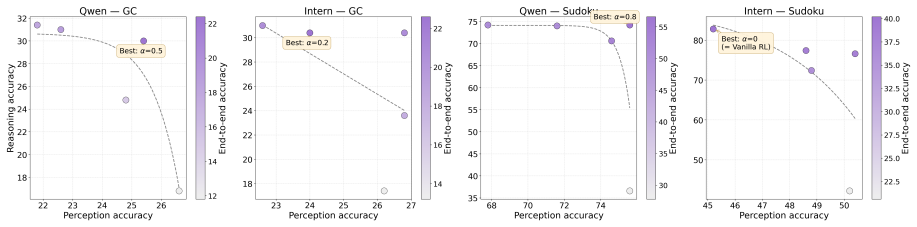
Post-training improves reasoning more substantially than perception. For supervised fine-tuning this stems from token imbalance in chain-of-thought supervision, where perception occupies fewer tokens and receives a weaker training signal. Dynamically reweighting the loss mitigates this imbalance and boosts end-to-end performance by up to 18.2. For reinforcement learning the asymmetry arises from reward coupling, where outcome rewards correlate more strongly with reasoning than with perception. Adding a perception-aware reward alleviates the imbalance and improves end-to-end accuracy by up to 6.0; even a reliable surrogate reward yields gains of 3.2 points.
What carries the argument
A controlled diagnostic framework built from two synthetic tasks that separate perception from reasoning.
Load-bearing premise
The two synthetic tasks truly isolate perception from reasoning without introducing other factors that drive the observed asymmetry.
What would settle it
If reweighting the loss in SFT or adding a perception-aware reward in RL fails to close the performance gap on the synthetic tasks while leaving reasoning gains intact, the diagnosed mechanisms would be refuted.
Editorial analysis
A structured set of objections, weighed in public.
Referee Report
Summary. The paper introduces a controlled diagnostic framework with two synthetic tasks designed to disentangle perception from reasoning in vision-language models. It reports a consistent perception-reasoning asymmetry under post-training: SFT improves reasoning more due to token imbalance in chain-of-thought supervision, while RL does so due to reward coupling with outcome signals. Interventions (dynamic loss reweighting for SFT; perception-aware rewards for RL, including a surrogate) are claimed to close the gap and improve end-to-end accuracy by up to 18.2, 6.0, and 3.2 points.
Significance. If the diagnostic tasks isolate the factors as claimed, the work supplies a mechanistic account of why perception lags reasoning in VLM post-training and supplies concrete, paradigm-specific fixes. The controlled synthetic setup and the SFT-vs-RL distinction are methodological strengths that could inform future training recipes.
major comments (1)
- [§3] §3 (Synthetic Tasks): The central attribution of the asymmetry to token imbalance (SFT) or reward coupling (RL) rests on the claim that the two synthetic tasks cleanly disentangle perception from reasoning. The manuscript provides no explicit ablation or correlation analysis ruling out confounds such as perception errors propagating into reasoning steps or task artifacts that couple the two. This is load-bearing for the causal claims and the reported gains from the interventions.
minor comments (2)
- [Abstract and §5] Abstract and results sections: quantitative gains (18.2, 6.0, 3.2) are stated without accompanying error bars, number of runs, or statistical tests; these should be added for reproducibility.
- [§4.2] Notation for the perception-aware reward and the surrogate reward should be defined explicitly with equations rather than prose descriptions.
Simulated Author's Rebuttal
We thank the referee for the constructive feedback and for recognizing the methodological strengths of the controlled synthetic setup and the SFT-vs-RL distinction. We address the single major comment below.
read point-by-point responses
-
Referee: [§3] §3 (Synthetic Tasks): The central attribution of the asymmetry to token imbalance (SFT) or reward coupling (RL) rests on the claim that the two synthetic tasks cleanly disentangle perception from reasoning. The manuscript provides no explicit ablation or correlation analysis ruling out confounds such as perception errors propagating into reasoning steps or task artifacts that couple the two. This is load-bearing for the causal claims and the reported gains from the interventions.
Authors: We agree that explicit validation strengthens the causal attribution. The tasks were constructed so that perception (object identification in isolated visual queries) and reasoning (relational inference over provided symbolic inputs) operate on disjoint token sequences and evaluation metrics, with no shared intermediate states that would induce propagation. Nevertheless, the manuscript does not currently include the requested correlation or ablation analyses. We will add them in revision: (i) Pearson correlation between per-example perception and reasoning accuracies across checkpoints, and (ii) a controlled error-injection ablation that perturbs only perception outputs while holding reasoning inputs fixed, quantifying downstream reasoning degradation. These additions will directly test for residual coupling. revision: yes
Circularity Check
No circularity: empirical diagnostic framework with independent experimental results
full rationale
The paper introduces synthetic tasks as a diagnostic tool and reports observed asymmetries from post-training experiments (SFT token imbalance, RL reward coupling). These are measured outcomes, not quantities defined in terms of themselves or fitted parameters renamed as predictions. No equations, self-citations, or uniqueness theorems appear in the provided text. The central claims rest on experimental deltas (e.g., +18.2, +6.0) rather than any reduction to inputs by construction. This is a standard empirical analysis; the disentanglement assumption is a methodological precondition, not a circular step.
Axiom & Free-Parameter Ledger
read the original abstract
Post-training has greatly improved reasoning in frontier vision-language models, yet its gains for perception remain comparatively limited, creating a bottleneck for end-to-end visual reasoning. To investigate this gap, we introduce a controlled diagnostic framework with two synthetic tasks that disentangle perception from reasoning. Our analysis reveals a consistent perception-reasoning asymmetry: posttraining improves reasoning more substantially than perception, though the underlying mechanism differs by training paradigm. For supervised fine-tuning (SFT), this asymmetry stems from token imbalance in chain-of-thought supervision, where perception occupies fewer tokens and thus receives a weaker training signal. Dynamically reweighting the loss mitigates this imbalance and boosts end-to-end performance by up to 18.2. For reinforcement learning (RL), the asymmetry instead arises from reward coupling: outcome rewards correlate more strongly with reasoning than with perception, weakening the signal for perception learning. Adding a perception-aware reward alleviates the imbalance and improves end-to-end accuracy by up to 6.0; even without groundtruth perception rewards, a reliable surrogate reward provide useful signal, yielding gains of 3.2 points. Together, our results comprehensively diagnose asymmetric optimization and suggest concrete interventions to balance perception and reasoning.
Figures



Reference graph
Works this paper leans on
-
[1]
Hallucination of Multimodal Large Language Models: A Survey
Hallucination of multimodal large language models: A survey. arXiv preprint arXiv:2404.18930. Yan Chen, Long Li, Teng Xi, Long Zeng, and Jingdong Wang. 2025. Perception before reasoning: Two-stage reinforcement learning for visual reasoning in vision- language models. arXiv preprint arXiv:2509.13031. Tianzhe Chu, Yuexiang Zhai, Jihan Yang, Shengbang Tong,...
work page internal anchor Pith review Pith/arXiv arXiv 2025
-
[2]
More Thinking, Less Seeing? Assessing Amplified Hallucination in Multimodal Reasoning Models
Let’s verify step by step. In International Conference on Learning Representations, volume 2024, pages 39578–39601. Chengzhi Liu, Zhongxing Xu, Qingyue Wei, Juncheng Wu, James Zou, Xin Eric Wang, Yuyin Zhou, and Sheng Liu. 2025. More thinking, less seeing? assess- ing amplified hallucination in multimodal reasoning models. arXiv preprint arXiv:2505.21523....
work page Pith review arXiv 2024
-
[3]
In Proceedings of the IEEE/CVF International Conference on Computer Vision, pages 2376–2385
R1-onevision: Advancing generalized mul- timodal reasoning through cross-modal formaliza- tion. In Proceedings of the IEEE/CVF International Conference on Computer Vision, pages 2376–2385. Guanyu Yao, Qiucheng Wu, Yang Zhang, Zhaowen Wang, Handong Zhao, and Shiyu Chang. 2025. Rethinking the text-vision reasoning imbalance in mllms through the lens of trai...
-
[4]
Mulberry: Empowering mllm with o1-like rea- soning and reflection via collective monte carlo tree search. Advances in Neural Information Processing Systems, 38:29918–29952. Xiang Yue, Yuansheng Ni, Kai Zhang, Tianyu Zheng, Ruoqi Liu, Ge Zhang, Samuel Stevens, Dongfu Jiang, Weiming Ren, Yuxuan Sun, and 1 others. 2024. Mmmu: A massive multi-discipline multi...
work page internal anchor Pith review Pith/arXiv arXiv 2024
-
[5]
The graph coloring dataset (Heyman and Zyl- berberg, 2025) released under MIT license is adapted for building our graph coloring task
2025
-
[6]
We have reviewed the licenses and intended-use conditions of all existing artifacts we used
The Sudoku dataset (Du et al., 2024) released under MIT license is adapted for building our Sudoku task; 9.MNIST images (LeCun et al., 2010) released under MIT license for rendering Sudoku im- ages. We have reviewed the licenses and intended-use conditions of all existing artifacts we used. The models and training frameworks we adopt are re- leased under ...
2024
-
[7]
Hyperparameter Value train_batch_size 128 lr 1e-6 ppo_mini_batch_size 128 use_kl_loss true kl_loss_coef 0.01 total_training_steps 100 Table 7: Hyperparameter settings for QwenVL RL
and largely follow its default hyperpa- rameter settings to ensure stable performance. Hyperparameter Value train_batch_size 128 lr 1e-6 ppo_mini_batch_size 128 use_kl_loss true kl_loss_coef 0.01 total_training_steps 100 Table 7: Hyperparameter settings for QwenVL RL. The hyperparameter settings are reported in Ta- ble 8. We also train on 4 × 80GB A100 GP...
2025
discussion (0)
Sign in with ORCID, Apple, or X to comment. Anyone can read and Pith papers without signing in.