Exact Geometric Typicality and Bipartite Entanglement from the Projected Central Limit Theorem on Hyperspheres
Pith reviewed 2026-06-29 06:37 UTC · model grok-4.3
The pith
The typical bipartite mutual information of a Haar-random pure state equals (d_A²-1)(d_B²-1) times an explicit Bose-Einstein integral over the remaining dimension.
A machine-rendered reading of the paper's core claim, the machinery that carries it, and where it could break.
Core claim
The exact typical mutual information factors as ⟨I(A:B)⟩ = (d_A²-1)(d_B²-1) 𝒢(d_A,d_B,d_E), where 𝒢 is the explicit Bose–Einstein integral whose asymptotic series is Bernoulli-factorized with every k≥1 order carrying the symmetric factor (d_A^{2k}-1)(d_B^{2k}-1) and all higher odd-order corrections vanishing identically.
What carries the argument
Projected Central Limit Theorem on hyperspheres, which supplies the exact moments of the Beta-distributed occupation probabilities and thereby the closed-form mutual-information integral.
If this is right
- The leading 1/N correction to typical mutual information separates into a bipartite coherence term (d_A²-1)(d_B²-1)/(2N) minus a classical term (d_A-1)(d_B-1)/(2N).
- All odd-order terms in the 1/N expansion of the typical mutual information beyond the first vanish identically.
- The dimensional counts (d-1) and (d²-1) acquire geometric meaning as the dimensions of the Cartan and su(d) parts of the generalized Bloch decomposition.
- The same hyperspherical moments recover Lubkin’s purity formula and the exact Beta distribution for reduced-state eigenvalues without invoking the Gaussian approximation.
Where Pith is reading between the lines
- The factorization may extend to other information measures whose definitions involve only eigenvalue or diagonal entropies of the reduced states.
- The exact integral form could be used to compute typical values of other correlation functions that are functions of the same occupation probabilities.
- Numerical verification for moderate system sizes would test whether the vanishing of odd-order corrections persists beyond the asymptotic regime.
Load-bearing premise
Global pure states are distributed according to the uniform Haar measure on the hypersphere.
What would settle it
Direct numerical sampling of Haar-random pure states for small d_A, d_B, d_E and comparison of the measured average mutual information against the value of the Bose-Einstein integral formula.
Figures
read the original abstract
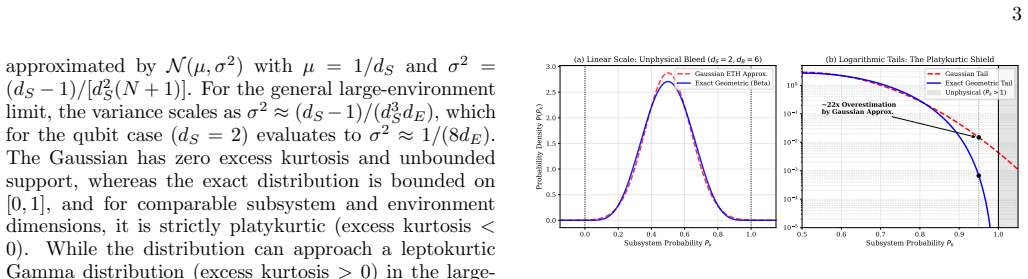
Starting from the exact Projected Central Limit Theorem on hyperspheres, we rederive the Beta distribution for subsystem occupation probabilities and Lubkin's purity formula from elementary hyperspherical moments, quantifying the finite-size ``platykurtic'' suppression of tails relative to the Gaussian approximation used in standard eigenstate-thermalization and typicality treatments. Our main new result concerns the bipartite quantum mutual information $\langle I(A{:}B)\rangle$ for Haar-random pure states. We show that its full asymptotic expansion in $1/N$ admits a Bernoulli-factorized form in which every order $k \ge 1$ carries the symmetric factor $(d_A^{2k}-1)(d_B^{2k}-1)$ and all higher odd-order corrections vanish identically. Through an exact algebraic reorganization of Page's formula (conjectured in Ref.~\cite{Page1993} and subsequently proven~\cite{Foong1994, SanchezRuiz1995, Sen1996}), we establish that the leading finite-size correction separates into a dominant $\mathfrak{su}(d_A) \otimes \mathfrak{su}(d_B)$ bipartite quantum coherence contribution $(d_A^2 - 1)(d_B^2 - 1)/(2N)$ and a subtracted classical-probability (Cartan $\otimes$ Cartan) contribution $(d_A - 1)(d_B - 1)/(2N)$, and we trace this separation to the difference between diagonal and eigenvalue entropies via Schur's majorisation theorem, with the dimensional counts $(d-1)$ and $(d^2-1)$ acquiring meaning through the Cartan structure of the generalised Bloch decomposition. These results admit a single non-perturbative closed form: the exact typical mutual information factors as $\langle I(A{:}B)\rangle = (d_A^2-1)(d_B^2-1)\,\mathcal{G}(d_A,d_B,d_E)$, with $\mathcal{G}$ given by an explicit Bose--Einstein integral whose asymptotic expansion in $1/N$ reproduces the Bernoulli series.
Editorial analysis
A structured set of objections, weighed in public.
Referee Report
Summary. The paper starts from the projected central limit theorem on hyperspheres to rederive the Beta distribution of subsystem occupation probabilities and Lubkin's purity formula from elementary moments. Its central claim is that the typical bipartite mutual information for Haar-random pure states admits the exact factorization ⟨I(A:B)⟩ = (d_A²-1)(d_B²-1) 𝒢(d_A,d_B,d_E), where 𝒢 is an explicit Bose–Einstein integral; the 1/N expansion of this expression is Bernoulli-factorized with every order k≥1 carrying the symmetric prefactor (d_A^{2k}-1)(d_B^{2k}-1) and all odd-order corrections beyond the leading term vanishing identically. The leading 1/N correction is further separated, via algebraic reorganization of Page's formula and Schur majorization, into an su(d_A)⊗su(d_B) coherence term (d_A²-1)(d_B²-1)/(2N) minus a classical Cartan⊗Cartan term (d_A-1)(d_B-1)/(2N).
Significance. If the exact non-perturbative identification holds, the result supplies a closed-form expression for finite-size typical entanglement that is free of fitting parameters and directly traceable to the hyperspherical geometry and the Cartan structure of the Bloch decomposition. The Bernoulli factorization with symmetric factors and the automatic vanishing of odd orders constitute a strong, falsifiable structural prediction. The derivation of the Beta distribution and Lubkin purity from projected-CLT moments without additional assumptions is also a clear technical contribution.
major comments (2)
- [Abstract (paragraph presenting the closed form)] The manuscript states that an exact algebraic reorganization of Page's formula (cited via Foong et al. and Sen) yields the Bose–Einstein integral form for 𝒢, but the explicit steps equating the reorganized sum to the integral (including the precise definition of the integral measure and the contour or summation index) are not supplied in the abstract or the paragraphs describing the non-perturbative closed form; without these steps it is impossible to verify that the equality is exact for finite d_A, d_B, d_E rather than holding only order-by-order in 1/N.
- [Abstract (paragraph on leading finite-size correction)] The separation of the leading 1/N correction into the (d_A²-1)(d_B²-1) coherence contribution minus the (d_A-1)(d_B-1) classical contribution is asserted to follow from Schur majorization applied to diagonal versus eigenvalue entropies; the manuscript should cite the precise statement of Schur's theorem used and show how the dimensional counts (d-1) versus (d²-1) arise directly from the Cartan decomposition in the generalized Bloch representation.
minor comments (1)
- [Abstract] The abstract refers to “the exact Projected Central Limit Theorem on hyperspheres” without giving its statement or the reference from which it is taken; a brief recall of the theorem (or a pointer to the relevant equation in the main text) would improve readability.
Simulated Author's Rebuttal
We thank the referee for the positive assessment of the paper's significance and for the constructive major comments. We address each point below with clarifications from the manuscript and indicate where revisions will improve clarity.
read point-by-point responses
-
Referee: [Abstract (paragraph presenting the closed form)] The manuscript states that an exact algebraic reorganization of Page's formula (cited via Foong et al. and Sen) yields the Bose–Einstein integral form for 𝒢, but the explicit steps equating the reorganized sum to the integral (including the precise definition of the integral measure and the contour or summation index) are not supplied in the abstract or the paragraphs describing the non-perturbative closed form; without these steps it is impossible to verify that the equality is exact for finite d_A, d_B, d_E rather than holding only order-by-order in 1/N.
Authors: The manuscript derives the exact factorization in Section 3 by starting from the closed-form Page expression (Foong et al., Sen) for the average von Neumann entropy and performing an algebraic re-summation that identifies each term in the resulting series with the corresponding term in the integral representation of the Bose–Einstein function. The integral is defined with the standard measure ∫_0^1 dx x^{d-1}/(1-x) (with appropriate regularization for the finite-dimensional cutoff), and the equality holds exactly for any finite d_A, d_B, d_E because the reorganization is an identity between two representations of the same finite sum, not an asymptotic approximation. To address the concern, we will insert a compact outline of these algebraic steps (including the explicit integral measure) immediately after the statement of the closed form in the introduction. revision: partial
-
Referee: [Abstract (paragraph on leading finite-size correction)] The separation of the leading 1/N correction into the (d_A²-1)(d_B²-1) coherence contribution minus the (d_A-1)(d_B-1) classical contribution is asserted to follow from Schur majorization applied to diagonal versus eigenvalue entropies; the manuscript should cite the precise statement of Schur's theorem used and show how the dimensional counts (d-1) versus (d²-1) arise directly from the Cartan decomposition in the generalized Bloch representation.
Authors: We agree that the connection can be made more explicit. The manuscript invokes Schur majorization to compare the entropy of the diagonal (population) part of the reduced density matrix with the entropy of its eigenvalues; the dimensional prefactors follow because the Cartan subalgebra of su(d) has dimension d-1 while the full algebra has dimension d²-1. In the revision we will (i) cite the standard statement of Schur’s theorem (Marshall–Olkin, Theorem 3.B.2) and (ii) add a short paragraph in Section 4 that derives the counts (d-1) and (d²-1) directly from the decomposition of the Bloch vector into Cartan and non-Cartan components. revision: yes
Circularity Check
No significant circularity; central result is algebraic reorganization of independent Page formula
full rationale
The paper starts from the Projected Central Limit Theorem on hyperspheres (taken as given) to rederive Beta distributions and Lubkin's purity via hyperspherical moments. The main claim—the exact factorization ⟨I(A:B)⟩ = (d_A²-1)(d_B²-1) 𝒢 with 𝒢 a Bose-Einstein integral—is obtained by 'exact algebraic reorganization of Page's formula' (explicitly cited to independent proofs in Foong1994, SanchezRuiz1995, Sen1996). No self-citations appear as load-bearing steps, no parameters are fitted then relabeled as predictions, and no ansatz or uniqueness theorem is smuggled via self-reference. The Bernoulli factorization and vanishing odd orders are direct consequences of the reorganization rather than imposed by definition on the inputs. The Haar measure assumption is standard and external to the derivation chain.
Axiom & Free-Parameter Ledger
axioms (2)
- domain assumption Projected Central Limit Theorem on hyperspheres supplies exact moments for subsystem occupation probabilities
- standard math Schur's majorisation theorem applies to diagonal versus eigenvalue entropies
Forward citations
Cited by 1 Pith paper
-
Non-Perturbative Closed Form for the Typical Bipartite Mutual Information of Haar-Random States
Derives a non-perturbative closed-form integral for the typical bipartite mutual information of Haar-random states as (d_A²-1)(d_B²-1) times an explicit convergent integral G.
Reference graph
Works this paper leans on
-
[1]
⟨I(A:B)⟩ →0 if either subsystem is trivial (d= 1)
The factorisation The Bernoulli expansion in Eq. (22) shows that (d 2k A − 1)(d2k B −1) appears at every orderk≥1. Sinced 2k A −1 = (d2 A −1) Pk−1 j=0 d2j A , the factor (d 2 A −1)(d 2 B −1) divides every term of the asymptotic series. We verified that this factorisation holds at the level of theexactmutual information: ⟨I(A:B)⟩= (d 2 A −1)(d 2 B −1)G(d A...
-
[2]
Closed-form non-perturbative expression The harmonic-number combination in Eq. (27) admits an exact integral representation via Binet’s second for- mula [38] ψ(z+ 1) = lnz+ 1 2z −2 Z ∞ 0 t dt (t2 +z 2)(e2πt −1) .(49) Applying this to each of the four digamma terms in Eq. (33), the constant and logarithmic pieces cancel pair- wise. The 1/(2z) pieces assemb...
-
[3]
platykurtic shield
Equivalent zeta-function form Using the identity−B 2k/(2k) =ζ(1−2k), the asymp- totic expansion in Eq. (22) can be rewritten as ⟨I(A:B)⟩ ∼ (d2 A −1)(d 2 B −1) 2N + ∞X k=1 ζ(1−2k) N2k (d2k A −1)(d 2k B −1). (52) The valuesζ(1−2k)∈Qat negative odd integers are pre- cisely the regularised values that appear in zeta-function regularisation of divergent sums (...
-
[4]
D. N. Page, Phys. Rev. Lett.71, 1291 (1993). [2] S. K. Foong and S. Kanno, Phys. Rev. Lett.72, 1148 (1994). 11
1993
-
[5]
S´ anchez-Ruiz, Phys
J. S´ anchez-Ruiz, Phys. Rev. E52, 5653 (1995)
1995
-
[6]
Sen, Phys
S. Sen, Phys. Rev. Lett.77, 1 (1996)
1996
-
[7]
J. M. Deutsch, Phys. Rev. A43, 2046 (1991)
2046
-
[8]
Srednicki, Phys
M. Srednicki, Phys. Rev. E50, 888 (1994)
1994
-
[9]
Rigol, V
M. Rigol, V. Dunjko, and M. Olshanii, Nature452, 854 (2008)
2008
-
[10]
Goldstein, J
S. Goldstein, J. L. Lebowitz, R. Tumulka, and N. Zangh` ı, Phys. Rev. Lett.96, 050403 (2006)
2006
-
[11]
Popescu, A
S. Popescu, A. J. Short, and A. Winter, Nat. Phys.2, 754 (2006)
2006
-
[12]
D’Alessio, Y
L. D’Alessio, Y. Kafri, A. Polkovnikov, and M. Rigol, Adv. Phys.65, 239 (2016)
2016
-
[13]
Klartag, Invent
B. Klartag, Invent. Math.168, 91 (2007)
2007
-
[14]
Preskill, Quantum2, 79 (2018)
J. Preskill, Quantum2, 79 (2018)
2018
-
[15]
Binderet al.,Thermodynamics in the Quantum Regime(Springer, 2018)
F. Binderet al.,Thermodynamics in the Quantum Regime(Springer, 2018)
2018
-
[16]
Hayden and J
P. Hayden and J. Preskill, JHEP09, 120 (2007)
2007
-
[17]
Wang and S
Z.-W. Wang and S. L. Braunstein, Nat. Astron.7, 755 (2023)
2023
-
[18]
Wang and S
Z.-W. Wang and S. L. Braunstein, Astrophys. J.962, 55 (2024)
2024
-
[19]
˙Zyczkowski and H.-J
K. ˙Zyczkowski and H.-J. Sommers, J. Phys. A34, 7111 (2001)
2001
-
[20]
Bengtsson and K
I. Bengtsson and K. ˙Zyczkowski,Geometry of Quantum States(Cambridge University Press, 2006)
2006
-
[21]
Lubkin, J
E. Lubkin, J. Math. Phys.19, 1028 (1978)
1978
-
[22]
Weingarten, J
D. Weingarten, J. Math. Phys.19, 599 (1978)
1978
-
[23]
Collins and P
B. Collins and P. ´Sniady, Commun. Math. Phys.264, 773 (2006)
2006
-
[24]
Non-Perturbative Closed Form for the Typical Bipartite Mutual Information of Haar-Random States
Z.-W. Wang, P.-W. Li, and S. L. Braunstein, Non- Perturbative Closed Form for the Typical Bipartite Mu- tual Information of Haar-Random States, arXiv preprint arXiv:2605.29725 (2026)
work page internal anchor Pith review Pith/arXiv arXiv 2026
-
[25]
Borel, Ann
´E. Borel, Ann. Sci. ´Ec. Norm. Sup´ er.23, 9 (1906)
1906
-
[26]
A. J. Stam, J. Appl. Probab.19, 221 (1982)
1982
-
[27]
Diaconis and D
P. Diaconis and D. Freedman, Ann. Stat.12, 793 (1984)
1984
-
[28]
Lloyd and H
S. Lloyd and H. Pagels, Ann. Phys.188, 186 (1988)
1988
-
[29]
W. K. Wootters, Found. Phys.20, 1365 (1990)
1990
-
[30]
Nadal, S
C. Nadal, S. N. Majumdar, and M. Vergassola, Phys. Rev. Lett.104, 110501 (2010)
2010
-
[31]
Schur, Sitzungsber
I. Schur, Sitzungsber. Berl. Math. Ges.22, 9 (1923)
1923
-
[32]
A. W. Marshall, I. Olkin, and B. C. Arnold,Inequali- ties: Theory of Majorization and Its Applications, 2nd ed. (Springer, New York, 2011)
2011
-
[33]
R. A. Horn and C. R. Johnson,Matrix Analysis, 2nd ed. (Cambridge University Press, Cambridge, 2012)
2012
-
[34]
Polkovnikov, Ann
A. Polkovnikov, Ann. Phys.326, 486 (2011)
2011
-
[35]
Wehrl, Rev
A. Wehrl, Rev. Mod. Phys.50, 221 (1978)
1978
-
[36]
Georgi,Lie Algebras in Particle Physics, 2nd ed
H. Georgi,Lie Algebras in Particle Physics, 2nd ed. (Westview Press, Boulder, 1999)
1999
-
[37]
Kimura, Phys
G. Kimura, Phys. Lett. A314, 339 (2003)
2003
-
[38]
M. S. Byrd and N. Khaneja, Phys. Rev. A68, 062322 (2003)
2003
-
[39]
R. A. Bertlmann and P. Krammer, J. Phys. A: Math. Theor.41, 235303 (2008)
2008
-
[40]
E. T. Whittaker and G. N. Watson,A Course of Mod- ern Analysis, 4th ed. (Cambridge University Press, Cam- bridge, 1927)
1927
-
[41]
Bianchi and P
E. Bianchi and P. Don` a, Phys. Rev. D100, 105010 (2019)
2019
-
[42]
Wei, Phys
L. Wei, Phys. Rev. E96, 022106 (2017); Phys. Rev. A 96, 062306 (2017)
2017
discussion (0)
Sign in with ORCID, Apple, or X to comment. Anyone can read and Pith papers without signing in.