Gate Parameter Lee-Yang Zeros and Dynamical Phases in Quantum Circuits
Pith reviewed 2026-06-29 07:12 UTC · model grok-4.3
The pith
Gate-parameter Lee-Yang zeros of Loschmidt amplitudes reorganize abruptly to mark dynamical phase transitions in finite quantum circuits.
A machine-rendered reading of the paper's core claim, the machinery that carries it, and where it could break.
Core claim
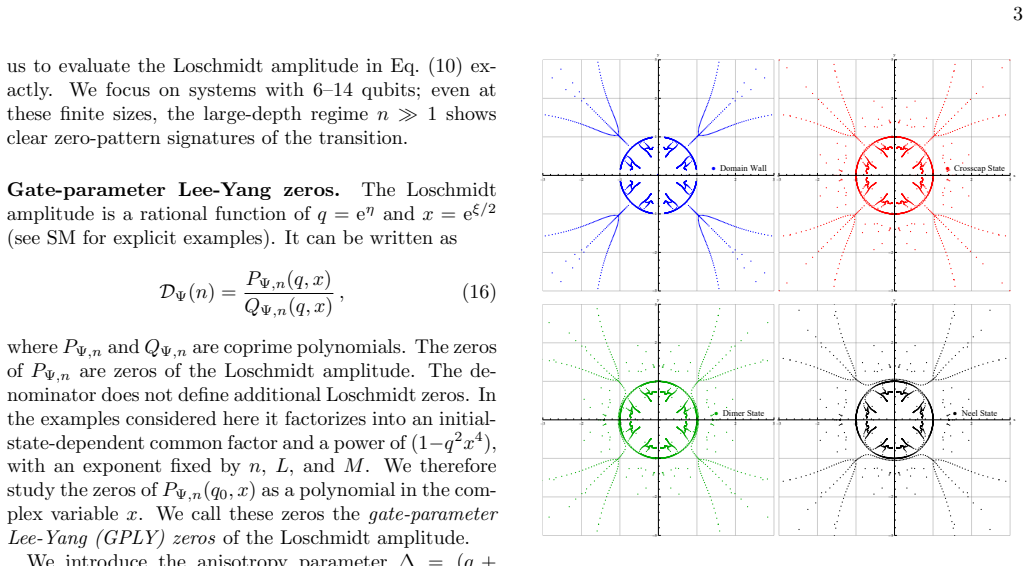
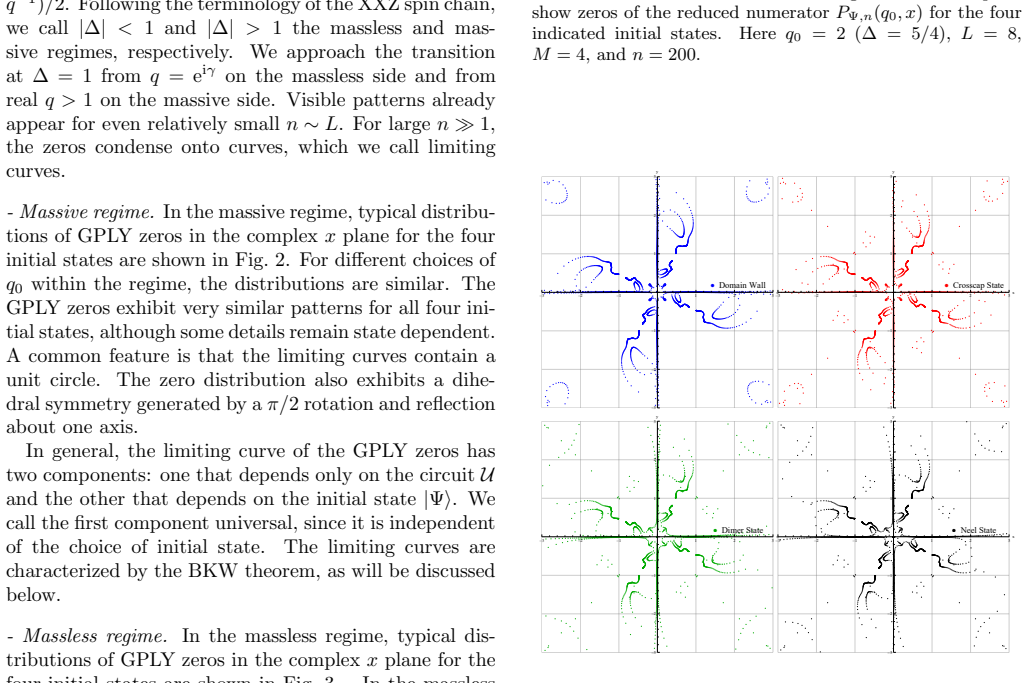
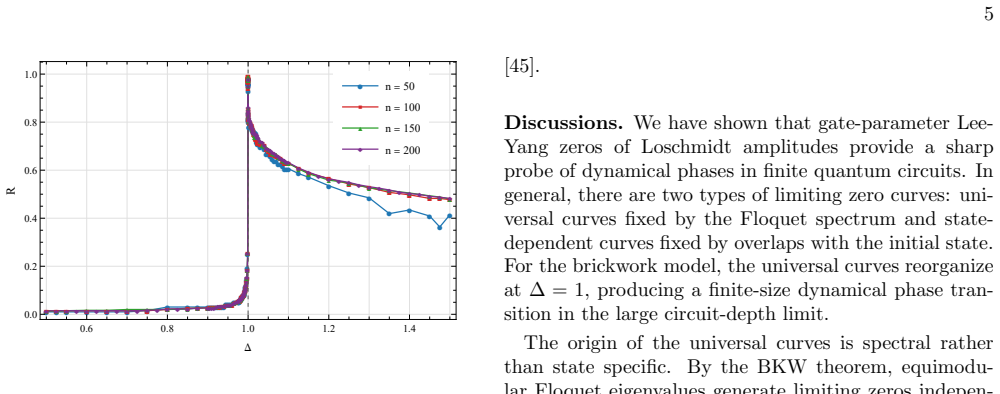
The Loschmidt amplitude is a rational function of the gate parameters; at fixed system size and large circuit depth its zeros in one complexified gate parameter condense onto limiting curves comprising a universal component governed by equimodular Floquet eigenvalues together with state-dependent contributions from eigenstate overlaps, and these curves reorganize abruptly when a parameter crosses a dynamical phase boundary.
What carries the argument
Gate-parameter Lee-Yang zeros of the Loschmidt amplitude, which condense onto curves set by the Beraha-Kahane-Weiss theorem applied to equimodular Floquet eigenvalues.
If this is right
- Dynamical phase transitions become detectable with modest qubit numbers without taking the thermodynamic limit.
- The diagnostic applies to non-integrable circuits because condensation follows from local unitarity and spectral competition alone.
- State-dependent overlaps control part of the zero curves, so initial-state choice can tune the visibility of the transition.
Where Pith is reading between the lines
- The same zero-reorganization signature could be checked in other Floquet models or in circuits with different gate sets to test generality beyond the brickwork example.
- If the rational-function property holds for open systems or noisy circuits, the zeros might still condense and provide a practical diagnostic on near-term hardware.
Load-bearing premise
The Loschmidt amplitude can be written as a rational function of the gate parameters whose zeros at fixed size and large depth condense onto limiting curves whose reorganization tracks the dynamical transition.
What would settle it
Compute the zeros of the Loschmidt amplitude for a non-integrable brickwork circuit at increasing depths; if the reorganization point fails to approach the known dynamical transition location the claim is false.
Figures
read the original abstract
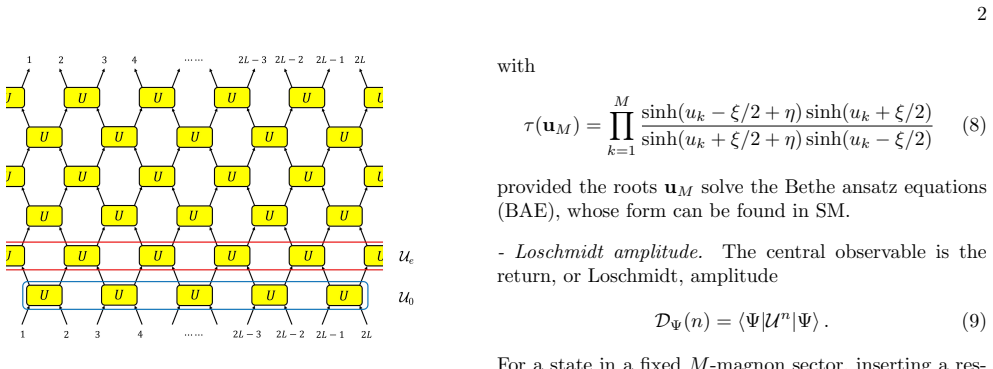
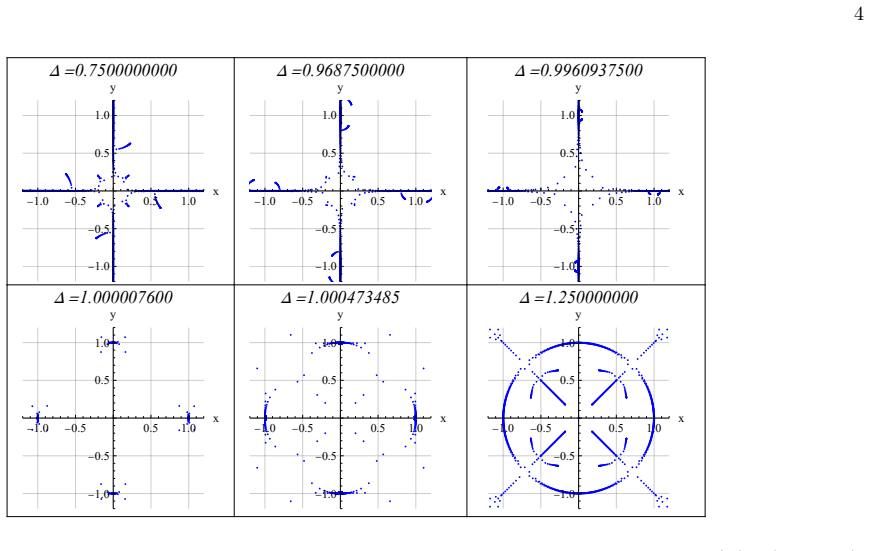
We propose gate-parameter Lee-Yang zeros of Loschmidt amplitudes as probes of dynamical phases in finite quantum circuits. We illustrate this approach using a brickwork model, where the time evolution is generated by repeated application of a Floquet operator. The Loschmidt amplitude can be expressed as a rational function of the gate parameters. At fixed system size and large circuit depth, its zeros in one complexified gate parameter, with the other parameter held fixed, condense onto limiting curves. We show that these curves comprise a universal component governed by equimodular Floquet eigenvalues, as described by the Beraha-Kahane-Weiss theorem, together with state-dependent contributions controlled by the overlap of eigenstate of the Floquet operator with the initial state. As one of the parameters is varied, the set of zeros reorganizes abruptly, providing a finite-qubit diagnostic of a dynamical phase transition. This mechanism does not rely on integrability: while integrability enables an exact calculation of the Loschmidt amplitude, the condensation of zeros follows from spectral competition and local unitarity alone.
Editorial analysis
A structured set of objections, weighed in public.
Referee Report
Summary. The paper proposes gate-parameter Lee-Yang zeros of Loschmidt amplitudes as probes of dynamical phases in finite quantum circuits. Using a brickwork Floquet model, it argues that the Loschmidt amplitude, expressed as a rational function of gate parameters, has zeros that condense onto limiting curves at fixed system size and large depth. These curves have a universal component from equimodular Floquet eigenvalues per the Beraha-Kahane-Weiss theorem and state-dependent contributions from eigenstate overlaps. Abrupt reorganization of zeros as a parameter varies provides a finite-qubit diagnostic of dynamical phase transitions, relying on spectral competition and local unitarity rather than integrability.
Significance. If the central mechanism is substantiated with explicit derivations, this offers a valuable finite-system diagnostic for dynamical phase transitions in quantum circuits that does not require integrability, potentially applicable to experimental and numerical studies of non-equilibrium phases. The connection to the Beraha-Kahane-Weiss theorem provides a rigorous foundation for the universal aspects of the zero condensation. The manuscript correctly notes that the mechanism follows from general spectral properties and local unitarity.
major comments (2)
- [Abstract] Abstract: The central claim that the Loschmidt amplitude is a rational function whose zeros condense onto curves governed by the Beraha-Kahane-Weiss theorem is stated without any explicit expression for the amplitude, the overlaps c_j, or the Floquet eigenvalues in the brickwork model, preventing direct verification of the rational-function property or the condensation mechanism.
- [Abstract] Abstract and implied main text: The assertion that reorganization of zeros provides a finite-qubit diagnostic of the dynamical transition rests on the spectral decomposition L = sum c_j λ_j^n and modulus competition, but no derivation or numerical check of how the state-dependent overlaps control the limiting curves is supplied, leaving the load-bearing step from spectral properties to observable reorganization unsupported in the given text.
minor comments (1)
- [Abstract] Abstract: The sentence 'We show that these curves comprise a universal component...' would benefit from an explicit forward reference to the section containing the application of the Beraha-Kahane-Weiss theorem.
Simulated Author's Rebuttal
We thank the referee for the careful reading and constructive comments on our manuscript. We respond point by point to the major comments below, clarifying the content of the main text while agreeing to revisions that improve explicitness and verifiability.
read point-by-point responses
-
Referee: [Abstract] Abstract: The central claim that the Loschmidt amplitude is a rational function whose zeros condense onto curves governed by the Beraha-Kahane-Weiss theorem is stated without any explicit expression for the amplitude, the overlaps c_j, or the Floquet eigenvalues in the brickwork model, preventing direct verification of the rational-function property or the condensation mechanism.
Authors: The abstract is a concise summary. The main text defines the brickwork Floquet circuit explicitly in terms of the two gate parameters, constructs the Floquet operator as a product of local two-qubit gates, and derives the Loschmidt amplitude via the spectral decomposition L = sum_j c_j λ_j^n, where the λ_j are the eigenvalues of the Floquet operator and the c_j are the overlaps with the initial state. The rational-function character follows directly from the finite-dimensional matrix representation of the circuit (a polynomial in each gate parameter). The Beraha-Kahane-Weiss theorem is then applied to the equimodular eigenvalues to obtain the universal component of the limiting curves. To address the verification concern, we will insert a short explicit formula for L and the relevant eigenvalues in the revised introduction. revision: yes
-
Referee: [Abstract] Abstract and implied main text: The assertion that reorganization of zeros provides a finite-qubit diagnostic of the dynamical transition rests on the spectral decomposition L = sum c_j λ_j^n and modulus competition, but no derivation or numerical check of how the state-dependent overlaps control the limiting curves is supplied, leaving the load-bearing step from spectral properties to observable reorganization unsupported in the given text.
Authors: The main text derives the limiting curves from the BKW theorem applied to equimodular Floquet eigenvalues and explains that the state-dependent overlaps c_j determine which eigenvalues dominate the sum at large depth, thereby selecting the particular curves that appear. Reorganization occurs when a parameter variation causes a change in the dominant pair of eigenvalues, which is diagnosed by the abrupt rearrangement of zeros. While this mechanism is grounded in the spectral decomposition and local unitarity, we agree that an expanded derivation of the overlap-controlled selection together with a numerical illustration of the reorganization would strengthen the presentation. We will add both in the revised manuscript. revision: yes
Circularity Check
No significant circularity; derivation uses external theorem and general spectral properties
full rationale
The paper's central claim—that zeros of the Loschmidt amplitude condense onto curves whose reorganization tracks dynamical transitions—rests on the spectral decomposition of the Floquet operator and the Beraha-Kahane-Weiss theorem on equimodular eigenvalues. This theorem is external (not derived or cited from the authors' prior work in the provided text). The argument explicitly states that condensation follows from spectral competition and local unitarity alone, independent of integrability (which is used only for exact Loschmidt amplitude calculation). No self-citations are load-bearing, no parameters are fitted and renamed as predictions, and no ansatz or uniqueness result is smuggled via self-reference. The derivation chain is self-contained against external benchmarks.
Axiom & Free-Parameter Ledger
axioms (2)
- standard math Beraha-Kahane-Weiss theorem governs the universal component of the zero curves via equimodular Floquet eigenvalues
- domain assumption Loschmidt amplitude is a rational function of the gate parameters
Reference graph
Works this paper leans on
-
[1]
0⟩(13) •Ne´ el state |ΨNe´ el⟩= lY j=1 σx 2j|00
0⟩(12) •Dimer state |Ψdimer⟩= lY j=1 (σx 2j−1 −σ x 2j)|00. . .0⟩(13) •Ne´ el state |ΨNe´ el⟩= lY j=1 σx 2j|00. . .0⟩(14) •Crosscap state |Ψcrosscap⟩= lY j=1 (1 +σ x j σx j+l)|00. . .0⟩(15) Overall normalization constants have been suppressed, since multiplication by a nonzero factor does not affect the zero set. For the initial states considered here, the...
-
[2]
a single branchλ k is strictly dominant atz, but its coefficient vanishes,α k(z) = 0
-
[3]
two or more dominant branches are equimodular at z. In the present context, the branch labeliruns over the physical Bethe eigenstates in the magnetization sectors present in|Ψ⟩, and locally we identify PΨ,n(q0, x)↔P n(x), αi(x)↔w Ψ,i(x), λ i(x)↔τ i(x). The first mechanism depends explicitly onw Ψ,i and is therefore state dependent. The second mechanism is...
-
[4]
M. A. Nielsen and I. L. Chuang,Quantum Computation and Quantum Information. Cambridge University Press, Cambridge, 10th anniversary edition ed., 2010
2010
-
[5]
Simulating physics with computers,
R. P. Feynman, “Simulating physics with computers,” International Journal of Theoretical Physics21(1982) 467–488
1982
-
[6]
Universal Quantum Simulators,
S. Lloyd, “Universal Quantum Simulators,”Science273 no. 5278, (1996) 1073–1078
1996
-
[7]
Quantum supremacy using a programmable superconducting processor,
F. Aruteet al., “Quantum supremacy using a programmable superconducting processor,”Nature574 (2019) 505–510
2019
-
[8]
Formation of robust bound states of interacting microwave photons,
A. Morvan, T. I. Andersen, X. Mi, C. Neill, A. Petukhov, K. Kechedzhi, D. Abanin, A. Michailidis, R. Acharya, F. Arute,et al., “Formation of robust bound states of interacting microwave photons,”Nature 612no. 7939, (2022) 240–245
2022
-
[9]
Measurement-induced entanglement and teleportation on a noisy quantum processor,
Google Quantum AI and Collaborators, “Measurement-induced entanglement and teleportation on a noisy quantum processor,”Nature622(2023) 481–486
2023
-
[10]
Quantum Entanglement Growth under Random Unitary Dynamics,
A. Nahum, J. Ruhman, S. Vijay, and J. Haah, “Quantum Entanglement Growth under Random Unitary Dynamics,”Phys. Rev. X7(2017) 031016
2017
-
[11]
Operator Hydrodynamics, OTOCs, and Entanglement Growth in Systems without Conservation Laws,
C. W. von Keyserlingk, T. Rakovszky, F. Pollmann, and S. L. Sondhi, “Operator Hydrodynamics, OTOCs, and Entanglement Growth in Systems without Conservation Laws,”Phys. Rev. X8(2018) 021013
2018
-
[12]
Quantum Zeno effect and the many-body entanglement transition,
Y. Li, X. Chen, and M. P. A. Fisher, “Quantum Zeno effect and the many-body entanglement transition,” Phys. Rev. B98(2018) 205136
2018
-
[13]
Unitary-projective entanglement dynamics,
A. Chan, R. M. Nandkishore, M. Pretko, and G. Smith, “Unitary-projective entanglement dynamics,”Phys. Rev. B99(2019) 224307
2019
-
[14]
Measurement-Induced Phase Transitions in the Dynamics of Entanglement,
B. Skinner, J. Ruhman, and A. Nahum, “Measurement-Induced Phase Transitions in the Dynamics of Entanglement,”Phys. Rev. X9(2019) 031009
2019
-
[15]
Random Quantum Circuits,
M. P. A. Fisher, V. Khemani, A. Nahum, and S. Vijay, “Random Quantum Circuits,”Annual Review of Condensed Matter Physics14(2023) 335–379
2023
-
[16]
Exact Correlation Functions for Dual-Unitary Lattice Models in 1+1 Dimensions,
B. Bertini, P. Kos, and T. Prosen, “Exact Correlation Functions for Dual-Unitary Lattice Models in 1+1 Dimensions,”Phys. Rev. Lett.123(2019) 210601
2019
-
[17]
Exact dynamics in dual-unitary quantum circuits,
L. Piroli, B. Bertini, J. I. Cirac, and T. Prosen, “Exact dynamics in dual-unitary quantum circuits,”Phys. Rev. B101(2020) 094304
2020
-
[19]
Bethe ansatz solutions for certain periodic quantum circuits,
I. L. Aleiner, “Bethe ansatz solutions for certain periodic quantum circuits,”Annals of Physics433 (2021) 168593,arXiv:2107.05715 [quant-ph]
-
[20]
Integrable Digital Quantum Simulation: Generalized Gibbs Ensembles and Trotter Transitions,
E. Vernier, B. Bertini, G. Giudici, and L. Piroli, “Integrable Digital Quantum Simulation: Generalized Gibbs Ensembles and Trotter Transitions,”Physical Review Letters130no. 26, (2023) 260401, arXiv:2212.06455 [cond-mat.stat-mech]
-
[21]
Statistical Theory of Equations of State and Phase Transitions. I. Theory of Condensation,
C. N. Yang and T. D. Lee, “Statistical Theory of Equations of State and Phase Transitions. I. Theory of Condensation,”Phys. Rev.87(1952) 404–409
1952
-
[22]
Statistical Theory of Equations of State and Phase Transitions. II. Lattice Gas and Ising Model,
T. D. Lee and C. N. Yang, “Statistical Theory of Equations of State and Phase Transitions. II. Lattice Gas and Ising Model,”Phys. Rev.87(1952) 410–419
1952
-
[23]
Statistical mechanics of equilibrium and nonequilibrium phase transitions: the Yang-Lee formalism,
I. Bena, M. Droz, and A. Lipowski, “Statistical mechanics of equilibrium and nonequilibrium phase transitions: the Yang-Lee formalism,”Int. J. Mod. Phys. B19(2005) 4269–4329
2005
-
[24]
M. Heyl, A. Polkovnikov, and S. Kehrein, “Dynamical Quantum Phase Transitions in the Transverse-Field Ising Model,”Phys. Rev. Lett.110(Mar, 2013) 135704. https://link.aps.org/doi/10.1103/PhysRevLett. 110.135704
-
[25]
Dynamical phase transitions after quenches in nonintegrable models,
C. Karrasch and D. Schuricht, “Dynamical phase transitions after quenches in nonintegrable models,” Phys. Rev. B87(2013) 195104
2013
-
[26]
Disentangling dynamical phase transitions from equilibrium phase transitions,
S. Vajna and B. D´ ora, “Disentangling dynamical phase transitions from equilibrium phase transitions,”Phys. Rev. B89(2014) 161105
2014
-
[27]
Dynamical topological order parameters far from equilibrium,
J. C. Budich and M. Heyl, “Dynamical topological order parameters far from equilibrium,”Phys. Rev. B 93(2016) 085416
2016
-
[28]
Dynamical quantum phase transitions: a review,
M. Heyl, “Dynamical quantum phase transitions: a review,”Reports on Progress in Physics81no. 5, (2018) 054001
2018
-
[29]
Fidelity zeros and Lee-Yang theory of quantum phase transitions,
T.-Y. Gu and G. Sun, “Fidelity zeros and Lee-Yang theory of quantum phase transitions,”Phys. Rev. B 113(2026) 014417,arXiv:2509.20258 [quant-ph]
-
[30]
Limits of Zeros of Recursively Defined Families of Polynomials,
S. Beraha, J. Kahane, and N. J. Weiss, “Limits of Zeros of Recursively Defined Families of Polynomials,” in Studies in Foundations and Combinatorics, vol. 1 of Advances in Mathematics Supplementary Studies, pp. 213–232. Academic Press, 1978
1978
-
[31]
Algebraic geometry and Bethe ansatz (I) the quotient ring for BAE
Y. Jiang and Y. Zhang, “Algebraic geometry and Bethe ansatz. Part I. The quotient ring for BAE,”JHEP03 (2018) 087,arXiv:1710.04693 [hep-th]
work page internal anchor Pith review Pith/arXiv arXiv 2018
-
[32]
Torus partition function of the six-vertex model from algebraic geometry
J. Lykke Jacobsen, Y. Jiang, and Y. Zhang, “Torus partition function of the six-vertex model from algebraic geometry,”JHEP03(2019) 152,arXiv:1812.00447 [hep-th]. 7
work page internal anchor Pith review Pith/arXiv arXiv 2019
-
[33]
Cylinder partition function of the 6-vertex model from algebraic geometry,
Z. Bajnok, J. L. Jacobsen, Y. Jiang, R. I. Nepomechie, and Y. Zhang, “Cylinder partition function of the 6-vertex model from algebraic geometry,”JHEP06 (2020) 169,arXiv:2002.09019 [hep-th]
-
[34]
Exact spin correlators of integrable quantum circuits from algebraic geometry,
A. Hutsalyuk, Y. Jiang, B. Pozsgay, H. Xu, and Y. Zhang, “Exact spin correlators of integrable quantum circuits from algebraic geometry,”SciPost Phys.19 no. 1, (2025) 003,arXiv:2405.16070 [quant-ph]
-
[35]
R. J. Baxter,Exactly Solved Models in Statistical Mechanics. Academic Press Inc, London, 1982
1982
-
[36]
V. E. Korepin, N. M. Bogoliubov, and A. G. Izergin, Quantum Inverse Scattering Method and Correlation Functions. Cambridge Monographs on Mathematical Physics. Cambridge University Press, Cambridge, UK, 1993
1993
-
[37]
Gaudin,La fonction d’onde de Bethe
M. Gaudin,La fonction d’onde de Bethe. Masson, Paris, 1983
1983
-
[38]
Calculation of norms of Bethe wave functions,
V. E. Korepin, “Calculation of norms of Bethe wave functions,”Commun. Math. Phys.86(1982) 391–418
1982
-
[39]
Calculation of scalar products of wave functions and form factors in the framework of the algebraic Bethe ansatz,
N. A. Slavnov, “Calculation of scalar products of wave functions and form factors in the framework of the algebraic Bethe ansatz,”Theor. Math. Phys.79(1989) 502–508
1989
-
[40]
Partition function of a six-vertex model in a finite volume,
A. G. Izergin, “Partition function of a six-vertex model in a finite volume,” inDoklady Akademii Nauk, vol. 297, pp. 331–333, Russian Academy of Sciences. 1987
1987
-
[41]
Determinant Formula for the Six-Vertex Model,
A. G. Izergin, D. A. Coker, and V. E. Korepin, “Determinant Formula for the Six-Vertex Model,” Journal of Physics A: Mathematical and General25 no. 16, (1992) 4315
1992
-
[42]
Inner products of Bethe states as partial domain wall partition functions
I. Kostov and Y. Matsuo, “Inner products of Bethe states as partial domain wall partition functions,” JHEP10(2012) 168,arXiv:1207.2562 [hep-th]
work page internal anchor Pith review Pith/arXiv arXiv 2012
-
[43]
Relaxation dynamics in the gapped XXZ spin-1/2 chain
J. Mossel and J.-S. Caux, “Relaxation dynamics in the gapped XXZ spin-1/2 chain,”New J. Phys.12(2010) 055028,arXiv:1002.3988 [cond-mat.str-el]
work page internal anchor Pith review Pith/arXiv arXiv 2010
-
[44]
A Gaudin-like determinant for overlaps of N\'eel and XXZ Bethe states
M. Brockmann, J. De Nardis, B. Wouters, and J.-S. Caux, “A Gaudin-like determinant for overlaps of N´ eel and XXZ Bethe states,”J. Phys. A: Math. Theor.47 (2014) 145003,arXiv:1401.2877 [cond-mat.stat-mech]
work page internal anchor Pith review Pith/arXiv arXiv 2014
-
[45]
Overlaps between eigenstates of the XXZ spin-1/2 chain and a class of simple product states
B. Pozsgay, “Overlaps between eigenstates of the XXZ spin-1/2 chain and a class of simple product states,”J. Stat. Mech.(2014) P06011,arXiv:1309.4593 [cond-mat.stat-mech]
work page internal anchor Pith review Pith/arXiv arXiv 2014
-
[46]
On exact overlaps in integrable spin chains,
Y. Jiang and B. Pozsgay, “On exact overlaps in integrable spin chains,”JHEP06(2020) 022, arXiv:2002.12065 [cond-mat.stat-mech]
-
[47]
Crosscap States in Integrable Field Theories and Spin Chains,
J. Caetano and S. Komatsu, “Crosscap States in Integrable Field Theories and Spin Chains,”J. Stat. Phys.187no. 3, (2022) 30,arXiv:2111.09901 [hep-th]
-
[48]
Lee-yang zeros and dynamical phases in integrable quantum circuits
C. Liu, Y. Wu, Y. Jiang, and Y. Zhang, “Lee-yang zeros and dynamical phases in integrable quantum circuits.” In preparation, 2026
2026
-
[49]
Lee-Yang Zeros and Critical Times in Decoherence of a Probe Spin Coupled to a Bath,
B.-B. Wei and R.-B. Liu, “Lee-Yang Zeros and Critical Times in Decoherence of a Probe Spin Coupled to a Bath,”Phys. Rev. Lett.109(2012) 185701
2012
-
[50]
Experimental Observation of Lee-Yang Zeros,
X. Peng, H. Zhou, B.-B. Wei, J. Cui, J. Du, and R.-B. Liu, “Experimental Observation of Lee-Yang Zeros,” Phys. Rev. Lett.114(2015) 010601
2015
-
[51]
Experimental Determination of Dynamical Lee-Yang Zeros,
K. Brandner, V. F. Maisi, J. P. Pekola, J. P. Garrahan, and C. Flindt, “Experimental Determination of Dynamical Lee-Yang Zeros,”Phys. Rev. Lett.118 (May, 2017) 180601.https://link.aps.org/doi/10. 1103/PhysRevLett.118.180601
2017
-
[52]
Many-body thermodynamics on quantum computers via partition function zeros,
A. Francis, D. Zhu, C. Huerta Alderete, S. Johri, X. Xiao, J. K. Freericks, C. Monroe, N. M. Linke, and A. F. Kemper, “Many-body thermodynamics on quantum computers via partition function zeros,” Science Advances7no. 34, (2021) eabf2447
2021
-
[53]
Integrability and charge transport in asymmetric quantum-circuit geometries,
C. Paletta, U. Duh, B. Pozsgay, and L. Zadnik, “Integrability and charge transport in asymmetric quantum-circuit geometries,”J. Phys. A: Math. Theor. 58(2025) 275001,arXiv:2503.04673 [cond-mat.stat-mech]. 8 Supplemental Material for “Gate Parameter Lee-Yang Zeros and Dynamical Phases in Quantum Circuits” BETHE ANSA TZ SOLUTION OF THE BRICKWORK MODEL In th...
discussion (0)
Sign in with ORCID, Apple, or X to comment. Anyone can read and Pith papers without signing in.