Do Proactive Agents Really Need an LLM to Decide When to Wake and What to Anchor?
Pith reviewed 2026-06-29 07:42 UTC · model grok-4.3
The pith
A small temporal graph model on OS event streams outperforms LLM-based triggers for proactive agents.
A machine-rendered reading of the paper's core claim, the machinery that carries it, and where it could break.
Core claim
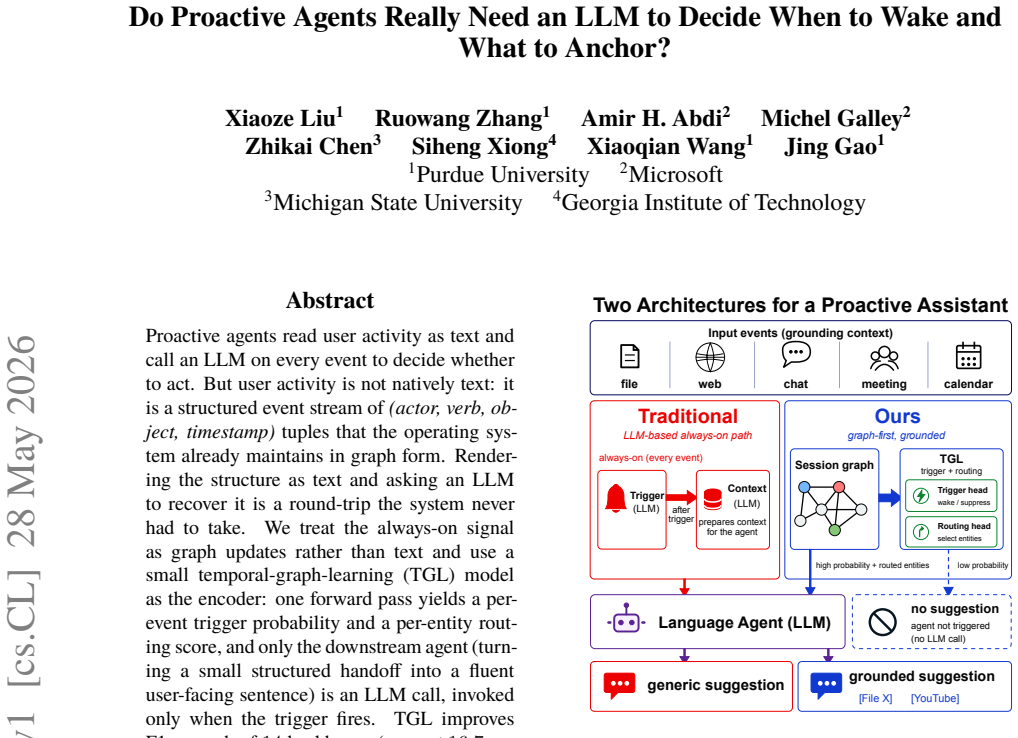
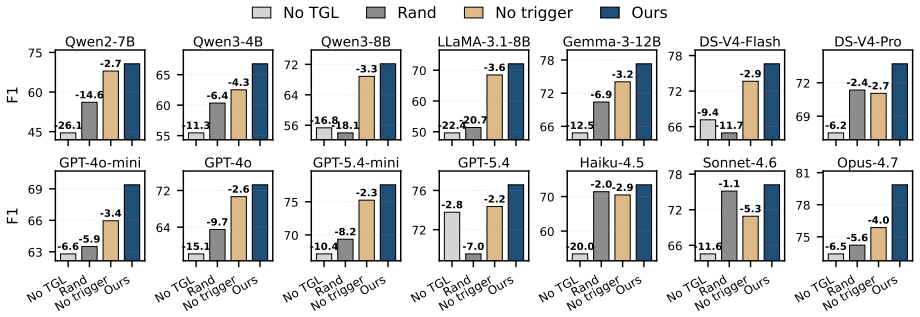
By treating user activity as graph updates of structured (actor, verb, object, timestamp) tuples and using a TGL encoder, the system produces a per-event trigger probability and per-entity routing score in one forward pass, resulting in higher F1 scores on 14 backbones with a mean improvement of 16.7 and up to 46.0, stronger AUCs, and inference speeds of 11.13 ms on GPU servers and 13.99 ms on laptops, 4-83 times faster than LLM triggers.
What carries the argument
Temporal graph learning (TGL) model acting as encoder on structured event streams to compute trigger probabilities and routing scores.
If this is right
- TGL improves F1 on each of 14 backbones with mean gain of 16.7 points.
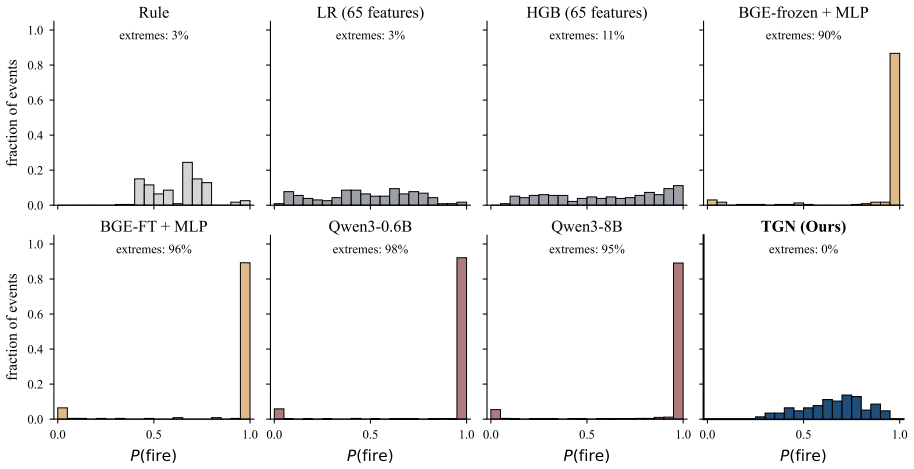
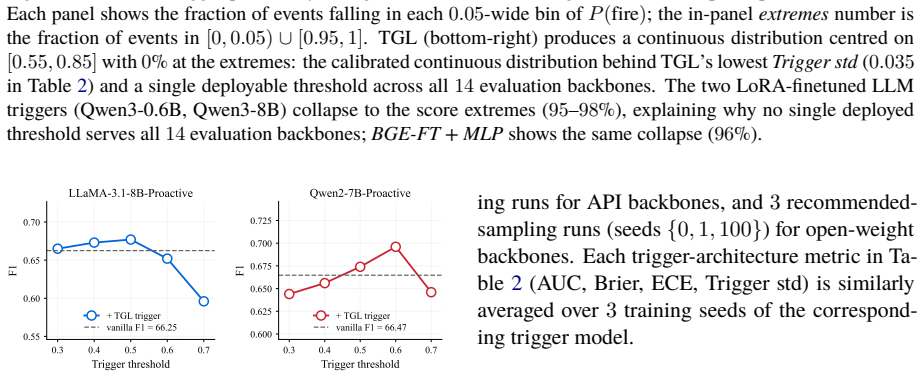
- One TGL checkpoint achieves the strongest trigger AUCs and most stable deployed threshold.
- Inference runs at 11.13 ms per event on GPU and 13.99 ms on laptop.
- Approximately 4-7x faster on GPU and 12-83x faster on laptop than LLM-as-trigger setups.
- Deployable with 220 MiB BF16 footprint on-device.
Where Pith is reading between the lines
- The separation allows the activity stream to remain local without repeated external LLM calls, improving privacy for sensitive user data.
- This architecture could be extended to other real-time decision systems that monitor structured logs rather than unstructured text.
- Reducing the frequency of LLM invocations may lower overall energy consumption in always-on agent deployments.
Load-bearing premise
The structured event stream of actor-verb-object-timestamp tuples already holds sufficient information to make accurate trigger decisions without additional context from an LLM.
What would settle it
A head-to-head test on the same event dataset showing that an LLM queried on text-rendered events produces higher F1 scores or AUC than the TGL model while matching or exceeding its speed.
Figures
read the original abstract
Proactive agents read user activity as text and call an LLM on every event to decide whether to act. But user activity is not natively text: it is a structured event stream of (actor, verb, object, timestamp) tuples that the operating system already maintains in graph form. Rendering the structure as text and asking an LLM to recover it is a round-trip the system never had to take. We treat the always-on signal as graph updates rather than text and use a small temporal-graph-learning (TGL) model as the encoder: one forward pass yields a per-event trigger probability and a per-entity routing score, and only the downstream agent (turning a small structured handoff into a fluent user-facing sentence) is an LLM call, invoked only when the trigger fires. TGL improves F1 on each of 14 backbones (mean +16.7, up to +46.0); in trigger-architecture comparisons, one TGL checkpoint gives the strongest trigger AUCs and the most stable deployed threshold. It runs at 11.13 ms per event on a GPU server and 13.99 ms on a consumer laptop, approximately 4--7x and 12--83x faster than every single-forward LLM-as-trigger configuration tested in each regime, with an approximately 220 MiB BF16 resident footprint deployable on-device alongside the privacy-sensitive activity stream it consumes.
Editorial analysis
A structured set of objections, weighed in public.
Referee Report
Summary. The paper claims that proactive agents can avoid per-event LLM calls for trigger decisions by instead processing the OS-maintained structured event stream (actor, verb, object, timestamp) as graph updates with a small temporal-graph-learning (TGL) encoder. One TGL forward pass produces a trigger probability and entity routing score; only when the trigger fires is an LLM invoked for the downstream response. Across 14 backbones the TGL approach improves F1 by a mean of +16.7 (up to +46.0), yields the strongest trigger AUCs and most stable deployed thresholds in architecture comparisons, and runs at 11.13 ms per event on a GPU server and 13.99 ms on a consumer laptop (4–7× and 12–83× faster than single-forward LLM triggers) with a 220 MiB BF16 footprint.
Significance. If the reported head-to-head results hold under a reproducible protocol, the work supplies direct empirical evidence that the structured graph already available to the OS contains sufficient signal for accurate trigger decisions, eliminating the text-rendering round-trip and enabling low-latency, on-device deployment. The latency and footprint numbers, together with the multi-backbone F1 gains, would constitute a concrete, falsifiable demonstration that LLM-based always-on triggering is unnecessary for this sub-task.
major comments (2)
- [Abstract / Experimental section] The abstract and available text present quantitative claims (F1 deltas, AUC rankings, latency figures, threshold stability) across 14 backbones and multiple runtime regimes, yet supply no description of the experimental protocol, dataset characteristics, how baselines were implemented or prompted, train/validation/test splits, or statistical tests. Without these details the reported gains cannot be verified or reproduced.
- [Trigger-architecture comparisons] The central comparison treats the TGL checkpoint as a single model evaluated against multiple LLM trigger configurations, but the manuscript does not state whether the TGL model was trained on the same event streams used for LLM evaluation or whether any hyper-parameter search or early-stopping criteria were applied uniformly; this information is required to assess whether the +16.7 mean F1 improvement is attributable to the graph representation itself.
minor comments (2)
- [Abstract] The latency numbers are given to two decimal places but without error bars or number of runs; adding this information would strengthen the speed claims.
- [Trigger-architecture comparisons] The phrase “one TGL checkpoint” is used without clarifying whether multiple random seeds or training runs were performed and how the reported checkpoint was selected.
Simulated Author's Rebuttal
We thank the referee for the constructive comments on experimental transparency. We agree that additional protocol details are required for reproducibility and will expand the manuscript accordingly. Point-by-point responses follow.
read point-by-point responses
-
Referee: [Abstract / Experimental section] The abstract and available text present quantitative claims (F1 deltas, AUC rankings, latency figures, threshold stability) across 14 backbones and multiple runtime regimes, yet supply no description of the experimental protocol, dataset characteristics, how baselines were implemented or prompted, train/validation/test splits, or statistical tests. Without these details the reported gains cannot be verified or reproduced.
Authors: We agree the current draft omits these details. The revised manuscript will include a dedicated Experiments section specifying: dataset as OS event streams of (actor, verb, object, timestamp) tuples collected from 14 backbones; temporal splits (70/15/15) to preserve causality; LLM baselines implemented with a standardized zero-shot prompt for binary trigger decisions; uniform hyper-parameter search via grid search on validation AUC; and statistical tests via bootstrap (1000 resamples) for F1 differences. These additions will support verification of the reported metrics. revision: yes
-
Referee: [Trigger-architecture comparisons] The central comparison treats the TGL checkpoint as a single model evaluated against multiple LLM trigger configurations, but the manuscript does not state whether the TGL model was trained on the same event streams used for LLM evaluation or whether any hyper-parameter search or early-stopping criteria were applied uniformly; this information is required to assess whether the +16.7 mean F1 improvement is attributable to the graph representation itself.
Authors: The TGL model was trained and evaluated on identical event streams using the same temporal splits. Hyper-parameter search (learning rate, dimensions, layers) and early-stopping (validation AUC patience) were applied uniformly to TGL and LLM configurations. The F1 gains are therefore attributable to native graph encoding. The revision will add an explicit paragraph stating this protocol. revision: yes
Circularity Check
No significant circularity identified
full rationale
The paper contains no equations, derivations, or load-bearing self-citations. All reported results consist of direct empirical comparisons (F1 improvements, AUC values, latency measurements) of a TGL encoder against LLM trigger baselines on a fixed structured event stream. The central claim that the graph representation suffices is tested by those head-to-head numbers rather than derived from any fitted parameter or prior self-referential result, leaving the work self-contained against external benchmarks.
Axiom & Free-Parameter Ledger
Forward citations
Cited by 1 Pith paper
-
Audio Interaction Model
Audio-Interaction unifies offline and online audio tasks into one streaming model via the SoundFlow framework and a new 2.6M-item streaming corpus, enabling real-time instruction following and proactive responses.
Reference graph
Works this paper leans on
-
[1]
In Proceedings of the SIGCHI Conference on Human Factors in Computing Systems , pages 175–
A diary study of task switching and interrup- tions. In Proceedings of the SIGCHI Conference on Human Factors in Computing Systems , pages 175–
-
[2]
Biplab Deka, Zifeng Huang, Chad Franzen, Joshua Hi- bschman, Daniel Afergan, Y ang Li, Jeffrey Nichols, and Ranjitha Kumar
ACM. Biplab Deka, Zifeng Huang, Chad Franzen, Joshua Hi- bschman, Daniel Afergan, Y ang Li, Jeffrey Nichols, and Ranjitha Kumar. 2017. Rico: A mobile app dataset for building data-driven design applications. In Proceedings of the 30th Annual ACM Symposium on User Interface Software and Technology , pages 845–854. Xiang Deng, Yu Gu, Boyuan Zheng, Shijie Ch...
2017
-
[3]
Advances in Neural Information Process- ing Systems, 36
Mind2web: Towards a generalist agent for the web. Advances in Neural Information Process- ing Systems, 36. 9 Y ang Deng, Lizi Liao, Zhonghua Zheng, Grace Hui Y ang, and Tat-Seng Chua. 2024. Towards human- centered proactive conversational agents. In Pro- ceedings of the 47th International ACM SIGIR Con- ference on Research and Development in Informa- tion...
2024
-
[4]
A Survey on Retrieval-Augmented Text Generation for Large Language Models
Matching attentional draw with utility in inter- ruption. In Proceedings of the SIGCHI Conference on Human Factors in Computing Systems, pages 41– 50. Jongyi Hong, Eui-Ho Suh, Junyoung Kim, and Su- Y eon Kim. 2009. Context-aware system for proac- tive personalized service based on context history. Expert Systems with Applications, 36(4):7448–7457. Guyue H...
work page internal anchor Pith review Pith/arXiv arXiv 2009
-
[5]
In Proceedings of the 2020 Conference on Empirical Methods in Natural Language Processing, EMNLP 2020, Online, November 16-20, 2020 , pages 6669– 6683, Stroudsburg, PA, USA
Recurrent event network: Autoregressive structure inferenceover temporal knowledge graphs . In Proceedings of the 2020 Conference on Empirical Methods in Natural Language Processing, EMNLP 2020, Online, November 16-20, 2020 , pages 6669– 6683, Stroudsburg, PA, USA. Association for Com- putational Linguistics. Brennan Jones, Y an Xu, Qisheng Li, and Stefan Scherer
2020
-
[6]
In Extended Ab- stracts of the CHI Conference on Human Factors in Computing Systems, pages 1–7
Designing a proactive context-aware ai chat- bot for people’s long-term goals . In Extended Ab- stracts of the CHI Conference on Human Factors in Computing Systems, pages 1–7. Raghav Kapoor, Y ash Parag Butala, Melisa Russak, Jing Yu Koh, Kiran Kamble, Waseem Alshikh, and Ruslan Salakhutdinov. 2024. Omniact: A dataset and benchmark for enabling multimodal...
-
[7]
Training proactive and personalized LLM agents.arXiv preprint arXiv:2511.02208, 2025
IEEE. Weiwei Sun, Xuhui Zhou, Weihua Du, Xingyao Wang, Sean Welleck, Graham Neubig, Maarten Sap, and Yiming Y ang. 2025. Training proactive and person- alized llm agents. arXiv preprint arXiv:2511.02208. Carnegie Mellon University. Zhaoxuan Tan, Qingkai Zeng, Yijun Tian, Zheyuan Liu, Bing Yin, and Meng Jiang. 2024. Democ- ratizing large language models vi...
-
[8]
In 6th Inter- national Conference on Learning Representations, ICLR 2018, Vancouver, BC, Canada, April 30 - May 3, 2018, Conference Track Proceedings , Vancouver, BC, Canada
Graph attention networks . In 6th Inter- national Conference on Learning Representations, ICLR 2018, Vancouver, BC, Canada, April 30 - May 3, 2018, Conference Track Proceedings , Vancouver, BC, Canada. OpenReview.net. Yuke Wang, Boyuan Feng, Zheng Wang, Tong Geng, Kevin Barker, Ang Li, and Yufei Ding
2018
-
[9]
PASK: Toward Intent-Aware Proactive Agents with Long-Term Memory
MGG: Accelerating graph neural net- works with fine-grained intra-kernel communication- computation pipelining on multi-GPU platforms . In 17th USENIX Symposium on Operating Systems De- sign and Implementation (OSDI) . Zixuan Wang, Bo Yu, Junzhe Zhao, Wenhao Sun, Sai Hou, Shuai Liang, Xing Hu, Yinhe Han, and Yiming Gan. 2025. Karma: Augmenting embodied ai...
work page internal anchor Pith review Pith/arXiv arXiv 2025
-
[10]
In The Eleventh International Con- ference on Learning Representations
ReAct: Synergizing reasoning and acting in language models. In The Eleventh International Con- ference on Learning Representations. Ceyao Zhang, Kaijie Y ang, Siyi Hu, Zihao Wang, Guanghe Li, Yihang Sun, Cheng Zhang, Zhaowei Zhang, Anji Liu, Song-Chun Zhu, Xiaojun Chang, Junge Zhang, Feng Yin, Yitao Liang, and Y aodong Y ang. 2024a. Proagent: building pro...
2024
-
[11]
The user opened ‘{file}’ in {app}
Appagent-pro: A proactive GUI agent system for multidomain information integration and user as- sistance. arXiv preprint arXiv:2508.18689. Shuyan Zhou, Frank F Xu, Hao Zhu, Xuhui Zhou, Robert Lo, Abishek Sridhar, Xianyi Cheng, Tianyue Ou, Y onatan Bisk, Daniel Fried, Uri Alon, and Gra- ham Neubig. 2024. Webarena: A realistic web en- vironment for building...
-
[12]
session_history: the last few user activities in this session (oldest first),→
-
[13]
current_observation: what the user is doing right now,→
-
[14]
task":"string
tgn_routing_nodes: graph-identified topics most relevant to the current activity,→ Your task: infer the user's current TASK THEME from the session history,,→ then generate ONE short, specific, actionable suggestion grounded in that theme.,→ Rules: - Use session_history to identify what the user is working on (the session theme).,→ - If tgn_routing_nodes c...
-
[15]
session_history: the last few user activities in this session, oldest first.,→
-
[16]
open the last file
current_observation: what the user is doing right now.,→ Your task: infer the user's current TASK THEME from the session history,,→ then generate ONE short, specific, actionable suggestion grounded in that theme.,→ Rules: - Use session_history to identify what the user is working on.,→ - The task must be a single sentence, concrete, max 150 characters.,→ ...
2025
discussion (0)
Sign in with ORCID, Apple, or X to comment. Anyone can read and Pith papers without signing in.