Functional MRI Time Series Generation via Wavelet-Based Image Transform and Spectral Flow Matching for Brain Disorder Identification
Pith reviewed 2026-06-29 09:12 UTC · model grok-4.3
The pith
Cascading wavelet and cosine transforms with spectral flow matching generates synthetic fMRI signals that improve brain network classification.
A machine-rendered reading of the paper's core claim, the machinery that carries it, and where it could break.
Core claim
The central claim is that converting BOLD signals to a dual wavelet-DCT frequency representation lets a spectral flow matching model learn structured, class-specific priors; inverting the generated maps then produces time-domain signals that preserve key physiological dynamics and measurably raise performance on fMRI-based brain disorder classification tasks.
What carries the argument
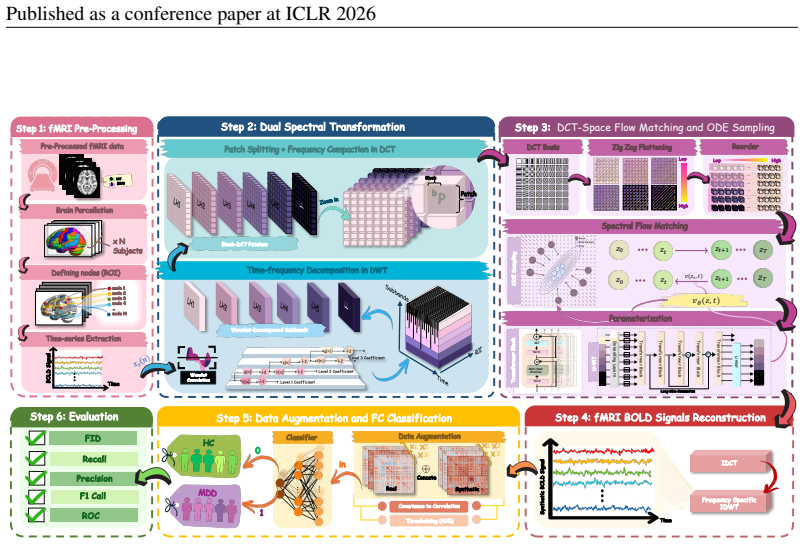
Dual-Spectral Flow Matching (DSFM), the cascade of discrete wavelet transform for multi-scale variations followed by discrete cosine transform for energy compaction, then spectral flow matching to generate class-conditioned cosine-frequency maps.
If this is right
- Class-conditioned generation supplies disorder-specific synthetic samples without violating frequency structure.
- The dual-transform priors reduce the non-stationarity problem that defeats many standard generative models on BOLD data.
- Reconstructed signals can be used directly as data augmentation for any downstream network classifier.
- The same pipeline supports generation at multiple scales because the wavelet step already encodes transient and multi-resolution features.
Where Pith is reading between the lines
- The same dual-transform route could be tested on EEG or MEG time series where similar non-stationarity appears.
- If the frequency priors hold, the generated data might also support simulation studies of how network connectivity changes under different disorder subtypes.
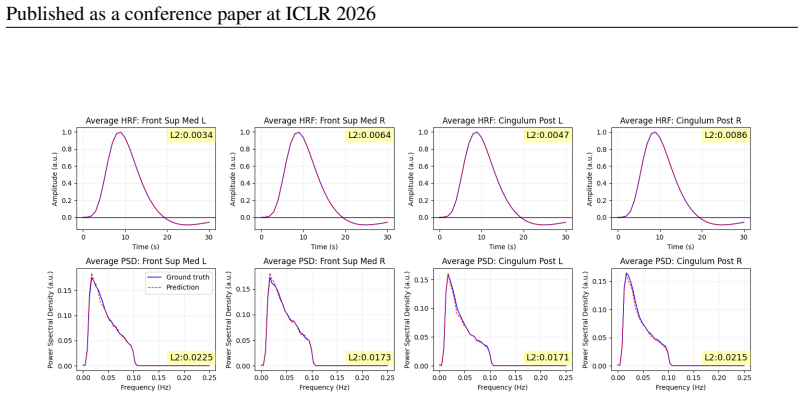
- A natural next measurement is whether the synthetic series match real data on standard physiological statistics such as power spectra in specific bands.
- Privacy-sensitive clinical datasets could be expanded by releasing only the trained flow model rather than raw scans.
Load-bearing premise
The generated cosine-frequency maps, once inverted through DCT and DWT, remain free of artifacts that would make the reconstructed BOLD signals less useful or less realistic than real data for classification.
What would settle it
An experiment in which adding the generated samples to real training data produces no gain in classification accuracy on held-out real fMRI, or in which quantitative metrics detect systematic non-physiological artifacts in the reconstructed time series.
Figures
read the original abstract
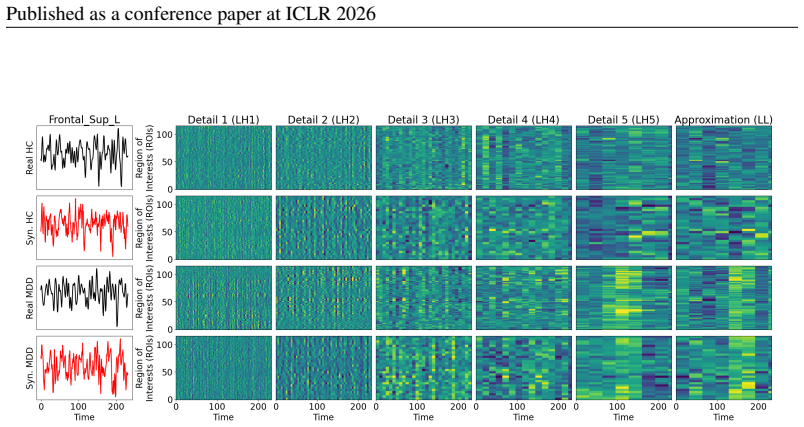
Functional Magnetic Resonance Imaging (fMRI) provides non-invasive access to dynamic brain activity by measuring blood oxygen level-dependent (BOLD) signals over time. However, the resource-intensive nature of fMRI acquisition limits the availability of high-fidelity samples required for data-driven brain analysis models. While modern generative models can synthesize fMRI data, they often remain challenging in replicating their inherent non-stationarity, intricate spatiotemporal dynamics, and physiological variations of raw BOLD signals. To address these challenges, we propose Dual-Spectral Flow Matching (DSFM), a novel fMRI generative framework that cascades dual frequency representation of BOLD signals with spectral flow matching. Specifically, our framework first converts BOLD signals into a wavelet decomposition map via a discrete wavelet transform (DWT) to capture globalized transient and multi-scale variations, and projects into the discrete cosine transform (DCT) space across brain regions and time to exploit localized energy compaction of low-frequency dominant BOLD coefficients. Subsequently, a spectral flow matching model is trained to generate class-conditioned cosine-frequency representation. The generated samples are reconstructed through inverse DCT and inverse DWT operations to recover physiologically plausible time-domain BOLD signals. This dual-transform approach imposes structured frequency priors and preserves key physiological brain dynamics. Ultimately, we demonstrate the efficacy of our approach through improved downstream fMRI-based brain network classification. The code is available at https://github.com/htew0001/DSFM.git .
Editorial analysis
A structured set of objections, weighed in public.
Referee Report
Summary. The paper introduces Dual-Spectral Flow Matching (DSFM), a generative model for fMRI BOLD time series. It first applies discrete wavelet transform (DWT) to capture multi-scale transients and global variations, then projects into discrete cosine transform (DCT) space for low-frequency energy compaction across regions and time. A class-conditioned spectral flow matching model is trained in this domain; generated cosine-frequency samples are inverted via inverse DCT and inverse DWT to produce time-domain signals asserted to be physiologically plausible. The framework is evaluated by showing improved performance on downstream fMRI-based brain network classification for disorder identification. Code is released at the cited GitHub repository.
Significance. If the dual-transform pipeline produces signals that retain BOLD non-stationarity, low-frequency dominance, and multi-scale structure without introducing classification artifacts, the method could meaningfully address data scarcity in neuroimaging. Public code availability is a concrete strength that enables direct reproducibility checks.
major comments (2)
- [Abstract] Abstract: The central claim that the approach yields 'improved downstream fMRI-based brain network classification' is asserted without any reported accuracy/F1 values, baseline comparisons (e.g., against vanilla diffusion or VAE generators), ablation results, or statistical tests. This absence makes it impossible to determine whether gains are attributable to the dual-transform priors or to generic data augmentation.
- [Abstract (reconstruction paragraph)] Abstract (reconstruction paragraph): The assertion that inverse DCT + inverse DWT 'recover physiologically plausible time-domain BOLD signals' that 'preserve key physiological brain dynamics' lacks any quantitative fidelity checks (power-spectrum match in the 0.01–0.1 Hz band, autocorrelation structure, or variance bounds typical of real BOLD). Because downstream classification improvements could arise from any augmented data rather than faithful samples, this validation step is load-bearing for the paper's efficacy claim.
minor comments (1)
- [Abstract] The acronym 'DSFM' is introduced after the full name; ensure the abbreviation is defined on first use and used consistently in all subsequent sections.
Simulated Author's Rebuttal
We thank the referee for the constructive comments on our manuscript. We address each major comment point-by-point below, with plans to revise the abstract for greater specificity and to add supporting quantitative details where appropriate.
read point-by-point responses
-
Referee: [Abstract] Abstract: The central claim that the approach yields 'improved downstream fMRI-based brain network classification' is asserted without any reported accuracy/F1 values, baseline comparisons (e.g., against vanilla diffusion or VAE generators), ablation results, or statistical tests. This absence makes it impossible to determine whether gains are attributable to the dual-transform priors or to generic data augmentation.
Authors: The experimental section of the manuscript (Section 4) reports the requested details, including accuracy and F1 scores, comparisons against vanilla diffusion and VAE generators, ablation studies isolating the dual-transform components, and statistical significance tests. To make the abstract self-contained, we will revise it to briefly cite key quantitative gains (e.g., relative accuracy improvement) and reference the baselines and ablations. revision: yes
-
Referee: [Abstract (reconstruction paragraph)] Abstract (reconstruction paragraph): The assertion that inverse DCT + inverse DWT 'recover physiologically plausible time-domain BOLD signals' that 'preserve key physiological brain dynamics' lacks any quantitative fidelity checks (power-spectrum match in the 0.01–0.1 Hz band, autocorrelation structure, or variance bounds typical of real BOLD). Because downstream classification improvements could arise from any augmented data rather than faithful samples, this validation step is load-bearing for the paper's efficacy claim.
Authors: We agree that explicit fidelity metrics strengthen the physiological-plausibility claim and help distinguish the method from generic augmentation. In the revised manuscript we will add a dedicated paragraph (or subsection) reporting power-spectrum correlation in the 0.01–0.1 Hz band, autocorrelation-function similarity, and variance bounds relative to real BOLD signals. revision: yes
Circularity Check
No circularity: forward generative pipeline with independent downstream validation
full rationale
The paper describes a forward pipeline (DWT to capture multi-scale transients, DCT for low-frequency compaction, spectral flow matching on the cosine-frequency domain, then inverse transforms) that generates class-conditioned samples. No equations, fitted parameters, or self-citations are shown that reduce the claimed preservation of BOLD dynamics or the classification improvement to a tautology or input by construction. The method is presented as a novel composition of standard transforms plus flow matching, with efficacy asserted via external downstream task performance rather than any self-referential fit or uniqueness theorem. This is the common case of a self-contained methodological proposal.
Axiom & Free-Parameter Ledger
axioms (2)
- domain assumption BOLD signals exhibit globalized transient and multi-scale variations that are captured by discrete wavelet transform.
- domain assumption Low-frequency dominant BOLD coefficients exhibit localized energy compaction under discrete cosine transform.
Reference graph
Works this paper leans on
-
[1]
A Fourier Space Perspective on Diffu- sion Models,
URLhttps://arxiv.org/abs/2505.11278. Ian Goodfellow, Jean Pouget-Abadie, Mehdi Mirza, Bing Xu, David Warde-Farley, Sherjil Ozair, Aaron Courville, and Yoshua Bengio. Generative adversarial networks.Communications of the ACM, 63(11):139–144, 2020. Ishaan Gulrajani, Faruk Ahmed, Martin Arjovsky, Vincent Dumoulin, and Aaron C Courville. Im- proved training o...
-
[2]
DiffWave: A Versatile Diffusion Model for Audio Synthesis
URLhttps://proceedings.neurips.cc/paper_files/paper/2020/ file/4c5bcfec8584af0d967f1ab10179ca4b-Paper.pdf. Emiel Hoogeboom and Tim Salimans. Blurring diffusion models. InThe Eleventh International Conference on Learning Representations, 2023. URLhttps://openreview.net/forum? id=OjDkC57x5sz. 11 Published as a conference paper at ICLR 2026 Yang Hu, Xiao Wan...
work page internal anchor Pith review Pith/arXiv arXiv 2020
-
[3]
Unsupervised Representation Learning with Deep Convolutional Generative Adversarial Networks
URLhttps://openreview.net/forum?id=vDoAA8xKXL. Fuad Noman, Sin-Yee Yap, Rapha¨el C.-W. Phan, Hernando Ombao, and Chee-Ming Ting. Graph autoencoder-based embedded learning in dynamic brain networks for autism spectrum disorder identification. In2022 IEEE International Conference on Image Processing (ICIP), pp. 2891– 2895, 2022. Fuad Noman, Chee-Ming Ting, ...
work page internal anchor Pith review Pith/arXiv arXiv 2022
-
[4]
Flow Matching, Fourier 1.00±0.20 107.90±14.35 0.46±0.02 0.05±0.00
-
[5]
Flow Matching, Wavelet 2.19±0.34 41.88±3.37 0.29±0.18 0.04±0.00
-
[6]
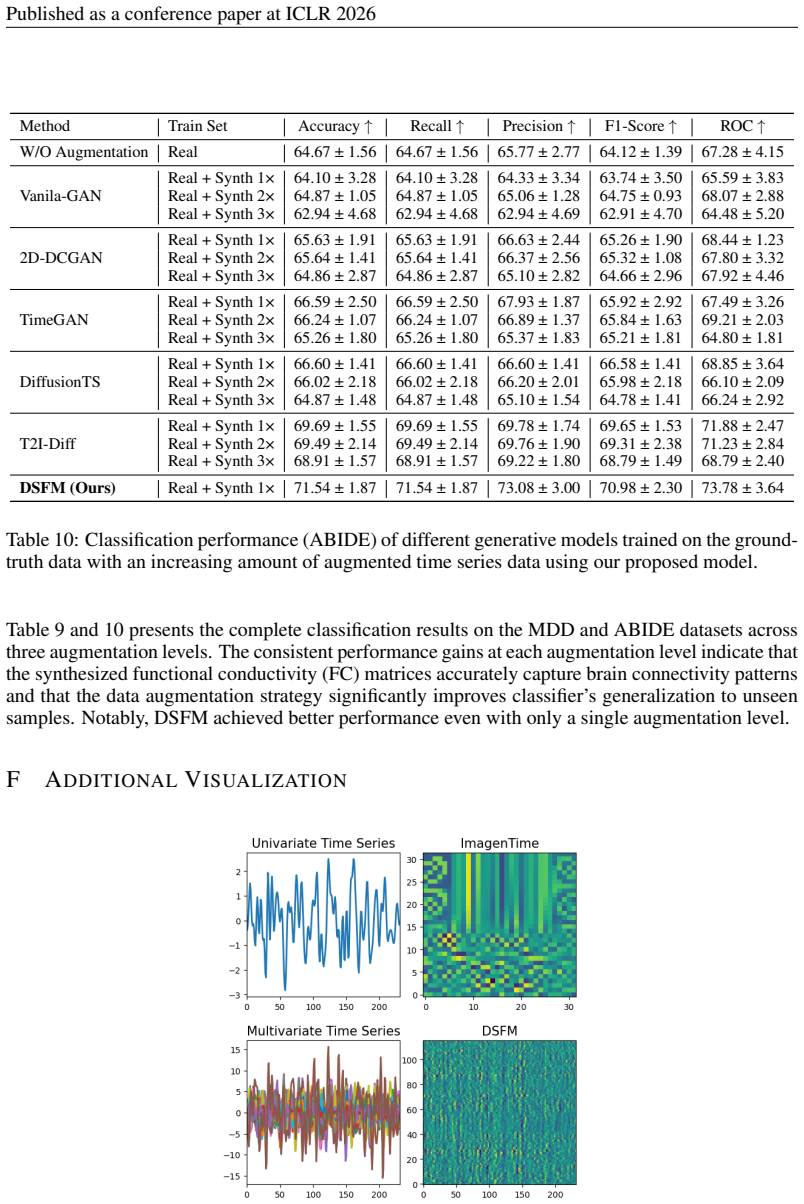
Table 8 presents the complete ablation results on the MDD dataset with additional experiments on different spectral representations and type of generative models
Diffusion, Wavelet 3.57±0.68 44.55±3.83 0.48±0.02 0.04±0.00 DSFM (Ours) 0.10±0.01 18.20±1.41 0.17±0.05 0.04±0.00 E.2 FULLRESULTS OFABLATIONSTUDIES. Table 8 presents the complete ablation results on the MDD dataset with additional experiments on different spectral representations and type of generative models. In comparison, the Fourier repre- sentation ac...
2062
discussion (0)
Sign in with ORCID, Apple, or X to comment. Anyone can read and Pith papers without signing in.