Magnetic Eruption and Nucleosynthesis in GR{ν}MHD Simulations of Spinning Neutron Star Mergers
Pith reviewed 2026-06-29 05:36 UTC · model grok-4.3
The pith
Aligned spins in neutron star mergers enable neutrino reprocessing that yields 0.0024 solar masses of proton-rich material and light r-process elements including nickel-56.
A machine-rendered reading of the paper's core claim, the machinery that carries it, and where it could break.
Core claim
In the aligned-spin configuration, the release of additional cold neutron-rich tidal ejecta in the equatorial plane permits development of a more tightly collimated polar outflow from the remnant and inner disk; strong neutrino reprocessing then converts 2.4 times 10 to the minus 3 solar masses of this material to proton-rich composition with electron fraction at least 0.49, enabling synthesis of light r-process elements including nickel-56 whose radioactive decay can produce a distinct electromagnetic signal from long-lived remnants, whereas antialigned spins impede magnetic amplification and outflow propagation.
What carries the argument
Neutrino reprocessing of magnetically driven polar outflows in the remnant and accretion disk, modulated by the initial spin alignment of the merging neutron stars.
If this is right
- Aligned spins produce a more collimated polar outflow than the irrotational case.
- Antialigned spins load the surroundings with debris and suppress magnetically driven winds.
- The synthesized nickel-56 decay supplies a potential electromagnetic counterpart distinct from other merger signals.
- The outflows remain too dense and slow to explain typical short gamma-ray bursts.
Where Pith is reading between the lines
- Spin configuration at merger could be inferred from the presence or absence of a nickel-decay bump in remnant light curves.
- The proton-rich ejecta mass found here may alter estimates of the total r-process contribution from neutron star mergers to galactic abundances.
- Higher-resolution runs or different neutrino schemes could change the exact electron-fraction distribution and therefore the nickel yield.
Load-bearing premise
The second-moment neutrino transport and grid resolution used are sufficient to capture the reprocessing of polar outflows and the growth of magnetic fields without major artifacts from the initial magnetic field or numerical setup.
What would settle it
A clear detection of the predicted nickel-56 decay signature in the light curve of a long-lived post-merger remnant, or the absence of any such signal in a sufficiently sensitive observation, would directly test whether the claimed amount of proton-rich material is produced.
Figures
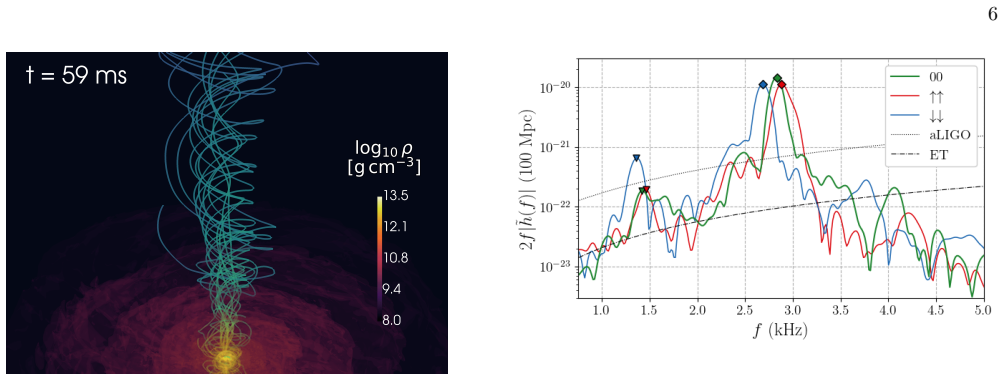
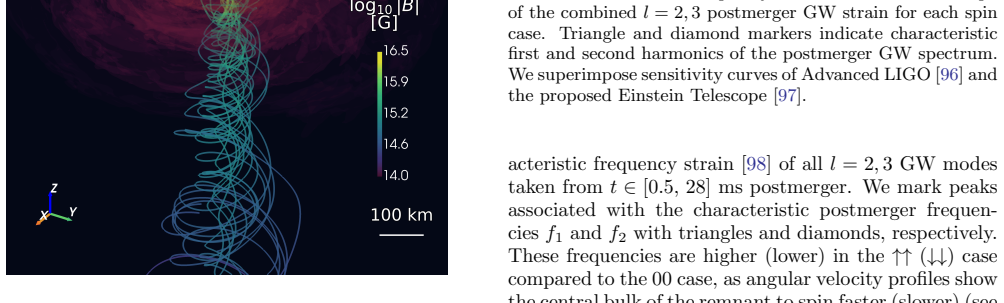
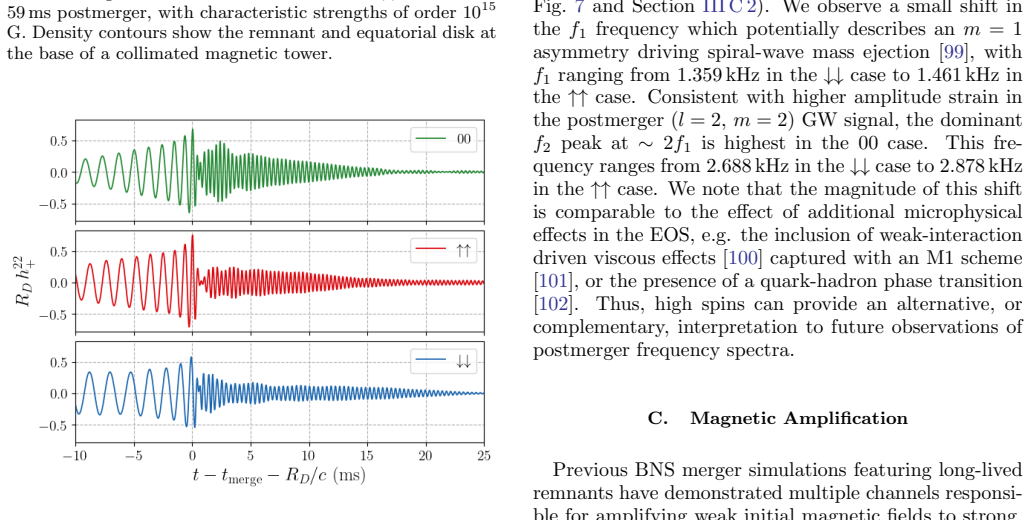
read the original abstract
We present three-dimensional general relativistic magnetohydrodynamics simulations of equal-mass binary neutron star mergers with varied neutron star spin configurations and second-moment neutrino transport, following the formation and early evolution of long-lived remnants. We compare a fiducial irrotational binary with binaries having spins that are aligned or antialigned with the orbital angular momentum, and examime how spin affects the merger dynamics, magnetic field evolution, outflows, and nucleosynthesis. Compared to the fiducial case, the aligned spin configuration releases more cold, neutron-rich tidal ejecta in the equatorial plane, which enables the development of a more tightly collimated polar outflow erupting from the remnant and inner accretion disk. Conversely, the case with spins antialigned with the orbit experiences a more violent collision at merger, disrupting magnetic amplification, loading the environment with debris, and impeding the propagation of magnetically driven winds. Strong neutrino reprocessing of the polar outflow in the irrotational and aligned spin cases produces $2.4\times 10^{-3}\,M_\odot$ of proton-rich ($Y_e \geq 0.49$) material, resulting in the synthesis of light r-process elements including $^{56}Ni$, whose subsequent decay potentially sends a unique electromagnetic signal from long-lived remnants. However, the outflows remain too dense and slow to be consistent with typical short gamma-ray bursts.
Editorial analysis
A structured set of objections, weighed in public.
Referee Report
Summary. The paper presents three-dimensional general relativistic magnetohydrodynamics (GRMHD) simulations with second-moment neutrino transport of equal-mass binary neutron star mergers under three spin configurations: irrotational, aligned, and antialigned. It investigates the effects of spin on merger dynamics, magnetic field evolution, outflows, and nucleosynthesis, finding that aligned spins lead to more collimated polar outflows while antialigned spins disrupt magnetic amplification. The key result is that neutrino reprocessing in the irrotational and aligned cases produces 2.4×10^{-3} M_⊙ of proton-rich material (Y_e ≥ 0.49), enabling synthesis of light r-process elements including 56Ni, with potential unique electromagnetic signals, although the outflows are too dense and slow for typical short gamma-ray bursts.
Significance. If the nucleosynthesis results hold, this work demonstrates the sensitivity of post-merger nucleosynthesis to neutron star spin orientation and provides a mechanism for light r-process element production in long-lived remnants. The direct simulation approach with neutrino transport adds to the understanding of multi-messenger signals from BNS mergers. The comparison across spin configurations is a particular strength.
major comments (2)
- [Abstract] Abstract and results on outflows/nucleosynthesis: the central quantitative claim of 2.4×10^{-3} M_⊙ of Y_e ≥ 0.49 material from neutrino reprocessing in polar outflows is load-bearing for the nucleosynthesis and EM-signal conclusions, yet the manuscript provides no resolution studies, convergence tests, or error estimates on Y_e evolution to confirm the second-moment closure does not introduce systematic bias near the Y_e=0.49 threshold.
- [Methods/Results] Neutrino transport section (methods/results): the second-moment model is used to capture reprocessing, but without explicit validation (e.g., comparison runs with alternate closures or higher-resolution trajectories) that heating/cooling rates along polar outflow paths are free of artifacts from the chosen grid or initial field strength, the proton-rich mass and 56Ni synthesis result cannot be fully assessed.
minor comments (1)
- [Abstract] Abstract: 'examime' is a typo and should read 'examine'.
Simulated Author's Rebuttal
We thank the referee for their careful reading and constructive comments, which highlight important aspects of validating our nucleosynthesis results. We respond to each major comment below, providing the strongest honest defense based on the simulations performed.
read point-by-point responses
-
Referee: [Abstract] Abstract and results on outflows/nucleosynthesis: the central quantitative claim of 2.4×10^{-3} M_⊙ of Y_e ≥ 0.49 material from neutrino reprocessing in polar outflows is load-bearing for the nucleosynthesis and EM-signal conclusions, yet the manuscript provides no resolution studies, convergence tests, or error estimates on Y_e evolution to confirm the second-moment closure does not introduce systematic bias near the Y_e=0.49 threshold.
Authors: We acknowledge that the current manuscript does not present dedicated resolution studies or convergence tests focused on the Y_e distribution near the 0.49 threshold. The second-moment closure is a standard approach in GRMHD merger simulations and has been shown in prior literature to accurately capture neutrino reprocessing in optically thick regions. The reported proton-rich mass arises from self-consistent evolution along polar trajectories where neutrino absorption dominates. We will add a dedicated paragraph in the methods and results sections discussing numerical uncertainties, citing validation studies of the closure, and noting that systematic biases would not alter the relative differences between spin configurations. This constitutes a partial revision via added discussion rather than new simulations. revision: partial
-
Referee: [Methods/Results] Neutrino transport section (methods/results): the second-moment model is used to capture reprocessing, but without explicit validation (e.g., comparison runs with alternate closures or higher-resolution trajectories) that heating/cooling rates along polar outflow paths are free of artifacts from the chosen grid or initial field strength, the proton-rich mass and 56Ni synthesis result cannot be fully assessed.
Authors: The grid resolution and initial magnetic field strength follow conventions established in the GRMHD merger literature to enable realistic magnetic amplification and disk formation. No alternate-closure comparison runs were performed in this study due to computational cost. The polar outflow paths lie in regions where the neutrino mean free path justifies the moment approximation, and heating/cooling rates are dominated by local thermodynamic conditions rather than grid-scale artifacts. We will expand the neutrino transport subsection to include explicit statements on these choices and their expected impact, emphasizing that any grid or field artifacts would affect all three spin cases comparably and thus preserve the reported spin-dependent trends in proton-rich ejecta. revision: partial
Circularity Check
No significant circularity; results from direct numerical integration
full rationale
The paper reports outcomes from three-dimensional GRMHD simulations with second-moment neutrino transport for three spin configurations. The central nucleosynthesis claim (2.4e-3 Msun of Y_e >=0.49 material and 56Ni production) follows from integrating the governing equations along simulated outflow trajectories; no step reduces by construction to a fitted parameter, self-definition, or load-bearing self-citation. The derivation chain consists of the numerical evolution itself and is self-contained against external benchmarks such as the stated initial conditions and resolution.
Axiom & Free-Parameter Ledger
free parameters (1)
- Initial spin configurations
axioms (2)
- standard math General relativistic magnetohydrodynamics equations govern the merger dynamics and magnetic field evolution
- domain assumption Second-moment neutrino transport provides an adequate model for neutrino reprocessing in the outflows
Forward citations
Cited by 1 Pith paper
-
Subgrid Modelling for Relativistic Magnetohydrodynamics with Machine Learning
First neural-network subgrid model for special relativistic MHD reproduces 4x-higher-resolution magnetic field amplification in 3D Kelvin-Helmholtz tests at 44x speedup.
Reference graph
Works this paper leans on
-
[1]
orbital hangup
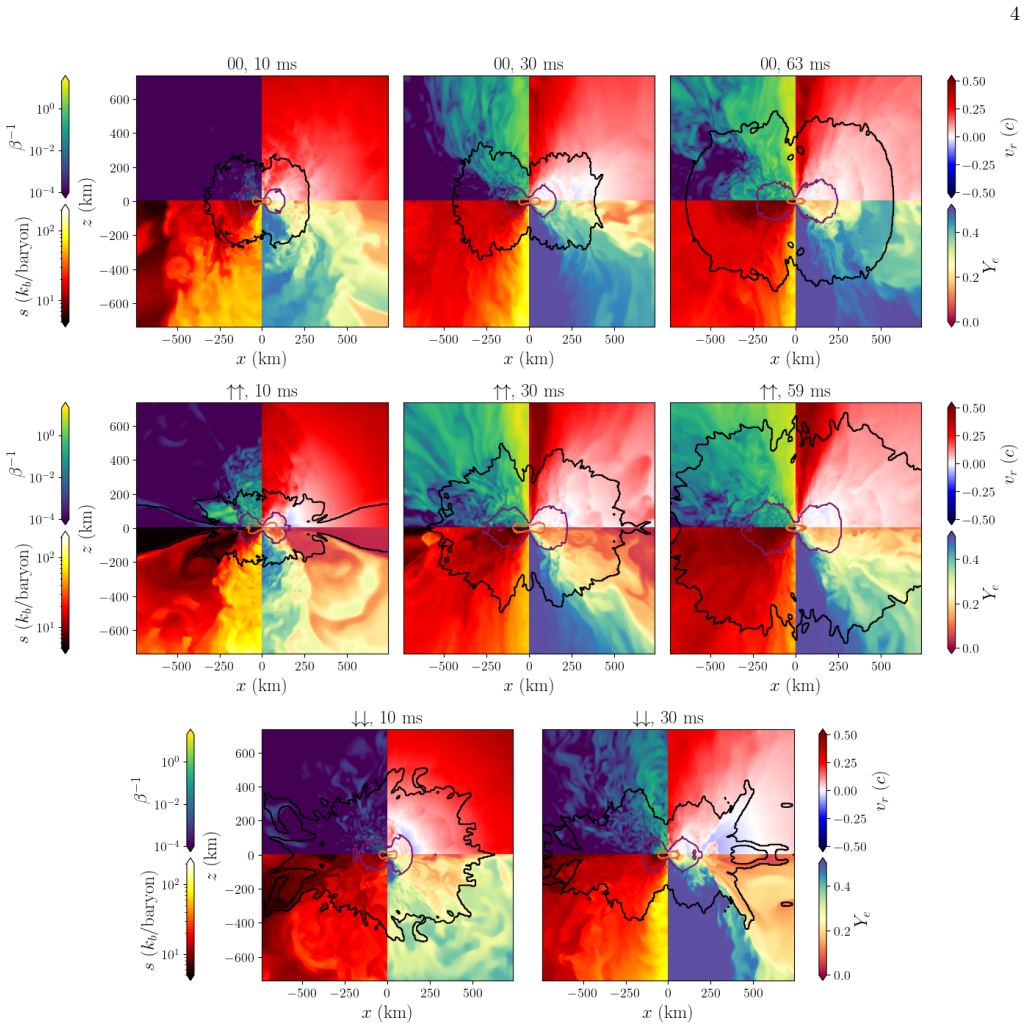
Low-Density Atmosphere Ideal GRMHD codes often require a numerical density floor, or atmosphere, as the HRSC schemes employed cannot evolve a pure vacuum. To ensure free propaga- tion of dynamical ejecta at the large distances we aim to 4 FIG. 1. Snapshots in the x-z plane of, clockwise from upper left, the inverse plasmaβparameter, radial velocityv r, el...
-
[2]
In the 00 and↑↑cases, this efficiently in- creases the total magnetic energy by an order of magni- tude until saturating near 2×10 50 erg, shown in the top panel of Fig
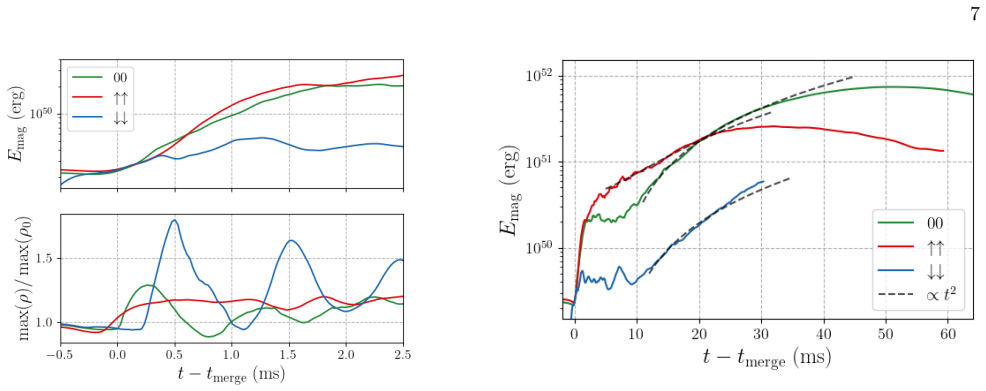
Kelvin-Helmholtz Instability Magnetic amplification immediately begins via KHI turbulence. In the 00 and↑↑cases, this efficiently in- creases the total magnetic energy by an order of magni- tude until saturating near 2×10 50 erg, shown in the top panel of Fig. 5. This turbulent phase lasts for∼2 ms before the shear layer dissipates and reorganizes into a ...
-
[3]
This differen- tial rotation increases the strength of the toroidal mag- netic field linearly in time, corresponding toE mag ∝t 2 shown by black dashed curves in Fig
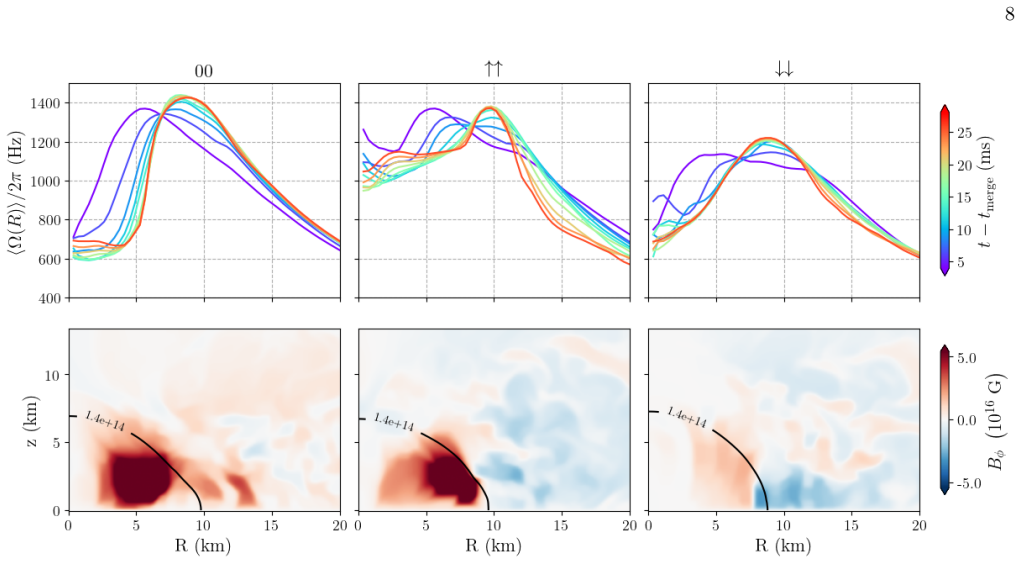
Magnetic Winding Following the initial turbulent phase, the HMNS rem- nants relax towards an axisymmetric state with a radi- ally varying angular velocity profile [108]. This differen- tial rotation increases the strength of the toroidal mag- netic field linearly in time, corresponding toE mag ∝t 2 shown by black dashed curves in Fig. 6. We observe ini- t...
-
[4]
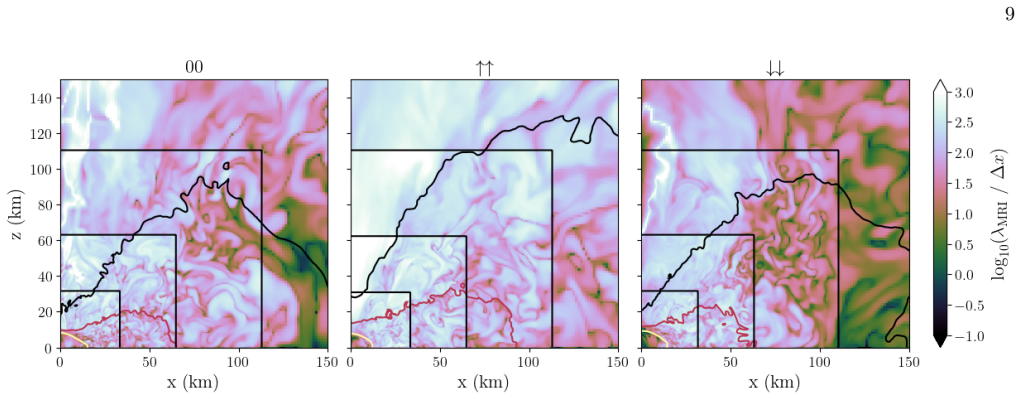
Magnetorotational Instability To estimate the activity of the MRI, we calculate the approximate local wavelength of the fastest growing mode as λMRI ≈ 2πvA Ω = 2π Ω |B|√4πρ (8) which holds for a Keplerian disk in Newtonian gravity. In Fig. 8, we plot the MRI quality factorλ MRI/∆x, the number of grid cells resolving this wavelength, in the x-z plane at th...
-
[5]
eruption
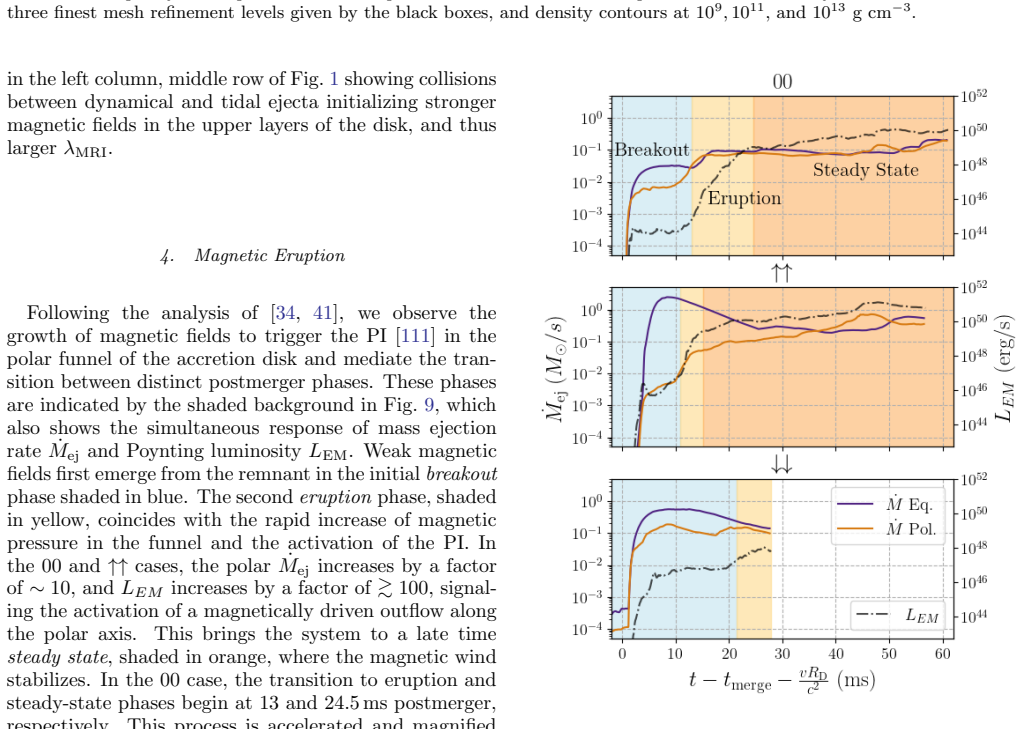
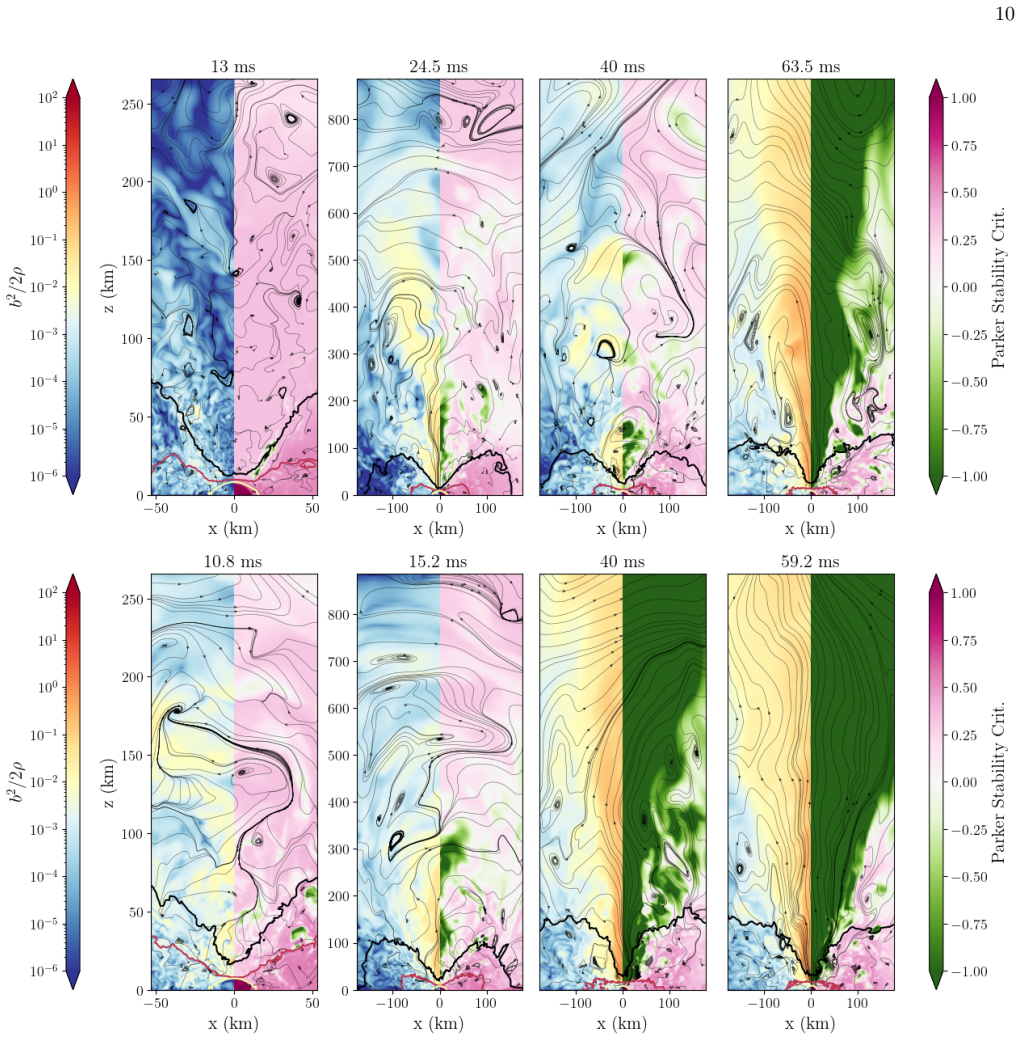
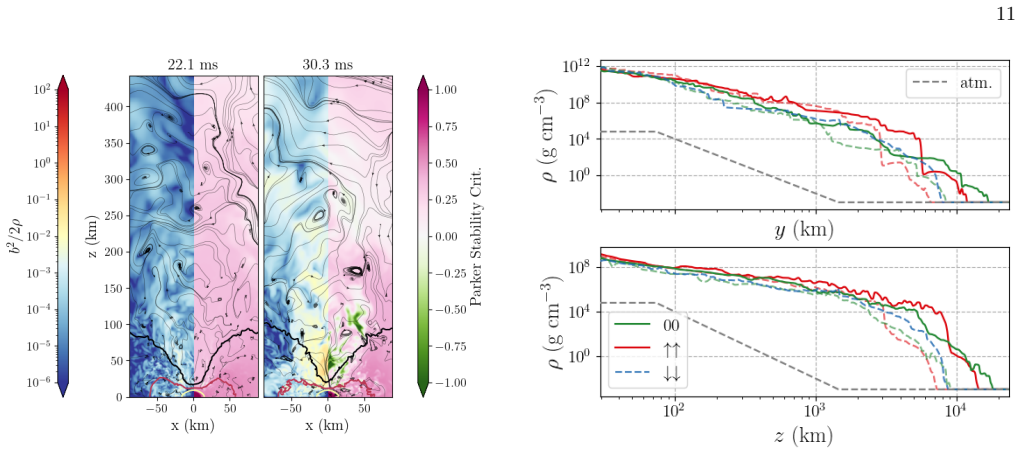
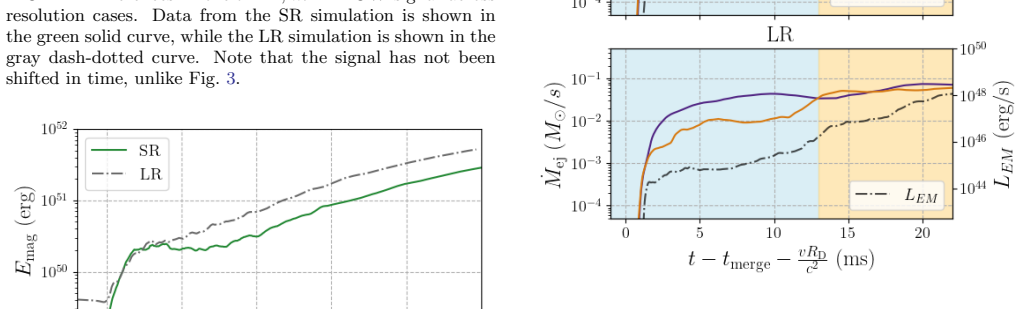
Magnetic Eruption Following the analysis of [34, 41], we observe the growth of magnetic fields to trigger the PI [111] in the polar funnel of the accretion disk and mediate the tran- sition between distinct postmerger phases. These phases are indicated by the shaded background in Fig. 9, which also shows the simultaneous response of mass ejection rate ˙Me...
-
[6]
EMERGE”, Prot. n. 2022KX2Z3B (CUP C53D23001150006), and from INAF via the Theory Grant 2023 “AfterJet
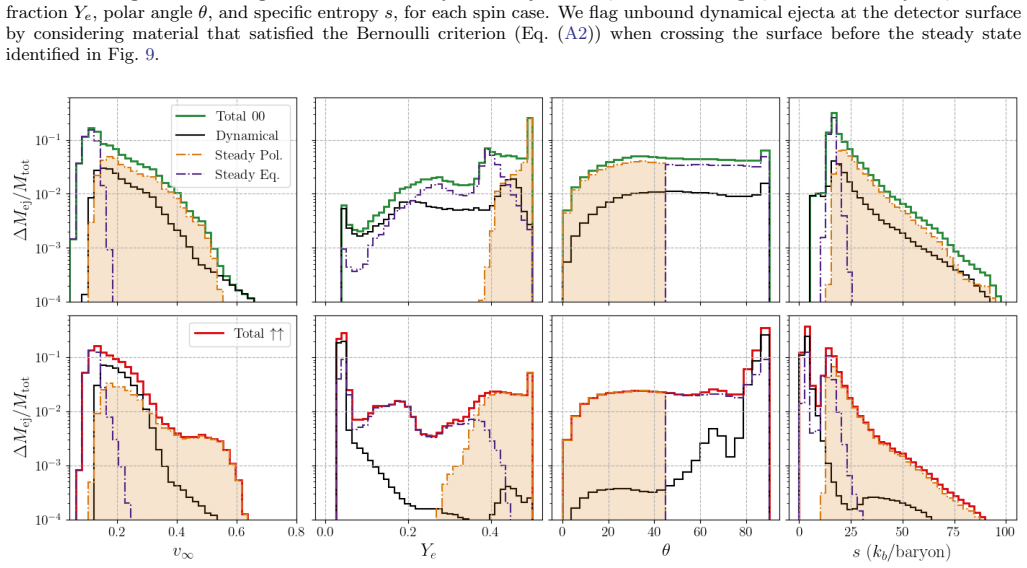
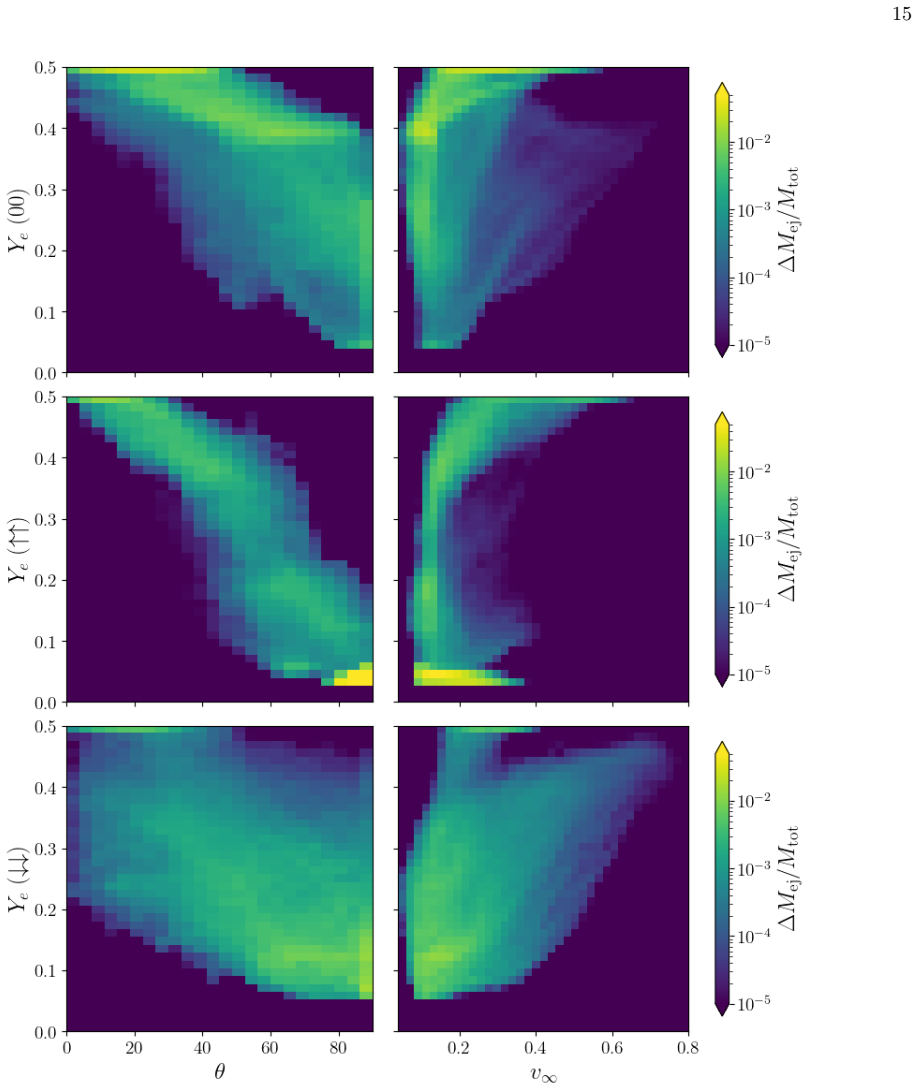
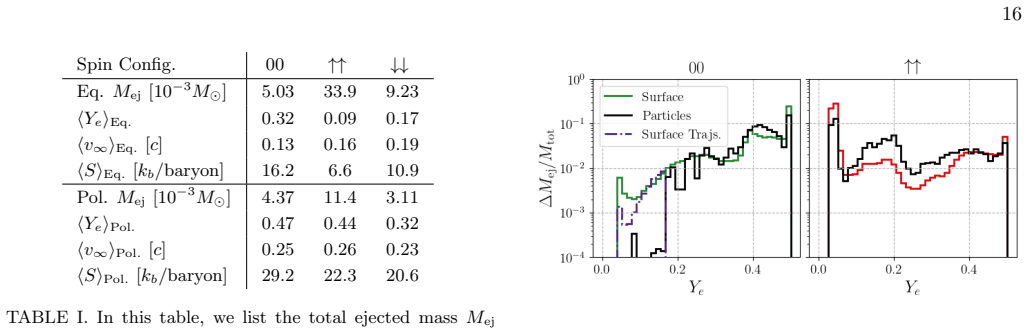
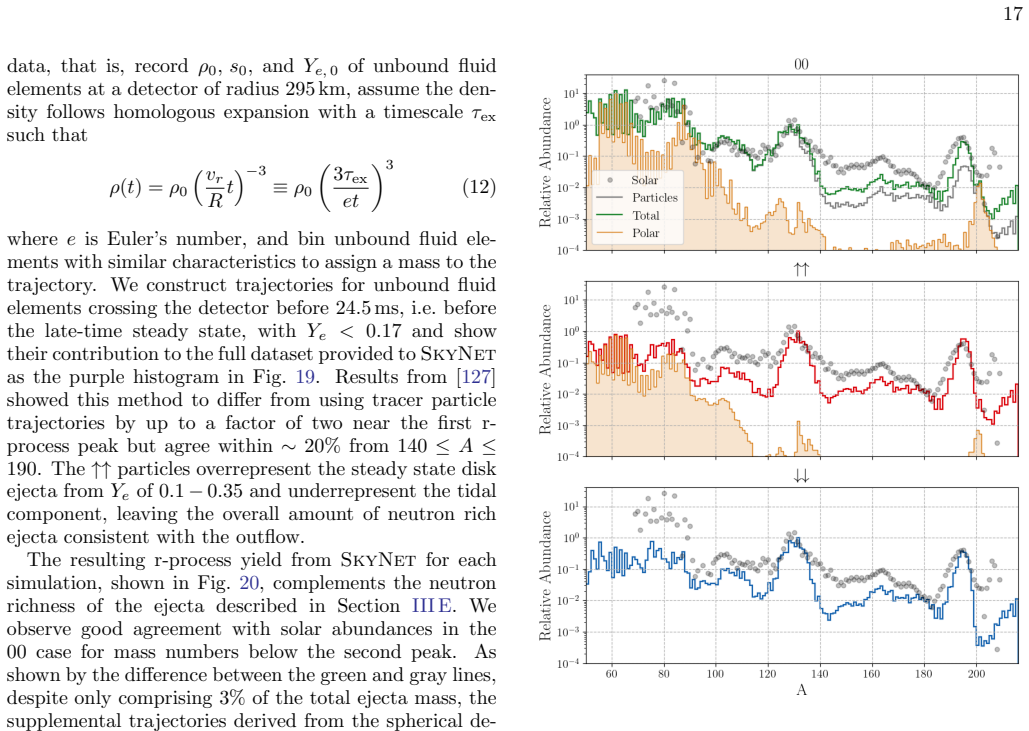
The↑↑particles overrepresent the steady state disk ejecta fromY e of 0.1−0.35 and underrepresent the tidal component, leaving the overall amount of neutron rich ejecta consistent with the outflow. The resulting r-process yield fromSkyNetfor each simulation, shown in Fig. 20, complements the neutron richness of the ejecta described in Section III E. We obs...
2022
-
[7]
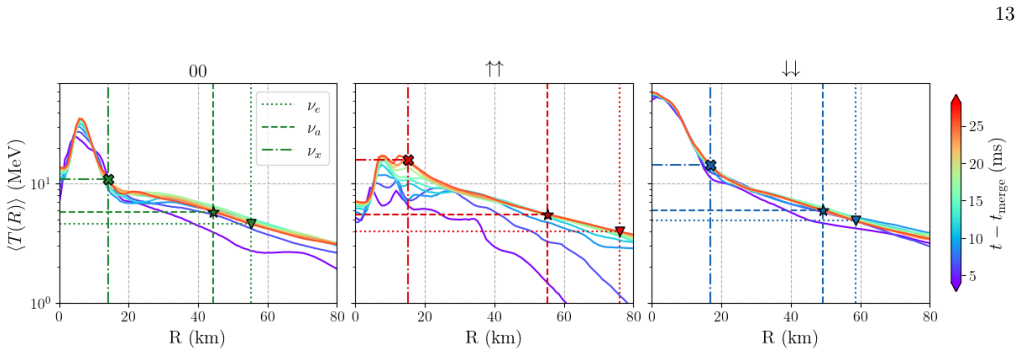
Averaged Radial Profiles When the postmerger system approaches an axisym- metric state, it becomes informative to compute averaged radial profiles of remnant characteristics. Given a quan- tityUdefined on the computational domain, we compute its azimuthal and time-average as ⟨U(R, tavg)⟩= 1 2π∆t Z 2π 0 Z tavg+∆t/2 tavg−∆t/2 U(R, ϕ, t)dt dϕ (A1) in the equ...
-
[8]
A fluid element interpolated to a de- tector point is flagged as unbound if it satisfies the the Bernoulli criterion −hut > h ∞ (A2) wherehis the specific enthalpy
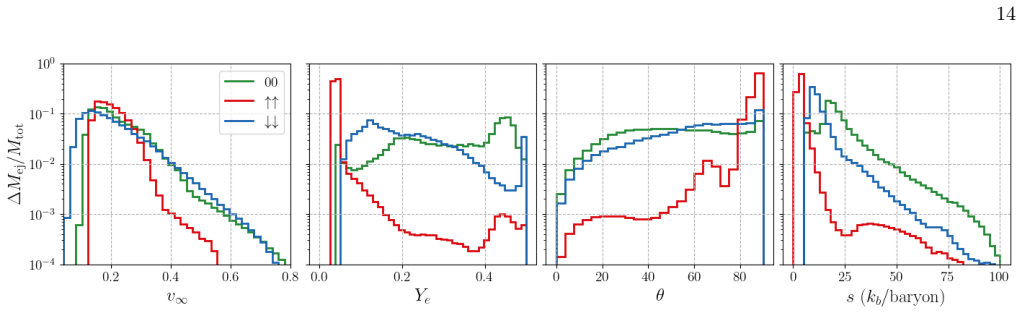
Unbound Material We place a spherical detector at a radius ofR D = 740 km and interpolate GRMHD quantities onto its grid of (n θ, n ϕ) = (55,96) points to track properties of un- bound material. A fluid element interpolated to a de- tector point is flagged as unbound if it satisfies the the Bernoulli criterion −hut > h ∞ (A2) wherehis the specific enthalp...
-
[9]
These data are later used as input to a nuclear reaction network to compute total nucleosynthetic yields
Tracer Particles and Nucleosynthesis We embed 96000 passive Lagrangian tracer particles into the fluid att= 0 to record the evolution ofρ, T,and Ye within unbound fluid elements. These data are later used as input to a nuclear reaction network to compute total nucleosynthetic yields. Initial particle locations are selected randomly from regions of the dom...
-
[10]
Figure 21 shows the dependence of the GW signal on resolution
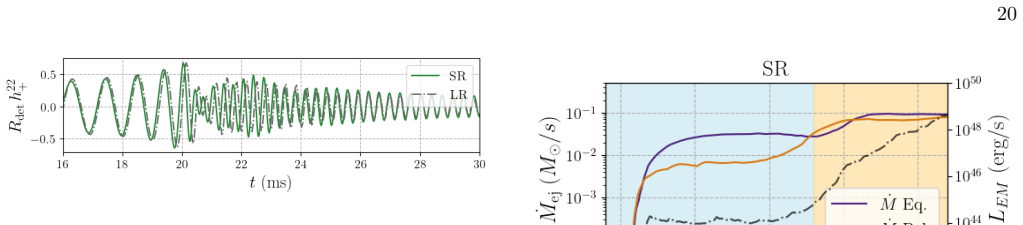
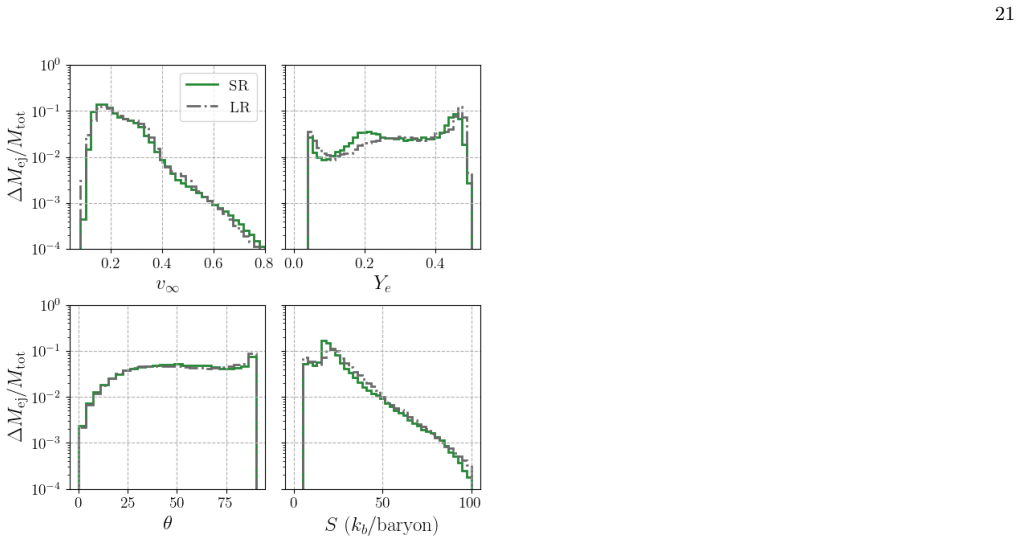
= 2.5×10 49 erg andE mag,LR (t= 0) = 5×10 49 erg. Figure 21 shows the dependence of the GW signal on resolution. Both signals start fromt= 0 at initial data and have not been time shifted, indicating that the SR simulation reaches merger 0.13 ms faster than with LR. While this difference is small and indicates comparable inspiral dynamics across resolutio...
-
[11]
B. P. Abbottet al.(LIGO Scientific, Virgo), Phys. Rev. Lett.119, 161101 (2017), arXiv:1710.05832 [gr-qc]
work page internal anchor Pith review Pith/arXiv arXiv 2017
-
[12]
B. P. Abbottet al.(LIGO Scientific, Virgo, Fermi GBM, INTEGRAL, IceCube, AstroSat Cadmium Zinc Telluride Imager Team, IPN, Insight-Hxmt, ANTARES, Swift, AGILE Team, 1M2H Team, Dark Energy Camera GW-EM, DES, DLT40, GRAWITA, Fermi-LAT, ATCA, ASKAP, Las Cumbres Observa- tory Group, OzGrav, DWF (Deeper Wider Faster Program), AST3, CAASTRO, VINROUGE, MAS- TER,...
work page internal anchor Pith review Pith/arXiv arXiv 2017
-
[13]
B. P. Abbottet al.(LIGO Scientific, Virgo), Phys. Rev. X9, 011001 (2019), arXiv:1805.11579 [gr-qc]
work page internal anchor Pith review Pith/arXiv arXiv 2019
-
[14]
B. P. Abbottet al.(LIGO Scientific, Virgo), Phys. Rev. Lett.121, 161101 (2018), arXiv:1805.11581 [gr-qc]
work page internal anchor Pith review Pith/arXiv arXiv 2018
-
[15]
B. P. Abbottet al.(LIGO Scientific, Virgo), Astro- phys. J. Lett.851, L16 (2017), arXiv:1710.09320 [astro- ph.HE]
work page internal anchor Pith review Pith/arXiv arXiv 2017
-
[16]
B. P. Abbottet al.(LIGO Scientific, Virgo, Fermi- GBM, INTEGRAL), Astrophys. J. Lett.848, L13 (2017), arXiv:1710.05834 [astro-ph.HE]
work page internal anchor Pith review Pith/arXiv arXiv 2017
-
[17]
P. S. Cowperthwaite, E. Berger, V. A. Villar, B. D. Metzger, M. Nicholl, R. Chornock, P. K. Blanchard, W. Fong, R. Margutti, M. Soares-Santos,et al., The Astrophysical Journal Letters848, L17 (2017)
2017
-
[18]
Albertet al.(ANTARES, IceCube, Pierre Auger, LIGO Scientific, Virgo), Astrophys
A. Albertet al.(ANTARES, IceCube, Pierre Auger, LIGO Scientific, Virgo), Astrophys. J. Lett.850, L35 (2017), arXiv:1710.05839 [astro-ph.HE]
-
[19]
B. P. Abbottet al.(LIGO Scientific, Virgo), Astro- phys. J. Lett.850, L39 (2017), arXiv:1710.05836 [astro- ph.HE]
work page internal anchor Pith review Pith/arXiv arXiv 2017
-
[20]
P. A. Evanset al., Science358, 1565 (2017), arXiv:1710.05437 [astro-ph.HE]
work page internal anchor Pith review Pith/arXiv arXiv 2017
-
[21]
R. Marguttiet al., Astrophys. J. Lett.848, L20 (2017), arXiv:1710.05431 [astro-ph.HE]
work page internal anchor Pith review Pith/arXiv arXiv 2017
-
[22]
Spectroscopic identification of r-process nucleosynthesis in a double neutron star merger
E. Pianet al., Nature551, 67 (2017), arXiv:1710.05858 [astro-ph.HE]
work page internal anchor Pith review Pith/arXiv arXiv 2017
-
[23]
B. D. Metzger and R. Fern´ andez, Monthly Notices of the Royal Astronomical Society441, 3444 (2014)
2014
-
[24]
B. D. Metzger, Living Reviews in Relativity20, 3 (2017), aDS Bibcode: 2017LRR....20....3M
2017
-
[25]
K. S. Thorne, Monthly Notices of the Royal Astronom- ical Society194, 439 (1981)
1981
-
[26]
Shibata, K
M. Shibata, K. Kiuchi, Y.-i. Sekiguchi, and Y. Suwa, Progress of Theoretical Physics125, 1255 (2011)
2011
-
[27]
Impact of an improved neutrino energy estimate on outflows in neutron star merger simulations
F. Foucart, E. O’Connor, L. Roberts, L. E. Kidder, H. P. Pfeiffer, and M. A. Scheel, Phys. Rev. D94, 123016 (2016), arXiv:1607.07450 [astro-ph.HE]
work page internal anchor Pith review Pith/arXiv arXiv 2016
-
[28]
Radice, S
D. Radice, S. Bernuzzi, A. Perego, and R. Haas, Monthly Notices of the Royal As- tronomical Society512, 1499 (2022), eprint: https://academic.oup.com/mnras/article- pdf/512/1/1499/42978846/stac589.pdf
2022
- [29]
-
[30]
P. L. Espino, D. Radice, F. Zappa, R. Gamba, and S. Bernuzzi, Physical Review D109, 103027 (2024)
2024
-
[31]
Bernuzzi, F
S. Bernuzzi, F. Magistrelli, M. Jacobi, D. Logoteta, A. Perego, and D. Radice, Monthly Notices of the Royal Astronomical Society542, 256 (2025)
2025
-
[32]
M. Ruffert, H.-T. Janka, and G. Schaefer, Astronomy & Astrophysics311, 532 (1996), arXiv:astro-ph/9509006 [astro-ph]
work page internal anchor Pith review Pith/arXiv arXiv 1996
-
[33]
Galeazzi, W
F. Galeazzi, W. Kastaun, L. Rezzolla, and J. A. Font, Physical Review D88, 064009 (2013)
2013
-
[34]
Radice, F
D. Radice, F. Galeazzi, J. Lippuner, L. F. Roberts, C. D. Ott, and L. Rezzolla, Monthly Notices of the Royal As- tronomical Society460, 3255 (2016)
2016
-
[35]
L. R. Werneck, Z. B. Etienne, A. Murguia-Berthier, R. Haas, F. Cipolletta, S. C. Noble, L. Ennoggi, F. G. Lopez Armengol, B. Giacomazzo, T. Assump¸ c˜ ao, J. Faber, T. Gupte, B. J. Kelly, and J. H. Krolik, Physical Review D107, 044037 (2023), aDS Bibcode: 2023PhRvD.107d4037W
2023
-
[36]
Arnould, S
M. Arnould, S. Goriely, and K. Takahashi, Physics Reports450, 97 (2007), aDS Bibcode: 2007PhR...450...97A
2007
-
[37]
Magistrelli, S
F. Magistrelli, S. Bernuzzi, A. Perego, and D. Radice, The Astrophysical Journal Letters974, L5 (2024)
2024
-
[38]
Jacobi, F
M. Jacobi, F. Magistrelli, E. Loffredo, G. Ricigliano, L. Chiesa, S. Bernuzzi, A. Perego, and A. Arcones, The Astrophysical Journal Letters999, L16 (2026)
2026
-
[39]
F. Schianchi, H. Gieg, V. Nedora, A. Neuweiler, M. Uje- vic, M. Bulla, and T. Dietrich, M1 neutrino transport within the numerical-relativistic code BAM with appli- cation to low mass binary neutron star mergers (2023), arXiv:2307.04572 [gr-qc]
-
[40]
Musolino and L
C. Musolino and L. Rezzolla, Monthly Notices of the Royal Astronomical Society528, 5952 (2024), ADS Bib- code: 2024MNRAS.528.5952M
2024
-
[41]
B. Daszuta, S. Bernuzzi, M. Jacobi, E. M. Guti´ errez, P. Hammond, W. Cook, and D. Radice, GR-Athena++: Binary Neutron Star Merger Simulations with Neutrino Transport (2026), arXiv:2602.18290 [gr-qc]
- [42]
-
[43]
Musolino, R
C. Musolino, R. Duqu´ e, and L. Rezzolla, The As- trophysical Journal966, L31 (2024), ADS Bibcode: 2024ApJ...966L..31M
2024
-
[44]
Musolino, L
C. Musolino, L. Rezzolla, and E. R. Most, The As- trophysical Journal984, L61 (2025), aDS Bibcode: 2025ApJ...984L..61M
2025
-
[45]
Neuweiler, H
A. Neuweiler, H. Gieg, H. Rose, H. Koehn, I. Markin, F. Schianchi, L. Brodie, A. Haber, V. Nedora, M. Bulla, and T. Dietrich, Physical Review D113, 043038 (2026)
2026
-
[46]
First 100 ms of a long-lived magnetized neutron star formed in a binary neutron star merger
R. Ciolfi, W. Kastaun, J. V. Kalinani, and B. Gi- acomazzo, Physical Review D100, 023005 (2019), arXiv:1904.10222 [astro-ph.HE]
work page internal anchor Pith review Pith/arXiv arXiv 2019
-
[47]
Ciolfi, Monthly Notices of the Royal Astronomi- cal Society495, L66 (2020), aDS Bibcode: 2020MN- 23 RAS.495L..66C
R. Ciolfi, Monthly Notices of the Royal Astronomi- cal Society495, L66 (2020), aDS Bibcode: 2020MN- 23 RAS.495L..66C
2020
- [48]
-
[49]
Aguilera-Miret, C
R. Aguilera-Miret, C. Palenzuela, F. Carrasco, S. Ross- wog, and D. Vigan` o, Physical Review D110, 083014 (2024)
2024
-
[50]
Bamber, A
J. Bamber, A. Tsokaros, M. Ruiz, and S. L. Shapiro, Physical Review D110, 024046 (2024)
2024
-
[51]
Jiang, H
J.-L. Jiang, H. H.-Y. Ng, M. Chabanov, and L. Rezzolla, Physical Review D111, 103043 (2025)
2025
-
[52]
J. V. Kalinani, R. Ciolfi, M. Campanelli, B. Giaco- mazzo, A. Pavan, A. Wen, and Y. Zlochower, The As- trophysical Journal Letters1000, L35 (2026)
2026
-
[53]
Combi and D
L. Combi and D. M. Siegel, Physical Re- view Letters131, 231402 (2023), aDS Bibcode: 2023PhRvL.131w1402C
2023
-
[54]
Curtis, P
S. Curtis, P. M¨ osta, Z. Wu, D. Radice, L. Roberts, G. Ricigliano, and A. Perego, Monthly Notices of the Royal Astronomical Society518, 5313 (2023), aDS Bib- code: 2023MNRAS.518.5313C
2023
-
[55]
D. R. Lorimer, Living Reviews in Relativity11, 8 (2008)
2008
-
[56]
Kastaun, F
W. Kastaun, F. Galeazzi, D. Alic, L. Rezzolla, and J. A. Font, Physical Review D88, 021501 (2013)
2013
-
[57]
Bernuzzi, T
S. Bernuzzi, T. Dietrich, W. Tichy, and B. Br¨ ugmann, Physical Review D89, 104021 (2014)
2014
-
[58]
Dietrich, S
T. Dietrich, S. Bernuzzi, M. Ujevic, and W. Tichy, Phys- ical Review D95, 044045 (2017)
2017
-
[59]
Kastaun, R
W. Kastaun, R. Ciolfi, A. Endrizzi, and B. Giacomazzo, Physical Review D96, 043019 (2017)
2017
-
[60]
W. E. East, V. Paschalidis, F. Pretorius, and A. Tsokaros, Physical Review D100, 124042 (2019)
2019
-
[61]
R. Dudi, T. Dietrich, A. Rashti, B. Br¨ ugmann, J. Stein- hoff, and W. Tichy, Physical Review D105, 064050 (2022), aDS Bibcode: 2022PhRvD.105f4050D
2022
-
[62]
M. Ruiz, A. Tsokaros, V. Paschalidis, and S. L. Shapiro, Physical Review D99, 084032 (2019), aDS Bibcode: 2019PhRvD..99h4032R
2019
-
[63]
E. R. Most, L. J. Papenfort, A. Tsokaros, and L. Rez- zolla, The Astrophysical Journal884, 40 (2019)
2019
-
[64]
Karaka¸ s, R
B. Karaka¸ s, R. Matur, and M. Ruffert, Monthly Notices of the Royal Astronomical Society545, staf2009 (2026)
2026
-
[65]
Schianchi, M
F. Schianchi, M. Ujevic, A. Neuweiler, H. Gieg, I. Markin, and T. Dietrich, Physical Review D109, 123011 (2024)
2024
- [66]
-
[67]
Campanelli, C
M. Campanelli, C. O. Lousto, and Y. Zlochower, Phys- ical Review D74, 041501 (2006)
2006
-
[68]
J. W. T. Hessels, S. M. Ransom, I. H. Stairs, P. C. C. Freire, V. M. Kaspi, and F. Camilo, Science311, 1901 (2006), arXiv:astro-ph/0601337 [astro-ph]
work page internal anchor Pith review Pith/arXiv arXiv 1901
-
[69]
Z. B. Etienne, V. Paschalidis, R. Haas, P. M¨ osta, and S. L. Shapiro, Classical and Quantum Gravity32, 175009 (2015)
2015
-
[70]
Lippuner and L
J. Lippuner and L. F. Roberts, The Astrophysical Jour- nal Supplement Series233, 18 (2017), aDS Bibcode: 2017ApJS..233...18L
2017
-
[71]
Rizzo, R
M. Rizzo, R. Haas, S. R. Brandt, Z. Etienne, D. Fergu- son, L. T. Sanches, B.-J. Tsao, L. Werneck, D. Boyer, G. Bozzola,et al., The einstein toolkit (2025)
2025
-
[72]
Schnetter, S
E. Schnetter, S. H. Hawley, and I. Hawke, Classical and Quantum Gravity21, 1465 (2004)
2004
-
[73]
Porth, K
O. Porth, K. Chatterjee, R. Narayan, C. F. Gammie, Y. Mizuno, P. Anninos, J. G. Baker, M. Bugli, C.- k. Chan, J. Davelaar,et al., The Astrophysical Jour- nal Supplement Series243, 26 (2019), aDS Bibcode: 2019ApJS..243...26P
2019
-
[74]
Ennoggi, M
L. Ennoggi, M. Campanelli, Y. Zlochower, S. C. No- ble, J. Krolik, F. Cattorini, J. V. Kalinani, V. Mewes, M. Chabanov, L. Ji, and M. C. de Simone, Phys- ical Review D112, 063009 (2025), aDS Bibcode: 2025PhRvD.112f3009E
2025
-
[75]
M. C. de Simone, M. Campanelli, L. Ennoggi, C. O. Lousto, and Y. Zlochower, Accretion, Jets, and Recoil in Merging Supermassive Binary Black Holes (2025), aDS Bibcode: 2025arXiv251005883D
2025
-
[76]
Manikantan and V
V. Manikantan and V. Paschalidis, Physical Review D 112, 103050 (2025)
2025
-
[77]
Ennoggi, M
L. Ennoggi, M. Campanelli, J. Krolik, S. C. No- ble, Y. Zlochower, and M. C. de Simone, Physical Review Letters136, 111401 (2026), aDS Bibcode: 2026PhRvL.136k1401E
2026
-
[78]
C. A. Raithel, V. Paschalidis, and F. ¨Ozel, Phys- ical Review D104, 063016 (2021), aDS Bibcode: 2021PhRvD.104f3016R
2021
-
[79]
F. G. Lopez Armengol, Z. B. Etienne, S. C. Noble, B. J. Kelly, L. R. Werneck, B. Drachler, M. Campan- elli, F. Cipolletta, Y. Zlochower, A. Murguia-Berthier, L. Ennoggi, M. Avara, R. Ciolfi, J. Faber, G. Fi- acco, B. Giacomazzo, T. Gupte, T. Ha, J. H. Krolik, V. Mewes, R. O’Shaughnessy, J. M. Rueda-Becerril, and J. Schnittman, Physical Review D106, 083015...
2022
-
[80]
Zenati, J
Y. Zenati, J. H. Krolik, L. R. Werneck, A. Murguia- Berthier, Z. B. Etienne, S. C. Noble, and T. Piran, The Astrophysical Journal958, 161 (2023)
2023
discussion (0)
Sign in with ORCID, Apple, or X to comment. Anyone can read and Pith papers without signing in.