SAGE: A Novelty Gate for Efficient Memory Evolution in Agentic LLMs
Pith reviewed 2026-06-28 23:01 UTC · model grok-4.3
The pith
SAGE routes new facts through a density-based novelty gate to add, ignore, or merge them in agent memory while cutting LLM calls.
A machine-rendered reading of the paper's core claim, the machinery that carries it, and where it could break.
Core claim
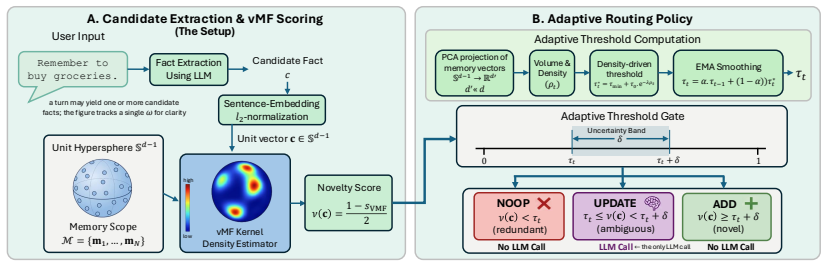
SAGE is a Spherical Adaptive Gate for memory Evolution that scores candidate facts with a von Mises-Fisher-based density estimator over memory embeddings and routes them with an adaptive threshold that tracks memory-store geometry. SAGE resolves clearly novel facts as ADD, clearly redundant facts as NOOP, and sends only uncertain cases to an LLM merge step, reducing expensive write-time reasoning.
What carries the argument
Spherical Adaptive Gate (SAGE) that applies a von Mises-Fisher density estimator to memory embeddings together with an adaptive threshold derived from memory-store geometry to classify each fact as novel, redundant, or uncertain.
If this is right
- On the reported benchmark, SAGE achieves the best average token-F1 against the prior memory system on all seven open-weight backbone comparisons.
- On the closed model it reduces add-phase API cost by 3.4× and add-phase latency by 2.5× with only a small average judge-score gap.
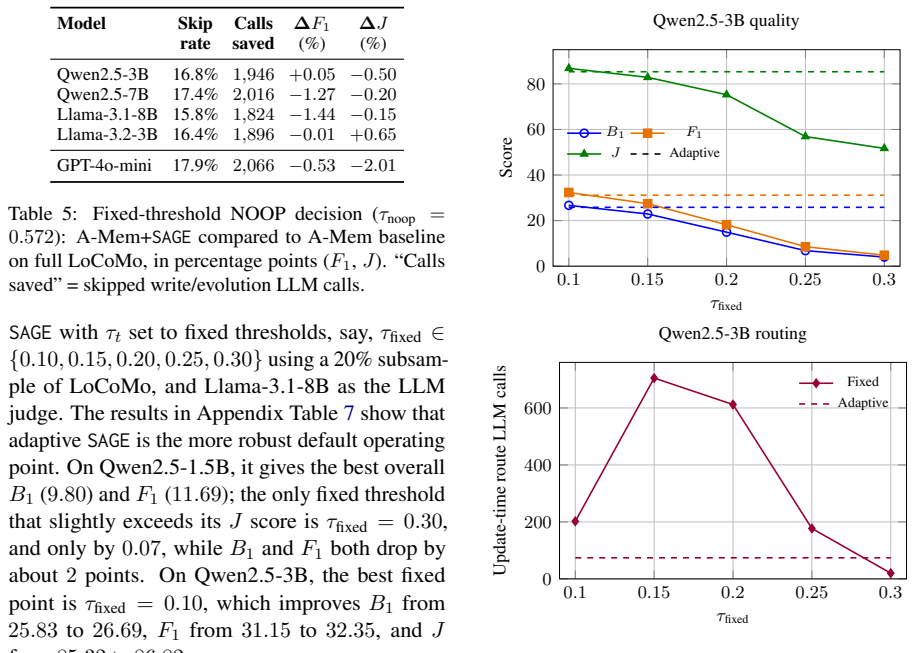
- Used as a drop-in binary gate for the prior memory system, SAGE skips roughly 16-18% of LLM calls across five models with minimal quality change on open-weight backbones.
- Novelty-aware write control improves both memory quality and system efficiency in long-term agentic memory.
Where Pith is reading between the lines
- The same embedding-density gate could be inserted into other memory architectures to limit redundant storage without changing their retrieval logic.
- Agents that ingest facts in a continuous stream might keep the gate active at all times to avoid repeated LLM involvement.
- If the geometry-tracking threshold proves stable, the same mechanism could be tested on embedding spaces produced by non-LLM encoders.
Load-bearing premise
The von Mises-Fisher density estimator over memory embeddings combined with an adaptive threshold that tracks memory-store geometry is sufficient to separate clearly novel, clearly redundant, and uncertain facts without systematic misclassification that would degrade downstream memory quality.
What would settle it
A controlled run in which every fact is forced through the full LLM merge step and the resulting token-F1 and judge scores are compared against the selective routing produced by the density gate on identical inputs and backbones.
Figures
read the original abstract
Agentic LLMs must continuously decide whether newly extracted facts should be added, merged with existing memories, or ignored, yet prior work has focused more on retrieval and storage than on principled write-side control. We frame memory evolution as a novelty-detection problem and propose SAGE, a Spherical Adaptive Gate for memory Evolution that scores candidate facts with a von Mises-Fisher-based density estimator over memory embeddings and routes them with an adaptive threshold that tracks memory-store geometry. SAGE resolves clearly novel facts as ADD, clearly redundant facts as NOOP, and sends only uncertain cases to an LLM merge step, reducing expensive write-time reasoning. On LoCoMo, SAGE achieves the best average token-F1 against Mem0 on all seven open-weight backbone comparisons, while on GPT-4o-mini it reduces add-phase API cost by 3.4$\times$ and add-phase latency by 2.5$\times$ with only a small average judge-score gap. As a drop-in binary gate for A-Mem, SAGE skips roughly 16-18% of LLM calls across five models with minimal quality change on open-weight backbones. These results suggest that novelty-aware write control is a practical lever for improving both memory quality and system efficiency in long-term agentic memory. The source code for our approach is accessible at https://github.com/swang1024/SAGE.
Editorial analysis
A structured set of objections, weighed in public.
Referee Report
Summary. The paper introduces SAGE, a Spherical Adaptive Gate for memory Evolution in agentic LLMs. It frames memory write decisions as a novelty-detection task, using a von Mises-Fisher density estimator over memory embeddings together with an adaptive threshold that tracks store geometry to route facts as ADD (clearly novel), NOOP (clearly redundant), or LLM merge (uncertain). This is claimed to reduce expensive write-time LLM calls. On the LoCoMo benchmark SAGE reports the best average token-F1 versus Mem0 across seven open-weight backbones; on GPT-4o-mini it reports 3.4× lower add-phase API cost and 2.5× lower latency with only a small judge-score gap. As a drop-in binary gate for A-Mem it skips 16-18% of LLM calls across five models with minimal quality change. The code is released at https://github.com/swang1024/SAGE.
Significance. If the gate's classification accuracy holds, the work supplies a lightweight, geometry-aware mechanism that simultaneously improves memory quality and system efficiency for long-horizon agentic applications; the open-source release is a concrete strength that would allow direct replication and extension.
major comments (2)
- [Abstract / method description] Abstract / method description: the central claim that the vMF density estimator plus adaptive threshold cleanly partitions novel/redundant/uncertain facts (thereby routing only uncertain cases to the LLM merge step) is load-bearing for both the token-F1 gains and the 3.4× cost reduction, yet the manuscript supplies neither per-class precision/recall for the gate nor an ablation of the adaptive threshold nor any analysis of embedding-distribution mismatch when memories cluster tightly or lie near decision boundaries.
- [Abstract] Abstract: all reported performance numbers (best average token-F1 on seven backbones, 3.4× cost / 2.5× latency reductions, 16-18% call skipping) are stated without any experimental protocol, statistical tests, data splits, or ablation details, so it is impossible to determine whether the observed gains are attributable to the proposed gate rather than to uncontrolled factors.
Simulated Author's Rebuttal
We thank the referee for the constructive feedback on our manuscript. We address each major comment below and will incorporate revisions to improve clarity and completeness.
read point-by-point responses
-
Referee: [Abstract / method description] Abstract / method description: the central claim that the vMF density estimator plus adaptive threshold cleanly partitions novel/redundant/uncertain facts (thereby routing only uncertain cases to the LLM merge step) is load-bearing for both the token-F1 gains and the 3.4× cost reduction, yet the manuscript supplies neither per-class precision/recall for the gate nor an ablation of the adaptive threshold nor any analysis of embedding-distribution mismatch when memories cluster tightly or lie near decision boundaries.
Authors: We agree that explicit per-class precision/recall for the gate, an ablation of the adaptive threshold, and analysis of embedding-distribution mismatch would strengthen the central claims. The current manuscript focuses on end-to-end results but does not include these gate-specific diagnostics. In revision we will add a dedicated 'Gate Analysis' subsection with precision/recall breakdowns on LoCoMo, a threshold ablation, and discussion of vMF behavior under tight clustering or boundary cases, supported by embedding visualizations. revision: yes
-
Referee: [Abstract] Abstract: all reported performance numbers (best average token-F1 on seven backbones, 3.4× cost / 2.5× latency reductions, 16-18% call skipping) are stated without any experimental protocol, statistical tests, data splits, or ablation details, so it is impossible to determine whether the observed gains are attributable to the proposed gate rather than to uncontrolled factors.
Authors: The experimental protocol (LoCoMo splits, backbone configurations, judge scoring, and cost/latency measurement) is described in Section 4, but the abstract indeed omits this context and no statistical tests appear in the reported results. We will revise the abstract to reference the evaluation setup and add paired statistical significance tests plus ablation details to the results section to confirm attribution to the gate. revision: yes
Circularity Check
No circularity; method relies on standard density estimation without self-referential reductions
full rationale
The paper frames memory evolution as novelty detection and describes SAGE via a von Mises-Fisher density estimator plus adaptive threshold on embeddings. No equations, derivations, or fitted parameters are shown that reduce the reported LoCoMo token-F1 gains, cost reductions, or gate decisions to quantities defined by construction within the same work. The approach invokes standard statistical tools rather than self-citations, ansatzes, or uniqueness theorems from the authors. Empirical results on benchmarks provide the support, with no load-bearing steps that collapse to input definitions or prior self-work.
Axiom & Free-Parameter Ledger
Reference graph
Works this paper leans on
-
[1]
The faiss library.IEEE Transactions on Big Data. Hsin-Ling Hsu and Jengnan Tzeng. 2025. Dat: Dynamic alpha tuning for hybrid retrieval in retrieval-augmented generation.arXiv preprint arXiv:2503.23013. Jeff Johnson, Matthijs Douze, and Hervé Jégou. 2019. Billion-scale similarity search with gpus.IEEE trans- actions on big data, 7(3):535–547. Vladimir Karp...
-
[2]
InProceedings of the 62nd Annual Meeting of the Association for Computational Linguistics (Volume 1: Long Papers), pages 13851– 13870
Evaluating very long-term conversational memory of llm agents. InProceedings of the 62nd Annual Meeting of the Association for Computational Linguistics (Volume 1: Long Papers), pages 13851– 13870. Kanti V Mardia and Peter E Jupp. 1999. Directional statistics.Wiley Series in Probability and Statistics, page 40. Charles Packer, Sarah Wooders, Kevin Lin, Vi...
1999
-
[3]
MemGPT: Towards LLMs as Operating Systems
Memgpt: Towards llms as operating systems. arXiv preprint arXiv:2310.08560. Joon Sung Park, Joseph O’Brien, Carrie Jun Cai, Mered- ith Ringel Morris, Percy Liang, and Michael S Bern- stein. 2023. Generative agents: Interactive simulacra of human behavior. InProceedings of the 36th an- nual acm symposium on user interface software and technology, pages 1–2...
work page internal anchor Pith review Pith/arXiv arXiv 2023
discussion (0)
Sign in with ORCID, Apple, or X to comment. Anyone can read and Pith papers without signing in.