REVIEW 3 major objections 32 references
A domain-specialized multimodal model trained on a new mechanical-drawing benchmark beats strong closed-source systems by 7.57 points on dense engineering drawings.
Reviewed by Pith at T0; open to challenge. T0 means a machine referee read the full paper against a public rubric. the ladder, T0–T4 →
T0 review · grok-4.5
2026-07-12 15:35 UTC pith:4QMGOBLT
load-bearing objection Real first unified mechanical-drawing VQA suite plus a solid 4B specialized baseline; headline +7.57 rests on LLM-judge scores that also shaped RL, with no human IAA. the 3 major comments →
MechVQA: Benchmarking and Enhancing Multimodal LLMs on Comprehensive Mechanical Drawing Understanding
The pith
A machine-rendered reading of the paper's core claim, the machinery that carries it, and where it could break.
Core claim
The paper claims that multi-stage post-training on MechVQA—full supervised fine-tuning of the language module, then DAPO-based self-play reinforcement learning with a taxonomy-aligned composite reward—turns a general 4B vision–language model into a domain baseline that substantially outperforms both large open-source and closed-source general MLLMs on comprehensive mechanical drawing understanding.
What carries the argument
MechVQA’s three-capability, ten-subtask taxonomy, paired with a DAPO reward that combines semantic accuracy (LLM-judged equivalence), binary schema format compliance, and quality scores for logic, professionalism, and conciseness; that stack is what carries the reported MechVL gains.
Load-bearing premise
Automatic multi-LLM semantic judging of free-form answers is treated as a faithful proxy for engineering correctness even though no human-expert upper bound or inter-annotator agreement is reported.
What would settle it
Have independent mechanical engineers re-label the same held-out answers under a fixed rubric; if MechVL’s advantage over the strongest closed- and open-source baselines disappears or reverses under human majority scores, the central performance claim fails.
If this is right
- Mechanical design and inspection workflows can treat specialized MLLMs as decision-support for dimension reading, multi-view correspondence, and anomaly checks rather than only generic VQA.
- Future engineering-drawing work can evaluate against the same Recognition / Reasoning / Judging split instead of isolated symbol or floor-plan tasks.
- Targeted self-play RL that upweights weak subtasks can reduce capability imbalance on dense, constraint-sensitive drawings.
- A public-source drawing benchmark with drawing-level splits becomes a shared testbed for domain adaptation of multimodal models.
- Standards-aware judging becomes a trainable signal, not only a human review step.
Where Pith is reading between the lines
- The same SFT-plus-group-RL recipe may transfer to other dense technical-document domains (electrical schematics, AEC drawings) where symbol standards and projection rules dominate.
- Freezing the vision encoder while fully updating only the language module implies that much of the remaining failure is in domain grounding and multi-step constraint use, not pure low-level perception alone.
- If judge models systematically reward fluent majority-model phrasing, reported gains partly measure style alignment; a human expert ceiling would separate drafting truth from judge preference.
Editorial analysis
A structured set of objections, weighed in public.
Referee Report
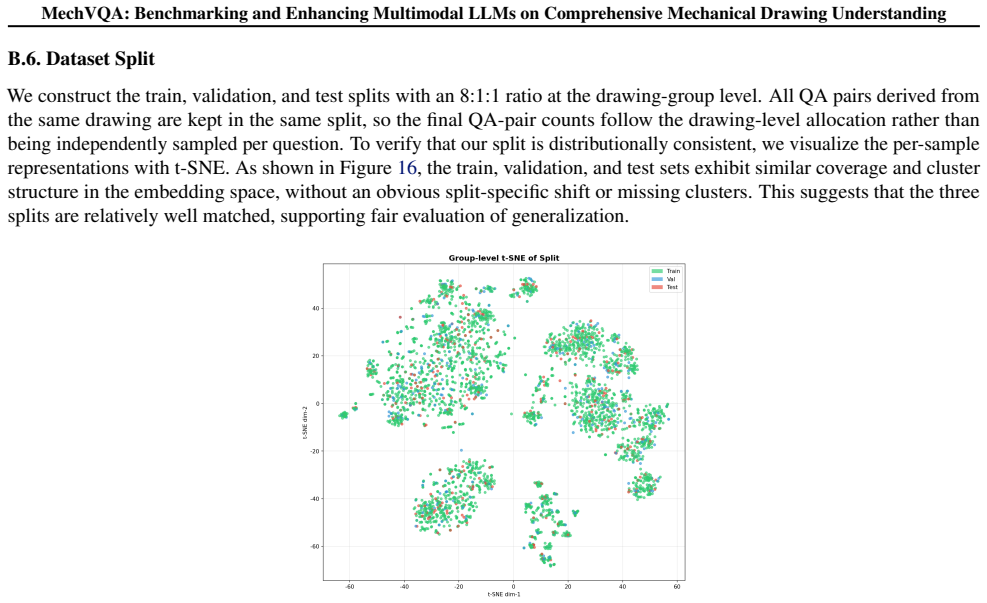
Summary. The paper introduces MechVQA, a mechanical-drawing VQA benchmark with 3,281 drawings and 20,778 QA pairs spanning 10 subtasks under Recognition, Reasoning, and Judging, built via a semi-automated pipeline with expert metadata checks, multi-model generation, cross-model validation, and majority voting. It then presents MechVL, a Qwen3-VL-4B-based baseline trained with full-parameter SFT followed by DAPO reinforcement learning using accuracy, format, and quality rewards. On the held-out test split, MechVL-4B-RL reports 84.85 total accuracy, exceeding the strongest open-source baseline (GLM-4.6V, 78.91) by 5.94 points and the strongest closed-source baseline (Gemini-3-Pro-Preview, 77.28) by 7.57 points, with larger gains on medium/hard items and on projection- and standards-sensitive subtasks. Ablations compare SFT vs. full/targeted RL, GRPO/GSPO/DAPO, and reward variants.
Significance. If the reported gains hold under expert-calibrated evaluation, this is a useful domain contribution: mechanical drawings are a high-value, under-served setting for MLLMs, and a unified Recognition/Reasoning/Judging taxonomy with real part/assembly sheets fills a clear gap relative to general VQA and narrower CAD/blueprint suites. Strengths include drawing-level 8:1:1 splits with CLIP-based near-duplicate control, multi-stage quality gates, explicit difficulty stratification, and systematic ablations of training stage, RL algorithm, and reward design (Tables 2–3; Figs. 2–4). The work is practically oriented toward design/inspection assistance and is careful about scope (public educational/professional drawings, not proprietary factory archives).
major comments (3)
- The central quantitative claim (abstract; Table 2: MechVL-4B-RL 84.85 vs. Gemini-3-Pro-Preview 77.28 / GLM-4.6V 78.91) rests on automatic multi-LLM semantic judging of free-form answers (Appendix C.4: GPT-OSS-120B, DeepSeek-V3.2, Kimi-k2 majority vote, without the image). Ground-truth answers are themselves largely produced by multi-model generation plus LLM majority voting (§3.3), and RL accuracy/quality rewards also use LLM-as-a-Judge (§4.2). Limitations explicitly note missing human-expert upper bounds and inter-annotator agreement. Without a calibrated human audit on a stratified test subset (especially GC, PM, AD, CJ), it is not established that the leaderboard measures drafting-grounded engineering correctness rather than preference for schema-compliant, professionally phrased, majority-model answers. This is load-bearing for the headline +7.57 claim.
- §5.1 and Appendix C.4 treat binary semantic match to model-voted ground truth as the primary metric, but do not report judge–judge agreement, human–judge agreement, or sensitivity of rankings to judge choice. Given that the same LLM-judge paradigm shapes both training rewards and final scores, a modest expert re-label or re-score study on the test set (or at least on Reasoning/Judging hard items) is needed to support the claim that domain post-training “significantly enhances mechanical drawing understanding” rather than optimizing for the automatic evaluator.
- Table 2 shows very large relative gains on sparse subtasks (e.g., AR 40→84, IL 61.15→82.01, PM 44→64) where sample counts are small (Fig. 2b: AR 1.9%, PM 3.6%, IC 1.5%, TT 1.3%). The paper should report per-subtask test sizes and uncertainty (bootstrap or binomial CIs) so that the capability-wise averages and “best on DA/IL/SU/AR/PM/AD” claims are not over-interpreted from few items.
Circularity Check
Empirical train/test benchmark paper with no derivation that equals its inputs by construction; only a mild shared LLM-judge loop between RL rewards and automatic scoring.
specific steps
-
other
[§4.2 Reward design; §5.1 Evaluation; Appendix C.4]
"Remarkably, instead of strict string matching, we also employ LLM-as-a-Judge for Accuracy Reward to assess semantic equivalence... Quality reward... Logic, Professionalism, and Conciseness... We employ multiple strong LLMs as automatic judges, including GPT-OSS-120B, DeepSeekV3.2, and Kimi-k2 for each test question."
Not a by-construction identity: train/test are split and baselines are external. Mild loop only—RL optimizes accuracy/quality under LLM judges, and the headline total is again majority-voted LLM semantic match to GT without the image. This can favor judge-preferred phrasing rather than force the numerical claim from the training labels alone; it is a soft evaluation circularity risk, not Eq.X≡Eq.Y.
full rationale
MechVQA/MechVL is an empirical systems paper, not a first-principles derivation. The load-bearing claim is a held-out test score (MechVL-4B-RL 84.85 vs Gemini-3-Pro-Preview 77.28 and GLM-4.6V 78.91 in Table 2), obtained after SFT+DAPO on a drawing-level train split with external general-purpose MLLM baselines under a fixed protocol. That is not a fitted parameter renamed as a prediction, nor a self-definitional identity, nor a uniqueness theorem imported from the same authors. Dataset construction uses multi-model generation and majority voting for QA pairs, and both RL accuracy/quality terms and final evaluation use LLM-as-a-Judge semantic scoring; that is a methodological validity risk (judge style may correlate with training rewards), but it does not make the reported total score equal to the training inputs by construction—the model is still scored against held-out ground-truth answers and compared to independent baselines. No self-citation uniqueness chain or ansatz-smuggling step is load-bearing. Score 1 only for the mild shared automatic-judge pathway; central empirical comparison remains independent of a circular reduction.
Axiom & Free-Parameter Ledger
free parameters (3)
- reward weights λ_acc / λ_qual / λ_fmt =
0.60 / 0.30 / 0.10
- DAPO clip ranges and group size =
clip [0.20, 0.28], G=10
- LLM-judge majority aggregation =
3 judges, majority of rounded scores
axioms (4)
- domain assumption Semantic majority vote among strong MLLMs yields unique, drawing-faithful ground-truth answers for retained QA pairs.
- domain assumption LLM-as-a-Judge binary/semantic scores are adequate substitutes for expert mechanical engineers when ranking models.
- domain assumption Public textbook/handbook/design-platform drawings under orthodox drafting conventions are a valid testbed for real-world mechanical drawing understanding.
- standard math Standard causal LM SFT and DAPO group-relative policy optimization improve instruction following and long-form reasoning under the stated rewards.
read the original abstract
Multimodal Large Language Models (MLLMs) have demonstrated significant achievements in general visual question answering (VQA) tasks. However, they remain brittle on mechanical engineering drawings, where high annotation density and weak domain knowledge, compounded by unreliable spatial relation reasoning under strict projection rules and geometric constraints, make decisive cues easy to miss and frequently lead to wrong answers. To bridge this gap, we introduce the first comprehensive mechanical drawing understanding dataset, MechVQA, created through a semi-automated construction and quality-control pipeline. MechVQA contains 3.3k high-density pictures with 21K question-answer pairs, spanning 10 different fine-grained tasks across three capability levels: Recognition, Reasoning, and Judging, providing a testbed to evaluate and improve MLLM understanding on real-world mechanical drawings. On top of MechVQA, we then develop the MechVL model through a multi-stage training paradigm, building a strong domain-specialized baseline. Extensive experimental results demonstrate that MechVL outperforms the strongest closed-source baseline by 7.57 percentage points on the MechVQA total score, significantly enhancing mechanical drawing understanding ability and providing a reusable foundation for deploying MLLMs in mechanical design and inspection scenarios.
Figures




Reference graph
Works this paper leans on
-
[1]
PMLR, 2019. Hu, E. J., Shen, Y ., Wallis, P., Allen-Zhu, Z., Li, Y ., Wang, S., Wang, L., Chen, W., et al. Lora: Low-rank adaptation of large language models.ICLR, 1(2):3, 2022. Khan, M. T., Chen, L., Yong, Z., Tan, J. M., Feng, W., and Moon, S. K. From drawings to decisions: A hybrid vision- language framework for parsing 2d engineering drawings into str...
arXiv 2019
-
[2]
The tip head is carburized and quenched, hardness 40–45 HRC
-
[3]
Unspecified chamfer: C1
-
[4]
Unspecified dimension tolerance according to GB/T1804–2000–m
2000
-
[5]
top-left drawing
Unspecified geometric tolerance according to GB/T1184–1996–K. Figure 6.Example of metadata extracted from a mechanical drawing B.2. Effect of Expert Verification To quantify the role of expert verification, we compare model-extracted metadata before human checking with the final expert-corrected metadata on the audited typical and newstandard groups. We e...
1996
-
[6]
Do not hallucinate or infer features that are not present
Generate questionsonly based on what is explicitly shown in the drawing. Do not hallucinate or infer features that are not present
-
[7]
Focus exclusively on the graphical content of the drawing
Ignore all surrounding textual descriptions(e.g., title blocks, notes, tables). Focus exclusively on the graphical content of the drawing
-
[8]
4.Prioritize question quality over quantity
If the drawing containsmultiple sub-figures, you must clearly specify which sub-figure each question refers to. 4.Prioritize question quality over quantity. Do not generate vague, trivial, or unanswerable questions. Given Drawing Metadata (Provided as Annotations): •Combination Type:Single drawing or Multiple sub-figures •Drawing Type:{drawing type}(provi...
-
[9]
Inspect the drawing and identify up tofive distinct locations or featuresthat are explicitly annotated with dimensions
-
[10]
right end of the shaft
For each identified location, determine: • Thedimension value(e.g.,Φ30,50,R5,15 ◦). • Theannotated location or feature(e.g., “right end of the shaft”, “bottom hole”, “top fillet”). • Theviewin which the dimension appears (e.g., front view, top view, side view, section A–A, detail view B)
-
[11]
Prefer diversity in bothlocationsanddimension types(e.g., diameter, length, radius, chamfer, angle)
-
[12]
dimensions
If fewer than five dimension annotations are present, report as many as can be reliably identified. Output Format:Return the result strictly in the following JSON format, without any additional explanation or commentary: { "dimensions": [ { "dimension_value": "e.g., Phi30", "location": "annotated feature or position", "view": "corresponding view name" } ]...
-
[13]
Do not hallucinate missing symbols or values
Generate questionsonly based on annotations that explicitly appear in the drawing. Do not hallucinate missing symbols or values
-
[14]
Focus exclusively on graphical annotations within the drawing views
Ignore all surrounding textual descriptions(e.g., title blocks, technical notes, tables). Focus exclusively on graphical annotations within the drawing views. 3.Prioritize correctness and clarity. Do not generate vague, redundant, or unanswerable questions. Given Drawing Metadata (Provided as Annotations): •Combination Type:Single drawing or Multiple sub-...
-
[15]
Inspect the drawing and identify existing annotations from the categories above
-
[16]
For each identified annotation, generate one clear and professional question
-
[17]
Each question must explicitly include: • Theannotation type(datum symbol, datum feature, GD&T, limit dimension, roughness, etc.); Theannotation content(specific symbol, value, or notation).Thelocation(which view and which feature of the part)
-
[18]
annotations
If a specific annotation type doesnotappear in the drawing, do not generate a question for that type. Output Format:Return the result strictly in the following JSON format, without any additional explanation or commentary: { "annotations": [ { "type": "annotation type (symbol/feature/roughness/other)", "content": "specific symbol or value", "location": "c...
-
[19]
Do not infer nonexistent views, annotations, or parts
Generate questionsonly based on elements that explicitly appear in the drawing. Do not infer nonexistent views, annotations, or parts
-
[20]
Focus exclusively on graphical views, symbols, and part depictions
Ignore surrounding textual descriptions(e.g., title blocks, notes). Focus exclusively on graphical views, symbols, and part depictions
-
[21]
If the drawing containsmultiple sub-figures, clearly specify which sub-figure each question refers to
-
[22]
Avoid vague or ambiguous spatial descriptions
Prioritizeclarity, correctness, and answerability. Avoid vague or ambiguous spatial descriptions. Given Drawing Metadata (Provided): •Combination Type:Single drawing or Multiple sub-figures •Drawing Type:{drawing type}(provided metadata, used as reference) •View Composition:{view info}(provided metadata, used as reference) Objective:Identify different vie...
-
[23]
Inspect the drawing and identify spatial or positional information from the categories above
-
[24]
Generatefiveprofessional questions covering different location categories when possible
-
[25]
Each question must explicitly include: • thelocation type(view / annotation / part / cross-view), • thetarget object(specific view, symbol, part, or feature) and a clearlocation description
-
[26]
locations
If a certain category is not present in the drawing, generate questions from other applicable categories. Output Format: { "locations": [ { "type": "location type (view / annotation / part / cross-view)", "object": "target object", "location_desc": "spatial description", "question": "generated professional question" } ] } Figure 12.Question generation pro...
-
[27]
Generate questionsonly for dimensions that are not directly labeledin the drawing
-
[28]
3.Do not generate questionsthat require complex geometric reasoning (e.g., trigonometry, Pythagorean theorem)
The target dimension must be computable usinglinear operations only(addition or subtraction) from explicitly annotated dimensions. 3.Do not generate questionsthat require complex geometric reasoning (e.g., trigonometry, Pythagorean theorem)
-
[29]
Ignore surrounding textual descriptions and focus only on graphical content and dimension annotations
Clearly specify thestart and end locationsof the dimension to be calculated. Ignore surrounding textual descriptions and focus only on graphical content and dimension annotations. Given Drawing Metadata (Provided): •Combination Type:Single drawing or Multiple sub-figures •Drawing Type:{drawing type}(provided metadata, used as reference) •View Composition:...
-
[30]
Identify up tofive locations/featuresthat satisfy all of the following: • the dimension isnot explicitly annotated; • the value can be obtained throughlinear calculation(addition or subtraction); • the required referenced dimensions are clearly annotated in the drawing
-
[31]
For each identified location, generate a professional question that includes: • thecalculation target(explicit start and end points); • theviewin which the calculation is performed (e.g., front view, top view, section view);thecalculation basis(which annotated dimensions are used)
-
[32]
In the front view, what is the distance from the left end face to the center of the middle hole?
If fewer than five valid locations exist, generate questions for as many as are reasonably supported. Question Examples: • “In the front view, what is the distance from the left end face to the center of the middle hole?” • “In the top view, what is the spacing between the two bosses?” Output Format: { "calculations": [ { "location": "description of the s...
discussion (0)
Sign in with ORCID, Apple, or X to comment. Anyone can read and Pith papers without signing in.