REVIEW 3 major objections 2 minor 9 references
Function2Scene generates 3D indoor layouts from natural-language descriptions of occupants and their activities rather than from lists of objects.
Reviewed by Pith at T0; open to challenge. T0 means a machine referee read the full paper against a public rubric. the ladder, T0–T4 →
T0 review · grok-4.3
2026-06-28 23:08 UTC pith:6N5L7UMF
load-bearing objection Function2Scene reframes scene synthesis around functional briefs and a 17-criteria taxonomy plus iterative geometric-LLM-VLM repair, but the 94.3% preference on 30 cases rests on thin experimental reporting. the 3 major comments →
Function2Scene: 3D Indoor Scene Layout from Functional Specifications
The pith
A machine-rendered reading of the paper's core claim, the machinery that carries it, and where it could break.
Core claim
Given a natural-language design brief, Function2Scene parses occupant personas and activities, derives a customized set of functional design constraints from a taxonomy of 17 criteria spanning spatial, ergonomic, activity, and environmental considerations, and uses these constraints to guide layout generation through iterative evaluation and refinement that combines geometric measurements, LLM-based contextual reasoning, and VLM-based visual assessment.
What carries the argument
Tool-augmented iterative check-and-repair loop driven by constraints derived from the 17-criteria functional taxonomy.
Load-bearing premise
Natural-language design briefs can be reliably parsed into a fixed taxonomy of 17 criteria that then guide effective layout generation through the iterative check-and-repair process.
What would settle it
A test set of new design briefs where the generated layouts are not preferred over LLM baselines in human pairwise comparisons, or where the parsing step misses key functional requirements.
If this is right
- Layouts better satisfy the functional requirements of the input briefs compared with object-centric prompts.
- Human raters prefer the outputs over recent LLM-based scene synthesis baselines in 94.3 percent of pairwise comparisons.
- Scene synthesis is reframed from placing plausible objects to designing spaces that support human use.
- The method applies directly to professionally written interior-design cases.
Where Pith is reading between the lines
- The fixed 17-criteria taxonomy could be extended or replaced by learned criteria to handle requirements outside the current set.
- Adding physics-based simulation inside the repair loop could validate dynamic movement and reachability beyond static geometric checks.
- The same parsing-plus-refinement structure could be applied to outdoor or multi-room functional briefs.
Editorial analysis
A structured set of objections, weighed in public.
Referee Report
Summary. The paper introduces Function2Scene, a framework that generates 3D indoor scene layouts from natural-language functional specifications (design briefs describing occupants and their activities). It parses personas and activities, derives constraints from a fixed taxonomy of 17 criteria (spatial, ergonomic, activity, environmental), and performs iterative check-and-repair using geometric measurements, LLM contextual reasoning, and VLM visual assessment. On 30 professionally written cases, layouts are preferred over recent LLM-based baselines in 94.3% of pairwise comparisons, reframing scene synthesis around functional support rather than object placement.
Significance. If the experimental result holds under rigorous controls, the work offers a substantive shift in text-driven 3D scene synthesis by prioritizing human-use constraints over plausibility. The taxonomy-driven constraint derivation and tool-augmented refinement loop are concrete technical contributions that could influence downstream applications in design software and embodied AI; the absence of free parameters or ad-hoc axioms in the core pipeline is a strength.
major comments (3)
- [Experiments] Experiments section: the 94.3% preference rate on 30 cases is the central empirical claim, yet the manuscript provides no details on baseline implementations, exact participant instructions, randomization of presentation order, or statistical significance testing; without these, the result cannot be assessed for robustness or selection effects.
- [Method] Method, refinement loop description: the iterative check-and-repair process combines LLM-based reasoning and VLM-based assessment in both generation and judgment steps; this raises a concrete risk of self-referential evaluation that is not addressed by any ablation or external validation, directly affecting the reliability of the functional-satisfaction claims.
- [Method] Method, taxonomy derivation: the claim that a fixed 17-criteria taxonomy can be reliably parsed from arbitrary natural-language briefs and then used to guide effective layout generation lacks supporting evidence (e.g., inter-annotator agreement or failure-case analysis) and is load-bearing for the entire pipeline.
minor comments (2)
- [Abstract] Abstract and introduction: the baselines are referred to only as 'recent LLM-based scene synthesis baselines' without naming the specific methods or citations; this should be explicit for reproducibility.
- Notation: the distinction between 'functional specifications' and the derived 'constraints' is used interchangeably in places; consistent terminology would improve clarity.
Simulated Author's Rebuttal
We thank the referee for the thoughtful and constructive report. We address each major comment below, indicating where revisions to the manuscript are planned.
read point-by-point responses
-
Referee: [Experiments] Experiments section: the 94.3% preference rate on 30 cases is the central empirical claim, yet the manuscript provides no details on baseline implementations, exact participant instructions, randomization of presentation order, or statistical significance testing; without these, the result cannot be assessed for robustness or selection effects.
Authors: We agree that these details are required to allow proper assessment of the result. The revised manuscript will expand the Experiments section with: complete specifications and implementation details for all baselines; the exact participant instructions and study protocol; confirmation that presentation order was randomized; the number of participants; and statistical significance testing (including p-values from a binomial or sign test on the preference data). revision: yes
-
Referee: [Method] Method, refinement loop description: the iterative check-and-repair process combines LLM-based reasoning and VLM-based assessment in both generation and judgment steps; this raises a concrete risk of self-referential evaluation that is not addressed by any ablation or external validation, directly affecting the reliability of the functional-satisfaction claims.
Authors: We acknowledge the risk of circularity. Geometric measurements provide an objective, non-LLM/VLM component. In the revision we will add an ablation that isolates each module (geometric only, geometric+LLM, full loop) and, on a subset of cases, report agreement with independent human judgments of functional satisfaction. We will also clarify the separation between generation and judgment prompts. revision: yes
-
Referee: [Method] Method, taxonomy derivation: the claim that a fixed 17-criteria taxonomy can be reliably parsed from arbitrary natural-language briefs and then used to guide effective layout generation lacks supporting evidence (e.g., inter-annotator agreement or failure-case analysis) and is load-bearing for the entire pipeline.
Authors: The taxonomy is drawn from established interior-design literature. The current manuscript does not contain an inter-annotator agreement study. The revision will include the complete taxonomy with definitions and few-shot examples, plus a failure-case analysis of parsing outcomes on the 30 evaluation briefs. This will provide concrete evidence of parsing behavior even if a full IAA study is not added. revision: partial
Circularity Check
No significant circularity detected
full rationale
The provided abstract and method description outline a parsing step to a fixed 17-criteria taxonomy followed by iterative geometric/LLM/VLM refinement, with the central result being a human preference study on 30 external cases (94.3% preference). No equations, fitted parameters renamed as predictions, or self-citation load-bearing steps appear in the text. The evaluation relies on external pairwise comparisons rather than internal self-referential metrics, rendering the derivation chain self-contained against the stated inputs.
Axiom & Free-Parameter Ledger
read the original abstract
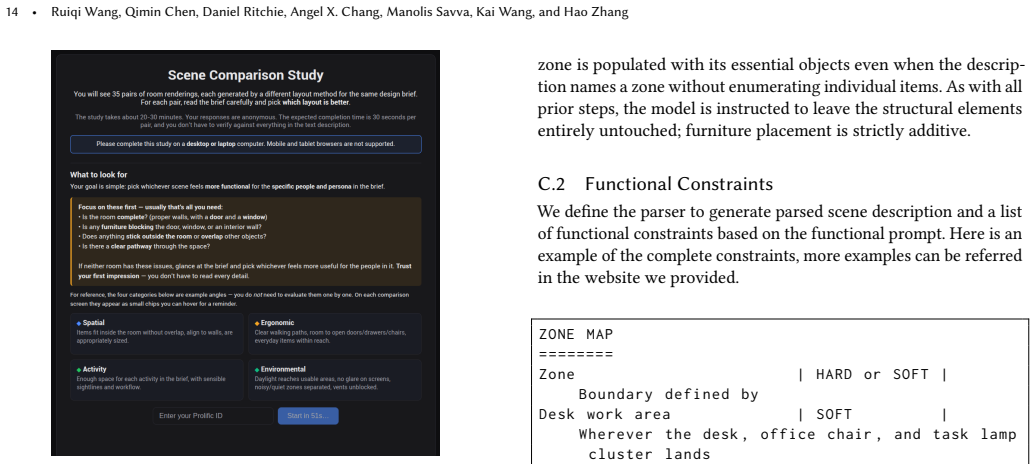
Most text-driven 3D indoor scene synthesis methods generate rooms from object-centric prompts, asking what furniture should be placed rather than how the space is used. Yet in real interior design, a layout is judged by how well it supports its occupants, e.g., their activities and physical needs. We introduce Function2Scene, a framework for generating 3D indoor layouts from functional specifications, i.e., natural-language design briefs describing who will use a room and what they need to do there. Given such a specification, our system parses occupant personas and activities, derives a customized set of functional design constraints from a taxonomy of 17 criteria spanning spatial, ergonomic, activity, and environmental considerations, and uses these constraints to guide layout generation. Rather than relying on an LLM to directly produce a final scene, Function2Scene performs iterative evaluation and refinement through a tool-augmented check-and-repair loop, combining geometric measurements, LLM-based contextual reasoning, and VLM-based visual assessment. Experiments on 30 professionally written interior-design cases show that Function2Scene produces layouts that better satisfy functional requirements than recent LLM-based scene synthesis baselines, with our results preferred in 94.3% of pairwise comparisons. Our work reframes text-driven indoor scene synthesis from placing plausible objects to designing spaces that support human use.
Figures


Reference graph
Works this paper leans on
-
[1]
Matthew Fisher, Manolis Savva, Yangyan Li, Pat Hanrahan, and Matthias Nießner
Example-based synthesis of 3D object arrangements.ACM Transactions on Graphics (TOG)31, 6 (2012), 1–11. Matthew Fisher, Manolis Savva, Yangyan Li, Pat Hanrahan, and Matthias Nießner
2012
-
[2]
Qiang Fu, Xiaowu Chen, Xiaotian Wang, Sijia Wen, Bin Zhou, and Hongbo Fu
Activity-centric scene synthesis for functional 3D scene modeling.ACM Transactions on Graphics (TOG)34, 6 (2015), 1–13. Qiang Fu, Xiaowu Chen, Xiaotian Wang, Sijia Wen, Bin Zhou, and Hongbo Fu. 2017. Adaptive synthesis of indoor scenes via activity-associated object relation graphs. ACM Transactions on Graphics (TOG)36, 6 (2017), 1–13. Jialin Gao, Donghao...
-
[3]
HOG-Layout: Hierarchical 3D Scene Generation, Optimization and Editing via Vision-Language Models
HOG-Layout: Hierarchical 3D Scene Generation, Optimization and Editing via Vision-Language Models.arXiv preprint arXiv:2604.10772(2026). Z Sadeghipour Kermani, Zicheng Liao, Ping Tan, and Hao Zhang. 2016. Learning 3D scene synthesis from annotated RGB-D images. InComputer Graphics Forum, Vol. 35. Wiley Online Library, 197–206. Rosemary Kilmer and W Otie K...
work page internal anchor Pith review Pith/arXiv arXiv 2026
-
[4]
Manolis Savva, Angel X Chang, Pat Hanrahan, Matthew Fisher, and Matthias Nießner
SceneGrok: Inferring action maps in 3D environments.ACM transactions on graphics (TOG)33, 6 (2014), 1–10. Manolis Savva, Angel X Chang, Pat Hanrahan, Matthew Fisher, and Matthias Nießner
2014
-
[5]
3d-generalist: Self-improving vision-language- action models for crafting 3d worlds,
Pigraphs: learning interaction snapshots from observations.ACM Transactions On Graphics (TOG)35, 4 (2016), 1–12. Fan-Yun Sun, Weiyu Liu, Siyi Gu, Dylan Lim, Goutam Bhat, Federico Tombari, Manling Li, Nick Haber, and Jiajun Wu. 2025a. Layoutvlm: Differentiable optimization of 3d layout via vision-language models. InProceedings of the Computer Vision and Pa...
-
[6]
InProceedings of the IEEE/CVF Winter Conference on Applications of Computer Vision
SceneEval: Evaluating semantic coherence in text-conditioned 3D indoor scene synthesis. InProceedings of the IEEE/CVF Winter Conference on Applications of Computer Vision. 7355–7365. Jiapeng Tang, Yinyu Nie, Lev Markhasin, Angela Dai, Justus Thies, and Matthias Nießner
-
[7]
InProceedings of the IEEE/CVF conference on computer vision and pattern recognition
Diffuscene: Denoising diffusion models for generative indoor scene synthesis. InProceedings of the IEEE/CVF conference on computer vision and pattern recognition. 20507–20518. Kai Wang, Yu-An Lin, Ben Weissmann, Manolis Savva, Angel X Chang, and Daniel Ritchie. 2019. Planit: Planning and instantiating indoor scenes with relation graph and spatial prior ne...
-
[8]
Lap-Fai Yu, Sai Kit Yeung, Chi-Keung Tang, Demetri Terzopoulos, Tony F Chan, and Stanley J Osher
Synthesizing open worlds with constraints using locally annealed reversible jump mcmc.ACM Transactions on Graphics (TOG)31, 4 (2012), 1–11. Lap-Fai Yu, Sai Kit Yeung, Chi-Keung Tang, Demetri Terzopoulos, Tony F Chan, and Stanley J Osher. 2011. Make it home: Automatic optimization of furniture arrange- ment.ACM Trans. Graph.30, 4 (2011), 86. Guangyao Zhai,...
2012
-
[9]
SceneReVis: A Self-Reflective Vision-Grounded Framework for 3D Indoor Scene Synthesis via Multi-turn RL.arXiv preprint arXiv:2602.09432(2026). Mengqi Zhou, Xipeng Wang, Yuxi Wang, and Zhaoxiang Zhang. 2025. RoomCraft: Con- trollable and Complete 3D Indoor Scene Generation.arXiv preprint arXiv:2506.22291 (2025). Yang Zhou, Zachary While, and Evangelos Kalo...
discussion (0)
Sign in with ORCID, Apple, or X to comment. Anyone can read and Pith papers without signing in.