Generating Reports or Repeating Templates? Measuring and Mitigating Template Collapse in 3D CT Report Generation
Pith reviewed 2026-06-28 22:52 UTC · model grok-4.3
The pith
Decoupling clinical detection from language synthesis prevents template collapse in 3D CT report generation.
A machine-rendered reading of the paper's core claim, the machinery that carries it, and where it could break.
Core claim
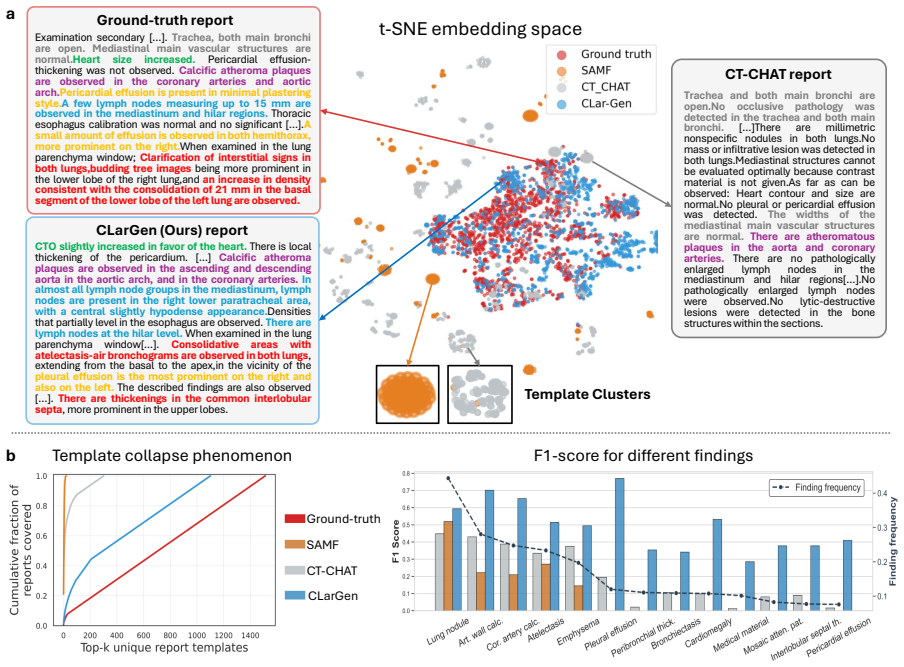
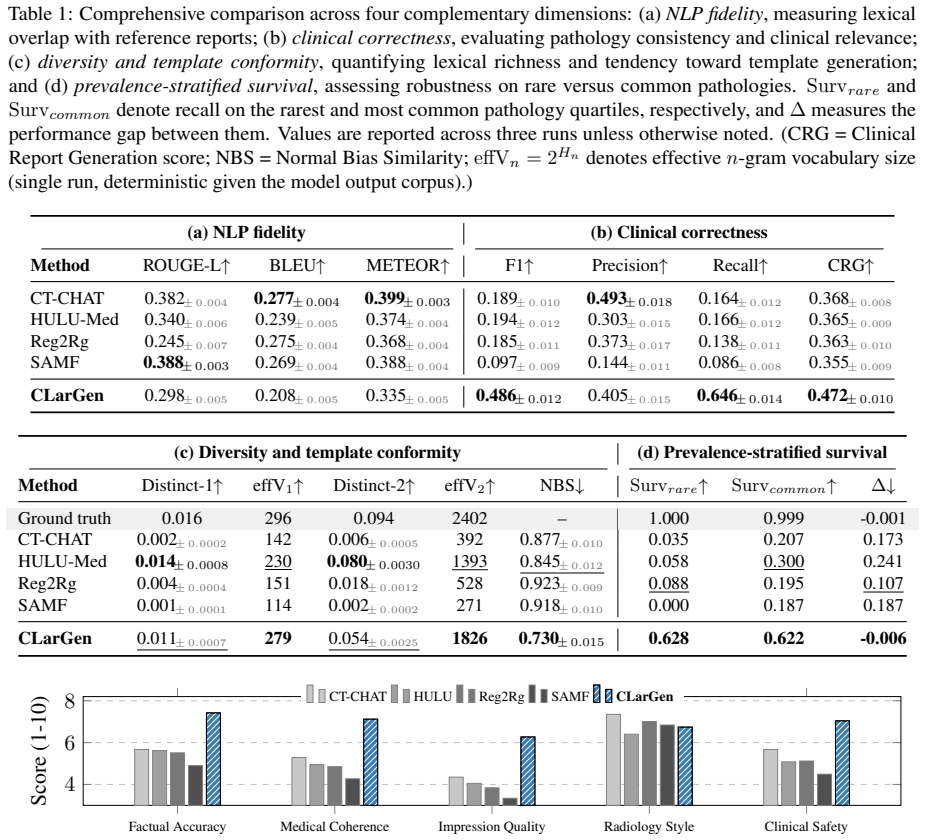
Template Collapse is diagnosed as the tendency of 3D medical VLMs to generate fluent reports that fail to detect and report pathologies, particularly rare ones, stemming from limited data, severe label imbalance, and weak volumetric signals. The proposed CLarGen framework mitigates this through a Latent Query Transformer for multi-label detection, pathology-guided retrieval of exemplars, and a medical language model for synthesis, resulting in macro-F1 of 0.487 versus 0.189 and CRG of 0.472 versus 0.368 across baselines while maintaining fluency.
What carries the argument
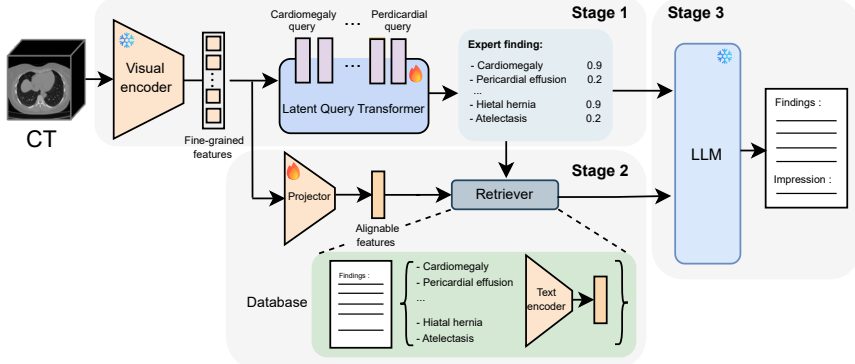
CLarGen, the decoupled framework separating clinical detection (Latent Query Transformer and retrieval) from language synthesis (medical language model).
If this is right
- CLarGen improves clinical accuracy metrics substantially over state-of-the-art baselines.
- Output diversity increases as models avoid collapsing to normal templates.
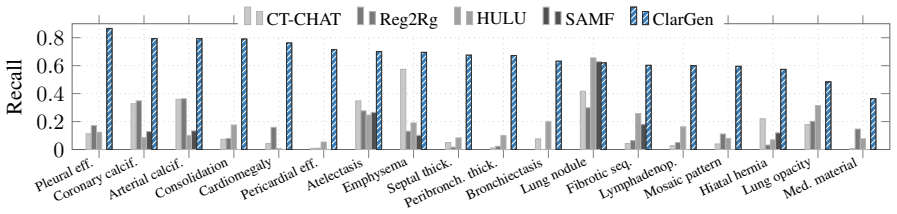
- Rare findings are reported more reliably through explicit detection.
- Fluent reporting is preserved alongside the gains in grounding.
Where Pith is reading between the lines
- If the detection component can be improved independently, report quality may increase further on diverse datasets.
- This decoupling may extend to other modalities like MRI where similar data constraints exist.
- Future models could incorporate real-time feedback from clinical validation to refine the detection stage.
Load-bearing premise
The root causes of Template Collapse can be overcome by explicitly separating clinical detection from language synthesis.
What would settle it
Observing no improvement in macro-F1 or rare-finding survival when CLarGen is tested on an independent 3D CT dataset with comparable constraints would falsify the mitigation effect.
Figures
read the original abstract
Modern 3D medical vision-language models (VLMs) can generate fluent radiology-style text while exhibit critically low pathology detection and output diversity, collapsing to generic templates that under-report rare yet critical findings. We identify this failure mode as Template Collapse. This failure stems from the unique constraints of 3D medical imaging, e.g., limited data, severe label imbalance, and weak signals from volumetric encoders. Under these constraints, text-generation objectives encourage shortcut learning and fluent but weakly grounded reports. We systematically diagnose the Template Collapse through clinical fidelity, output diversity, normal-template bias, and rare-finding survival. To mitigate it, we propose CLarGen, a decoupled framework that separates what to say (clinical detection) from how to say it (language synthesis). CLarGen uses (i) a Latent Query Transformer for multi-label pathology detection, (ii) pathology-guided retrieval for clinically matched exemplars, and (iii) a medical language model to synthesize the final report from detected findings and retrieved context. Across state-of-the-art 3D CT report generation baselines, CLarGen mitigates Template Collapse and substantially improves clinical accuracy (macro-F1 0.487 vs. 0.189; CRG 0.472 vs. 0.368) while maintaining fluent reporting. Our results suggest that explicit, measurable clinical grounding is essential for template-collapse-resistant 3D CT report generation. Code will be released upon acceptance.
Editorial analysis
A structured set of objections, weighed in public.
Referee Report
Summary. The manuscript diagnoses Template Collapse in 3D CT report generation models, where fluent outputs mask critically low pathology detection and diversity due to limited data, label imbalance, and weak volumetric signals. It proposes CLarGen, a decoupled framework that separates clinical detection (via Latent Query Transformer for multi-label pathology detection) from language synthesis (via pathology-guided retrieval of exemplars and a medical LM to generate reports from detected findings and context). Experiments across SOTA baselines report substantial gains in clinical accuracy (macro-F1 0.487 vs. 0.189; CRG 0.472 vs. 0.368) while preserving fluency, with the conclusion that explicit clinical grounding is essential.
Significance. If the empirical results hold under rigorous verification, the work offers a concrete, measurable diagnosis of a pervasive failure mode in medical VLMs and a practical mitigation via explicit decoupling. The quantitative improvements on clinical fidelity and rare-finding survival metrics, combined with the planned code release, provide a reproducible baseline for future 3D CT report generation research and could meaningfully advance reliable AI support in radiology.
major comments (2)
- [§4] §4 (Experiments): The abstract and summary results report macro-F1 and CRG gains without reference to data splits, number of runs, statistical significance testing, or ablation on the three CLarGen components; this information is load-bearing for the central claim that the decoupled framework mitigates Template Collapse rather than reflecting post-hoc tuning or dataset-specific effects.
- [§3.2] §3.2 (Latent Query Transformer): The multi-label detection module is presented as addressing weak volumetric signals, but the manuscript does not quantify how its query mechanism differs from standard transformer encoders in prior 3D VLMs or provide an ablation isolating its contribution to the reported F1 lift.
minor comments (3)
- [Abstract] Abstract: The phrase 'substantially improves clinical accuracy' should be accompanied by the exact baseline names and a brief note on the evaluation protocol to allow readers to assess the comparison immediately.
- [§2] §2 (Related Work): The discussion of 2D report generation methods is brief; adding one or two sentences contrasting 2D vs. 3D constraints would clarify why Template Collapse is presented as a distinct 3D phenomenon.
- [Figure 3] Figure 3 (qualitative examples): The caption should explicitly label which findings are rare vs. common to support the 'rare-finding survival' claim in the diagnosis section.
Simulated Author's Rebuttal
We thank the referee for the constructive feedback on experimental reporting and module analysis. We address the major comments point by point below.
read point-by-point responses
-
Referee: [§4] §4 (Experiments): The abstract and summary results report macro-F1 and CRG gains without reference to data splits, number of runs, statistical significance testing, or ablation on the three CLarGen components; this information is load-bearing for the central claim that the decoupled framework mitigates Template Collapse rather than reflecting post-hoc tuning or dataset-specific effects.
Authors: We agree these details are necessary to substantiate the central claim. The manuscript's §4 uses a patient-level split on the 3D CT dataset and reports aggregate metrics across baselines, but does not explicitly detail the split ratios, run count, or significance tests in the main text. We will revise §4 to state the exact split (70/15/15), report means and standard deviations over 5 runs, add paired statistical tests confirming the macro-F1 and CRG lifts are significant, and include a full ablation table isolating the contribution of each CLarGen component (detection, retrieval, synthesis). This will demonstrate the gains arise from decoupling rather than tuning. revision: yes
-
Referee: [§3.2] §3.2 (Latent Query Transformer): The multi-label detection module is presented as addressing weak volumetric signals, but the manuscript does not quantify how its query mechanism differs from standard transformer encoders in prior 3D VLMs or provide an ablation isolating its contribution to the reported F1 lift.
Authors: The Latent Query Transformer differs by maintaining a set of learnable pathology-specific queries that perform cross-attention directly on volumetric patch tokens, producing independent multi-label logits without global pooling or single-vector aggregation used in standard 3D transformer encoders of prior VLMs. This design targets sparse, weak signals by allowing each query to attend selectively. While §3.2 describes the architecture, we acknowledge the absence of a side-by-side quantification and ablation; we will add both a comparative table against prior encoders and an ablation removing the query mechanism (showing the resulting F1 drop) to the revised manuscript. revision: yes
Circularity Check
No significant circularity
full rationale
The paper is an empirical methods contribution that diagnoses template collapse via clinical metrics and proposes the CLarGen decoupled framework (latent query transformer + retrieval + medical LM). No equations, derivations, or predictions are presented that reduce to fitted inputs or self-definitions by construction. Claims rest on direct baseline comparisons (macro-F1, CRG) rather than any self-referential loop or imported uniqueness theorem. The work is therefore self-contained against external benchmarks.
Axiom & Free-Parameter Ledger
Reference graph
Works this paper leans on
-
[1]
Qwen3-vl technical report.arXiv preprint arXiv:2511.21631. Shruthi Bannur, Kenza Bouzid, Daniel C Castro, Anton Schwaighofer, Anja Thieme, Sam Bond-Taylor, Max- imilian Ilse, Fernando Pérez-García, Valentina Sal- vatelli, Harshita Sharma, and 1 others. 2024. Maira- 2: Grounded radiology report generation.arXiv preprint arXiv:2406.04449. Louis Blankemeier,...
work page internal anchor Pith review Pith/arXiv arXiv 2024
-
[2]
InMedical Image Com- puting and Computer Assisted Intervention (MICCAI) 2024, LNCS 15012, pages 476–486
Ct2rep: Automated radiology report genera- tion for 3d medical imaging. InMedical Image Com- puting and Computer Assisted Intervention (MICCAI) 2024, LNCS 15012, pages 476–486. Springer. Ibrahim Ethem Hamamci, Sezgin Er, Suprosanna Shit, Hadrien Reynaud, Bernhard Kainz, and Bjoern Menze. 2025. Crg score: A distribution-aware clini- cal metric for radiolog...
2024
-
[3]
arXiv preprint arXiv:2510.08668 (2025)
From slices to volumes: Multi-scale fusion of 2d and 3d features for ct scan report generation. InInternational Conference on Medical Image Com- puting and Computer-Assisted Intervention, pages 268–277. Springer. Eui Jin Hwang, Jin Mo Goo, and Chang Min Park. 2025. Ai applications for thoracic imaging: considerations for best practice.Radiology, 314(2):e2...
-
[4]
Medregion-ct: region-focused multimodal llm for comprehensive 3d ct report generation.arXiv preprint arXiv:2506.23102. Jiwei Li, Michel Galley, Chris Brockett, Jianfeng Gao, and William B Dolan. 2016. A diversity-promoting objective function for neural conversation models. InProceedings of the 2016 conference of the North American chapter of the associati...
work page internal anchor Pith review arXiv 2016
-
[5]
Expert Findings: A definitive list of pathologies found to be 'present'or'absent'in the scan
-
[6]
Operational rules: - Output only two sections: Findings : and Impressions : - Do not contradict the expert labels or invent findings
Reference Reports: A set of reports from similar clinical cases. Operational rules: - Output only two sections: Findings : and Impressions : - Do not contradict the expert labels or invent findings. - Use the reference reports to guide vocabulary and phrasing. - Maintain concise and objective radiology style. - Avoid verbose or assistant-like language. Th...
-
[7]
Strict Output Format: Your response must only contain the Findings : and Impressions : sections
Stylistic fidelity. Strict Output Format: Your response must only contain the Findings : and Impressions : sections. User Prompt Template Here is the information for a new CT scan. Please write the radiology report. Expert Findings for the Scan: {expert_labels} Reference Reports from Similar Cases: {top_k_reports} Your Generated Report: Appendix Fig. A.1:...
2025
discussion (0)
Sign in with ORCID, Apple, or X to comment. Anyone can read and Pith papers without signing in.