An Automated Photometric Pipeline for the 80cm Xizang University Telescope
Pith reviewed 2026-06-28 21:11 UTC · model grok-4.3
The pith
Researchers built and integrated an automated Python pipeline that processes photometric data from the 80cm Xizang University telescope and extracts light curves at accuracy levels matching programs used by similar telescopes.
A machine-rendered reading of the paper's core claim, the machinery that carries it, and where it could break.
Core claim
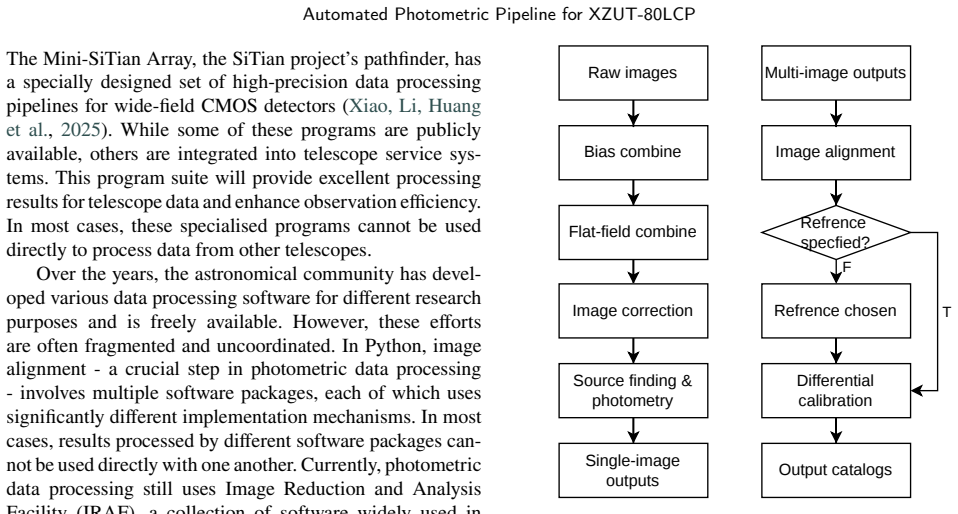
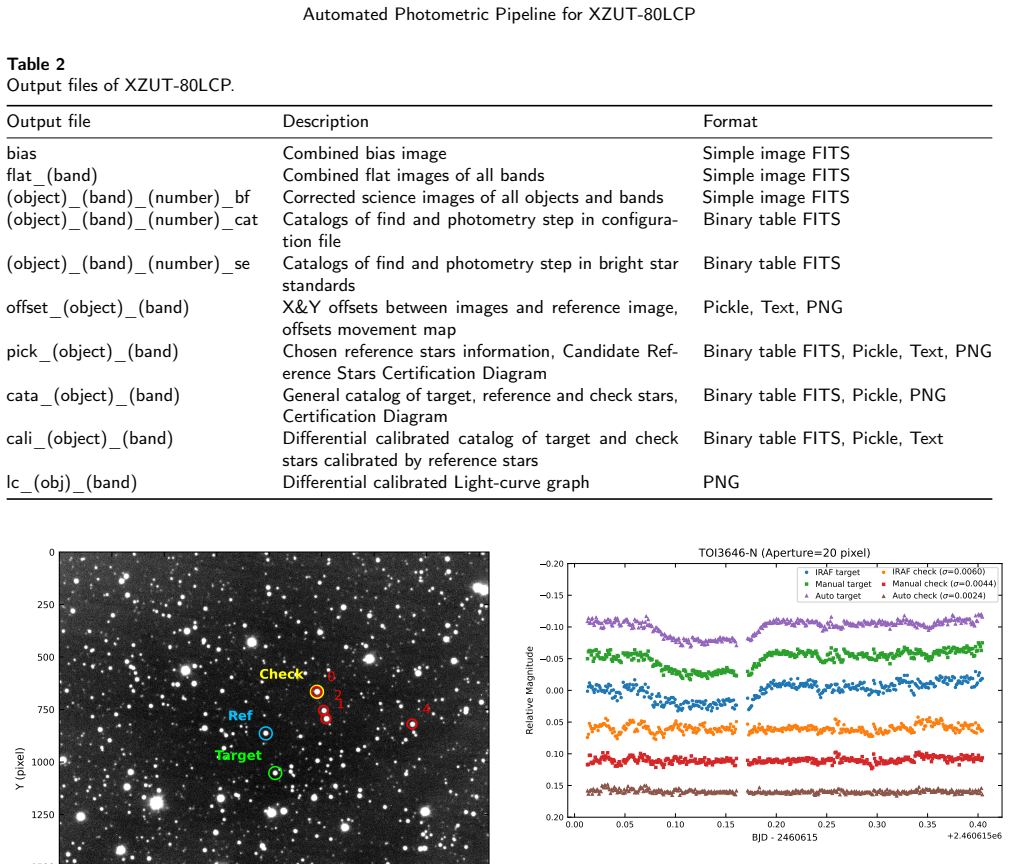
We have developed an automatic pipeline for processing photometric data and extracting light curves using Python 3. This pipeline has several advantages, including high speed, ease of use, and modularity. The differential photometric accuracy of this pipeline is comparable to that of data processing programs used by other similar telescopes. This development effectively overcomes the limitations of manually processing data, providing efficient and reliable support for future studies of variable stars. The pipeline has already been integrated into the telescope's operational system.
What carries the argument
The automated photometric pipeline written in Python 3 that ingests raw telescope images, performs differential photometry, and outputs light curves.
If this is right
- Data from the 80cm telescope can now be processed without manual intervention during trial operations.
- Variable-star studies gain an efficient and reliable data-reduction path.
- The modular design allows future additions or modifications to the processing steps.
- Integration into the telescope system means the pipeline is already in active use.
Where Pith is reading between the lines
- Similar telescopes without dedicated pipelines could adopt or adapt the same Python structure to reduce processing time.
- If the modularity is as claimed, individual modules could be swapped to test different photometric algorithms on the same dataset.
- Ongoing operation after integration implies the pipeline meets basic stability requirements for repeated nightly use.
Load-bearing premise
The accuracy comparison holds because the pipeline has been tested on actual data from the 80cm telescope under realistic conditions.
What would settle it
A side-by-side test on the same set of 80cm telescope images showing that the pipeline's photometric scatter on known constant stars is measurably larger than the scatter obtained with a reference pipeline used at another similar telescope.
Figures
read the original abstract
Processing astronomical data can take up a significant amount of researchers' time. The 80cm telescope at Xizang University is currently in its trial operation phase; however, it lacks a data processing program, which makes efficient handling of the data it generates an urgent concern. To address this issue, we have developed an automatic pipeline for processing photometric data and extracting light curves using Python 3. This pipeline has several advantages, including high speed, ease of use, and modularity. The differential photometric accuracy of this pipeline is comparable to that of data processing programs used by other similar telescopes. This development effectively overcomes the limitations of manually processing data, providing efficient and reliable support for future studies of variable stars. The pipeline has already been integrated into the telescope's operational system.
Editorial analysis
A structured set of objections, weighed in public.
Referee Report
Summary. The paper describes the development of an automated Python 3 photometric pipeline for the 80 cm Xizang University Telescope during its trial phase. The pipeline performs data processing and light-curve extraction with claimed advantages of speed, ease of use, and modularity; it is stated to have been integrated into the telescope's operational system. The central claim is that the pipeline achieves differential photometric accuracy comparable to programs used by other similar telescopes, thereby supporting efficient variable-star studies.
Significance. If the accuracy claim were supported by quantitative validation on real data, the pipeline would offer a practical, modular tool that reduces manual processing time for this specific telescope. The work addresses a clear operational gap but, as presented, provides no benchmarks, error budgets, or comparisons, limiting its assessed contribution to the field of astronomical instrumentation and data pipelines.
major comments (2)
- [Abstract] Abstract: The claim that 'the differential photometric accuracy of this pipeline is comparable to that of data processing programs used by other similar telescopes' is presented without any quantitative metrics (e.g., RMS scatter in magnitudes), test datasets, comparison tables, or error analysis. This assertion is load-bearing for the paper's contribution yet unsupported by evidence in the manuscript.
- [Results/Validation] Results/Validation section (if present): No section reports performance on actual 80 cm telescope frames, including direct comparisons of photometric precision against published values from comparable pipelines or standard codes. Without such validation, the central accuracy claim cannot be evaluated.
minor comments (1)
- The manuscript would benefit from explicit description of the input data formats, calibration steps, and any external libraries used, to improve reproducibility.
Simulated Author's Rebuttal
We thank the referee for the constructive comments. We agree that the central accuracy claim requires quantitative support from real data and will revise the manuscript accordingly to include validation metrics and comparisons.
read point-by-point responses
-
Referee: [Abstract] Abstract: The claim that 'the differential photometric accuracy of this pipeline is comparable to that of data processing programs used by other similar telescopes' is presented without any quantitative metrics (e.g., RMS scatter in magnitudes), test datasets, comparison tables, or error analysis. This assertion is load-bearing for the paper's contribution yet unsupported by evidence in the manuscript.
Authors: We agree that the accuracy claim requires supporting quantitative evidence. The original manuscript emphasized the pipeline's development, modularity, and integration but did not present the supporting metrics. In revision we will add RMS scatter values, test datasets from the 80 cm telescope, and comparison tables to published results from similar systems. revision: yes
-
Referee: [Results/Validation] Results/Validation section (if present): No section reports performance on actual 80 cm telescope frames, including direct comparisons of photometric precision against published values from comparable pipelines or standard codes. Without such validation, the central accuracy claim cannot be evaluated.
Authors: We acknowledge the lack of a dedicated validation section reporting performance on actual frames. We will add this section in the revised manuscript, including photometric precision results from real 80 cm telescope data, error analysis, and comparisons to other pipelines or standard codes. revision: yes
Circularity Check
No circularity; paper describes software pipeline without derivations or self-referential claims
full rationale
The manuscript presents an automated Python pipeline for photometric data reduction on an 80 cm telescope. No equations, parameter fits, predictions, uniqueness theorems, or ansatzes appear. The accuracy-comparability statement is an empirical claim whose validation (if present) would rest on external test data rather than reducing to the pipeline's own inputs by construction. No self-citation load-bearing steps or renamings of known results are identifiable. This is a standard non-circular engineering/software paper.
Axiom & Free-Parameter Ledger
axioms (1)
- domain assumption Standard Python 3 libraries and established astronomical data reduction practices are sufficient for the pipeline implementation.
Reference graph
Works this paper leans on
-
[1]
Online course material
AAVSO,2011.Variablestarclassificationandlightcurves.AAVSOCourse Manual, CHOICE (Carolyn Hurless Online Institute for Continuing Education in Astronomy). Online course material. Bao, H.,
2011
-
[2]
Astronomy&AstrophysicsSupplement117,393–404
Sextractor: Software for source extraction. Astronomy&AstrophysicsSupplement117,393–404. doi:10.1051/aas: 1996164. Cai, M., Xu, Z., Fan, L., et al.,
-
[3]
The 2.5-meter wide field survey telescope real-time data processing pipeline i: From raw data to alert distribution.arXive-prints,arXiv:2501.15018doi:10.48550/arXiv.2501. 15018. Collaboration, A., Price-Whelan, A.M., Lim, P.L., et al.,
-
[4]
doi:10.3847/1538-4357/ac7c74. Greenfield, P.,
work page internal anchor Pith review doi:10.3847/1538-4357/ac7c74
-
[5]
Matplotlib: A 2D Graphics Environment
Matplotlib: A 2d graphics environment. Computing in Science & Engineering 9, 90–95. doi:10.1109/MCSE.2007.55. Jurić, M., Kantor, J., Lim, K.T., et al.,
-
[6]
doi:10.48550/arXiv.1512.07914. Li,Y.,Zheng,J.,Chen,T.,etal.,2025.Progressoftheresearchontheorbital periodvariationofthecontactbinarylpuma. ProgressinAstronomy43, 129–141. Lin,Q.,2012. ResearchandImplementationofXinglongObservatoryData Sharing and Observation Support Platform. Ph.D. thesis. University of Chinese Academy of Sciences. Beijing. Suonan-Daji, Z...
-
[7]
Plateau Scientific Research 9, 130–140
Evaluation of exoplanet recognition observation and photometric performance of the 80 cm telescope at xizang university. Plateau Scientific Research 9, 130–140. doi:10.16249/j.cnki.2096-4617.2025.03.014. Tody,D.,1986. Theirafdatareductionandanalysissystem,in:Instrumen- tation in astronomy VI, p
-
[8]
Instrumentation in astronomy VI , year = 1986, editor =
doi:10.1117/12.968154. Xiao, K., Li, Z., Huang, Y., et al.,
-
[9]
Research in Astronomy and Astrophysics 25, 044006
The mini-sitian array: Imaging processing pipeline. Research in Astronomy and Astrophysics 25, 044006. doi:10.1088/1674-4527/adc78d. Yang, G., Wu, W.,
-
[10]
Research in Astronomy and Technology 20, 83–89
An automatic light-curve extraction pipeline. Research in Astronomy and Technology 20, 83–89. doi:10.14005/j. cnki.issn1672-7673.20220920.002. Zheng, J., Jiang, L., Tian, J.,
-
[11]
A fast photometric image alignment algorithm with row and column means. New Astronomy 110, 102224. doi:10.1016/j.newast.2024.102224. Zhong, W., Liu, Y., Yuan, Y., et al.,
-
[12]
Astro- nomical Research and Technology 15, 465–472
Design and realization of photometric processing pipeline for 1.26m infrared telescope. Astro- nomical Research and Technology 15, 465–472. doi:10.14005/j.cnki. issn1672-7673.20180427.009. Xu et al.:Preprint submitted to Elsevier Page 6 of 6
discussion (0)
Sign in with ORCID, Apple, or X to comment. Anyone can read and Pith papers without signing in.