REVIEW 2 major objections 7 minor 54 references
Reviewed by Pith at T0; open to challenge.
T0 means a machine referee read the full paper against a public rubric. The mark states how deep the mechanical check went, never who wrote it. the ladder, T0–T4 →
T0 review · glm-5.2
Algorithm Registers Do More Than Disclose: They Can Gate Markets and Build Regulatory Infrastructure
2026-07-04 15:09 UTC pith:WSR5MWH6
load-bearing objection Solid comparative policy analysis with a real empirical contribution; one of three claimed 'functions beyond transparency' is conceptually shaky. the 2 major comments →
Understanding the Role of Algorithm Registers in AI Governance Through Comparative Analysis of China and the UK
The pith
A machine-rendered reading of the paper's core claim, the machinery that carries it, and where it could break.
Core claim
The paper's central finding is that an algorithm register is not a fixed instrument with a fixed function. Its governance role is produced by concrete design choices—whether registration is mandatory, whether regulators verify submissions, whether non-compliance blocks deployment, what information is required, and how (or whether) it is disclosed publicly. China's Beian demonstrates that a register can function as a pre-market approval system, a supervisory tool, and an industrial-policy instrument simultaneously, while the UK's ATRS demonstrates that a register can function as a self-declared public-disclosure tool with no enforcement teeth. The comparison reveals three analytically separa
What carries the argument
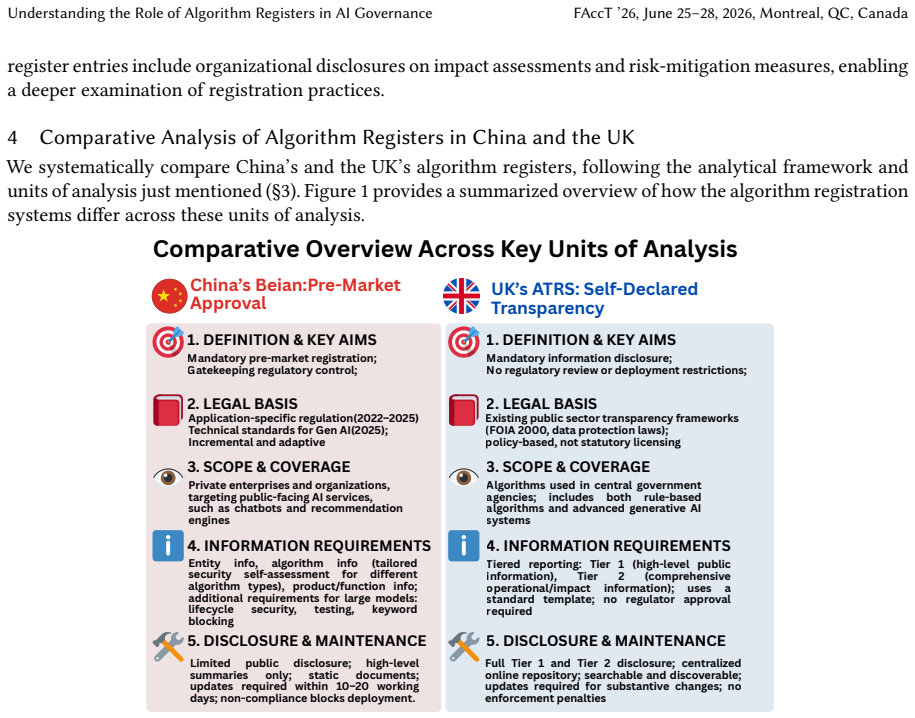
The analytical framework compares registers across five dimensions: (1) Definition and Key Aims, (2) Legal Basis, (3) Scope and Coverage, (4) Information Requirements, and (5) Disclosure and Maintenance. These dimensions map how design choices produce governance functions. The three governance functions identified are: ecosystem-level understanding (aggregate registration data reveals market structure and trends), enforceable oversight (mandatory registration with verification and consequences enables regulatory control), and expandable regulatory infrastructure (a register can be extended to new algorithm types and layered with additional requirements over time).
Load-bearing premise
The paper's analysis is based on formal regulatory design and stated intent as captured in publicly available documents, not on observed operational practice. The authors acknowledge they cannot observe how regulators actually verify submissions, whether they have sufficient capacity to assess the information provided, or what procedures are followed in practice. If the gap between formal design and operational reality is large—for instance, if Chinese regulators rubber-stamp
What would settle it
If empirical study of operational practice showed that Chinese regulators routinely approve registrations without substantive review, or that UK government bodies face meaningful informal consequences for non-compliance with ATRS, the claimed functional distinctions between the two systems would need significant qualification.
If this is right
- Policymakers designing new algorithm registers should treat the register's governance function as a design decision, not an automatic consequence of creating a database. Choices about verification, enforcement, and scope determine whether the register is a transparency tool, a market gate, or regulatory infrastructure.
- The EU AI Act's registration requirements for high-risk AI systems could, depending on implementation, produce ecosystem-level understanding of private-sector AI deployment across Europe—a function no European register currently provides.
- Registers can function as 'regulatory scaffolding': a reusable infrastructure that allows regulators to layer successive requirements over time. China's extension of Beian from recommendation algorithms to generative AI illustrates how a single registration mechanism can accommodate new governance demands without building entirely new regulatory structures.
- The gap between formal design and operational practice matters: if regulators lack capacity to verify submissions, the claimed governance functions (pre-market approval, supervisory control) may not hold in practice. This gap is currently unobservable from publicly available documents alone.
Where Pith is reading between the lines
- If the paper's framework is correct, then a register's governance function could be deliberately tuned by adjusting any single design dimension—for example, adding verification procedures to a self-declared transparency register would shift it toward an oversight function, while removing enforcement from a pre-market gate would reduce it to a transparency tool.
- The three functions identified (ecosystem understanding, enforceable oversight, expandable infrastructure) may not be exhaustive. Other jurisdictional configurations—voluntary private-sector registers, or hybrid public-private models—could produce additional governance functions not captured by the China-UK comparison alone.
- The paper's finding that China's Beian serves as industrial policy (via subsidies linked to registration) suggests that registers can also function as economic instruments shaping market entry and competitive dynamics, a role that extends beyond the three governance functions the authors explicitly name.
Editorial analysis
A structured set of objections, weighed in public.
Referee Report
Summary. This paper conducts a comparative analysis of algorithm registers in China (Beian) and the UK (ATRS), examining how differences in design—scope, verification, enforcement, information requirements, and disclosure mode—shape the governance functions these registers serve. Drawing on 17 official documents (Appendix A) and quantitative analysis of 5,822 Chinese registry entries, the authors argue that registers can perform functions beyond transparency: pre-market approval, ecosystem-level understanding, and expandable regulatory infrastructure. The qualitative document analysis is systematic, the analytical framework (adapted from Roberts et al. 2023) is clearly specified, and the China registry data analysis provides concrete empirical grounding. The paper is well-structured and addresses a genuine gap in the literature, which has largely treated registers through a transparency lens.
Significance. The paper makes a timely contribution to AI governance scholarship by systematically comparing two contrasting register designs and linking design choices to governance functions. The quantitative analysis of China's registry data (5,822 entries, 3,787 entities) is a notable empirical strength, as is the comprehensive document set in Appendix A. The identification of pre-market approval and regulatory infrastructure as functions distinct from transparency is well-supported and policy-relevant. The paper is honest about its limitations, particularly the gap between formal design and operational practice (§6).
major comments (2)
- §5, first function ('Registers Enable Ecosystem-Level Understanding Even with Poor Individual Records'): The paper's central claim is that registers serve functions 'beyond transparency,' but this first function is defined as the ability to observe 'aggregate patterns across actors, sectors, and regions' through registration data. The paper's own literature review (§2) defines transparency broadly as making algorithms 'visible and accessible' through 'systematically recording the existence, purpose, and operational scope of algorithms.' Ecosystem-level understanding through aggregated registration data appears to fall within this definition—it is visibility at aggregate scale rather than a categorically different function. The paper does not provide an explicit boundary criterion distinguishing aggregate visibility from transparency as a scaling effect. If this function is reclassified,
- §4.1 vs. §4.2: The comparative analysis is substantially asymmetric. §4.1 on China's Beian spans multiple subsections with detailed quantitative analysis (Figures 3a/3b, entity distribution, category shifts), while §4.2 on the UK's ATRS is largely descriptive without comparable quantitative depth. Figure 5 shows ATRS registration counts by year, but there is no analysis of algorithm types (Figure 4 is shown but not analyzed in text), organizational patterns, or temporal trends comparable to the China analysis. This asymmetry weakens the comparative claim because the paper cannot demonstrate that the UK register does or does not enable ecosystem-level understanding using the same analytical tools applied to China's data.
minor comments (7)
- Figure 1: The emoji-based comparison table is difficult to read in print and the text within cells is very small. Consider replacing with a standard table or structured comparison format for clarity.
- §4.1.3: The statement that DeepSeek's first registration appeared 'seven months before its public launch' is presented as notable, but the significance is not explained. A brief clarification of what this reveals about the registration timeline relative to development would help.
- Table 3 (Appendix C): The column abbreviations (RM, UR, CE, DE, DS, MS, DSec) are defined in the caption, but 'DS' appears twice—once for 'Diversity Safeguards' and once for 'Data Security.' This should be disambiguated.
- §4.2.4: The paper notes that the shift from Tier 2 on-request disclosure to full public disclosure of both tiers happened, but states the 'rationale for this move toward full public disclosure of both tiers is unclear.' If the rationale is genuinely unknown, a brief note on what sources were checked would strengthen this claim.
- §5, third function: The term 'regulatory scaffolding' is attributed to [38] (Sheehan 2023) but is used without explicit definition. A brief gloss of the term would help readers unfamiliar with the source.
- §4.1.1: The footnote translating Chinese terms (footnote 1) contains encoding artifacts that render some characters incorrectly. This should be corrected for the final version.
- The paper would benefit from a brief discussion of how the EU AI Act's registration requirements (mentioned only in passing in §5) relate to the three governance functions identified, given the EU's influence on global AI governance and the registration regime.
Simulated Author's Rebuttal
The referee raises two substantive points. On the first, we agree the boundary between ecosystem-level understanding and transparency needs explicit articulation and will revise accordingly. On the second, we agree the UK analysis lacks the quantitative depth applied to China and will add discussion of Figure 4 and further quantitative treatment of ATRS data, while noting the inherent asymmetry in dataset sizes.
read point-by-point responses
-
Referee: §5, first function: The paper's central claim is that registers serve functions 'beyond transparency,' but ecosystem-level understanding through aggregated registration data appears to fall within the paper's own definition of transparency. The paper does not provide an explicit boundary criterion distinguishing aggregate visibility from transparency as a scaling effect.
Authors: We thank the referee for this careful observation. The referee is correct that our literature review (§2) characterizes transparency broadly as making algorithms 'visible and accessible' through 'systematically recording the existence, purpose, and operational scope of algorithms.' We agree that, as currently written, the boundary between ecosystem-level understanding and transparency is not explicitly drawn, and this creates an ambiguity the referee rightly identifies. We will revise §5 to provide an explicit boundary criterion. The distinction we intend is as follows: transparency, as conceptualized in the existing literature, primarily concerns enabling external actors (citizens, civil society, journalists) to scrutinize individual algorithmic systems—to understand what a specific algorithm does, assess its risks, and hold its operator accountable. Ecosystem-level understanding, by contrast, refers to a function that does not depend on the quality or usefulness of any individual record. Even when individual entries are partial, vague, or minimally useful for scrutiny—as we show is the case for both China's Beian and, to a lesser extent, the UK's ATRS—the aggregation of registration data enables observation of structural patterns (market concentration, sectoral distribution, temporal trends, competitive dynamics) that serve a fundamentally different purpose: systemic monitoring rather than individual accountability. This function is primarily valuable to regulators and policy analysts rather than to citizens seeking to scrutinize specific systems, and it operates even when the register fails as a transparency mechanism in the conventional sense. We will make this distinction explicit in the revised §5 and adjust the framing in §2 to clarify that our use of 'transcends revision: no
Circularity Check
No circularity found
full rationale
This is a comparative policy analysis paper with no mathematical derivation chain, no fitted parameters, and no quantitative predictions. The central claim—that algorithm registers can serve functions beyond transparency depending on design choices—is supported by qualitative document analysis of primary regulatory sources and descriptive statistics from registry data. The three governance functions identified (ecosystem-level understanding, enforceable oversight, expandable regulatory infrastructure) are analytical categories derived from the comparative data, not predictions or derived quantities. Self-citations exist (references [11], [23], [28] include co-author Singh), but they support minor conceptual points in the background and discussion sections and are not load-bearing for the paper's central comparative argument, which rests on independent analysis of Chinese and UK regulatory documents and registry data. No step in the paper's reasoning reduces to its inputs by construction.
Axiom & Free-Parameter Ledger
axioms (4)
- domain assumption Roberts et al. (2023) comparative framework for AI regulatory policy is a valid basis for analyzing algorithm registers, as adapted by the authors.
- domain assumption Publicly available regulatory documents, registration guidelines, and registry data accurately represent the design and intended functions of algorithm registers.
- domain assumption China and the UK are sufficiently contrasting cases to surface a wide range of design choices and governance functions relevant to algorithm registers globally.
- ad hoc to paper The three identified governance functions (ecosystem-level understanding, enforceable oversight, expandable regulatory infrastructure) are analytically distinct from transparency.
read the original abstract
Algorithm registers are increasingly being both considered and deployed as instruments in AI governance. They are often expected to deliver transparency; however, in practice their design, scope, and implementation vary substantially. Currently, we lack a holistic understanding of the potential roles that registers might play in AI governance, and how different design choices both shape and reflect those roles. This paper therefore asks how do algorithm registers differ across jurisdictions, and what do these differences reveal about their roles in AI governance? Towards this, we conduct a comparative analysis of two influential but contrasting algorithm registration mechanisms, China's Beian system and the UK's Algorithmic Transparency Recording Standard (ATRS), drawing on publicly available regulatory documents, registration guidelines, and registry data. Crucially, our analysis shows that an algorithm register, depending on its design and implementation, can serve functions beyond transparency, including pre-market approval, enabling ecosystem-level understanding, and acting as a broader regulatory infrastructure. As algorithm registries proliferate globally, we stress the importance of researchers and policymakers considering and examining the concrete governance functions that algorithm registries can perform as a result of their design and institutional context, rather than approaching them primarily through a transparency lens.
Figures


Reference graph
Works this paper leans on
- [1]
-
[2]
Sacha Alanoca, Shira Gur-Arieh, Tom Zick, and Kevin Klyman. 2025. Comparing Apples to Oranges: A Taxonomy for Navigating the Global Landscape of AI Regulation. In Proceedings of the 2025 ACM Conference on Fairness, Accountability, and Transparency (FAccT ’25). Association for Computing Machinery, New York, NY, USA, 914 ⚶937. doi:10.1145/3715275.3732059
- [3]
-
[4]
Digital Trade Alliance. 2024. Briefing Note: AI Regulation in the European Union and China. https://dtalliance.org/2024/06/18/briefing- note-ai-regulation-in-the-european-union-and-china/
work page 2024
-
[5]
Mike Ananny and Kate Crawford. 2018. Seeing without knowing: Limitations of the transparency ideal and its application to algorithmic accountability. New Media & Society 20 (03 2018), 973–989. doi:10.1177/1461444816676645
-
[6]
Anna Artyushina. 2024. Will You Take This Algorithm to Court? https://www.cigionline.org/articles/will-you-take-this-algorithm-to- court/. Accessed 2025-12-09
work page 2024
-
[7]
BritainThinks. 2021. Complete transparency, complete simplicity. https://assets.publishing.service.gov.uk/media/ 60ccae1c8fa8f57cef61fcc7/Complete_transparency__complete_simplicity_-_Accessible.pdf
work page 2021
-
[8]
Cabinet Office, Department for Science, Innovation and Technology and Government Digital Service (Algorithmic Transparency Recording Standard). 2022. Hampshire and Thames Valley Police: DARAT
work page 2022
-
[9]
Corinne. Cath and Fieke. Jansen. 2022. Dutch comfort: The limits of AI governance through municipal registers. Techné: Research in Philosophy and Technology 26, 3 (2022), 395–412. doi:10.5840/techne202323172
-
[10]
Loup Cellard. 2024. Theaters of Algorithmic Transparency and the Politics of Exemplarity. Science, Technology, & Human Values (11 2024). doi:10.1177/01622439241294008
-
[11]
Shreya Chappidi, Jennifer Cobbe, Chris Norval, Anjali Mazumder, and Jat Singh. 2025. Accountability Capture: How Record-Keeping to Support AI Transparency and Accountability (Re)shapes Algorithmic Oversight. Proceedings of the AAAI/ACM Conference on AI, Ethics, and Society 8 (10 2025), 554–566. doi:10.1609/aies.v8i1.36570
-
[12]
China Media Project. 2022. New Licensing System for Online Dramas.https://chinamediaproject.org/2022/06/01/new-licensing-system- for-online-dramas/ . Accessed: 2025-12-16
work page 2022
-
[13]
Michael Chromik, Malin Eiband, Felicitas Buchner, Adrian Krüger, and Andreas Butz. 2021. I Think I Get Your Point, AI! The Illusion of Explanatory Depth in Explainable AI. In Proceedings of the 26th International Conference on Intelligent User Interfaces (College Station, TX, USA) (IUI ’21). Association for Computing Machinery, New York, NY, USA, 307 ⚶317...
-
[14]
Jennifer Cobbe, Michelle Seng Ah Lee, and Jatinder Singh. 2021. Reviewable Automated Decision-Making: A Framework for Account- able Algorithmic Systems. In Proceedings of the 2021 ACM Conference on Fairness, Accountability, and Transparency (Virtual Event, Canada) (FAccT ’21). Association for Computing Machinery, New York, NY, USA, 598 ⚶609. doi:10.1145/3...
-
[15]
Eric Corbett and Remi Denton. 2023. Interrogating the T in FAccT. InProceedings of the 2023 ACM Conference on Fairness, Accountability, and Transparency (Chicago, IL, USA) (FAccT ’23). Association for Computing Machinery, New York, NY, USA, 1624 ⚶1634. doi:10.1145/ 3593013.3594104
-
[16]
Innovation Department for Science and Technology. 2022. Piloting the National Algorithmic Transparency Standard. https://rtau.blog. gov.uk/2022/06/01/piloting-the-national-algorithmic-transparency-standard
work page 2022
-
[17]
Innovation & Technology Department for Science and Government Digital Service. 2025. A blueprint for modern digital gov- ernment. https://www.gov.uk/government/publications/a-blueprint-for-modern-digital-government/a-blueprint-for-modern-digital- government-html#section-3
work page 2025
-
[18]
Department for Science, Innovation and Technology and Office for Artificial Intelligence. 2023. A pro-innovation approach to AI regulation. https://www.gov.uk/government/publications/ai-regulation-a-pro-innovation-approach/white-paper
work page 2023
-
[19]
Malin Eiband, Daniel Buschek, Alexander Kremer, and Heinrich Hussmann. 2019. The Impact of Placebic Explanations on Trust in Intelligent Systems. In Extended Abstracts of the 2019 CHI Conference on Human Factors in Computing Systems (Glasgow, Scotland Uk) (CHI EA ’19). Association for Computing Machinery, New York, NY, USA, 1 ⚶6. doi:10.1145/3290607.3312787
-
[20]
Luciano Floridi. 2020. Artificial Intelligence as a Public Service: Learning from Amsterdam and Helsinki. Philosophy & Technology 33 (12 2020), 541–546. doi:10.1007/s13347-020-00434-3 Understanding the Role of Algorithm Registers in AI Governance FAccT ’26, June 25–28, 2026, Montreal, QC, Canada
-
[21]
Geopolitechs. 2025. China’s New Rule Requiring Tech Companies to Label AI‑Generated Content. https://www.geopolitechs.org/p/ chinas-new-rule-requiring-tech-companies . Accessed: 2025-12-15
work page 2025
-
[22]
House of Lords Justice and Home Affairs Committee. 2022. Technology rules? The advent of new technologies in the justice system. https://publications.parliament.uk/pa/ld5802/ldselect/ldjusthom/180/180.pdf
work page 2022
-
[23]
Anna Ida Hudig, Emma Kallina, and Jatinder Singh. 2026. oItns Just a Wild, Wild West p: Harnessing Public Procurement as an AI Governance Mechanism. In Proceedings of the 2026 CHI Conference on Human Factors in Computing Systems (CHI ’26) . Association for Computing Machinery, New York, NY, USA, Article 35, 22 pages. doi:10.1145/3772318.3791968
-
[24]
Latham & Watkins LLP. 2023. China ns New AI Regulations. https://www.lw.com/admin/upload/SiteAttachments/Chinas-New-AI- Regulations.pdf
work page 2023
- [25]
-
[26]
Natalia Modjeska and Omdia. 2021. The tool to improve AI transparency has arrived: AI Registers. https://omdia.tech.informa.com/ blogs/2021/may/the-tool-to-improve-ai-transparency-has-arrived-ai-registers
work page 2021
-
[27]
Esther Nieuwenhuizen. 2024. Algorithm Registers: A Box-Ticking Exercise or Meaningful Tool for Transparency? Information Polity 29, 4 (2024), 415–433. arXiv: https://doi.org/10.1177/15701255241297107 doi:10.1177/15701255241297107
-
[28]
Chris Norval, Kristin Cornelius, Jennifer Cobbe, and Jatinder Singh. 2022. Disclosure by Design: Designing information disclosures to support meaningful transparency and accountability. In Proceedings of the 2022 ACM Conference on Fairness, Accountability, and Transparency (Seoul, Republic of Korea) (FAccT ’22). Association for Computing Machinery, New Yo...
-
[29]
Openresearch Amsterdam. 2020. Public AI Registers: Using artificial intelligence (AI)? Be transparent and create citizens nengagement. https://openresearch.amsterdam/en/page/73074/public-ai-registers . Accessed 2025-12-09
work page 2020
-
[30]
Ciarán O’Riordan. 2022. Dutch government launches Algorithms Register. https://interoperable-europe.ec.europa.eu/collection/open- source-observatory-osor/news/dutch-government-launches-algorithms-register . Accessed 2025‑12‑09
work page 2022
-
[31]
Soizic Pénicaud. 2025. Making Algorithm Registers Work for Meaningful Transparency: State of the art and policy recommendations on how to design, implement and evaluate algorithm registers . Technical Report. IA Ciudadana. https://iaciudadana.org/2025/03/13/making- algorithm-registers-work-for-meaningful-transparency/ Accessed 2025-12-08
work page 2025
-
[32]
Huw Roberts, Emmie Hine, Mariarosaria Taddeo, and Luciano Floridi. 2024. Global AI governance: barriers and pathways forward. 100, 3 (May 2024), 1275–1286. doi:10.1093/ia/iiae073
-
[33]
Huw Roberts, Marta Ziosi, Cailean Osborne, and Lama Saouma. 2023. A Comparative Framework for AI Regulatory Policy. https: //ceimia.org/wp-content/uploads/2023/05/a-comparative-framework-for-ai-regulatory-policy.pdf Accessed: 2025-11-27
work page 2023
-
[34]
Albert Sanchez-Graells. 2024. Digital Technologies and Public Procurement: Gatekeeping and Experimentation in Digital Public Governance. Oxford University Press. doi:10.1093/oso/9780198866770.001.0001
-
[35]
Kendra Schaefer. 2025. Seeking the next DeepSeek: What China’s generative AI registration data can tell us about China’s AI com- petitiveness. https://triviumchina.com/research/seeking-the-next-deepseek-what-chinas-generative-ai-registration-data-can-tell-us- about-chinas-ai-competitiveness/
work page 2025
-
[36]
Government Digital Service. 2025. Guidance for organisations using the Algorithmic Transparency Recording Standard: Algorithmic Transparency Recording Standard guidance for public sector bodies. https://www.gov.uk/government/publications/guidance-for- organisations-using-the-algorithmic-transparency-recording-standard/algorithmic-transparency-recording-st...
work page 2025
-
[37]
Government Digital Service, Central Digital, and Data Office. 2022. Department for Health and Social Care and NHS Digital: QCovid algorithm. https://www.gov.uk/government/publications/department-for-health-and-social-care-and-nhs-digital-qcovid-algorithm
work page 2022
-
[38]
Matt Sheehan. 2023. China’s AI Regulations and How They Get Made. Carnegie Endowment for International Peace. https://carnegie- production-assets.s3.amazonaws.com/static/files/202307-Sheehan_Chinese%20AI%20gov-1.pdf
work page 2023
-
[39]
Matt Sheehan. 2024. Tracing the Roots of China ns AI Regulations. https://carnegie-production-assets.s3.amazonaws.com/static/files/ Sheehan_Reverse_Engineering_AI_Gov-UPDATED-1.pdf
work page 2024
-
[40]
Matt Sheehan and Sharon Du. 2022. What China ns Algorithm Registry Reveals about AI Governance. https://carnegieendowment. org/2022/12/09/what-chinas-algorithm-registry-reveals-about-ai-governance-pub-88606 . Accessed 2025-12-09
work page 2022
-
[41]
Ruoxin Su and Dechun Zhang. 2025. Adaptive Sovereignty: China’s Evolving Legislative Framework for Transnational Data Gover- nance. Politics and Governance 13 (07 2025). doi:10.17645/pag.10413
-
[42]
Oleksandr Svitych. 2025. Blind transparency: a critical discourse analysis of the EU AI Act. Critical Policy Studies 0, 0 (2025), 1–17. doi:10.1080/19460171.2025.2496193
-
[43]
Treasury Board of Canada Secretariat. 2025. Canada launches first register of AI uses in federal government. https://www.canada.ca/ en/treasury-board-secretariat/news/2025/11/canada-launches-first-register-of-ai-uses-in-federal-government.html . Accessed 2025- 12-09
work page 2025
-
[44]
Amnesty International UK. 2025. Automated Racism: How police data and algorithms code discrimination into policing. FAccT ’26, June 25–28, 2026, Montreal, QC, Canada Pi et al
work page 2025
-
[45]
UK Government iDepartment for Science, Innovation and Technology (Algorithmic Transparency Recording Standard). 2024. DSIT: Ask Ops Chatbot
work page 2024
-
[46]
Responsible Technology Adoption Unit. 2021. Engaging with the public about algorithmic transparency in the public sector. https: //rtau.blog.gov.uk/2021/06/21/engaging-with-the-public-about-algorithmic-transparency-in-the-public-sector/
work page 2021
-
[47]
Michel van Genderen, Davy Van de Sande, Lotty Hooft, Andreas Reis, Alexander Cornet, Jacobien Oosterhoff, Bjorn van der Ster, Joost Huiskens, Reggie Townsend, Jasper van Bommel, Diederik Gommers, and Jeroen Hoven. 2024. Charting a new course in healthcare: early-stage AI algorithm registration to enhance trust and transparency. npj Digital Medicine 7 (202...
-
[48]
Martijn van Vliet, Nena Schuitemaker, Sergio España, Inge van de Weerd, and Sjaak Brinkkemper. 2024. Defining and Implement- ing Algorithm Registers: An Organizational Perspective. In ECIS 2024 Proceedings . https://aisel.aisnet.org/ecis2024/track04_impactai/ track04_impactai/5
work page 2024
-
[49]
Lucas Wright, Roxana Mika Muenster, Briana Vecchione, Tianyao Qu, Pika (Senhuang) Cai, Alan Smith, Comm 2450 Student Investi- gators, Jacob Metcalf, and J. Nathan Matias. 2024. Null Compliance: NYC Local Law 144 and the challenges of algorithm accountability. In Proceedings of the 2024 ACM Conference on Fairness, Accountability, and Transparency (Rio de J...
-
[50]
Manuel Wörsdörfer. 2025. The E.U. ns artificial intelligence act: an ordoliberal assessment. AI Ethics 5 (2025), 263–278. doi:10.1007/ s43681-023-00337-x
work page 2025
-
[51]
Baiyang Xiao. 2025. Agile and iterative governance: China ns regulatory response to AI. Computer Law & Security Review 58 (2025), 106183. doi:10.1016/j.clsr.2025.106183
-
[52]
Angela Huyue Zhang. 2024. The Promise and Perils of Chinans Regulation of Artificial Intelligence. Columbia Journal of Transnational Law (2024). doi:10.2139/ssrn.4708676 forthcoming
-
[53]
Miri Zilka, Holli Sargeant, and Adrian Weller. 2022. Transparency, Governance and Regulation of Algorithmic Tools Deployed in the Criminal Justice System: a UK Case Study. In Proceedings of the 2022 AAAI/ACM Conference on AI, Ethics, and Society (Oxford, United Kingdom) (AIES ’22). Association for Computing Machinery, New York, NY, USA, 880 ⚶889. doi:10.1...
-
[54]
ದರБ . 2025.ႋႨӱФҰԩ . https://paper.people.com.cn/rmrb/pc/ content/202511/26/content_30116948.html. [56]შ. 2023.؇2023, 2 (2023). ୯࿐ᆀห़ 2,ֻ92 ௹. [57]ຩ. 2024.ğAIGCሹ. https://www.sohu.com/a/796224307_120992898. [58]अ. 2024.๙ᆩ. https://www.sz.gov.cn/szzt2010/wgkzl/jcgk/jcygk/ zdzcjc/content/post_11752733.html Accessed: 2025-12-17. Understanding the Role of Al...
discussion (0)
Sign in with ORCID, Apple, or X to comment. Anyone can read and Pith papers without signing in.