Rare Events, Real Signals: Functional Ensembles as Units of Computation in Deep Spiking Networks
Pith reviewed 2026-06-30 15:58 UTC · model grok-4.3
The pith
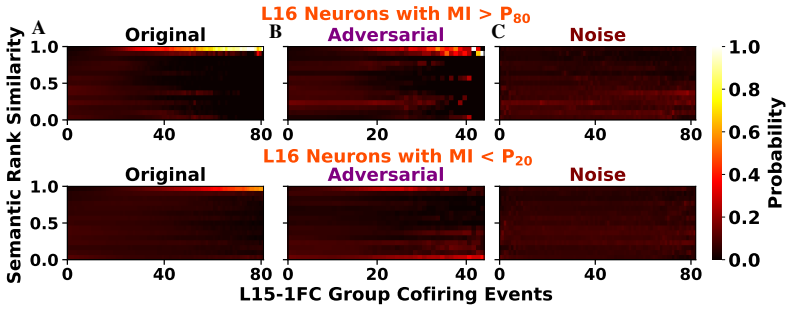
Informative class encodings in spiking neural networks occur only during rare high-cofiring events of functional ensembles.
A machine-rendered reading of the paper's core claim, the machinery that carries it, and where it could break.
Core claim
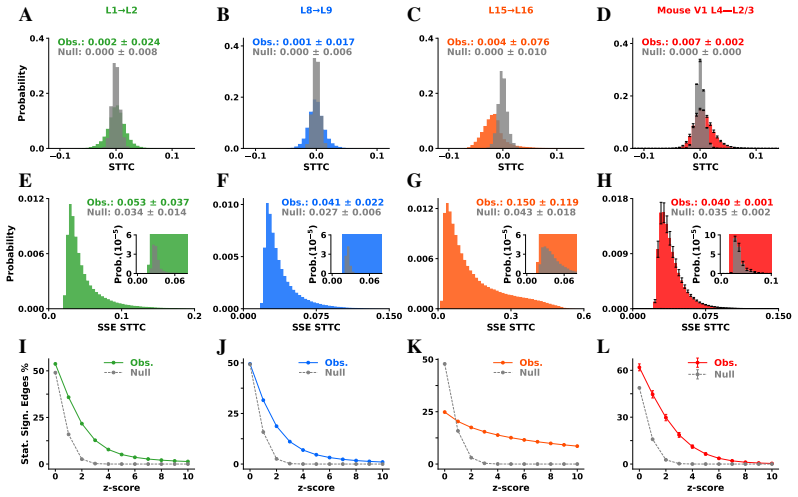
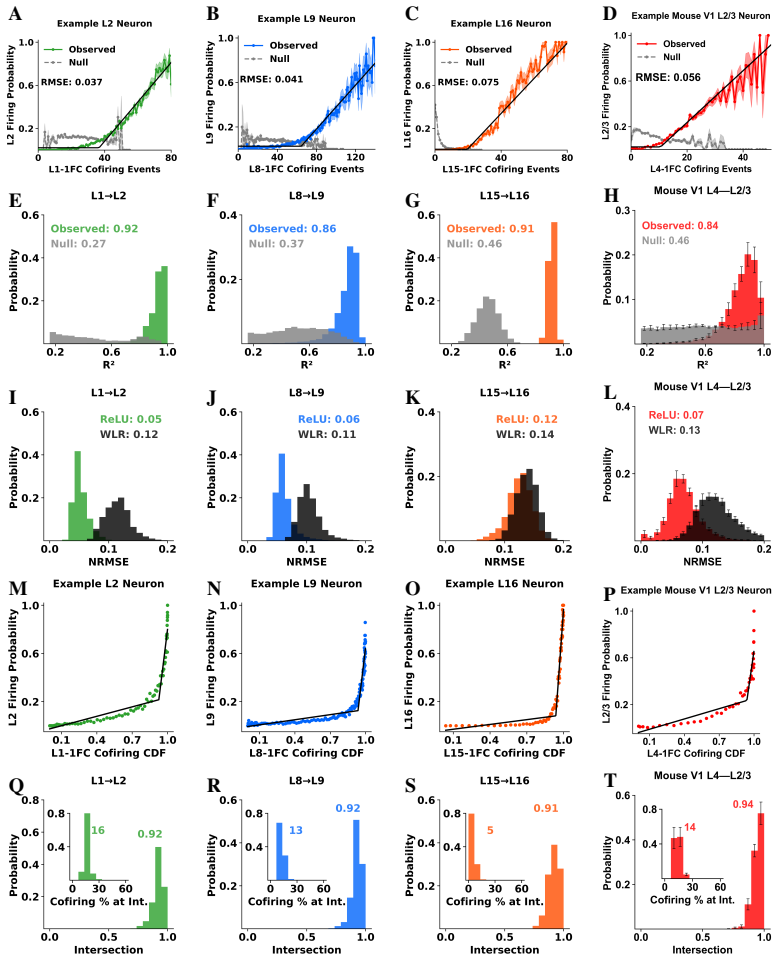
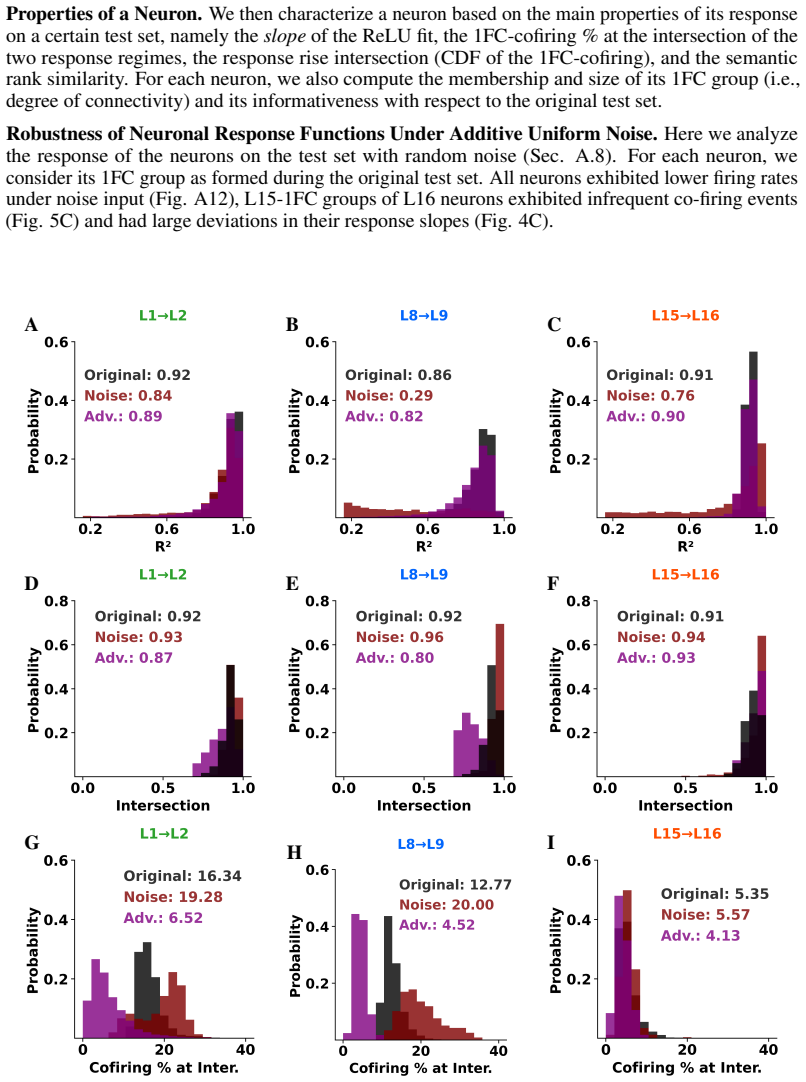
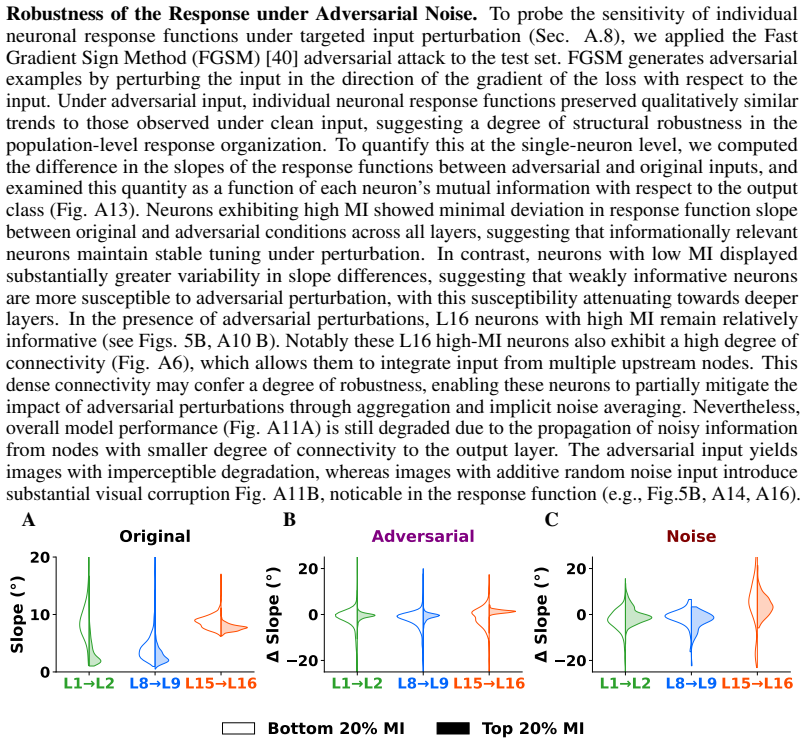
First-order functionally-connected (1FC) groups are defined by a neuron's statistically significant pairwise correlations with neurons in the preceding layer. Their aggregate cofiring predicts downstream responses through a robust ReLU-like function whose gain increases with group size. Reliable encoding of the input class is observed exclusively during infrequent high 1FC cofiring events. These ensembles preserve functional connectivity principles from biological cortex, are shaped by learning, and their response profiles are disrupted by noise or adversarial inputs, particularly in early layers.
What carries the argument
The 1FC ensemble, formed via statistically significant pairwise correlations across layers, whose aggregate cofiring serves as the predictor for downstream activity and class encoding.
If this is right
- Downstream responses follow a ReLU-like relationship from 1FC cofiring, with gain scaling by ensemble size.
- High cofiring events are infrequent yet necessary for reliable class encoding.
- Response profiles disrupt under random noise or adversarial perturbations, especially early and intermediate layers.
- Functional connectivity structure emerges from learning and collapses under weight permutation.
Where Pith is reading between the lines
- If the ensembles are the computational units, then network interventions could target cofiring patterns to alter behavior more precisely.
- The concentration of signal in rare events implies that standard rate-based analyses may miss key computations in both artificial and biological networks.
- This approach offers a way to perform high-resolution diagnostics on information pathways in trained models.
- Similar ensemble-based encoding might explain efficient computation in biological sensory systems.
Load-bearing premise
Statistically significant pairwise correlations between neurons in adjacent layers define ensembles whose combined activity functions as an independent variable that predicts downstream neuronal responses.
What would settle it
Finding that class encoding remains reliable even during low 1FC cofiring periods, or that aggregate cofiring does not predict downstream activity in a consistent ReLU-like manner.
Figures
read the original abstract
We investigate how internal representations emerge across hierarchical processing systems by introducing a neuroscience-inspired framework for analyzing deep spiking neural networks (SNN) through the lens of functional connectivity. Drawing on concepts from systems neuroscience and information theory, we form the first-order functionally-connected (1FC) group of a neuron based on its statistically significant pairwise correlations with neurons from the previous layer of a trained SNN architecture. We then track its response properties during inference under various conditions. Our analysis shows that several principles of functional connectivity previously observed in biological cortex are preserved in spiking ResNet architectures. These 1FC ensembles display interesting properties: their aggregate cofiring reliably predicts downstream neuronal responses through a robust, ReLU-like input-output relationship, whose gain scales systematically with ensemble size. Reliable encoding of the presented class emerges only during high 1FC cofiring events, which themselves occur infrequently, indicating that informative representations are concentrated in rare but highly coordinated activity patterns. Under uniform random noise or adversarial perturbations, these response profiles are disrupted, particularly in early and intermediate layers. This enables a targeted high-resolution interrogation at specific nodes and pathways. We showed that the functional connectivity structure is shaped by learning and this structure breaks under weight permutation. These establish 1FC ensembles as a functionally meaningful substrate for input encoding and information transfer, with potential implications in designing targeted fine-grained diagnostics on the information flow.
Editorial analysis
A structured set of objections, weighed in public.
Referee Report
Summary. The paper introduces a neuroscience-inspired analysis framework for deep spiking neural networks that defines first-order functionally-connected (1FC) ensembles via statistically significant pairwise correlations between a neuron and the preceding layer. It reports that aggregate cofiring within these ensembles predicts downstream firing rates through a ReLU-like mapping whose gain increases with ensemble size, that class-selective encoding is reliable only during infrequent high-cofiring events, and that the connectivity structure is learning-dependent, disrupted by noise or adversarial inputs, and absent under weight permutation.
Significance. If the independence of 1FC ensembles from their defining correlations can be established with appropriate controls, the framework would supply a concrete, falsifiable method for identifying rare coordinated events as the primary carriers of class information in SNNs, offering a potential bridge between cortical functional-connectivity studies and mechanistic interpretability of artificial networks.
major comments (2)
- [Abstract] Abstract (paragraph on 1FC group formation): the definition of 1FC groups rests on the same pairwise-correlation threshold later used to identify cofiring events whose aggregate activity is claimed to act as an independent predictor of downstream responses; no surrogate-data tests, partial-correlation conditioning on earlier layers, or ablation against size-matched random groups are described, leaving open whether the reported ReLU-like mapping and predictive gain survive removal of transitive or shared-input effects.
- [Abstract] Abstract (claims on rarity and class encoding): the assertions that 'reliable encoding of the presented class emerges only during high 1FC cofiring events' and that 'informative representations are concentrated in rare but highly coordinated activity patterns' are presented without any reported quantitative metrics (R² values, p-values, sample sizes, or cross-validation procedures), which are required to assess whether the rarity claim is load-bearing or an artifact of post-hoc selection.
minor comments (1)
- The abstract refers to 'spiking ResNet architectures' without specifying depth, neuron model, or training dataset; these details are needed to evaluate reproducibility.
Simulated Author's Rebuttal
We thank the referee for the detailed and constructive comments. We address each major point below and commit to revisions that strengthen the manuscript by adding the requested controls and metrics.
read point-by-point responses
-
Referee: [Abstract] Abstract (paragraph on 1FC group formation): the definition of 1FC groups rests on the same pairwise-correlation threshold later used to identify cofiring events whose aggregate activity is claimed to act as an independent predictor of downstream responses; no surrogate-data tests, partial-correlation conditioning on earlier layers, or ablation against size-matched random groups are described, leaving open whether the reported ReLU-like mapping and predictive gain survive removal of transitive or shared-input effects.
Authors: We agree that demonstrating independence from transitive and shared-input effects is essential for the framework's validity. In the revised manuscript we will add surrogate-data controls that shuffle spike times while preserving per-neuron rates, partial-correlation analyses conditioned on preceding-layer activity, and direct comparisons against size-matched random ensembles. These tests and their outcomes will be reported in the Methods and Results sections to confirm that the ReLU-like mapping and ensemble-size-dependent gain remain after removal of the identified confounds. revision: yes
-
Referee: [Abstract] Abstract (claims on rarity and class encoding): the assertions that 'reliable encoding of the presented class emerges only during high 1FC cofiring events' and that 'informative representations are concentrated in rare but highly coordinated activity patterns' are presented without any reported quantitative metrics (R² values, p-values, sample sizes, or cross-validation procedures), which are required to assess whether the rarity claim is load-bearing or an artifact of post-hoc selection.
Authors: We accept that explicit quantitative metrics are required to substantiate the rarity and selectivity claims. The revised manuscript will include R² values for the cofiring-to-response fits, p-values for statistical comparisons of class-encoding reliability across cofiring regimes, explicit sample sizes (number of events, trials, and networks), and any cross-validation details. These metrics will be added to the abstract and the corresponding results paragraphs. revision: yes
Circularity Check
No significant circularity in derivation chain
full rationale
The paper presents an empirical analysis framework for SNNs: 1FC groups are formed via statistically significant pairwise correlations with the prior layer, after which observational properties (aggregate cofiring, ReLU-like input-output mapping, gain scaling with size, rarity of informative events) are measured on held-out inference data. No equation or step equates the claimed functional relationships to the group-definition criterion by construction; the ReLU-like profile and downstream prediction are data-driven findings, not definitional identities or refitted parameters. The structure is shaped by learning (verified via permutation controls) and the method is self-contained against external benchmarks without load-bearing self-citation or ansatz smuggling.
Axiom & Free-Parameter Ledger
free parameters (1)
- statistical significance threshold for pairwise correlations
axioms (1)
- domain assumption Statistically significant pairwise correlations between neurons in adjacent layers capture functionally relevant connectivity
invented entities (1)
-
1FC ensemble
no independent evidence
Reference graph
Works this paper leans on
-
[1]
There Will Be a Scientific Theory of Deep Learning
Jamie Simon, Daniel Kunin, Alexander Atanasov, Enric Boix-Adserà, Blake Bordelon, Jeremy Cohen, Nikhil Ghosh, Florentin Guth, Arthur Jacot, Mason Kamb, et al. There will be a scientific theory of deep learning.arXiv preprint arXiv:2604.21691, 2026
work page internal anchor Pith review Pith/arXiv arXiv 2026
-
[2]
The platonic representation hypothesis
Minhyuk Huh, Brian Cheung, Tongzhou Wang, and Phillip Isola. The platonic representation hypothesis. InInternational Conference on Machine Learning (ICML), 2024
2024
-
[3]
Network dissec- tion: Quantifying interpretability of deep visual representations
David Bau, Bolei Zhou, Aditya Khosla, Aude Oliva, and Antonio Torralba. Network dissec- tion: Quantifying interpretability of deep visual representations. InProceedings of the IEEE Conference on Computer Vision and Pattern Recognition (CVPR), 2017
2017
-
[4]
Similarity of neural network representations revisited
Simon Kornblith, Mohammad Norouzi, Honglak Lee, and Geoffrey Hinton. Similarity of neural network representations revisited. InInternational Conference on Machine Learning (ICML), 2019
2019
-
[5]
Representation learning: A review and new perspectives.IEEE Transactions on Pattern Analysis and Machine Intelligence, 35(8): 1798–1828, 2013
Yoshua Bengio, Aaron Courville, and Pascal Vincent. Representation learning: A review and new perspectives.IEEE Transactions on Pattern Analysis and Machine Intelligence, 35(8): 1798–1828, 2013
2013
-
[6]
Cerebral cortex: architecture, intracortical connections, motor projections
Nó R de Lorente. Cerebral cortex: architecture, intracortical connections, motor projections. Physiology of the nervous system, pages 288–330, 1949
1949
-
[7]
Markus Meister, Rachel O. L. Wong, Denis A. Baylor, and Carla J. Shatz. Synchronous bursts of action potentials in ganglion cells of the developing mammalian retina.Science, 252(5008):939–943, May 1991. ISSN 1095-9203. doi: 10.1126/science.2035024. URL http://dx.doi.org/10.1126/science.2035024
-
[8]
M. Abeles, H. Bergman, E. Margalit, and E. Vaadia. Spatiotemporal firing patterns in the frontal cortex of behaving monkeys.Journal of Neurophysiology, 70(4):1629–1638, October 1993. doi: 10.1152/jn.1993.70.4.1629. URLhttps://doi.org/10.1152/jn.1993.70.4.1629
-
[9]
Amiram Grinvald, Amos Arieli, Misha Tsodyks, and Tal Kenet. Neuronal assemblies: Single cortical neurons are obedient members of a huge orchestra.Biopolymers, 68(3):422–436, February 2003. doi: 10.1002/bip.10273. URLhttps://doi.org/10.1002/bip.10273
-
[10]
The first stage of perception: growth of the assembly.The Organization of Behavior, 4(60):78–60, 1949
Donald O Hebb. The first stage of perception: growth of the assembly.The Organization of Behavior, 4(60):78–60, 1949
1949
-
[11]
Spontaneous and driven cortical activity: implications for computation.Curr Opin Neurobiol, 19(4):439–444, August 2009
Dario L Ringach. Spontaneous and driven cortical activity: implications for computation.Curr Opin Neurobiol, 19(4):439–444, August 2009
2009
-
[12]
Luis Carrillo-Reid, Weijian Yang, Yuki Bando, Darcy S. Peterka, and Rafael Yuste. Imprinting and recalling cortical ensembles.Science, 353(6300):691–694, August 2016. doi: 10.1126/ science.aaf7560. URLhttps://doi.org/10.1126/science.aaf7560
-
[13]
The structures and functions of correlations in neural population codes.Nature Reviews Neuroscience, 23(9), 2022
Stefano Panzeri, Monica Moroni, Houman Safaai, and Christopher D Harvey. The structures and functions of correlations in neural population codes.Nature Reviews Neuroscience, 23(9), 2022. 11
2022
-
[14]
Neural correlations, population coding and computation.Nature reviews neuroscience, 7(5), 2006
Bruno B Averbeck, Peter E Latham, and Alexandre Pouget. Neural correlations, population coding and computation.Nature reviews neuroscience, 7(5), 2006
2006
-
[15]
R. Yuste. From the neuron doctrine to neural networks.Nature Reviews Neuroscience, 2015. URLhttps://doi.org/10.1038/nrn3962
-
[16]
Attractor dynamics of network up states in the neocortex.Nature, 423(6937):283–288, May 2003
Rosa Cossart, Dmitriy Aronov, and Rafael Yuste. Attractor dynamics of network up states in the neocortex.Nature, 423(6937):283–288, May 2003. ISSN 1476-4687. doi: 10.1038/nature01614. URLhttp://dx.doi.org/10.1038/nature01614
-
[17]
Jae-eun Kang Miller, Inbal Ayzenshtat, Luis Carrillo-Reid, and Rafael Yuste. Visual stimuli recruit intrinsically generated cortical ensembles.Proceedings of the National Academy of Sci- ences of the United States of America, 111(38):E4053—61, September 2014. ISSN 0027-8424. doi: 10.1073/pnas.1406077111. URLhttps://europepmc.org/articles/PMC4183303
-
[18]
Cell assemblies at multiple time scales with arbitrary lag constellations.Elife, 6:e19428, 2017
Eleonora Russo and Daniel Durstewitz. Cell assemblies at multiple time scales with arbitrary lag constellations.Elife, 6:e19428, 2017
2017
-
[19]
Neuronal ensembles: Building blocks of neural circuits.Neuron, 2024
Rafael Yuste, Rosa Cossart, and Emre Yaksi. Neuronal ensembles: Building blocks of neural circuits.Neuron, 2024. ISSN 0896-6273. doi: https://doi.org/10.1016/j.neuron.2023.12.008. URLhttps://www.sciencedirect.com/science/article/pii/S0896627323009674
-
[20]
Tal Kenet, Dmitri Bibitchkov, Misha Tsodyks, Amiram Grinvald, and Amos Arieli. Sponta- neously emerging cortical representations of visual attributes.Nature, 425(6961):954–956, Oct 2003. ISSN 1476-4687. doi: 10.1038/nature02078. URL https://doi.org/10.1038/ nature02078
-
[21]
Artur Luczak, Peter Barthó, and Kenneth D. Harris. Spontaneous events outline the realm of possible sensory responses in neocortical populations.Neuron, 62(3):413–425, May 2009. doi: 10.1016/j.neuron.2009.03.014. URL https://doi.org/10.1016/j.neuron.2009.03. 014
-
[22]
Ganna Palagina, Jochen F. Meyer, and Stelios M. Smirnakis. Inhibitory units: An organizing nidus for feature-selective sub-networks in area v1.bioRxiv, 2018. doi: 10.1101/282988. URL https://www.biorxiv.org/content/early/2018/03/15/282988
-
[23]
Maria Papadopouli, Ioannis Smyrnakis, Emmanouil Koniotakis, Mario-Alexios Savaglio, Christina Brozi, Eleftheria Psilou, Ganna Palagina, and Stelios Manolis Smirnakis. Brain orchestra under spontaneous conditions: Identifying communication modules from the func- tional architecture of area v1.bioRxiv, 2024. doi: 10.1101/2024.02.29.582364. URL https://www.b...
-
[24]
Keliris, Ganna Palagina, Stelios M
Mario Alexios Savaglio, Christina Brozi, Eleftheria Psilou, Chryssalenia Koumpouzi, Marianna Papadostefanaki, Christos Vasilakos, Spyros Nessis, Emmanouel Smyrnakis, Vasileios Akoutas, Georgios A. Keliris, Ganna Palagina, Stelios M. Smirnakis, and Maria Papadopouli. Direction of motion decoding in mouse v1: Neuron predictive power relates to functional co...
2025
-
[25]
Smirnakis, and Maria Papadopouli
Mario Alexios Savaglio, Christina Brozi, Stelios M. Smirnakis, and Maria Papadopouli. On tem- poral robustness & brain-state stability of functional connectivity in mouse primary visual area v1 compared to higher visual area al. InIEEE 25th International Conference on Bioinformatics and Bioengineering (BIBE) Best Paper Award, 2025
2025
-
[26]
Decoding the brain: From neural representations to mechanistic models
Mackenzie Weygandt Mathis, Adriana Perez Rotondo, Edward F Chang, Andreas S Tolias, and Alexander Mathis. Decoding the brain: From neural representations to mechanistic models. Cell, 187(21):5814–5832, 2024
2024
-
[27]
Deep learning in spiking neural networks.Neural networks, 111:47–63, 2019
Amirhossein Tavanaei, Masoud Ghodrati, Saeed Reza Kheradpisheh, Timothée Masquelier, and Anthony Maida. Deep learning in spiking neural networks.Neural networks, 111:47–63, 2019
2019
-
[28]
From attribution maps to human-understandable explanations through concept relevance propagation.Nature machine intelligence, 5(9):1006– 1019, 2023
Reduan Achtibat, Maximilian Dreyer, Ilona Eisenbraun, Sebastian Bosse, Thomas Wiegand, Wojciech Samek, and Sebastian Lapuschkin. From attribution maps to human-understandable explanations through concept relevance propagation.Nature machine intelligence, 5(9):1006– 1019, 2023. 12
2023
-
[29]
How important is a neuron
Kedar Dhamdhere, Mukund Sundararajan, and Qiqi Yan. How important is a neuron. In International Conference on Learning Representations, 2019. URL https://openreview. net/forum?id=SylKoo0cKm
2019
-
[30]
David Bau, Jun-Yan Zhu, Hendrik Strobelt, Agata Lapedriza, Bolei Zhou, and Antonio Torralba. Understanding the role of individual units in a deep neural network.Proceedings of the National Academy of Sciences, 117(48):30071–30078, 2020. doi: 10.1073/pnas.1907375117. URL https://www.pnas.org/doi/abs/10.1073/pnas.1907375117
-
[31]
The building blocks of interpretability.Distill, 2018
Chris Olah, Arvind Satyanarayan, Ian Johnson, Shan Carter, Ludwig Schubert, Katherine Ye, and Alexander Mordvintsev. The building blocks of interpretability.Distill, 2018. doi: 10.23915/distill.00010. https://distill.pub/2018/building-blocks
-
[32]
https://distill.pub/2020/circuits/zoom-in
Chris Olah, Nick Cammarata, Ludwig Schubert, Gabriel Goh, Michael Petrov, and Shan Carter. Zoom in: An introduction to circuits.Distill, 2020. doi: 10.23915/distill.00024.001. https://distill.pub/2020/circuits/zoom-in
-
[33]
Locating and Editing Factual Associations in GPT
Kevin Meng, David Bau, Alex Andonian, and Yonatan Belinkov. Locating and editing fac- tual associations in GPT.Advances in Neural Information Processing Systems, 36, 2022. arXiv:2202.05262
work page internal anchor Pith review Pith/arXiv arXiv 2022
-
[34]
Learning Deep Features for Discriminative Localization
Bolei Zhou, Aditya Khosla, Àgata Lapedriza, Aude Oliva, and Antonio Torralba. Learning deep features for discriminative localization.CoRR, abs/1512.04150, 2015. URL http: //arxiv.org/abs/1512.04150
work page internal anchor Pith review Pith/arXiv arXiv 2015
-
[35]
Grad-CAM: Visual explanations from deep networks via gradient- based localization.Int
Ramprasaath R Selvaraju, Michael Cogswell, Abhishek Das, Ramakrishna Vedantam, Devi Parikh, and Dhruv Batra. Grad-CAM: Visual explanations from deep networks via gradient- based localization.Int. J. Comput. Vis., 128(2):336–359, February 2020
2020
-
[36]
Ablation-CAM: Visual explanations for deep convolutional network via gradient-free localization
Saurabh Desai and Harish G Ramaswamy. Ablation-CAM: Visual explanations for deep convolutional network via gradient-free localization. In2020 IEEE Winter Conference on Applications of Computer Vision (WACV). IEEE, March 2020
2020
-
[37]
Bowers, Gaurav Malhotra, Federico Adolfi, Marin Dujmovi´c, Milton L
Jeffrey S. Bowers, Gaurav Malhotra, Federico Adolfi, Marin Dujmovi´c, Milton L. Montero, Valerio Biscione, Guillermo Puebla, John H. Hummel, and Rachel F. Heaton. On the importance of severely testing deep learning models of cognition.Cognitive Systems Research, 82:101158,
-
[38]
doi: 10.1016/j.cogsys.2023.101158
-
[39]
Deep residual learning for image recognition
Kaiming He, Xiangyu Zhang, Shaoqing Ren, and Jian Sun. Deep residual learning for image recognition. InProceedings of the IEEE conference on computer vision and pattern recognition, pages 770–778, 2016
2016
-
[40]
Learning multiple layers of features from tiny images
Alex Krizhevsky. Learning multiple layers of features from tiny images. Technical re- port, University of Toronto, 2009. URL https://api.semanticscholar.org/CorpusID: 18268744
2009
-
[41]
Explaining and Harnessing Adversarial Examples
Ian J. Goodfellow, Jonathon Shlens, and Christian Szegedy. Explaining and harnessing adver- sarial examples.CoRR, abs/1412.6572, 2014. URLhttps://api.semanticscholar.org/ CorpusID:6706414
work page internal anchor Pith review Pith/arXiv arXiv 2014
-
[42]
Similarity of neural network models: A survey of functional and representational measures.ACM Comput
Max Klabunde, Tobias Schumacher, Markus Strohmaier, and Florian Lemmerich. Similarity of neural network models: A survey of functional and representational measures.ACM Comput. Surv., 57(9):1–52, September 2025
2025
-
[43]
Localizing Model Behavior with Path Patching
Nicholas Goldowsky-Dill, Christopher Macleod, Lucas Jun Koba Sato, and Aryaman Arora. Localizing model behavior with path patching.ArXiv, abs/2304.05969, 2023. URL https: //api.semanticscholar.org/CorpusID:258079237
work page internal anchor Pith review Pith/arXiv arXiv 2023
-
[44]
Bridging the black box: A survey on mechanistic interpretability in ai.ACM Comput
Shriyank Somvanshi, Md Monzurul Islam, Amir Rafe, Anannya Ghosh Tusti, Arka Chakraborty, Anika Baitullah, Tausif Islam Chowdhury, Nawaf Alnawmasi, Anandi Dutta, and Subasish Das. Bridging the black box: A survey on mechanistic interpretability in ai.ACM Comput. Surv., 58 (8), February 2026. ISSN 0360-0300. doi: 10.1145/3787104. URL https://doi.org/10. 114...
-
[45]
Understanding intermediate layers using linear classifier probes
Guillaume Alain and Yoshua Bengio. Understanding intermediate layers using linear clas- sifier probes.ArXiv, abs/1610.01644, 2016. URL https://api.semanticscholar.org/ CorpusID:9794990
work page internal anchor Pith review Pith/arXiv arXiv 2016
-
[46]
Svcca: Singular vector canonical correlation analysis for deep learning dynamics and interpretability
Maithra Raghu, Justin Gilmer, Jason Yosinski, and Jascha Sohl-Dickstein. Svcca: Singular vector canonical correlation analysis for deep learning dynamics and interpretability. In I. Guyon, U. V . Luxburg, S. Bengio, H. Wallach, R. Fergus, S. Vishwanathan, and R. Garnett, editors,Advances in Neural Information Processing Systems 30, pages 6076–6085. Curran...
2017
-
[47]
Interpret neural networks by identifying critical data routing paths
Yulong Wang, Hang Su, Bo Zhang, and Xiaolin Hu. Interpret neural networks by identifying critical data routing paths. In2018 IEEE/CVF Conference on Computer Vision and Pattern Recognition, pages 8906–8914. IEEE, June 2018
2018
-
[48]
Visual explanations from spiking neural networks using inter-spike intervals.Sci
Kim Youngeun and Panda Priyadarshini. Visual explanations from spiking neural networks using inter-spike intervals.Sci. Rep., 11(1):19037, September 2021
2021
-
[49]
Correlations and neuronal population information.Annual review of neuroscience, 39, 2016
Adam Kohn, Ruben Coen-Cagli, Ingmar Kanitscheider, and Alexandre Pouget. Correlations and neuronal population information.Annual review of neuroscience, 39, 2016
2016
-
[50]
Carsen Stringer, Marius Pachitariu, Nicholas Steinmetz, Charu Bai Reddy, Matteo Carandini, and Kenneth D. Harris. Spontaneous behaviors drive multidimensional, brainwide activity. Science, 364(6437), April 2019. doi: 10.1126/science.aav7893. URLhttps://doi.org/10. 1126/science.aav7893
-
[51]
Cortical areas interact through a communication subspace.Neuron, 102(1):249–259.e4, February 2019
João D Semedo, Amin Zandvakili, Christian K Machens, Byron M Yu, and Adam Kohn. Cortical areas interact through a communication subspace.Neuron, 102(1):249–259.e4, February 2019
2019
-
[52]
Coordinated neuronal ensembles in primary auditory cortical columns.eLife, 7:e35587, jun 2018
Jermyn Z See, Craig A Atencio, Vikaas S Sohal, and Christoph E Schreiner. Coordinated neuronal ensembles in primary auditory cortical columns.eLife, 7:e35587, jun 2018. ISSN 2050-084X. doi: 10.7554/eLife.35587. URLhttps://doi.org/10.7554/eLife.35587
-
[53]
Alexander Bae, Mahaly Baptiste, Maya R
J. Alexander Bae, Mahaly Baptiste, Maya R. Baptiste, Caitlyn A. Bishop, Agnes L. Bodor, Derrick Brittain, Victoria Brooks, JoAnn Buchanan, Daniel J. Bumbarger, Manuel A. Castro, Brendan Celii, Erick Cobos, Forrest Collman, Nuno Maçarico da Costa, Bethanny Danskin, Sven Dorkenwald, Leila Elabbady, Paul G. Fahey, Tim Fliss, Emmanouil Froudarakis, Jay Gager,...
-
[54]
Using goal-driven deep learning models to understand sensory cortex.Nat
Daniel L K Yamins and James J DiCarlo. Using goal-driven deep learning models to understand sensory cortex.Nat. Neurosci., 19(3):356–365, March 2016
2016
-
[55]
Deep residual network predicts cortical representation and organization of visual features for rapid categorization.Sci
Haiguang Wen, Junxing Shi, Wei Chen, and Zhongming Liu. Deep residual network predicts cortical representation and organization of visual features for rapid categorization.Sci. Rep., 8 (1):3752, February 2018. 14
2018
-
[56]
Deep residual learning in spiking neural networks
Wei Fang, Zhaofei Yu, Yanqi Chen, Tiejun Huang, Timothée Masquelier, and Yonghong Tian. Deep residual learning in spiking neural networks. In M. Ranzato, A. Beygelz- imer, Y . Dauphin, P.S. Liang, and J. Wortman Vaughan, editors,Advances in Neu- ral Information Processing Systems, volume 34, pages 21056–21069. Curran Associates, Inc., 2021. URL https://pr...
2021
-
[57]
Incorporating learnable membrane time constant to enhance learning of spiking neural networks
Wei Fang, Zhaofei Yu, Yanqi Chen, Timothee Masquelier, Tiejun Huang, and Yonghong Tian. Incorporating learnable membrane time constant to enhance learning of spiking neural networks. InProceedings of the IEEE/CVF International Conference on Computer Vision (ICCV), pages 2661–2671, October 2021
2021
-
[58]
Catherine S. Cutts and Stephen J. Eglen. Detecting pairwise correlations in spike trains: An objective comparison of methods and application to the study of retinal waves.Journal of Neuroscience, 34(43):14288–14303, 2014. ISSN 0270-6474. doi: 10.1523/JNEUROSCI. 2767-14.2014. URLhttps://www.jneurosci.org/content/34/43/14288
-
[59]
Deep learning.nature, 521(7553):436–444, 2015
Yann LeCun, Yoshua Bengio, and Geoffrey Hinton. Deep learning.nature, 521(7553):436–444, 2015
2015
-
[60]
Deep sparse rectifier neural networks
Xavier Glorot, Antoine Bordes, and Yoshua Bengio. Deep sparse rectifier neural networks. In Geoffrey Gordon, David Dunson, and Miroslav Dudík, editors,Proceedings of the Fourteenth International Conference on Artificial Intelligence and Statistics, volume 15 ofProceedings of Machine Learning Research, pages 315–323, Fort Lauderdale, FL, USA, 11–13 Apr 201...
2011
-
[61]
Zeiler and Rob Fergus
Matthew D. Zeiler and Rob Fergus. Visualizing and understanding convolutional networks. In David Fleet, Tomas Pajdla, Bernt Schiele, and Tinne Tuytelaars, editors,Computer Vision – ECCV 2014, pages 818–833, Cham, 2014. Springer International Publishing
2014
-
[62]
Learning Transferable Visual Models From Natural Language Supervision
Alec Radford, Jong Wook Kim, Chris Hallacy, Aditya Ramesh, Gabriel Goh, Sandhini Agar- wal, Girish Sastry, Amanda Askell, Pamela Mishkin, Jack Clark, Gretchen Krueger, and Ilya Sutskever. Learning transferable visual models from natural language supervision.CoRR, abs/2103.00020, 2021. URLhttps://arxiv.org/abs/2103.00020
work page internal anchor Pith review Pith/arXiv arXiv 2021
-
[63]
ray fish
Aditi Aravind. Sttcpy: Efficient spike time tiling coefficient calculations for large-scale spiking datasets, 2024. URLhttps://github.com/aditiaravind/STTCPy. 15 A Technical appendices and supplementary material A.1 SNN Architecture and Training Details From a practical standpoint, hierarchical representation learning necessitates sufficient network depth...
2024
discussion (0)
Sign in with ORCID, Apple, or X to comment. Anyone can read and Pith papers without signing in.