The New Social Image: How AI Competency and AI Proactivity Influence Self- and Peer-Perceptions in the Workplace
Pith reviewed 2026-06-28 20:50 UTC · model grok-4.3
The pith
Highly competent and proactive AI can reduce humans' feelings of ownership and job meaningfulness in workplace teams.
A machine-rendered reading of the paper's core claim, the machinery that carries it, and where it could break.
Core claim
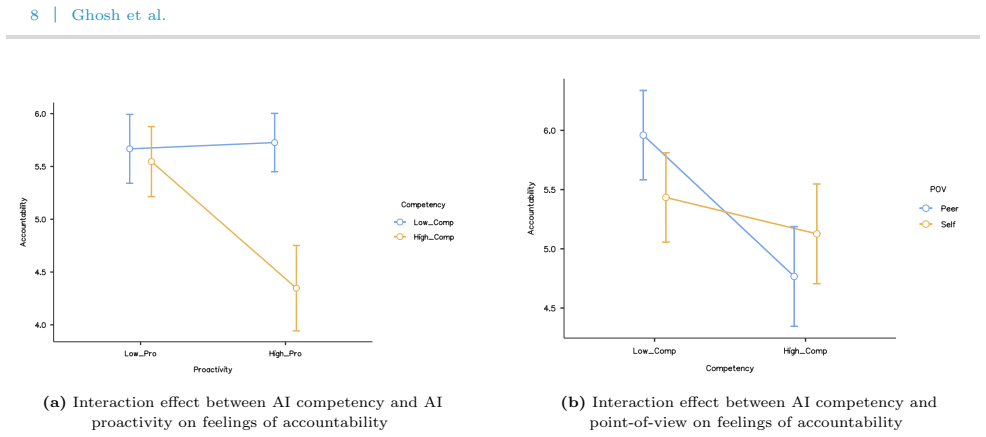
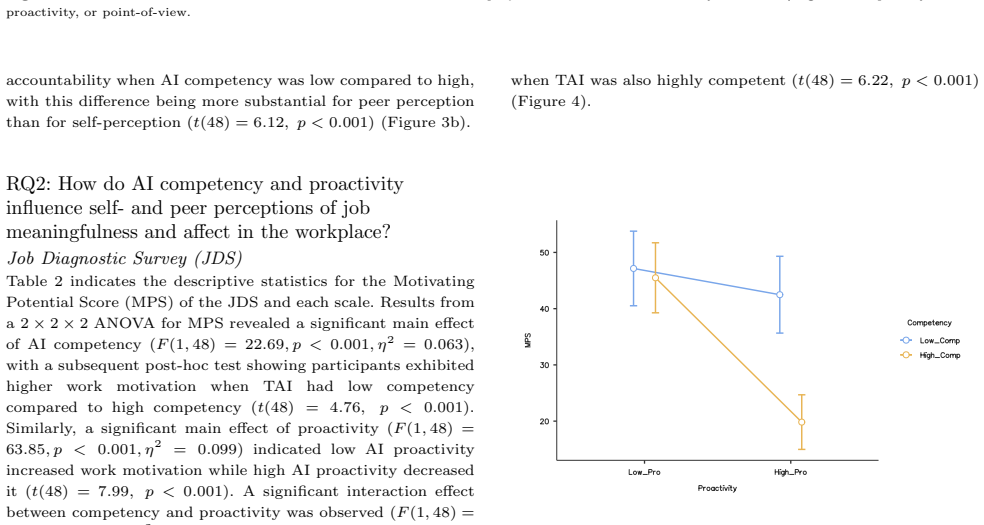
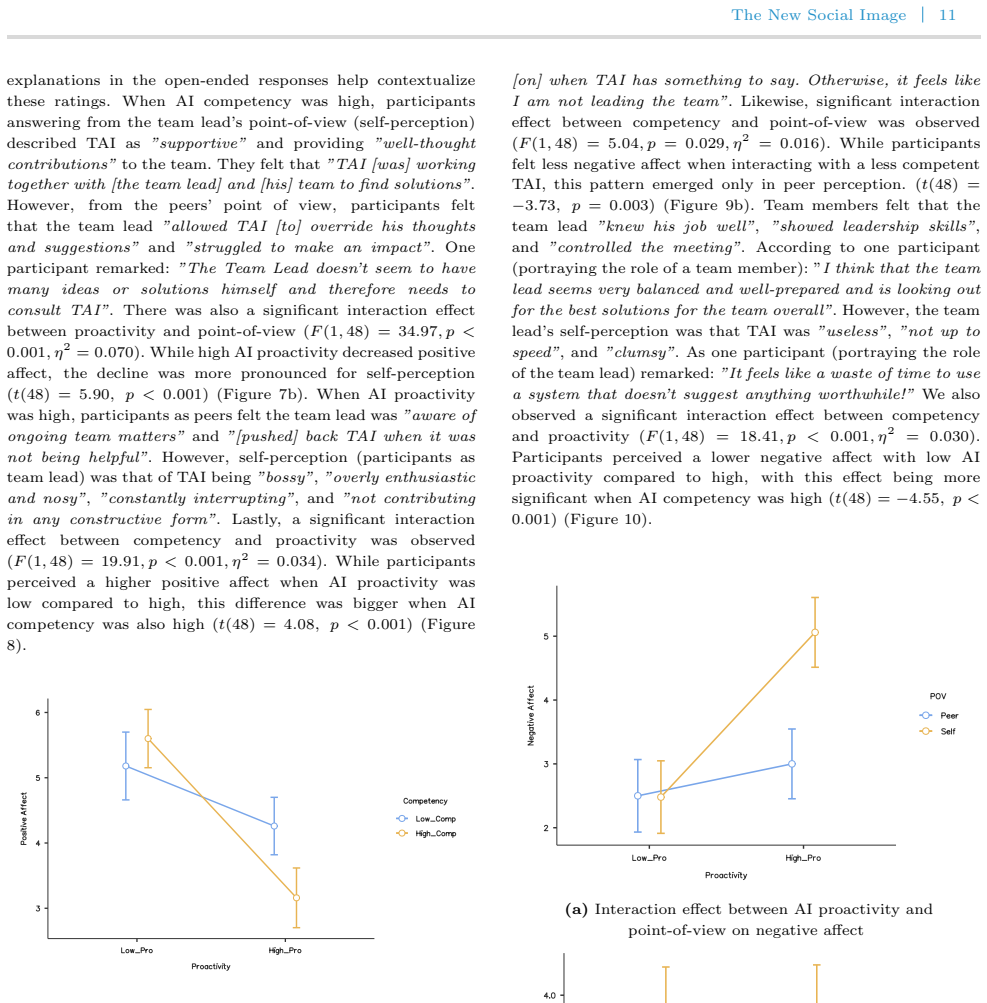
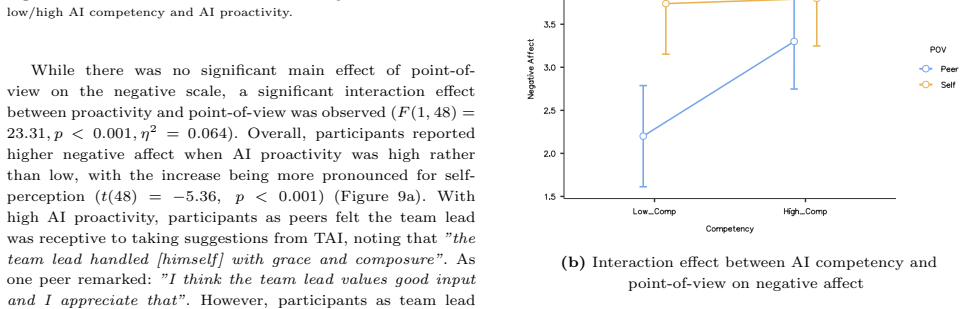
In a 2x2x2 vignette study, participants rated higher ownership, job meaningfulness, satisfaction, and positive affect when AI showed low competency or low proactivity; high levels of either produced the opposite pattern, with differences between self-perception and peer-perception conditions. The central claim is that highly competent and proactive AI-driven systems can have undesirable impacts on perceptions of ownership, job identity, social image and team dynamics, and consequently, job meaningfulness.
What carries the argument
The 2x2x2 vignette study that varies AI proactivity (low/high), AI competency (low/high), and point-of-view (self/peer) to measure effects on ownership, affect, meaningfulness, satisfaction, and role dynamics.
If this is right
- Low AI proactivity or competency tends to improve feelings of ownership, meaningfulness, and satisfaction while increasing positive affect.
- Point-of-view influences the strength of effects, such as higher job satisfaction under low proactivity appearing more in self-perception than peer-perception.
- Performance metrics alone are insufficient for AI design because high competency and proactivity can undermine role dynamics and social image.
- These perception shifts can reduce overall job meaningfulness in human-AI teams.
Where Pith is reading between the lines
- Organizations may need to calibrate AI proactivity deliberately to avoid unintended erosion of worker engagement.
- The vignette approach leaves open whether repeated real-world exposure produces stronger or weaker effects than one-time imagined scenarios.
- Similar perception trade-offs could appear in other domains where AI takes initiative, such as creative or decision-making tasks.
Load-bearing premise
Participants' ratings of imagined vignette scenarios accurately capture real-world self- and peer-perceptions when humans actually collaborate with deployed AI systems over time.
What would settle it
A longitudinal field study that measures actual changes in reported ownership and job meaningfulness before and after real teams work with high-competency, high-proactivity AI for several months.
Figures





read the original abstract
Human-AI collaboration is considered the most promising way to incorporate AI in the workplace. What remains unexplored are the experiential consequences of this teaming. More specifically, in a team with AI, how humans perceive themselves (self-perception) and how they are perceived by their coworkers (peer perception) in terms of work ownership and job meaningfulness. In a 2x2x2 vignette study (n=50), participants rated perceptions of ownership, affect, job meaningfulness and satisfaction, and role dynamics across two levels (low/high) of AI proactivity and AI competency as within-subject factors, with point-of-view (self perception/peer perception) as between-subjects. Our results showed that AI with low competency or low proactivity generally improved feelings related to ownership, meaningfulness, satisfaction, and role dynamics, and also increased positive affect while reducing negative affect. However, these effects were often influenced by point-of-view. For instance, low AI proactivity resulted in higher job satisfaction from self-perception rather than peer perception. Based on our findings, we argue that designing AI for the future of work solely around performance metrics may not be adequate. Highly competent and proactive AI-driven systems can have undesirable impacts on perceptions of ownership, job identity, social image and team dynamics, and consequently, job meaningfulness.
Editorial analysis
A structured set of objections, weighed in public.
Referee Report
Summary. The paper claims that in a 2×2×2 vignette study (n=50), low AI competency or low proactivity improves perceptions of ownership, job meaningfulness, satisfaction, affect, and role dynamics, with some effects moderated by point-of-view (self vs. peer), whereas high competency and proactivity can have undesirable impacts on these perceptions and thus on job meaningfulness. It concludes that AI design should not focus solely on performance metrics.
Significance. If the results hold, this work is significant for highlighting potential negative social and perceptual effects of advanced AI in collaborative work settings, contributing to HCI and organizational psychology by emphasizing the importance of ownership and social image in human-AI teams. It offers a cautionary note against purely performance-driven AI development.
major comments (2)
- [Abstract] Abstract: The abstract reports directional results from the factorial vignette study but provides no statistical details, effect sizes, power analysis, or handling of the between-subjects factor; with n=50 modest for the design, this undermines confidence in the data supporting the stated claims.
- [Study Design] Study Design: The central claim that high AI competency/proactivity produces undesirable effects depends on vignette ratings generalizing to real-world sustained collaboration; no evidence or discussion is provided that hypothetical self- and peer-perception scores translate outside the vignette frame where stakes and temporal exposure are absent. A concrete test would involve comparing vignette predictions to outcomes in a longitudinal field deployment.
minor comments (1)
- [Abstract] Abstract: The description of the design as 2x2x2 with within-subject for AI factors and between for POV could be clarified with more detail on analysis approach.
Simulated Author's Rebuttal
We thank the referee for their constructive feedback. We address each major comment below and describe the revisions we will make.
read point-by-point responses
-
Referee: [Abstract] Abstract: The abstract reports directional results from the factorial vignette study but provides no statistical details, effect sizes, power analysis, or handling of the between-subjects factor; with n=50 modest for the design, this undermines confidence in the data supporting the stated claims.
Authors: We agree that the abstract would be strengthened by including key statistical information. In the revised version we will add effect sizes for the primary findings and briefly note the 2×2×2 mixed design and sample size. A full power analysis and detailed statistical reporting will remain in the Methods and Results sections, as abstract length limits preclude exhaustive detail. revision: yes
-
Referee: [Study Design] Study Design: The central claim that high AI competency/proactivity produces undesirable effects depends on vignette ratings generalizing to real-world sustained collaboration; no evidence or discussion is provided that hypothetical self- and peer-perception scores translate outside the vignette frame where stakes and temporal exposure are absent. A concrete test would involve comparing vignette predictions to outcomes in a longitudinal field deployment.
Authors: We acknowledge the ecological-validity concern. We will expand the Limitations and Future Work sections to discuss the constraints of vignette methodology, including the absence of sustained interaction and real stakes, and will explicitly caution against overgeneralization. A longitudinal field deployment lies outside the scope of the present study; we will instead position such work as an important direction for follow-up research. revision: partial
Circularity Check
No circularity: empirical vignette study with direct observational results
full rationale
The paper reports a 2×2×2 vignette study (n=50) in which participants rate imagined scenarios on ownership, affect, meaningfulness, satisfaction, and role dynamics. No equations, parameter fitting, or derivations appear; results are presented as statistical main effects and interactions from participant ratings rather than quantities defined in terms of the study's own fitted values. No self-citation load-bearing steps, uniqueness theorems, or ansatzes are invoked to justify the central claims. The derivation chain consists solely of data collection and analysis, remaining self-contained against external benchmarks.
Axiom & Free-Parameter Ledger
axioms (1)
- domain assumption Vignette-based ratings validly measure real workplace self- and peer-perceptions of ownership and meaningfulness
Reference graph
Works this paper leans on
-
[1]
Ahmad, S. (2013). Paradigms of quality of work life.Journal of Human Values, 19(1), 73–82. Duffy, R. D., Blustein, D. L., Diemer, M. A., & Autin, K. L. (2016). The psychology of working theory.Journal of counseling psychology, 63(2),
2013
-
[2]
A., Autin, K
Allan, B. A., Autin, K. L., Duffy, R. D., & Sterling, H. M. (2020). Decent and meaningful work: A longitudinal study. Journal of Counseling Psychology, 67(6),
2020
-
[3]
(1974).Working: People talk about what they do all day and how they feel about what they do
Terkel, S. (1974).Working: People talk about what they do all day and how they feel about what they do. The New Press. Hom, P. W., & Griffeth, R. (1994).Employee turnover. South- Western College Publishing. Sparks, J. R., & Schenk, J. A. (2001). Explaining the effects of transformational leadership: an investigation of the effects of higher-order motives ...
1974
-
[4]
Laschke, M., Uhde, A., & Hassenzahl, M
491–511. Laschke, M., Uhde, A., & Hassenzahl, M. (2020). Positive work practices. Opportunities and challenges in designing meaningful work-related technology.arXiv preprint arXiv:2003.05533. Smids, J., Nyholm, S., & Berkers, H. (2020). Robots in the workplace: a threat to—or opportunity for—meaningful work?Philosophy & Technology, 33(3), 503–522. Baldauf...
-
[5]
Limna, P. (2023). Artificial Intelligence (AI) in the hospitality industry: A review article.International Journal of Computing Sciences Research, 7, 1306–1317. Gupta, S., Modgil, S., Lee, CK., & Sivarajah, U. (2023). The future is yesterday: Use of AI-driven facial recognition to enhance value in the travel and tourism industry. Information Systems Front...
2023
-
[6]
Castelo, N., Bos, M. W., & Lehmann, D. R. (2019). Task-dependent algorithm aversion.Journal of Marketing Research, 56(5), 809–825. Ashktorab, Z., Liao, Q. V., Dugan, C., Johnson, J., Pan, Q., Zhang, W., Kumaravel, S., & Campbell, M. (2020). Human- ai collaboration in a cooperative game setting: Measuring social perception and outcomes.Proceedings of the A...
-
[7]
G., Subi´ c, J., & Nancu, D
Sima, V., Gheorghe, I. G., Subi´ c, J., & Nancu, D. (2020). Influences of the industry 4.0 revolution on the human capital development and consumer behavior: A systematic review. Sustainability, 12(10),
2020
-
[8]
Parashar, B., Sharma, R., Rana, G., & Balaji, R. D. (2023). Foundation concepts for industry 4.0.New Horizons for Industry 4.0 in Modern Business, 51–68. Raftopoulos, M., & Hamari, J. (2023). Human-AI collaboration in organisations: A literature review on enabling value creation. Crandall, J. W., Oudah, M., Tennom, I., Ishowo-Oloko, F., Abdallah, S., Bonn...
2023
-
[9]
The future of human-AI collaboration: a taxonomy of design knowledge for hybrid intelligence systems
Akata, Z., Balliet, D., De Rijke, M., Dignum, F., Dignum, V., Eiben, G., Fokkens, A., Grossi, D., Hindriks, K., Hoos, H., Hung, H., Jonker, C., Monz, C., Neerincx, M., Oliehoek, F., Prakken, H., Schlobach, S., Van der Gaag, Linda., Van Harmelen, F., ... Welling, M. (2020). A research agenda for hybrid intelligence: Augmenting human intellect with collabor...
work page Pith review arXiv 2020
-
[10]
& Robert Jr, L
You, S., Kim, J.-H., Lee, S., Kamat, V. & Robert Jr, L. P. (2018). Enhancing perceived safety in human- robot collaborative construction using immersive virtual environments.Automation in Construction, 96, 161–170. Esterwood, C., & Robert, L. P. (2020). Human robot team design.Proceedings of the 8th International Conference on Human-Agent Interaction, 251...
2018
-
[11]
Dubey, A., Abhinav, K., Jain, S., Arora, V., & Puttaveerana, A. (2020). HACO: A framework for developing human-AI teaming.Proceedings of the 13th Innovations in Software Engineering Conference, 1–9. Hemmer, P., Schemmer, M., V¨ ossing, M., & K¨ uhl, N. (2021). Human-AI complementarity in hybrid intelligence systems: A structured literature review.PACIS,
2020
-
[12]
Should I Follow the Human, or Follow the Robot?
Holstein, K., & Aleven, V. (2022). Designing for human-AI complementarity in K-12 education.AI Magazine, 43(2), 239–248. Lui, A., & Lamb, G. W. (2018). Artificial intelligence and augmented intelligence collaboration: Regaining trust and confidence in the financial sector.Information & Communications Technology Law, 27(3), 267–283. Buckley, R. P., Zetzsch...
2022
-
[13]
Breazeal, C., Gray, J., Hoffman, G., & Berlin, M. (2004). Social robots: beyond tools to partners. 551 -
2004
-
[14]
https://doi.org/10.1109/ROMAN.2004.1374820 Cohen, P. R., & Levesque, H. J. (1991). Confirmations and joint action.Proceedings of the 12th International Joint Conference on Artificial Intelligence, 2, 951–957. Walliser, J. C., De Visser, E. J., Wiese, E., & Shaw, T. H. (2019). Team structure and team building improve human–machine teaming with autonomous a...
-
[15]
Nothdurft, F., Ultes, S., & Minker, W. (2014). Finding appropriate interaction strategies for proactive dialogue systems—an open quest.Proceedings of the 2nd 20 Ghosh et al. European and the 5th Nordic Symposium on Multimodal Communication, 73–80. Deng, Y., Lei, W., Huang, M., & Chua, T. (2023). Goal awareness for conversational AI: Proactivity, non- coll...
work page internal anchor Pith review Pith/arXiv arXiv 2014
-
[16]
H., Zhang, M., & Choudhury, T
Rabbi, M., Aung, M. H., Zhang, M., & Choudhury, T. (2015). MyBehavior: Automatic personalized health feedback from user behaviors and preferences using smartphones.Proceedings of the 2015 ACM International Joint Conference on Pervasive and Ubiquitous Computing, 707–718. Yorke-Smith, N., Saadati, S., Myers, K. L., & Morley, D. N. (2012). The design of a pr...
2015
-
[17]
Superpowers
Butz, M. V., Sigaud, O., & G´ erard, P. (2004).Anticipatory behavior in adaptive learning systems: Foundations, theories, and systems(Vol. 2684). Springer. Cerejo, J., & Carvalhais, M. (2023). Anticipation as a Tool for Designing the Future.International Conference on Design and Digital Communication, 37–52. Kraus, M., Schiller, M., Behnke, G., Bercher, P...
2004
-
[18]
The New Social Image 21 Cohen, J. (2013). Statistical power analysis for the behavioral sciences. Abbass, H. A. (2019). Social integration of artificial intelligence: Functions, automation allocation logic, and human-autonomy trust.Cognitive Computation, 11(2), 159–171. Daugherty, P. R., & Wilson, H. J. (2019). Creating the symbiotic AI workforce of the f...
2013
-
[19]
https://doi.org/10.2307/30040651 Cramarenco, R. E., Burc˘ a-Voicu, M. I., & Dabija, D. C. (2023). The impact of artificial intelligence (AI) on employees’ skills and well-being in global labor markets: A systematic review. Oeconomia Copernicana, 14(3), 731–767. Kinowska, H., & Sienkiewicz, L. J. (2023). Influence of algorithmic management practices on wor...
-
[20]
Training a Helpful and Harmless Assistant with Reinforcement Learning from Human Feedback
Rosso, B. D., Dekas, K. H., & Wrzesniewski, A. (2010). On the meaning of work: A theoretical integration and review. Research in organizational behavior, 30, 91–127. Shneiderman, B. (2022).Human-centered AI. Oxford University Press. Fanni, R., Steinkogler, V. E., Zampedri, G., & Pierson, J. (2023). Enhancing human agency through redress in Artificial Inte...
work page internal anchor Pith review Pith/arXiv arXiv 2010
discussion (0)
Sign in with ORCID, Apple, or X to comment. Anyone can read and Pith papers without signing in.