Proton High-Order Cumulants in Au+Au Collisions at High Baryon Density from JAM with a Centrality-Independent Framework
Pith reviewed 2026-06-28 18:12 UTC · model grok-4.3
The pith
The CIGAR method eliminates initial volume fluctuations from higher-order proton cumulants in JAM simulations of Au+Au collisions at 3.2–4.5 GeV.
A machine-rendered reading of the paper's core claim, the machinery that carries it, and where it could break.
Core claim
The CIGAR method effectively eliminates initial volume fluctuations from the calculation of higher-order cumulants of proton number distributions in JAM-simulated Au+Au collisions at √sNN = 3.2, 3.5, 3.9, and 4.5 GeV, yielding results that differ from those obtained with the Centrality Bin Width Correction method and that incorporate spectator effects; these JAM+CIGAR distributions therefore constitute a dynamic non-critical baseline for QCD critical point searches in the high-baryon-density regime.
What carries the argument
Centrality-Independent Genuine Cumulant Analysis fRamework (CIGAR), a centrality-independent procedure that extracts genuine cumulants by removing initial volume fluctuations without binning in centrality.
If this is right
- CIGAR produces cumulant values that are independent of the chosen centrality estimator and therefore more directly comparable across experiments.
- The JAM results at these four energies supply a concrete numerical reference for non-critical proton cumulants at high baryon density.
- Spectator nucleons contribute measurably to the cumulants and must be accounted for when interpreting data.
- Any experimental excess over the JAM+CIGAR baseline can be attributed more confidently to critical or non-equilibrium dynamics.
Where Pith is reading between the lines
- The method could be applied to other conserved quantities such as net-charge or net-strangeness cumulants within the same model.
- If other transport models produce different baselines under CIGAR, the spread would quantify model uncertainty in the non-critical reference.
- The framework may allow re-analysis of existing RHIC data at similar energies without re-deriving centrality bins.
Load-bearing premise
The JAM transport model produces proton number fluctuations that faithfully represent non-critical dynamics at these energies, so that differences between CIGAR and CBWC results can be attributed to volume removal rather than model artifacts.
What would settle it
Direct comparison of experimental proton cumulant ratios at √sNN = 3–5 GeV with the JAM+CIGAR predictions; a statistically significant deviation after experimental acceptance and efficiency corrections would falsify the claim that the baseline is purely non-critical.
Figures
read the original abstract
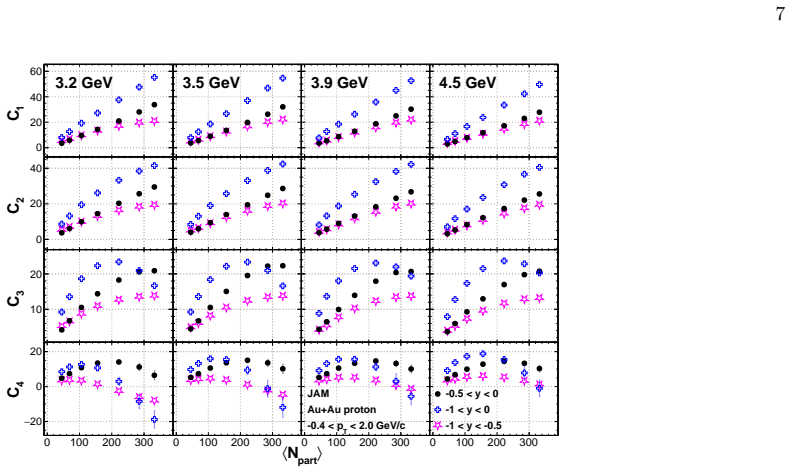
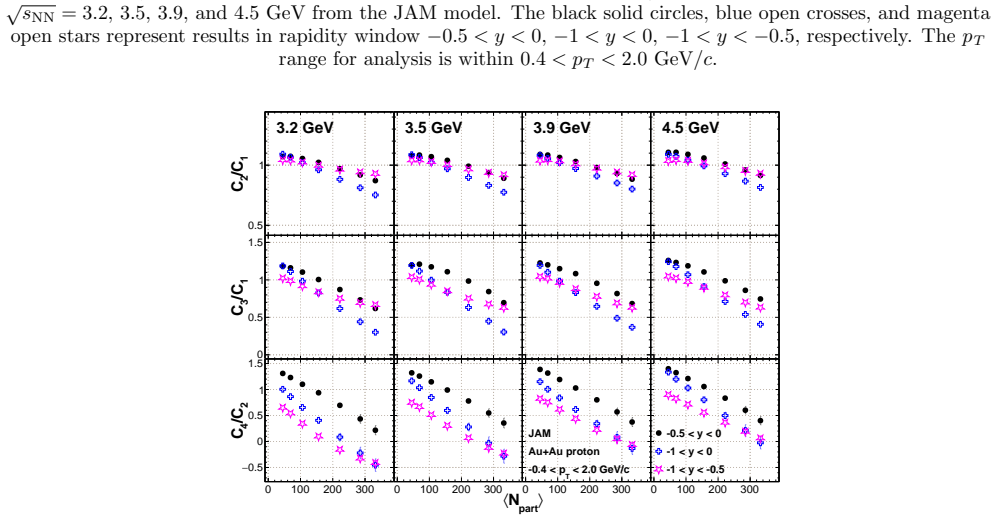
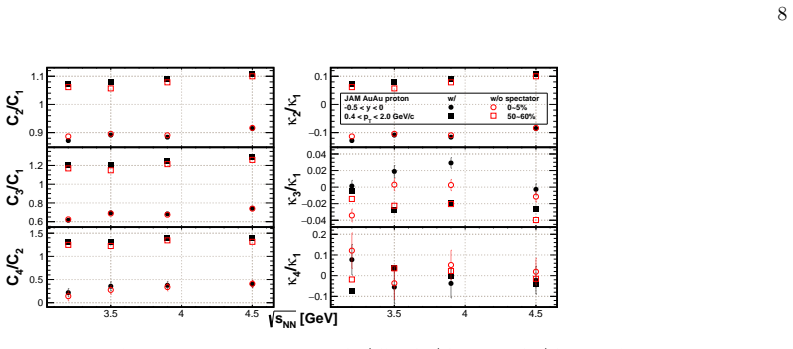
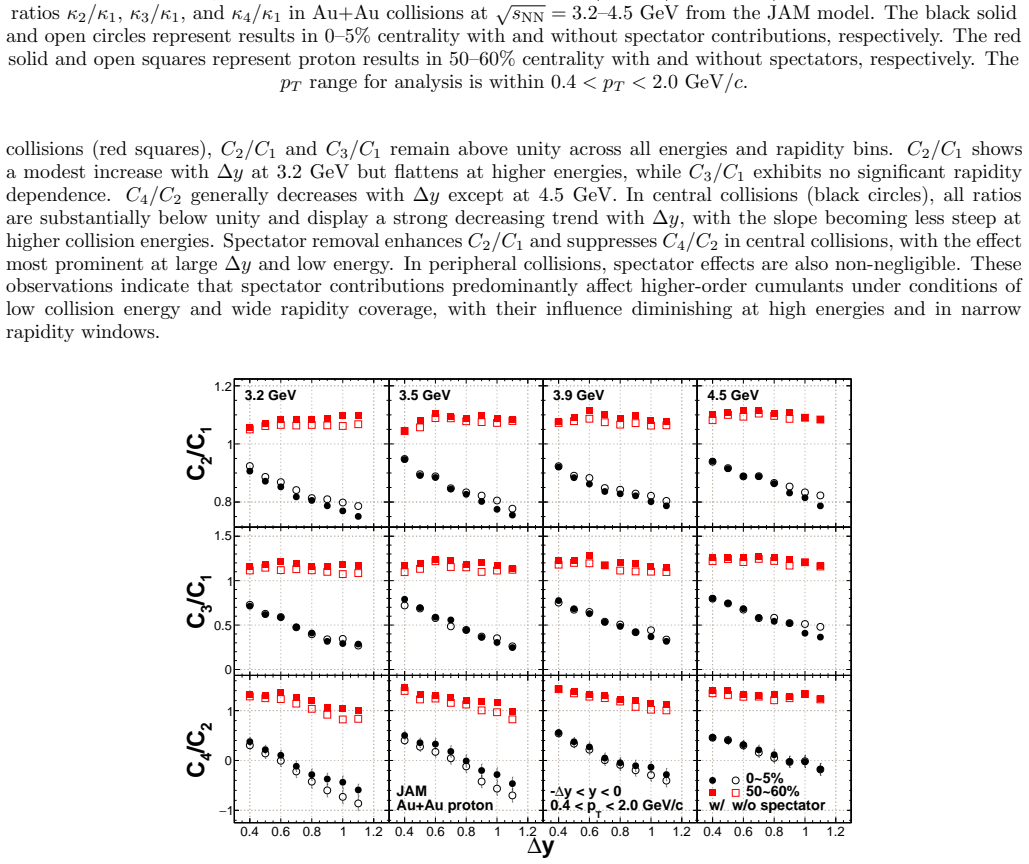
The event-by-event higher-order cumulants of conserved quantities such as net-baryon, net-electric charge, and net-strangeness in heavy-ion collisions have been extensively utilized in experimental searches for the QCD critical point, notably in the RHIC-STAR experiment. In this study, we conduct a systematic analysis of higher-order cumulants of proton number distributions in Au+Au collisions at center-of-mass energies of $\sqrt{s_{\rm NN}} = 3.2$, $3.5$, $3.9$, and $4.5$ GeV using the JAM model. We calculate cumulants, factorial cumulants, and their ratios using a novel method, Centrality-Independent Genuine Cumulant Analysis fRamework (CIGAR), which effectively eliminates initial volume fluctuations. We comprehensively compare the CIGAR method with the traditional Centrality Bin Width Correction (CBWC) method. In addition, the effect of spectators on cumulant is systematically investigated. Our results provide a dynamic non-critical baseline in the high-baryon-density regime which is crucial for QCD critical point searches in heavy-ion collisions.
Editorial analysis
A structured set of objections, weighed in public.
Referee Report
Summary. The paper computes higher-order cumulants and factorial cumulants of proton number distributions in Au+Au collisions at √s_NN = 3.2–4.5 GeV with the JAM transport model. It introduces the CIGAR framework to remove initial volume fluctuations, performs a systematic comparison against the CBWC method, examines spectator contributions, and positions the resulting JAM+CIGAR results as a dynamic non-critical baseline for QCD critical-point searches.
Significance. If the CIGAR method demonstrably isolates volume effects without model-dependent artifacts and if JAM reproduces generic non-critical proton fluctuations, the work would supply a needed reference baseline at high baryon density. The direct CIGAR–CBWC comparison and spectator study are concrete strengths that could be cited by experimental analyses.
major comments (2)
- [Results and discussion sections (comparison of CIGAR vs. CBWC)] The central claim that JAM supplies a usable non-critical baseline rests on the untested assumption that its hadronic dynamics (resonance production, baryon stopping, proton-number fluctuations) reproduce the correct non-critical behavior at these energies. No cross-validation against other transport models (e.g., UrQMD or SMASH) or against known analytic limits is presented; therefore differences between CIGAR and CBWC cannot be unambiguously attributed to volume-fluctuation removal rather than JAM-specific dynamics.
- [Method section describing CIGAR implementation] The manuscript does not quantify the residual volume-fluctuation contribution after CIGAR is applied (e.g., via a controlled test with fixed initial volume). Without such a diagnostic, the assertion that CIGAR “effectively eliminates” volume fluctuations remains an unverified modeling choice rather than a demonstrated result.
minor comments (2)
- [Abstract] The abstract states that “systematic analysis” and “comprehensive comparison” were performed but supplies no numerical values, error estimates, or key ratios; adding a short quantitative summary would improve readability.
- [Throughout] Notation for factorial cumulants versus ordinary cumulants should be defined once in the text and used consistently in all figures and tables.
Simulated Author's Rebuttal
We thank the referee for the constructive comments. We respond point-by-point below, clarifying the internal nature of the CIGAR–CBWC comparison and agreeing to add a diagnostic test for residual volume fluctuations.
read point-by-point responses
-
Referee: [Results and discussion sections (comparison of CIGAR vs. CBWC)] The central claim that JAM supplies a usable non-critical baseline rests on the untested assumption that its hadronic dynamics (resonance production, baryon stopping, proton-number fluctuations) reproduce the correct non-critical behavior at these energies. No cross-validation against other transport models (e.g., UrQMD or SMASH) or against known analytic limits is presented; therefore differences between CIGAR and CBWC cannot be unambiguously attributed to volume-fluctuation removal rather than JAM-specific dynamics.
Authors: We note that both CIGAR and CBWC results are derived from the identical set of JAM events. Consequently, observed differences between the methods can be attributed only to their respective treatments of volume fluctuations, not to differences in the underlying hadronic dynamics. We will revise the text to state this explicitly and to place the JAM choice in the context of prior validations for baryon stopping at these energies. revision: partial
-
Referee: [Method section describing CIGAR implementation] The manuscript does not quantify the residual volume-fluctuation contribution after CIGAR is applied (e.g., via a controlled test with fixed initial volume). Without such a diagnostic, the assertion that CIGAR “effectively eliminates” volume fluctuations remains an unverified modeling choice rather than a demonstrated result.
Authors: We agree that a controlled diagnostic would strengthen the claim. In the revised manuscript we will add a test using events generated with fixed initial volume to quantify any residual fluctuations remaining after CIGAR and report the outcome. revision: yes
Circularity Check
No circularity: JAM simulation and CIGAR method supply independent baseline
full rationale
The paper's central claim rests on running the external JAM transport model to generate proton-number cumulants at the stated energies, then applying the CIGAR centrality-independent framework to remove volume fluctuations and comparing the output to the standard CBWC procedure. No equation, parameter fit, or result is shown to be defined in terms of the target cumulant ratios themselves; the model dynamics (resonance production, baryon stopping) are treated as an independent input whose outputs serve as the non-critical reference. Self-citations are not invoked as load-bearing uniqueness theorems, and no ansatz or renaming reduces the reported baseline to a tautology. The derivation chain therefore remains self-contained against external benchmarks.
Axiom & Free-Parameter Ledger
Reference graph
Works this paper leans on
- [1]
- [2]
-
[3]
X. Luo, Q. Wang, N. Xu, and P. Zhuang, eds.,Properties of QCD Matter at High Baryon Density(Springer, 2022), ISBN 978-981-19-4440-6, 978-981-19-4443-7, 978-981-19-4441-3
2022
-
[4]
D. A. Clarke, P. Dimopoulos, F. Di Renzo, J. Goswami, C. Schmidt, S. Singh, and K. Zambello, Phys. Rev. D112, L091504 (2025), 2405.10196
arXiv 2025
-
[5]
M. Hippert, J. Grefa, T. A. Manning, J. Noronha, J. Noronha-Hostler, I. P. Vazquez, C. Ratti, R. Rougemont, and M. Trujillo, Phys. Rev. D110, 094006 (2024), URL https://link.aps.org/doi/10.1103/PhysRevD.110.094006
-
[6]
W.-j. Fu, J. M. Pawlowski, and F. Rennecke, Phys. Rev. D101, 054032 (2020), URL https://link.aps.org/doi/10.1103/ PhysRevD.101.054032
2020
-
[7]
P. J. Gunkel and C. S. Fischer, Phys. Rev. D104, 054022 (2021), URL https://link.aps.org/doi/10.1103/PhysRevD.104. 054022
- [8]
- [9]
-
[10]
R.-G. Cai, S. He, L. Li, and H.-A. Zeng, Sci. China Phys. Mech. Astron.69, 240414 (2026), 2406.12772
arXiv 2026
-
[11]
L. Zhu, X. Chen, K. Zhou, H. Zhang, and M. Huang, Phys. Rev. D112, 026019 (2025), 2501.17763
arXiv 2025
-
[12]
X. Luo and N. Xu, Nucl. Sci. Tech.28, 112 (2017), 1701.02105, URL https://link.springer.com/article/10.1007/ s41365-017-0257-0
Pith/arXiv arXiv 2017
-
[13]
M. A. Stephanov, Phys. Rev. Lett.102, 032301 (2009), 0809.3450
Pith/arXiv arXiv 2009
-
[14]
Asakawa and M
M. Asakawa and M. Kitazawa, Progress in Particle and Nuclear Physics90, 299 (2016), ISSN 0146-6410, URL https: //www.sciencedirect.com/science/article/pii/S0146641016300023
2016
-
[15]
M. Kitazawa and X. Luo, Phys. Rev. C96, 024910 (2017), URL https://link.aps.org/doi/10.1103/PhysRevC.96.024910
-
[16]
Z. Li, Y. Chen, D. Li, and M. Huang, Chin. Phys. C42, 013103 (2018), 1706.02238
Pith/arXiv arXiv 2018
-
[17]
Z. Li, K. Xu, X. Wang, and M. Huang, Eur. Phys. J. C79, 245 (2019), 1801.09215
Pith/arXiv arXiv 2019
-
[18]
W.-j. Fu, X. Luo, J. M. Pawlowski, F. Rennecke, and S. Yin, Phys. Rev. D111, L031502 (2025), 2308.15508
arXiv 2025
-
[19]
Y. Lu, C. S. Fischer, F. Gao, Y.-x. Liu, and J. M. Pawlowski (2026), 2603.09336
arXiv 2026
-
[20]
M. M. Aggarwal, Z. Ahammed, A. V. Alakhverdyants, I. Alekseev, J. Alford, B. D. Anderson, D. Arkhipkin, G. S. Averichev, J. Balewski, L. S. Barnby, et al. (STAR Collaboration), Phys. Rev. Lett.105, 022302 (2010), URL https: //link.aps.org/doi/10.1103/PhysRevLett.105.022302
-
[21]
Adamczyk, J
L. Adamczyk, J. K. Adkins, G. Agakishiev, M. M. Aggarwal, Z. Ahammed, I. Alekseev, J. Alford, C. D. Anson, A. Aparin, D. Arkhipkin, et al. (STAR Collaboration), Phys. Rev. Lett.112, 032302 (2014), URL https://link.aps.org/doi/10.1103/ PhysRevLett.112.032302
2014
-
[22]
Adamczyk, J
L. Adamczyk, J. K. Adkins, G. Agakishiev, M. M. Aggarwal, Z. Ahammed, I. Alekseev, J. Alford, C. D. Anson, A. Aparin, D. Arkhipkin, et al. (STAR Collaboration), Phys. Rev. Lett.113, 092301 (2014), URL https://link.aps.org/doi/10.1103/ PhysRevLett.113.092301. 10
2014
-
[23]
J. Adam, L. Adamczyk, J. R. Adams, J. K. Adkins, G. Agakishiev, M. M. Aggarwal, Z. Ahammed, I. Alekseev, D. M. Anderson, R. Aoyama, et al. (STAR Collaboration), Phys. Rev. C100, 014902 (2019), URL https://link.aps.org/doi/10. 1103/PhysRevC.100.014902
2019
-
[24]
J. Adam, L. Adamczyk, J. R. Adams, J. K. Adkins, G. Agakishiev, M. M. Aggarwal, Z. Ahammed, I. Alekseev, D. M. Anderson, A. Aparin, et al. (STAR Collaboration), Phys. Rev. Lett.126, 092301 (2021), URL https://link.aps.org/doi/ 10.1103/PhysRevLett.126.092301
-
[25]
M. S. Abdallah, J. Adam, L. Adamczyk, J. R. Adams, J. K. Adkins, G. Agakishiev, I. Aggarwal, M. M. Aggarwal, Z. Ahammed, I. Alekseev, et al. (STAR Collaboration), Phys. Rev. C104, 024902 (2021), URL https://link.aps.org/doi/ 10.1103/PhysRevC.104.024902
-
[26]
M. S. Abdallah, J. Adam, L. Adamczyk, J. R. Adams, J. K. Adkins, G. Agakishiev, I. Aggarwal, M. M. Aggarwal, Z. Ahammed, I. Alekseev, et al. (STAR Collaboration), Phys. Rev. Lett.127, 262301 (2021), URL https://link.aps.org/ doi/10.1103/PhysRevLett.127.262301
-
[27]
B. E. Aboona, J. Adam, L. Adamczyk, J. R. Adams, I. Aggarwal, M. M. Aggarwal, Z. Ahammed, D. M. Anderson, E. C. Aschenauer, J. Atchison, et al. (STAR Collaboration), Phys. Rev. Lett.130, 082301 (2023), URL https://link.aps.org/ doi/10.1103/PhysRevLett.130.082301
-
[28]
J. Chen et al., Nucl. Sci. Tech.35, 214 (2024), 2407.02935, URL https://link.springer.com/article/10.1007/ s41365-024-01591-2
arXiv 2024
-
[29]
B. E. Aboona et al. (STAR), Phys. Rev. Lett.135, 142301 (2025), 2504.00817
arXiv 2025
-
[30]
M. S. Abdallah, B. E. Aboona, J. Adam, L. Adamczyk, J. R. Adams, J. K. Adkins, I. Aggarwal, M. M. Aggarwal, Z. Ahammed, D. M. Anderson, et al. (The STAR Collaboration), Phys. Rev. C107, 024908 (2023), URL https://link.aps. org/doi/10.1103/PhysRevC.107.024908
-
[31]
X. Luo, J. Xu, B. Mohanty, and N. Xu, Journal of Physics G: Nuclear and Particle Physics40, 105104 (2013), URL https://doi.org/10.1088/0954-3899/40/10/105104
-
[32]
Wang and X
Z. Wang and X. Luo, Physics Letters B871, 139984 (2025), ISSN 0370-2693, URL https://www.sciencedirect.com/science/ article/pii/S0370269325007427
2025
-
[33]
Nara, EPJ Web Conf.208, 11004 (2019)
Y. Nara, EPJ Web Conf.208, 11004 (2019)
2019
-
[34]
Y. Nara, N. Otuka, A. Ohnishi, K. Niita, and S. Chiba, Phys. Rev. C61, 024901 (1999), URL https://link.aps.org/doi/ 10.1103/PhysRevC.61.024901
-
[35]
S. He, X. Luo, Y. Nara, S. Esumi, and N. Xu, Physics Letters B762, 296 (2016), 1607.06376
Pith/arXiv arXiv 2016
-
[36]
Zhang, S
Y. Zhang, S. He, H. Liu, Z. Yang, and X. Luo, Phys. Rev. C101, 034909 (2020), URL https://link.aps.org/doi/10.1103/ PhysRevC.101.034909
2020
-
[37]
A. Chatterjee, Y. Zhang, H. Liu, R. Wang, S. He, and X. Luo, Chinese Physics C45, 064003 (2021), 2009.03755
arXiv 2021
-
[38]
O. Savchuk, Phys. Rev. C111, 024913 (2025), URL https://link.aps.org/doi/10.1103/PhysRevC.111.024913
-
[39]
S. He, X. Luo, Y. Nara, S. Esumi, and N. Xu, Physics Letters B762, 296 (2016), ISSN 0370-2693, URL https://www. sciencedirect.com/science/article/pii/S0370269316305585
2016
-
[40]
Sweger and S
Z. Sweger and S. Collaboration, inProceedings of the 31st International Conference on Ultra-relativistic Nucleus-Nucleus Collisions (Quark Matter 2025)(2025), oral presentation
2025
-
[41]
CBM Collaboration,Cbm progress report 2023, Online (2023), accessed on 16 June 2025, URL https://doi.org/10.15120/ GSI-2024-00765
2023
discussion (0)
Sign in with ORCID, Apple, or X to comment. Anyone can read and Pith papers without signing in.