An Exploratory Study into using Machine-Learning for Fast Step-by-step Emulation of Numerical Mechanical Thrombectomy Simulations for Ischemic Stroke
Pith reviewed 2026-06-28 18:49 UTC · model grok-4.3
The pith
Machine learning surrogates accurately predict single steps of mechanical thrombectomy simulations with large speedups but become unstable over longer autoregressive runs in complex geometries.
A machine-rendered reading of the paper's core claim, the machinery that carries it, and where it could break.
Core claim
Surrogate models trained on simulation data can accurately predict individual time steps of mechanical thrombectomy simulations and deliver large computational speedups, but they lose stability when used autoregressively to emulate full sequences in geometries of realistic complexity.
What carries the argument
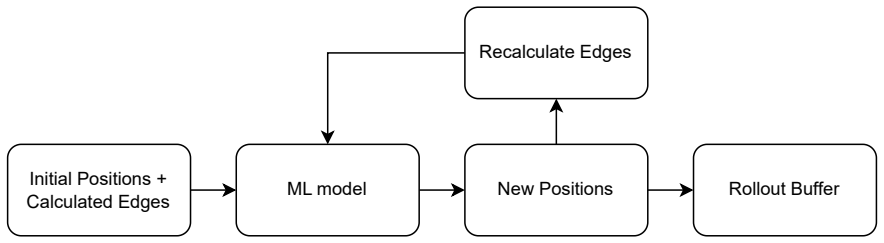
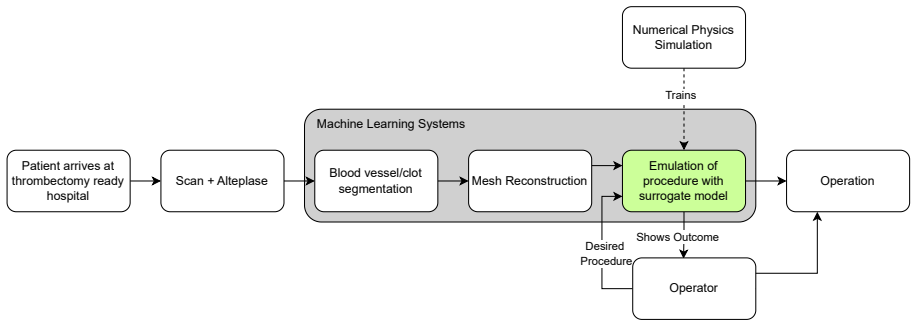
Step-by-step machine learning surrogate models trained to replace the numerical solver at each time increment of the aspiration procedure.
If this is right
- Single-step surrogates can replace the solver for short segments or simple geometries where stability is not required.
- Specific data augmentations measurably raise single-step accuracy and speedup.
- The current approach cannot yet replace full simulations for realistic patient geometries over clinically relevant time scales.
Where Pith is reading between the lines
- Adding physics-based loss terms or constraint layers during training could reduce drift in long rollouts.
- Hybrid schemes that periodically correct the surrogate with a short full-physics segment might extend usable horizon without losing all speed gains.
- If stability is achieved, the same training pipeline could be applied to other interventional radiology simulations that currently run too slowly for intra-procedural use.
Load-bearing premise
Single-step accuracy will carry over to stable, long-horizon autoregressive predictions without external correction or retraining.
What would settle it
Compare the final clot position and flow field after 500 autoregressive surrogate steps against a full numerical run on the same complex geometry; large divergence would falsify stability.
Figures
read the original abstract
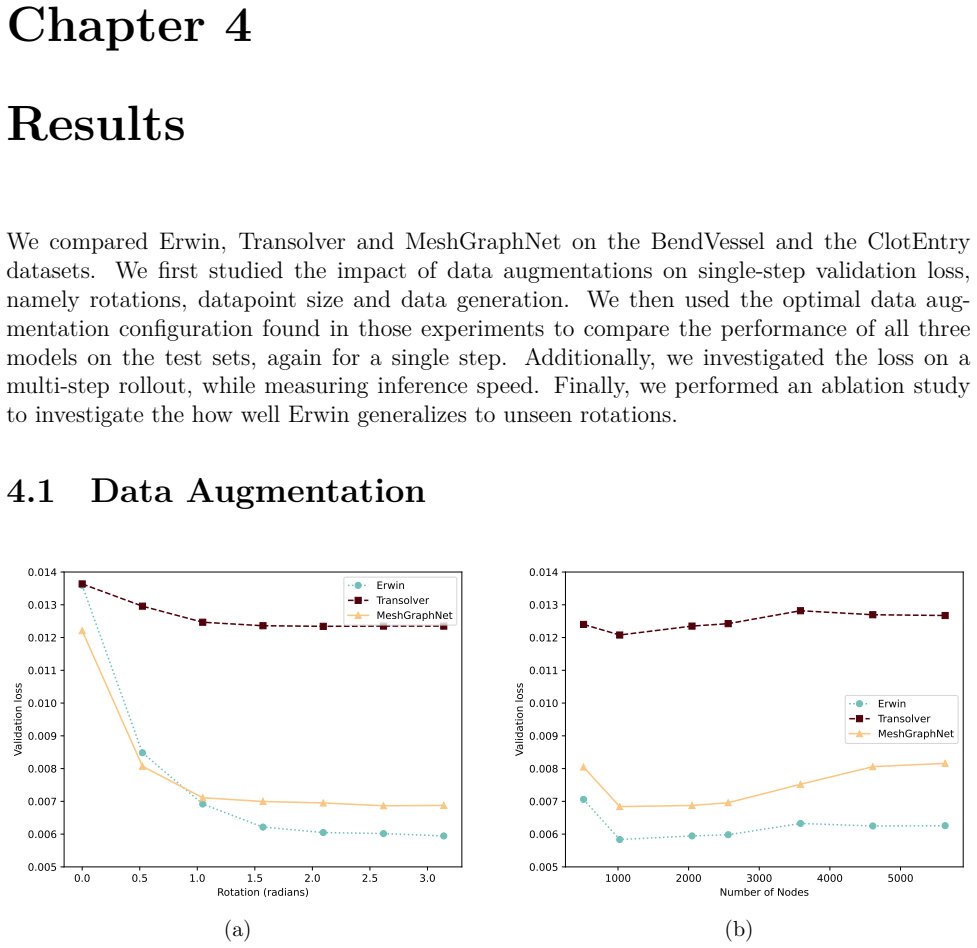
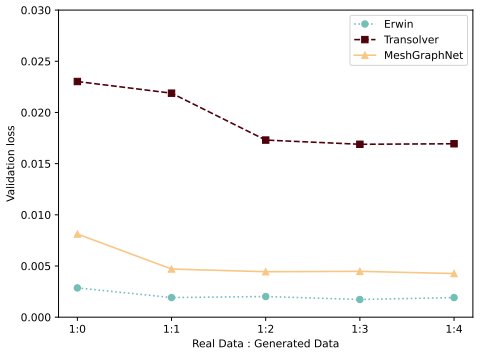
The treatment of ischemic stroke using mechanical thrombectomy involves difficult decisions under intense time constraints. Numerical physics simulations can in theory inform operators to make better decisions regarding treatment approaches and device selection, but are too slow to do so in practice. In this thesis, we investigate if current machine learning based surrogates can accurately emulate these simulations in a step-by-step manner while making them significantly faster. To do this we train three surrogate models on two simulations that involve a simplified aspiration procedure, with varying levels of geometric complexity. Our results show that two of our models accurately predict singular simulation steps and provide substantial speedups, especially when combined with specific data augmentations. However, the models showed a lack of stability when emulating simulations with complex geometries over longer time periods. Overall, this work provides a foundation for future studies to develop stable methods that scale to realistic numerical physics simulations of mechanical thrombectomy.
Editorial analysis
A structured set of objections, weighed in public.
Referee Report
Summary. The manuscript is an exploratory study examining whether machine-learning surrogates can emulate step-by-step numerical simulations of mechanical thrombectomy for ischemic stroke. Three surrogate models are trained on data from two simplified aspiration simulations that differ in geometric complexity. The central claims are that two of the models produce accurate single-step predictions and yield substantial speedups (especially with data augmentations), while autoregressive rollouts become unstable on complex geometries over longer time horizons. The work positions itself as providing a foundation for future stable, scalable emulators rather than delivering a production-ready solution.
Significance. If the single-step accuracy and speedup claims are substantiated with quantitative evidence, the study would usefully document the practical difficulties of applying current ML surrogate techniques to even modestly complex hemodynamics problems. The explicit acknowledgment that multi-step stability fails on realistic geometries is a strength, as it correctly bounds the scope and identifies the central open challenge. However, the reliance on highly simplified geometries and the absence of reported metrics limit the immediate impact on either the ML-for-physics or computational-medicine communities.
major comments (2)
- [Abstract] Abstract: the assertion that 'two of our models accurately predict singular simulation steps' is presented without any quantitative metrics, error measures, baseline comparisons, training-set sizes, or architecture details. Because this is the primary positive result, the lack of supporting numbers makes the claim impossible to evaluate.
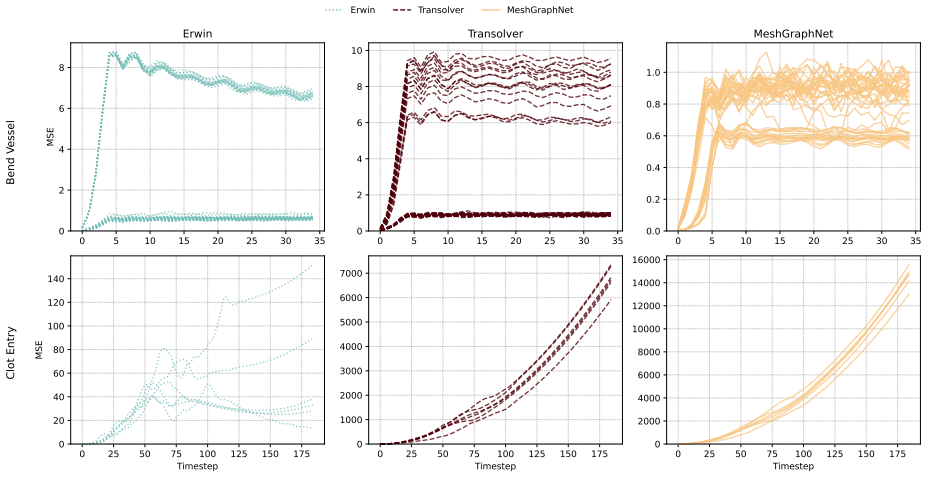
- [Abstract] The manuscript reports instability under autoregressive rollout but provides no quantitative characterization (e.g., divergence time, error growth rates, or dependence on geometry complexity). This omission is load-bearing for the paper's own stated boundary condition.
minor comments (2)
- The abstract and introduction should explicitly name the three surrogate model families and the two simulation geometries so readers can immediately understand the experimental scope.
- Clarify whether the reported speedups include data-generation overhead or only inference time; this distinction is important for assessing practical utility.
Simulated Author's Rebuttal
We thank the referee for the constructive feedback on our exploratory study. We agree that the abstract would benefit from including key quantitative metrics to better support the central claims and will revise it accordingly.
read point-by-point responses
-
Referee: [Abstract] Abstract: the assertion that 'two of our models accurately predict singular simulation steps' is presented without any quantitative metrics, error measures, baseline comparisons, training-set sizes, or architecture details. Because this is the primary positive result, the lack of supporting numbers makes the claim impossible to evaluate.
Authors: The full manuscript details these elements in the Methods (model architectures, training-set sizes from the two simulations) and Results (error measures such as field-wise L2 norms, baseline comparisons to the numerical solver, and speedup factors) sections. We agree the abstract should be self-contained and will revise it to include summary quantitative values for single-step accuracy and speedups. revision: yes
-
Referee: [Abstract] The manuscript reports instability under autoregressive rollout but provides no quantitative characterization (e.g., divergence time, error growth rates, or dependence on geometry complexity). This omission is load-bearing for the paper's own stated boundary condition.
Authors: We agree that quantitative characterization strengthens the stated limitations. The manuscript qualitatively describes the instability for complex geometries over longer horizons; we will revise the abstract and results to add metrics such as divergence time steps and error growth rates as a function of geometry complexity. revision: yes
Circularity Check
No significant circularity detected
full rationale
This paper is an empirical ML training study that generates simulation data from two simplified aspiration procedures, trains three surrogate models, and reports measured single-step prediction accuracy plus wall-clock speedups on held-out steps. No derivations, equations, or self-referential predictions appear; the central claims rest on direct comparison to external simulation outputs rather than any reduction to fitted inputs or self-citations. The acknowledged instability under autoregressive rollout on complex geometries is explicitly reported as a boundary condition, not an unexamined assumption.
Axiom & Free-Parameter Ledger
Reference graph
Works this paper leans on
-
[1]
Global burden, risk factor analysis, and prediction study of ischemic stroke, 1990–2030
Jiahui Fan, Xiaoguang Li, Xueying Yu, Zhenqiu Liu, Yanfeng Jiang, Yibin Fang, Ming Zong, Chen Suo, Qiuhong Man, and Lize Xiong. Global burden, risk factor analysis, and prediction study of ischemic stroke, 1990–2030. Neurology, 101(2):e137–e150, 2023
1990
-
[2]
Endovascular treat- ment for acute ischaemic stroke in routine clinical practice: prospective, observational cohort study (mr clean registry)
Ivo GH Jansen, Maxim JHL Mulder, and Robert-Jan B Goldhoorn. Endovascular treat- ment for acute ischaemic stroke in routine clinical practice: prospective, observational cohort study (mr clean registry). bmj, 360, 2018
2018
-
[3]
Trends in acute ischemic stroke treatments and mortality in the united states from 2012 to 2018
Sharath Kumar Anand, William J Benjamin, Arjun Rohit Adapa, Jiwon V Park, D Andrew Wilkinson, Badih J Daou, James F Burke, and Aditya S Pandey. Trends in acute ischemic stroke treatments and mortality in the united states from 2012 to 2018. Neurosurgical focus, 51(1):E2, 2021
2012
-
[4]
Treatments in ischemic stroke: current and future
Maria Giulia Mosconi and Maurizio Paciaroni. Treatments in ischemic stroke: current and future. European Neurology, 85(5):349–366, 2022
2022
-
[5]
Overview of mechanical thrombec- tomy techniques
Stephan A Munich, Kunal Vakharia, and Elad I Levy. Overview of mechanical thrombec- tomy techniques. Neurosurgery, 85(suppl_1):S60–S67, 2019
2019
-
[6]
First pass effect: a new measure for stroke thrombectomy devices
Osama O Zaidat, Alicia C Castonguay, Italo Linfante, Rishi Gupta, Coleman O Martin, William E Holloway, Nils Mueller-Kronast, Joey D English, Guilherme Dabus, Tim W Malisch, et al. First pass effect: a new measure for stroke thrombectomy devices. Stroke, 49(3):660–666, 2018
2018
-
[7]
Risk of thrombus fragmentation during endovascular stroke treatment
J Kaesmacher, T Boeckh-Behrens, S Simon, C Maegerlein, JF Kleine, C Zimmer, L Schirmer, H Poppert, and T Huber. Risk of thrombus fragmentation during endovascular stroke treatment. American Journal of Neuroradiology , 38(5):991–998, 2017
2017
-
[8]
Why does mechanical thrombectomy in large vessel occlusion some- times fail? a review of the literature
Leonard LL Yeo, Pervinder Bhogal, Anil Gopinathan, Yang Cunli, Benjamin Tan, and Tommy Andersson. Why does mechanical thrombectomy in large vessel occlusion some- times fail? a review of the literature. Clinical Neuroradiology, 29(3):401–414, 2019
2019
-
[9]
Lapergue, R
B. Lapergue, R. Blanc, B. Gory, et al. Effect of endovascular contact aspiration vs stent retriever on revascularization in patients with acute ischemic stroke and large vessel oc- clusion: The aster randomized clinical trial. JAMA, 318(5):443–452, 2017
2017
-
[10]
Computational modeling of interventional and implantable endovascular devices
Mahdi Daei Daei. Computational modeling of interventional and implantable endovascular devices. PhD thesis, Institut Polytechnique de Paris, 2023
2023
-
[11]
The first virtual patient-specific thrombectomy procedure
Giulia Luraghi, Sara Bridio, Jose Felix Rodriguez Matas, Gabriele Dubini, Nikki Boodt, Frank JH Gijsen, Aad van der Lugt, Behrooz Fereidoonnezhad, Kevin M Moerman, Patrick McGarry, et al. The first virtual patient-specific thrombectomy procedure. Journal of Biomechanics, 126:110622, 2021. 36
2021
-
[12]
Simulation of stent retriever thrombectomy in acute ischemic stroke by finite element analysis
Ronghui Liu, Chang Jin, Lizhen Wang, Yisong Yang, Yubo Fan, and Weidong Wang. Simulation of stent retriever thrombectomy in acute ischemic stroke by finite element analysis. Computer Methods in Biomechanics and Biomedical Engineering , 25(7):740–749, 2022
2022
-
[13]
Time-based decision making for reperfusion in acute ischemic stroke
Mathias Grøan, Johanna Ospel, Soffien Ajmi, Else Charlotte Sandset, Martin W Kurz, Mona Skjelland, and Rajiv Advani. Time-based decision making for reperfusion in acute ischemic stroke. Frontiers in Neurology, 12:728012, 2021
2021
-
[14]
Diag- nosis and management of acute ischemic stroke: speed is critical
Tapuwa D Musuka, Stephen B Wilton, Mouhieddin Traboulsi, and Michael D Hill. Diag- nosis and management of acute ischemic stroke: speed is critical. Cmaj, 187(12):887–893, 2015
2015
-
[15]
Neural operator: Learning maps between function spaces
Zongyi Li. Neural operator: Learning maps between function spaces. In 2021 Fall Western Sectional Meeting. AMS, 2021
2021
-
[16]
Multi-scale time-stepping of partial differential equations with transformers
AmirPouya Hemmasian and Amir Barati Farimani. Multi-scale time-stepping of partial differential equations with transformers. Computer Methods in Applied Mechanics and Engineering, 426:116983, 2024
2024
-
[17]
Predicting clinical outcomes of large vessel occlusion before mechanical thrombectomy using machine learning
Hidehisa Nishi, Naoya Oishi, Akira Ishii, Isao Ono, Takenori Ogura, Tadashi Sunohara, Hideo Chihara, Ryu Fukumitsu, Masakazu Okawa, Norikazu Yamana, et al. Predicting clinical outcomes of large vessel occlusion before mechanical thrombectomy using machine learning. Stroke, 50(9):2379–2388, 2019
2019
-
[18]
A machine learning approach to investigate the relationship between shape features and numerically predicted risk of ascending aortic aneurysm
Liang Liang, Minliang Liu, Caitlin Martin, John A Elefteriades, and Wei Sun. A machine learning approach to investigate the relationship between shape features and numerically predicted risk of ascending aortic aneurysm. Biomechanics and modeling in mechanobiol- ogy, 16(5):1519–1533, 2017
2017
-
[19]
Learn- ing mesh-based simulation with graph networks
Tobias Pfaff, Meire Fortunato, Alvaro Sanchez-Gonzalez, and Peter Battaglia. Learn- ing mesh-based simulation with graph networks. In International conference on learning representations, 2020
2020
-
[20]
Transolver: A Fast Transformer Solver for PDEs on General Geometries
Haixu Wu, Huakun Luo, Haowen Wang, Jianmin Wang, and Mingsheng Long. Tran- solver: A fast transformer solver for pdes on general geometries (2024). URL https://arxiv. org/abs/2402.02366, 2024
work page internal anchor Pith review Pith/arXiv arXiv 2024
-
[21]
Maksim Zhdanov, Max Welling, and Jan-Willem van de Meent. Erwin: A tree-based hierarchical transformer for large-scale physical systems. arXiv preprint arXiv:2502.17019 , 2025
-
[22]
Occurrence of intracranial large vessel occlusion in consecutive, non-referred pa- tients with acute ischemic stroke
Debbie Beumer, Maxim JHL Mulder, Ghesrouw Saiedie, Susanne Fonville, Robert J van Oostenbrugge, Wim H van Zwam, Philip J Homburg, Aad van der Lugt, and Diederik WJ Dippel. Occurrence of intracranial large vessel occlusion in consecutive, non-referred pa- tients with acute ischemic stroke. Neurovascular Imaging, 2(1):11, 2016
2016
-
[23]
Variations in the configuration of the circle of willis
Kanchan Kapoor, Balbir Singh, and Inder Jit Dewan. Variations in the configuration of the circle of willis. Anatomical science international , 83(2):96–106, 2008
2008
-
[24]
Geometry and symmetry of willis’ circle and middle cerebral artery aneurysms development
Carmelo Lucio Sturiale, Alba Scerrati, Luca Ricciardi, Oriela Rustemi, Anna Maria Au- ricchio, Nicolò Norri, Amedeo Piazza, Fabio Raneri, Alberto Benato, Alessio Albanese, et al. Geometry and symmetry of willis’ circle and middle cerebral artery aneurysms development. Journal of Clinical Medicine , 13(10):2808, 2024. 37
2024
-
[25]
Indications for mechani- cal thrombectomy for acute ischemic stroke: current guidelines and beyond
Ashutosh P Jadhav, Shashvat M Desai, and Tudor G Jovin. Indications for mechani- cal thrombectomy for acute ischemic stroke: current guidelines and beyond. Neurology, 97(20_Supplement_2):S126–S136, 2021
2021
-
[26]
Fea- sibility of distal mechanical thrombectomy in m3, a3 and p3 segments via a 0.013-inch delivery system: preliminary experience
Yilmaz Onal, Murat Velioglu, Ugur Demir, Erhan Celikoglu, and Hakki M Karakas. Fea- sibility of distal mechanical thrombectomy in m3, a3 and p3 segments via a 0.013-inch delivery system: preliminary experience. Turk Neurosurg, 30(4):614–620, 2020
2020
-
[27]
The anatomy of the posterior communicating artery as a risk factor for ischemic cerebral infarction
Don F Schomer, Michael P Marks, Gary K Steinberg, Iain M Johnstone, Derek B Boothroyd, Michael R Ross, Norbert J Pelc, and Dieter R Enzmann. The anatomy of the posterior communicating artery as a risk factor for ischemic cerebral infarction. New England Journal of Medicine , 330(22):1565–1570, 1994
1994
-
[28]
Development of synthetic thrombus models to simulate stroke treatment in a physical neurointerventional training model
Nadine Wortmann, Thomas Andersek, Helena Guerreiro, Anna A Kyselyova, Andreas M Frölich, Jens Fiehler, and Dieter Krause. Development of synthetic thrombus models to simulate stroke treatment in a physical neurointerventional training model. All Life , 15(1):283–301, 2022
2022
-
[29]
Thrombus composition and efficacy of throm- bolysis and thrombectomy in acute ischemic stroke
Precious Jolugbo and Robert AS Ariens. Thrombus composition and efficacy of throm- bolysis and thrombectomy in acute ischemic stroke. Stroke, 52(3):1131–1142, 2021
2021
-
[30]
Acute ischemic stroke thrombi have an outer shell that impairs fibrinolysis
Lucas Di Meglio, Jean-Philippe Desilles, Véronique Ollivier, Mialitiana Solo Nomenjana- hary, Sara Di Meglio, Catherine Deschildre, Stéphane Loyau, Jean-Marc Olivot, Raphaël Blanc, Michel Piotin, et al. Acute ischemic stroke thrombi have an outer shell that impairs fibrinolysis. Neurology, 93(18):e1686–e1698, 2019
2019
-
[31]
Acute ischemic stroke: a review of imag- ing, patient selection, and management in the endovascular era
Sharath Kumar GG and Chinmay P Nagesh. Acute ischemic stroke: a review of imag- ing, patient selection, and management in the endovascular era. part ii: Patient selection, endovascular thrombectomy, and postprocedure management. Journal of Clinical Inter- ventional Radiology ISVIR , 2(03):169–183, 2018
2018
-
[32]
Recent advances in devices for mechanical thrombectomy
Raphaël Blanc, Simon Escalard, Humain Baharvadhat, Jean Philippe Desilles, William Boisseau, Robert Fahed, Hocine Redjem, Gabriele Ciccio, Stanislas Smajda, Benjamin Maier, et al. Recent advances in devices for mechanical thrombectomy. Expert review of medical devices, 17(7):697–706, 2020
2020
-
[33]
Penumbra ace
Penumbra Inc. Penumbra ace. https://www.penumbrainc.com/products/ penumbra-ace/. Accessed: 2025-11-28
2025
-
[34]
React aspiration catheter
Medtronic. React aspiration catheter. https://www.medtronic.com/en-us/ healthcare-professionals/products/neurological/neurovascular/catheters/ aspiration-neurovascular-catheters/react-catheter.html . Accessed: 2025-11-28
2025
-
[35]
Trevo xp provue retriever
Stryker. Trevo xp provue retriever. https://www.stryker.com/us/en/neurovascular/ products/trevo--xp-provue-retriever-.html . Accessed: 2025-11-28
2025
-
[36]
Eric device
Terumo Neurovascular. Eric device. https://www.terumoneuro.com/emea/products/ eric. Accessed: 2025-11-28
2025
-
[37]
An integral equation approach to boundary value problems of classical elastostatics
Frank J Rizzo. An integral equation approach to boundary value problems of classical elastostatics. Quarterly of applied mathematics , 25(1):83–95, 1967
1967
-
[38]
Explicit algorithms for the nonlinear dynamics of shells
Ted Belytschko, Jerry I Lin, and Tsay Chen-Shyh. Explicit algorithms for the nonlinear dynamics of shells. Computer methods in applied mechanics and engineering , 42(2):225– 251, 1984. 38
1984
-
[39]
Multiphysics simulations of rocket engine combustion
Yen-Sen Chen, TH Chou, BR Gu, Jong-Shinn Wu, Bill Wu, YY Lian, and Luke Yang. Multiphysics simulations of rocket engine combustion. Computers & Fluids , 45(1):29–36, 2011
2011
-
[40]
Computational nuclear physics
Karlheinz Langanke, Joachim A Maruhn, and Steven E Koonin. Computational nuclear physics. Springer, 1991
1991
-
[41]
The role of computational methods in cardiovascular medicine: a narrative review
Ivan Fumagalli, Stefano Pagani, Christian Vergara, Dilachew A Adebo, Maurizio Del Greco, Antonio Frontera, Giovanni Battista Luciani, Gianluca Pontone, Roberto Scro- fani, Alfio Quarteroni, et al. The role of computational methods in cardiovascular medicine: a narrative review. Translational Pediatrics, 13(1):146, 2024
2024
-
[42]
A review of low-cost ultrasound compatible phantoms
Leah A Groves, Mohamed Keita, Saidou Talla, Ron Kikinis, Gabor Fichtinger, Parvin Mousavi, and Mamadou Camara. A review of low-cost ultrasound compatible phantoms. IEEE Transactions on Biomedical Engineering , 70(12):3436–3448, 2023
2023
-
[43]
Mechanical characterization of thrombi retrieved with endovascular thrombectomy in patients with acute ischemic stroke
Nikki Boodt, Philip R W Snouckaert van Schauburg, Hajo M Hund, Behrooz Fereidoon- nezhad, J Patrick McGarry, Ali C Akyildiz, Adriaan CGM Van Es, Simon F De Meyer, Diederik WJ Dippel, Hester F Lingsma, et al. Mechanical characterization of thrombi retrieved with endovascular thrombectomy in patients with acute ischemic stroke. Stroke, 52(8):2510–2517, 2021
2021
-
[44]
Discover- ing symmetry breaking in physical systems with relaxed group convolution, 2024
Rui Wang, Elyssa Hofgard, Han Gao, Robin Walters, and Tess E Smidt. Discover- ing symmetry breaking in physical systems with relaxed group convolution, 2024. URL https://arxiv. org/abs/2310.02299 , 2023
-
[45]
Applications of deep learning in molecule gen- eration and molecular property prediction
W Patrick Walters and Regina Barzilay. Applications of deep learning in molecule gen- eration and molecular property prediction. Accounts of chemical research , 54(2):263–270, 2020
2020
-
[46]
A deep learning approach to estimate stress distribution: a fast and accurate surrogate of finite-element analysis
Liang Liang, Minliang Liu, Caitlin Martin, and Wei Sun. A deep learning approach to estimate stress distribution: a fast and accurate surrogate of finite-element analysis. Journal of The Royal Society Interface , 15(138):20170844, 2018
2018
-
[47]
Learning the intrinsic dynamics of spatio-temporal processes through latent dynamics net- works
Francesco Regazzoni, Stefano Pagani, Matteo Salvador, Luca Dede’, and Alfio Quarteroni. Learning the intrinsic dynamics of spatio-temporal processes through latent dynamics net- works. Nature Communications, 15(1):1834, 2024
2024
-
[48]
Learning to accelerate partial differ- ential equations via latent global evolution
Tailin Wu, Takashi Maruyama, and Jure Leskovec. Learning to accelerate partial differ- ential equations via latent global evolution. Advances in Neural Information Processing Systems, 35:2240–2253, 2022
2022
-
[49]
The illustrated transformer
Jay Alammar. The illustrated transformer. https://jalammar.github.io/ illustrated-transformer/, 2018. Accessed: 2026-01-31; originally published June 27, 2018
2018
-
[50]
Attention is all you need
Ashish Vaswani, Noam Shazeer, Niki Parmar, Jakob Uszkoreit, Llion Jones, Aidan N Gomez, Łukasz Kaiser, and Illia Polosukhin. Attention is all you need. Advances in neural information processing systems , 30, 2017
2017
-
[51]
Neural message passing for quantum chemistry
Justin Gilmer, Samuel S Schoenholz, Patrick F Riley, Oriol Vinyals, and George E Dahl. Neural message passing for quantum chemistry. In International conference on machine learning, pages 1263–1272. Pmlr, 2017. 39
2017
-
[52]
The thrombolysis in myocardial infarction (timi) trial
TIMI Study Group. The thrombolysis in myocardial infarction (timi) trial. phase i findings. The New England Journal of Medicine , 312(14):932–936, April 4 1985
1985
-
[53]
Language modeling with gated convolutional networks
Yann N Dauphin, Angela Fan, Michael Auli, and David Grangier. Language modeling with gated convolutional networks. In International conference on machine learning, pages 933–
-
[54]
GLU Variants Improve Transformer
Noam Shazeer. Glu variants improve transformer. arXiv preprint arXiv:2002.05202 , 2020
work page internal anchor Pith review Pith/arXiv arXiv 2002
-
[55]
Root mean square layer normalization
Biao Zhang and Rico Sennrich. Root mean square layer normalization. Advances in neural information processing systems , 32, 2019
2019
-
[56]
U-net: Convolutional networks for biomedical image segmentation
Olaf Ronneberger, Philipp Fischer, and Thomas Brox. U-net: Convolutional networks for biomedical image segmentation. In International Conference on Medical image computing and computer-assisted intervention , pages 234–241. Springer, 2015
2015
-
[57]
A new model for learning in graph domains
Marco Gori, Gabriele Monfardini, and Franco Scarselli. A new model for learning in graph domains. In Proceedings. 2005 IEEE international joint conference on neural networks, 2005., volume 2, pages 729–734. IEEE, 2005
2005
-
[58]
Generating cerebral vessel trees of acute ischemic stroke patients using conditional set-diffusion
Thijs P Kuipers, Praneeta R Konduri, Henk Marquering, and Erik J Bekkers. Generating cerebral vessel trees of acute ischemic stroke patients using conditional set-diffusion. In Medical Imaging with Deep Learning , 2024
2024
-
[59]
Nvidia physicsnemo: An open-source framework for physics- based deep learning in science and engineering, February 2023
PhysicsNeMo Contributors. Nvidia physicsnemo: An open-source framework for physics- based deep learning in science and engineering, February 2023. Accessed: 2026-01-21
2023
-
[60]
Decoupled Weight Decay Regularization
Ilya Loshchilov and Frank Hutter. Decoupled weight decay regularization. arXiv preprint arXiv:1711.05101, 2017
work page internal anchor Pith review Pith/arXiv arXiv 2017
-
[61]
Physics-informed neural net- works: A deep learning framework for solving forward and inverse problems involving nonlinear partial differential equations
Maziar Raissi, Paris Perdikaris, and George E Karniadakis. Physics-informed neural net- works: A deep learning framework for solving forward and inverse problems involving nonlinear partial differential equations. Journal of Computational physics , 378:686–707, 2019. 40
2019
discussion (0)
Sign in with ORCID, Apple, or X to comment. Anyone can read and Pith papers without signing in.