Computation and Language · arXiv:2606.01019 v1 · submitted 31 May 2026 · 22 references
Hybrid Verified Decoding: Learning to Allocate Verification in Speculative Decoding
The paper says
“Large Language Model (LLM) generation remains expensive because autoregressive decoding calls the model once for each new token.”
more of the abstract
Speculative decoding reduces this cost by drafting multiple tokens and verifying them with the target model in one step, but its speedup depends on how many drafted tokens are accepted. Parameter-free draft sources can propose long continuations at low cost in structured and agentic workloads, yet a cache match that looks promising at one generation step may have low payoff at the next. We propose Hybrid Verified Decoding, which predicts the accepted length of a cache draft before verification and uses this payoff estimate to choose between cache verification and a model-based drafter. Across three LLMs and sixteen datasets, Hybrid Verified Decoding is especially effective on agentic workflows, where it outperforms EAGLE3 in every setting with a 2.73x average speedup. Our analysis shows how prompt structure creates cache opportunities, how high-payoff cache drafts concentrate in a small part of the draft space, and how payoff-guided selection reduces sequential decoding work, pointing to runtime draft selection as a promising direction for speculative decoding.
from the abstract
Pith says
Machine review · grok-4.3 · 28 Jun 2026 · what was read was not recorded · not checked by a person
It can be wrong. Challenge this review or reply to it.
No verdict was given on this paper.
3 major objections · 2 minor
How often objections from reviews like this one are right: not yet measured
Not checked: figures, code, what the 22 references say.
The paper says, at Abstract / Experiments
The review did not quote this passage.
Pith says: Objection 1 of 3 · major
Abstract and Experiments section: The central claim of 2.73x average speedup on agentic workflows (and consistent outperformance over EAGLE3) is presented without any reported metrics on the learned predictor's accuracy, such as correlation, MAE, or R² between predicted and actual accepted lengths. This leaves the hybrid selection benefit unproven, as gains could arise from base drafter properties rather than learned allocation.
The paper says, at Method
The review did not quote this passage.
Pith says: Objection 2 of 3 · major
Method section: No details are provided on predictor training, including training data construction, features used, loss function, validation procedure, or hyperparameter choices. Without these, the claim that the method 'predicts the accepted length' and 'uses this payoff estimate' cannot be assessed or reproduced.
The paper says, at Experiments
The review did not quote this passage.
Pith says: Objection 3 of 3 · major
Experiments section: Results lack error bars, details on run variance, data exclusion rules, or ablation studies isolating the predictor's contribution (e.g., vs. always-cache, always-model, or random selection). This undermines the cross-dataset and cross-LLM claims of reliable speedups.
2 minor objections
The paper says, at Abstract
Pith says: minor objection 1 of 2
The abstract mentions 'sixteen datasets' but does not list them or categorize agentic vs. non-agentic; adding this in §4 would improve clarity.
The paper says, at Method
Pith says: minor objection 2 of 2
Notation for 'payoff estimate' and 'accepted length' should be formalized with an equation in the Method section for precision.
What would settle it
On the agentic subset, compute Pearson correlation and MAE between the predictor’s scalar output and the empirically observed accepted length for every cache draft; also report wall-clock speedup of the full hybrid versus (a) cache-only and (b) EAGLE3-only. If correlation < 0.5 or hybrid speedup does not exceed the better of the two single strategies by >10 %, the selection mechanism adds no value.
from the skeptic's reading
How the review went
5 readings by grok-4.3 · 28 Jun 2026
- Reader no verdict given
- Skeptic agrees
- Editor wrote the review in brief
- Referee major revision: 3 major objections, 2 minor
- Strongest defence (simulated, not the authors)
Pith did not check this review's objections against the paper.
The review in full
The review in brief, machine-written
The one or two things to know: the paper adds a learned predictor that estimates how many tokens a cache draft will yield before verification, then uses that estimate to pick cache verification or a model-based drafter. It reports consistent outperformance over EAGLE3 on agentic workflows, averaging 2.73x across three LLMs and sixteen datasets.
What is actually new is the runtime allocation step based on a pre-verification payoff estimate. The work does a reasonable job covering multiple models and datasets and includes some analysis of prompt structure and where high-payoff cache drafts appear. Those parts give a concrete picture of when cache-based drafting helps in structured generation.
The soft spot is the missing evidence on the predictor. The abstract states that it predicts accepted length and uses the estimate for selection, yet supplies no correlation, MAE, or ablation that shows the predictor improves decisions over simply having both drafters available. Without those numbers it is difficult to tell whether the speedups come from learned allocation or from cache happening to match well on the test cases. Training details and validation rules are also absent, which leaves the central mechanism unexamined.
This paper is for people working on practical LLM inference speedups, especially in agentic or tool-calling settings. A reader who needs empirical comparisons on real workloads would get some value from the results and the direction toward dynamic draft selection.
It deserves peer review. The idea is straightforward, the evaluation scope is decent, and the reported gains are large enough to check, even if the authors will have to add the predictor diagnostics and ablations.
The strongest objection
The central claim—that payoff-guided selection between cache and model-based drafters yields reliable speedups, especially the 2.73× gain on agentic workflows—requires the predictor to produce forecasts that correlate with actual accepted lengths. Without this, decisions default to noisy or biased choices and any reported advantage over EAGLE3 could be explained by simply using cache when it happens to be good rather than by learned allocation. The abstract states the method “predicts the accepted length” and “uses this payoff estimate” but supplies no correlation, MAE, or ablation that isolates the predictor’s contribution from the two base drafters.
The reader’s weakest assumption is exactly the load-bearing condition for the empirical claim. Because the abstract alone is the only evidence supplied here, the absence of predictor-quality metrics keeps the result UNVERDICTED; the concrete test above would directly settle whether the concern lands.
The referee's report
If the predictor's forecasts are shown to be accurate and the reported speedups are reproducible with proper controls, the work would be significant for speculative decoding. It highlights runtime draft selection as a direction and identifies cache opportunities in structured/agentic tasks. The approach could improve efficiency where parameter-free cache drafts are viable but variable in payoff.
Pith's reading of the paper (a machine's summary, not the authors')
The paper shows how to decide at each generation step whether to verify a long cache draft or fall back to a model-based drafter. It trains a predictor that guesses how many tokens from the cache draft the target model will accept before any verification runs. This decision matters in workloads where cache matches occur often but can fail quickly, because verifying a low-payoff draft wastes a full model call. When the predictor is accurate, the hybrid choice cuts the number of sequential model evaluations needed to produce a response. The evaluation across three models and sixteen datasets finds the largest gains on agentic tasks, where prompt structure repeatedly creates usable cache continuations.
What carries the argument. The payoff predictor that estimates accepted length of a cache draft before verification.
Core claim. Hybrid Verified Decoding trains a predictor to forecast the accepted length of a cache draft, then routes the verification step to the cache when the forecast is high and to a model-based drafter when the forecast is low. On agentic workflows this selection produces a 2.73 times average speedup over EAGLE3 while using the same target models; the same method shows smaller but positive gains on other datasets. The analysis traces the gains to the fact that high-payoff cache drafts occupy only a small region of the draft space and that prompt structure makes those drafts predictable.
The premise it rests on. A learned predictor can accurately forecast the accepted length of a given cache draft before verification occurs, enabling reliable selection between cache and model-based drafters.
If the paper is right (Pith's inferences, not the authors')
High-payoff cache drafts concentrate in a small region of the draft space, so payoff-guided selection avoids most low-value verifications.
Agentic prompts create repeated cache opportunities that the predictor can exploit without changing the underlying draft source.
Payoff-guided routing reduces the total number of sequential target-model calls compared with always using one drafter type.
Runtime draft selection becomes a practical lever for further gains once multiple draft sources are available.
The same predictor could be tested on draft sources other than simple caches to see whether payoff estimation remains useful.
If the predictor transfers across target models, one trained instance could serve multiple LLMs without retraining.
Combining payoff prediction with more than two draft sources might allow finer routing decisions at each step.
Strongest defence (simulated, not the authors)
We thank the referee for the constructive feedback. We agree that additional details on the predictor and experimental rigor will strengthen the manuscript and plan to revise accordingly. We address each major comment below.
-
Referee: [Abstract / Experiments] Abstract and Experiments section: The central claim of 2.73x average speedup on agentic workflows (and consistent outperformance over EAGLE3) is presented without any reported metrics on the learned predictor's accuracy, such as correlation, MAE, or R² between predicted and actual accepted lengths. This leaves the hybrid selection benefit unproven, as gains could arise from base drafter properties rather than learned allocation.
Simulated defence: We agree that reporting predictor accuracy metrics (e.g., correlation, MAE, R²) would directly support the value of learned allocation. While end-to-end speedups and analyses of payoff concentration are presented, we will add these predictor-specific evaluations to the revised Experiments section.
-
Referee: [Method] Method section: No details are provided on predictor training, including training data construction, features used, loss function, validation procedure, or hyperparameter choices. Without these, the claim that the method 'predicts the accepted length' and 'uses this payoff estimate' cannot be assessed or reproduced.
Simulated defence: We will expand the Method section in the revision to include full details on training data construction, features, loss function, validation procedure, and hyperparameter choices for the predictor.
-
Referee: [Experiments] Experiments section: Results lack error bars, details on run variance, data exclusion rules, or ablation studies isolating the predictor's contribution (e.g., vs. always-cache, always-model, or random selection). This undermines the cross-dataset and cross-LLM claims of reliable speedups.
Simulated defence: We agree that error bars, variance details, data exclusion rules, and ablations (vs. always-cache, always-model, random selection) would improve robustness. We will incorporate these in the revised Experiments section.
Check this review
Pith stored no record of this review's passes and took no fingerprint of it. Reviews made by code from 13 Nov 2026 on carry both.
How often reviews like this one are right
Reviews like this one: written by grok-4.3, where what was read was not recorded.
How often objections from reviews like this one are right: not yet measured
Reviews by people
This review was written by a machine. No person has reviewed this paper on Pith yet. A scientist listed on Pith can review it for a fee, and their review is published here whatever it concludes.
The paper
Abstract
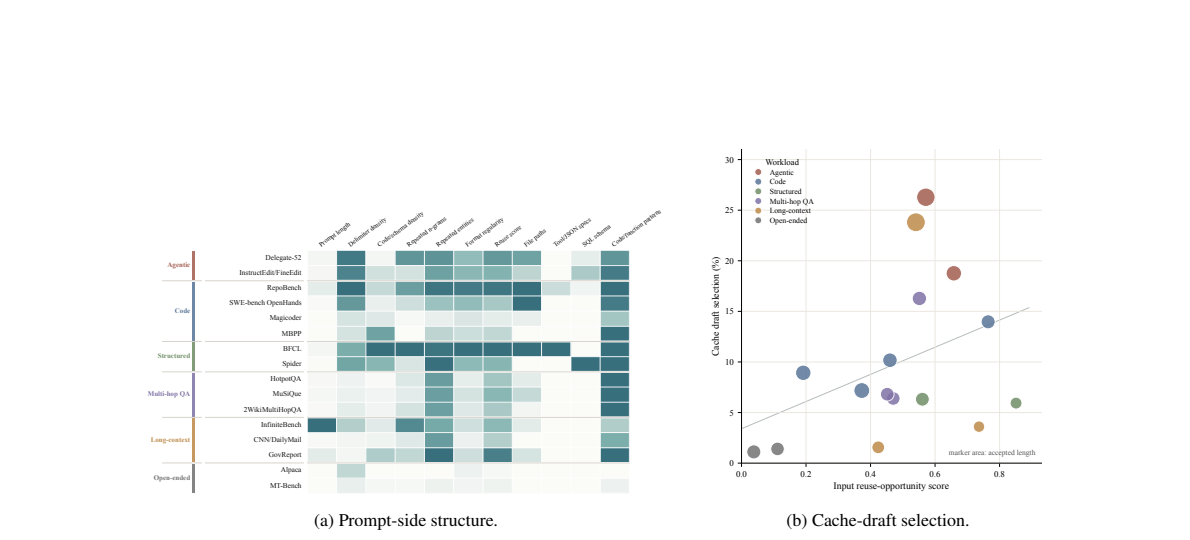
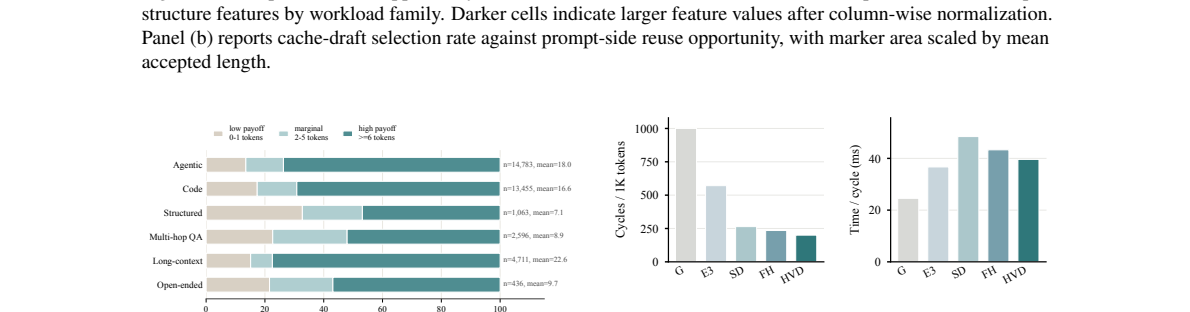
Large Language Model (LLM) generation remains expensive because autoregressive decoding calls the model once for each new token. Speculative decoding reduces this cost by drafting multiple tokens and verifying them with the target model in one step, but its speedup depends on how many drafted tokens are accepted. Parameter-free draft sources can propose long continuations at low cost in structured and agentic workloads, yet a cache match that looks promising at one generation step may have low payoff at the next. We propose Hybrid Verified Decoding, which predicts the accepted length of a cache draft before verification and uses this payoff estimate to choose between cache verification and a model-based drafter. Across three LLMs and sixteen datasets, Hybrid Verified Decoding is especially effective on agentic workflows, where it outperforms EAGLE3 in every setting with a 2.73x average speedup. Our analysis shows how prompt structure creates cache opportunities, how high-payoff cache drafts concentrate in a small part of the draft space, and how payoff-guided selection reduces sequential decoding work, pointing to runtime draft selection as a promising direction for speculative decoding.
The paper's own sentences, arranged, kept beside the review and separate from it. Each label is drawn from a closed vocabulary; the number beside it is the probability the classifier gave that label. No sentence in this record was written by a model.
abstract compiled · 2026-09-23
The authors' main claim, as the classifier picked it out 0.58
“Our analysis shows how prompt structure creates cache opportunities, how high-payoff cache drafts concentrate in a small part of the draft space, and how payoff-guided selection reduces sequential decoding work, pointing to runtime draft selection as a promising direction for speculative decoding.”
How the main claim is stated: asserted 0.76
What the abstract itself states, as probabilities: claims first 0.04 · states limitation 0.21 · human participants 0.03 · controlled comparison 0.89 · randomized assignment 0.02 · states quantitative result 0.99 · compares with prior results 0.97 · mentions code or data availability 0.02
The abstract, sentence by sentence
This table labels the abstract only (arXiv listing abstract v1). The number is the probability the classifier gave the label.
| Sentence | Role | The authors' own work | States the main conclusion | Strength |
|---|---|---|---|---|
| Large Language Model (LLM) generation remains expensive because autoregressive decoding calls the model once for each new token. | background 1.00 | 0.06 | 0.02 | asserted 1.00 |
| Speculative decoding reduces this cost by drafting multiple tokens and verifying them with the target model in one step, but its speedup depends on how many drafted tokens are accepted. | background 1.00 | 0.06 | 0.03 | asserted 1.00 |
| Parameter-free draft sources can propose long continuations at low cost in structured and agentic workloads, yet a cache match that looks promising at one generation step may have low payoff at the next. | background 0.62 | 0.12 | 0.03 | hedged possibility 0.51 |
| We propose Hybrid Verified Decoding, which predicts the accepted length of a cache draft before verification and uses this payoff estimate to choose between cache verification and a model-based drafter. | method 0.59 | 0.93 | 0.21 | asserted 1.00 |
| Across three LLMs and sixteen datasets, Hybrid Verified Decoding is especially effective on agentic workflows, where it outperforms EAGLE3 in every setting with a 2.73x average speedup. | result 1.00 | 0.96 | 0.62 | asserted 1.00 |
| Our analysis shows how prompt structure creates cache opportunities, how high-payoff cache drafts concentrate in a small part of the draft space, and how payoff-guided selection reduces sequential decoding work, pointing to runtime draft selection as a promising direction for speculative decoding. | interpretation 0.95 | 0.94 | 0.65 | asserted 0.76 |
What kind of paper the classifier reports this is: method or tool 1.00 · evidence from observation or experiment 0.98
What was examined, and what was not
Sources read
- arXiv listing abstract v1
Not examined
- full text
- figures and tables
- references and citing sentences
- relations to other papers
Levels run
- P abstract
Not run
- S sections
- T body sentences
- C citations
- R cross-paper relations
How the labels were made
Compiled by classifier-1.13.0 via TypeSafe API, question bank abstract-p1-20260923, 2026-09-23: 1 request, 5,081 input tokens.
Every quoted sentence on this record is the authors'. Every label is from Pith's closed vocabulary, with the probability shown beside it. This record as JSON
Figures (5)


Showing 4 of the paper's 5 figures. Figures are the authors', reproduced from the paper.
References (22)
- [1] Fast Inference from Transformers via Speculative Decoding , author =. Proceedings of the 40th International Conference on Machine Learning , pages =. 2023 , editor = on Pith
- [2] Accelerating Large Language Model Decoding with Speculative Sampling , author=. 2023 , eprint= on Pith
- [3] Yuhui Li and Fangyun Wei and Chao Zhang and Hongyang Zhang , booktitle=. 2024 , url= on Pith
- [4] EAGLE-3: Scaling up Inference Acceleration of Large Language Models via Training-Time Test , author=. 2025 , eprint= on Pith
- [5] Cai, Tianle and Li, Yuhong and Geng, Zhengyang and Peng, Hongwu and Lee, Jason D. and Chen, Deming and Dao, Tri , booktitle =. Medusa: Simple. 2024 , editor = on Pith
- [6] PARD: Accelerating LLM Inference with Low-Cost PARallel Draft Model Adaptation , author=. 2025 , eprint= on Pith
- [7] Prompt Lookup Decoding , author =. 2023 , month = on Pith
- [8] Fu, Yichao and Bailis, Peter and Stoica, Ion and Zhang, Hao , booktitle =. Break the Sequential Dependency of. 2024 , editor = on Pith
- [9] AdaEAGLE: Optimizing Speculative Decoding via Explicit Modeling of Adaptive Draft Structures , author=. 2024 , eprint= on Pith
- [10] Nightjar: Dynamic Adaptive Speculative Decoding for Large Language Models Serving , author=. 2026 , eprint= on Pith
- [11] Huang, Kaiyu and Wu, Hao and Shi, Zhubo and Zou, Han and Yu, Minchen and Shi, Qingjiang , title =. 2026 , isbn =. doi:10.1145/3772052.3772239 , booktitle = on Pithdoi:10.1145/3772052.3772239
- [12] ECHO: Elastic Speculative Decoding with Sparse Gating for High-Concurrency Scenarios , author=. 2026 , eprint= on Pith
- [13] TALON: Confidence-Aware Speculative Decoding with Adaptive Token Trees , author=. 2026 , eprint= on Pith
- [14] MARS: Unleashing the Power of Speculative Decoding via Margin-Aware Verification , author=. 2026 , eprint= on Pith
- [15] Speculative Decoding: Performance or Illusion? , author=. 2026 , eprint= on Pith
- [16] Gabriele Oliaro and Zhihao Jia and Daniel F Campos and Aurick Qiao , booktitle=. SuffixDecoding: Extreme Speculative Decoding for Emerging. 2026 , url= on Pith
- [17] Qwen3 Technical Report , author=. 2025 , eprint= on Pith
- [18] The Llama 3 Herd of Models , author=. 2024 , eprint= on Pith
- [19] Efficient memory management for large language model serving with pagedattention , author=. Proceedings of the 29th symposium on operating systems principles , pages= on Pith
- [20] Li, Yuhui and Wei, Fangyun and Zhang, Chao and Zhang, Hongyang. EAGLE -2: Faster Inference of Language Models with Dynamic Draft Trees. Proceedings of the 2024 Conference on Empirical Methods in Natural Language Processing. 2024. doi:10.18653/v1/2024.emnlp-main.422 on Pithdoi:10.18653/v1/2024.emnlp-main.422
show 2 more
- [21] He, Zhenyu and Zhong, Zexuan and Cai, Tianle and Lee, Jason and He, Di. REST : Retrieval-Based Speculative Decoding. Proceedings of the 2024 Conference of the North American Chapter of the Association for Computational Linguistics: Human Language Technologies (Volume 1: Long P... on Pithdoi:10.18653/v1/2024.naacl-long.88
- [22] Yan, Minghao and Agarwal, Saurabh and Venkataraman, Shivaram. Decoding Speculative Decoding. Proceedings of the 2025 Conference of the Nations of the Americas Chapter of the Association for Computational Linguistics: Human Language Technologies (Volume 1: Long Papers). 2025. d... on Pithdoi:10.18653/v1/2025.naacl-long.328
Cited by 1 Pith paper
Reviewed papers on Pith that cite this one. The full citation record
- CoPyro: Feeding Copy Proposals to Parallel Drafters cs.CL · Nov 2026
Challenges and discussion
Disagree with the review, or know something it missed? Leave a comment, or challenge this review formally: a challenge becomes a permanent entry in this paper's record, and its decision is published here.
Come back by email
A short list of the week's newly reviewed papers. Nothing is sent until you confirm from your inbox, and every email has a link that stops it. No account.
No comments yet.
Sign in to comment