On the Limits of Token Reduction for Efficient Unified Vision Language Training
Pith reviewed 2026-06-28 16:56 UTC · model grok-4.3
The pith
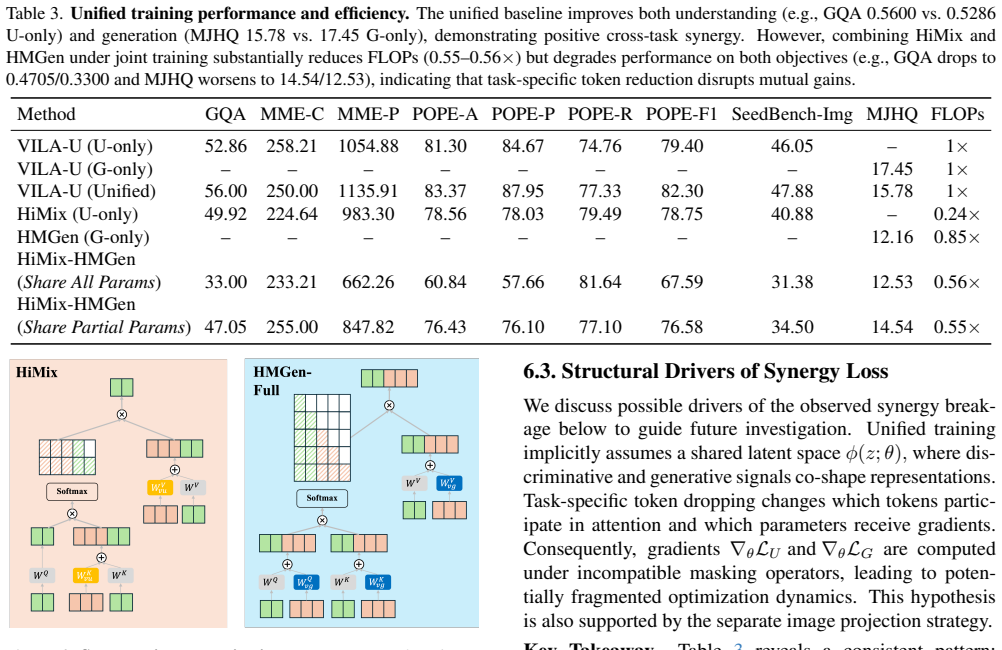
Task-specific token reduction eliminates mutual performance gains in unified vision-language model training.
A machine-rendered reading of the paper's core claim, the machinery that carries it, and where it could break.
Core claim
Unified VLMs exhibit a fundamental asymmetry in layerwise attention: visual understanding shows substantial late-layer redundancy in image tokens, whereas visual generation maintains persistent dependence on image tokens across all depths. Task-specific token dropping therefore produces large efficiency gains in isolated training but, under unified training, necessitates divergent parameter pathways that eliminate the mutual performance gains normally observed in joint optimization.
What carries the argument
Layerwise attention allocation patterns that expose the asymmetry between late-layer visual redundancy in understanding and persistent image-token dependence in generation.
If this is right
- Task-specific token accelerators deliver efficiency gains when each objective is trained in isolation.
- The same accelerators produce consistent synergy loss when both objectives train jointly.
- Task-specific dropping forces the model onto divergent parameter pathways.
- Efficient unified modeling requires preservation of shared cross-task structures.
- Acceleration methods must be designed to be synergy-aware rather than task-isolated.
Where Pith is reading between the lines
- The same attention-asymmetry limit may appear in other multimodal unified models that combine understanding and generation.
- Methods that keep a single shared backbone while allowing selective computation could avoid the observed divergence.
- Empirical checks on larger-scale or differently pretrained unified VLMs would test whether the asymmetry is architecture-independent.
- Efficiency research for unified models should prioritize joint-optimization compatibility from the design stage.
Load-bearing premise
The layerwise attention patterns observed are general properties of unified VLMs rather than artifacts of the tested architectures or training setups.
What would settle it
Apply the same task-specific token dropping to a different unified VLM architecture or training regime and check whether the mutual performance gains of joint optimization disappear or remain.
Figures


read the original abstract
Unified vision-language models (VLMs) integrate visual understanding and visual generation within a single autoregressive backbone, but their joint training is computationally expensive and largely overlooked from an efficiency perspective. In this work, we study the feasibility and limits of token-reduction-based acceleration for unified VLM training. Through a systematic analysis of layerwise attention allocation, we uncover a fundamental asymmetry: visual understanding exhibits substantial late-layer visual redundancy, whereas visual generation maintains persistent dependence on image tokens across depth. Guided by this observation, we design task-specific accelerators that selectively reduce image-token computation for each objective. While these methods achieve significant efficiency gains in isolated settings, we observe a consistent synergy loss under unified training -- task-specific token dropping necessitates divergent parameter pathways and eliminates the mutual performance gains typically observed in joint optimization. Our findings suggest that efficient unified modeling requires preserving shared cross-task structures, highlighting the need for synergy-aware acceleration strategies. Project page: https://chicychen.github.io/TokenReductionUnifiedVLM/.
Editorial analysis
A structured set of objections, weighed in public.
Referee Report
Summary. The manuscript claims that unified vision-language models exhibit a fundamental asymmetry in layerwise attention allocation—visual understanding shows substantial late-layer visual redundancy while visual generation maintains persistent image-token dependence across depth. This leads to the design of task-specific token-reduction accelerators that yield efficiency gains in isolated settings but produce a consistent synergy loss under joint training, as task-specific dropping forces divergent parameter pathways and removes the mutual performance benefits of unified optimization. The authors conclude that efficient unified modeling requires preserving shared cross-task structures and thus needs synergy-aware acceleration strategies.
Significance. If the asymmetry and resulting synergy-loss observation hold, the work is significant for identifying a concrete limit on naive token-reduction approaches in multi-task VLMs and for providing a diagnostic (layerwise attention analysis) that could inform better efficiency methods. The emphasis on preserving joint-optimization benefits rather than maximizing per-task speedups is a useful corrective for the field. No machine-checked proofs or parameter-free derivations are present, but the experimental framing of the synergy loss is a clear, falsifiable contribution if the supporting data and controls are robust.
major comments (1)
- [Abstract] Abstract: the central claim that task-specific token dropping 'necessitates divergent parameter pathways and eliminates the mutual performance gains' is load-bearing for the recommendation of synergy-aware strategies. This inference depends on the layerwise attention asymmetry being a general property of unified VLMs rather than an artifact of the tested architectures or training setups; the abstract provides no indication of cross-architecture ablations or controls that would establish this generality.
minor comments (2)
- The manuscript should clarify in the methods or experimental sections whether the attention-allocation analysis was performed on multiple model scales or only a single backbone, as this directly affects the scope of the 'fundamental asymmetry' claim.
- Ensure that all quantitative efficiency gains and synergy-loss measurements are accompanied by the exact token-reduction ratios, layer ranges, and training budgets used, to allow direct reproduction.
Simulated Author's Rebuttal
We thank the referee for the constructive feedback. We address the concern about the abstract's framing of generality below and will make corresponding revisions.
read point-by-point responses
-
Referee: [Abstract] Abstract: the central claim that task-specific token dropping 'necessitates divergent parameter pathways and eliminates the mutual performance gains' is load-bearing for the recommendation of synergy-aware strategies. This inference depends on the layerwise attention asymmetry being a general property of unified VLMs rather than an artifact of the tested architectures or training setups; the abstract provides no indication of cross-architecture ablations or controls that would establish this generality.
Authors: We agree that the abstract should better contextualize the experimental scope. Our layerwise attention analysis and synergy-loss observations were obtained across multiple representative unified VLM backbones and training regimes, with the asymmetry appearing consistently. We will revise the abstract to explicitly name the architectures and setups employed, thereby indicating the basis for our claims. Comprehensive cross-architecture ablations would strengthen generality but lie outside the current scope; the reported results already demonstrate that task-specific reduction disrupts joint-optimization benefits in the tested unified settings, supporting the call for synergy-aware methods. revision: yes
Circularity Check
No circularity; purely empirical observations with no derivations or self-referential reductions
full rationale
The paper contains no equations, derivations, fitted parameters presented as predictions, or load-bearing self-citations. All claims derive from direct experimental measurements of attention allocation and training outcomes across the tested models and setups. The observed asymmetry and synergy loss are reported as experimental results rather than constructed from prior definitions or ansatzes within the work. No step reduces by construction to its inputs, satisfying the default expectation of non-circularity for observation-driven studies.
Axiom & Free-Parameter Ledger
Reference graph
Works this paper leans on
-
[1]
Token merging: Your vit but faster, 2023
Daniel Bolya, Cheng-Yang Fu, Xiaoliang Dai, Peizhao Zhang, Christoph Feichtenhofer, and Judy Hoffman. Token merging: Your vit but faster, 2023. 1, 2
2023
-
[2]
Sharegpt4v: Improving large multi-modal models with better captions
Lin Chen, Jinsong Li, Xiaoyi Dong, Pan Zhang, Conghui He, Jiaqi Wang, Feng Zhao, and Dahua Lin. Sharegpt4v: Improving large multi-modal models with better captions. In European Conference on Computer Vision, pages 370–387. Springer, 2024. 5
2024
-
[3]
An image is worth 1/2 tokens after layer 2: Plug-and-play inference acceleration for large vision-language models, 2024
Liang Chen, Haozhe Zhao, Tianyu Liu, Shuai Bai, Junyang Lin, Chang Zhou, and Baobao Chang. An image is worth 1/2 tokens after layer 2: Plug-and-play inference acceleration for large vision-language models, 2024. 1, 2, 3
2024
-
[4]
InstructBLIP: Towards general-purpose vision-language models with instruction tuning
Wenliang Dai, Junnan Li, Dongxu Li, Anthony Tiong, Junqi Zhao, Weisheng Wang, Boyang Li, Pascale Fung, and Steven Hoi. InstructBLIP: Towards general-purpose vision-language models with instruction tuning. InThirty- seventh Conference on Neural Information Processing Sys- tems, 2023. 1
2023
-
[5]
The llama 3 herd of models.arXiv e-prints, pages arXiv–2407,
Abhimanyu Dubey, Abhinav Jauhri, Abhinav Pandey, Ab- hishek Kadian, Ahmad Al-Dahle, Aiesha Letman, Akhil Mathur, Alan Schelten, Amy Yang, Angela Fan, et al. The llama 3 herd of models.arXiv e-prints, pages arXiv–2407,
-
[6]
Taming transformers for high-resolution image synthesis, 2021
Patrick Esser, Robin Rombach, and Bj ¨orn Ommer. Taming transformers for high-resolution image synthesis, 2021. 1
2021
-
[7]
Scaling rectified flow trans- formers for high-resolution image synthesis, 2024
Patrick Esser, Sumith Kulal, Andreas Blattmann, Rahim Entezari, Jonas M ¨uller, Harry Saini, Yam Levi, Dominik Lorenz, Axel Sauer, Frederic Boesel, Dustin Podell, Tim Dockhorn, Zion English, Kyle Lacey, Alex Goodwin, Yan- nik Marek, and Robin Rombach. Scaling rectified flow trans- formers for high-resolution image synthesis, 2024. 1
2024
-
[8]
MME: A comprehensive evaluation benchmark for multimodal large language models
Chaoyou Fu, Peixian Chen, Yunhang Shen, Yulei Qin, Mengdan Zhang, Xu Lin, Jinrui Yang, Xiawu Zheng, Ke Li, Xing Sun, Yunsheng Wu, Rongrong Ji, Caifeng Shan, and Ran He. MME: A comprehensive evaluation benchmark for multimodal large language models. InThe Thirty-ninth An- nual Conference on Neural Information Processing Systems Datasets and Benchmarks Trac...
2025
-
[9]
Making llama see and draw with seed tokenizer, 2023
Yuying Ge, Sijie Zhao, Ziyun Zeng, Yixiao Ge, Chen Li, Xintao Wang, and Ying Shan. Making llama see and draw with seed tokenizer, 2023. 1
2023
-
[10]
When Attention Sink Emerges in Language Models: An Empirical View
Xiangming Gu, Tianyu Pang, Chao Du, Qian Liu, Fengzhuo Zhang, Cunxiao Du, Ye Wang, and Min Lin. When attention sink emerges in language models: An empirical view.arXiv preprint arXiv:2410.10781, 2024. 2
work page internal anchor Pith review Pith/arXiv arXiv 2024
-
[11]
Denoising diffu- sion probabilistic models, 2020
Jonathan Ho, Ajay Jain, and Pieter Abbeel. Denoising diffu- sion probabilistic models, 2020. 1
2020
-
[12]
Matryoshka query trans- former for large vision-language models, 2024
Wenbo Hu, Zi-Yi Dou, Liunian Harold Li, Amita Kamath, Nanyun Peng, and Kai-Wei Chang. Matryoshka query trans- former for large vision-language models, 2024. 1, 2
2024
-
[13]
Hudson and Christopher D
Drew A. Hudson and Christopher D. Manning. Gqa: A new dataset for real-world visual reasoning and compositional question answering, 2019. 6
2019
-
[14]
Unified language-vision pretraining in llm with dynamic discrete visual tokenization, 2024
Yang Jin, Kun Xu, Kun Xu, Liwei Chen, Chao Liao, Jian- chao Tan, Quzhe Huang, Bin Chen, Chenyi Lei, An Liu, Chengru Song, Xiaoqiang Lei, Di Zhang, Wenwu Ou, Kun Gai, and Yadong Mu. Unified language-vision pretraining in llm with dynamic discrete visual tokenization, 2024. 1
2024
-
[15]
Seed-bench: Benchmarking multimodal llms with generative comprehension, 2023
Bohao Li, Rui Wang, Guangzhi Wang, Yuying Ge, Yixiao Ge, and Ying Shan. Seed-bench: Benchmarking multimodal llms with generative comprehension, 2023. 6
2023
-
[16]
Playground v2.5: Three insights towards enhancing aesthetic quality in text-to-image genera- tion, 2024
Daiqing Li, Aleks Kamko, Ehsan Akhgari, Ali Sabet, Lin- miao Xu, and Suhail Doshi. Playground v2.5: Three insights towards enhancing aesthetic quality in text-to-image genera- tion, 2024. 6, 7
2024
-
[17]
Tokenpacker: Efficient visual projector for multimodal llm, 2024
Wentong Li, Yuqian Yuan, Jian Liu, Dongqi Tang, Song Wang, Jie Qin, Jianke Zhu, and Lei Zhang. Tokenpacker: Efficient visual projector for multimodal llm, 2024. 2
2024
-
[18]
Evaluating object hallucination in large vision-language models, 2023
Yifan Li, Yifan Du, Kun Zhou, Jinpeng Wang, Wayne Xin Zhao, and Ji-Rong Wen. Evaluating object hallucination in large vision-language models, 2023. 6
2023
-
[19]
Llama-vid: An image is worth 2 tokens in large language models, 2023
Yanwei Li, Chengyao Wang, and Jiaya Jia. Llama-vid: An image is worth 2 tokens in large language models, 2023. 2
2023
-
[20]
Boosting multimodal large language models with visual to- kens withdrawal for rapid inference, 2025
Zhihang Lin, Mingbao Lin, Luxi Lin, and Rongrong Ji. Boosting multimodal large language models with visual to- kens withdrawal for rapid inference, 2025. 2
2025
-
[21]
Improved baselines with visual instruction tuning, 2023
Haotian Liu, Chunyuan Li, Yuheng Li, and Yong Jae Lee. Improved baselines with visual instruction tuning, 2023. 1
2023
-
[22]
Visual instruction tuning
Haotian Liu, Chunyuan Li, Qingyang Wu, and Yong Jae Lee. Visual instruction tuning. InNeurIPS, 2023. 1
2023
-
[23]
World model on million-length video and language with blockwise ringattention
Hao Liu, Wilson Yan, Matei Zaharia, and Pieter Abbeel. World model on million-length video and language with blockwise ringattention. InThe Thirteenth International Conference on Learning Representations, 2025. 1
2025
-
[24]
Cheap and quick: Efficient vision- language instruction tuning for large language models, 2023
Gen Luo, Yiyi Zhou, Tianhe Ren, Shengxin Chen, Xiaoshuai Sun, and Rongrong Ji. Cheap and quick: Efficient vision- language instruction tuning for large language models, 2023. 1, 2
2023
-
[25]
Unitok: A uni- fied tokenizer for visual generation and understanding, 2025
Chuofan Ma, Yi Jiang, Junfeng Wu, Jihan Yang, Xin Yu, Ze- huan Yuan, Bingyue Peng, and Xiaojuan Qi. Unitok: A uni- fied tokenizer for visual generation and understanding, 2025. 1
2025
-
[26]
Janusflow: Harmonizing autoregression and rectified flow for unified multimodal understanding and generation, 2024
Yiyang Ma, Xingchao Liu, Xiaokang Chen, Wen Liu, Chengyue Wu, Zhiyu Wu, Zizheng Pan, Zhenda Xie, Haowei Zhang, Xingkai yu, Liang Zhao, Yisong Wang, Jiaying Liu, and Chong Ruan. Janusflow: Harmonizing autoregression and rectified flow for unified multimodal understanding and generation, 2024. 1
2024
-
[27]
Learning transferable visual models from natural language supervision, 2021
Alec Radford, Jong Wook Kim, Chris Hallacy, Aditya Ramesh, Gabriel Goh, Sandhini Agarwal, Girish Sastry, Amanda Askell, Pamela Mishkin, Jack Clark, Gretchen Krueger, and Ilya Sutskever. Learning transferable visual models from natural language supervision, 2021. 1
2021
-
[28]
Dynamicvit: Efficient vision transformers with dynamic token sparsification
Yongming Rao, Wenliang Zhao, Benlin Liu, Jiwen Lu, Jie Zhou, and Cho-Jui Hsieh. Dynamicvit: Efficient vision transformers with dynamic token sparsification. InAdvances in Neural Information Processing Systems (NeurIPS), 2021. 1, 2
2021
-
[29]
High-resolution image syn- thesis with latent diffusion models, 2022
Robin Rombach, Andreas Blattmann, Dominik Lorenz, Patrick Esser, and Bj¨orn Ommer. High-resolution image syn- thesis with latent diffusion models, 2022. 1, 2
2022
-
[30]
Yuzhang Shang, Mu Cai, Bingxin Xu, Yong Jae Lee, and Yan Yan. Llava-prumerge: Adaptive token reduction for efficient large multimodal models.arXiv preprint arXiv:2403.15388,
-
[31]
Journeydb: A benchmark for generative im- age understanding.Advances in neural information process- ing systems, 36:49659–49678, 2023
Keqiang Sun, Junting Pan, Yuying Ge, Hao Li, Haodong Duan, Xiaoshi Wu, Renrui Zhang, Aojun Zhou, Zipeng Qin, Yi Wang, et al. Journeydb: A benchmark for generative im- age understanding.Advances in neural information process- ing systems, 36:49659–49678, 2023. 7
2023
-
[32]
Chameleon: Mixed-modal early-fusion foundation models, 2024
Chameleon Team. Chameleon: Mixed-modal early-fusion foundation models, 2024. 1, 2
2024
-
[33]
Visual autoregressive modeling: Scalable image generation via next-scale prediction, 2024
Keyu Tian, Yi Jiang, Zehuan Yuan, Bingyue Peng, and Li- wei Wang. Visual autoregressive modeling: Scalable image generation via next-scale prediction, 2024. 1
2024
-
[34]
Llama: Open and efficient foundation lan- guage models, 2023
Hugo Touvron, Thibaut Lavril, Gautier Izacard, Xavier Martinet, Marie-Anne Lachaux, Timoth´ee Lacroix, Baptiste Rozi`ere, Naman Goyal, Eric Hambro, Faisal Azhar, Aure- lien Rodriguez, Armand Joulin, Edouard Grave, and Guil- laume Lample. Llama: Open and efficient foundation lan- guage models, 2023. 5
2023
-
[35]
Neural discrete representation learning,
Aaron van den Oord, Oriol Vinyals, and Koray Kavukcuoglu. Neural discrete representation learning,
-
[36]
Emu3: Next-token prediction is all you need, 2024
Xinlong Wang, Xiaosong Zhang, Zhengxiong Luo, Quan Sun, Yufeng Cui, Jinsheng Wang, Fan Zhang, Yueze Wang, Zhen Li, Qiying Yu, Yingli Zhao, Yulong Ao, Xuebin Min, Tao Li, Boya Wu, Bo Zhao, Bowen Zhang, Liangdong Wang, Guang Liu, Zheqi He, Xi Yang, Jingjing Liu, Yonghua Lin, Tiejun Huang, and Zhongyuan Wang. Emu3: Next-token prediction is all you need, 2024. 1, 2
2024
-
[37]
Janus: Decoupling Visual Encoding for Unified Multimodal Understanding and Generation
Chengyue Wu, Xiaokang Chen, Zhiyu Wu, Yiyang Ma, Xingchao Liu, Zizheng Pan, Wen Liu, Zhenda Xie, Xingkai Yu, Chong Ruan, et al. Janus: Decoupling visual encoding for unified multimodal understanding and generation.arXiv preprint arXiv:2410.13848, 2024. 1, 2
work page internal anchor Pith review Pith/arXiv arXiv 2024
-
[38]
arXiv preprint arXiv:2412.04332 , year=
Junfeng Wu, Yi Jiang, Chuofan Ma, Yuliang Liu, Heng- shuang Zhao, Zehuan Yuan, Song Bai, and Xiang Bai. Liq- uid: Language models are scalable and unified multi-modal generators.arXiv preprint arXiv:2412.04332, 2024. 1
-
[39]
VILA-U: a Unified Foundation Model Integrating Visual Understanding and Generation
Yecheng Wu, Zhuoyang Zhang, Junyu Chen, Haotian Tang, Dacheng Li, Yunhao Fang, Ligeng Zhu, Enze Xie, Hongxu Yin, Li Yi, et al. Vila-u: a unified foundation model inte- grating visual understanding and generation.arXiv preprint arXiv:2409.04429, 2024. 1, 2
work page internal anchor Pith review Pith/arXiv arXiv 2024
-
[40]
Efficient streaming language models with attention sinks.arXiv, 2023
Guangxuan Xiao, Yuandong Tian, Beidi Chen, Song Han, and Mike Lewis. Efficient streaming language models with attention sinks.arXiv, 2023. 2
2023
-
[41]
Show-o: One Single Transformer to Unify Multimodal Understanding and Generation
Jinheng Xie, Weijia Mao, Zechen Bai, David Junhao Zhang, Weihao Wang, Kevin Qinghong Lin, Yuchao Gu, Zhijie Chen, Zhenheng Yang, and Mike Zheng Shou. Show-o: One single transformer to unify multimodal understanding and generation.arXiv preprint arXiv:2408.12528, 2024. 1, 2
work page internal anchor Pith review Pith/arXiv arXiv 2024
-
[42]
Scaling autoregressive multi-modal mod- els: Pretraining and instruction tuning, 2023
Lili Yu, Bowen Shi, Ramakanth Pasunuru, Benjamin Muller, Olga Golovneva, Tianlu Wang, Arun Babu, Binh Tang, Brian Karrer, Shelly Sheynin, Candace Ross, Adam Polyak, Rus- sell Howes, Vasu Sharma, Puxin Xu, Hovhannes Tamoyan, Oron Ashual, Uriel Singer, Shang-Wen Li, Susan Zhang, Richard James, Gargi Ghosh, Yaniv Taigman, Maryam Fazel-Zarandi, Asli Celikyilm...
2023
-
[43]
Anygpt: Unified multimodal llm with discrete sequence modeling, 2025
Jun Zhan, Junqi Dai, Jiasheng Ye, Yunhua Zhou, Dong Zhang, Zhigeng Liu, Xin Zhang, Ruibin Yuan, Ge Zhang, Linyang Li, Hang Yan, Jie Fu, Tao Gui, Tianxiang Sun, Yu- Gang Jiang, and Xipeng Qiu. Anygpt: Unified multimodal llm with discrete sequence modeling, 2025. 1
2025
-
[44]
A-vl: Adaptive attention for large vision- language models, 2025
Junyang Zhang, Mu Yuan, Ruiguang Zhong, Puhan Luo, Huiyou Zhan, Ningkang Zhang, Chengchen Hu, and Xi- angyang Li. A-vl: Adaptive attention for large vision- language models, 2025. 1, 2
2025
-
[45]
Llava-mini: Efficient image and video large multimodal models with one vision token, 2025
Shaolei Zhang, Qingkai Fang, Zhe Yang, and Yang Feng. Llava-mini: Efficient image and video large multimodal models with one vision token, 2025. 2
2025
-
[46]
Himix: Reducing computational com- plexity in large vision-language models, 2025
Xuange Zhang, Dengjie Li, Bo Liu, Zenghao Bao, Yao Zhou, Baisong Yang, Zhongying Liu, Yujie Zhong, Zheng Zhao, and Tongtong Yuan. Himix: Reducing computational com- plexity in large vision-language models, 2025. 2, 5
2025
-
[47]
Ar- gus: A compact and versatile foundation model for vision
Weiming Zhuang, Chen Chen, Zhizhong Li, Sina Sajad- manesh, Jingtao Li, Jiabo Huang, Vikash Sehwag, Vivek Sharma, Hirotaka Shinozaki, Felan Carlo Garcia, et al. Ar- gus: A compact and versatile foundation model for vision. In Proceedings of the Computer Vision and Pattern Recognition Conference, pages 4418–4429, 2025. 1
2025
discussion (0)
Sign in with ORCID, Apple, or X to comment. Anyone can read and Pith papers without signing in.