Design and development of Fabry-Perot based wavelength calibration system for PARAS-2 spectrograph
Pith reviewed 2026-06-28 12:58 UTC · model grok-4.3
The pith
Fabry-Perot etalon with xenon lamp achieves theoretical 10 cm/s wavelength stability for PARAS-2 spectrograph
A machine-rendered reading of the paper's core claim, the machinery that carries it, and where it could break.
Core claim
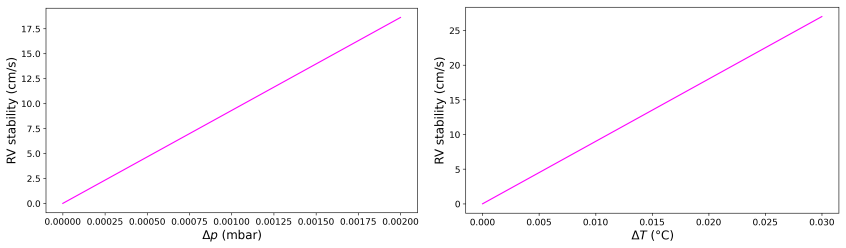
The central claim is that the Fabry-Perot etalon wavelength calibrator, when operated under the reported temperature and pressure control, reaches a theoretical stability within 10 cm/s and therefore constitutes a reliable alternative to laser frequency combs for high-resolution spectroscopic calibration.
What carries the argument
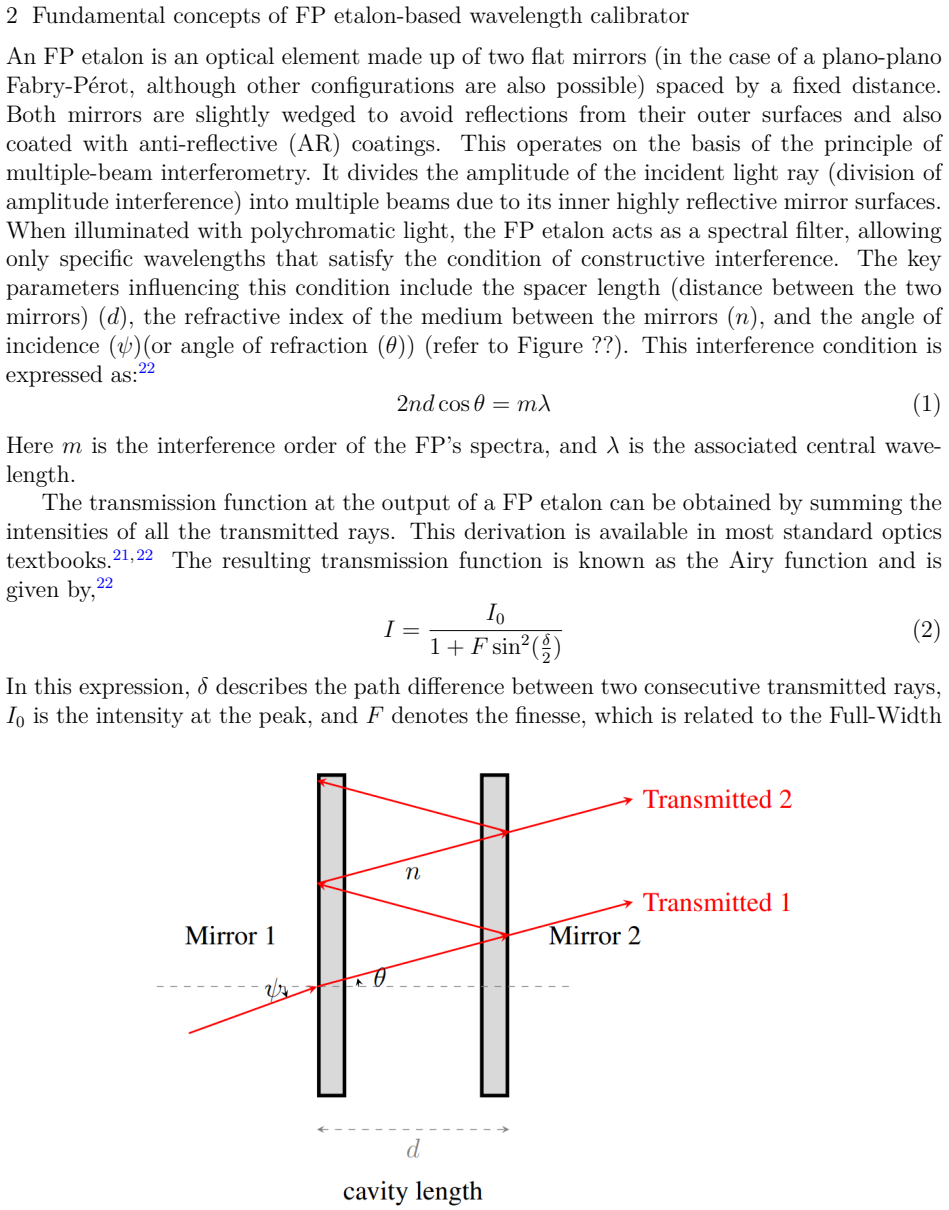
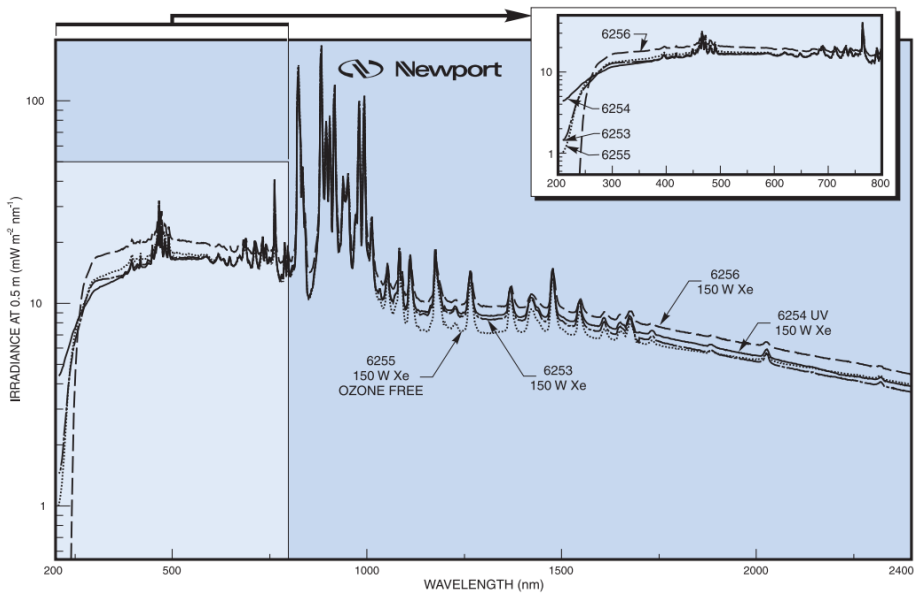
The Fabry-Perot etalon illuminated by a xenon arc lamp, which generates a dense comb-like spectrum whose line positions remain stable when temperature and pressure variations are limited to the measured levels.
If this is right
- The system supplies a dense, uniformly spaced grid of lines for determining stellar line positions and tracking instrumental drifts.
- It covers the full range of 62 echelle orders needed by the PARAS-2 spectrograph.
- The observed 40-70 cm/s relative drifts are attributed to xenon arc-lamp instabilities rather than the etalon itself.
- The design is positioned as a practical substitute for laser frequency combs in high-precision radial-velocity work.
Where Pith is reading between the lines
- Mitigating the arc-lamp wandering could bring measured performance closer to the 10 cm/s theoretical floor.
- The same environmental-control approach could be applied to other echelle spectrographs that need affordable dense-line calibration.
- Systematic tests that isolate lamp output from etalon transmission would clarify the dominant error source.
Load-bearing premise
That temperature and pressure stability alone set the wavelength drift limit once the arc-lamp contribution is subtracted, with all other mechanical, optical, and illumination effects remaining negligible.
What would settle it
A long-term measurement of actual line-position drift exceeding 10 cm/s while temperature and pressure stay within the stated RMS bounds would falsify the stability claim.
Figures
read the original abstract
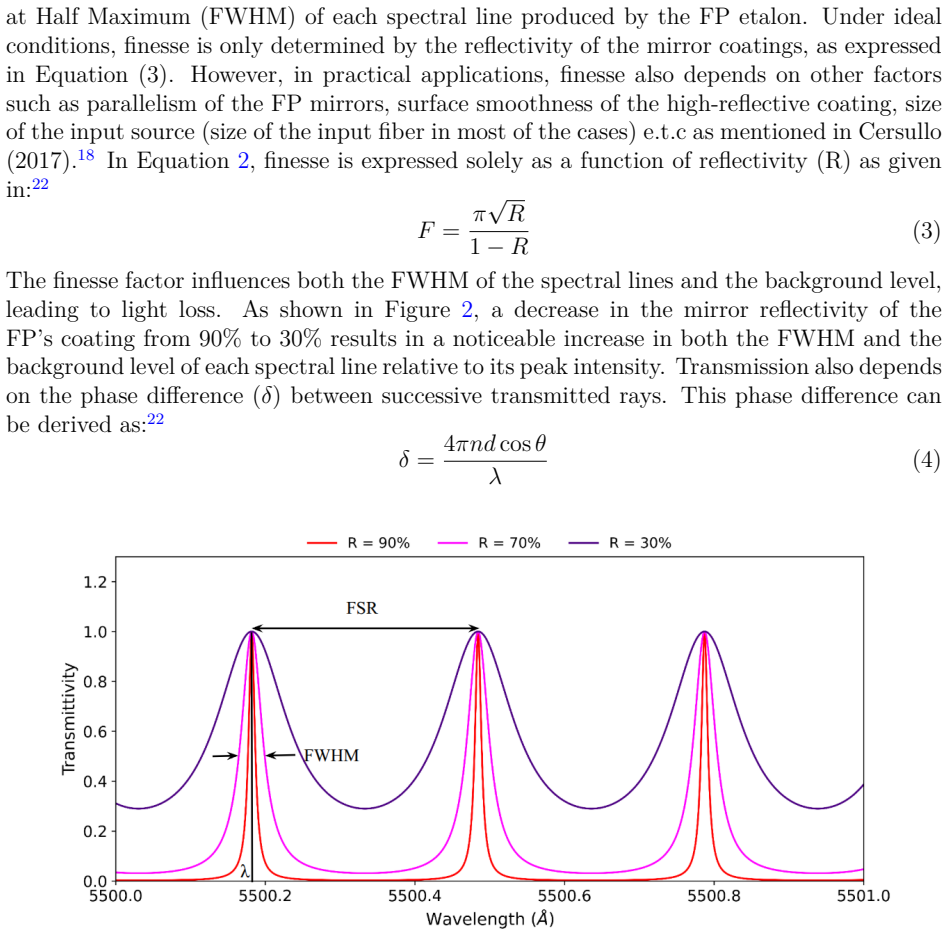
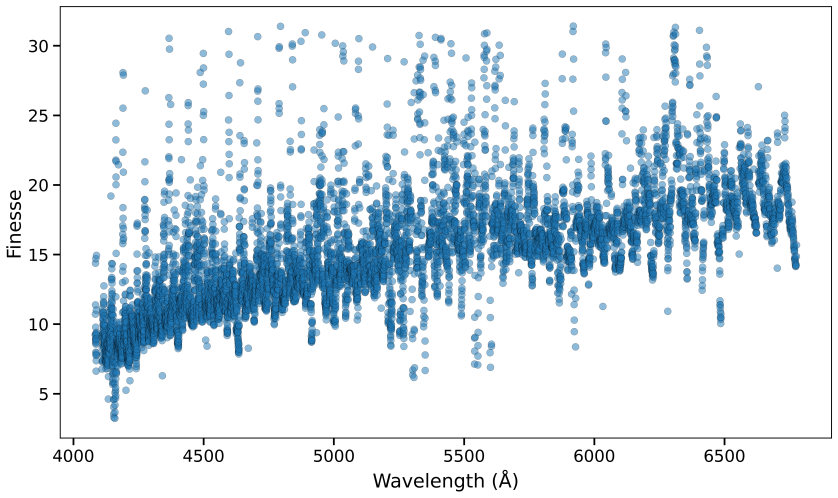
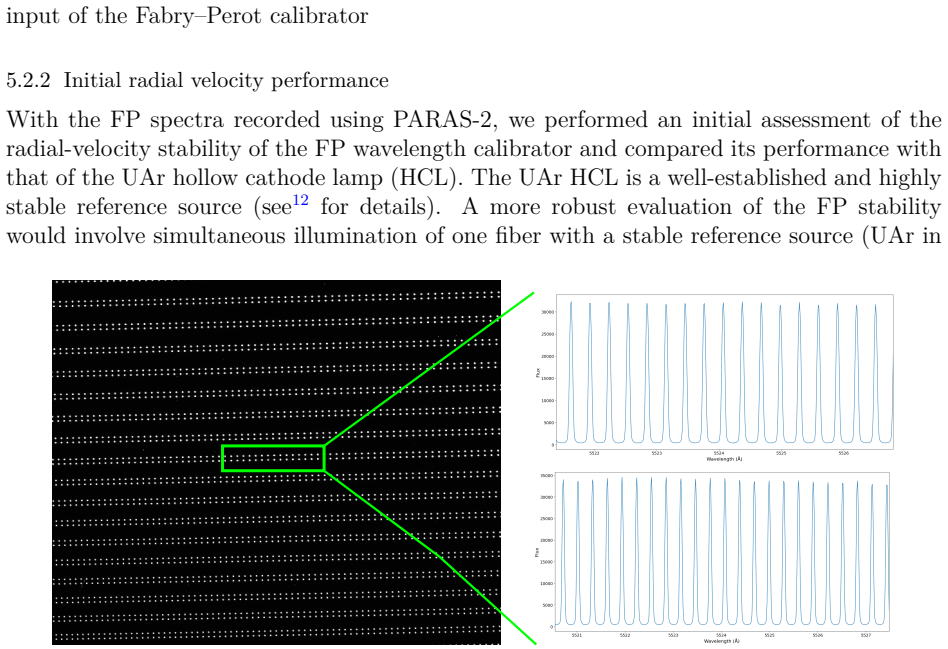
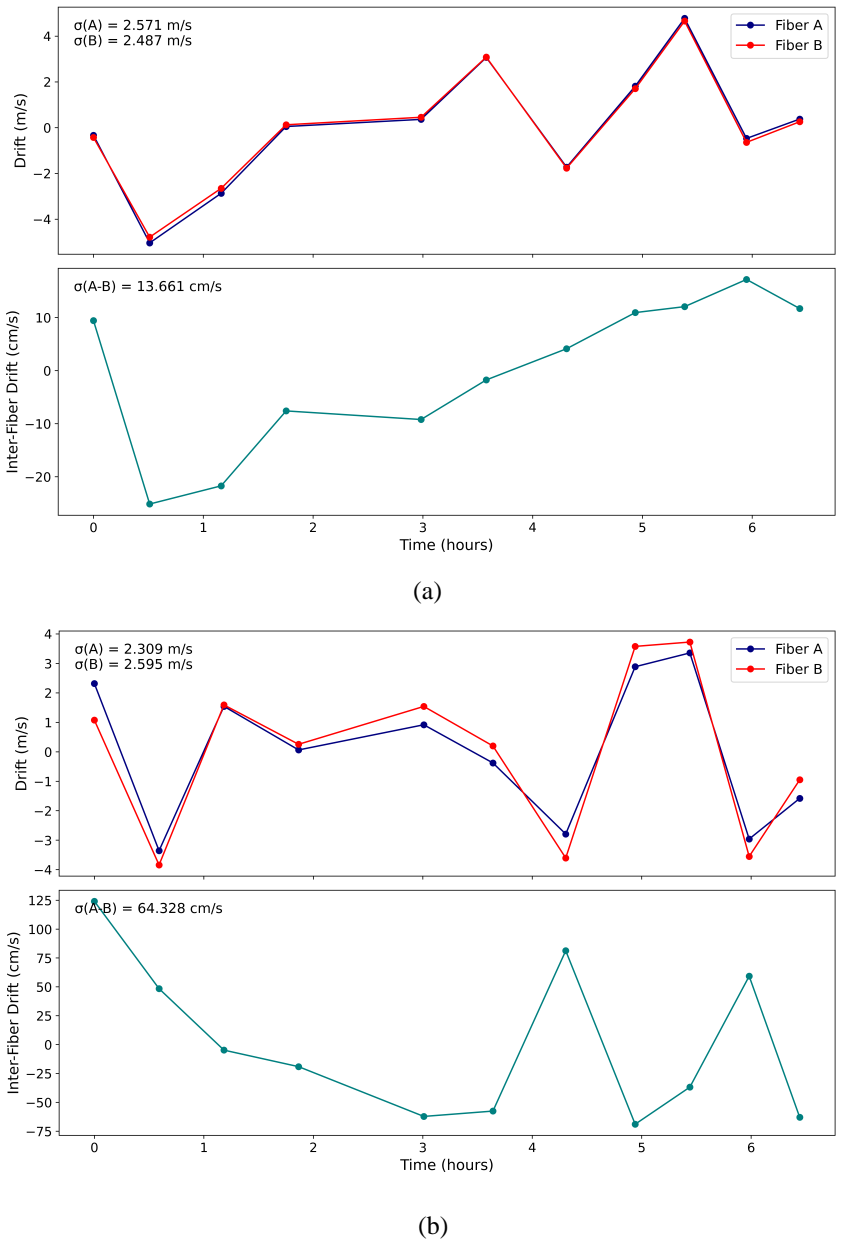
Precise wavelength calibration is essential for high-precision radial velocity (RV) spectrographs, necessitating a stable calibrator that provides a dense grid of uniformly spaced lines to accurately determine stellar line positions and monitor instrumental drifts. In this work, we present the development of a cost-effective Fabry-Perot (FP) etalon-based wavelength calibrator designed to overcome the limitations of conventional sources such as hollow cathode lamps (HCLs) and iodine cells. This FP calibrator, combined with a Xenon (Xe) arc lamp assembly, has been integrated with the PARAS-2 spectrograph on the PRL 2.5m telescope at Mount Abu Observatory. Operated under controlled temperature and pressure conditions, the system generates a dense, comb-like spectrum covering 62 echelle orders with more than 10,000 well-defined and stable spectral lines, enabling precise measurement of instrumental drift. Initial results show that the free spectral range (FSR) varies from 0.16 \AA~near 4000 \AA~to 0.49 \AA~ near 7000 \AA, with a value of 0.3 \AA~around the central wavelength of 5500 \AA~. The estimated finesse ranges from 9 near 4000 \AA~to 19 near 6900 \AA, with an approximate value of 17 at 5500 \AA. The temperature and pressure stability tests demonstrate RMS variations of $0.002 ^\circ\mathrm{C}$ and $5\times10^{-4}$ mbar, respectively. Based on these values, the theoretical stability of the FP wavelength calibrator is estimated to be within 10 cm/s, establishing it as a reliable alternative to Laser Frequency Combs (LFCs) for high-resolution spectroscopic calibration. We present an initial assessment of the RV stability of the FP calibrator, yielding 40-70 cm/s of relative drifts, which are up for further investigations. The observed excess over the theoretically estimated limit is likely attributable to instabilities arising from arc wandering in the xenon arc lamp.
Editorial analysis
A structured set of objections, weighed in public.
Referee Report
Summary. The paper describes the design and integration of a Fabry-Perot etalon wavelength calibrator paired with a Xe arc lamp for the PARAS-2 echelle spectrograph. It reports a dense grid of >10,000 lines across 62 orders with measured FSR (0.16–0.49 Å) and finesse (9–19), environmental control yielding 0.002 °C and 5×10^{-4} mbar RMS stability, and a derived theoretical RV stability limit of 10 cm/s that positions the system as a cost-effective alternative to LFCs. Observed relative drifts of 40–70 cm/s are reported and attributed to arc-lamp instabilities.
Significance. If the mapping from environmental RMS values to the 10 cm/s limit is placed on a firm, reproducible footing with a full error budget, the work supplies a practical, lower-cost calibration approach suitable for moderate-aperture RV instruments. The explicit reporting of line counts, FSR/finesse curves, and on-sky drift measurements provides concrete benchmarks that other groups can use when evaluating FP calibrators.
major comments (2)
- [Abstract] Abstract (stability estimate paragraph): The conversion of the measured temperature (0.002 °C RMS) and pressure (5×10^{-4} mbar RMS) into a theoretical RV stability of 10 cm/s is asserted without any derivation, partial-derivative chain, coefficient table, or uncertainty propagation. Because this number is the sole quantitative basis for claiming the FP system is a “reliable alternative to LFCs,” the absence of the intermediate steps (e.g., d(nL)/nL expressed in terms of ΔT and ΔP for the specific spacer and fill gas) renders the central performance claim unverifiable from the given data.
- [Abstract] Abstract (drift assessment paragraph): The observed 40–70 cm/s relative drifts are stated to exceed the 10 cm/s theoretical limit and are attributed entirely to Xe arc-lamp wandering, yet no quantitative error budget or residual analysis is supplied that isolates lamp contributions from other potential terms (mirror coating aging, mounting creep, illumination non-uniformity, detector effects). Without this separation, the claim that the FP etalon itself already meets the sub-10 cm/s target remains untested.
minor comments (1)
- [Abstract] The phrase “which are up for further investigations” is awkward; “which warrant further investigation” would be clearer.
Simulated Author's Rebuttal
We thank the referee for the constructive comments, which highlight areas where additional detail will strengthen the manuscript. We address each major comment below and will revise accordingly.
read point-by-point responses
-
Referee: [Abstract] Abstract (stability estimate paragraph): The conversion of the measured temperature (0.002 °C RMS) and pressure (5×10^{-4} mbar RMS) into a theoretical RV stability of 10 cm/s is asserted without any derivation, partial-derivative chain, coefficient table, or uncertainty propagation. Because this number is the sole quantitative basis for claiming the FP system is a “reliable alternative to LFCs,” the absence of the intermediate steps (e.g., d(nL)/nL expressed in terms of ΔT and ΔP for the specific spacer and fill gas) renders the central performance claim unverifiable from the given data.
Authors: We agree that the mapping from the measured RMS temperature and pressure stabilities to the quoted 10 cm/s theoretical RV limit lacks an explicit derivation in the current text. In the revised manuscript we will add a new subsection (or appendix) that presents the partial-derivative chain for the optical-path-length change d(nL)/nL, the relevant coefficients for the Zerodur spacer and air fill gas, the conversion to velocity units, and a basic uncertainty propagation. This will render the 10 cm/s figure reproducible from the reported environmental data. revision: yes
-
Referee: [Abstract] Abstract (drift assessment paragraph): The observed 40–70 cm/s relative drifts are stated to exceed the 10 cm/s theoretical limit and are attributed entirely to Xe arc-lamp wandering, yet no quantitative error budget or residual analysis is supplied that isolates lamp contributions from other potential terms (mirror coating aging, mounting creep, illumination non-uniformity, detector effects). Without this separation, the claim that the FP etalon itself already meets the sub-10 cm/s target remains untested.
Authors: We acknowledge that the present attribution of the 40–70 cm/s drifts rests on the known behavior of Xe arc lamps and does not yet include a full quantitative error budget that isolates every possible systematic term. The manuscript already describes these measurements as an “initial assessment” that is “up for further investigations.” In revision we will expand the relevant section with a preliminary error-budget table listing the dominant known contributions and will explicitly state that dedicated follow-up tests (e.g., with a more stable illumination source) are required to confirm that the etalon itself reaches the theoretical limit. revision: partial
Circularity Check
No circularity: stability estimate derived from independent environmental measurements without reduction to fit or self-citation
full rationale
The paper reports measured RMS temperature (0.002 °C) and pressure (5×10^{-4} mbar) stabilities, then states that these yield a theoretical FP stability within 10 cm/s. No equations, partial derivatives, or coefficient tables are supplied that would make the 10 cm/s figure tautological with the inputs. No self-citations, uniqueness theorems, or ansatzes are invoked to justify the mapping. The observed 40-70 cm/s drifts are separately attributed to the Xe arc lamp, leaving the theoretical limit as an external estimate rather than a redefinition of the same data. This satisfies the default expectation of a non-circular derivation chain.
Axiom & Free-Parameter Ledger
axioms (2)
- standard math Fabry-Perot transmission peaks occur at wavelengths satisfying the standard etalon equation mλ = 2nd cosθ
- domain assumption Wavelength drift is linearly proportional to changes in cavity optical path length induced by temperature and pressure
Reference graph
Works this paper leans on
-
[1]
Setting New Standards with HARPS,
Fleury, M., Gilliotte, A., Gojak, D., Guzman, J.-C., Kohler, D., Lizon, J.-L., Longinotti, A., Lovis, C., Megevand, D., Pasquini, L., Reyes, J., Sivan, J.-P., Sosnowska, D., Soto, R., Udry, S., van Kesteren, A., Weber, L., and Weilenmann, U., “Setting New Standards with HARPS,” The Messenger, 114, 20–24 (2003). https://ui.adsabs.harvard.edu/abs/ 2003Msngr...
2003
-
[2]
Terrien, R., Ramsey, L., Bender, C. F., Botzer, B., and Sigurdsson, S., “Demonstration of on-sky calibration of astronomical spectra using a 25 GHz near-IR laser frequency comb,” Optics Express, 20(6), 6631–6643 (2012). https://opg.optica.org/oe/abstract. cfm?URI=oe-20-6-6631 5 Murphy, M. T., Udem, Th., Holzwarth, R., Sizmann, A., Pasquini, L., Araujo-Hau...
-
[3]
https://ui.adsabs.harvard
Telescopes, Instruments, and Systems, 7, 038005 (2021). https://ui.adsabs.harvard. edu/abs/2021JATIS...7c8005S 23 7 Baliwal, S., Sharma, R., Chakraborty, A., Khandelwal, A., Nikitha, K. J., Safonov, B. S.,
2021
-
[4]
Discovery and characterization of a dense sub-Saturn TOI-6651b,
Strakhov, I. A., Montalto, M., Eastman, J. D., Latham, D. W., Bieryla, A., Prasad, N. J. S. S. V., Bharadwaj, K. K., Lad, K. A., Das, S. N., and Nayak, A., “Discovery and characterization of a dense sub-Saturn TOI-6651b,” Astronomy & Astrophysics, 691, A12 (2024). https://doi.org/10.1051/0004-6361/202450934 8 Baliwal, S., Sharma, R., Chakraborty, A., Niki...
-
[5]
TOI-6038 A b: A dense sub-Saturn in the transition regime between the Neptunian ridge and savanna,
Bharadwaj, K. K., Lad, K. A., Nayak, A., Joshi, V., and Eastman, J. D., “TOI-6038 A b: A dense sub-Saturn in the transition regime between the Neptunian ridge and savanna,” arXiv e-prints, arXiv:2501.02272 (2025). https://arxiv.org/abs/2501.02272 9 Khandelwal, A., Chaturvedi, P., Chakraborty, A., Sharma, R., Guenther, E. W., Pers- son, C. M., Fridlund, M....
-
[6]
Discovery of a massive giant planet with extreme density around the sub-giant star TOI-4603,
Nayak, A., Lendl, M., and Mordasini, C., “Discovery of a massive giant planet with extreme density around the sub-giant star TOI-4603,” Astronomy & Astrophysics, 672, L7 (2023). https://doi.org/10.1051/0004-6361/202245608 11 Terrien, R. C., Ninan, J. P., Diddams, S. A., Mahadevan, S., Halverson, S., Ben- der, C., Fredrick, C., Hearty, F., Jennings, J., Me...
-
[7]
Schwab, C., and Stefansson, G., “Broadband stability of the Habitable Zone Planet Finder Fabry–Pérot etalon calibration system: evidence for chromatic variation,” arXiv e-prints, arXiv:2103.08456 (2021). https://arxiv.org/abs/2103.08456 12 Chakraborty, A., Bharadwaj, K. K., Prasad Neelam, J. S. S. V., Sharma, R., Lad, K. A.,
arXiv 2021
-
[8]
The PRL 2.5 m Telescope and its First Light Instruments: FOC and PARAS-2,
Nayak, A., Jithendran, N., Joshi, V., Mishra, V. K., and Ahmed, N., “The PRL 2.5 m Telescope and its First Light Instruments: FOC and PARAS-2,” Bulletin de la Société Royale des Sciences de Liège, 93(2), 68–88 (2024). https://doi.org/10.25518/0037-9565. 11602 13 Lovis, C. and Pepe, F., “A new list of thorium and argon spectral lines in the visi- ble,” Ast...
-
[9]
A dual cavity Fabry-Perot device for high precision Doppler measurements in astronomy
Takami, Proc. SPIE 7735, 77354X (2010). https://doi.org/10.1117/12.857951 15 Schäfer, S. and Reiners, A., “Two Fabry–Perot interferometers for high precision wave- length calibration in the near-infrared,” in Ground-based and Airborne Instrumentation for Astronomy IV, ed. I. S. McLean, S. K. Ramsay, and H. Takami, Proc. SPIE 8446, 844694 (2012). https://d...
work page internal anchor Pith review Pith/arXiv arXiv doi:10.1117/12.857951 2010
-
[10]
Caballero, J. A., Ribas, I., Guillén Cardona, C., Del Sordo, F., Fernández, M., García-López, A., Guijarro, A., Hatzes, A. P., Lafarga, M., Lodieu, N., Kürster, M., Molaverdikhani, K., Montes, D., and Morales, J. C., “The CARMENES search for exoplanets around M dwarfs: Understanding the wavelength dependence of ra- dial velocity measurements,” Astronomy &...
-
[11]
Catalog for the ESPRESSO blind radial velocity exoplanet survey,
Poretti, E., Rojas-Ayala, B., Rebolo, R., Suárez Mascareño, A., and Zapatero Osorio, M. R., “Catalog for the ESPRESSO blind radial velocity exoplanet survey,” Astronomy & Astrophysics, 629, A80 (2019). https://doi.org/10.1051/0004-6361/201834729 29 Oshagh, M., “Noise Sources in Photometry and Radial Velocities,” in Asteroseismology and Exoplanets: Listeni...
-
[12]
Strategies, Processes, and Systems VII, ed. A. B. Peck, R. L. Seaman, and C. R. Benn, Proc. SPIE 10704, 1070407 (2018). https://doi.org/10.1117/12.2312286 31 Kerber, F., Nave, G., and Sansonetti, C. J., “The Spectrum of Th–Ar Hollow Cathode Lamps in the 691–5804 nm region: Establishing Wavelength Standards for the Calibra- tion of Infrared Spectrographs,”...
-
[13]
Design and development of Cassegrain module for PARAS-2 spectrograph (CAMPAS),
Chakraborty, A., and Joshi, V., “Design and development of Cassegrain module for PARAS-2 spectrograph (CAMPAS),” Journal of Astronomical Telescopes, Instruments, and Systems, 11, 045003 (2025). https://doi.org/10.1117/1.JATIS.11.4.045003 36 Hao, J., Tang, L., Ye, H., Hao, Z., Han, J., Zhai, Y., Zhang, K., Wei, R., and Xiao, D., “Effect of Near-field Distr...
discussion (0)
Sign in with ORCID, Apple, or X to comment. Anyone can read and Pith papers without signing in.