WebSpline: Structure-Informed Splines for Real-Time 3D Gaussians from Monocular Videos
Pith reviewed 2026-06-28 15:20 UTC · model grok-4.3
The pith
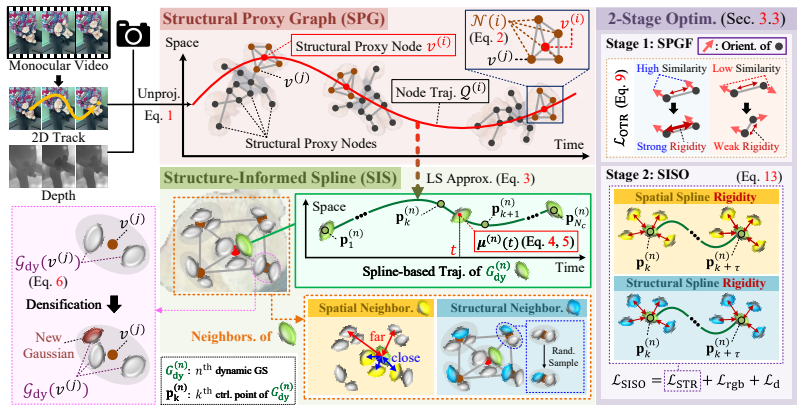
WebSpline models dynamic Gaussian trajectories with learnable cubic Hermite splines organized by a Structural Proxy Graph to enable high-fidelity monocular video reconstruction and fast rendering.
A machine-rendered reading of the paper's core claim, the machinery that carries it, and where it could break.
Core claim
The central claim is that representing each dynamic Gaussian trajectory as a learnable cubic Hermite spline whose motion parameters are structurally organized by an auxiliary Structural Proxy Graph allows the entire system to be optimized in two stages from monocular input: the graph is initialized from 2D tracks and refined via temporal rigidity regularization to enforce coherence across the sequence, the splines are then initialized from the refined graph and further optimized under spatial and structural neighborhood constraints, and at inference Gaussian motion is obtained solely by evaluating the learned splines, producing both high rendering quality and speeds over ten times faster tha
What carries the argument
The Structure-Informed Spline (SIS) representation: a learnable cubic Hermite spline for each Gaussian trajectory whose motion is organized by an auxiliary Structural Proxy Graph (SPG).
If this is right
- The SPG initialization and rigidity regularization step produces structural coherence for moving objects throughout the monocular sequence.
- Subsequent optimization of the SIS under spatial and structural constraints yields high-fidelity Gaussian reconstructions.
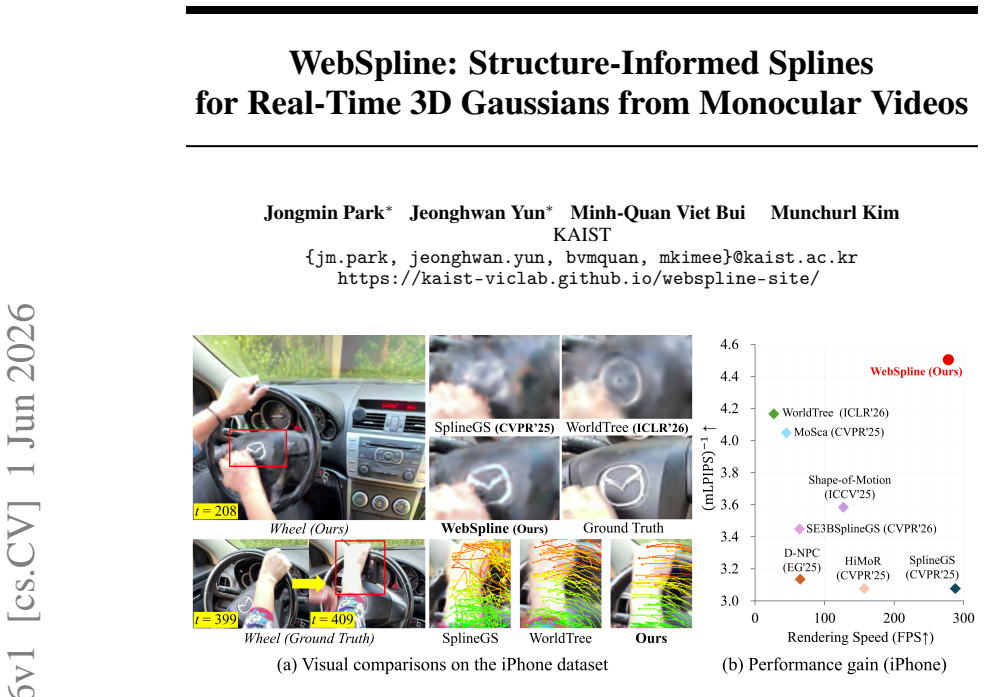
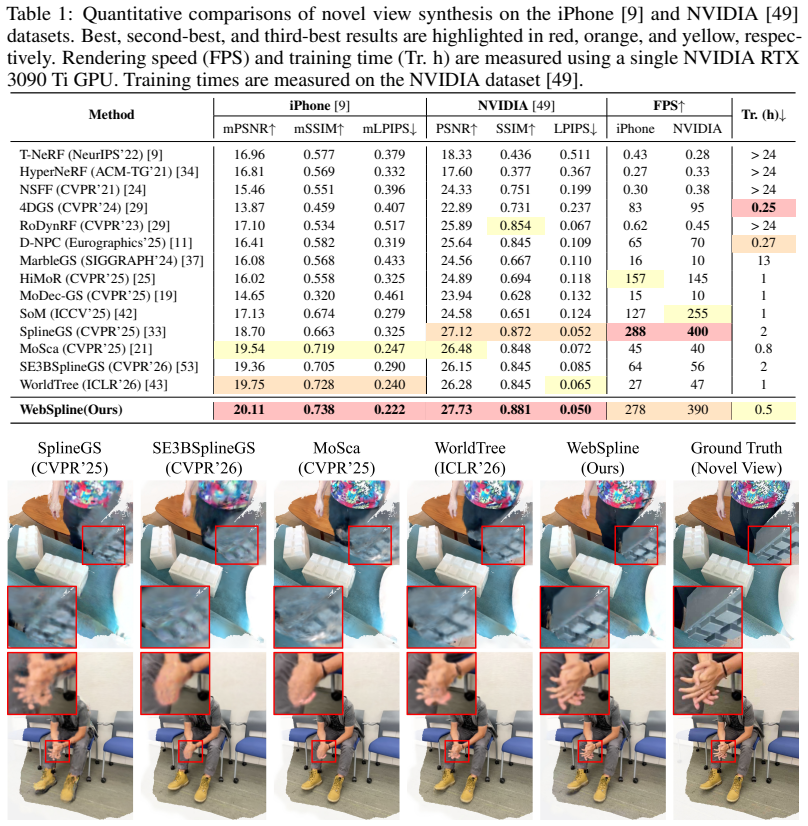
- Direct evaluation of the learned SIS at inference time produces rendering speeds more than ten times higher than WorldTree while matching or exceeding its quality on the iPhone and NVIDIA datasets.
Where Pith is reading between the lines
- If the SPG reliably encodes rigidity, the same two-stage pipeline could be applied to multi-object scenes without requiring explicit object segmentation.
- Replacing per-frame optimization with spline evaluation might reduce compute in other dynamic Gaussian methods that currently rely on dense temporal supervision.
- Extending the temporal rigidity term to handle longer sequences would test whether the current regularization remains stable when drift accumulates.
Load-bearing premise
That initializing the Structural Proxy Graph from 2D point tracks and refining it with temporal rigidity regularization is sufficient to establish structural coherence for moving objects across the entire monocular sequence.
What would settle it
A monocular video of a non-rigidly deforming object where the reconstructed trajectories produce visibly inconsistent object shapes or broken structural connections after the two-stage optimization.
Figures
read the original abstract
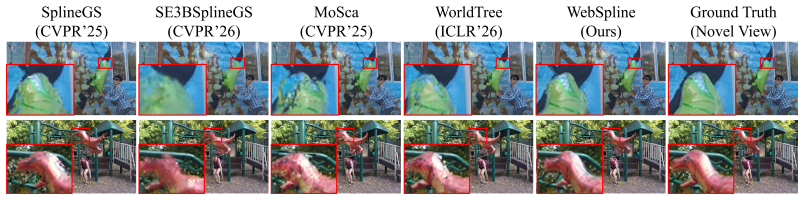
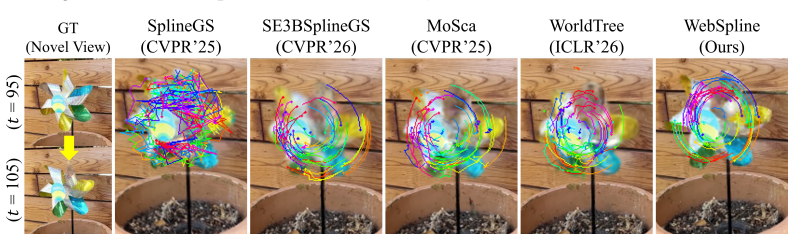
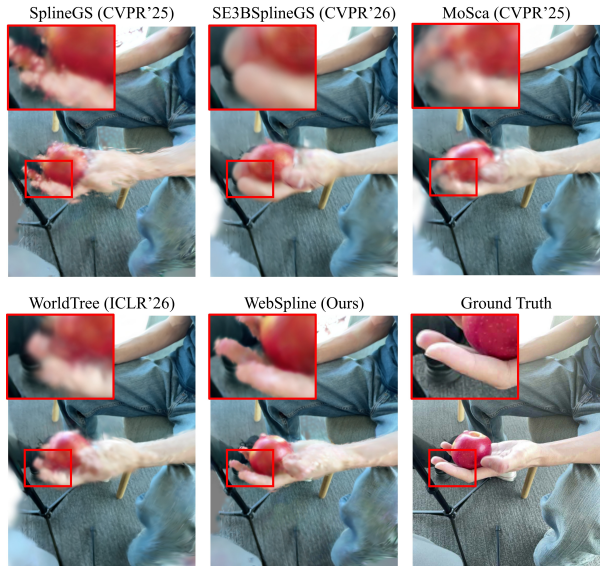
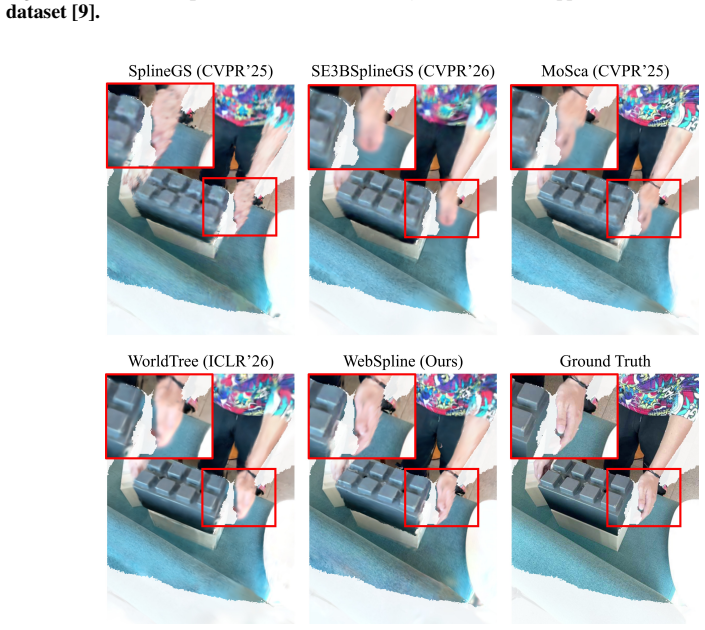
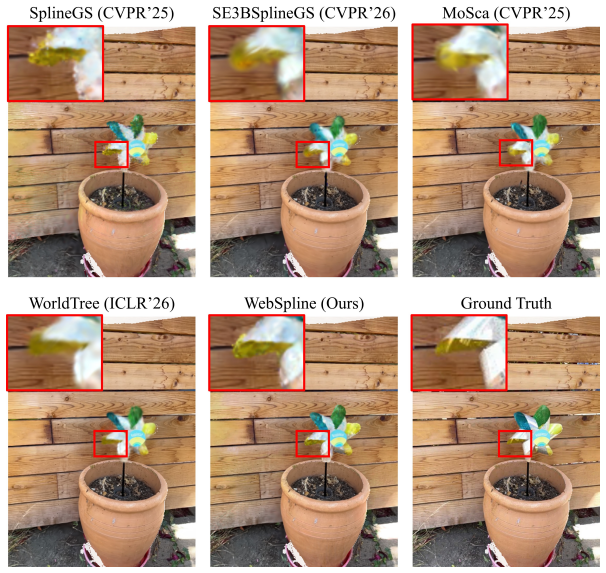
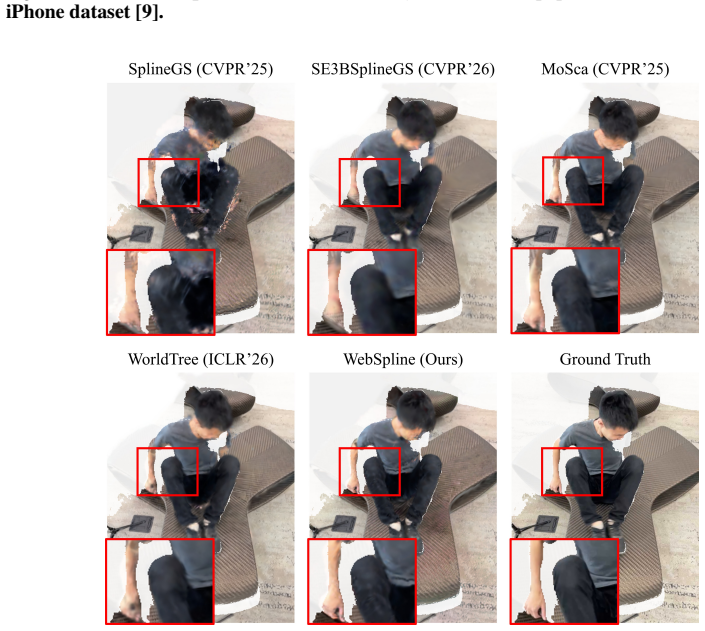
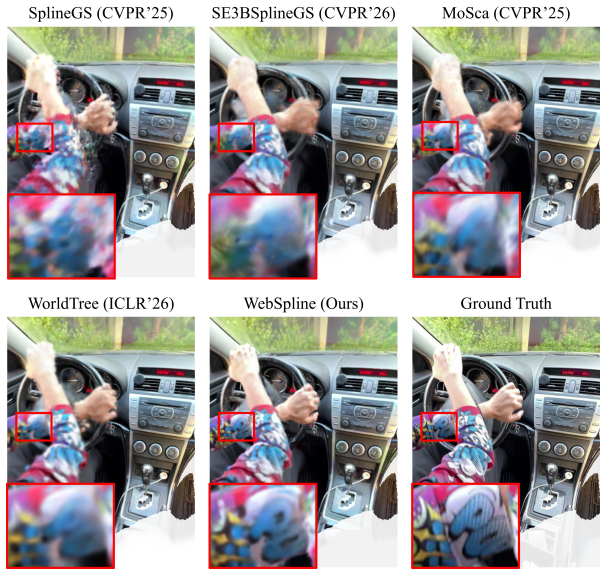
Dynamic scene reconstruction from monocular videos remains highly challenging, as existing methods often struggle to balance global structural coherence and local fine-grained details under limited multi-view cues. To address this challenge, we propose WebSpline, a novel dynamic 3D Gaussian framework that enables structurally coherent and high-fidelity reconstruction from monocular videos with fast rendering. The core of WebSpline is the Structure-Informed Spline (SIS) representation, which models each dynamic Gaussian trajectory using a learnable cubic Hermite spline whose motion is structurally organized with an auxiliary Structural Proxy Graph (SPG). The proposed framework is optimized in two stages: (i) in the first stage, the SPG is initialized from 2D point tracks and refined with temporal rigidity regularization to establish structural coherence for moving objects across the sequence; and (ii) in the second stage, the SIS representation is initialized from the refined SPG and optimized under both spatial and structural neighborhood constraints. At inference, Gaussian motion is obtained solely by evaluating the learned SIS, enabling fast rendering. Extensive experiments on the challenging monocular dynamic scene benchmarks, iPhone and NVIDIA, demonstrate that our WebSpline achieves state-of-the-art rendering quality while rendering over 10 times faster than WorldTree, the second-best method on the iPhone dataset.
Editorial analysis
A structured set of objections, weighed in public.
Referee Report
Summary. The paper claims to introduce WebSpline, a novel dynamic 3D Gaussian framework for structurally coherent and high-fidelity reconstruction from monocular videos. It uses a Structure-Informed Spline (SIS) representation based on learnable cubic Hermite splines organized by a Structural Proxy Graph (SPG). The framework is optimized in two stages: SPG initialization from 2D point tracks with temporal rigidity regularization, followed by SIS optimization under spatial and structural constraints. Inference uses only the SIS for fast rendering. Experiments on iPhone and NVIDIA datasets show SOTA rendering quality and over 10 times faster rendering than WorldTree on the iPhone dataset.
Significance. If the results hold, this work would be significant as it addresses a key challenge in dynamic scene reconstruction by balancing global structural coherence and local details in monocular settings while enabling real-time rendering. The integration of spline-based trajectories with a structural graph proxy is a creative approach that could influence future methods in 3D Gaussian splatting for dynamic scenes. The reported speedup is particularly notable for practical applications.
major comments (2)
- [Method section] Method, stage (i): The assumption that SPG initialization from 2D point tracks plus temporal rigidity regularization establishes structural coherence for moving objects is load-bearing for the central claim, yet the manuscript provides no 3D track accuracy metrics, ablation on the regularization, or failure-case analysis for depth ambiguity, drift, or occlusions. Any weakness here directly affects the neighborhood constraints used in stage (ii) SIS optimization.
- [Experiments section] Experiments: The SOTA rendering quality and >10x speedup claims versus WorldTree on the iPhone dataset are presented without detailed quantitative tables, error bars, or ablation isolating the contribution of the SPG-derived constraints, making it impossible to verify whether the structural coherence assumption holds on the reported benchmarks.
minor comments (2)
- [Abstract] Abstract: The description of the two-stage optimization would be clearer if it referenced the specific equations or pseudocode for the cubic Hermite spline and the SPG construction.
- Notation: Ensure consistent definition of acronyms (SIS, SPG) and variables at first use throughout the main text and figures.
Simulated Author's Rebuttal
We thank the referee for the constructive feedback. The comments correctly identify areas where additional validation would strengthen the central claims regarding structural coherence. We address each point below and will incorporate revisions to provide the requested evidence.
read point-by-point responses
-
Referee: [Method section] Method, stage (i): The assumption that SPG initialization from 2D point tracks plus temporal rigidity regularization establishes structural coherence for moving objects is load-bearing for the central claim, yet the manuscript provides no 3D track accuracy metrics, ablation on the regularization, or failure-case analysis for depth ambiguity, drift, or occlusions. Any weakness here directly affects the neighborhood constraints used in stage (ii) SIS optimization.
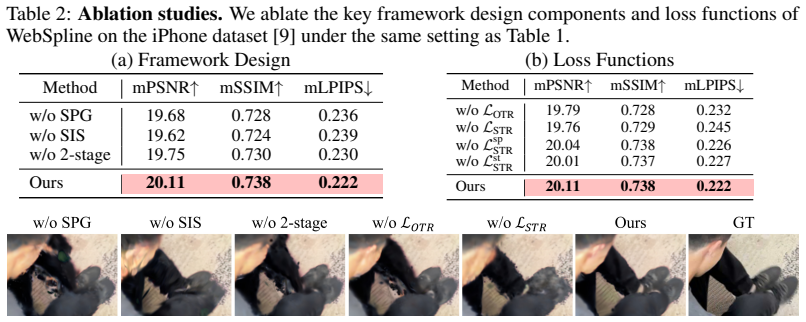
Authors: We agree that the SPG stage is foundational. The current manuscript emphasizes end-to-end results, but we will revise to add: quantitative 3D track accuracy metrics (using proxy evaluations or synthetic subsets where feasible), an ablation isolating the temporal rigidity term, and a dedicated paragraph with qualitative failure-case examples for depth ambiguity, drift, and occlusions. These additions will directly support the neighborhood constraints in stage (ii). revision: yes
-
Referee: [Experiments section] Experiments: The SOTA rendering quality and >10x speedup claims versus WorldTree on the iPhone dataset are presented without detailed quantitative tables, error bars, or ablation isolating the contribution of the SPG-derived constraints, making it impossible to verify whether the structural coherence assumption holds on the reported benchmarks.
Authors: We acknowledge that the experimental section would benefit from greater detail. In revision we will expand the tables to include per-scene metrics with error bars (from repeated runs where variance is measurable), and add an ablation that removes or varies the SPG-derived constraints while reporting both quality and runtime. This will isolate their contribution and allow direct verification of the structural coherence assumption on the iPhone and NVIDIA benchmarks. revision: yes
Circularity Check
No significant circularity detected
full rationale
The derivation proceeds in two explicit stages: SPG initialization from independent 2D point tracks plus temporal rigidity regularization, followed by SIS initialization and optimization under neighborhood constraints derived from that SPG. Neither stage reduces the final representation or performance claims back to a quantity defined by the same representation; the inputs (2D tracks) and regularization are external to the learned spline parameters. No self-citations, ansatzes, or fitted-input-as-prediction patterns appear in the described chain.
Axiom & Free-Parameter Ledger
Reference graph
Works this paper leans on
-
[1]
38, volume 38
J Harold Ahlberg, Edwin Norman Nilson, and Joseph Leonard Walsh.The Theory of Splines and Their Applications: Mathematics in Science and Engineering: A Series of Monographs and Textbooks, Vol. 38, volume 38. Elsevier, 2016
2016
-
[2]
Per-gaussian embedding-based deformation for deformable 3d gaussian splatting
Jeongmin Bae, Seoha Kim, Youngsik Yun, Hahyun Lee, Gun Bang, and Youngjung Uh. Per-gaussian embedding-based deformation for deformable 3d gaussian splatting. InEuropean Conference on Computer Vision, pages 321–335. Springer, 2024
2024
-
[3]
Barron, Ben Mildenhall, Matthew Tancik, Peter Hedman, Ricardo Martin-Brualla, and Pratul P
Jonathan T. Barron, Ben Mildenhall, Matthew Tancik, Peter Hedman, Ricardo Martin-Brualla, and Pratul P. Srinivasan. Mip-nerf: A multiscale representation for anti-aliasing neural radiance fields, 2021. URL https://arxiv.org/abs/2103.13415
-
[4]
Barron, Ben Mildenhall, Dor Verbin, Pratul P
Jonathan T. Barron, Ben Mildenhall, Dor Verbin, Pratul P. Srinivasan, and Peter Hedman. Mip-nerf 360: Unbounded anti-aliased neural radiance fields, 2022. URLhttps://arxiv.org/abs/2111.12077
-
[5]
Mobgs: Motion deblurring dynamic 3d gaussian splatting for blurry monocular video
Minh-Quan Viet Bui, Jongmin Park, Juan Luis Gonzalez, Jaeho Moon, Jihyong Oh, and Munchurl Kim. Mobgs: Motion deblurring dynamic 3d gaussian splatting for blurry monocular video. InProceedings of the AAAI Conference on Artificial Intelligence, volume 40, pages 2480–2489, 2026
2026
-
[6]
Tensorf: Tensorial radiance fields
Anpei Chen, Zexiang Xu, Andreas Geiger, Jingyi Yu, and Hao Su. Tensorf: Tensorial radiance fields. In European conference on computer vision, pages 333–350. Springer, 2022
2022
-
[7]
A practical guide to splines.Springer-Verlag google schola, 1978
C De Boor. A practical guide to splines.Springer-Verlag google schola, 1978
1978
-
[8]
Plenoxels: Radiance fields without neural networks
Sara Fridovich-Keil, Alex Yu, Matthew Tancik, Qinhong Chen, Benjamin Recht, and Angjoo Kanazawa. Plenoxels: Radiance fields without neural networks. InProceedings of the IEEE/CVF conference on computer vision and pattern recognition, pages 5501–5510, 2022
2022
-
[9]
Monocular dynamic view synthesis: A reality check.Advances in Neural Information Processing Systems, 35:33768–33780, 2022
Hang Gao, Ruilong Li, Shubham Tulsiani, Bryan Russell, and Angjoo Kanazawa. Monocular dynamic view synthesis: A reality check.Advances in Neural Information Processing Systems, 35:33768–33780, 2022
2022
-
[10]
Sc-gs: Sparse- controlled gaussian splatting for editable dynamic scenes.CVPR, 2024
Yi-Hua Huang, Yang-Tian Sun, Ziyi Yang, Xiaoyang Lyu, Yan-Pei Cao, and Xiaojuan Qi. Sc-gs: Sparse- controlled gaussian splatting for editable dynamic scenes.CVPR, 2024
2024
-
[11]
Moritz Kappel, Florian Hahlbohm, Timon Scholz, Susana Castillo, Christian Theobalt, Martin Eisemann, Vladislav Golyanik, and Marcus Magnor. D-npc: Dynamic neural point clouds for non-rigid view synthesis from monocular video.arXiv preprint arXiv:2406.10078, 2024
-
[12]
Cotracker: It is better to track together.arXiv, 2023
Nikita Karaev, Ignacio Rocco, Benjamin Graham, Natalia Neverova, Andrea Vedaldi, and Christian Rupprecht. Cotracker: It is better to track together.arXiv, 2023
2023
-
[13]
Cotracker3: Simpler and better point tracking by pseudo-labelling real videos
Nikita Karaev, Yuri Makarov, Jianyuan Wang, Natalia Neverova, Andrea Vedaldi, and Christian Rupprecht. Cotracker3: Simpler and better point tracking by pseudo-labelling real videos. InProceedings of the IEEE/CVF International Conference on Computer Vision, pages 6013–6022, 2025
2025
-
[14]
Skinning with dual quaternions
Ladislav Kavan, Steven Collins, Ji ˇrí Žára, and Carol O’Sullivan. Skinning with dual quaternions. In Proceedings of the 2007 symposium on Interactive 3D graphics and games, pages 39–46, 2007
2007
- [15]
-
[16]
Approximate differentiable rendering with algebraic surfaces
Leonid Keselman and Martial Hebert. Approximate differentiable rendering with algebraic surfaces. In European Conference on Computer Vision, pages 596–614. Springer, 2022
2022
-
[17]
Flexible techniques for differentiable rendering with 3d gaussians
Leonid Keselman and Martial Hebert. Flexible techniques for differentiable rendering with 3d gaussians. arXiv preprint arXiv:2308.14737, 2023
-
[18]
Alexander Kirillov, Eric Mintun, Nikhila Ravi, Hanzi Mao, Chloe Rolland, Laura Gustafson, Tete Xiao, Spencer Whitehead, Alexander C. Berg, Wan-Yen Lo, Piotr Dollár, and Ross Girshick. Segment anything. In2023 IEEE/CVF International Conference on Computer Vision (ICCV), pages 3992–4003, 2023. doi: 10.1109/ICCV51070.2023.00371
-
[19]
Modec-gs: Global-to-local motion decomposition and temporal interval adjustment for compact dynamic 3d gaussian splatting
Sangwoon Kwak, Joonsoo Kim, Jun Young Jeong, Won-Sik Cheong, Jihyong Oh, and Munchurl Kim. Modec-gs: Global-to-local motion decomposition and temporal interval adjustment for compact dynamic 3d gaussian splatting. InProceedings of the IEEE/CVF Conference on Computer Vision and Pattern Recognition (CVPR), 2025. 10
2025
-
[20]
Fully explicit dynamic gaussian splatting
Junoh Lee, Chang-Yeon Won, Hyunjun Jung, Inhwan Bae, and Hae-Gon Jeon. Fully explicit dynamic gaussian splatting. InNeurIPS, 2024
2024
-
[21]
Jiahui Lei, Yijia Weng, Adam Harley, Leonidas Guibas, and Kostas Daniilidis. Mosca: Dynamic gaussian fusion from casual videos via 4d motion scaffolds.arXiv preprint arXiv:2405.17421, 2024
-
[22]
St-4dgs: Spatial-temporally consistent 4d gaussian splatting for efficient dynamic scene rendering
Deqi Li, Shi-Sheng Huang, Zhiyuan Lu, Xinran Duan, and Hua Huang. St-4dgs: Spatial-temporally consistent 4d gaussian splatting for efficient dynamic scene rendering. InACM SIGGRAPH 2024 Con- ference Papers, SIGGRAPH ’24, New York, NY , USA, 2024. Association for Computing Machinery. ISBN 9798400705250. doi: 10.1145/3641519.3657520. URL https://doi.org/10....
-
[23]
Spacetime gaussian feature splatting for real-time dynamic view synthesis
Zhan Li, Zhang Chen, Zhong Li, and Yi Xu. Spacetime gaussian feature splatting for real-time dynamic view synthesis. InCVPR, 2024
2024
-
[24]
Neural scene flow fields for space-time view synthesis of dynamic scenes
Zhengqi Li, Simon Niklaus, Noah Snavely, and Oliver Wang. Neural scene flow fields for space-time view synthesis of dynamic scenes. InCVPR, 2021
2021
-
[25]
Himor: Monocular deformable gaussian reconstruction with hierarchical motion representation
Yiming Liang, Tianhan Xu, and Yuta Kikuchi. Himor: Monocular deformable gaussian reconstruction with hierarchical motion representation. InProceedings of the IEEE/CVF Conference on Computer Vision and Pattern Recognition, pages 886–895, 2025
2025
-
[26]
Gaufre: Gaussian deformation fields for real-time dynamic novel view synthesis.arXiv, 2023
Yiqing Liang, Numair Khan, Zhengqin Li, Thu Nguyen-Phuoc, Douglas Lanman, James Tompkin, and Lei Xiao. Gaufre: Gaussian deformation fields for real-time dynamic novel view synthesis.arXiv, 2023
2023
-
[27]
Depth Anything 3: Recovering the Visual Space from Any Views
Haotong Lin, Sili Chen, Junhao Liew, Donny Y Chen, Zhenyu Li, Guang Shi, Jiashi Feng, and Bingyi Kang. Depth anything 3: Recovering the visual space from any views.arXiv preprint arXiv:2511.10647, 2025
work page internal anchor Pith review Pith/arXiv arXiv 2025
-
[28]
Gaussian-flow: 4d reconstruction with dynamic 3d gaussian particle
Youtian Lin, Zuozhuo Dai, Siyu Zhu, and Yao Yao. Gaussian-flow: 4d reconstruction with dynamic 3d gaussian particle. InProceedings of the IEEE/CVF Conference on Computer Vision and Pattern Recognition, pages 21136–21145, 2024
2024
-
[29]
Robust dynamic radiance fields
Yu-Lun Liu, Chen Gao, Andreas Meuleman, Hung-Yu Tseng, Ayush Saraf, Changil Kim, Yung-Yu Chuang, Johannes Kopf, and Jia-Bin Huang. Robust dynamic radiance fields. InCVPR, 2023
2023
-
[30]
Dynamic 3d gaussians: Tracking by persistent dynamic view synthesis, 2023
Jonathon Luiten, Georgios Kopanas, Bastian Leibe, and Deva Ramanan. Dynamic 3d gaussians: Tracking by persistent dynamic view synthesis, 2023. URLhttps://arxiv.org/abs/2308.09713
-
[31]
Ben Mildenhall, Pratul P. Srinivasan, Matthew Tancik, Jonathan T. Barron, Ravi Ramamoorthi, and Ren Ng. Nerf: Representing scenes as neural radiance fields for view synthesis, 2020. URL https: //arxiv.org/abs/2003.08934
-
[32]
Instant neural graphics primitives with a multiresolution hash encoding.ACM transactions on graphics (TOG), 41(4):1–15, 2022
Thomas Müller, Alex Evans, Christoph Schied, and Alexander Keller. Instant neural graphics primitives with a multiresolution hash encoding.ACM transactions on graphics (TOG), 41(4):1–15, 2022
2022
-
[33]
Splinegs: Robust motion-adaptive spline for real-time dynamic 3d gaussians from monocular video
Jongmin Park, Minh-Quan Viet Bui, Juan Luis Gonzalez Bello, Jaeho Moon, Jihyong Oh, and Munchurl Kim. Splinegs: Robust motion-adaptive spline for real-time dynamic 3d gaussians from monocular video. InProceedings of the Computer Vision and Pattern Recognition Conference (CVPR), pages 26866–26875, June 2025
2025
-
[34]
Barron, Sofien Bouaziz, Dan B Goldman, Ricardo Martin-Brualla, and Steven M
Keunhong Park, Utkarsh Sinha, Peter Hedman, Jonathan T. Barron, Sofien Bouaziz, Dan B Goldman, Ricardo Martin-Brualla, and Steven M. Seitz. Hypernerf: A higher-dimensional representation for topologically varying neural radiance fields.ACM Trans. Graph., 2021
2021
-
[35]
Unidepth: Universal monocular metric depth estimation
Luigi Piccinelli, Yung-Hsu Yang, Christos Sakaridis, Mattia Segu, Siyuan Li, Luc Van Gool, and Fisher Yu. Unidepth: Universal monocular metric depth estimation. InCVPR, 2024
2024
-
[36]
Modgs: Dynamic gaussian splatting from casually-captured monocular videos with depth priors
LIU Qingming, Yuan Liu, Jiepeng Wang, Xianqiang Lyu, Peng Wang, Wenping Wang, and Junhui Hou. Modgs: Dynamic gaussian splatting from casually-captured monocular videos with depth priors. InThe Thirteenth International Conference on Learning Representations, 2025
2025
-
[37]
Dynamic gaussian marbles for novel view synthesis of casual monocular videos
Colton Stearns, Adam Harley, Mikaela Uy, Florian Dubost, Federico Tombari, Gordon Wetzstein, and Leonidas Guibas. Dynamic gaussian marbles for novel view synthesis of casual monocular videos. In SIGGRAPH Asia 2024 Conference Papers, pages 1–11, 2024
2024
-
[38]
Direct voxel grid optimization: Super-fast convergence for radiance fields reconstruction
Cheng Sun, Min Sun, and Hwann-Tzong Chen. Direct voxel grid optimization: Super-fast convergence for radiance fields reconstruction. InProceedings of the IEEE/CVF conference on computer vision and pattern recognition, pages 5459–5469, 2022. 11
2022
-
[39]
Raft: Recurrent all-pairs field transforms for optical flow
Zachary Teed and Jia Deng. Raft: Recurrent all-pairs field transforms for optical flow. InEuropean conference on computer vision, pages 402–419. Springer, 2020
2020
-
[40]
Diwen Wan, Ruijie Lu, and Gang Zeng. Superpoint gaussian splatting for real-time high-fidelity dynamic scene reconstruction.arXiv preprint arXiv:2406.03697, 2024
-
[41]
Fourier plenoctrees for dynamic radiance field rendering in real-time
Liao Wang, Jiakai Zhang, Xinhang Liu, Fuqiang Zhao, Yanshun Zhang, Yingliang Zhang, Minye Wu, Jingyi Yu, and Lan Xu. Fourier plenoctrees for dynamic radiance field rendering in real-time. InProceedings of the IEEE/CVF Conference on Computer Vision and Pattern Recognition, pages 13524–13534, 2022
2022
-
[42]
Shape of motion: 4d reconstruction from a single video
Qianqian Wang, Vickie Ye, Hang Gao, Weijia Zeng, Jake Austin, Zhengqi Li, and Angjoo Kanazawa. Shape of motion: 4d reconstruction from a single video. InInternational Conference on Computer Vision (ICCV), 2025
2025
-
[43]
Worldtree: Towards 4d dynamic worlds from monocular video using tree-chains
Qisen Wang, Yifan Zhao, and Jia Li. Worldtree: Towards 4d dynamic worlds from monocular video using tree-chains. InThe Fourteenth International Conference on Learning Representations, 2026. URL https://openreview.net/forum?id=mVo6cyFR6C
2026
-
[44]
arXiv preprint arXiv:2310.08528 (2023)
Guanjun Wu, Taoran Yi, Jiemin Fang, Lingxi Xie, Xiaopeng Zhang, Wei Wei, Wenyu Liu, Qi Tian, and Xinggang Wang. 4d gaussian splatting for real-time dynamic scene rendering, 2024. URL https: //arxiv.org/abs/2310.08528
-
[45]
Gmflow: Learning optical flow via global matching
Haofei Xu, Jing Zhang, Jianfei Cai, Hamid Rezatofighi, and Dacheng Tao. Gmflow: Learning optical flow via global matching. InProceedings of the IEEE/CVF conference on computer vision and pattern recognition, pages 8121–8130, 2022
2022
-
[46]
Depth anything: Unleashing the power of large-scale unlabeled data
Lihe Yang, Bingyi Kang, Zilong Huang, Xiaogang Xu, Jiashi Feng, and Hengshuang Zhao. Depth anything: Unleashing the power of large-scale unlabeled data. InCVPR, 2024
2024
-
[47]
Depth anything v2.Advances in Neural Information Processing Systems, 37:21875–21911, 2024
Lihe Yang, Bingyi Kang, Zilong Huang, Zhen Zhao, Xiaogang Xu, Jiashi Feng, and Hengshuang Zhao. Depth anything v2.Advances in Neural Information Processing Systems, 37:21875–21911, 2024
2024
-
[48]
arXiv preprint arXiv:2309.13101 (2023)
Ziyi Yang, Xinyu Gao, Wen Zhou, Shaohui Jiao, Yuqing Zhang, and Xiaogang Jin. Deformable 3d gaussians for high-fidelity monocular dynamic scene reconstruction.arXiv preprint arXiv:2309.13101, 2023
-
[49]
Novel view synthesis of dynamic scenes with globally coherent depths from a monocular camera
Jae Shin Yoon, Kihwan Kim, Orazio Gallo, Hyun Soo Park, and Jan Kautz. Novel view synthesis of dynamic scenes with globally coherent depths from a monocular camera. InCVPR, 2020
2020
-
[50]
Plenoctrees for real-time rendering of neural radiance fields
Alex Yu, Ruilong Li, Matthew Tancik, Hao Li, Ren Ng, and Angjoo Kanazawa. Plenoctrees for real-time rendering of neural radiance fields. InProceedings of the IEEE/CVF international conference on computer vision, pages 5752–5761, 2021
2021
-
[51]
Mip-splatting: Alias-free 3d gaussian splatting
Zehao Yu, Anpei Chen, Binbin Huang, Torsten Sattler, and Andreas Geiger. Mip-splatting: Alias-free 3d gaussian splatting. InProceedings of the IEEE/CVF conference on computer vision and pattern recognition, pages 19447–19456, 2024
2024
-
[52]
Gaussian opacity fields: Efficient adaptive surface reconstruction in unbounded scenes.ACM Transactions on Graphics (ToG), 43(6):1–13, 2024
Zehao Yu, Torsten Sattler, and Andreas Geiger. Gaussian opacity fields: Efficient adaptive surface reconstruction in unbounded scenes.ACM Transactions on Graphics (ToG), 43(6):1–13, 2024
2024
-
[53]
Xuankai Zhang, Junjin Xiao, Shangwei Huang, Wei-shi Zheng, and Qing Zhang. Learning explicit continuous motion representation for dynamic gaussian splatting from monocular videos.arXiv preprint arXiv:2603.25058, 2026. 12 Appendix A Demo Videos We provide a demo video, WebSpline_demo.mp4, with extensive qualitative comparisons between WebSpline and state-o...
discussion (0)
Sign in with ORCID, Apple, or X to comment. Anyone can read and Pith papers without signing in.