Multidimensional Reconciliation in Continuous-Variable QKD: Review, Coding Schemes, and Open Source Simulation
Pith reviewed 2026-06-28 12:42 UTC · model grok-4.3
The pith
Multidimensional reconciliation maps the Gaussian quantum channel to a virtual BIAWGN channel so binary error-correcting codes can operate efficiently in continuous-variable QKD.
A machine-rendered reading of the paper's core claim, the machinery that carries it, and where it could break.
Core claim
Multidimensional reconciliation constructs a virtual BIAWGN channel from the Gaussian quantum channel in CV-QKD, allowing modern binary error-correcting codes to achieve high reconciliation efficiency at low signal-to-noise ratios; the paper supplies explicit high-dimensional constructions, their integration with LDPC codes, and an open-source evaluation framework that maps the performance trade-offs.
What carries the argument
The multidimensional reconciliation procedure that rotates and scales received data vectors in dimension d to produce virtual binary inputs corrupted by additive Gaussian noise whose statistics match those of a BIAWGN channel.
If this is right
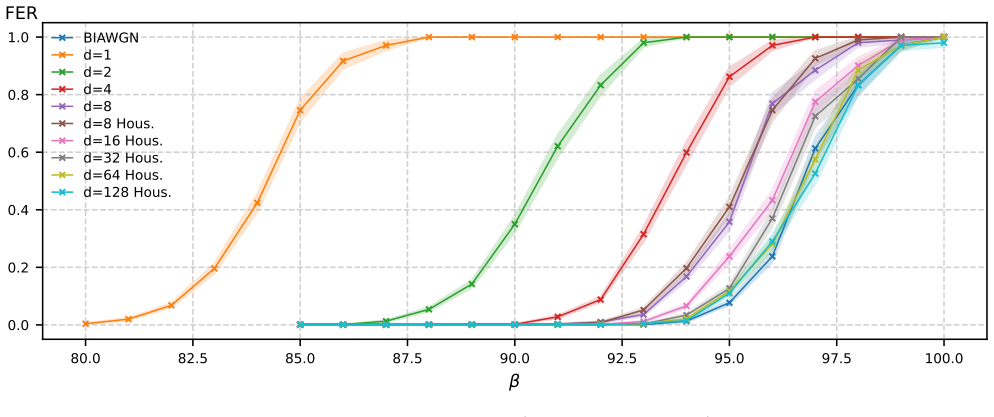
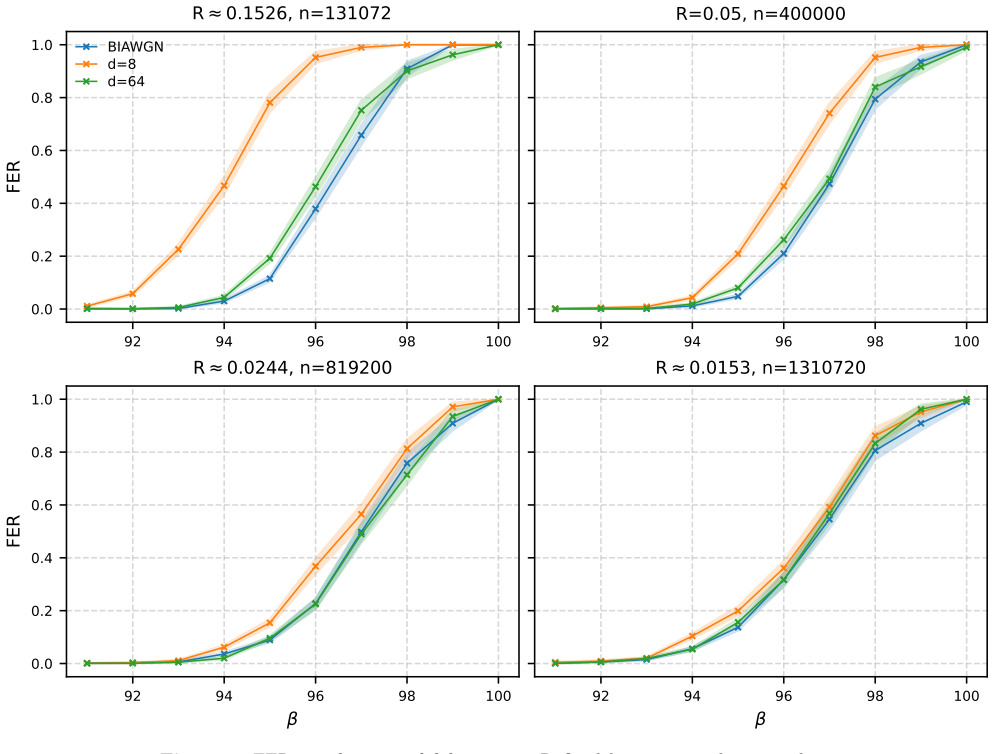
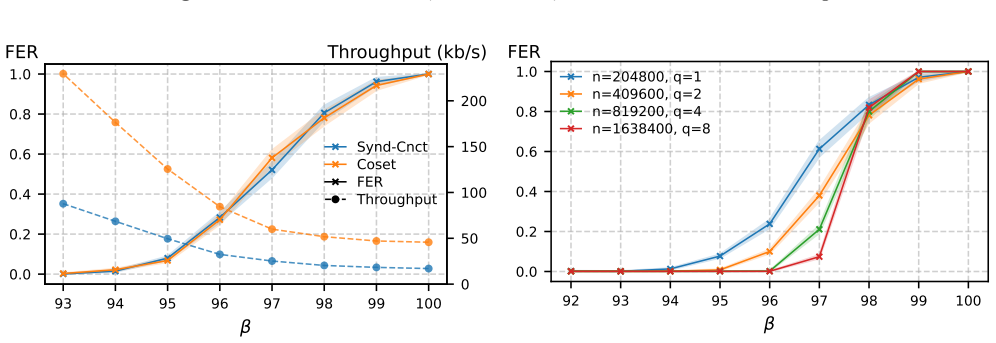
- Reconciliation efficiency increases with dimension while frame error rate depends on the chosen LDPC code and its degree distribution.
- The HDirac simulator enables systematic testing of any dimension with current LDPC constructions for reverse reconciliation.
- Designers can select dimension to meet a target efficiency versus distance trade-off in a CV-QKD link budget.
- High-dimensional constructions remove the previous restriction to algebraic dimensions and broaden the set of usable binary codes.
Where Pith is reading between the lines
- If the virtual-channel equivalence continues to hold at still higher dimensions, reconciliation could approach the Shannon limit more closely in extremely noisy regimes.
- The released simulator could be used to benchmark other code families or to optimize degree distributions specifically for the virtual channel.
- The identified efficiency–error-rate curves could guide the choice between fixed-dimension and adaptive-dimension reconciliation in deployed systems.
Load-bearing premise
The multidimensional reconciliation procedure successfully maps the physical Gaussian quantum channel onto a virtual BIAWGN channel for dimensions beyond 8.
What would settle it
A direct Monte-Carlo measurement, for dimension 16, of the mutual information or bit-error-rate curve between the reconciled bits and the virtual noise variable, compared against the theoretical BIAWGN curve for the same SNR.
Figures
read the original abstract
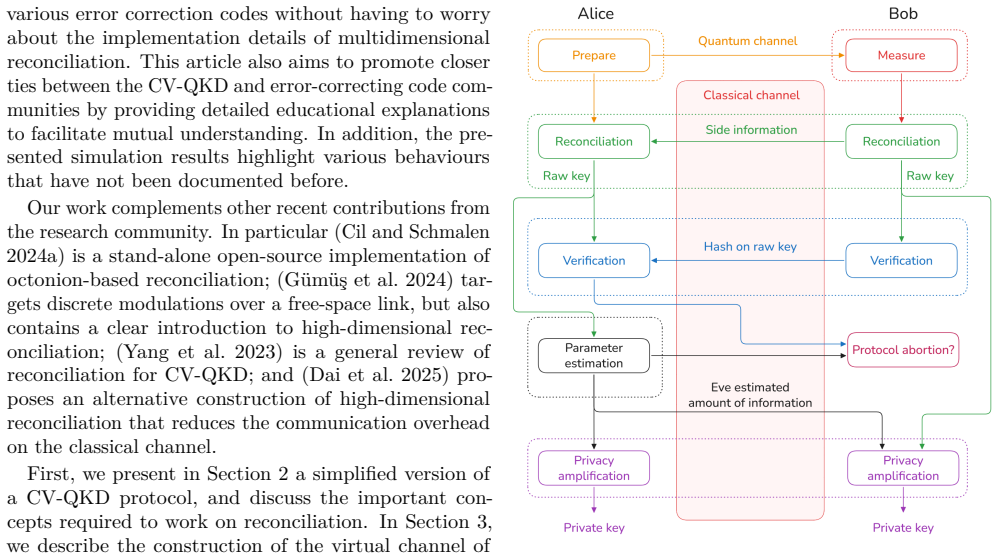
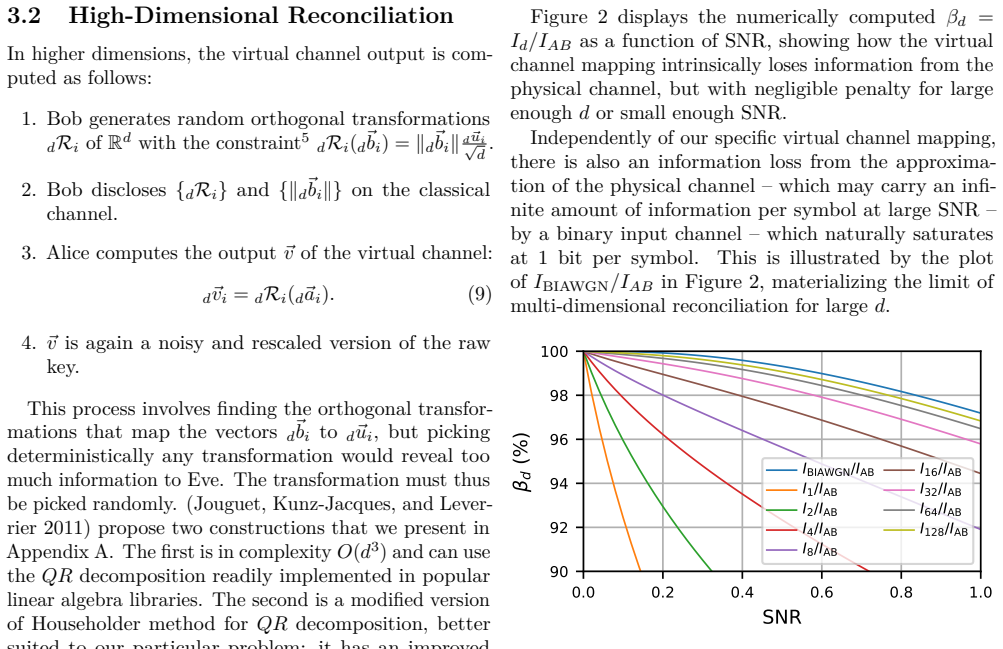
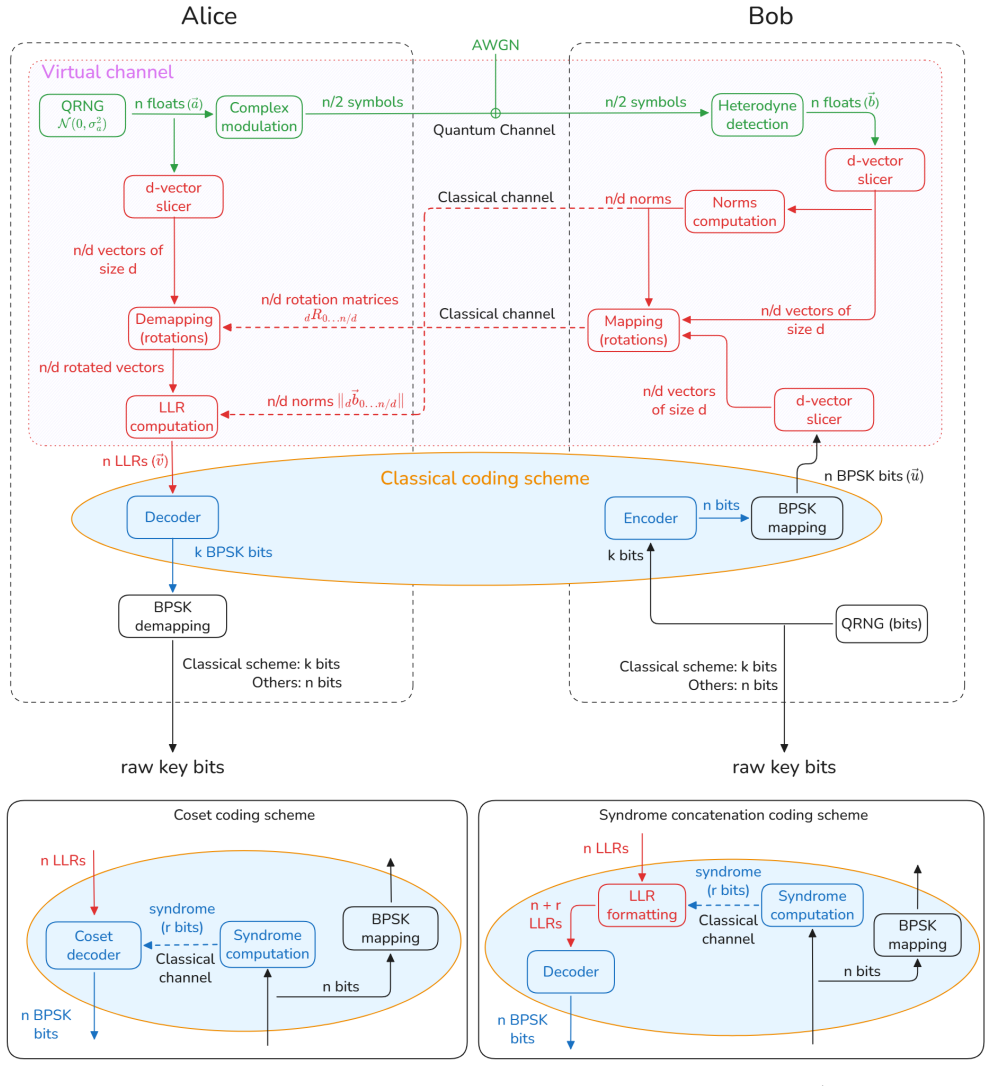
Continuous-variable quantum key distribution (CV-QKD) requires highly efficient reconciliation techniques to operate at low signal-to-noise ratios and long distances. Multidimensional reconciliation addresses this challenge by transforming the physical Gaussian quantum channel into a virtual binary-input additive white Gaussian noise (BIAWGN) channel, enabling the use of modern errorcorrecting codes. In this work, we review the principles of multidimensional reconciliation, with a particular focus on high-dimensional constructions beyond the algebraic dimensions 1, 2, 4, 8. We describe the construction of the virtual channel, discuss practical coding schemes for reverse reconciliation, and analyse their integration with linear error-correcting codes. We also present an opensource simulation framework, HDirac, implementing multidimensional reconciliation for arbitrary dimensions, and use it to evaluate state-of-the-art LDPC codes. The results highlight key trade-offs between dimension, reconciliation efficiency, and frame error rate, providing practical guidance for CV-QKD system design.
Editorial analysis
A structured set of objections, weighed in public.
Referee Report
Summary. The paper reviews multidimensional reconciliation techniques for continuous-variable quantum key distribution (CV-QKD), with emphasis on constructions for dimensions beyond the algebraic cases of 1, 2, 4 and 8. It details the mapping of the physical Gaussian channel to a virtual binary-input additive white Gaussian noise (BIAWGN) channel via orthogonal transformations, discusses integration with linear error-correcting codes for reverse reconciliation, presents the open-source HDirac simulator supporting arbitrary dimensions, and reports simulation results using LDPC codes that illustrate trade-offs among dimension, reconciliation efficiency and frame error rate.
Significance. If the reported efficiencies and frame-error-rate results hold under the stated channel mapping, the work supplies concrete practical guidance for CV-QKD system designers choosing operating dimensions and code parameters. The release of the HDirac simulation framework constitutes a reusable, reproducible resource that can accelerate further research on high-dimensional reconciliation.
major comments (2)
- [Section 5] Section 5: the efficiencies and frame error rates reported for dimensions d>8 are presented as evidence of practical trade-offs, yet the manuscript contains no statistical verification (normality tests, additivity checks, or quantile-quantile plots) on the post-reconciliation noise samples generated by HDirac. Without such evidence the assumption that the virtual channel remains exactly BIAWGN for these dimensions is unconfirmed, directly affecting the validity of the claimed performance numbers.
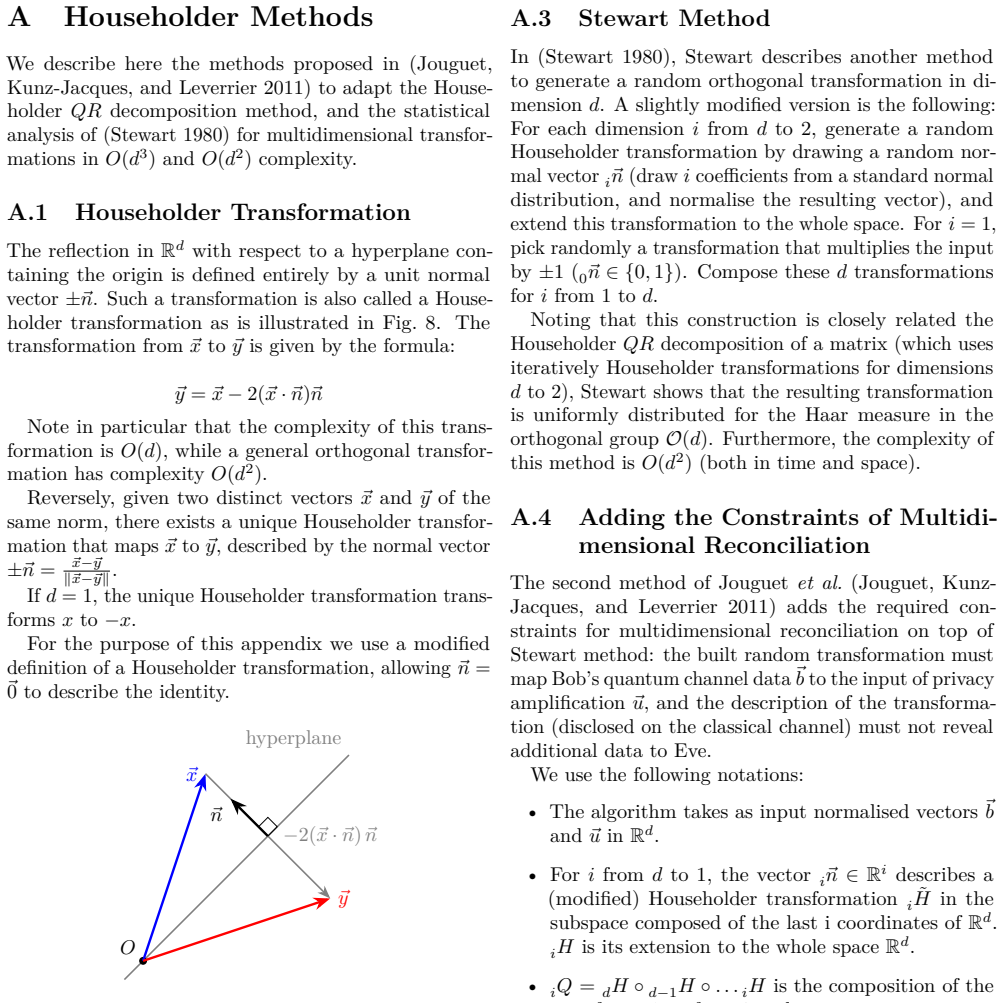
- [Section 3] Section 3: the construction of the virtual channel for arbitrary d is described via orthogonal transformations, but the text does not quantify the numerical precision or sphere-covering uniformity achieved by the implemented rotations for d>8; any deviation from ideal uniformity would alter the effective noise distribution and therefore the reconciliation efficiency bounds.
minor comments (2)
- [Abstract] The abstract states that results highlight key trade-offs but supplies no numerical values, error bars or dimension values; adding a single sentence with representative efficiency/FER figures would improve readability.
- [Section 2] Notation for the virtual-channel noise variance is introduced without an explicit equation reference in the early sections; a forward pointer to the defining equation would aid readers.
Simulated Author's Rebuttal
We thank the referee for the careful and constructive review. The comments highlight important aspects of validation that will strengthen the manuscript. We respond to each major comment below.
read point-by-point responses
-
Referee: [Section 5] Section 5: the efficiencies and frame error rates reported for dimensions d>8 are presented as evidence of practical trade-offs, yet the manuscript contains no statistical verification (normality tests, additivity checks, or quantile-quantile plots) on the post-reconciliation noise samples generated by HDirac. Without such evidence the assumption that the virtual channel remains exactly BIAWGN for these dimensions is unconfirmed, directly affecting the validity of the claimed performance numbers.
Authors: We agree that the absence of explicit statistical verification leaves the BIAWGN assumption for d>8 insufficiently supported in the current text. In the revised manuscript we will add, in Section 5, Shapiro-Wilk normality tests, checks for additivity of the noise, and quantile-quantile plots computed on the post-reconciliation samples produced by HDirac for all reported dimensions. These additions will directly confirm (or quantify any deviation from) the virtual-channel model underlying the reported efficiencies and frame-error rates. revision: yes
-
Referee: [Section 3] Section 3: the construction of the virtual channel for arbitrary d is described via orthogonal transformations, but the text does not quantify the numerical precision or sphere-covering uniformity achieved by the implemented rotations for d>8; any deviation from ideal uniformity would alter the effective noise distribution and therefore the reconciliation efficiency bounds.
Authors: The observation is correct: while the algebraic construction guarantees uniformity when the rotations are exact, the manuscript does not report numerical metrics for d>8. We will revise Section 3 to include (i) the maximum deviation from orthogonality (Frobenius norm) measured for the implemented rotation matrices and (ii) a quantitative sphere-covering uniformity metric (e.g., maximum gap between successive points on the unit sphere) evaluated over the dimensions simulated in HDirac. These figures will be presented in a new table or short appendix so that readers can assess any impact on the claimed efficiency bounds. revision: yes
Circularity Check
No circularity: results are direct simulation outputs on standard virtual channel construction
full rationale
The paper reviews the multidimensional reconciliation procedure (standard orthogonal transformation to virtual BIAWGN), implements it in open-source HDirac for arbitrary dimensions, and reports empirical efficiencies/FERs from LDPC simulations. These are independent numerical outcomes, not fitted parameters renamed as predictions, self-definitions, or self-citation chains. No load-bearing step reduces by construction to its own inputs; the derivation chain is self-contained against external benchmarks.
Axiom & Free-Parameter Ledger
axioms (1)
- domain assumption The physical Gaussian quantum channel can be transformed into a virtual binary-input additive white Gaussian noise (BIAWGN) channel via multidimensional reconciliation.
Reference graph
Works this paper leans on
-
[1]
, author =
Theoretical security analysis of subframing for error correction in CVQKD. , author =. 2026 , journal =
2026
-
[2]
Continuous Variable Quantum Cryptography Using Coherent States , author =. Phys. Rev. Lett. , volume =. 2002 , month =
2002
-
[3]
Proceedings of the 6th International Conference on Quantum Communications, Measurement, and Computing , year =
Reverse reconciliation protocols for quantum cryptography with continuous variables , author =. Proceedings of the 6th International Conference on Quantum Communications, Measurement, and Computing , year =
-
[4]
Calibration Attack and Defense in Continuous Variable Quantum Key Distribution , year =
Ferenczi, Agnes and Grangier, Philippe and Grosshans, Frederic , booktitle =. Calibration Attack and Defense in Continuous Variable Quantum Key Distribution , year =
-
[5]
Long-distance continuous-variable quantum key distribution with a Gaussian modulation , author =. Phys. Rev. A , volume =. 2011 , month =
2011
-
[6]
Multidimensional reconciliation for a continuous-variable quantum key distribution , volume =
Leverrier, Anthony and Alléaume, Romain and Boutros, Joseph and Zémor, Gilles and Grangier, Philippe , year =. Multidimensional reconciliation for a continuous-variable quantum key distribution , volume =. Physical Review A , publisher =. doi:10.1103/physreva.77.042325 , number =
-
[7]
2024 , eprint =
The Road to Near-Capacity CV-QKD Reconciliation: An FEC-Agnostic Design , author =. 2024 , eprint =
2024
-
[8]
AFF3CT: A Fast Forward Error Correction Toolbox! , journal =. 2019 , issn =. doi:https://doi.org/10.1016/j.softx.2019.100345 , author =
-
[9]
and Cardinal, J
Van Assche, G. and Cardinal, J. and Cerf, N.J. , journal =. Reconciliation of a quantum-distributed Gaussian key , year =
-
[10]
Richardson and R
Thomas J. Richardson and R. Modern Coding Theory , publisher =. 2008 , url =
2008
-
[11]
Quantum Info
Jouguet, Paul and Kunz-Jacques, Sébastien , title =. Quantum Info. Comput. , month =. 2014 , issue_date =
2014
-
[12]
Rate-Adaptive Polar-Coding-Based Reconciliation for Continuous-Variable Quantum Key Distribution at Low Signal-to-Noise Ratio , author =. Phys. Rev. Appl. , volume =. 2023 , month =
2023
-
[13]
2016 IEEE International Conference on Communications (ICC) , year =
Design of Raptor codes in the low SNR regime with applications in quantum key distribution , author =. 2016 IEEE International Conference on Communications (ICC) , year =
2016
-
[14]
Continuous-Variable Quantum Key Distribution with Rateless Reconciliation Protocol , author =. Phys. Rev. Appl. , volume =. 2019 , month =
2019
-
[15]
Quantum Information Processing , year =
Wen, Xuan and Li, Qiong and Mao, Haokun and Luo, Yi and Yan, Bingze and Huang, Furong , title =. Quantum Information Processing , year =
-
[16]
Information reconciliation with extremely low signal-to-noise ratio for continuous-variable quantum key distribution with LDPC-Hadamard codes , author =. Phys. Rev. Appl. , volume =. 2025 , month =
2025
-
[17]
High-Speed Reconciliation for CVQKD Based on Spatially Coupled LDPC Codes , year =
Jiang, Xue-Qin and Yang, Siyuan and Huang, Peng and Zeng, Guihua , journal =. High-Speed Reconciliation for CVQKD Based on Spatially Coupled LDPC Codes , year =
-
[18]
Low Rate Protograph-Based LDPC Codes for Continuous Variable Quantum Key Distribution , year =
Gümüş, Kadir and Schmalen, Laurent , booktitle =. Low Rate Protograph-Based LDPC Codes for Continuous Variable Quantum Key Distribution , year =
-
[19]
Rate-Adaptive Protograph-Based Raptor-Like LDPC Code for Continuous-Variable Quantum Key Distribution , year =
Erdem Eray Cil and Laurent Schmalen , booktitle =. Rate-Adaptive Protograph-Based Raptor-Like LDPC Code for Continuous-Variable Quantum Key Distribution , year =. Advanced Photonics Congress 2024 , keywords =
2024
-
[20]
2015 , eprint =
Repeat-Accumulate Codes for Reconciliation in Continuous Variable Quantum Key Distribution , author =. 2015 , eprint =
2015
-
[21]
Multiedge-type low-density parity-check codes for continuous-variable quantum key distribution , author =. Phys. Rev. A , volume =. 2021 , month =
2021
-
[22]
E. E. Cil and L. Schmalen , title =. Proc. International Conference on Quantum Cryptography (QCRYPT) , address =. 2024 , code_url =
2024
-
[23]
2014 , eprint =
Rate-Compatible LDPC Codes Based on Puncturing and Extension Techniques for Short Block Lengths , author =. 2014 , eprint =
2014
-
[24]
Mario Milicevic and Chen Feng and Lei M. Zhang and P. Glenn Gulak , title =. npj Quantum Information , year =. doi:10.1038/s41534-018-0070-6 , issn =
-
[25]
2024 , month =
Rate-adaptive Reconciliation for Experimental Continuous-variable Quantum Key Distribution with Discrete Modulation over a Free-space Optical Link , author =. 2024 , month =
2024
-
[26]
doi:10.1088/1367-2630/aa54d7 , year =
Johnson, Sarah J and Lance, Andrew M and Ong, Lawrence and Shirvanimoghaddam, Mahyar and Ralph, T C and Symul, Thomas , title =. doi:10.1088/1367-2630/aa54d7 , year =
-
[27]
Security of Continuous-Variable Quantum Key Distribution via a Gaussian de Finetti Reduction , author =. Phys. Rev. Lett. , volume =. 2017 , month =
2017
-
[28]
Improved composable key rates for CV-QKD , author =. Phys. Rev. Res. , volume =. 2024 , month =
2024
-
[29]
Arbitrarily-high-dimensional reconciliation via cross-rotation for continuous-variable quantum key distribution , author =. Phys. Rev. A , volume =. 2025 , month =
2025
-
[30]
Eigen v3 , howpublished =
Ga\". Eigen v3 , howpublished =
-
[31]
2025 , eprint =
QKD security proofs for decoy-state BB84: protocol variations, proof techniques, gaps and limitations , author =. 2025 , eprint =
2025
-
[32]
G. W. Stewart , journal =. The Efficient Generation of Random Orthogonal Matrices with an Application to Condition Estimators , urldate =
-
[33]
EPJ Quantum Technology , volume =
Information reconciliation of continuous-variables quantum key distribution: principles, implementations and applications , author =. EPJ Quantum Technology , volume =. 2023 , month =
2023
-
[34]
Virtual channel of multidimensional reconciliation in a continuous-variable quantum key distribution , author =. Phys. Rev. A , volume =. 2021 , month =
2021
-
[35]
2006 , month = Dec, keywords =
Lodewyck, J. 2006 , month = Dec, keywords =
2006
-
[36]
Journal of Physics B: Atomic, Molecular and Optical Physics , abstract =
Fossier, S and Diamanti, E and Debuisschert, T and Tualle-Brouri, R and Grangier, P , title =. Journal of Physics B: Atomic, Molecular and Optical Physics , abstract =. doi:10.1088/0953-4075/42/11/114014 , year =
-
[37]
Finite-size analysis of a continuous-variable quantum key distribution , author =. Phys. Rev. A , volume =. 2010 , month =
2010
-
[38]
ArXiv , year =
Dalek: An Unconventional and Energy-Aware Heterogeneous Cluster , author =. ArXiv , year =
-
[39]
Experimental demonstration of long-distance continuous-variable quantum key distribution , journal =
Jouguet, Paul and Kunz-Jacques, S. Experimental demonstration of long-distance continuous-variable quantum key distribution , journal =. 2013 , volume =. doi:10.1038/nphoton.2013.63 , issn =
-
[40]
Jaksch, Kevin and others , title =. 2410.12915 , archiveprefix =
-
[41]
Concurrency and Computation: Practice and Experience , volume =
Cassagne, Adrien and Tajan, Romain and Aumage, Olivier and Leroux, Camille and Barthou, Denis and Jégo, Christophe , title =. Concurrency and Computation: Practice and Experience , volume =. doi:https://doi.org/10.1002/cpe.7820 , abstract =
-
[42]
HDirac , month = 06, year = 2026, version =
2026
discussion (0)
Sign in with ORCID, Apple, or X to comment. Anyone can read and Pith papers without signing in.