Quantum Simulation of Nucleon-Antinucleon Interaction in Large-N QCD₂ on an IBM Quantum Nighthawk Processor
Pith reviewed 2026-06-28 14:11 UTC · model grok-4.3
The pith
The kink-antikink interaction potential from large-N QCD2 can be extracted on quantum hardware via conditional energies of nonunitary string operators.
A machine-rendered reading of the paper's core claim, the machinery that carries it, and where it could break.
Core claim
In the large-N limit of two-dimensional QCD, baryons emerge as topological solitons (kinks) of an effective mesonic field theory. The continuum bosonized Hamiltonian is mapped to a finite XXZ spin chain; nucleon and antinucleon states correspond to kink and antikink excitations whose interaction is encoded in spin correlations. Implementing the chain on qubits via Jordan-Wigner encoding, a variational ground-state ansatz, and postselected nonunitary string operators yields conditional energies from which the kink-antikink potential is built; this potential is attractive and can be robustly extracted due to structured error cancellation, with device results agreeing with exact diagonalization
What carries the argument
Jordan-Wigner mapping of the bosonized Hamiltonian to an XXZ spin chain, realized with a variational ground-state ansatz and postselected nonunitary disorder operator insertions whose conditional energies furnish the interaction potential.
If this is right
- The kink-antikink potential exhibits the expected attractive behavior once extracted from the device.
- Structured error cancellation on the processor makes the conditional energies robust enough for reliable potential reconstruction.
- Benchmarks against exact diagonalization and ideal statevector evaluation confirm agreement for the finite chain.
- Large-L matrix-product-state calculations connect the finite-device result to the continuum field theory limit.
Where Pith is reading between the lines
- The same nonunitary-operator technique might be applied to other soliton-bearing models whose Hamiltonians map to spin chains.
- If the mapping remains faithful at larger qubit counts, the approach could probe multi-kink scattering or finite-density effects.
- Error-cancellation patterns observed here may guide circuit designs for other noisy simulations of topological excitations.
Load-bearing premise
The Jordan-Wigner mapping of the continuum bosonized Hamiltonian to the finite XXZ spin chain, together with the variational ansatz and postselected disorder operators, faithfully reproduces the nucleon-antinucleon dynamics of the original field theory without dominant finite-size or hardware artifacts.
What would settle it
A clear mismatch between the potential extracted from the quantum device and the potential obtained from large-L matrix-product-state calculations taken to the continuum limit would show that the hardware simulation does not reproduce the field-theory dynamics.
Figures
read the original abstract
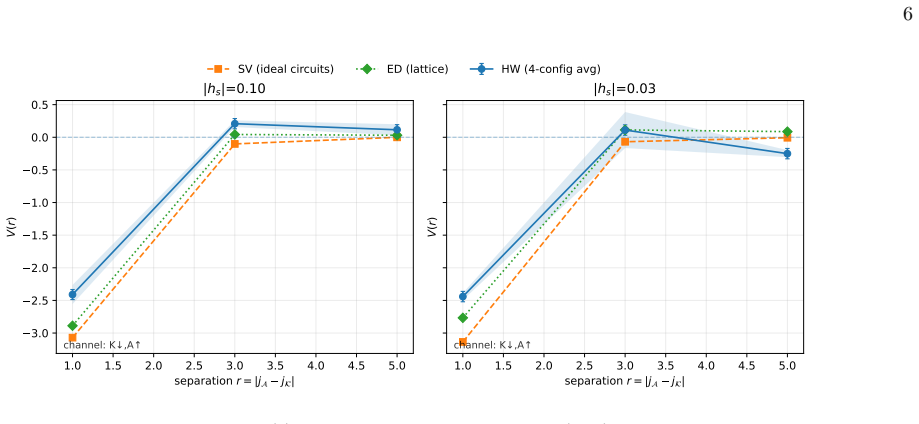
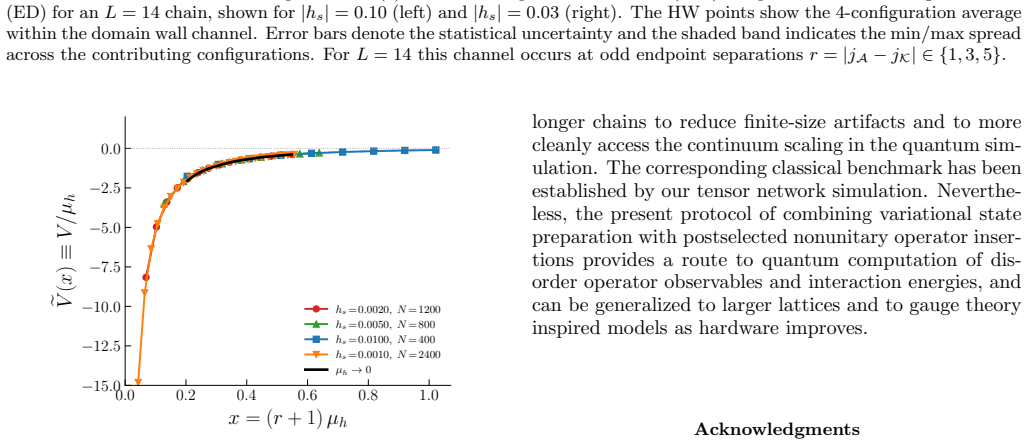
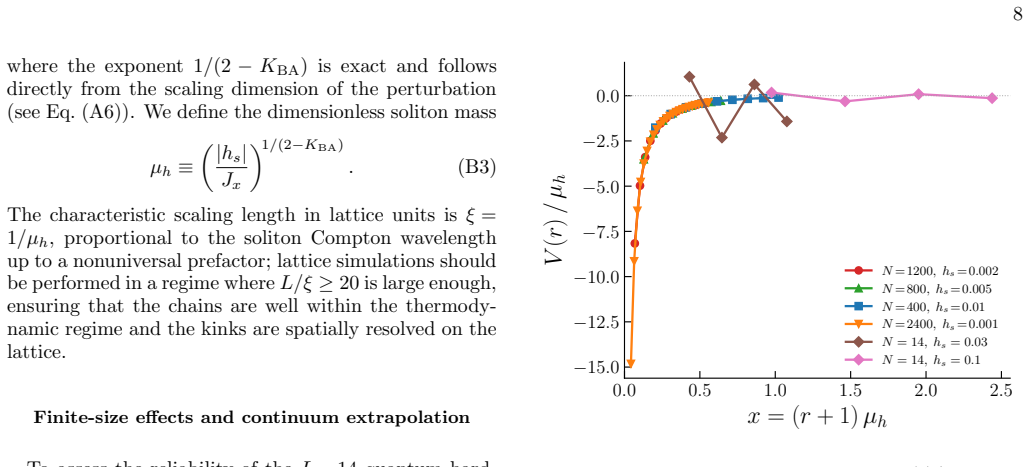
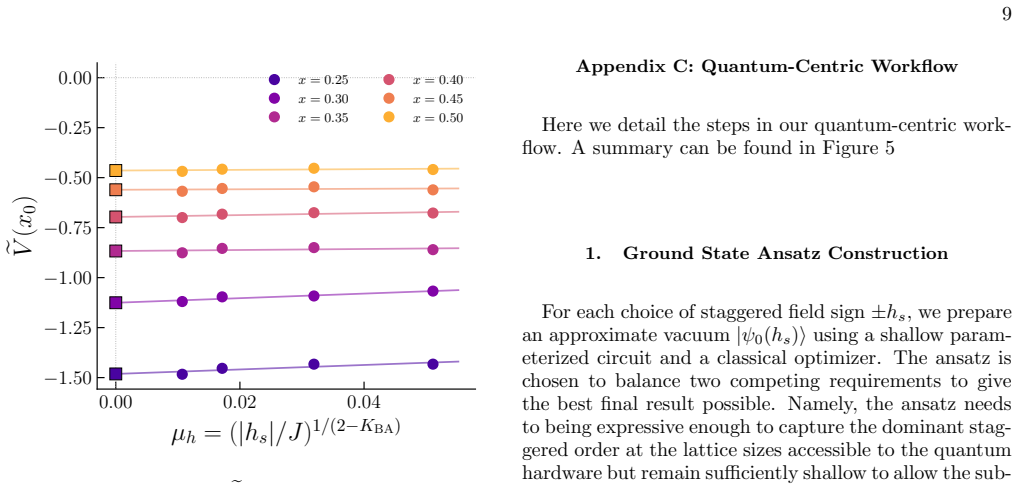
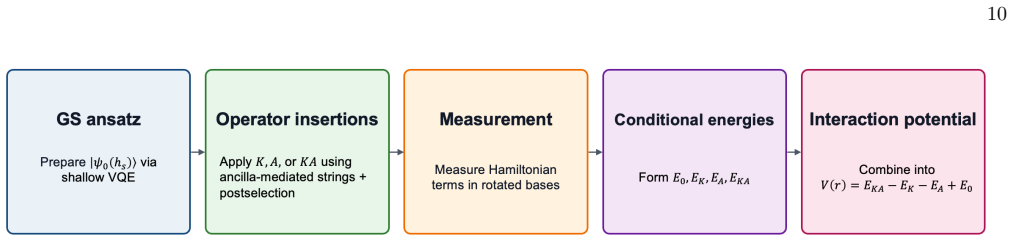
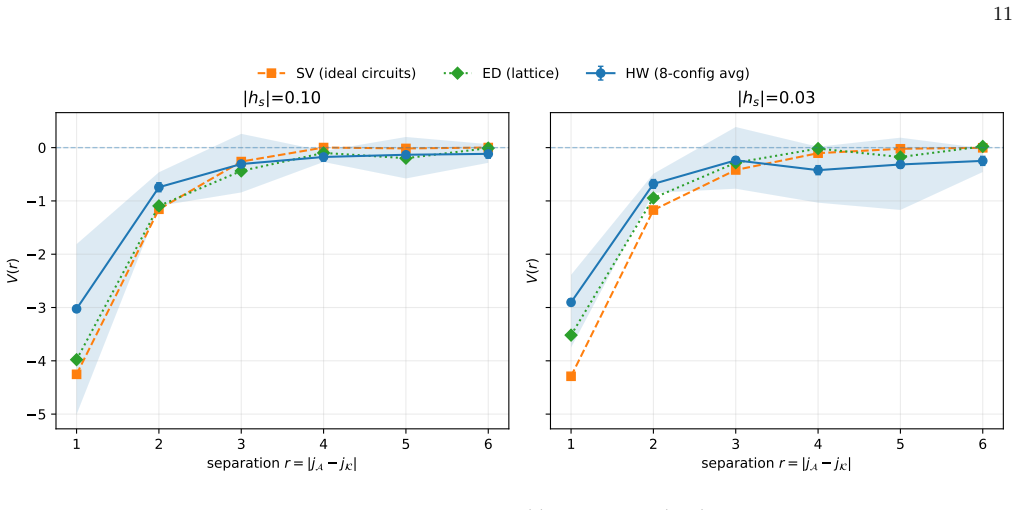
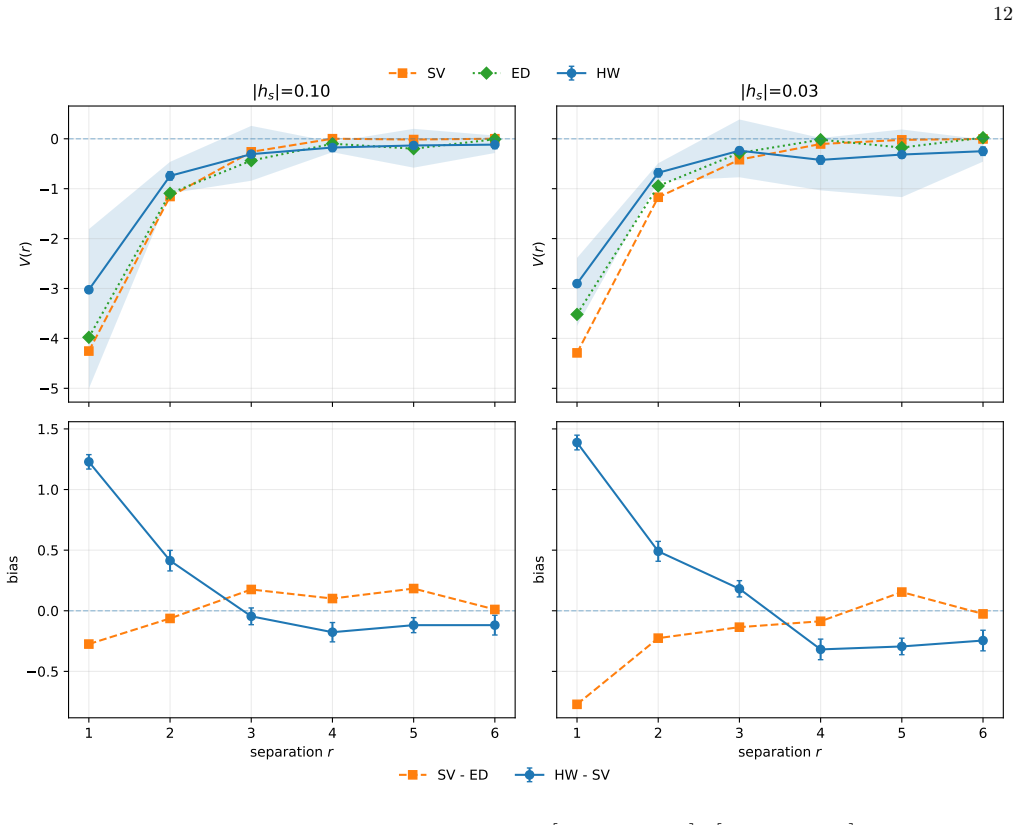
We report a quantum simulation of the nucleon--antinucleon interaction in large-$N$ two-dimensional quantum chromodynamics (QCD$_2$) on the IBM Quantum Nighthawk processor. In the large-$N$ limit, QCD$_2$ admits a bosonized description in which baryons emerge as topological solitons (kinks) of an effective mesonic field theory, providing a controlled, nonperturbative framework for baryon--antibaryon dynamics. We formulate the problem by mapping the continuum bosonized Hamiltonian to a spin-chain representation equivalent to an XXZ model with anisotropy set by the QCD parameters. In this mapping, nucleon and antinucleon states correspond to kink and antikink excitations, respectively, while their interaction is encoded in the spin correlations of the chain. Using Jordan--Wigner encoding, we implement the resulting XXZ Hamiltonian on a finite set of qubits and realize it via a variational ground state ansatz and postselected nonunitary disorder operator insertions optimized for the Nighthawk architecture. We then show the kink--antikink interaction potential built from the conditional energies of these nonunitary string operators can be robustly extracted from the quantum hardware due to structured error cancelation. The resulting potential exhibits the expected attractive behavior. The quantum simulation results are benchmarked against exact diagonalization, ideal statevector evaluation showing good agreement. To connect the device result to the continuum field theory, we extract the potential in the continuum limit using large-$L$ matrix product state calculations.
Editorial analysis
A structured set of objections, weighed in public.
Referee Report
Summary. The manuscript reports a quantum simulation of nucleon-antinucleon interactions in large-N QCD₂ on the IBM Quantum Nighthawk processor. The continuum bosonized Hamiltonian is mapped to an XXZ spin chain via Jordan-Wigner encoding; nucleon and antinucleon states are realized as kink and antikink excitations. A variational ground-state ansatz together with postselected nonunitary disorder operators is executed on hardware; the kink-antikink potential is extracted from conditional energies, with the claim that structured error cancellation renders the result robust. The extracted potential is reported to exhibit the expected attractive behavior, to agree with exact diagonalization and ideal statevector benchmarks, and to connect to the continuum limit via large-L matrix-product-state calculations.
Significance. If the central claim holds, the work would provide a concrete demonstration that conditional energies of postselected nonunitary operators on present-day superconducting hardware can yield a physically meaningful interaction potential for a nonperturbative field-theory problem. The approach of leveraging structured error cancellation to extract differences rather than absolute energies could be transferable to other lattice gauge-theory simulations. The connection to large-N QCD₂ and the use of both hardware and MPS data to reach the continuum limit would strengthen the bridge between quantum simulation and high-energy phenomenology.
major comments (3)
- [Abstract] Abstract: the assertion of “good agreement” with exact diagonalization and ideal statevector evaluation supplies no quantitative metrics, error bars, or details on how postselection modifies the extracted potential; the central claim of robust hardware extraction therefore cannot be verified from the given information.
- [Hardware extraction of the potential] Hardware extraction paragraph: the claim that the potential is “robustly extracted … due to structured error cancelation” is supported only by comparisons to exact diagonalization and ideal statevector simulations; these benchmarks do not test whether real-device noise (state-dependent readout, non-Pauli errors) preserves the required cancellation structure in the conditional energies of the nonunitary string operators.
- [Mapping and variational ansatz] Mapping and ansatz section: the Jordan-Wigner mapping of the bosonized Hamiltonian together with the variational ansatz and postselected disorder operators is asserted to faithfully reproduce the nucleon-antinucleon dynamics, yet no quantitative assessment of finite-size effects, truncation errors, or dominant hardware artifacts is provided to substantiate the absence of uncontrolled bias in the extracted potential.
minor comments (1)
- [Methods] Notation for the disorder operators and the definition of the conditional energy should be made explicit in a single equation block to avoid ambiguity when comparing hardware and classical results.
Simulated Author's Rebuttal
We thank the referee for their careful reading of our manuscript and for the constructive comments. We address each of the major comments below.
read point-by-point responses
-
Referee: [Abstract] Abstract: the assertion of “good agreement” with exact diagonalization and ideal statevector evaluation supplies no quantitative metrics, error bars, or details on how postselection modifies the extracted potential; the central claim of robust hardware extraction therefore cannot be verified from the given information.
Authors: We agree that the abstract would benefit from quantitative metrics to support the claim of good agreement. In the revised version, we will add specific quantitative measures such as the relative error between the hardware-extracted potential and the exact diagonalization results, along with error bars derived from multiple hardware runs. We will also include a brief description of the postselection procedure and its effect on the potential extraction. revision: yes
-
Referee: [Hardware extraction of the potential] Hardware extraction paragraph: the claim that the potential is “robustly extracted … due to structured error cancelation” is supported only by comparisons to exact diagonalization and ideal statevector simulations; these benchmarks do not test whether real-device noise (state-dependent readout, non-Pauli errors) preserves the required cancellation structure in the conditional energies of the nonunitary string operators.
Authors: The agreement between the hardware results and the ideal statevector simulations indicates that the structured error cancellation is effective under the actual device noise present during the experiment. However, we acknowledge that explicit tests using simulated noise models for state-dependent readout and non-Pauli errors are not included. We will add a discussion clarifying that the robustness is supported by the close match to benchmarks, which would not hold if the cancellation structure were significantly disrupted by the noise. revision: partial
-
Referee: [Mapping and variational ansatz] Mapping and ansatz section: the Jordan-Wigner mapping of the bosonized Hamiltonian together with the variational ansatz and postselected disorder operators is asserted to faithfully reproduce the nucleon-antinucleon dynamics, yet no quantitative assessment of finite-size effects, truncation errors, or dominant hardware artifacts is provided to substantiate the absence of uncontrolled bias in the extracted potential.
Authors: We agree that quantitative assessments are important. The manuscript already includes comparisons for different system sizes in the MPS calculations for the continuum limit, but we will expand the main text to include explicit quantification of finite-size effects on the extracted potential, estimates of variational truncation errors, and an analysis of hardware artifacts based on the observed discrepancies with ideal simulations. revision: yes
Circularity Check
No significant circularity; derivation relies on independent benchmarks
full rationale
The paper maps the bosonized large-N QCD2 Hamiltonian to an XXZ spin chain via Jordan-Wigner, implements a variational ansatz plus postselected disorder operators on hardware, extracts the kink-antikink potential from conditional energies, and validates the result against exact diagonalization, ideal statevector simulation, and large-L matrix-product-state calculations for the continuum limit. These external numerical checks are independent of the hardware extraction step and do not reduce the reported attractive potential to a fitted parameter or self-citation by construction. No load-bearing self-citation, ansatz smuggling, or renaming of known results appears in the derivation chain.
Axiom & Free-Parameter Ledger
Reference graph
Works this paper leans on
-
[1]
The ansatz is chosen to balance two competing requirements to give the best final result possible
Ground State Ansatz Construction For each choice of staggered field sign±h s, we prepare an approximate vacuum|ψ 0(hs)⟩using a shallow param- eterized circuit and a classical optimizer. The ansatz is chosen to balance two competing requirements to give the best final result possible. Namely, the ansatz needs to being expressive enough to capture the domin...
-
[2]
Postselected disorder operator insertions The kink (K) and antikink (A) disorder operators used in the main text are nonunitary (see Eq. (8)). To imple- ment these nonunitary operators, we embed them into a larger unitary circuit with ancilla qubits, followed by projective measurement of the ancillas and postselection on the all zeros outcome. Concretely,...
-
[3]
K-first” and “A-first
Configuration averaging and sublattice channels a. Four-configuration averaging.On a finite open chain, observables depend on where the kink and antikink insertions (j K, jA) sit relative to the boundaries, as well as the hardware embedding. To reduce this geometry dependence, we evaluateV(r) in multiple configurations that differ only by the choice of in...
-
[4]
Compilation used a hardware-aware qubit layout focused on qubit locality and quality metrics
Error suppression and ancilla readout calibration All hardware circuits were executed within a single batch per dataset to reduce the impact of calibration drift. Compilation used a hardware-aware qubit layout focused on qubit locality and quality metrics. Dynami- cal decoupling was enabled on idle windows to suppress dephasing during the nonlocal ancilla...
-
[5]
Postselection and effective sample sizes Compared to the raw shot budget, ancilla postselec- tion reduces the effective sample size contributing to the conditional energies in Eq. (14). Table I summarizes the hardware resources and postselection yields for both datasets. We report the average postselection keep frac- tions for the single insertion circuit...
-
[6]
Within each batch, all circuits share a common compilation stack and were executed in a short time window to mitigate drift
Device All production results reported were obtained on the IBM Quantum Computeribm miamifeaturing the Nighthawk superconducting processor and using the Qiskit Runtime batch execution mode. Within each batch, all circuits share a common compilation stack and were executed in a short time window to mitigate drift
-
[7]
Prod. circs
Embedding: data-chain and ancillas We embed theL= 14 logical spin chain onto a contigu- ous path of physical qubits (the data chain) and place a small set of ancilla qubits adjacent to this path to imple- ment the nonunitary disorder operator strings. We used a simple heuristic involving qubit locality and timing er- rors for score and choose different ph...
-
[8]
These values are used in the ancilla readout correction described in Appendix C 4
Batch ancilla calibration For the same batch, the ancilla calibration circuits yield an averageP(0|0)≈0.98 andP(1|0)≈0.02 across the seven ancillas used for postselection. These values are used in the ancilla readout correction described in Appendix C 4. 13
-
[9]
C. B. Dover, T. Gutsche, M. Maruyama, and A. Faessler, The Physics of nucleon - anti-nucleon annihilation, Prog. Part. Nucl. Phys.29, 87 (1992)
1992
-
[10]
X.-W. Kang, J. Haidenbauer, and U.-G. Meißner, Antinucleon-nucleon interaction in chiral effective field theory, JHEP02, 113, arXiv:1311.1658 [hep-ph]
-
[11]
Luscher, Volume Dependence of the Energy Spectrum in Massive Quantum Field Theories
M. Luscher, Volume Dependence of the Energy Spectrum in Massive Quantum Field Theories. 2. Scattering States, Commun. Math. Phys.105, 153 (1986)
1986
-
[12]
Luscher, Two particle states on a torus and their re- lation to the scattering matrix, Nucl
M. Luscher, Two particle states on a torus and their re- lation to the scattering matrix, Nucl. Phys. B354, 531 (1991)
1991
-
[13]
S. R. Beane, W. Detmold, K. Orginos, and M. J. Savage, Nuclear Physics from Lattice QCD, Prog. Part. Nucl. Phys.66, 1 (2011), arXiv:1004.2935 [hep-lat]
Pith/arXiv arXiv 2011
-
[14]
’t Hooft, A Two-Dimensional Model for Mesons, Nucl
G. ’t Hooft, A Two-Dimensional Model for Mesons, Nucl. Phys. B75, 461 (1974)
1974
-
[15]
C. G. J. Callan, N. Coote, and D. J. Gross, Two- dimensional yang-mills theory: A model of quark con- finement, Physical Review D13, 1649 (1976)
1976
-
[16]
Witten, Nonabelian Bosonization in Two-Dimensions, Commun
E. Witten, Nonabelian Bosonization in Two-Dimensions, Commun. Math. Phys.92, 455 (1984)
1984
-
[17]
Y. Frishman and J. Sonnenschein, Bosonization and QCD in two-dimensions, Phys. Rept.223, 309 (1993), arXiv:hep-th/9207017
Pith/arXiv arXiv 1993
-
[18]
D. J. Gross, I. R. Klebanov, A. V. Matytsin, and A. V. Smilga, Screening versus confinement in (1+1)- dimensions, Nucl. Phys. B461, 109 (1996), arXiv:hep- th/9511104
arXiv 1996
-
[19]
S. R. Coleman, The Quantum Sine-Gordon Equation as the Massive Thirring Model, Phys. Rev. D11, 2088 (1975)
2088
-
[20]
Mandelstam, Soliton Operators for the Quantized Sine-Gordon Equation, Phys
S. Mandelstam, Soliton Operators for the Quantized Sine-Gordon Equation, Phys. Rev. D11, 3026 (1975)
1975
-
[21]
R. F. Dashen, B. Hasslacher, and A. Neveu, The Parti- cle Spectrum in Model Field Theories from Semiclassical Functional Integral Techniques, Phys. Rev. D11, 3424 (1975)
1975
-
[22]
L. D. Faddeev and V. E. Korepin, Quantum Theory of Solitons: Preliminary Version, Phys. Rept.42, 1 (1978)
1978
-
[23]
A. B. Zamolodchikov and A. B. Zamolodchikov, Factor- ized s Matrices in Two-Dimensions as the Exact Solutions of Certain Relativistic Quantum Field Models, Annals Phys.120, 253 (1979)
1979
-
[24]
Rajaraman,Solitons and Instantons
R. Rajaraman,Solitons and Instantons. An Introduction to Solitons and Instantons in Quantum Field Theory, North-Holland personal library (North-Holland Publish- ing Company, 1982)
1982
-
[25]
Affleck and M
I. Affleck and M. Oshikawa, Field-induced gap in cu ben- zoate and others= 1 2 antiferromagnetic chains, Phys. Rev. B60, 1038 (1999)
1999
-
[26]
Oshikawa and I
M. Oshikawa and I. Affleck, Field-induced gap inS= 1/2 antiferromagnetic chains, Phys. Rev. Lett.79, 2883 (1997)
1997
-
[27]
Luther and I
A. Luther and I. Peschel, Calculation of critical expo- nents in two-dimensions from quantum field theory in one-dimension, Phys. Rev. B12, 3908 (1975)
1975
-
[28]
F. D. M. Haldane, Luttinger liquid theory of one- dimensional quantum fluids. I. Properties of the Lut- tinger model and their extension to the general 1D in- teracting spinless Fermi gas, J. Phys. C14, 2585 (1981)
1981
-
[29]
Giamarchi,Quantum Physics in One Dimension(Ox- ford University Press, 2003)
T. Giamarchi,Quantum Physics in One Dimension(Ox- ford University Press, 2003)
2003
-
[30]
V. E. Korepin, N. M. Bogoliubov, and A. G. Izer- gin,Quantum Inverse Scattering Method and Correla- tion Functions, Cambridge Monographs on Mathemat- ical Physics (Cambridge University Press, Cambridge, 1993)
1993
-
[31]
L. D. Faddeev and L. A. Takhtajan, The quantum method of the inverse problem and the heisenberg xyz model, Russian Mathematical Surveys34, 11 (1979)
1979
-
[32]
C. W. Baueret al., Quantum Simulation for High- Energy Physics, PRX Quantum4, 027001 (2023), arXiv:2204.03381 [quant-ph]
arXiv 2023
-
[33]
C. W. Bauer, Z. Davoudi, N. Klco, and M. J. Savage, Quantum simulation of fundamental particles and forces, Nature Rev. Phys.5, 420 (2023), arXiv:2404.06298 [hep- ph]
arXiv 2023
-
[34]
A. N. Ciavarella and C. W. Bauer, Quantum Simulation of SU(3) Lattice Yang-Mills Theory at Leading Order in Large-Nc Expansion, Phys. Rev. Lett.133, 111901 (2024), arXiv:2402.10265 [hep-ph]
arXiv 2024
- [35]
-
[36]
A. Di Meglioet al., Quantum Computing for High- Energy Physics: State of the Art and Challenges, PRX Quantum5, 037001 (2024), arXiv:2307.03236 [quant-ph]
arXiv 2024
-
[37]
A. Nicholsonet al., Toward a resolution of the NN controversy, PoSLATTICE2021, 098 (2022), arXiv:2112.04569 [hep-lat]
arXiv 2022
-
[38]
S. Amarasinghe, R. Baghdadi, Z. Davoudi, W. Det- mold, M. Illa, A. Parreno, A. V. Pochinsky, P. E. Shanahan, and M. L. Wagman, Variational study of two-nucleon systems with lattice QCD, Phys. Rev. D 107, 094508 (2023), [Erratum: Phys.Rev.D 110, 119904 (2024)], arXiv:2108.10835 [hep-lat]
arXiv 2023
-
[39]
S. R. Beane, E. Chang, S. D. Cohen, W. Detmold, H. W. Lin, T. C. Luu, K. Orginos, A. Parreno, M. J. Savage, and A. Walker-Loud (NPLQCD), Light Nuclei and Hyper- nuclei from Quantum Chromodynamics in the Limit of SU(3) Flavor Symmetry, Phys. Rev. D87, 034506 (2013), arXiv:1206.5219 [hep-lat]
Pith/arXiv arXiv 2013
-
[40]
S. R. Beaneet al.(NPLQCD), Nucleon-Nucleon Scatter- ing Parameters in the Limit of SU(3) Flavor Symmetry, Phys. Rev. C88, 024003 (2013), arXiv:1301.5790 [hep- lat]
Pith/arXiv arXiv 2013
-
[41]
T. Iritani, S. Aoki, T. Doi, T. Hatsuda, Y. Ikeda, T. In- oue, N. Ishii, H. Nemura, and K. Sasaki (HAL QCD), Consistency between L¨ uscher’s finite volume method and HAL QCD method for two-baryon systems in lattice QCD, JHEP03, 007, arXiv:1812.08539 [hep-lat]
-
[42]
N. Ishii, S. Aoki, and T. Hatsuda, The Nuclear Force from Lattice QCD, Phys. Rev. Lett.99, 022001 (2007), arXiv:nucl-th/0611096
Pith/arXiv arXiv 2007
-
[43]
T. Iritaniet al., Mirage in Temporal Correlation func- tions for Baryon-Baryon Interactions in Lattice QCD, JHEP10, 101, arXiv:1607.06371 [hep-lat]
-
[44]
S. R. Beaneet al., Comment on ”Are two nucleons bound in lattice QCD for heavy quark masses? - San- ity check with L¨ uscher’s finite volume formula -” (2017), arXiv:1705.09239 [hep-lat]. 14
Pith/arXiv arXiv 2017
-
[45]
I. Tewset al., Nuclear Forces for Precision Nuclear Physics: A Collection of Perspectives, Few Body Syst. 63, 67 (2022), arXiv:2202.01105 [nucl-th]
arXiv 2022
-
[46]
J. R. Green, A. D. Hanlon, P. M. Junnarkar, and H. Wittig, Continuum limit of baryon-baryon scattering with SU(3) flavor symmetry, PoSLATTICE2021, 294 (2022), arXiv:2111.09675 [hep-lat]
arXiv 2022
-
[47]
J. R. Green, Status of two-baryon scattering in lattice QCD, PoSCD2024, 019 (2026), arXiv:2502.15546 [hep- lat]
arXiv 2026
- [48]
-
[49]
Witten, Baryons in the 1/n Expansion, Nucl
E. Witten, Baryons in the 1/n Expansion, Nucl. Phys. B 160, 57 (1979)
1979
-
[50]
D. B. Kaplan and M. J. Savage, The Spin flavor depen- dence of nuclear forces from large n QCD, Phys. Lett. B 365, 244 (1996), arXiv:hep-ph/9509371
arXiv 1996
-
[51]
D. B. Kaplan and A. V. Manohar, The Nucleon-nucleon potential in the 1/N(c) expansion, Phys. Rev. C56, 76 (1997), arXiv:nucl-th/9612021
Pith/arXiv arXiv 1997
-
[52]
S. R. Beane, Nucleon-nucleon scattering in the 1 / N(c) expansion, inThe Phenomenology of Large N(c) QCD (2002) pp. 199–208, arXiv:hep-ph/0204107
Pith/arXiv arXiv 2002
-
[53]
E. H. Fradkin and L. Susskind, Order and Disorder in Gauge Systems and Magnets, Phys. Rev. D17, 2637 (1978)
1978
-
[54]
Jordan and E
P. Jordan and E. P. Wigner, About the Pauli exclusion principle, Z. Phys.47, 631 (1928)
1928
-
[55]
E. H. Lieb, T. Schultz, and D. Mattis, Two soluble mod- els of an antiferromagnetic chain, Annals Phys.16, 407 (1961)
1961
-
[56]
T. D. Schultz, D. C. Mattis, and E. H. Lieb, Two- dimensional Ising model as a soluble problem of many fermions, Rev. Mod. Phys.36, 856 (1964)
1964
-
[57]
S. B. Rutkevich, Kink confinement in the antiferromag- netic xxz spin-(1/2) chain in a weak staggered magnetic field, EPL (Europhysics Letters)121, 37001 (2018)
2018
-
[58]
S. R. White, Density matrix formulation for quantum renormalization groups, Phys. Rev. Lett.69, 2863 (1992)
1992
-
[59]
U. Schollwoeck, The density-matrix renormalization group in the age of matrix product states, Annals Phys. 326, 96 (2011), arXiv:1008.3477 [cond-mat.str-el]
Pith/arXiv arXiv 2011
-
[60]
M. C. Ba˜ nuls, K. Cichy, J. I. Cirac, K. Jansen, and S. K¨ uhn, Tensor Networks and their use for Lat- tice Gauge Theories, PoSLATTICE2018, 022 (2018), arXiv:1810.12838 [hep-lat]
arXiv 2018
-
[61]
M. C. Ba˜ nulset al., Simulating Lattice Gauge Theories within Quantum Technologies, Eur. Phys. J. D74, 165 (2020), arXiv:1911.00003 [quant-ph]
arXiv 2020
discussion (0)
Sign in with ORCID, Apple, or X to comment. Anyone can read and Pith papers without signing in.