SVHalluc: Benchmarking Speech-Vision Hallucination in Audio-Visual Large Language Models
Pith reviewed 2026-06-28 16:22 UTC · model grok-4.3
The pith
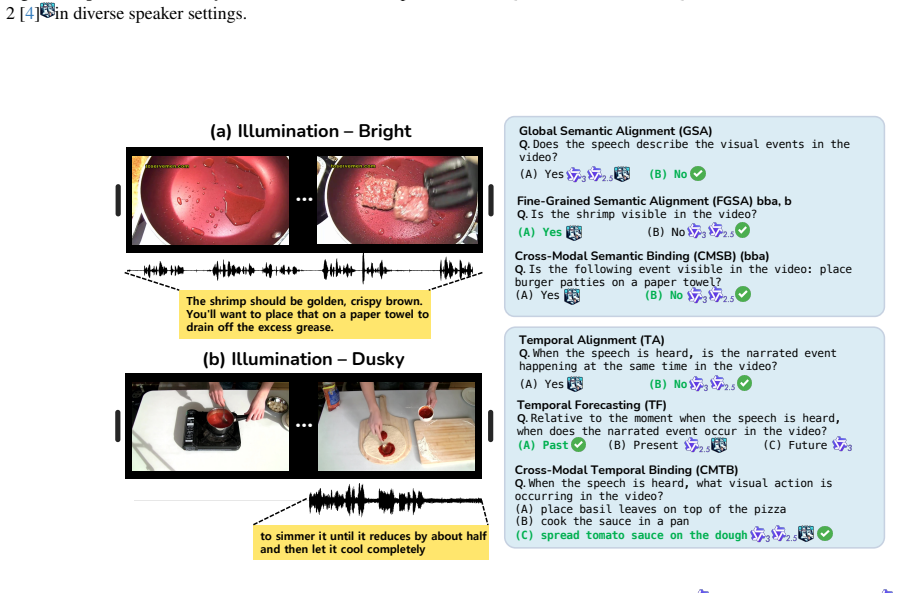
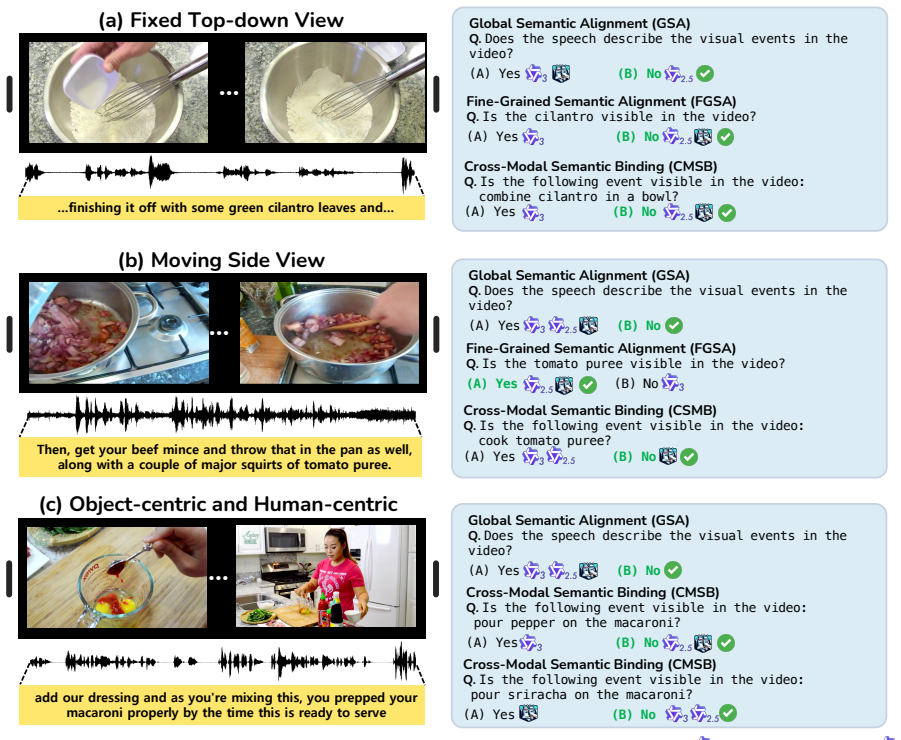
Open-source audio-visual LLMs fail to align spoken content with matching visual scenes and perform near random on new semantic and temporal tests.
A machine-rendered reading of the paper's core claim, the machinery that carries it, and where it could break.
Core claim
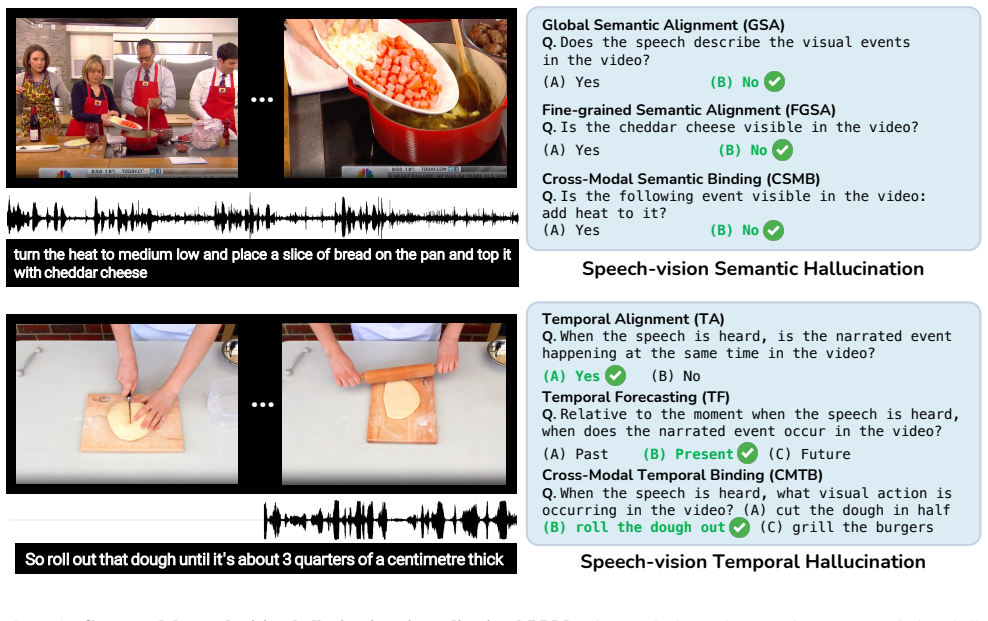
Speech content induces hallucinations in audio-visual LLMs because current models cannot reliably align the semantics and temporal structure of spoken language with corresponding visual signals. The SVHalluc benchmark exposes this through dedicated semantic and temporal tasks, where state-of-the-art open-source models reach near-random accuracy while Gemini 2.5 Pro succeeds. The paper attributes the shortfall to limited cross-modality understanding rather than deficits in single-modality perception and concludes that existing models lack speech-grounded video comprehension.
What carries the argument
The SVHalluc benchmark, which isolates speech-vision hallucination through complementary semantic and temporal evaluation tasks on paired speech and video data.
If this is right
- Audio-visual LLMs require new training objectives that explicitly link spoken semantics and timing to visual content.
- Benchmarks focused only on environmental sounds miss a distinct failure mode tied to human speech.
- Performance gaps between open-source and closed models on these tasks point to differences in cross-modal training scale or data.
- Real-world applications that rely on spoken narration of video will inherit the same alignment errors until the limitation is addressed.
Where Pith is reading between the lines
- The same cross-modal weakness may appear in other paired modalities such as text and video when temporal ordering is critical.
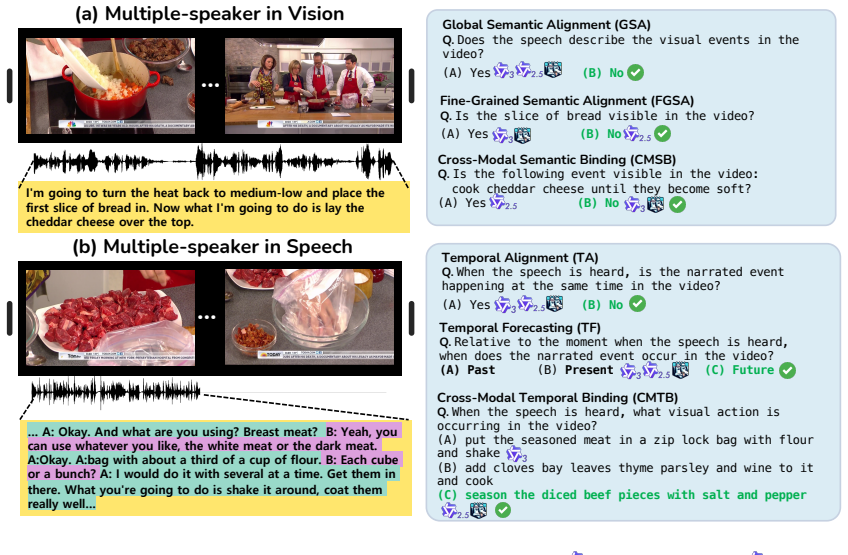
- Extending the benchmark to longer videos or multi-speaker scenes would reveal whether the limitation scales with complexity.
- Closed models may already embed implicit alignment signals that open models lack, suggesting targeted distillation could close part of the gap.
Load-bearing premise
The benchmark tasks and chosen data pairs accurately measure speech-vision alignment without other dataset or task factors artificially depressing model scores.
What would settle it
Retraining an open-source audio-visual LLM on explicit speech-visual alignment objectives and then measuring whether its accuracy on the SVHalluc tasks rises well above chance would test the claim.
Figures
read the original abstract
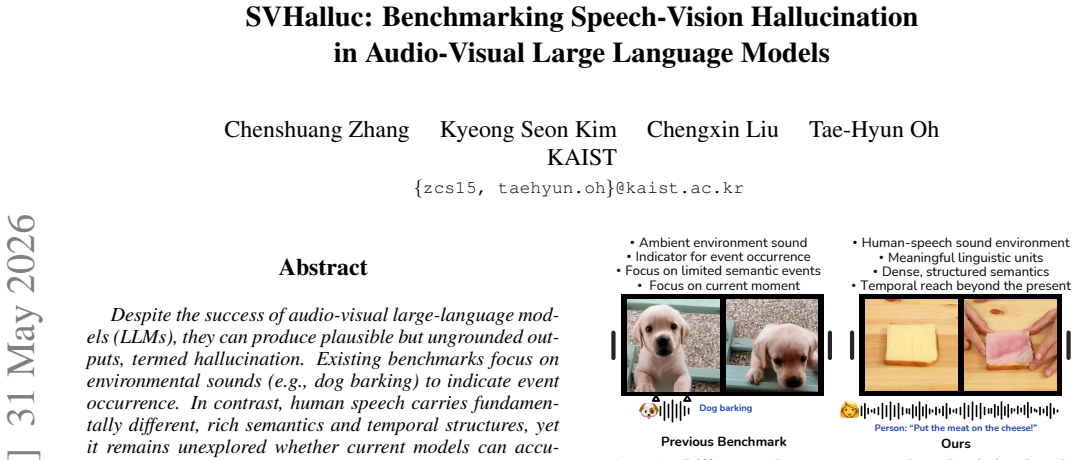
Despite the success of audio-visual large-language models (LLMs), they can produce plausible but ungrounded outputs, termed hallucination. Existing benchmarks focus on environmental sounds (e.g., dog barking) to indicate event occurrence. In contrast, human speech carries fundamentally different, rich semantics and temporal structures, yet it remains unexplored whether current models can accurately align speech content with corresponding visual signals. In this work, we show that speech content can induce hallucinations in audio-visual LLMs. To systematically study this, we introduce SVHalluc, the first comprehensive benchmark for evaluating speech-vision hallucination in audio-visual LLMs. Our benchmark diagnoses speech-vision hallucinations from two critical and complementary aspects: semantic and temporal. Experimental results demonstrate that state-of-the-art open-source audio-visual LLMs struggle with aligning speech content with corresponding visual signals, with a near-random accuracy on multiple tasks. In contrast, Gemini 2.5 Pro significantly outperforms the open-source models. Our analysis suggests that their failures stem from limited ability in cross-modality understanding, despite strong performance in single-modality perception. Our work uncovers a new and fundamental limitation of current audio-visual LLMs and highlights the need for speech-grounded video comprehension. Project page: https://chenshuang-zhang.github.io/projects/svhalluc/.
Editorial analysis
A structured set of objections, weighed in public.
Referee Report
Summary. The paper introduces SVHalluc, the first benchmark for speech-vision hallucination in audio-visual LLMs, evaluating models on semantic and temporal alignment between speech content and visual signals. It reports that state-of-the-art open-source AV LLMs achieve near-random accuracy on multiple tasks, while Gemini 2.5 Pro significantly outperforms them, attributing the failures to limited cross-modality understanding despite strong single-modality perception.
Significance. If the benchmark construction and task design validly isolate speech-vision hallucination, the work identifies a previously unexplored limitation in open-source audio-visual LLMs for aligning rich semantic and temporal structures in human speech with visuals. This has implications for video comprehension applications and motivates further research on speech-grounded models, with the contrast to proprietary models providing a useful baseline.
major comments (2)
- [Abstract] Abstract: The abstract reports performance numbers (near-random accuracy on multiple tasks) but provides no details on benchmark construction, dataset statistics, statistical testing, or controls for confounds; without these, the central claim that models struggle specifically with speech-vision alignment cannot be fully evaluated from the available text.
- [Abstract] The manuscript does not describe single-modality baselines or verification that they are verifiably strong, which is required to support the attribution of failures to limited cross-modality understanding rather than other factors in task design or data selection.
Simulated Author's Rebuttal
We thank the referee for the detailed and constructive feedback. We address each major comment below. The full manuscript contains the requested details on benchmark construction, statistics, and single-modality baselines (Sections 3 and 4), but we agree the abstract can be strengthened to better support the central claims from the abstract text alone. We will revise accordingly.
read point-by-point responses
-
Referee: [Abstract] Abstract: The abstract reports performance numbers (near-random accuracy on multiple tasks) but provides no details on benchmark construction, dataset statistics, statistical testing, or controls for confounds; without these, the central claim that models struggle specifically with speech-vision alignment cannot be fully evaluated from the available text.
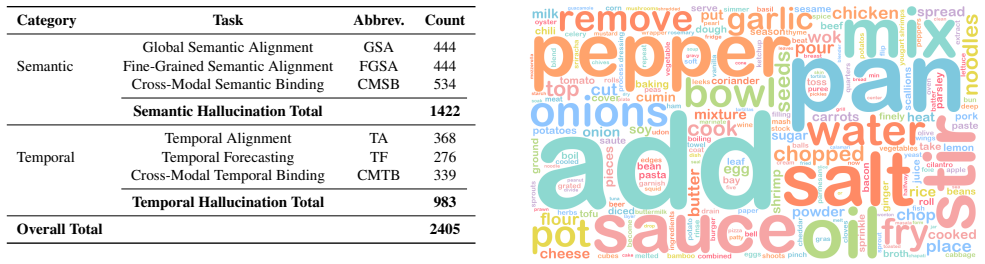
Authors: We acknowledge that the abstract, due to length constraints, does not include these details. The full manuscript provides them in Section 3 (benchmark construction and controls for confounds such as visual-only and audio-only distractors), Table 1 (dataset statistics), and Section 4.3 (statistical testing with significance levels). To address the concern, we will revise the abstract to include a concise summary sentence on benchmark scale, task design, and controls, enabling better evaluation of the speech-vision alignment claim directly from the abstract. revision: yes
-
Referee: [Abstract] The manuscript does not describe single-modality baselines or verification that they are verifiably strong, which is required to support the attribution of failures to limited cross-modality understanding rather than other factors in task design or data selection.
Authors: We agree this attribution requires explicit support. The full manuscript includes single-modality baselines in Section 4.2, where audio-only and vision-only tasks show high accuracy (confirming strong unimodal perception) while cross-modal tasks drop to near-random levels. We will revise the abstract to briefly reference these verified single-modality results and their contrast with cross-modal performance, and ensure the revised manuscript makes the verification explicit in the abstract text. revision: yes
Circularity Check
Empirical benchmark evaluation with no derivation chain or self-referential reduction
full rationale
This is an empirical benchmark paper that constructs SVHalluc tasks and reports model accuracies on them. No equations, parameters, predictions, or uniqueness theorems are present. Central claims (near-random accuracy on open-source AV LLMs) rest on external model testing rather than any internal definition, fit, or self-citation that reduces the result to its own inputs by construction. The work is self-contained against external benchmarks and receives the default non-circularity finding.
Axiom & Free-Parameter Ledger
Reference graph
Works this paper leans on
-
[1]
Flamingo: a visual language model for few-shot learning
Jean-Baptiste Alayrac, Jeff Donahue, Pauline Luc, Antoine Miech, Iain Barr, Yana Hasson, Karel Lenc, Arthur Men- sch, Katherine Millican, Malcolm Reynolds, Roman Ring, Eliza Rutherford, Serkan Cabi, Tengda Han, Zhitao Gong, Sina Samangooei, Marianne Monteiro, Jacob Menick, Se- bastian Borgeaud, Andrew Brock, Aida Nematzadeh, Sa- hand Sharifzadeh, Mikolaj ...
2022
-
[2]
Internvl: Scaling up vision foundation models and aligning for generic visual-linguistic tasks
Zhe Chen, Jiannan Wu, Wenhai Wang, Weijie Su, Guo Chen, Sen Xing, Muyan Zhong, Qinglong Zhang, Xizhou Zhu, Lewei Lu, Bin Li, Ping Luo, Tong Lu, Yu Qiao, and Jifeng Dai. Internvl: Scaling up vision foundation models and aligning for generic visual-linguistic tasks. InCVPR, pages 24185–24198, 2024. 1, 7
2024
-
[3]
Video-Holmes: Can MLLM Think Like Holmes for Complex Video Reasoning?
Junhao Cheng, Yuying Ge, Teng Wang, Yixiao Ge, Jing Liao, and Ying Shan. Video-holmes: Can mllm think like holmes for complex video reasoning?arXiv preprint arXiv:2505.21374, 2025. 8
work page internal anchor Pith review Pith/arXiv arXiv 2025
-
[4]
VideoLLaMA 2: Advancing Spatial-Temporal Modeling and Audio Understanding in Video-LLMs
Zesen Cheng, Sicong Leng, Hang Zhang, Yifei Xin, Xin Li, Guanzheng Chen, Yongxin Zhu, Wenqi Zhang, Ziyang Luo, Deli Zhao, and Lidong Bing. Videollama 2: Advancing spatial-temporal modeling and audio understanding in video- llms.arXiv preprint arXiv:2406.07476, 2024. 1, 5, 7, 8, 2, 3
work page internal anchor Pith review Pith/arXiv arXiv 2024
-
[5]
Gonzalez, Ion Stoica, and Eric P
Wei-Lin Chiang, Zhuohan Li, Zi Lin, Ying Sheng, Zhang- hao Wu, Hao Zhang, Lianmin Zheng, Siyuan Zhuang, Yong- hao Zhuang, Joseph E. Gonzalez, Ion Stoica, and Eric P. Xing. Vicuna: An open-source chatbot impressing gpt-4 with 90%* chatgpt quality, 2023. 7
2023
-
[6]
Avtrustbench: Assessing and enhancing reliability and robustness in audio-visual llms
Sanjoy Chowdhury, Sayan Nag, Subhrajyoti Dasgupta, Yaot- ing Wang, Mohamed Elhoseiny, Ruohan Gao, and Dinesh Manocha. Avtrustbench: Assessing and enhancing reliability and robustness in audio-visual llms. InICCV, pages 1590– 1601, 2025. 5, 8
2025
-
[7]
Kaixiong Gong, Kaituo Feng, Bohao Li, Yibing Wang, Mo- fan Cheng, Shijia Yang, Jiaming Han, Benyou Wang, Yutong Bai, Zhuoran Yang, and Xiangyu Yue. Av-odyssey bench: Can your multimodal llms really understand audio-visual in- formation?arXiv preprint arXiv:2412.02611, 2024. 8
-
[8]
Gemini 2.5 pro.https://docs.cloud
Google. Gemini 2.5 pro.https://docs.cloud. google.com/vertex-ai/generative-ai/docs/ models/gemini/2-5-pro, 2025. 2, 7
2025
-
[9]
Onellm: One framework to align all modalities with language
Jiaming Han, Kaixiong Gong, Yiyuan Zhang, Jiaqi Wang, Kaipeng Zhang, Dahua Lin, Yu Qiao, Peng Gao, and Xi- angyu Yue. Onellm: One framework to align all modalities with language. InCVPR, pages 26584–26595, 2024. 8
2024
-
[10]
Worldsense: Evaluating real-world omni- modal understanding for multimodal LLMs
Jack Hong, Shilin Yan, Jiayin Cai, Xiaolong Jiang, Yao Hu, and Weidi Xie. Worldsense: Evaluating real-world omni- modal understanding for multimodal LLMs. InICLR, 2026. 8
2026
-
[11]
Ciem: Contrastive instruction evaluation method for better instruction tuning.arXiv:2309.02301, 2023
Hongyu Hu, Jiyuan Zhang, Minyi Zhao, and Zhenbang Sun. Ciem: Contrastive instruction evaluation method for better instruction tuning.arXiv:2309.02301, 2023. 8
-
[12]
VLM’s eye examination: Instruct and in- spect visual competency of vision language models.Trans- actions on Machine Learning Research, 2025
Nam Hyeon-Woo, Moon Ye-Bin, Wonseok Choi, Lee Hyun, and Tae-Hyun Oh. VLM’s eye examination: Instruct and in- spect visual competency of vision language models.Trans- actions on Machine Learning Research, 2025. 8
2025
-
[13]
SMILE: Multimodal dataset for understand- ing laughter in video with language models
Lee Hyun, Kim Sung-Bin, Seungju Han, Youngjae Yu, and Tae-Hyun Oh. SMILE: Multimodal dataset for understand- ing laughter in video with language models. InNAACL Find- ings, pages 1149–1167, 2024. 1, 8
2024
-
[14]
A VCD: Mitigating hallucinations in audio-visual large lan- guage models through contrastive decoding
Chaeyoung Jung, Youngjoon Jang, and Joon Son Chung. A VCD: Mitigating hallucinations in audio-visual large lan- guage models through contrastive decoding. InNeurIPS,
-
[15]
Automated model discovery via multi-modal & multi-step pipeline
Lee Jung-Mok, Nam Hyeon-Woo, Moon Ye-Bin, Junhyun Nam, and Tae-Hyun Oh. Automated model discovery via multi-modal & multi-step pipeline. InNeurIPS, 2025. 7
2025
-
[16]
Videocomp: Advancing fine-grained composi- tional and temporal alignment in video-text models
Dahun Kim, AJ Piergiovanni, Ganesh Mallya, and Anelia Angelova. Videocomp: Advancing fine-grained composi- tional and temporal alignment in video-text models. In CVPR, pages 29060–29070, 2025. 4
2025
-
[17]
mEOL: Training-free instruction-guided mul- timodal embedder for vector graphics and image retrieval
Kyeong Seon Kim, Baek Seong-Eun, Lee Jung-Mok, and Tae-Hyun Oh. mEOL: Training-free instruction-guided mul- timodal embedder for vector graphics and image retrieval. In WACV, pages 1191–1200, 2026. 7
2026
-
[18]
The curse of multi-modalities: Evaluating hal- lucinations of large multimodal models across language, vi- sual, and audio
Sicong Leng, Yun Xing, Zesen Cheng, Yang Zhou, Hang Zhang, Xin Li, Deli Zhao, Shijian Lu, Chunyan Miao, and Lidong Bing. The curse of multi-modalities: Evaluating hal- lucinations of large multimodal models across language, vi- sual, and audio. InNeurIPS Datasets and Benchmarks Track,
-
[19]
LLaV A-onevision: Easy visual task transfer.Transactions on Machine Learning Research,
Bo Li, Yuanhan Zhang, Dong Guo, Renrui Zhang, Feng Li, Hao Zhang, Kaichen Zhang, Peiyuan Zhang, Yanwei Li, Zi- wei Liu, and Chunyuan Li. LLaV A-onevision: Easy visual task transfer.Transactions on Machine Learning Research,
-
[20]
LLaV A-med: Training a large language- and-vision assistant for biomedicine in one day
Chunyuan Li, Cliff Wong, Sheng Zhang, Naoto Usuyama, Haotian Liu, Jianwei Yang, Tristan Naumann, Hoifung Poon, and Jianfeng Gao. LLaV A-med: Training a large language- and-vision assistant for biomedicine in one day. InNeurIPS Datasets and Benchmarks Track, 2023. 8
2023
-
[21]
Evaluating object hallucination in large vision-language models
Yifan Li, Yifan Du, Kun Zhou, Jinpeng Wang, Xin Zhao, and Ji-Rong Wen. Evaluating object hallucination in large vision-language models. InEMNLP, pages 292–305, 2023. 8
2023
-
[22]
Video-LLaV A: Learning united visual repre- sentation by alignment before projection
Bin Lin, Yang Ye, Bin Zhu, Jiaxi Cui, Munan Ning, Peng Jin, and Li Yuan. Video-LLaV A: Learning united visual repre- sentation by alignment before projection. InEMNLP, pages 5971–5984, 2024. 1, 7, 8
2024
-
[23]
Visual instruction tuning
Haotian Liu, Chunyuan Li, Qingyang Wu, and Yong Jae Lee. Visual instruction tuning. InNeurIPS, 2023. 7
2023
-
[24]
Improved baselines with visual instruction tuning
Haotian Liu, Chunyuan Li, Yuheng Li, and Yong Jae Lee. Improved baselines with visual instruction tuning. InCVPR, pages 26296–26306, 2024. 8
2024
-
[25]
Introducing gpt-5.https://openai.com/ index/introducing-gpt-5/, 2025
openAI. Introducing gpt-5.https://openai.com/ index/introducing-gpt-5/, 2025. 4, 1
2025
-
[26]
Blaschko, and Tinne Tuytelaars
Gorjan Radevski, Teodora Popordanoska, Matthew B. Blaschko, and Tinne Tuytelaars. DA VE: Diagnostic bench- mark for audio visual evaluation. InNeurIPS Datasets and Benchmarks Track, 2025. 1, 2, 4, 5
2025
-
[27]
Learning transferable visual models from natural language supervision
Alec Radford, Jong Wook Kim, Chris Hallacy, Aditya Ramesh, Gabriel Goh, Sandhini Agarwal, Girish Sastry, Amanda Askell, Pamela Mishkin, Jack Clark, Gretchen Krueger, and Ilya Sutskever. Learning transferable visual models from natural language supervision. InICML, pages 8748–8763, 2021. 7
2021
-
[28]
Robust speech recognition via large-scale weak supervision
Alec Radford, Jong Wook Kim, Tao Xu, Greg Brockman, Christine Mcleavey, and Ilya Sutskever. Robust speech recognition via large-scale weak supervision. InICML, pages 28492–28518, 2023. 4, 6
2023
-
[29]
MMAU: A massive multi-task audio understanding and reasoning benchmark
S Sakshi, Utkarsh Tyagi, Sonal Kumar, Ashish Seth, Ra- maneswaran Selvakumar, Oriol Nieto, Ramani Duraiswami, Sreyan Ghosh, and Dinesh Manocha. MMAU: A massive multi-task audio understanding and reasoning benchmark. In ICLR, 2025. 8
2025
-
[30]
Robustness analysis of video-language models against visual and language pertur- bations
Madeline Chantry Schiappa, Shruti Vyas, Hamid Palangi, Yogesh S Rawat, and Vibhav Vineet. Robustness analysis of video-language models against visual and language pertur- bations. InNeurIPS Datasets and Benchmarks Track, 2022. 4
2022
-
[31]
video-SALMONN: Speech-enhanced audio-visual large language models
Guangzhi Sun, Wenyi Yu, Changli Tang, Xianzhao Chen, Tian Tan, Wei Li, Lu Lu, Zejun Ma, Yuxuan Wang, and Chao Zhang. video-SALMONN: Speech-enhanced audio-visual large language models. InICML, pages 47198–47217, 2024. 6, 7
2024
-
[32]
A VHBench: A cross- modal hallucination benchmark for audio-visual large lan- guage models
Kim Sung-Bin, Oh Hyun-Bin, JungMok Lee, Arda Senocak, Joon Son Chung, and Tae-Hyun Oh. A VHBench: A cross- modal hallucination benchmark for audio-visual large lan- guage models. InICLR, 2025. 1, 2, 5, 8
2025
-
[33]
Changli Tang, Yixuan Li, Yudong Yang, Jimin Zhuang, Guangzhi Sun, Wei Li, Zejun Ma, and Chao Zhang. video- salmonn 2: Caption-enhanced audio-visual large language models.arXiv preprint arXiv:2506.15220, 2025. 5, 7, 8
-
[34]
Silero vad: pre-trained enterprise-grade voice activity detector (vad), number detector and language clas- sifier.https://github.com/snakers4/silero- vad, 2024
Silero Team. Silero vad: pre-trained enterprise-grade voice activity detector (vad), number detector and language clas- sifier.https://github.com/snakers4/silero- vad, 2024. 7
2024
-
[35]
LLaMA: Open and Efficient Foundation Language Models
Hugo Touvron, Thibaut Lavril, Gautier Izacard, Xavier Martinet, Marie-Anne Lachaux, Timoth´ee Lacroix, Baptiste Rozi`ere, Naman Goyal, Eric Hambro, Faisal Azhar, Aure- lien Rodriguez, Armand Joulin, Edouard Grave, and Guil- laume Lample. Llama: Open and efficient foundation lan- guage models.arXiv preprint arXiv:2302.13971, 2023. 1
work page internal anchor Pith review Pith/arXiv arXiv 2023
-
[36]
Jin Xu, Zhifang Guo, Jinzheng He, Hangrui Hu, Ting He, Shuai Bai, Keqin Chen, Jialin Wang, Yang Fan, Kai Dang, Bin Zhang, Xiong Wang, Yunfei Chu, and Jun- yang Lin. Qwen2.5-omni technical report.arXiv preprint arXiv:2503.20215, 2025. 1, 5, 6, 7, 8, 2, 3
work page internal anchor Pith review Pith/arXiv arXiv 2025
-
[37]
Jin Xu, Zhifang Guo, Hangrui Hu, Yunfei Chu, Xiong Wang, Jinzheng He, Yuxuan Wang, Xian Shi, Ting He, Xinfa Zhu, Yuanjun Lv, Yongqi Wang, Dake Guo, He Wang, Linhan Ma, Pei Zhang, Xinyu Zhang, Hongkun Hao, Zishan Guo, Baosong Yang, Bin Zhang, Ziyang Ma, Xipin Wei, Shuai Bai, Keqin Chen, Xuejing Liu, Peng Wang, Mingkun Yang, Dayiheng Liu, Xingzhang Ren, Bo ...
work page internal anchor Pith review Pith/arXiv arXiv 2025
-
[38]
An Yang, Anfeng Li, Baosong Yang, Beichen Zhang, Binyuan Hui, Bo Zheng, Bowen Yu, Chang Gao, Chen- gen Huang, Chenxu Lv, Chujie Zheng, Dayiheng Liu, Fan Zhou, Fei Huang, Feng Hu, Hao Ge, Haoran Wei, Huan Lin, Jialong Tang, Jian Yang, Jianhong Tu, Jianwei Zhang, Jianxin Yang, Jiaxi Yang, Jing Zhou, Jingren Zhou, Junyang Lin, Kai Dang, Keqin Bao, Kexin Yang...
work page internal anchor Pith review Pith/arXiv arXiv 2025
-
[39]
BEAF: Observing before-after changes to evaluate hallucination in vision-language models
Moon Ye-Bin, Nam Hyeon-Woo, Wonseok Choi, and Tae- Hyun Oh. BEAF: Observing before-after changes to evaluate hallucination in vision-language models. InECCV, pages 232–248, 2024. 2, 8
2024
-
[40]
Moon Ye-Bin, Roy Miles, Tae-Hyun Oh, Ismail Elezi, and Jiankang Deng. RetouchLLM: Training-free code-based im- age retouching with vision language models.arXiv preprint arXiv: 2510.08054, 2025. 7
-
[41]
Video-LLaMA: An instruction-tuned audio-visual language model for video un- derstanding
Hang Zhang, Xin Li, and Lidong Bing. Video-LLaMA: An instruction-tuned audio-visual language model for video un- derstanding. InEMNLP System Demonstrations, pages 543– 553, 2023. 8
2023
-
[42]
Luowei Zhou, Chenliang Xu, and Jason J. Corso. To- wards automatic learning of procedures from web instruc- tional videos. InAAAI, 2018. 4, 5
2018
-
[43]
Streaming dense video captioning
Xingyi Zhou, Anurag Arnab, Shyamal Buch, Shen Yan, Austin Myers, Xuehan Xiong, Arsha Nagrani, and Cordelia Schmid. Streaming dense video captioning. InCVPR, pages 18243–18252, 2024. 4
2024
-
[44]
Alleviating hallucinations in large language models through multi-model contrastive decoding and dy- namic hallucination detection
Chenyu Zhu, YEFENG LIU, Hao Zhang, Aowen Wang, Yangxue, Guanhua Chen, Longyue Wang, Weihua Luo, and Kaifu Zhang. Alleviating hallucinations in large language models through multi-model contrastive decoding and dy- namic hallucination detection. InNeurIPS, 2025. 8
2025
-
[45]
MiniGPT-4: Enhancing vision-language understanding with advanced large language models
Deyao Zhu, Jun Chen, Xiaoqian Shen, Xiang Li, and Mo- hamed Elhoseiny. MiniGPT-4: Enhancing vision-language understanding with advanced large language models. In ICLR, 2024. 1
2024
-
[46]
this looks great
Xin Zou, Yizhou Wang, Yibo Yan, Yuanhuiyi Lyu, Ken- ing Zheng, Sirui Huang, Junkai Chen, Peijie Jiang, Jia Liu, Chang Tang, and Xuming Hu. Look twice before you an- swer: Memory-space visual retracing for hallucination miti- gation in multimodal large language models. InICML, 2025. 1, 8 SVHalluc: Benchmarking Speech-Vision Hallucination in Audio-Visual La...
2025
discussion (0)
Sign in with ORCID, Apple, or X to comment. Anyone can read and Pith papers without signing in.