Simulating Condensed Matter Physics on Quantum Hardware
Pith reviewed 2026-06-28 12:34 UTC · model grok-4.3
The pith
Noisy quantum simulations of condensed matter already serve as prototypes for the encodings and error controls required in future fault-tolerant machines.
A machine-rendered reading of the paper's core claim, the machinery that carries it, and where it could break.
Core claim
The paper establishes that present noisy quantum simulations serve not only as near-term demonstrations, but also as prototypes for the encodings, diagnostic protocols and error-control strategies required for future fault-tolerant quantum simulation of condensed matter phenomena.
What carries the argument
The review's organized survey of hardware platforms, basic digital quantum simulation ingredients, applications spanning ground-state problems through open-system physics, and methodological tools used in current workflows.
If this is right
- Diagnostic protocols validated on noisy devices will scale directly to larger error-corrected systems for ground-state and dynamics problems.
- Encodings developed for topological phases and strongly correlated matter will form the basis of fault-tolerant implementations.
- Methodological tools summarized will become standard components in future quantum-simulation workflows.
- Analog experiments on ultracold atoms and Rydberg arrays will continue to provide independent benchmarks for digital approaches.
Where Pith is reading between the lines
- Investment in current noisy hardware therefore carries long-term value for building fault-tolerant simulators rather than serving only short-term publicity.
- The inclusion of high-energy-physics-inspired simulations suggests potential for cross-field transfer of simulation techniques between condensed matter and particle physics.
- A natural extension would be quantitative mapping of current error rates in these prototypes onto the thresholds required for fault-tolerant operation on specific condensed-matter Hamiltonians.
Load-bearing premise
The review assumes its selection of representative hardware platforms and condensed-matter applications captures the current state and trajectory of the field without major omissions.
What would settle it
A major condensed-matter simulation result achieved on an unmentioned hardware platform whose encodings and error strategies do not align with those highlighted in the review would undermine the prototype claim.
Figures
read the original abstract
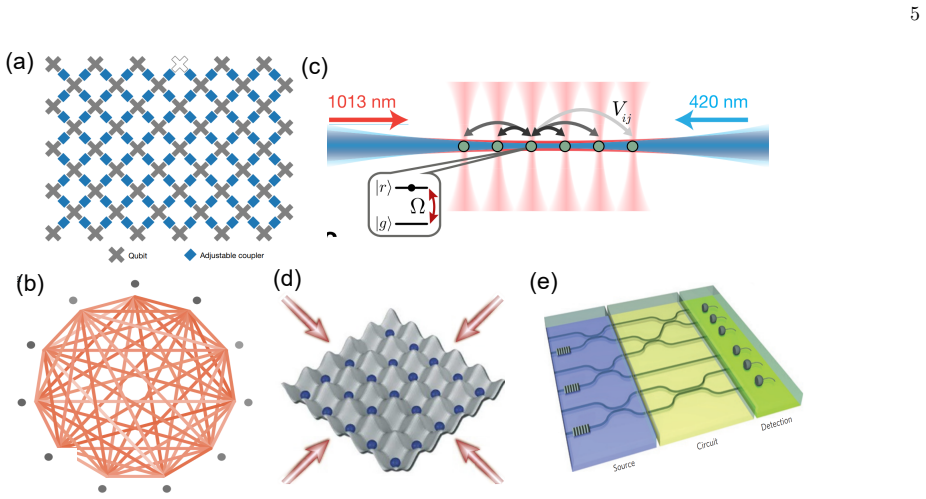
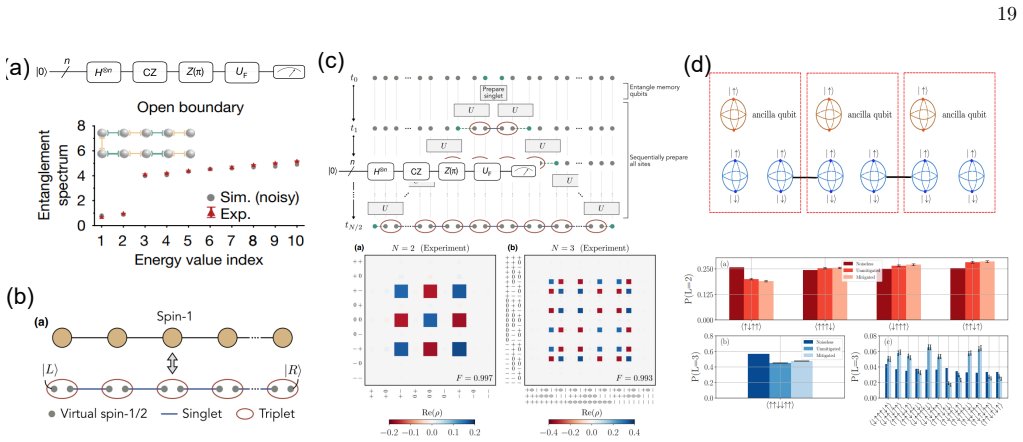
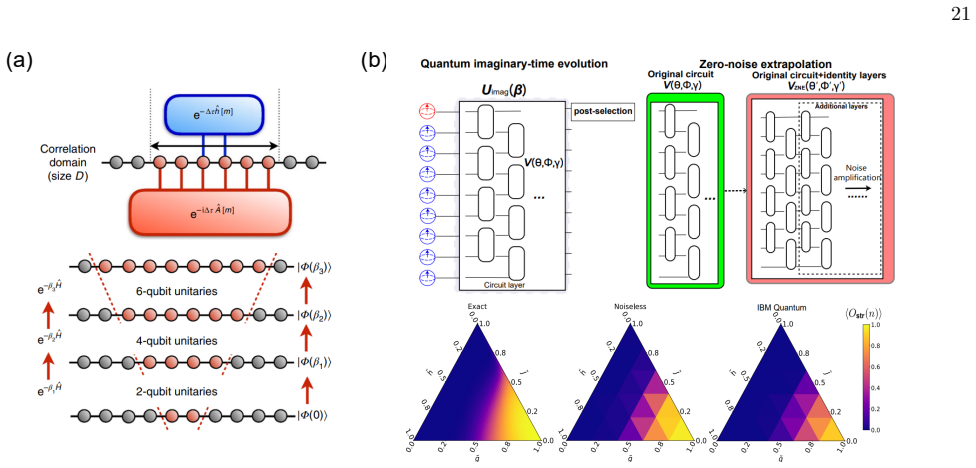
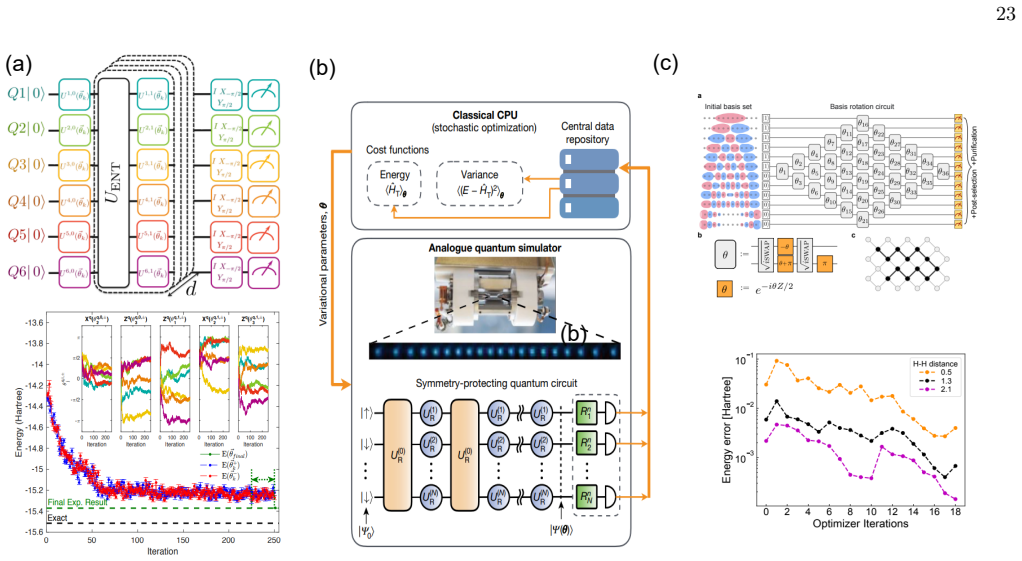
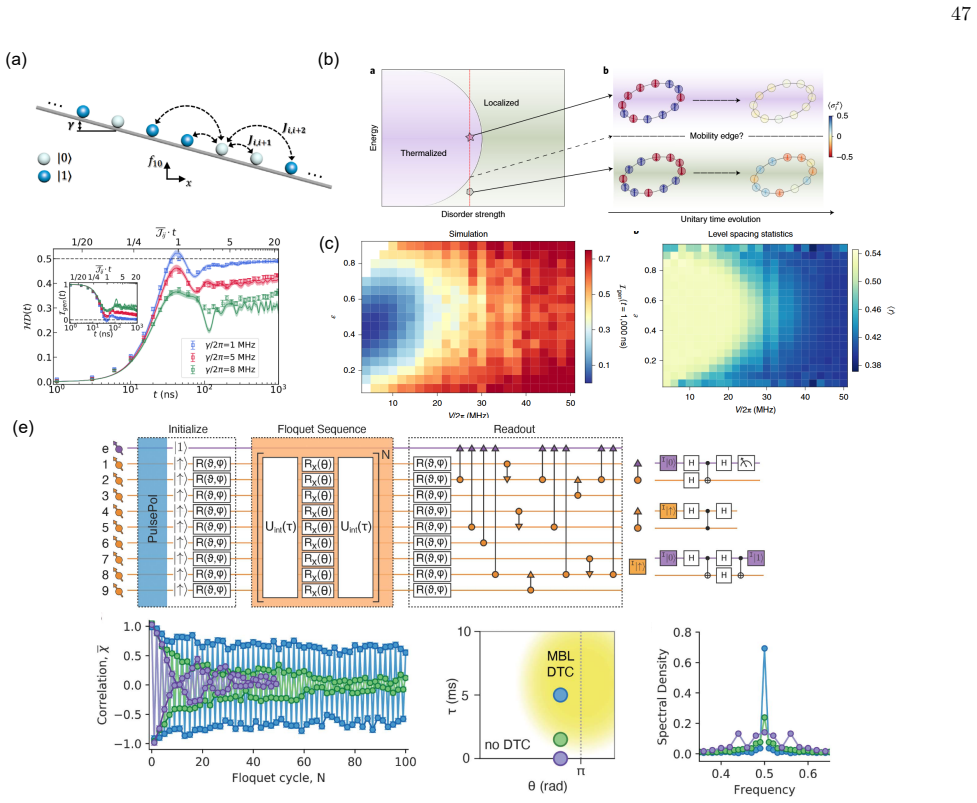
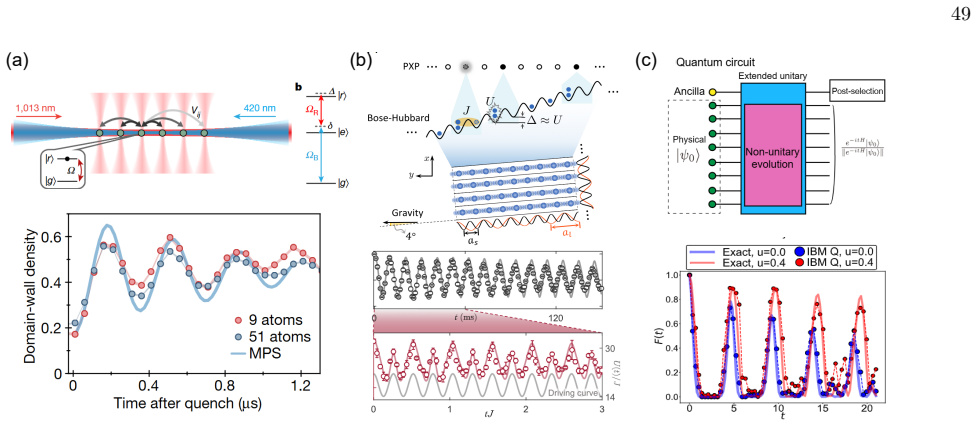
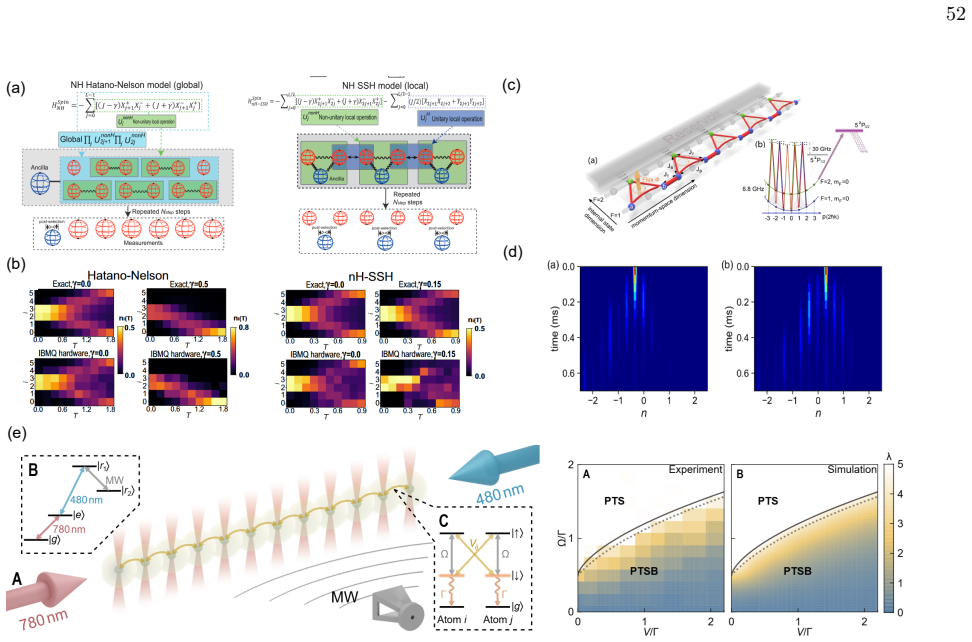
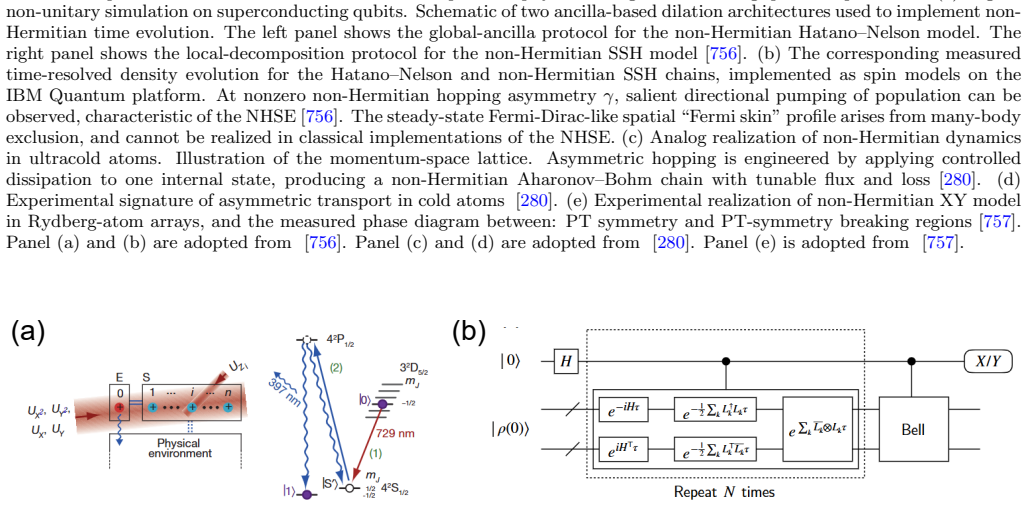
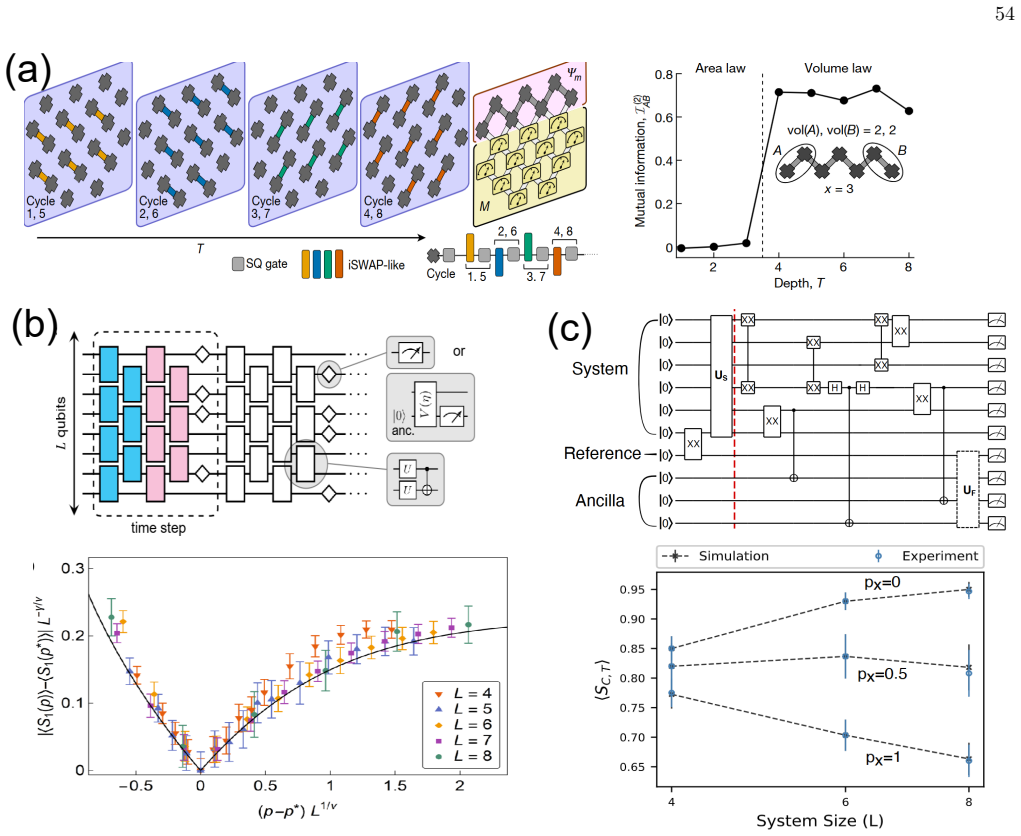
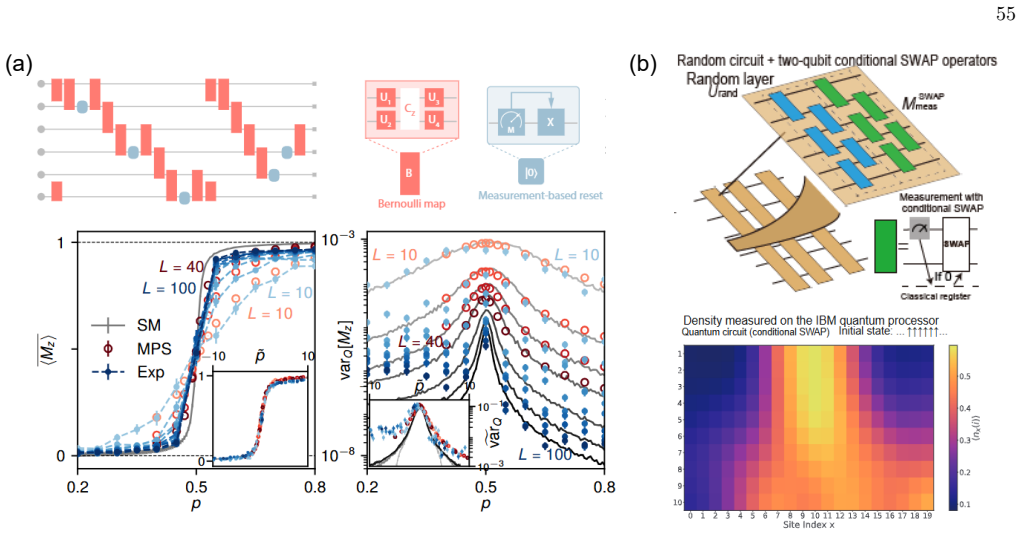
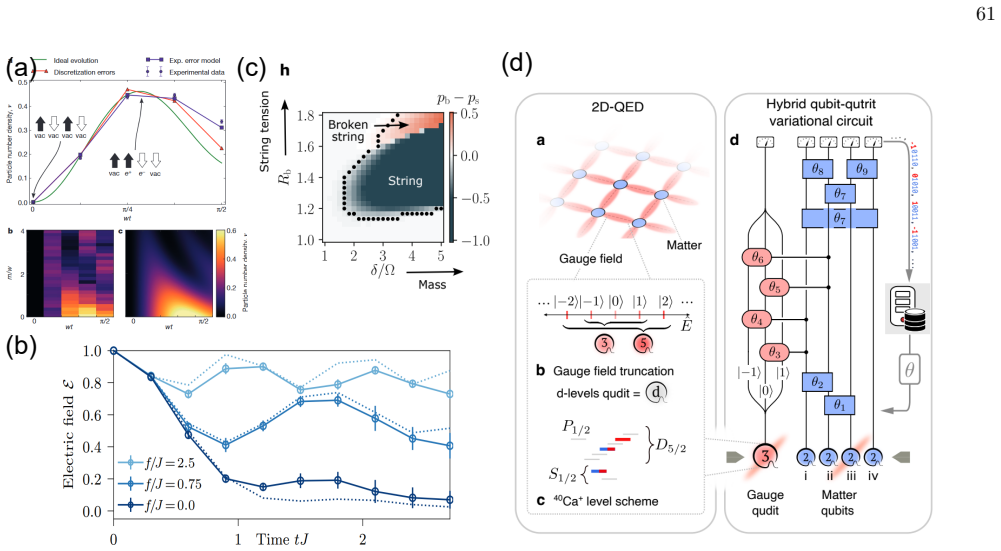
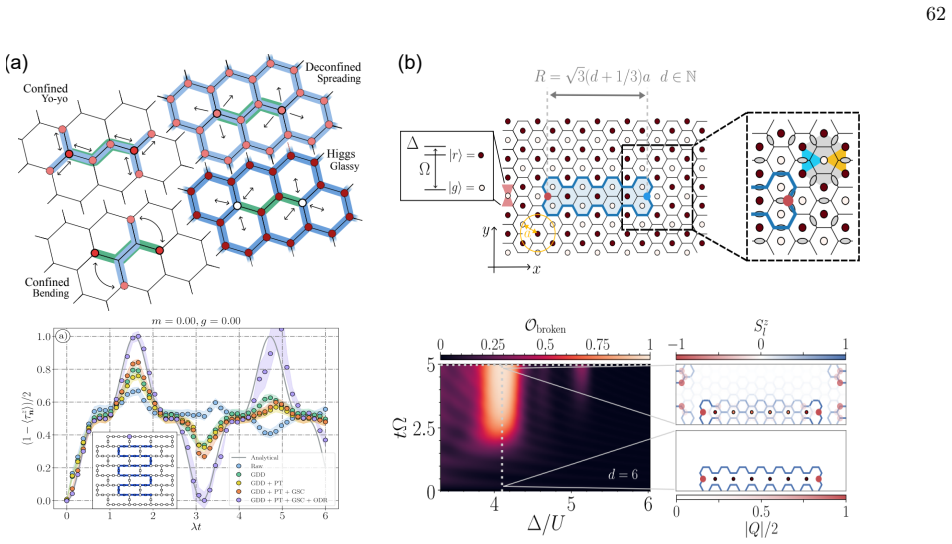
Quantum hardware platforms are getting increasingly sophisticated in their ability to simulate condensed matter, including but not limited to strongly-correlated, topological, and non-equilibrium phenomena. This review surveys recent progress in quantum-hardware-based simulations of condensed matter, primarily emphasizing gate-based digital quantum computer simulation, with analog experiments discussed as complementary benchmarks. We first review major hardware platforms, including superconducting qubits, trapped-ions, ultracold atoms, Rydberg arrays, photonic systems, and moire quantum materials. We then introduce the basic ingredients of digital quantum simulation. Building on this foundation, we discuss representative applications to condensed-matter physics, spanning ground-state problems, strongly correlated matter, topological phases, non-equilibrium dynamics, open-system physics, and high-energy-physics-inspired simulations. Finally, we summarize key methodological tools used in state-of-the-art quantum-simulation workflows. We emphasize that present noisy quantum simulations serve not only as near-term demonstrations, but also as prototypes for the encodings, diagnostic protocols and error-control strategies required for future fault-tolerant quantum simulation.
Editorial analysis
A structured set of objections, weighed in public.
Referee Report
Summary. The manuscript is a review surveying recent progress in quantum-hardware-based simulations of condensed matter physics. It first reviews major hardware platforms (superconducting qubits, trapped ions, ultracold atoms, Rydberg arrays, photonic systems, and moiré quantum materials), then introduces the basic ingredients of digital quantum simulation, discusses representative applications spanning ground-state problems, strongly correlated matter, topological phases, non-equilibrium dynamics, open-system physics, and high-energy-physics-inspired simulations, and finally summarizes key methodological tools. The central perspective is that present noisy quantum simulations serve not only as near-term demonstrations but also as prototypes for the encodings, diagnostic protocols, and error-control strategies required for future fault-tolerant quantum simulation.
Significance. If the survey is accurate and balanced, the review would provide a useful synthesis for the condensed-matter and quantum-information communities by connecting hardware developments with specific physics applications and methodological advances. The forward-looking framing of NISQ-era work as prototyping for fault-tolerant simulation offers helpful context without advancing new technical claims.
minor comments (2)
- [Abstract] Abstract: the high-level overview of platforms and applications is clear, but adding a brief statement on the approximate time window or number of works surveyed would help readers gauge the review's currency and scope.
- The transition from the hardware-platforms section to the applications section would benefit from an explicit roadmap sentence to improve navigation for readers focused on specific condensed-matter topics.
Simulated Author's Rebuttal
We thank the referee for the careful reading and positive assessment of our manuscript as a useful synthesis for the condensed-matter and quantum-information communities. The recommendation for minor revision is noted. However, the report lists no specific major comments requiring response.
Circularity Check
No significant circularity
full rationale
The manuscript is a review surveying hardware platforms and applications in quantum simulation of condensed matter. It advances no original derivations, equations, fitted parameters, or quantitative predictions. All content consists of summaries of external literature with forward-looking synthesis; no load-bearing step reduces by construction to the paper's own inputs or self-citations. This is the expected outcome for a non-derivational survey paper.
Axiom & Free-Parameter Ledger
Forward citations
Cited by 1 Pith paper
-
Engineering of non-Hermitian interactions in digital qudit quantum simulators
Derives an analytical mapping from hybrid unitary-projective qutrit evolution to target non-Hermitian two-body interactions for pseudo-spins in a Zeno subspace, validated numerically.
Reference graph
Works this paper leans on
-
[1]
Yang, Z.-X
B. Yang, Z.-X. Hu, C. H. Lee, and Z. Papi´ c, Generalized pseudopotentials for the anisotropic fractional quantum hall effect, Phys. Rev. Lett.118, 146403 (2017)
2017
-
[2]
Z. Liu, A. Gromov, and Z. Papi´ c, Geometric quench and nonequilibrium dynamics of fractional quantum hall states, Phys. Rev. B98, 155140 (2018)
2018
-
[3]
M. F. Lapa, A. Gromov, and T. L. Hughes, Geometric quench in the fractional quantum hall effect: Exact so- lution in quantum hall matrix models and comparison with bimetric theory, Phys. Rev. B99, 075115 (2019)
2019
-
[4]
Liang, Z
J. Liang, Z. Liu, Z. Yang, Y. Huang, U. Wurstbauer, C. R. Dean, K. W. West, L. N. Pfeiffer, L. Du, and A. Pinczuk, Evidence for chiral graviton modes in frac- tional quantum Hall liquids, Nature628, 78 (2024)
2024
-
[5]
Pinczuk, B
A. Pinczuk, B. S. Dennis, L. N. Pfeiffer, and K. W. West, Observation of collective excitations in the frac- tional quantum Hall effect, Phys. Rev. Lett.70, 3983 (1993)
1993
-
[6]
P. M. Platzman and S. He, Resonant raman scattering from magneto rotons in the fractional quantum Hall liq- uid, Phys. Scr.T66, 167 (1996)
1996
-
[7]
M. Kang, A. Pinczuk, B. S. Dennis, L. N. Pfeiffer, and K. W. West, Observation of multiple magnetorotons in the fractional quantum Hall effect, Phys. Rev. Lett.86, 2637 (2001)
2001
-
[8]
I. V. Kukushkin, J. H. Smet, V. W. Scarola, V. Uman- sky, and K. von Klitzing, Dispersion of the excitations of fractional quantum Hall states, Science324, 1044 (2009)
2009
-
[9]
Maciejko, B
J. Maciejko, B. Hsu, S. A. Kivelson, Y. Park, and S. L. Sondhi, Field theory of the quantum hall nematic tran- sition, Phys. Rev. B88, 125137 (2013)
2013
-
[10]
J. Werschnik and E. K. U. Gross, Quantum optimal control theory, J. Phys. B: At. Mol. Opt. Phys.40, R175 (2007), arXiv:0707.1883 [quant-ph]
Pith/arXiv arXiv 2007
-
[11]
Petersen and D
I. Petersen and D. Dong, Quantum control theory and applications: a survey, IET Control Theory Appl.4, 2651 (2010)
2010
-
[12]
Rahmani, Quantum dynamics with an ensemble of hamiltonians, Mod
A. Rahmani, Quantum dynamics with an ensemble of hamiltonians, Mod. Phys. Lett. B27, 1330019 (2013)
2013
-
[13]
Wecker, M
D. Wecker, M. B. Hastings, and M. Troyer, Training a quantum optimizer, Phys. Rev. A94, 022309 (2016)
2016
-
[14]
A Quantum Approximate Optimization Algorithm
E. Farhi, J. Goldstone, and S. Gutmann, A quantum approximate optimization algorithm, arXiv preprint arXiv:1411.4028 10.48550/arXiv.1411.4028 (2014)
work page internal anchor Pith review Pith/arXiv arXiv doi:10.48550/arxiv.1411.4028 2014
-
[15]
E. Farhi and A. W. Harrow, Quantum supremacy through the quantum approximate optimiza- tion algorithm, arXiv preprint arXiv:1602.07674 10.48550/arXiv.1602.07674 (2016)
-
[16]
Z.-C. Yang, A. Rahmani, A. Shabani, H. Neven, and C. Chamon, Optimizing variational quantum algorithms using pontryagin’s minimum principle, Phys. Rev. X7, 021027 (2017)
2017
-
[17]
Z. Wang, S. Hadfield, Z. Jiang, and E. G. Rieffel, Quan- tum approximate optimization algorithm for maxcut: A fermionic view, Phys. Rev. A97, 022304 (2018)
2018
-
[18]
Zhou, S.-T
L. Zhou, S.-T. Wang, S. Choi, H. Pichler, and M. D. Lukin, Quantum approximate optimization algorithm: Performance, mechanism, and implementation on near- term devices, Phys. Rev. X10, 021067 (2020)
2020
-
[19]
S.-H. Lin, R. Dilip, A. G. Green, A. Smith, and F. Poll- mann, Real- and imaginary-time evolution with com- pressed quantum circuits, PRX Quantum2, 010342 (2021)
2021
-
[20]
T. Y. Ng, J. M. Koh, and D. E. Koh, Analytical expres- sions for the quantum approximate optimization algo- rithm and its variants (2024), arXiv:2411.09745 [quant- ph]
arXiv 2024
-
[21]
Moudgalya, B
S. Moudgalya, B. A. Bernevig, and N. Regnault, Quan- tum many-body scars in a landau level on a thin torus, Phys. Rev. B102, 195150 (2020)
2020
-
[22]
S. Moudgalya, A. Prem, R. Nandkishore, N. Regnault, and B. A. Bernevig, Thermalization and its absence within krylov subspaces of a constrained hamiltonian (2019), arXiv:1910.14048 [cond-mat.str-el]
arXiv 2019
-
[23]
Feiguin, S
A. Feiguin, S. Trebst, A. W. W. Ludwig, M. Troyer, A. Kitaev, Z. Wang, and M. H. Freedman, Interact- ing anyons in topological quantum liquids: The golden chain, Phys. Rev. Lett.98, 160409 (2007)
2007
-
[24]
Saravanan and S
V. Saravanan and S. M. Saeed, Pauli error propagation- based gate rescheduling for quantum circuit error miti- gation, IEEE Trans. Quantum Eng.3, 1 (2022)
2022
-
[25]
A. Javadi-Abhari, M. Treinish, K. Krsulich, C. J. Wood, J. Lishman, J. Gacon, S. Martiel, P. D. Nation, L. S. Bishop, A. W. Cross, B. R. Johnson, and J. M. Gambetta, Quantum computing with Qiskit (2024), arXiv:2405.08810 [quant-ph]
Pith/arXiv arXiv 2024
-
[26]
M. G. Davis, E. Smith, A. Tudor, K. Sen, I. Siddiqi, and C. Iancu, Towards optimal topology aware quantum cir- 92 cuit synthesis, inProc. 2020 IEEE Int. Conf. Quantum Comput. Eng. (QCE)(2020) pp. 223–234
2020
-
[27]
J. Haah, M. B. Hastings, R. Kothari, and G. H. Low, Quantum algorithm for simulating real time evolution of lattice hamiltonians, SIAM J. Comput.52, FOCS18 (2023)
2023
-
[28]
A. M. Childs, Y. Su, M. C. Tran, N. Wiebe, and S. Zhu, Theory of trotter error with commutator scaling, Phys. Rev. X11, 011020 (2021)
2021
-
[29]
A. Kirmani, A. A. Allocca, J.-X. Zhu, A. Rahmani, S. Ganeshan, and P. Ghaemi, Measuring the hall vis- cosity of the laughlin state on noisy quantum computers (2025), arXiv:2512.09982 [cond-mat.str-el]
arXiv 2025
-
[30]
Harley, I
D. Harley, I. Datta, F. R. Klausen, A. Bluhm, D. S. Fran¸ ca, A. H. Werner, and M. Christandl, Going be- yond gadgets: the importance of scalability for analogue quantum simulators, Nat. Commun.15, 6527 (2024)
2024
-
[31]
Trivedi, A
R. Trivedi, A. F. Rubio, and J. I. Cirac, Quantum ad- vantage and stability to errors in analogue quantum sim- ulators, Nat. Commun.15, 6507 (2024)
2024
-
[32]
M. Morgado and S. Whitlock, Quantum simulation and computing with rydberg-interacting qubits, AVS Quan- tum Sci.3, 023501 (2021), arXiv:2011.03031 [quant-ph]
arXiv 2021
-
[33]
Defenu, T
N. Defenu, T. Donner, T. Macr` ı, G. Pagano, S. Ruffo, and A. Trombettoni, Long-range interacting quantum systems, Rev. Mod. Phys.95, 035002 (2023)
2023
-
[34]
Aidelsburger, S
M. Aidelsburger, S. Nascimbene, and N. Goldman, Ar- tificial gauge fields in materials and engineered systems, C. R. Phys.19, 394 (2018)
2018
-
[35]
U.-J. Wiese, Ultracold quantum gases and lattice sys- tems: quantum simulation of lattice gauge theories, Ann. Phys. (Berl.)525, 777 (2013), arXiv:1305.1602 [cond-mat.quant-gas]
Pith/arXiv arXiv 2013
-
[36]
M. Dalmonte and S. Montangero, Lattice gauge the- ory simulations in the quantum information era, Con- temp. Phys.57, 388 (2016), arXiv:1602.03776 [cond- mat.quant-gas]
Pith/arXiv arXiv 2016
-
[37]
Kato, On the adiabatic theorem of quantum mechan- ics, J
T. Kato, On the adiabatic theorem of quantum mechan- ics, J. Phys. Soc. Jpn.5, 435 (1950)
1950
-
[38]
Quantum Computation by Adiabatic Evolution
E. Farhi, J. Goldstone, S. Gutmann, and M. Sipser, Quantum computation by adiabatic evolution, arXiv preprint quant-ph/0001106 10.48550/arXiv.quant- ph/0001106 (2000)
work page internal anchor Pith review Pith/arXiv arXiv doi:10.48550/arxiv.quant- 2000
-
[39]
A. J. Leggett, Bose-einstein condensation in the alkali gases: Some fundamental concepts, Rev. Mod. Phys. 73, 307 (2001)
2001
-
[40]
M. C. Gutzwiller, Effect of correlation on the ferromag- netism of transition metals, Phys. Rev. Lett.10, 159 (1963)
1963
-
[41]
M. P. Fisher, P. B. Weichman, G. Grinstein, and D. S. Fisher, Boson localization and the superfluid-insulator transition, Phys. Rev. B40, 546 (1989)
1989
-
[42]
Capogrosso-Sansone, S ¸
B. Capogrosso-Sansone, S ¸. G. S¨ oyler, N. Prokof’ev, and B. Svistunov, Monte carlo study of the two-dimensional Bose-Hubbard model, Phys. Rev. A77, 015602 (2008)
2008
-
[43]
Endres, M
M. Endres, M. Cheneau, T. Fukuhara, C. Weitenberg, P. Schauß, C. Gross, L. Mazza, M. C. Ba˜ nuls, L. Pol- let, and I. Bloch, Observation of correlated particle-hole pairs and string order in low-dimensional Mott insula- tors, Science334, 200 (2011)
2011
-
[44]
F. C. Zhang and T. M. Rice, Effective hamiltonian for the superconducting Cu oxides, Phys. Rev. B37, 3759 (1988)
1988
-
[45]
T. A. Hilker, G. Salomon, F. Grusdt, A. Omran, M. Boll, E. Demler, I. Bloch, and C. Gross, Revealing hidden antiferromagnetic correlations in doped hubbard chains via string correlators, Science357, 484 (2017)
2017
-
[46]
C. S. Chiu, G. Ji, A. Bohrdt, M. Xu, M. Knap, E. Dem- ler, F. Grusdt, M. Greiner, and D. Greif, String patterns in the doped hubbard model, Science365, 251 (2019)
2019
-
[47]
Wecker, M
D. Wecker, M. B. Hastings, N. Wiebe, B. K. Clark, C. Nayak, and M. Troyer, Solving strongly correlated electron models on a quantum computer, Phys. Rev. A 92, 062318 (2015)
2015
-
[48]
Xiang, K
Z.-C. Xiang, K. Huang, Y.-R. Zhang, T. Liu, Y.-H. Shi, C.-L. Deng, T. Liu, H. Li, G.-H. Liang, Z.-Y. Mei, H. Yu, G. Xue, Y. Tian, X. Song, Z.-B. Liu, K. Xu, D. Zheng, F. Nori, and H. Fan, Simulating chern in- sulators on a superconducting quantum processor, Nat. Commun.14, 5433 (2023)
2023
-
[49]
X. Xiao, J. K. Freericks, and A. F. Kemper, Robust measurement of wave function topology on nisq quan- tum computers, Quantum7, 987 (2023)
2023
-
[50]
Viyuela, A
O. Viyuela, A. Rivas, S. Gasparinetti, A. Wallraff, S. Filipp, and M. A. Mart´ ın-Delgado, Observation of topological uhlmann phases with superconducting qubits, npj Quantum Inf.4, 10 (2018)
2018
-
[51]
J. M. Koh, T. Tai, and C. H. Lee, Simulation of interaction-induced chiral topological dynamics on a digital quantum computer, Phys. Rev. Lett.129, 140502 (2022)
2022
-
[52]
J. M. Koh, T. Tai, and C. H. Lee, Realization of higher- order topological lattices on a quantum computer, Nat. Commun.15, 5807 (2024)
2024
-
[53]
M. D. Schroer, M. H. Kolodrubetz, W. F. Kindel, M. Sandberg, J. Gao, M. R. Vissers, D. P. Pappas, A. Polkovnikov, and K. W. Lehnert, Measuring a topo- logical transition in an artificial spin-1/2 system, Phys. Rev. Lett.113, 050402 (2014)
2014
-
[54]
F. Mei, Q. Guo, Y.-F. Yu, L. Xiao, S.-L. Zhu, and S. Jia, Digital simulation of topological matter on pro- grammable quantum processors, Phys. Rev. Lett.125, 160503 (2020)
2020
-
[55]
T. Y. Ng, Y. Wang, W. J. Chan, R. Shen, T. Chen, and C. H. Lee, Digital simulation of non-hermitian knotted bands on quantum hardware, arXiv preprint arXiv:2604.26914 10.48550/arXiv.2604.26914 (2026)
work page internal anchor Pith review Pith/arXiv arXiv doi:10.48550/arxiv.2604.26914 2026
-
[56]
X. Xiao, J. K. Freericks, and A. F. Kemper, Determining quantum phase diagrams of topological Kitaev-inspired models on NISQ quantum hardware, Quantum5, 553 (2021)
2021
-
[57]
M. J. Ranˇ ci´ c, Exactly solving the kitaev chain and gen- erating majorana-zero-modes out of noisy qubits, Sci. Rep.12, 19882 (2022)
2022
-
[58]
J. P. T. Stenger, G. Ben-Shach, D. Pekker, and N. T. Bronn, Simulating spectroscopy experiments with a su- perconducting quantum computer, Phys. Rev. Res.4, 043106 (2022)
2022
-
[59]
K. J. Sung, M. J. Ranˇ ci´ c, O. T. Lanes, and N. T. Bronn, Simulating majorana zero modes on a noisy quantum processor, Quantum Sci. Technol.8, 025010 (2023)
2023
-
[60]
Google Quantum AI and Collaborators, Non-abelian braiding of graph vertices in a superconducting proces- sor, Nature618, 264 (2023)
2023
-
[61]
J. M. Koh, W.-T. Xue, T. Tai, D. E. Koh, and C. H. Lee, Interacting non-hermitian edge and cluster bursts on a digital quantum processor, arXiv preprint 93 arXiv:2503.14595 10.48550/arXiv.2503.14595 (2025)
-
[62]
Qi, Generic wave-function description of fractional quantum anomalous hall states and fractional topolog- ical insulators, Phys
X.-L. Qi, Generic wave-function description of fractional quantum anomalous hall states and fractional topolog- ical insulators, Phys. Rev. Lett.107, 126803 (2011)
2011
-
[63]
Huang and D
Z. Huang and D. P. Arovas, Entanglement spectrum and wannier center flow of the hofstadter problem, Phys. Rev. B86, 245109 (2012)
2012
-
[64]
C. H. Lee and P. Ye, Free-fermion entanglement spec- trum through wannier interpolation, Phys. Rev. B91, 085119 (2015)
2015
-
[65]
D. J. Thouless, M. Kohmoto, M. P. Nightingale, and M. den Nijs, Quantized hall conductance in a two- dimensional periodic potential, Phys. Rev. Lett.49, 405 (1982)
1982
-
[66]
parity anomaly
F. D. M. Haldane, Model for a quantum hall effect with- out landau levels: Condensed-matter realization of the “parity anomaly”, Phys. Rev. Lett.61, 2015 (1988)
2015
-
[67]
Y. Gu, C. H. Lee, X. Wen, G. Y. Cho, S. Ryu, and X.- L. Qi, Holographic duality between (2+ 1)-dimensional quantum anomalous hall state and (3+ 1)-dimensional topological insulators, Phys. Rev. B94, 125107 (2016)
2016
-
[68]
K. Sun, Z. Gu, H. Katsura, and S. Das Sarma, Nearly flatbands with nontrivial topology, Phys. Rev. Lett. 106, 236803 (2011)
2011
-
[69]
Regnault and B
N. Regnault and B. A. Bernevig, Fractional chern insu- lator, Phys. Rev. X1, 021014 (2011)
2011
-
[70]
C. H. Lee and X.-L. Qi, Lattice construction of pseudopotential hamiltonians for fractional chern insulators, arXiv preprint arXiv:1308.6831 10.48550/arXiv.1308.6831 (2013)
work page internal anchor Pith review Pith/arXiv arXiv doi:10.48550/arxiv.1308.6831 2013
-
[71]
C. H. Lee, Many-body topological and skin states with- out open boundaries, Phys. Rev. B104, 195102 (2021)
2021
-
[72]
J. Niu, T. Yan, Y. Zhou, Z. Tao, X. Li, W. Liu, L. Zhang, H. Jia, S. Liu, Z. Yan, Y. Chen, and D. Yu, Simulation of higher-order topological phases and re- lated topological phase transitions in a superconducting qubit, Sci. Bull.66, 1168 (2021)
2021
-
[73]
Bianco and R
R. Bianco and R. Resta, Mapping topological order in coordinate space, Phys. Rev. B84, 241106 (2011)
2011
-
[74]
M. B. Hastings and T. A. Loring, Almost commuting matrices, localized Wannier functions, and the quantum Hall effect, J. Math. Phys.51, 015214 (2010)
2010
-
[75]
Prodan, B
E. Prodan, B. Leung, and J. Bellissard, The non- commutativenth-chern number (n⩾1), J. Phys. A Math. Theor.46, 485202 (2013)
2013
-
[76]
Xu, Q.-Q
X.-Y. Xu, Q.-Q. Wang, M. Heyl, J. C. Budich, W.-W. Pan, Z. Chen, M. Jan, K. Sun, J.-S. Xu, Y.-J. Han, C.-F. Li, and G.-C. Guo, Measuring a dynamical topological order parameter in quantum walks, Light Sci. Appl.9, 7 (2020)
2020
-
[77]
Chen, C.-Z
R. Chen, C.-Z. Chen, B. Zhou, and D.-H. Xu, Finite- size effects in non-hermitian topological systems, Phys. Rev. B99, 155431 (2019)
2019
-
[78]
Yao and Z
S. Yao and Z. Wang, Edge states and topological invari- ants of non-hermitian systems, Phys. Rev. Lett.121, 086803 (2018)
2018
-
[79]
F. K. Kunst, E. Edvardsson, J. C. Budich, and E. J. Bergholtz, Biorthogonal bulk-boundary correspondence in non-hermitian systems, Phys. Rev. Lett.121, 026808 (2018)
2018
-
[80]
Yokomizo and S
K. Yokomizo and S. Murakami, Non-bloch band theory of non-hermitian systems, Phys. Rev. Lett.123, 066404 (2019)
2019
discussion (0)
Sign in with ORCID, Apple, or X to comment. Anyone can read and Pith papers without signing in.