Formation of multiple dust rings and gaps in protoplanetary discs by a single migrating planet II: radiative discs and observational signatures
Pith reviewed 2026-06-28 12:17 UTC · model grok-4.3
The pith
A single migrating planet in a radiative protoplanetary disc opens multiple dust rings and gaps that stay visible for at least 400 kyr.
A machine-rendered reading of the paper's core claim, the machinery that carries it, and where it could break.
Core claim
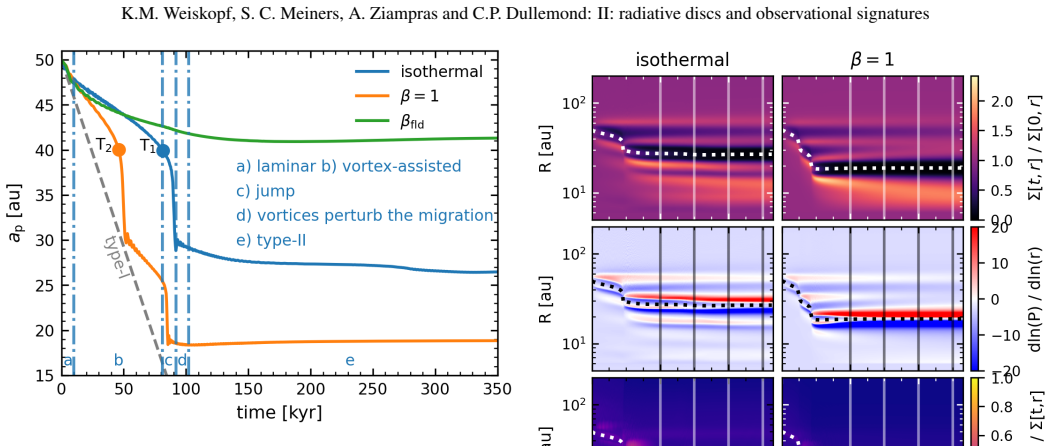
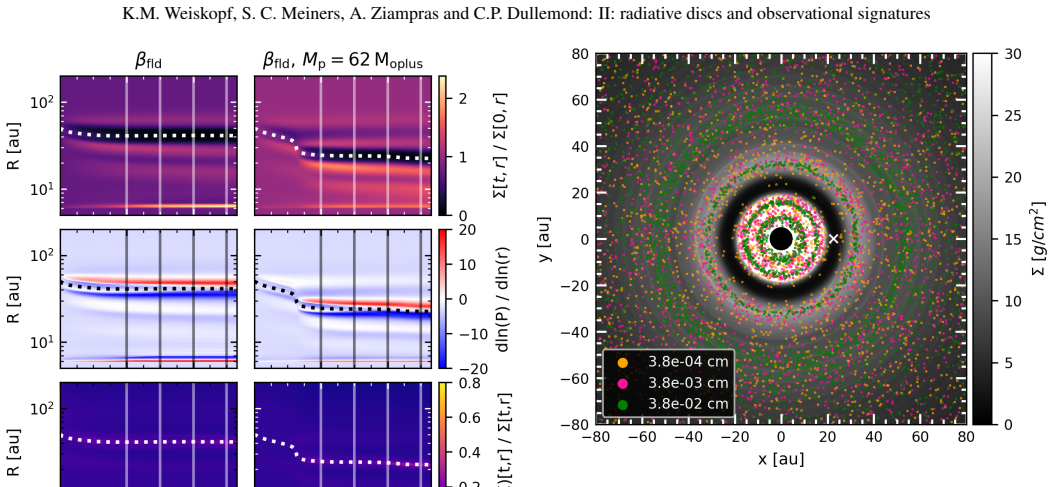
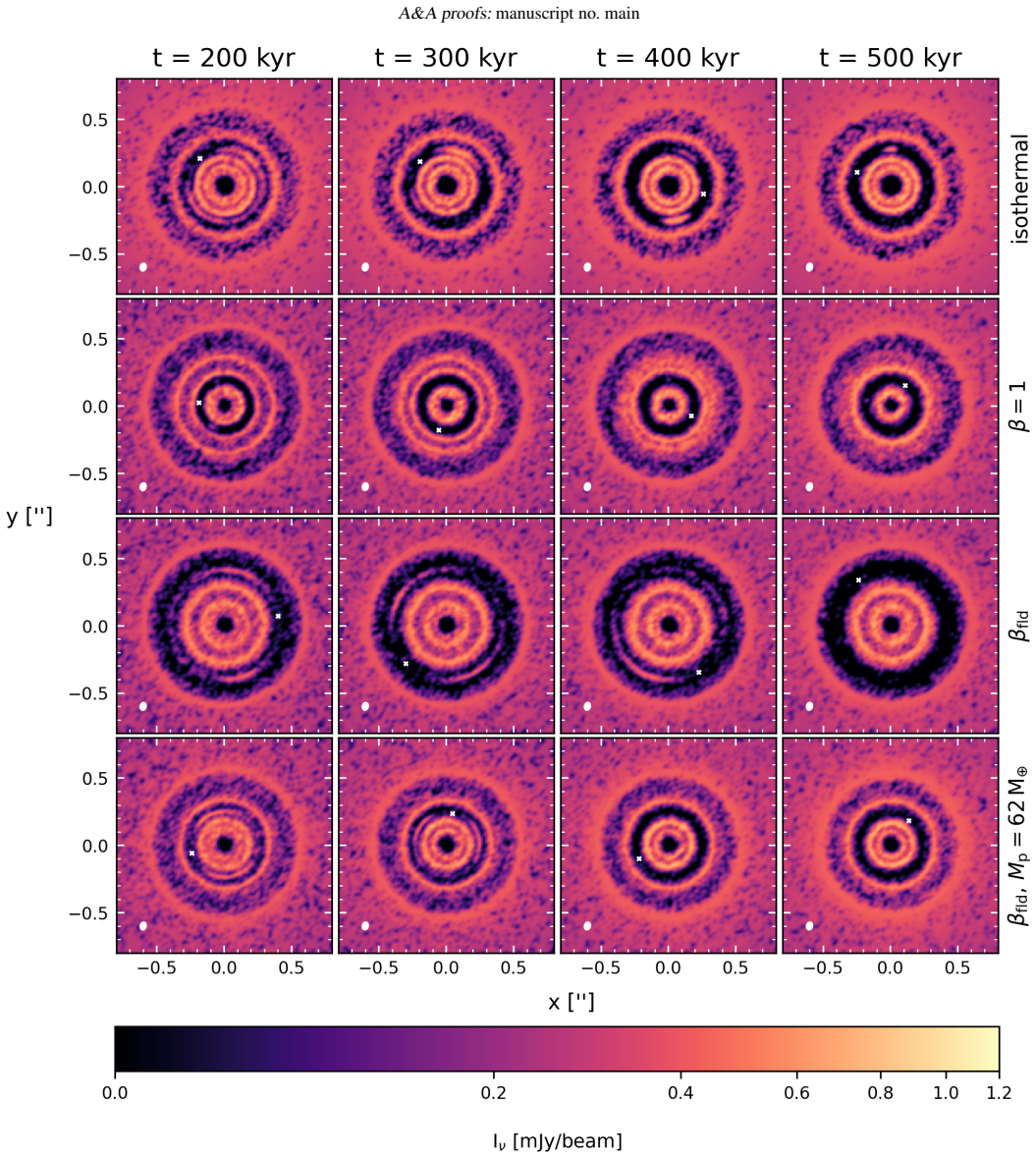
For all equations of state considered, the planet undergoes one or several migration jumps, each producing dust rings and gaps. The lifetime of these structures depends on the phase of slow migration preceding and occurring between jumps, but in all cases they remain visible for at least 400 kyr. Cooling has a deciding effect on the migration behaviour and the number of jumps, but no measurable influence on the lifetime of the dust structures.
What carries the argument
Migration jumps that occur when a planet interacts with the disc under different radiative cooling prescriptions, each jump opening a new set of dust rings and gaps.
If this is right
- One planet can account for multiple observed rings without requiring additional planets.
- Cooling physics controls how many jumps occur but does not change how long the resulting dust features last.
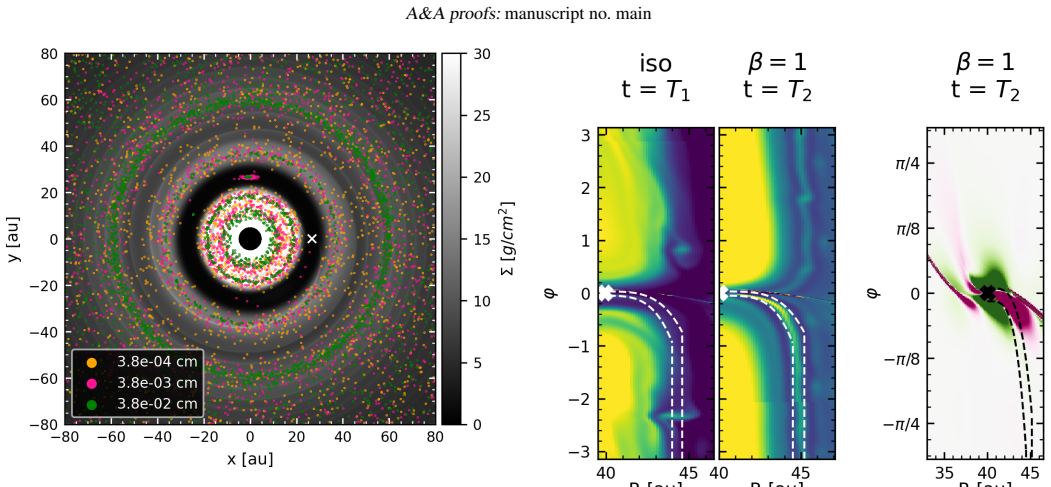
- The dust structures produced this way exhibit few large-scale asymmetries after the initial formation phase.
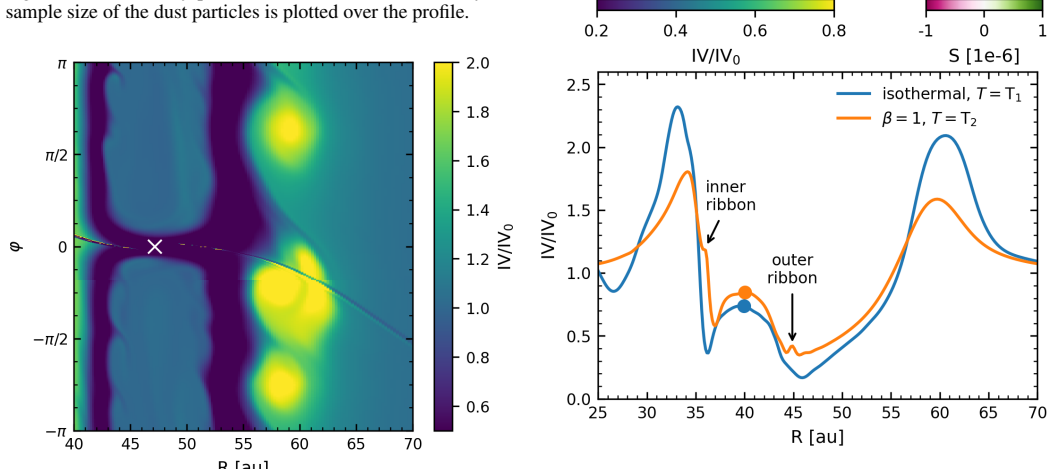
- Vortices generated during the jumps disappear on timescales of roughly 90 kyr on average.
Where Pith is reading between the lines
- Observers interpreting multi-ring discs should consider single-planet migration scenarios before invoking multiple planets or other mechanisms.
- The robustness of structure lifetime across cooling models suggests that similar features could appear even if the thermal physics differs from the models used here.
- Extending the runs to three dimensions would test whether the two-dimensional approximation over- or under-predicts the number of migration jumps.
Load-bearing premise
The simulations assume a low-viscosity disc and that the chosen two-dimensional hydrodynamic equations of state plus post-processed radiative transfer capture the essential physics of real three-dimensional radiative discs with dust.
What would settle it
Images of a disc containing a single known planet that show dust rings and gaps with lifetimes clearly shorter than 400 kyr or with large asymmetries persisting much longer than 90 kyr would falsify the central claim.
Figures

read the original abstract
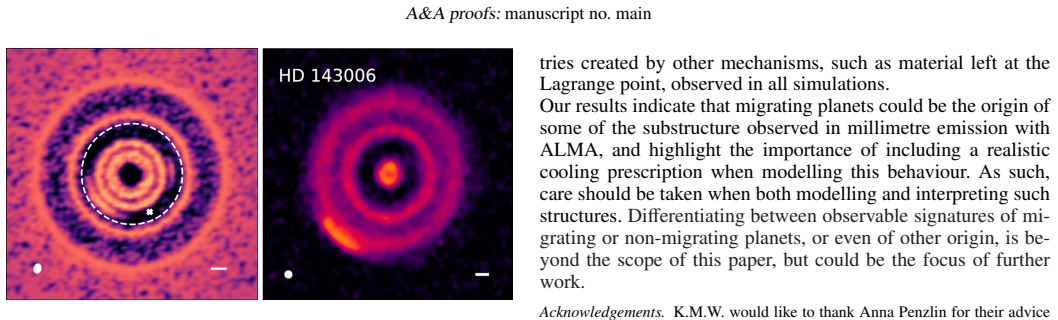
Dust structures in protoplanetary discs have been widely observed and their creation remains an active field of research. Several possible origins have already been explored, including magneto-hydrodynamics, shadows and planets-disc interactions. The goal of this paper is to investigate whether a single migrating planet in a low-viscosity disc, including radiative processes, is capable of generating observable dust structures. We aim to examine both the lifetime of such structures and potential asymmetries within them. We perform a set of high-resolution, two-dimensional hydrodynamic simulations of migrating planets using three different equations of state: isothermal, constant $\beta$-cooling and an adaptive $\beta$ model. Dust is included in all simulations and the resulting dust density profiles are then post-processed to create radiative transfer images. For all equations of state considered, the planet undergoes one or several migration jumps, each producing dust rings and gaps. The lifetime of these structures depends on the phase of slow migration preceding and occurring between jumps, but in all cases they remain visible for at least 400 kyr. We find that cooling has a deciding effect on the migration behaviour and the number of jumps, but no measurable influence on the lifetime of the dust structures. The structures exhibit relatively few asymmetries, and large-scale vortices persist for an average of only 90 kyr. Our models highlight the capacity of planets to open multiple gaps while migrating, and stress the importance of a realistic cooling model. Care should be taken when interpreting and comparing such models directly to observations.
Editorial analysis
A structured set of objections, weighed in public.
Referee Report
Summary. The paper claims that 2D hydrodynamic simulations of a single migrating planet in a low-viscosity protoplanetary disc, run with isothermal, constant β-cooling, and adaptive β equations of state (all including dust), produce one or more migration jumps; each jump generates dust rings and gaps that remain visible for at least 400 kyr after post-processed radiative transfer, independent of the cooling prescription, although cooling controls the number and timing of jumps. The resulting structures exhibit few asymmetries and large-scale vortices persist for an average of only 90 kyr.
Significance. If the results hold, the work shows that a single planet can open multiple gaps while migrating in radiative discs and that the resulting dust structures are long-lived enough to be observable, offering a concrete alternative to MHD or shadow mechanisms. The systematic comparison across three equations of state and the inclusion of dust in every run are clear strengths; the emphasis on observational signatures via radiative-transfer images adds direct relevance to ALMA data.
major comments (2)
- [Methods] Methods section: the manuscript states that the simulations are 'high-resolution' yet reports neither resolution tests, convergence checks, nor quantitative error measures on migration rates or dust surface-density profiles; without these the robustness of the jump behavior and the 400 kyr visibility claim across the three EOS cannot be verified.
- [Results] Results section: the headline result that dust structures remain visible for at least 400 kyr independent of cooling rests on 2D hydrodynamics plus post-processed radiative transfer; vertical temperature stratification and self-consistent 3D radiative diffusion can modify the corotation torque and dust scale height, potentially suppressing jumps or shortening ring lifetimes below the reported threshold.
minor comments (2)
- [Abstract] Abstract: 'deciding effect' should read 'decisive effect'.
- [Abstract] Abstract: the statement that vortices 'persist for an average of only 90 kyr' should specify the sample over which the average is taken and the precise definition of 'large-scale'.
Simulated Author's Rebuttal
We thank the referee for their constructive review and for highlighting both the strengths and the areas needing clarification in our manuscript. We respond to each major comment below.
read point-by-point responses
-
Referee: [Methods] Methods section: the manuscript states that the simulations are 'high-resolution' yet reports neither resolution tests, convergence checks, nor quantitative error measures on migration rates or dust surface-density profiles; without these the robustness of the jump behavior and the 400 kyr visibility claim across the three EOS cannot be verified.
Authors: We agree that the absence of explicit resolution tests and convergence checks weakens the presentation. In the revised manuscript we will add a new subsection to the Methods section that reports resolution tests performed at 50% and 150% of the fiducial grid resolution. These tests will include direct comparisons of planet migration rates and azimuthally averaged dust surface-density profiles, together with quantitative error measures (e.g., L2 norms between resolutions). The results confirm that both the occurrence of migration jumps and the 400 kyr visibility of the dust structures are converged at the resolution used in the paper. revision: yes
-
Referee: [Results] Results section: the headline result that dust structures remain visible for at least 400 kyr independent of cooling rests on 2D hydrodynamics plus post-processed radiative transfer; vertical temperature stratification and self-consistent 3D radiative diffusion can modify the corotation torque and dust scale height, potentially suppressing jumps or shortening ring lifetimes below the reported threshold.
Authors: We acknowledge that our study is performed in two dimensions and that three-dimensional effects, including vertical temperature stratification and self-consistent radiative diffusion, could alter the corotation torque and dust scale height. In the revised manuscript we will expand the final discussion section to explicitly state these limitations and to note that the reported lifetimes and jump statistics should be regarded as a 2D baseline. We will also add a short paragraph outlining why full 3D radiative hydrodynamical runs over the necessary timescales remain computationally prohibitive at present. revision: partial
- Confirmation or refutation of whether vertical stratification and 3D radiative diffusion suppress migration jumps or shorten dust-ring lifetimes below 400 kyr cannot be provided without new three-dimensional radiative simulations, which lie outside the scope of the present work.
Circularity Check
Numerical hydrodynamic experiments exhibit no circularity
full rationale
The paper consists entirely of 2D hydrodynamic simulations (isothermal, constant-β, adaptive-β) with embedded dust, followed by post-processed radiative transfer imaging. No analytic derivation chain exists; migration jumps and dust ring lifetimes are direct numerical outputs under the chosen equations of state and low-viscosity assumption. No parameter is fitted to a subset of data and then relabeled as a prediction, no self-citation supplies a load-bearing uniqueness theorem, and no ansatz is smuggled via prior work. The central claims are therefore self-contained numerical results rather than reductions to their own inputs.
Axiom & Free-Parameter Ledger
free parameters (2)
- disc viscosity
- beta cooling parameters
axioms (2)
- domain assumption Two-dimensional hydrodynamic equations adequately represent disc evolution
- domain assumption Dust density can be post-processed from gas hydrodynamics without strong back-reaction
Reference graph
Works this paper leans on
-
[1]
Direct observational constraints from CN and C _ 2 H emission
High turbulence in the IM Lup protoplanetary disk. Direct observational constraints from CN and C _ 2 H emission. , keywords =. doi:10.1051/0004-6361/202347757 , archivePrefix =. 2312.04618 , primaryClass =
-
[2]
Gaps and Rings in an ALMA Survey of Disks in the Taurus Star-forming Region
Gaps and Rings in an ALMA Survey of Disks in the Taurus Star-forming Region. , keywords =. doi:10.3847/1538-4357/aae8e1 , archivePrefix =. 1810.06044 , primaryClass =
work page internal anchor Pith review Pith/arXiv arXiv doi:10.3847/1538-4357/aae8e1
-
[3]
ALMA Survey of Lupus Protoplanetary Disks. II. Gas Disk Radii. , keywords =. doi:10.3847/1538-4357/aab890 , archivePrefix =. 1803.05923 , primaryClass =
work page internal anchor Pith review Pith/arXiv arXiv doi:10.3847/1538-4357/aab890
-
[4]
Molecules with ALMA at Planet-forming Scales (MAPS). I. Program Overview and Highlights. , keywords =. doi:10.3847/1538-4365/ac1432 , archivePrefix =. 2109.06268 , primaryClass =
-
[5]
Motivation, sample, data reduction, and results overview
The ALMA survey to Resolve exoKuiper belt Substructures (ARKS): I. Motivation, sample, data reduction, and results overview. , keywords =. doi:10.1051/0004-6361/202556489 , archivePrefix =. 2601.11708 , primaryClass =
-
[6]
The PLUTO Code for Adaptive Mesh Computations in Astrophysical Fluid Dynamics
The PLUTO Code for Adaptive Mesh Computations in Astrophysical Fluid Dynamics. , keywords =. doi:10.1088/0067-0049/198/1/7 , archivePrefix =. 1110.0740 , primaryClass =
work page internal anchor Pith review Pith/arXiv arXiv doi:10.1088/0067-0049/198/1/7
-
[7]
PLUTO: a Numerical Code for Computational Astrophysics
PLUTO: A Numerical Code for Computational Astrophysics. , keywords =. doi:10.1086/513316 , archivePrefix =. astro-ph/0701854 , primaryClass =
work page internal anchor Pith review Pith/arXiv arXiv doi:10.1086/513316
-
[8]
Cooling-induced Vortex Decay in Keplerian Disks. , keywords =. doi:10.3847/1538-4357/ac1d4e , archivePrefix =. 2108.06345 , primaryClass =
-
[9]
Settling and growth of dust particles in a laminar phase of a low-mass solar nebula , journal =
Yoshitsugu Nakagawa and Minoru Sekiya and Chushiro Hayashi , abstract =. Settling and growth of dust particles in a laminar phase of a low-mass solar nebula , journal =. 1986 , issn =. doi:https://doi.org/10.1016/0019-1035(86)90121-1 , url =
-
[10]
Aerodynamics of solid bodies in the solar nebula. , keywords =. doi:10.1093/mnras/180.2.57 , adsurl =
-
[11]
On the width and shape of gaps in protoplanetary disks
On the width and shape of gaps in protoplanetary disks. , keywords =. doi:10.1016/j.icarus.2005.10.007 , archivePrefix =. astro-ph/0511082 , primaryClass =
work page internal anchor Pith review Pith/arXiv arXiv doi:10.1016/j.icarus.2005.10.007 2005
-
[14]
Ring shaped dust accumulation in transition disks
Ring shaped dust accumulation in transition disks. , keywords =. doi:10.1051/0004-6361/201219315 , archivePrefix =. 1207.6485 , primaryClass =
work page internal anchor Pith review Pith/arXiv arXiv doi:10.1051/0004-6361/201219315
-
[15]
Müller, T. W. A. and Kley, W. , month = mar, year =. Circumstellar disks in binary star systems. Astronomy and Astrophysics , publisher =. doi:10.1051/0004-6361/201118202 , abstract =
-
[16]
and Pascucci, Ilaria and Pinilla, Paola and Cieza, Lucas A
Zhang, Ke and Pérez, Laura M. and Pascucci, Ilaria and Pinilla, Paola and Cieza, Lucas A. and Carpenter, John and Trapman, Leon and Deng, Dingshan and Agurto-Gangas, Carolina and Sierra, Anibal and Kurtovic, Nicolás T. and Ruiz-Rodriguez, Dary A. and Vioque, Miguel and Miley, James and Tabone, Benoît and González-Ruilova, Camilo and Anania, Rossella and R...
-
[17]
McNally, Colin P. and Nelson, Richard P. and Paardekooper, Sijme-Jan and Benítez-Llambay, Pablo , month = mar, year =. Migrating super-. Monthly Notices of the Royal Astronomical Society , publisher =. doi:10.1093/mnras/stz023 , abstract =
-
[18]
Zhang, Shangjia and Zhu, Zhaohuan , month = apr, year =. The effects of disc self-gravity and radiative cooling on the formation of gaps and spirals by young planets , volume =. Monthly Notices of the Royal Astronomical Society , publisher =. doi:10.1093/mnras/staa404 , abstract =
-
[19]
Goodman, J. and Rafikov, R. R. , month = may, year =. Planetary. The Astrophysical Journal , publisher =. doi:10.1086/320572 , abstract =
-
[20]
Rafikov, R. R. , month = jun, year =. Planet. The Astrophysical Journal , publisher =. doi:10.1086/340228 , abstract =
-
[21]
Teague, Richard and Benisty, Myriam and Facchini, Stefano and Fukagawa, Misato and Pinte, Christophe and Andrews, Sean M. and Bae, Jaehan and Barraza-Alfaro, Marcelo and Cataldi, Gianni and Cuello, Nicolás and Curone, Pietro and Czekala, Ian and Fasano, Daniele and Flock, Mario and Galloway-Sprietsma, Maria and Garg, Himanshi and Hall, Cassandra and Hammo...
-
[22]
and Guilera, Octavio and Pérez, Sebastián and Rannou, Fernando R
Orcajo, Santiago and Cieza, Lucas A. and Guilera, Octavio and Pérez, Sebastián and Rannou, Fernando R. and González-Ruilova, Camilo and Batalla-Falcon, Grace and Bhowmik, Trisha and Chavan, Prachi and Casassus, Simon and Dasgupta, Anuroop and Diaz, Kevin and Gomez, José L. and Hales, Antonio S. and Miley, J. M. and Miller Bertolami, Marcelo M. and Nogueir...
-
[23]
Migration of massive planets in accreting disks
Migration of massive planets in accreting disks. , keywords =. doi:10.1051/0004-6361/201424837 , archivePrefix =. 1411.3190 , primaryClass =
work page internal anchor Pith review Pith/arXiv arXiv doi:10.1051/0004-6361/201424837
-
[24]
Meiners, S. C. and Weiskopf, K. M. and Rometsch, T. and Dullemond, C. P. , title =
-
[25]
Rodenkirch, P. J. and Rometsch, T. and Dullemond, C. P. and Weber, P. and Kley, W. , month = mar, year =. Modeling the nonaxisymmetric structure in the. Astronomy and Astrophysics , publisher =. doi:10.1051/0004-6361/202038484 , abstract =
-
[26]
and Birnstiel, Tilman and Benisty, Myriam and Nelson, Richard P
Ziampras, Alexandros and Dullemond, Cornelis P. and Birnstiel, Tilman and Benisty, Myriam and Nelson, Richard P. , month = jun, year =. Spirals, rings, and vortices shaped by shadows in protoplanetary discs: from radiative hydrodynamical simulations to observable signatures , volume =. Monthly Notices of the Royal Astronomical Society , publisher =. doi:1...
-
[27]
and Kley, Wilhelm and Dullemond, Cornelis P
Rometsch, Thomas and Rodenkirch, Peter J. and Kley, Wilhelm and Dullemond, Cornelis P. , month = nov, year =. Migration jumps of planets in transition discs , volume =. Astronomy and Astrophysics , publisher =. doi:10.1051/0004-6361/202038311 , abstract =
-
[28]
Levermore, C. D. and Pomraning, G. C. , month = aug, year =. A flux-limited diffusion theory , volume =. The Astrophysical Journal , publisher =. doi:10.1086/159157 , abstract =
-
[29]
and Paardekooper, Sijme-Jan , month = sep, year =
Ziampras, Alexandros and Nelson, Richard P. and Paardekooper, Sijme-Jan , month = sep, year =. Halting the migration of super-. Monthly Notices of the Royal Astronomical Society , publisher =. doi:10.1093/mnras/staf1130 , abstract =
-
[30]
and Kuiper, Rolf and Sudarshan, Prakruti and Ziampras, Alexandros and Elbakyan, Vardan G
Cecil, Michael and Flock, Mario and Malygin, Mykola G. and Kuiper, Rolf and Sudarshan, Prakruti and Ziampras, Alexandros and Elbakyan, Vardan G. , month = feb, year =. The role of detailed gas and dust opacities in shaping the evolution of the inner disc edge subject to episodic accretion , url =. doi:10.48550/arXiv.2602.10674 , abstract =
-
[31]
Klahr, Hubert and Baehr, Hans and Melon Fuksman, Julio David , month = feb, year =. Thermal. The Astrophysical Journal , publisher =. doi:10.3847/1538-4357/ae0f9d , abstract =
-
[32]
Kanagawa, Kazuhiro D. and Muto, Takayuki and Tanaka, Hidekazu and Tanigawa, Takayuki and Takeuchi, Taku and Tsukagoshi, Takashi and Momose, Munetake , month = jun, year =. Mass constraint for a planet in a protoplanetary disk from the gap width , volume =. Publications of the Astronomical Society of Japan , publisher =. doi:10.1093/pasj/psw037 , abstract =
-
[33]
Miranda, Ryan and Rafikov, Roman R. , month = dec, year =. Gaps and. The Astrophysical Journal , publisher =. doi:10.3847/1538-4357/abbee7 , abstract =
-
[34]
Armitage, Philip J. , month = jan, year =. Astrophysics of. doi:https://doi.org/10.1017/9781108344227 , publisher =
-
[35]
Lyra, Wladimir and Umurhan, Orkan M. , month = jul, year =. The. Publications of the Astronomical Society of the Pacific , publisher =. doi:10.1088/1538-3873/aaf5ff , abstract =
-
[36]
The Astrophysical Journal , author =. 2011 , pages =. doi:10.1088/2041-8205/740/1/L6 , abstract =
-
[37]
Theoretical
Bartelmann, Klaus , year =. Theoretical
-
[38]
Steiner, D. and Gehrig, L. and Ratschiner, B. and Ragossnig, F. and Vorobyov, E. I. and Güdel, M. and Dorfi, E. A. , month = nov, year =. Time-dependent, long-term hydrodynamic simulations of the inner protoplanetary disk. Astronomy and Astrophysics , publisher =. doi:10.1051/0004-6361/202140447 , abstract =
-
[39]
Desch, Steven J. and Turner, Neal J. , month = oct, year =. High-temperature. The Astrophysical Journal , publisher =. doi:10.1088/0004-637X/811/2/156 , abstract =
-
[40]
Huang, Jane and Andrews, Sean M. and Dullemond, Cornelis P. and Isella, Andrea and Pérez, Laura M. and Guzmán, Viviana V. and Öberg, Karin I. and Zhu, Zhaohuan and Zhang, Shangjia and Bai, Xue-Ning and Benisty, Myriam and Birnstiel, Tilman and Carpenter, John M. and Hughes, A. Meredith and Ricci, Luca and Weaver, Erik and Wilner, David J. , month = dec, y...
-
[41]
Lodato, G. and Clarke, C. J. , month = sep, year =. Massive planets in. Monthly Notices of the Royal Astronomical Society , publisher =. doi:10.1111/j.1365-2966.2004.08112.x , abstract =
-
[42]
Flock, M. and Ruge, J. P. and Dzyurkevich, N. and Henning, Th. and Klahr, H. and Wolf, S. , month = feb, year =. Gaps, rings, and non-axisymmetric structures in protoplanetary disks. Astronomy and Astrophysics , publisher =. doi:10.1051/0004-6361/201424693 , abstract =
-
[43]
Lodato, G. and Rice, W. K. M. , month = apr, year =. Testing the locality of transport in self-gravitating accretion discs -. Monthly Notices of the Royal Astronomical Society , publisher =. doi:10.1111/j.1365-2966.2005.08875.x , abstract =
-
[44]
Astronomy & Astrophysics , author =
Formation of giant planets and brown dwarfs on wide orbits , volume =. Astronomy & Astrophysics , author =. 2013 , pages =. doi:10.1051/0004-6361/201220601 , urldate =
-
[45]
The rovibrational spectrum of BeH, MgH and CaH in the X ^ 2 ^ + state
Fu. Monthly Notices of the Royal Astronomical Society , author =. 2012 , pages =. doi:10.1111/j.1365-2966.2012.21612.x , abstract =
-
[46]
Masset, F. S. and Papaloizou, J. C. B. , month = may, year =. Runaway. The Astrophysical Journal , publisher =. doi:10.1086/373892 , abstract =
-
[47]
The Astrophysical Journal Letters , author =
The. The Astrophysical Journal Letters , author =. 2018 , pages =. doi:10.3847/2041-8213/aaf743 , abstract =
-
[48]
Thermal baroclinic instabilities in accretion disks
Klahr, Hubert , month = apr, year =. Thermal baroclinic instabilities in accretion disks. doi:10.48550/arXiv.2404.15933 , abstract =
-
[49]
Villenave, Marion and Rosotti, Giovanni P. and Lambrechts, Michiel and Ziampras, Alexandros and Pinte, Christophe and Ménard, François and Stapelfeldt, Karl R. and Duchêne, Gaspard and Baylock, Emily and Doi, Kiyoaki , month = may, year =. Turbulence in protoplanetary disks:. Astronomy and Astrophysics , publisher =. doi:10.1051/0004-6361/202553822 , abstract =
-
[50]
Villenave, M. and Stapelfeldt, K. R. and Duchêne, G. and Ménard, F. and Lambrechts, M. and Sierra, A. and Flores, C. and Dent, W. R. F. and Wolff, S. and Ribas, Á. and Benisty, M. and Cuello, N. and Pinte, C. , month = may, year =. A. The Astrophysical Journal , publisher =. doi:10.3847/1538-4357/ac5fae , abstract =
-
[51]
and Birnstiel, Tilman and Huang, Jane and Kurtovic, Nicolás T
Dullemond, Cornelis P. and Birnstiel, Tilman and Huang, Jane and Kurtovic, Nicolás T. and Andrews, Sean M. and Guzmán, Viviana V. and Pérez, Laura M. and Isella, Andrea and Zhu, Zhaohuan and Benisty, Myriam and Wilner, David J. and Bai, Xue-Ning and Carpenter, John M. and Zhang, Shangjia and Ricci, Luca , month = dec, year =. The. The Astrophysical Journa...
-
[52]
Rosotti, Giovanni P. , month = jun, year =. Empirical constraints on turbulence in proto-planetary discs , volume =. New Astronomy Reviews , publisher =. doi:10.1016/j.newar.2023.101674 , abstract =
-
[53]
Bai, Xue-Ning , month = aug, year =. Global. The Astrophysical Journal , publisher =. doi:10.3847/1538-4357/aa7dda , abstract =
-
[54]
2012 , note =
Astrophysics Source Code Library , author =. 2012 , note =
2012
-
[55]
Space Science Reviews , author =
The. Space Science Reviews , author =. 2020 , note =. doi:10.1007/s11214-020-00675-w , abstract =
-
[56]
coords2sigma , url =
Rometsch, Thomas , month = feb, year =. coords2sigma , url =
-
[57]
Kanagawa, K. D. and Tanaka, H. and Muto, T. and Tanigawa, T. and Takeuchi, T. , month = mar, year =. Formation of a disc gap induced by a planet: effect of the deviation from. Monthly Notices of the Royal Astronomical Society , publisher =. doi:10.1093/mnras/stv025 , abstract =
-
[58]
The Astrophysical Journal , author =
Planet–. The Astrophysical Journal , author =. 2020 , pages =. doi:10.3847/1538-4357/ab791a , abstract =
-
[59]
Dempsey, Adam M. and Muñoz, Diego J. and Lithwick, Yoram , month = sep, year =. Outward. The Astrophysical Journal , publisher =. doi:10.3847/2041-8213/ac22af , abstract =
-
[60]
Scardoni, Chiara E. and Clarke, Cathie J. and Rosotti, Giovanni P. and Booth, Richard A. and Alexander, Richard D. and Ragusa, Enrico , month = aug, year =. Inward and outward migration of massive planets: moving towards a stalling radius , volume =. Monthly Notices of the Royal Astronomical Society , publisher =. doi:10.1093/mnras/stac1700 , abstract =
-
[61]
Goldreich, P. and Tremaine, S. , month = nov, year =. The excitation of density waves at the. The Astrophysical Journal , publisher =. doi:10.1086/157448 , abstract =
-
[62]
Ogilvie, G. I. and Lubow, S. H. , month = mar, year =. On the wake generated by a planet in a disc , volume =. Monthly Notices of the Royal Astronomical Society , publisher =. doi:10.1046/j.1365-8711.2002.05148.x , abstract =
-
[63]
and Huang, Jane and Pérez, Laura M
Andrews, Sean M. and Huang, Jane and Pérez, Laura M. and Isella, Andrea and Dullemond, Cornelis P. and Kurtovic, Nicolás T. and Guzmán, Viviana V. and Carpenter, John M. and Wilner, David J. and Zhang, Shangjia and Zhu, Zhaohuan and Birnstiel, Tilman and Bai, Xue-Ning and Benisty, Myriam and Hughes, A. Meredith and Öberg, Karin I. and Ricci, Luca , month ...
work page internal anchor Pith review doi:10.3847/2041-8213/aaf741 2041
-
[64]
The Open Journal of Astrophysics , keywords =
The reflex instability: exponential growth of a large-scale m = 1 mode in astrophysical discs. The Open Journal of Astrophysics , keywords =. doi:10.33232/001c.143230 , archivePrefix =. 2508.07859 , primaryClass =
-
[65]
The Open Journal of Astrophysics , keywords =
On inertial forces (indirect terms) in problems with a central body. The Open Journal of Astrophysics , keywords =. doi:10.33232/001c.141682 , archivePrefix =. 2506.23331 , primaryClass =
-
[66]
Theory of rotating stars , url =
Tassoul, Jean-Louis , month = jan, year =. Theory of rotating stars , url =
-
[67]
Meheut, H. and Casse, F. and Varniere, P. and Tagger, M. , month = jun, year =. Rossby wave instability and three-dimensional vortices in accretion disks , volume =. Astronomy and Astrophysics , publisher =. doi:10.1051/0004-6361/201014000 , abstract =
-
[68]
The Astrophysical Journal , author =. 2016 , pages =. doi:10.3847/0004-637X/831/2/122 , abstract =
-
[69]
Zhang, Minghao and Huang, Pinghui and Dong, Ruobing , month = jan, year =. The. The Astrophysical Journal , publisher =. doi:10.3847/1538-4357/ad055c , abstract =
-
[70]
Kanagawa, Kazuhiro D. and Nomura, Hideko and Tsukagoshi, Takashi and Muto, Takayuki and Kawabe, Ryohei , month = apr, year =. Model of a. The Astrophysical Journal , publisher =. doi:10.3847/1538-4357/ab781e , abstract =
-
[71]
Varnière, P. and Tagger, M. , month = feb, year =. Reviving. Astronomy and Astrophysics , publisher =. doi:10.1051/0004-6361:200500226 , abstract =
-
[72]
From Protoplanetary Disks to Planet Formation: Saas-Fee Advanced Course 45
From. From Protoplanetary Disks to Planet Formation: Saas-Fee Advanced Course 45. Swiss Society for Astrophysics and Astronomy , author =. 2019 , note =. doi:10.1007/978-3-662-58687-7 , abstract =
-
[73]
Lovelace, R. V. E. and Li, H. and Colgate, S. A. and Nelson, A. F. , month = mar, year =. Rossby. The Astrophysical Journal , publisher =. doi:10.1086/306900 , abstract =
-
[74]
, month = jan, year =
Kley, W. , month = jan, year =. Radiation hydrodynamics of the boundary layer in accretion disks. Astronomy and Astrophysics , publisher =
-
[75]
Masset, F. S. , month = sep, year =. On the. The Astrophysical Journal , publisher =. doi:10.1086/322446 , abstract =
-
[76]
2021 , note =
Astrophysics Source Code Library , author =. 2021 , note =
2021
-
[77]
Lin, D. N. C. and Papaloizou, J. , month = jan, year =. On the dynamical origin of the solar system. , url =
-
[78]
Zhu, Zhaohuan and Stone, James M. and Rafikov, Roman R. and Bai, Xue-ning , month = apr, year =. Particle. The Astrophysical Journal , publisher =. doi:10.1088/0004-637X/785/2/122 , abstract =
-
[79]
Chiang, E. I. and Goldreich, P. , month = nov, year =. Spectral. The Astrophysical Journal , publisher =. doi:10.1086/304869 , abstract =
-
[80]
Shakura, N. I. and Sunyaev, R. A. , month = jan, year =. Black holes in binary systems. Astronomy and Astrophysics , publisher =
-
[81]
Woitke, P. and Min, M. and Pinte, C. and Thi, W.-F. and Kamp, I. and Rab, C. and Anthonioz, F. and Antonellini, S. and Baldovin-Saavedra, C. and Carmona, A. and Dominik, C. and Dionatos, O. and Greaves, J. and Güdel, M. and Ilee, J. D. and Liebhart, A. and Ménard, F. and Rigon, L. and Waters, L. B. F. M. and Aresu, G. and Meijerink, R. and Spaans, M. , mo...
-
[82]
Bell, K. R. and Lin, D. N. C. , month = jun, year =. Using. The Astrophysical Journal , publisher =. doi:10.1086/174206 , abstract =
discussion (0)
Sign in with ORCID, Apple, or X to comment. Anyone can read and Pith papers without signing in.