Little Red Dot progenitors from Compact Starbursts: A Natural Path to Early AGN Formation
Pith reviewed 2026-06-28 09:26 UTC · model grok-4.3
The pith
High-resolution simulations show that compact high-redshift starbursts rapidly accumulate central mass sufficient to form million-solar-mass black holes.
A machine-rendered reading of the paper's core claim, the machinery that carries it, and where it could break.
Core claim
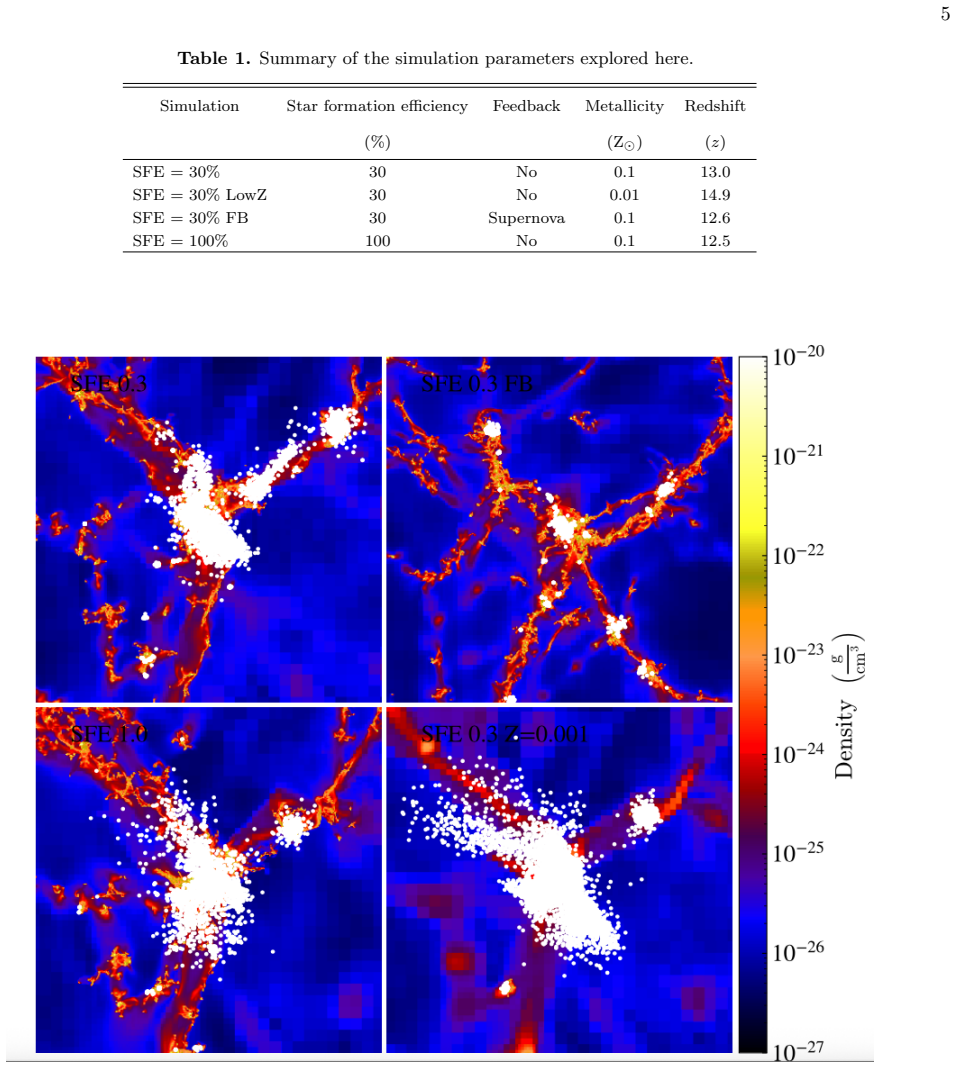
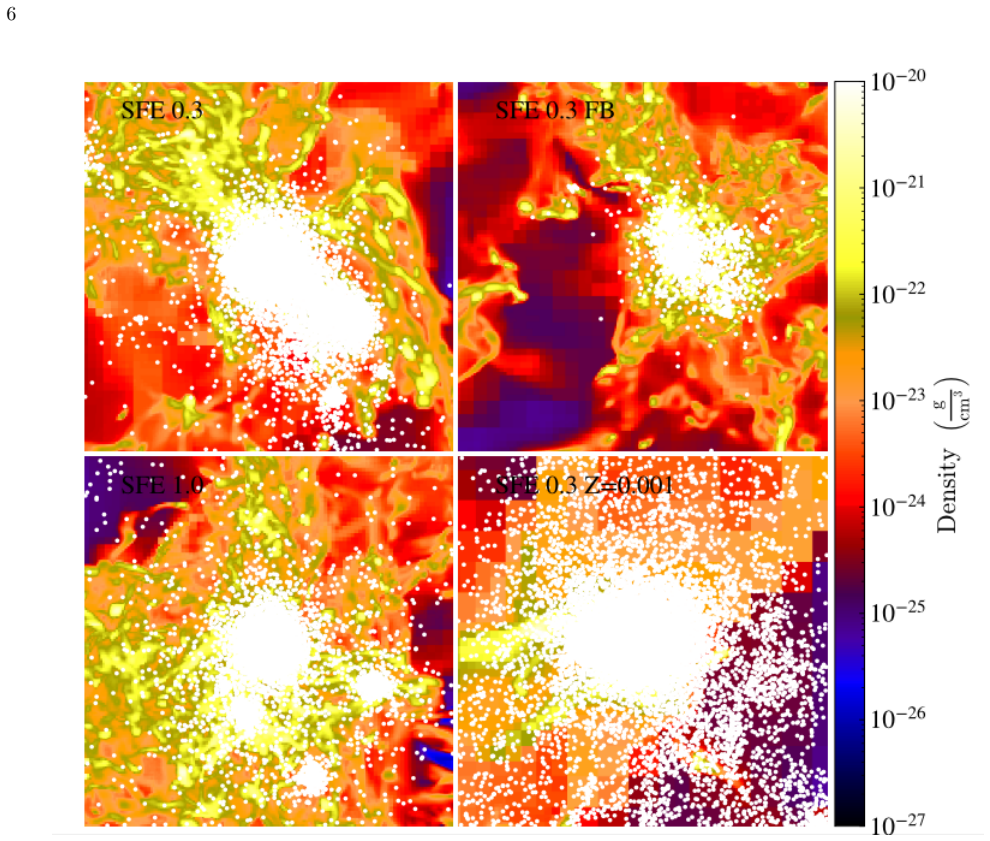
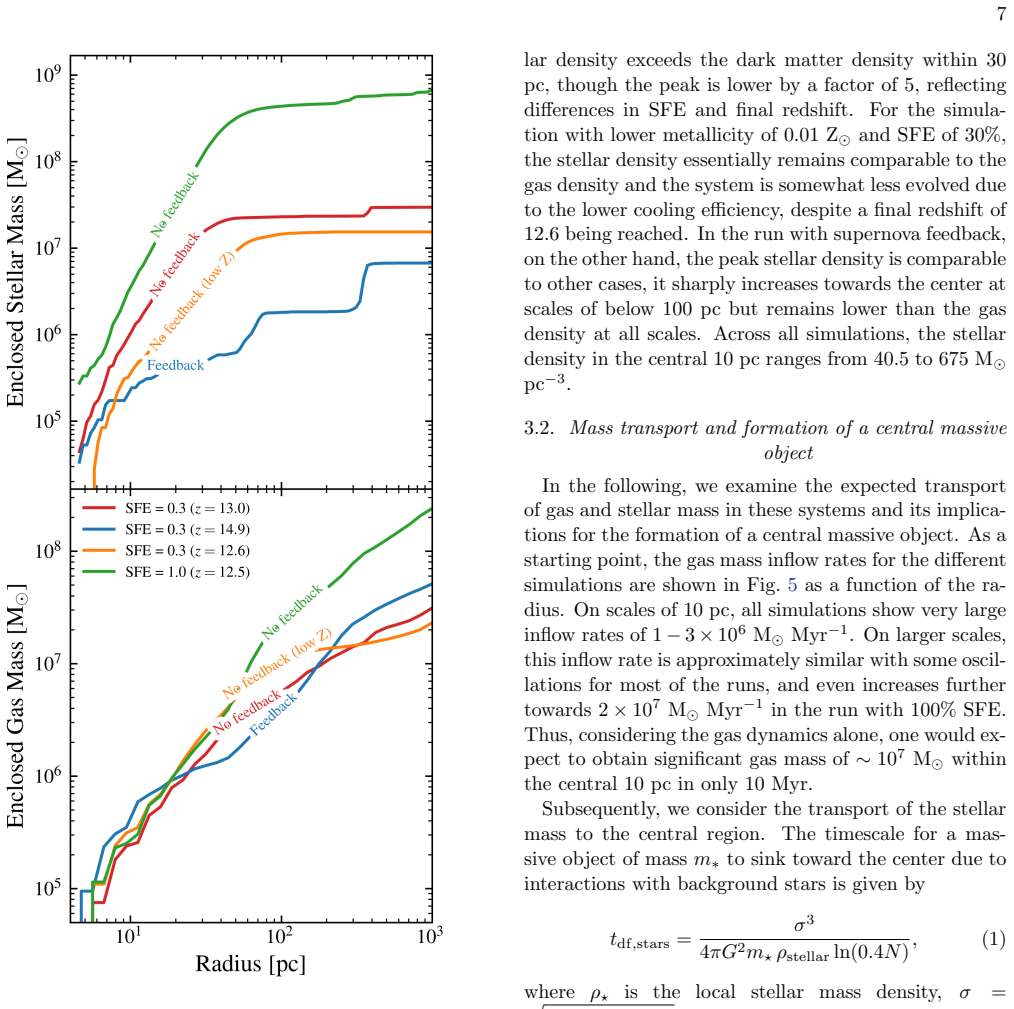
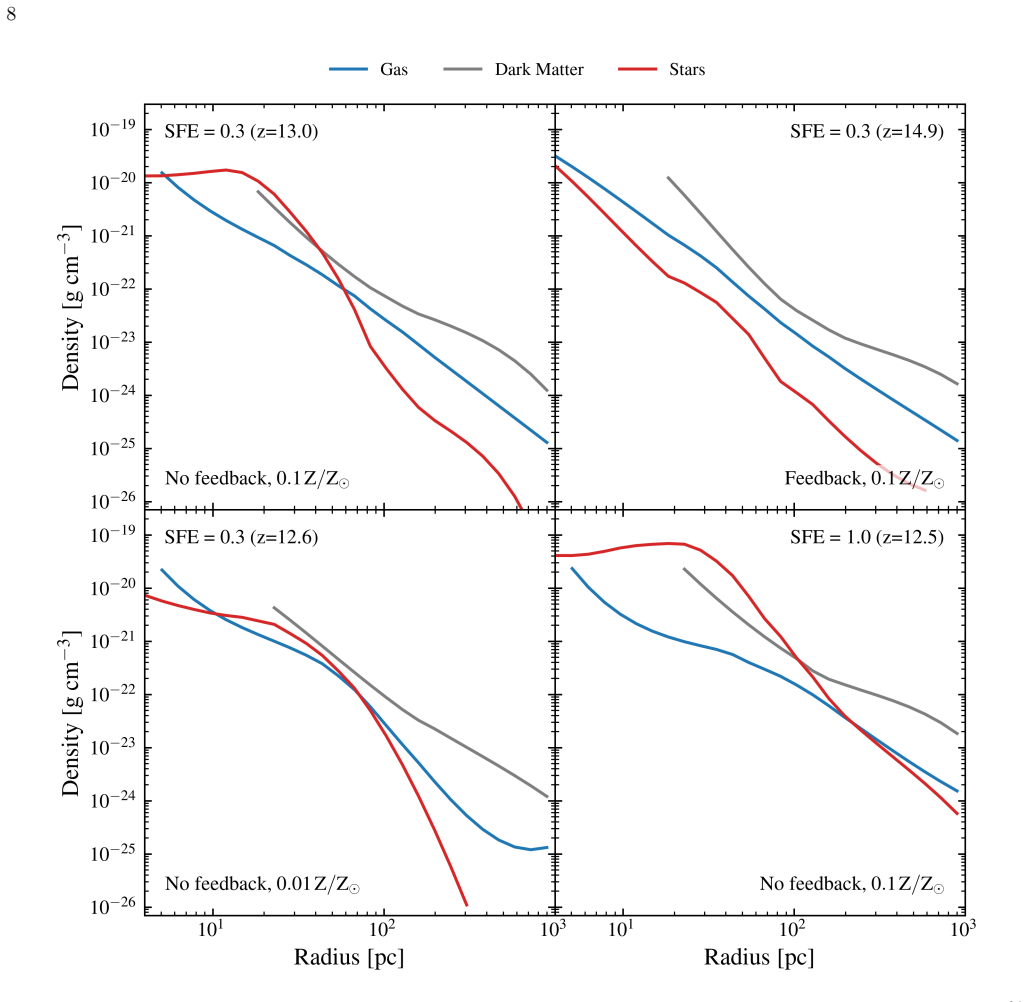
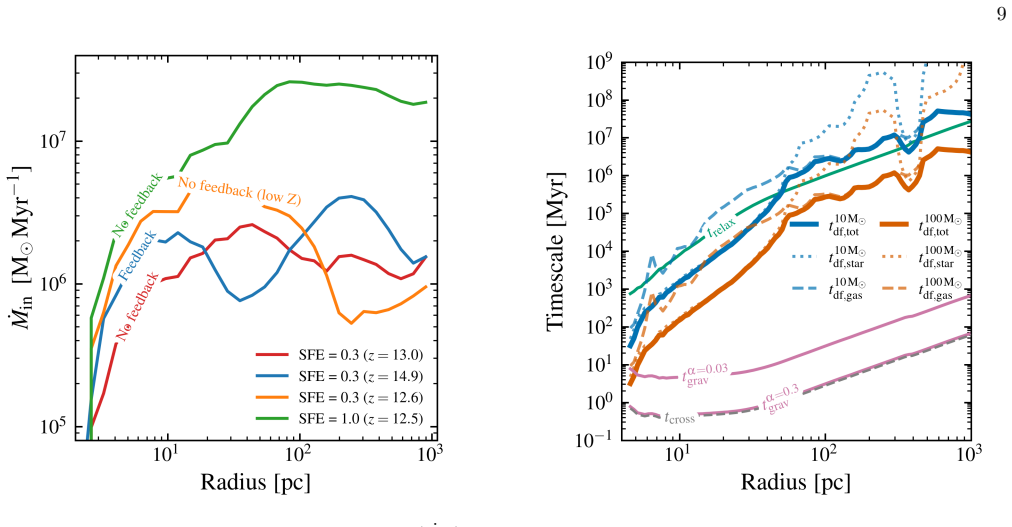
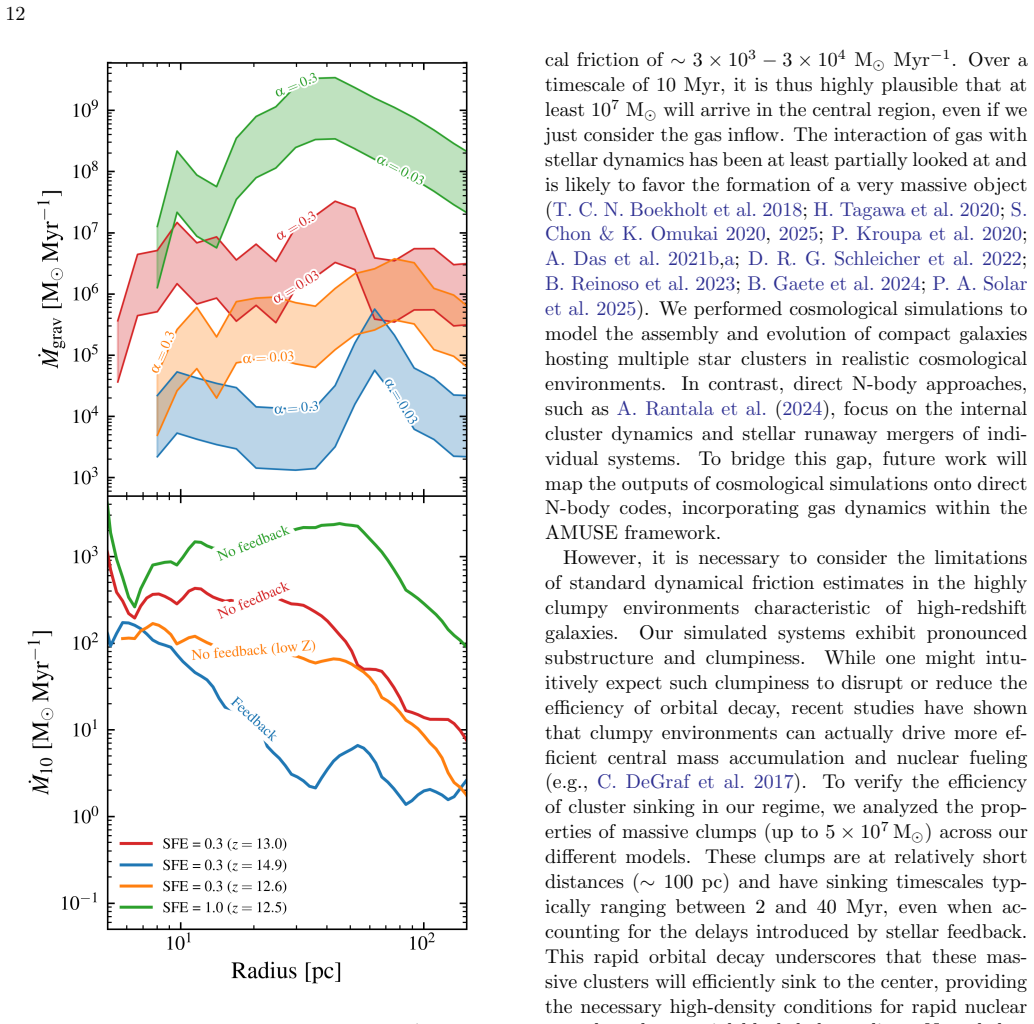
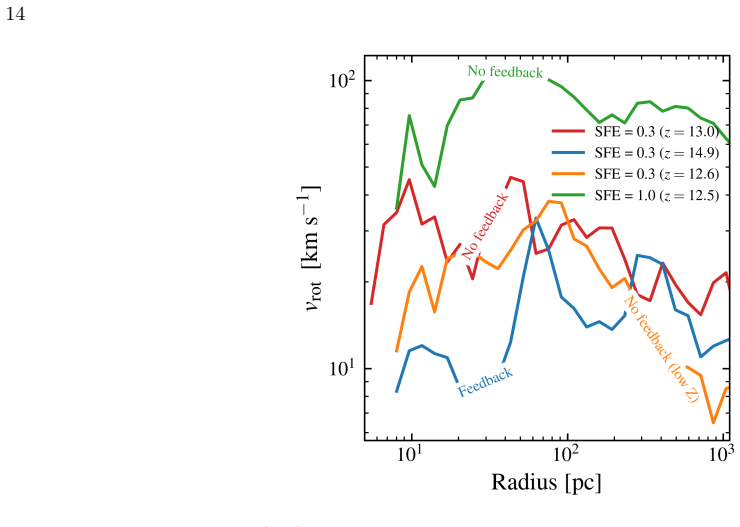
Simulations with 30% and 100% star formation efficiency and confined feedback produce compact galaxies of 10^7 to 6x10^8 solar masses with most mass inside 200-300 pc. Gas inflows accumulate roughly 10^7 solar masses at the center in 10 Myr while torques and friction add further mass, yielding a 10^6 solar mass black hole at 10% efficiency and naturally producing an AGN inside these dense systems.
What carries the argument
High-resolution cosmological simulations that track gas inflows, gravitational torques, and stellar dynamical friction inside environments with high star formation efficiency and confined feedback.
If this is right
- Compact stellar systems at high redshift can evolve directly into AGN through internal mass redistribution.
- Central black hole growth to 10^6 solar masses occurs on 10 Myr timescales inside dense environments.
- Stellar and AGN explanations for Little Red Dots are compatible as sequential phases in the same objects.
- Multiple channels (inflows, torques, friction) operate together to concentrate mass at galactic centers.
Where Pith is reading between the lines
- This internal pathway could account for some of the massive black holes seen at high redshift without invoking rare external seeding events.
- Kinematic maps of gas and stars in Little Red Dots might show ongoing inward migration signatures if the process is active.
- The need for feedback confinement implies that outflow properties in the early universe differ from those observed locally.
Load-bearing premise
Star formation efficiencies of 30% or 100% with feedback confined to small central regions actually occur inside these high-redshift compact galaxies.
What would settle it
Observations that find star formation efficiencies well below 30% or widespread unconfined feedback in the central regions of Little Red Dot candidates or their progenitors would prevent the described rapid central mass accumulation.
Figures
read the original abstract
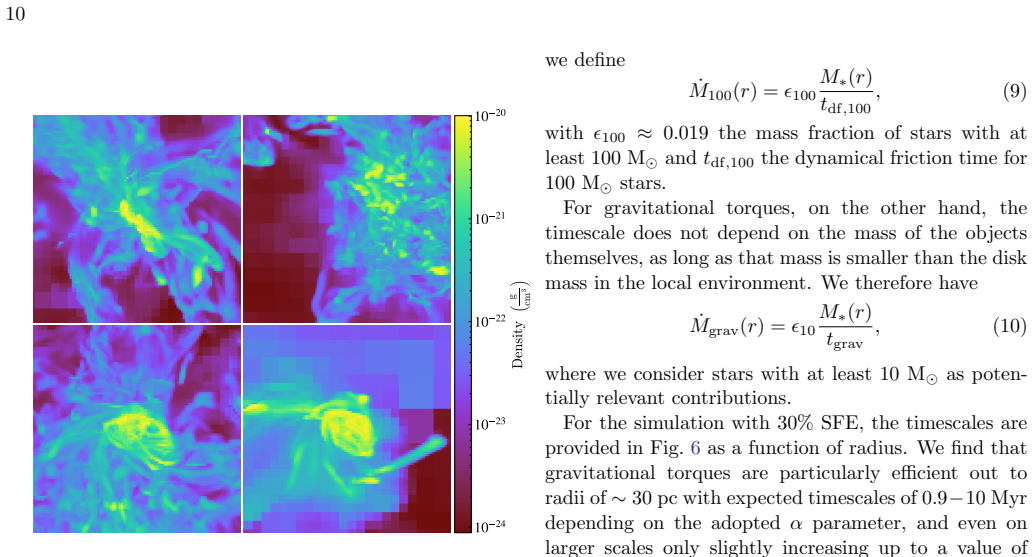
The recent discovery of Little Red Dots (LRDs) by the James Webb Space Telescope has challenged traditional models of early galaxy and black hole co-evolution. The nature of these highly compact objects remains heavily debated, with explanations divided between dust-reddened active galactic nuclei (AGN) and extremely dense stellar populations. We perform high-resolution cosmological simulations to model the formation of LRD precursors. Motivated by recent high-redshift observations and theoretical results, we specifically explore environments characterized by high star formation efficiencies (30\% and 100\%) and confined feedback. Our simulations naturally produce highly compact galaxies with stellar masses of $10^7-6 \times 10^8 $\,M$_\odot$, with most of the mass concentrated within $200-300$ pc. We find that, in these dense environments, gas inflows, gravitational torques, and stellar dynamical friction operate on highly efficient timescales. Over a 10 Myr timescale, gas inflows can accumulate $\rm \sim 10^7 M_\odot$ at the galactic center, while gravitational torques and dynamical friction can contribute an additional $10^5-10^9$\,M$_\odot$ and $10^3-10^4$\, M$_\odot$ through the inward migration of massive stars. Assuming a conservative 10\% efficiency to account for feedback, this rapid mass accumulation can lead to the formation of a $\sim 10^6$\,M$_\odot$ central black hole, naturally giving rise to an AGN in these dense systems. Therefore, stellar and AGN interpretations of LRDs may not be mutually exclusive; rather, dense stellar systems are likely precursors to AGN.
Editorial analysis
A structured set of objections, weighed in public.
Referee Report
Summary. The manuscript uses high-resolution cosmological simulations to model the formation of Little Red Dot (LRD) progenitors in high-redshift environments with imposed star formation efficiencies of 30% and 100% and confined feedback. These runs produce compact galaxies (stellar masses 10^7–6×10^8 M_⊙ within 200–300 pc) in which gas inflows (~10^7 M_⊙), gravitational torques (10^5–10^9 M_⊙), and dynamical friction (10^3–10^4 M_⊙) over 10 Myr enable central mass accumulation; scaling by a conservative 10% efficiency then yields a ~10^6 M_⊙ black hole, positioning dense stellar systems as natural precursors to early AGN and suggesting the stellar and AGN interpretations of LRDs are not mutually exclusive.
Significance. If the chosen efficiencies and feedback confinement are realized at high redshift, the work supplies a concrete evolutionary channel linking compact starbursts to rapid central black-hole growth, offering a way to unify the two competing explanations for JWST-detected LRDs. The explicit quantification of multiple mass-transport channels (inflows, torques, friction) within a single simulation framework is a useful contribution to early galaxy–BH co-evolution models.
major comments (3)
- [Abstract] Abstract and setup description: the headline claim that rapid mass accumulation “naturally” produces a ~10^6 M_⊙ BH is conditional on the imposed star-formation efficiencies of 30% and 100% plus confined feedback; these values are load-bearing for all quoted mass budgets, yet the manuscript supplies neither a sensitivity study nor a direct comparison to standard sub-grid efficiencies (typically ≪10%) that would be required to test whether the pathway survives under more conventional assumptions.
- [Methods] Simulation description (throughout): no resolution, particle/mass resolution, convergence tests, or code reference is provided; without these, the reported gas-inflow, torque, and dynamical-friction rates cannot be assessed for numerical robustness and remain unreproducible.
- [Results] Results on mass accumulation: the 10% efficiency scaling to ~10^6 M_⊙ is introduced without derivation or variation; if this factor is varied by even a factor of a few, the final BH mass falls below the threshold needed to “naturally give rise to an AGN,” undermining the central interpretive claim.
minor comments (2)
- [Abstract] Abstract: inconsistent LaTeX formatting for solar masses (M_⊙ vs M$_\\,odot$); standardize notation.
- [Introduction] The motivation section should include explicit citations to the “recent high-redshift observations” invoked to justify the 30–100% efficiencies.
Simulated Author's Rebuttal
We thank the referee for their detailed and constructive report. We address each of the major comments below and indicate where revisions will be made to the manuscript.
read point-by-point responses
-
Referee: [Abstract] Abstract and setup description: the headline claim that rapid mass accumulation “naturally” produces a ~10^6 M_⊙ BH is conditional on the imposed star-formation efficiencies of 30% and 100% plus confined feedback; these values are load-bearing for all quoted mass budgets, yet the manuscript supplies neither a sensitivity study nor a direct comparison to standard sub-grid efficiencies (typically ≪10%) that would be required to test whether the pathway survives under more conventional assumptions.
Authors: The chosen efficiencies are motivated by recent high-redshift observations and theoretical results indicating elevated star formation in dense, high-z environments. We agree that the results are conditional on these parameters. While a full sensitivity study is beyond the current scope, we will revise the manuscript to include a more detailed justification of these choices in the methods section and add a discussion paragraph addressing the impact of lower efficiencies on the mass accumulation and the resulting black hole mass. revision: partial
-
Referee: [Methods] Simulation description (throughout): no resolution, particle/mass resolution, convergence tests, or code reference is provided; without these, the reported gas-inflow, torque, and dynamical-friction rates cannot be assessed for numerical robustness and remain unreproducible.
Authors: We acknowledge this omission in the presentation. The simulations were performed with a specific high-resolution cosmological code, and resolution details along with convergence tests were conducted but not explicitly detailed in the text. In the revised version, we will add a dedicated subsection in the methods describing the code reference, particle and mass resolutions, spatial resolution, and summarize the convergence tests performed to ensure the robustness of the reported mass transport rates. revision: yes
-
Referee: [Results] Results on mass accumulation: the 10% efficiency scaling to ~10^6 M_⊙ is introduced without derivation or variation; if this factor is varied by even a factor of a few, the final BH mass falls below the threshold needed to “naturally give rise to an AGN,” undermining the central interpretive claim.
Authors: The 10% efficiency is introduced as a conservative estimate to account for feedback effects, consistent with literature on black hole accretion efficiency. We will revise the results section to provide a brief derivation or reference for this value and include a short discussion on how the final black hole mass scales with this efficiency factor, noting the conditions under which the AGN formation threshold is met. revision: partial
Circularity Check
No significant circularity; results emerge from simulations with externally motivated parameters.
full rationale
The paper's derivation consists of running cosmological simulations under explicitly chosen conditions (SFE of 30% or 100% plus confined feedback, motivated by observations) that produce compact stellar distributions and central mass inflows as direct outputs. The subsequent scaling to a ~10^6 M_⊙ black hole applies an independent conservative 10% efficiency assumption to those simulation-derived masses. No step reduces by the paper's own equations to a quantity defined in terms of itself, no fitted input is relabeled as a prediction, and no load-bearing self-citation chain is present. The central claim remains conditional on the stated parameter regime rather than tautological.
Axiom & Free-Parameter Ledger
free parameters (2)
- star formation efficiency =
30% and 100%
- feedback efficiency =
10%
axioms (1)
- domain assumption High-resolution cosmological simulations accurately capture gas inflows, gravitational torques, and stellar dynamical friction on the stated timescales in dense environments
Reference graph
Works this paper leans on
-
[1]
Akins, H. B., Casey, C. M., Lambrides, E., et al. 2024, arXiv e-prints, arXiv:2406.10341, doi: 10.48550/arXiv.2406.10341
-
[2]
Anninos, P., Zhang, Y., Abel, T., & Norman, M. L. 1997, New Astronomy, 2, 209, doi: 10.1016/S1384-1076(97)00009-2
-
[3]
Arca-Sedda, M., Kamlah, A. W. H., Spurzem, R., et al. 2024, Monthly Notices of the Royal Astronomical Society, 528, 5119, doi: 10.1093/mnras/stad3952 Astropy Collaboration, Robitaille, T. P., Tollerud, E. J., et al. 2013, A&A, 558, A33, doi: 10.1051/0004-6361/201322068 Astropy Collaboration, Price-Whelan, A. M., Sip˝ ocz, B. M., et al. 2018, AJ, 156, 123,...
-
[4]
Baggen, J. F. W., Scoggins, M. T., van Dokkum, P., et al. 2026, arXiv e-prints, arXiv:2602.02702, doi: 10.48550/arXiv.2602.02702
work page internal anchor Pith review Pith/arXiv arXiv doi:10.48550/arxiv.2602.02702 2026
-
[5]
Baggen, J. F. W., van Dokkum, P., Labb´ e, I., et al. 2023, ApJL, 955, L12, doi: 10.3847/2041-8213/acf5ef
-
[6]
Begelman, M. C. 2010, MNRAS, 402, 673, doi: 10.1111/j.1365-2966.2009.15916.x
-
[7]
Begelman, M. C., & Silk, J. 2023, MNRAS, 526, L94, doi: 10.1093/mnrasl/slad124
-
[8]
Behroozi, P. S., Wechsler, R. H., & Wu, H.-Y. 2013, ApJ, 762, 109, doi: 10.1088/0004-637X/762/2/109
work page internal anchor Pith review doi:10.1088/0004-637x/762/2/109 2013
-
[9]
Boekholt, T. C. N., Schleicher, D. R. G., Fellhauer, M., et al. 2018, MNRAS, 476, 366, doi: 10.1093/mnras/sty208
-
[10]
2003, ApJ, 596, 34, doi: 10.1086/377529
Bromm, V., & Loeb, A. 2003, ApJ, 596, 34, doi: 10.1086/377529
-
[11]
Bryan, G. L., Norman, M. L., O’Shea, B. W., et al. 2014, ApJS, 211, 19, doi: 10.1088/0067-0049/211/2/19
-
[12]
Cen, R., & Ostriker, J. P. 1992, ApJL, 399, L113, doi: 10.1086/186620
-
[13]
Ceverino, D., Klypin, A., Klimek, E. S., et al. 2014, MNRAS, 442, 1545, doi: 10.1093/mnras/stu956
-
[14]
2020, MNRAS, 494, 2851, doi: 10.1093/mnras/staa863
Chon, S., & Omukai, K. 2020, MNRAS, 494, 2851, doi: 10.1093/mnras/staa863
-
[15]
2025, MNRAS, 539, 2561, doi: 10.1093/mnras/staf598
Chon, S., & Omukai, K. 2025, MNRAS, 539, 2561, doi: 10.1093/mnras/staf598
-
[16]
Chworowsky, K., Finkelstein, S. L., Boylan-Kolchin, M., et al. 2024, AJ, 168, 113, doi: 10.3847/1538-3881/ad57c1
-
[17]
Das, A., Schleicher, D. R. G., Basu, S., & Boekholt, T. C. N. 2021a, MNRAS, 505, 2186, doi: 10.1093/mnras/stab1428
-
[18]
Das, A., Schleicher, D. R. G., Leigh, N. W. C., & Boekholt, T. C. N. 2021b, MNRAS, 503, 1051, doi: 10.1093/mnras/stab402
-
[19]
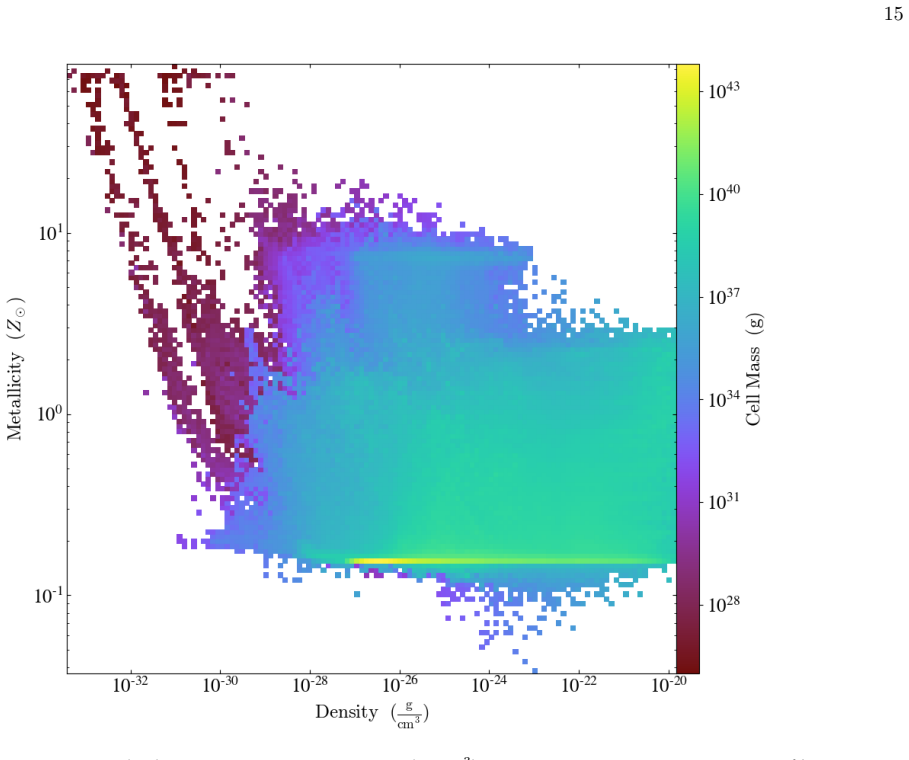
DeGraf, C., Dekel, A., Gabor, J., & Bournaud, F. 2017, Monthly Notices of the Royal Astronomical Society, 466, 1462, doi: 10.1093/mnras/stw2777 15 Figure 10.Gas metallicity (Z ⊙) as a function of gas density (g cm −3) for the feedback run with SFE = 30%. The color bar denotes the total gas cell mass. The presence of highly metal-enriched gas at very low d...
-
[20]
Li, Z. 2023, MNRAS, 523, 3201, doi: 10.1093/mnras/stad1557
-
[21]
2025, arXiv e-prints, arXiv:2511.07578, doi: 10.48550/arXiv.2511.07578 D´ ıaz, V
Dekel, A., Dutta Chowdhury, D., Lapiner, S., et al. 2025, arXiv e-prints, arXiv:2511.07578, doi: 10.48550/arXiv.2511.07578 D´ ıaz, V. B., Schleicher, D. R. G., Latif, M. A., Grete, P., &
-
[22]
2024, A&A, 684, A195, doi: 10.1051/0004-6361/202347783
Banerjee, R. 2024, A&A, 684, A195, doi: 10.1051/0004-6361/202347783
-
[23]
Eisenstein, D. J., Johnson, B. D., Robertson, B., et al. 2025, ApJS, 281, 50, doi: 10.3847/1538-4365/ae1137
-
[24]
J., Willott, C., Alberts, S., et al
Eisenstein, D. J., Willott, C., Alberts, S., et al. 2026, ApJS, 283, 6, doi: 10.3847/1538-4365/ae3163
-
[25]
2006, ApJL, 648, L13, doi: 10.1086/507988
Escala, A. 2006, ApJL, 648, L13, doi: 10.1086/507988
-
[26]
2007, ApJ, 671, 1264, doi: 10.1086/523092
Escala, A. 2007, ApJ, 671, 1264, doi: 10.1086/523092
-
[27]
2021, ApJ, 908, 57, doi: 10.3847/1538-4357/abd93c
Escala, A. 2021, ApJ, 908, 57, doi: 10.3847/1538-4357/abd93c
-
[28]
2025, ApJ, 995, 44, doi: 10.3847/1538-4357/ae200e
Escala, A., Zimmermann, L., Valdebenito, S., et al. 2025, ApJ, 995, 44, doi: 10.3847/1538-4357/ae200e
-
[29]
J., Zitrin, A., Plat, A., et al
Furtak, L. J., Zitrin, A., Plat, A., et al. 2023, ApJ, 952, 142, doi: 10.3847/1538-4357/acdc9d
-
[30]
Gaete, B., Schleicher, D. R. G., Lupi, A., et al. 2024, A&A, 690, A378, doi: 10.1051/0004-6361/202450770
-
[31]
Gammie, C. F. 2001, ApJ, 553, 174, doi: 10.1086/320631
-
[32]
Glover, S. C. O., & Jappsen, A.-K. 2007, ApJ, 666, 1, doi: 10.1086/519445
-
[33]
Greene, J. E., Labbe, I., Goulding, A. D., et al. 2024, ApJ, 964, 39, doi: 10.3847/1538-4357/ad1e5f
-
[34]
A., Pacucci, F., & Kocevski, D
Guia, C. A., Pacucci, F., & Kocevski, D. D. 2024, Research Notes of the American Astronomical Society, 8, 207, doi: 10.3847/2515-5172/ad7262 Haemmerl´ e, L. 2020, A&A, 644, A154, doi: 10.1051/0004-6361/202039828
-
[35]
Hahn, O., & Abel, T. 2011, MNRAS, 415, 2101, doi: 10.1111/j.1365-2966.2011.18820.x
-
[36]
2018, MNRAS, 478, 4799, doi: 10.1093/mnras/sty1315
Haid, S., Walch, S., Seifried, D., et al. 2018, MNRAS, 478, 4799, doi: 10.1093/mnras/sty1315
-
[37]
Hopkins, P. F., & Quataert, E. 2011, MNRAS, 415, 1027, doi: 10.1111/j.1365-2966.2011.18542.x 16
-
[38]
2014, MNRAS, 445, 1549, doi: 10.1093/mnras/stu1870
Inayoshi, K., & Haiman, Z. 2014, MNRAS, 445, 1549, doi: 10.1093/mnras/stu1870
-
[39]
Kim, J.-G., Kim, W.-T., & Ostriker, E. C. 2018, ApJ, 859, 68, doi: 10.3847/1538-4357/aabe27
-
[40]
Kim, J.-h., Wise, J. H., Alvarez, M. A., & Abel, T. 2011, ApJ, 738, 54, doi: 10.1088/0004-637X/738/1/54
-
[41]
D., Onoue, M., Inayoshi, K., et al
Kocevski, D. D., Onoue, M., Inayoshi, K., et al. 2023, ApJL, 954, L4, doi: 10.3847/2041-8213/ace5a0
-
[42]
2001, MNRAS, 322, 231, doi: 10.1046/j.1365-8711.2001.04022.x
Kroupa, P. 2001, MNRAS, 322, 231, doi: 10.1046/j.1365-8711.2001.04022.x
-
[43]
2020, MNRAS, 498, 5652, doi: 10.1093/mnras/staa2276
Kroupa, P., Subr, L., Jerabkova, T., & Wang, L. 2020, MNRAS, 498, 5652, doi: 10.1093/mnras/staa2276
-
[44]
LaChance, P., Bhowmick, A. K., Croft, R. A. C., et al. 2025, arXiv e-prints, doi: 10.48550/arXiv.2512.13957
-
[45]
LaChance, P., Croft, R. A. C., Di Matteo, T., et al. 2026, The Open Journal of Astrophysics, 9, doi: 10.33232/001c.155493
-
[46]
Lancaster, L., Ostriker, E. C., Kim, J.-G., & Kim, C.-G. 2021, ApJ, 914, 90, doi: 10.3847/1538-4357/abf8ac
-
[47]
2023, MNRAS, 522, 4515, doi: 10.1093/mnras/stad1263
Lapiner, S., Dekel, A., Freundlich, J., et al. 2023, MNRAS, 522, 4515, doi: 10.1093/mnras/stad1263
-
[48]
Latif, M. A., & Khochfar, S. 2020, MNRAS, 497, 3761, doi: 10.1093/mnras/staa2218
-
[49]
Latif, M. A., & Schleicher, D. R. G. 2015, A&A, 578, A118, doi: 10.1051/0004-6361/201525855
-
[50]
Latif, M. A., & Schleicher, D. R. G. 2016, A&A, 585, A151, doi: 10.1051/0004-6361/201527266
-
[51]
Latif, M. A., & Schleicher, D. R. G. 2023, ApJL, 952, L9, doi: 10.3847/2041-8213/ace34f
-
[52]
Latif, M. A., Schleicher, D. R. G., & Khochfar, S. 2023, ApJ, 945, 137, doi: 10.3847/1538-4357/acbcc2
-
[53]
2013a, MNRAS, 433, 1607, doi: 10.1093/mnras/stt834
Niemeyer, J. 2013a, MNRAS, 433, 1607, doi: 10.1093/mnras/stt834
-
[54]
Niemeyer, J. C. 2013b, MNRAS, 436, 2989, doi: 10.1093/mnras/stt1786
-
[55]
How Overmassive Black Holes Formed at Cosmic Dawn
Latif, M. A., Whalen, D. J., Khochfar, S., & Cullen, F. 2026, arXiv e-prints, arXiv:2603.28682, doi: 10.48550/arXiv.2603.28682
work page internal anchor Pith review Pith/arXiv arXiv doi:10.48550/arxiv.2603.28682 2026
-
[57]
Latif, M. A., Whalen, D. J., Khochfar, S., Herrington, N. P., & Woods, T. E. 2022b, Nature, 607, 48, doi: 10.1038/s41586-022-04813-y
-
[58]
Vergara, M. C. 2025, A&A, 694, A42, doi: 10.1051/0004-6361/202451672
-
[59]
Liempi, M., Schleicher, D. R. G., Latif, M. A., et al. 2026, arXiv e-prints, arXiv:2602.21002, doi: 10.48550/arXiv.2602.21002
-
[60]
2014, MNRAS, 442, 3616, doi: 10.1093/mnras/stu1120
Lupi, A., Colpi, M., Devecchi, B., Galanti, G., & Volonteri, M. 2014, MNRAS, 442, 3616, doi: 10.1093/mnras/stu1120
-
[61]
Lynden-Bell, D., & Kalnajs, A. J. 1972, MNRAS, 157, 1, doi: 10.1093/mnras/157.1.1
-
[62]
Matthee, J., Naidu, R. P., Brammer, G., et al. 2024, ApJ, 963, 129, doi: 10.3847/1538-4357/ad2345
-
[63]
Mayer, L., Capelo, P. R., Zwick, L., & Di Matteo, T. 2024, ApJ, 961, 76, doi: 10.3847/1538-4357/ad11cf
-
[64]
H., Burkhart, B., Somerville, R
Menon, S. H., Burkhart, B., Somerville, R. S., Thompson, T. A., & Sternberg, A. 2025, ApJ, 987, 12, doi: 10.3847/1538-4357/add2f9
-
[65]
Nagamine, K., Springel, V., & Hernquist, L. 2004, MNRAS, 348, 435, doi: 10.1111/j.1365-2966.2004.07180.x
-
[66]
2026, ApJ, 998, 124, doi: 10.3847/1538-4357/ae32f3
Nandal, D., & Loeb, A. 2026, ApJ, 998, 124, doi: 10.3847/1538-4357/ae32f3
-
[67]
2025, ApJ, 994, 40, doi: 10.3847/1538-4357/ae1619
Pacucci, F., Hernquist, L., & Fujii, M. 2025, ApJ, 994, 40, doi: 10.3847/1538-4357/ae1619
-
[68]
2024, ApJ, 976, 96, doi: 10.3847/1538-4357/ad84f7 Planck Collaboration, Ade, P
Pacucci, F., & Narayan, R. 2024, ApJ, 976, 96, doi: 10.3847/1538-4357/ad84f7 Planck Collaboration, Ade, P. A. R., Aghanim, N., et al. 2016, A&A, 594, A13, doi: 10.1051/0004-6361/201525830 Portegies Zwart, S. F., Baumgardt, H., Hut, P., Makino, J., & McMillan, S. L. W. 2004, Nature, 428, 724, doi: 10.1038/nature02448
-
[69]
Rantala, A., Lah´ en, N., Naab, T., Escobar, G. J., & Iorio, G. 2025, MNRAS, 543, 2130, doi: 10.1093/mnras/staf1519
-
[70]
2024, MNRAS, 531, 3770, doi: 10.1093/mnras/stae1413
Rantala, A., Naab, T., & Lah´ en, N. 2024, MNRAS, 531, 3770, doi: 10.1093/mnras/stae1413
-
[71]
2026, arXiv e-prints, arXiv:2601.07917, doi: 10.48550/arXiv.2601.07917
Rantala, A., Naab, T., Lah´ en, N., et al. 2026, arXiv e-prints, arXiv:2601.07917, doi: 10.48550/arXiv.2601.07917
-
[72]
Reinoso, B., Klessen, R. S., Schleicher, D., Glover, S. C. O., & Solar, P. 2023, MNRAS, 521, 3553, doi: 10.1093/mnras/stad790
-
[73]
Reinoso, B., Latif, M. A., & Schleicher, D. R. G. 2025, A&A, 700, A66, doi: 10.1051/0004-6361/202554762
-
[74]
Reinoso, B., Schleicher, D. R. G., Fellhauer, M., Klessen, R. S., & Boekholt, T. C. N. 2018, A&A, 614, A14, doi: 10.1051/0004-6361/201732224
-
[75]
P., Naab, T., Rantala, A., et al
Rizzuto, F. P., Naab, T., Rantala, A., et al. 2023, Monthly Notices of the Royal Astronomical Society, 521, 2930, doi: 10.1093/mnras/stad734
-
[76]
Rusakov, V., Watson, D., Nikopoulos, G. P., et al. 2026, Nature, 649, 574, doi: 10.1038/s41586-025-09900-4 17
-
[77]
Saavedra-Bastidas, J., Schleicher, D. R. G., Klessen, R. S., et al. 2024, A&A, 690, A186, doi: 10.1051/0004-6361/202450409
-
[78]
Sakurai, Y., Yoshida, N., & Fujii, M. S. 2019, MNRAS, 484, 4665, doi: 10.1093/mnras/stz315
-
[79]
2013, A&A, 558, A59, doi: 10.1051/0004-6361/201321949
Latif, M. 2013, A&A, 558, A59, doi: 10.1051/0004-6361/201321949
-
[80]
Schleicher, D. R. G., Reinoso, B., & Klessen, R. S. 2023, MNRAS, 521, 3972, doi: 10.1093/mnras/stad807
-
[81]
Schleicher, D. R. G., Reinoso, B., Latif, M., et al. 2022, MNRAS, 512, 6192, doi: 10.1093/mnras/stac926
discussion (0)
Sign in with ORCID, Apple, or X to comment. Anyone can read and Pith papers without signing in.