REVIEW 5 major objections 5 minor 4 cited by
The Mpemba effect in one-dimensional thermal relaxation is driven by boundaries, not by the shape of the potential landscape.
Reviewed by Pith at T0; open to challenge. T0 means a machine referee read the full paper against a public rubric. the ladder, T0–T4 →
T0 review · deepseek-v4-flash
2026-08-02 12:29 UTC pith:2OL3TFTA
load-bearing objection Solid spectral analysis with an exact solvable piecewise model, but the headline 'boundaries, not internal structure' claim is undercut by the paper's own symmetric double-well examples. the 5 major comments →
Predicting the conditions for observing the Mpemba effect
The pith
A machine-rendered reading of the paper's core claim, the machinery that carries it, and where it could break.
Core claim
The central claim is that boundaries, not the internal structure of the potential, control the Mpemba effect in overdamped Langevin systems. In the low-temperature limit the derivative of the first excited left eigenmode acts as a downward Dirac delta peak located at the potential minimum (single well) or saddle (double well). Consequently the overlap coefficient a2 that controls the slowest relaxation reduces, up to a constant, to the cumulative probability Π(x*,β_i) of finding the initial equilibrium distribution to the left of that point. The Mpemba effect then appears when this cumulative probability is non-monotonic in the initial temperature, and a wall is the generic ingredient that m
What carries the argument
The load-bearing object is the first nontrivial left eigenmode ℓ2(x) of the adjoint Fokker-Planck operator, whose derivative is shown to be sharply localized at the potential minimum or saddle in the low-bath-temperature regime. With that delta-peak property, the overlap coefficient a2 = ∫ℓ2(x)π(x,β_i)dx becomes a2 ≈ C + Π(x*,β_i), where Π is the cumulative equilibrium probability to the left of x*. The criterion ∂a2/∂β_i = 0, which defines the Mpemba temperature, is therefore read off from how the population on one side of x* varies with initial temperature; a wall reverses that population flow at high temperature. For symmetric potentials, parity forces a2 = 0 and the leading coefficient a
Load-bearing premise
The derivations assume that at low bath temperature the first excited left eigenmode is a sharp step with a transition width w(T) that vanishes as T→0, so that its derivative is a Dirac delta peak; the paper establishes this by a scaling argument and numerical checks, not by a proof, and every classification result that reduces a2 to a cumulative probability inherits this assumption.
What would settle it
Numerically diagonalize the Fokker-Planck operator for an asymmetric single-well potential with unbounded x^4 growth and no wall (e.g., V = x^4 + x^3 + 0.3x^2) and plot the overlap coefficient a2 as a function of initial inverse temperature β_i. The paper predicts ∂a2/∂β_i has no zero for any β_i; observing even one finite zero would falsify the no-wall part of the classification. Independently, measuring the width of the transition layer of ℓ2 at decreasing bath temperatures and finding that it saturates at a finite value would falsify the delta-peak assumption.
If this is right
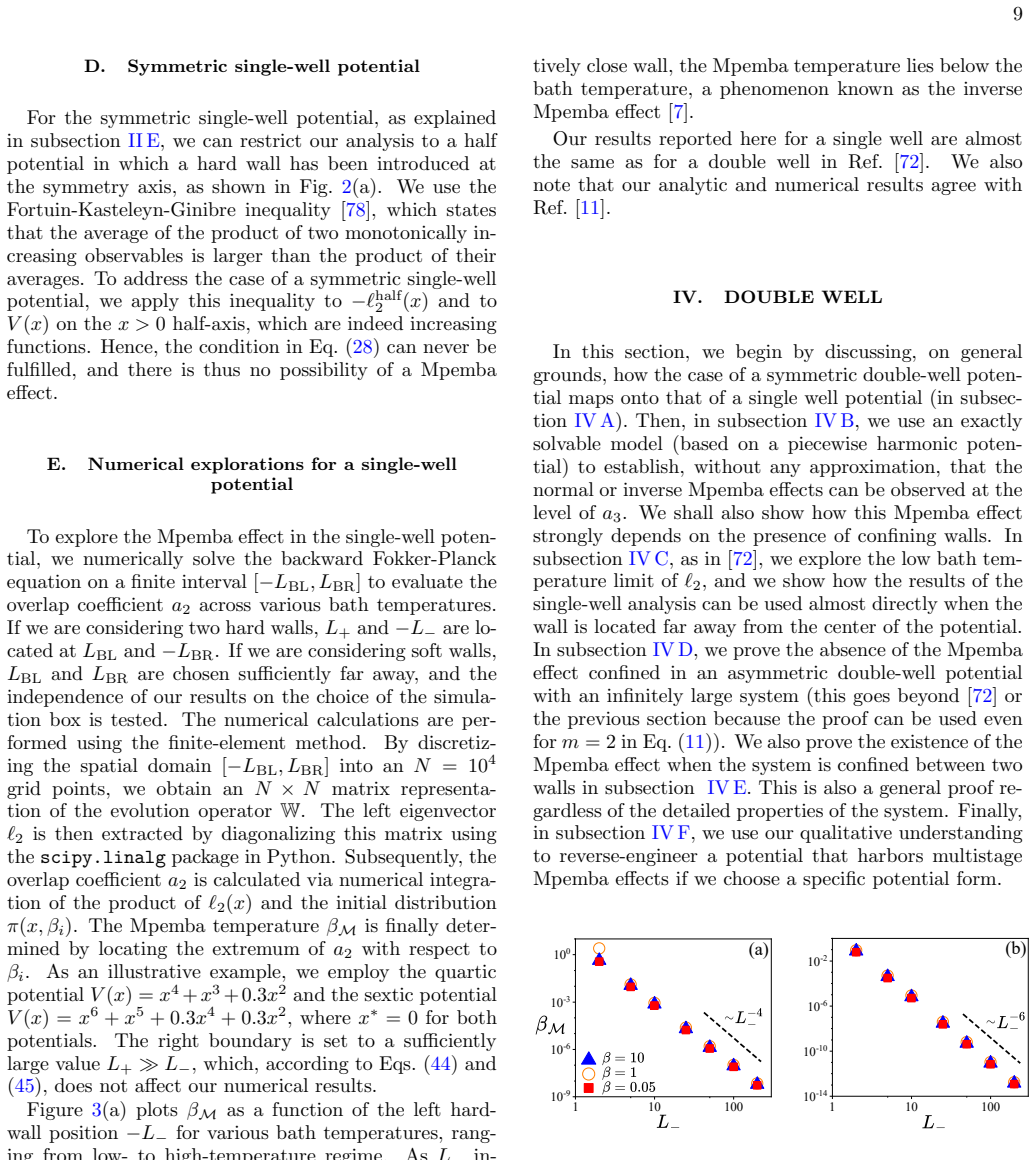
- In an asymmetric single well, the Mpemba effect appears only when at least one boundary is present; for a polynomial potential with distant walls the Mpemba inverse temperature scales as β_M ~ ln(L_-)/L_-^m, vanishing as the wall moves to infinity.
- Soft walls—regions where the potential grows with a higher power q than its bulk power m—act like hard walls, producing the same scaling, while a pure power-law tail (q=m) gives no effect.
- Symmetric single-well potentials never exhibit the effect, because a correlation inequality for monotone observables prevents the relevant coefficient from becoming non-monotonic.
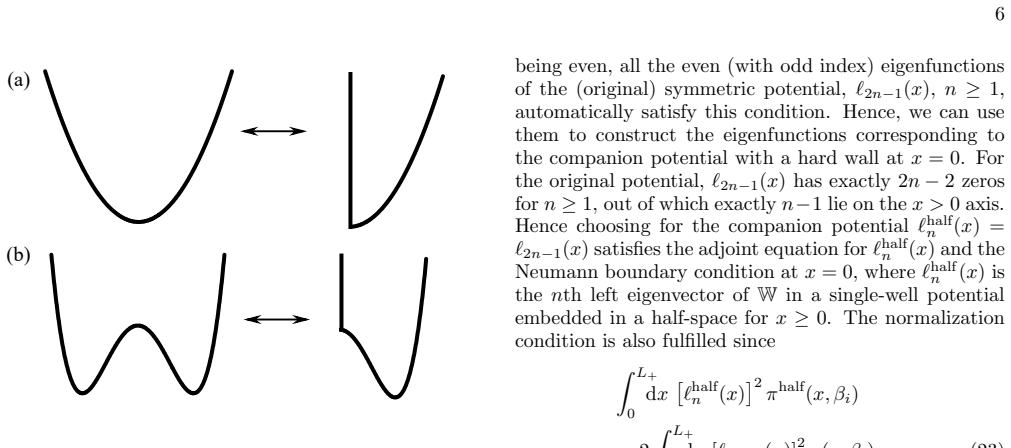
- Symmetric double-well potentials can exhibit the effect even without walls through the third eigenmode, and this is exactly the a2 effect of an asymmetric single-well system with a wall at the symmetry axis.
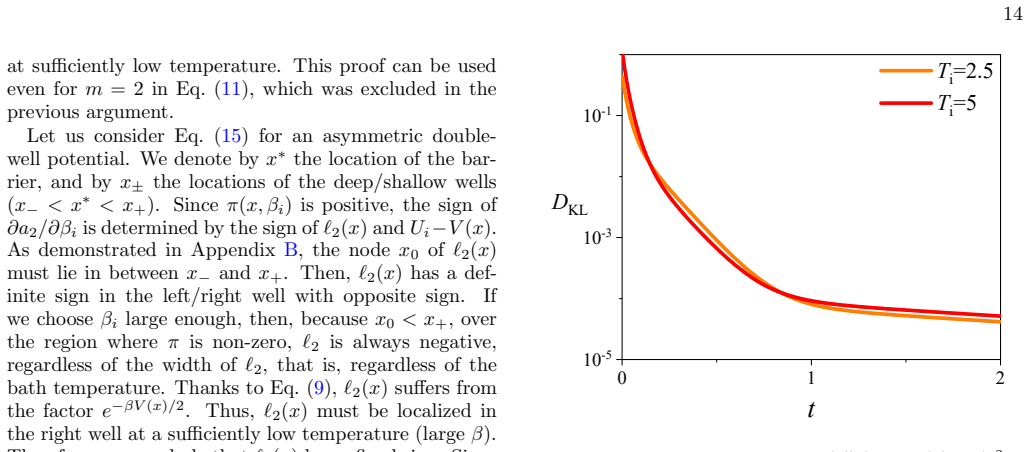
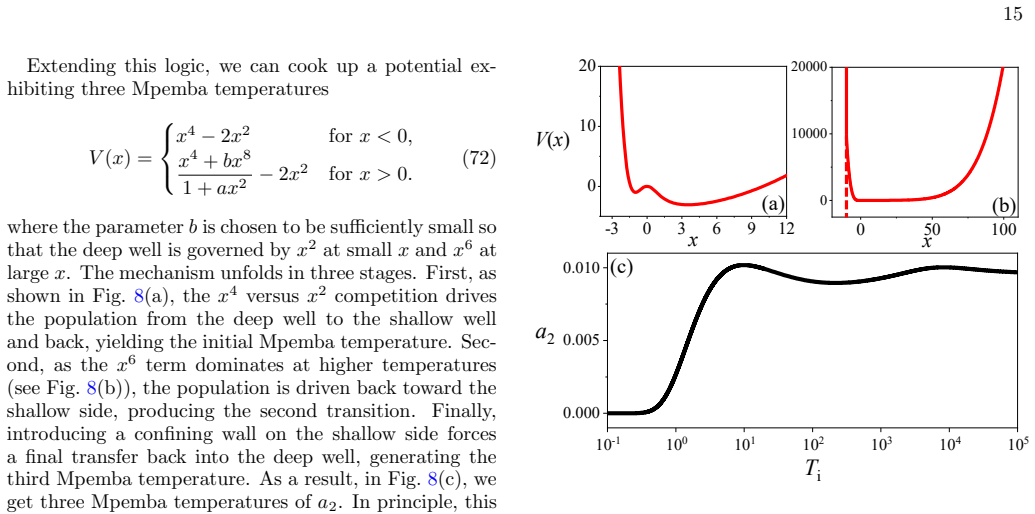
- An asymmetric double well with no confining walls has no Mpemba effect for cold initial conditions; placing a wall on the shallow side guarantees at least one Mpemba temperature, and nested power-law regions can be engineered to produce many successive Mpemba temperatures.
Where Pith is reading between the lines
- An implication the authors leave implicit: since soft walls are sufficient, a localized steepening of the potential—rather than a literal impenetrable boundary—should be enough to trigger the effect; this makes the prediction checkable in optical or microfluidic traps without hard confinement.
- If the cumulative-probability criterion is the true mechanism, it suggests a direct experimental diagnostic: measure the fraction of particles on the shallow side of the potential minimum or saddle as a function of initial temperature; whenever that fraction is non-monotonic, an Mpemba crossing should follow.
- The multistage recipe points to a general design rule: any potential built from a hierarchy of power-law sectors with increasing exponents on alternating sides should produce one Mpemba temperature per sector boundary, which could be tested numerically by scanning the coefficients in the engineered potential.
- The paper's classification is stated for one dimension; a likely but unproven extension is that radially symmetric higher-dimensional potentials reduce to these 1D cases through the radial coordinate, with the outer boundary playing the role of the wall.
Editorial analysis
A structured set of objections, weighed in public.
Referee Report
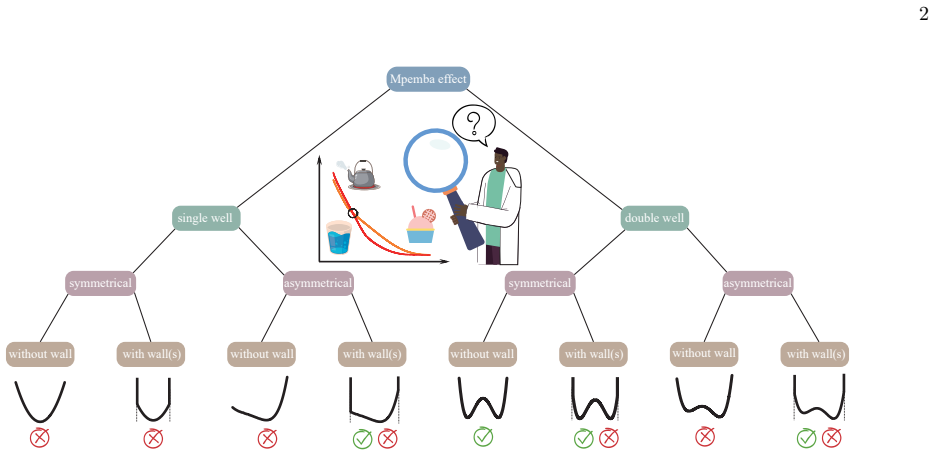
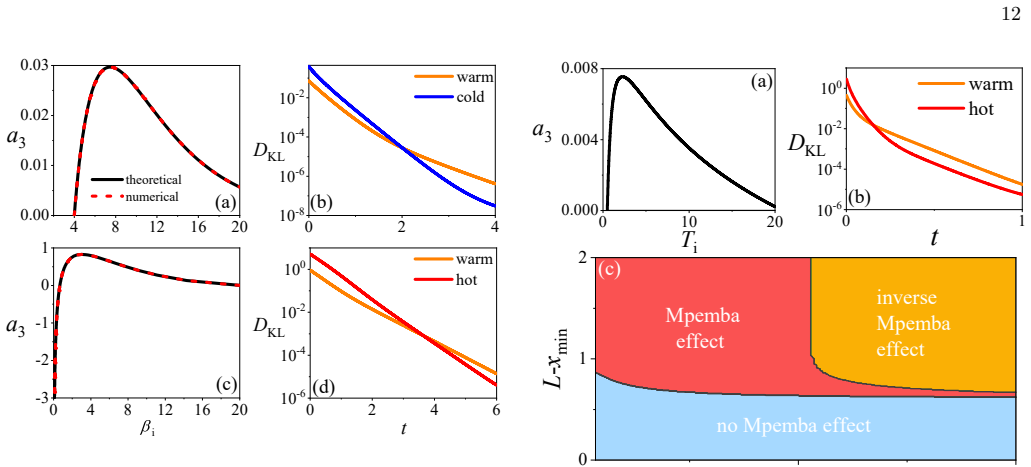
Summary. The paper studies the Mpemba effect in one-dimensional overdamped Langevin dynamics with equilibrium initial conditions. It uses a spectral decomposition of the Fokker–Planck operator and argues that, in the low-bath-temperature regime, the derivative of the first excited left eigenmode is approximately a downward Dirac delta peak centered at the potential minimum (single well) or the barrier (double well). This ansatz reduces the initial-condition overlap coefficient a2 to a cumulative probability (Eq. 22), and the paper derives conditions for a non-monotonic a2(β_i), i.e., for the existence of a Mpemba temperature. The main classification (Fig. 1) covers single- and double-well potentials, symmetric and asymmetric, with and without hard/soft walls. The authors claim that the effect is primarily driven by boundaries (hard or soft) rather than by internal structure such as metastability or the number of minima. They support this with a scaling law β_M ∝ ln L_-/L_-^m for single wells, an exact piecewise-harmonic solution for a symmetric double-well exhibiting the effect through a3, numerical phase diagrams, and an engineered potential with three Mpemba temperatures.
Significance. The paper contains several valuable technical contributions: the exact piecewise-harmonic solution in Sec. IVB, the numerical phase diagrams in Figs. 3–6, the explicit scaling law of Eq. (45), and the demonstration of a multistage Mpemba effect in Sec. IVF. If the classification is correct, it would provide a useful predictive framework for designing potentials that exhibit the Mpemba effect. However, the paper's central explanatory claim—that boundaries are the primary driver, rather than internal landscape structure—is not supported by the paper's own symmetric double-well examples, in which the effect appears in unbounded potentials through the internal barrier. In addition, the proof in Sec. IVE/Appendix F establishes a zero of an energy difference, not directly of ∂a2/∂β_i, and the gap to the actual Mpemba condition is only bridged by the unproven step-function approximation. The paper is likely publishable after major revision, but the abstract and conclusions currently overstate the strength and universality of the findings.
major comments (5)
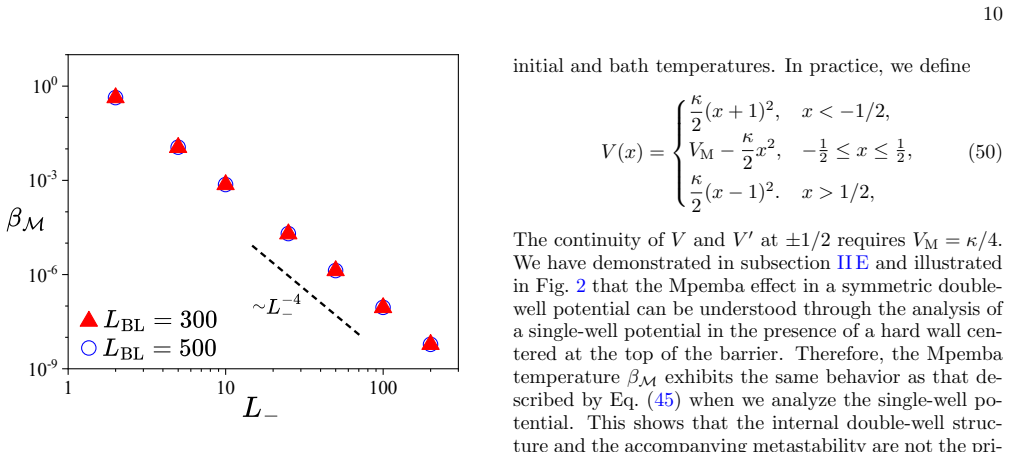
- [Abstract, Sec. V, Sec. IVB, Fig. 6] The central claim that the Mpemba effect is 'primarily driven by the presence of boundaries, either hard or soft, rather than the specific internal structure ... such as metastability or the number of minima' is contradicted by the paper's own symmetric double-well results. In Sec. IVB, the piecewise-harmonic potential of Eq. (50) and the smooth quartic V(x)=(x^2-1)^2 both extend to ±∞ with no physical boundary, yet the paper demonstrates Mpemba effects via a3 (Figs. 5 and 6). The mapping in Eqs. (23)–(24) to a half-space companion with a hard wall at the symmetry plane is a mathematical identity between eigenfunctions; it does not imply that the original system contains a physical wall. The non-monotonic a3 is enabled by the internal barrier at x=0, i.e., by the double-well structure itself. The explanatory claim should be substantially revised or explicitly qualified.
- [Sec. IIB, Eq. (14); Sec. IVA] The paper defines the Mpemba effect through a2 and states that 'a necessary condition for observing the Mpemba effect ... is that the overlap coefficient a2 must exhibit a non-monotonic behavior.' However, for symmetric double-well potentials a2 vanishes identically, and the effect is driven by a3, as the paper itself demonstrates in Sec. IV. The definition and the necessary-condition statement are therefore only valid for asymmetric systems where a2 is the first nonzero coefficient. The framework should be generalized to the leading nonzero overlap coefficient, otherwise the logical connection between the definition and the later symmetric-double-well analysis is inconsistent.
- [Sec. IVE, Appendix F, Eq. (F2), Eq. (29)] Theorem 1 of Appendix F proves the existence of a zero of δU(β_i), the difference of mean energies on the two sides of the barrier. It does not prove the existence of a zero of ∂a2/∂β_i. The reduction of ∂a2/∂β_i=0 to U_-=U_+ relies on replacing ℓ2 by a step function (Eq. (29)), an approximation that has finite-width corrections controlled by no bound in the paper. Consequently, the statement that 'a wall on the shallower side guarantees at least one Mpemba temperature, even for m=2' is not established for the actual Fokker–Planck dynamics. A proof that ∂a2/∂β_i has the same sign as (U_- - U_+) up to a controllable error term, or an explicit low-temperature asymptotic result, is needed.
- [Fig. 1; Sec. IIIB, Eq. (44)] The classification in Fig. 1 marks 'asymmetric single well with wall(s)' as a guaranteed green checkmark. However, Sec. IIIB shows that the existence of β_M depends on the relative wall positions: the implicit equation (44) has no solution when L_+ ≤ L_-, and β_M tends to zero as L_- → ∞ even if the wall is present. Thus the 'guaranteed presence' in the decision tree is too strong. The paper itself notes sensitivity to wall location, but Fig. 1 does not encode this for single-well potentials. The classification should distinguish between 'wall present and positioned sufficiently far' and 'wall present but too close.'
- [Sec. IIIA, Eq. (26); Sec. IVC, Eq. (71)] The entire analytical classification rests on the low-temperature property that -∂_x ℓ2(x) ≃ δ(x-x*). The scaling argument in Sec. IIIA (w(T) ∼ T^{1/m'}) is suggestive and numerically supported, but it is not a rigorous proof, and it excludes the m=2 case. For double-well potentials, the width estimate uses Kramers' formula for λ2 in a self-consistency condition (Eq. (71)), not a theorem. Since the central reductions to Eq. (22) and the population-shift mechanism all assume this delta property, the paper should state the conditions under which the classification is proven and provide a more careful estimate of the finite-temperature corrections, or explicitly label those parts of the classification as low-temperature asymptotic predictions.
minor comments (5)
- [Sec. IIB, Eq. (14)] The definition of the Mpemba effect via |a2(β_i^h)| < |a2(β_i^c)| is stated only for the a2 coefficient; later the effect is identified through |a3| for symmetric double wells. Please define the effect for the leading nonzero coefficient and clarify that the condition on a2 applies only when a2 is nonzero.
- [Sec. IIIB, Eq. (29)] The equation 'U−p− − p−(U−p− + U+p+) = 0' is difficult to parse. After substituting the step function ℓ2 = θ(x*-x), the condition should reduce to p_- p_+ (U_- - U_+) = 0, i.e., U_- = U_+. Please rewrite the equation in a clearer form.
- [Sec. IIE, Eq. (23)] The sign convention for ℓ2 is stated as positive for x < x0 and negative for x > x0 (Sec. IIC), but the step approximation in Sec. IIIB uses ℓ2(x) ≃ θ(x*-x), which is positive on the left and zero on the right. To be consistent, define the plateau values and state whether the right plateau is zero or a constant C_+ that does not depend on β_i.
- [Sec. IIIE, Figs. 3 and 4] The text says the quartic potential is V(x)=x^4+x^3+0.3x^2, but the figures refer to V(x)∼x^4 and V(x)∼x^6. Clarify whether the figures use the full polynomial or only the leading term, and define the precise relationship between L_-, L_BL, L_+, and L_BR in the numerical setup.
- [Appendix B] Appendix B appears to be a self-contained note about a possible quadratic local profile of ℓ2 and its resolution. It is not referenced in the main text and seems tangential to the main argument. Either integrate it into the main text or remove it.
Circularity Check
No significant circularity: the predictions are derived from spectral analysis and exact solutions; self-citations are contextual and rederived.
full rationale
The central derivation chain is self-contained. The Mpemba condition is defined through the overlap coefficient a2, and the key input — the low-temperature step-function shape of ℓ2(x) with −∂xℓ2 ≈ δ(x−x*) — is obtained from a scaling argument (Sec. III A, w ∼ T^{1/m′}) and from a saddle-point/error-function calculation for the double well (Sec. IV C), not from the desired Mpemba condition. This input is then used in Eq. (22) to map a2 onto the cumulative probability Π(x*, βi); that is a derived asymptotic relation, not a fitted parameter renamed as a prediction. The piecewise-harmonic symmetric double well is solved exactly: the eigenvalues are fixed by the transcendental condition Eq. (57) and a3 is given in closed form, Eq. (64), with no fitting to the non-monotonicity. The scaling law βM ∝ ln L−/L−^m, Eq. (45), follows from the asymptotic analysis and is tested against independent finite-difference diagonalization. The mapping of symmetric potentials to half-space companions (Eqs. (23)-(24)) is an exact Sturm-Liouville identity and legitimately explains why a3 can play the role of a2^half. The caveat is interpretive rather than circular: for the symmetric double well V=(x^2−1)^2 (Fig. 6) there is no physical boundary, and the 'steep wall essential' wording in Sec. IV B refers to the wall inserted by the mapping at the symmetry plane; this is an overreach of the headline 'boundary-driven' claim but does not enter the derivation of the predicted coefficients. Self-citations [73] and [75] frame the work, but the paper rederives the double-well step-function argument, the no-wall absence proof (Sec. IV D) and the wall-presence existence proof (Sec. IV E) from the spectral problem, so the citations are not load-bearing. The admitted limitation in Sec. V — that only the necessary condition through a2 is treated and a sufficient condition would require a3 — is a scope statement, not circularity.
Axiom & Free-Parameter Ledger
axioms (5)
- standard math The Fokker-Planck operator can be mapped to a 1D Schrödinger operator with non-degenerate eigenvalues (Darboux transformation, Eqs. 6-8).
- domain assumption Initial states are Boltzmann equilibria π(x,β_i) and quenches are instantaneous; relaxation is monitored via KL divergence at late times.
- domain assumption In the low bath temperature regime, -∂_x ℓ2(x) ≈ δ(x-x*) with x* the minimum (single well) or saddle (double well); width w(T) → 0 as T→0 (Sec. II C-D, III A).
- domain assumption For double-well potentials at low bath temperature, λ2 ∝ e^{-βΔV_b} (Kramers) and the saddle-point expansion of ℓ2 around the barrier is valid (Eqs. 67-70).
- standard math FKG inequality is applicable to the half-space eigenfunction and potential (Sec. III D).
read the original abstract
The Mpemba effect, a counterintuitive phenomenon where a hotter system relaxes faster than a colder one, has been widely observed in various nonequilibrium systems. Despite this progress, the fundamental structural features of the energy landscape required for its emergence remain a subject of debate. In this study, we investigate the conditions for the Mpemba effect within one-dimensional overdamped Langevin dynamics. We classify the potential landscapes based on the presence of single or double wells, their symmetry properties, and the existence of walls. We establish that the existence of the effect is primarily driven by the presence of boundaries, either hard or soft, rather than the specific internal structure of the potential landscape, such as metastability or the number of minima. By employing a spectral decomposition of the Fokker-Planck operator, we analyze the behavior of the first nontrivial eigenmode and demonstrate that its derivative acts as a Dirac delta peak in the low-temperature regime. This helps us elucidate the mechanism underlying the Mpemba effect: it appears as the interplay between this behavior and the initial population dynamics in a non-trivial way induced by the presence of the wall. Our analysis provides a unified classification across single- and double-well potentials, highlighting the crucial role of boundary conditions and asymmetry. Furthermore, we demonstrate that this framework allows for the engineering of potential landscapes capable of producing multistage Mpemba transitions.
Figures



Forward citations
Cited by 4 Pith papers
-
Quantization of the classical Mpemba effect
Quantization of the classical bistable-potential Mpemba effect shifts anomalous relaxation to ultra-cold temperatures and produces inverse and double-inverse Mpemba effects absent in classical dynamics.
-
Quantum tunneling Mpemba effect
Non-monotonic a2(Ti) from Sturm-Liouville nodal alignment drives a size-independent quantum tunneling Mpemba effect under boundary absorption when over-barrier decay vastly outpaces the tunneling doublet.
-
Mpemba effect in a chemomechanical model of the Kinesin molecular motor
The Mpemba effect appears in Lipowsky’s six-state kinesin network under equilibrium and driven conditions, and motor velocity relaxation reproduces the anomalous spectral relaxation.
-
A closed system setting for quantum thermalisation in free fermions
In a closed tripartite free-fermion setup, the central subsystem relaxes to the bath temperature without the Mpemba effect, with the relaxation fully characterised by generalised hydrodynamics.
Reference graph
Works this paper leans on
-
[1]
(57) is automatically fulfilled
Inverse Mpemba effect To obtain analytical insight, we consider a special choice of parameter for which the eigenvalue can be found exactly, namely, for which the matching condition in Eq. (57) is automatically fulfilled. It turns out that im- posingβκ= 4 leads toν 2 = 1 and thus toλ 2 =κfor the single-well potential with a hard wall atx= 0. For this part...
-
[2]
(57) must be solved numerically
Mpemba effect for a quench to a lower temperature If we abandon the conditionβκ= 4 and work at an arbitrary bath temperature, no closed-form solution is readily available, and the eigenvalue problem in Eq. (57) must be solved numerically. In that case, we numeri- cally evaluate the overlap coefficienta 3 using the gen- eral expressions derived in subsecti...
-
[3]
Substituting V ′(x) =κxinto Eq
The harmonic potential benchmark (V(x)∼x 2) Let us consider a symmetric harmonic confinement defined byV(x) =κx 2/2 withκ >0. Substituting V ′(x) =κxinto Eq. (B1), we obtain T ℓ′′ 2 (x)−κxℓ ′ 2(x) +λ 2ℓ2(x) = 0.(B2) By introducing the dimensionless variableξ= x√ 2T /κ , Eq. (B2) can be transformed into Hermite’s differential equation: d2ℓ2 dξ2 −2ξ dℓ2 dξ ...
-
[4]
Resolution of the quadratic local profile in asymmetric potentials The quadratic formℓ 2(x)∼const. +Ax 2 obtained in the main text is a specific, local consequence of expand- ing around a weakly asymmetric double-well potential, rather than an intrinsic property of arbitrary potentials V(x). Consider a system where a reference potentialV 0(x) is purely sy...
-
[5]
Corre- spondingly,φ 1(x) and|φ 2(x)|are exponentially localized nearx=αin the right well, with only exponentially small weight in the left well
Low-temperature localization Asβ→ ∞, the right well, which contains the global minimum, dominates the Boltzmann weight. Corre- spondingly,φ 1(x) and|φ 2(x)|are exponentially localized nearx=αin the right well, with only exponentially small weight in the left well. In contrast, the eigenfunctionφ 2(x) must be orthogo- nal toφ 1(x): Z dxφ1(x)φ2(x) = 0.(D1) ...
-
[6]
Assume, for contradiction, thatx 0 ≤x −
Location of the node We now show that the unique nodex 0 ofφ 2(x) lies in the central region (x −, x+) for sufficiently largeβ. Assume, for contradiction, thatx 0 ≤x −. Thenφ 2(x) has a fixed sign throughout the central region and the right well. Sinceφ 1(x) is exponentially small in those regions, the orthogonality condition (D1) cannot be sat- isfied. S...
-
[7]
The left eigenfunction is ℓ2(x) = eβV(x)/2 φ2(x).(D4) Since the exponential factor is positive everywhere,ℓ 2 has the same sign structure asφ 2
Fixed sign bias in the wells Since the node lies strictly in the barrier (central) re- gion, the sign ofφ 2(x) is constant throughout each well: φ2(x) ( >0x < x 0, <0x > x 0, (D3) up to an overall sign choice. The left eigenfunction is ℓ2(x) = eβV(x)/2 φ2(x).(D4) Since the exponential factor is positive everywhere,ℓ 2 has the same sign structure asφ 2. He...
-
[8]
The result relies only on explicit properties of 19 the potential, orthogonality to the ground state, and the Sturm-Liouville nodal theorem, and does not invoke heuristic arguments
Conclusion For connected harmonic–antiharmonic–harmonic double-well potentials with a unique global minimum, the second left eigenfunctionℓ 2(x) exhibits a rigorous and robust left-right sign bias in the low-temperature regime. The result relies only on explicit properties of 19 the potential, orthogonality to the ground state, and the Sturm-Liouville nod...
-
[9]
Problem setting and statement LetV(x) be a smooth one-dimensional potential sat- isfying: (1)V(x)→+∞as|x| → ∞(normalizability); (2)V(x) has exactly two local minimax − < x+ and one local maximumx ∗; and (3)V(x −)> V(x +) (asymmetric double well). By using the Boltzmann distributionπ(x, β) = e−βiV(x) /Z(βi) and the thermal average ⟨V⟩ βi = Z dxV(x)π(x, βi)...
-
[10]
Ex- pandingV(x) nearx + yields V(x) =V(x +) + k∗ 2 (x−x +)2 +O (x−x +)3 ,(E2) wherek ∗ >0
General low-temperature expansion in the initial condition (Model-independent) The unique global minimum is located atx=x +. Ex- pandingV(x) nearx + yields V(x) =V(x +) + k∗ 2 (x−x +)2 +O (x−x +)3 ,(E2) wherek ∗ >0. By Laplace’s method, the partition func- tion satisfies Z(β i) = e−βiV(x +) r 2π βik∗ 1 +O 1 βi .(E3) Similarly, the thermal average of the p...
-
[11]
However, the essential requirement is not the low temperature itself, but the localization property of the probability distributionπ(x, βi)
General condition for sign correlation The previous argument was formulated in the limit of low initial temperatureβ i → ∞, which guarantees strong localization of the initial distribution around the global minimum. However, the essential requirement is not the low temperature itself, but the localization property of the probability distributionπ(x, βi). ...
-
[12]
Then pβi (x−)∼e −βi∆V ≪p βi (x+).(E8) In a neighborhood ofx −, V(x)−⟨V⟩ βi = ∆V+O (x−x −)2 −O 1 βi >0 (E9) for sufficiently largeβ i
Contribution from the secondary well Letx − be the local minimum of the higher-energy well, with ∆V=V(x −)−V(x +)>0. Then pβi (x−)∼e −βi∆V ≪p βi (x+).(E8) In a neighborhood ofx −, V(x)−⟨V⟩ βi = ∆V+O (x−x −)2 −O 1 βi >0 (E9) for sufficiently largeβ i. Thus, regions that arenotdominant in probability nec- essarily correspond to positive values ofV(x)− ⟨V⟩ βi
-
[13]
For asymmetric double 20 wells, it holds uniformly in regions that dominate the Boltzmann weight
Summary of applicability The sign correlation holdsgenerallyfor any smooth confining potential with a unique global minimum in the low initial temperature regime. For asymmetric double 20 wells, it holds uniformly in regions that dominate the Boltzmann weight. The argument is therefore not merely physical intuition but a consequence of precise asymp- toti...
-
[14]
E. B. Mpemba and D. G. Osborne, Cool? Phys. Educ. 4, 172 (1969)
1969
-
[15]
H. C. Burridge and P. F. Linden, Questioning the Mpemba effect: hot water does not cool more quickly than cold, Sci. Rep.6, 37665 (2016)
2016
-
[16]
J. I. Katz, Reply to Burridge & Linden: Hot water may freeze sooner than cold, arXiv preprint arXiv:1701.03219 (2017)
Pith/arXiv arXiv 2017
-
[17]
G. Teza, J. Bechhoefer, A. Lasanta, O. Raz, and M. Vucelja, Speedups in nonequilibrium thermal relaxation: Mpemba and related effects, Phys. Rep.1164, 1 (2026)
2026
-
[18]
F. Ares, P. Calabrese, and S. Murciano, The quantum Mpemba effects, Nat. Rev. Phys.7, 451 (2025)
2025
-
[19]
Bechhoefer, A
J. Bechhoefer, A. Kumar, and R. Ch´ etrite, A fresh un- derstanding of the Mpemba effect, Nat. Rev. Phys.3, 534 (2021)
2021
-
[20]
Lu and O
Z. Lu and O. Raz, Nonequilibrium Thermodynamics of the Markovian Mpemba Effect and Its Inverse, Proc. Natl. Acad. Sci. U.S.A.114, 5083 (2017)
2017
-
[21]
Klich, O
I. Klich, O. Raz, O. Hirschberg, and M. Vucelja, Mpemba Index and Anomalous Relaxation, Phys. Rev. X9, 021060 (2019)
2019
-
[22]
D. M. Busiello, D. Gupta, and A. Maritan, Inducing and optimizing Markovian Mpemba effect with stochastic re- set, New J. Phys.23, 103012 (2021)
2021
-
[23]
Kumar and J
A. Kumar and J. Bechhoefer, Exponentially faster cool- ing in a colloidal system, Nature584, 64 (2020)
2020
-
[24]
Kumar, Anomalous relaxation in colloidal systems, PhD thesis, Simon Fraser University, 2021
A. Kumar, Anomalous relaxation in colloidal systems, PhD thesis, Simon Fraser University, 2021
2021
-
[25]
Kumar, R
A. Kumar, R. Ch´ etrite and J. Bechhoefer, Anomalous heating in a colloidal system, Proc. Natl. Acad. Sci. U.S.A.119, e2118484119 (2022)
2022
-
[26]
Malhotra and H
I. Malhotra and H. L¨ owen, Double Mpemba effect in the cooling of trapped colloids, J. Chem. Phys.161, 164903 (2024)
2024
-
[27]
Y. Tian, Y. Zheng, L.-H. Liu, L. Wang, G.-C. Guo, and F.-W. Sun, Experimental study of Mpemba effect in an energy Langevin system, Phys. Rev. Research7, L042020 (2025)
2025
-
[28]
Lasanta, F
A. Lasanta, F. Vega Reyes, A. Prados, and A. Santos, When the Hotter Cools More Quickly: Mpemba Effect in Granular Fluids, Phys. Rev. Lett.119, 148001 (2017)
2017
-
[29]
Torrente, M
A. Torrente, M. A. L´ opez-Casta˜ no, A. Lasanta, F. Vega Reyes, A. Prados, and A. Santos, Large Mpemba-like effect in a gas of inelastic rough hard spheres, Phys. Rev. E99, 060901(R) (2019)
2019
-
[30]
Biswas, V
A. Biswas, V. V. Prasad, O. Raz, and R. Rajesh, Mpemba effect in driven granular gas, Phys. Rev. E102, 012906 (2020)
2020
-
[31]
Biswas, V
A. Biswas, V. V. Prasad, and R. Rajesh, Mpemba effect in an anisotropically driven granular Maxwell gases, EPL 136, 46001 (2021)
2021
-
[32]
Momp´ o, M
E. Momp´ o, M. A. L´ opez Casta˜ no, A. Lasanta, F. Vega Reyes, and A. Torrente, Memory effects in a gas of vis- coelastic particles, Phys. Fluids33, 062005 (2021)
2021
-
[33]
Meg ´ ıas and A
A. Meg ´ ıas and A. Santos, Mpemba-like effect protocol for granular gases of inelastic and rough hard disks, Front. Phys.10, 971671 (2022)
2022
-
[34]
Patr´ on, B
A. Patr´ on, B. S´ anchez-Rey, C. A. Plata and A. Prados, Non-equilibrium memory effects: Granular fluids and be- yond, EPL143, 61002 (2023)
2023
-
[35]
Keller, V
T. Keller, V. Torggler, S. B. J¨ ager, S. Sch¨ utz, H. Ritsch, and G. Morigi, Quenches across the self-organization transition in multimode cavities, New J. Phys.20, 025004 (2018)
2018
-
[36]
Santos and A
A. Santos and A. Prados, Mpemba effect in molecu- lar gases under nonlinear drag, Phys. Fluids32, 072010 (2020)
2020
-
[37]
Patr´ on, B
A. Patr´ on, B. S´ anchez-Rey and A. Prados, Strong non- exponential relaxation and memory effects in a fluid with nonlinear drag, Phys. Rev. E104, 064127 (2021)
2021
-
[38]
Takada, H
S. Takada, H. Hayakawa, and A. Santos, Mpemba effect in inertial suspensions, Phys. Rev. E103, 032901 (2021)
2021
-
[39]
Santos, Mpemba meets Newton: Exploring the Mpemba and Kovacs effects in the time-delayed cooling law, Phys
A. Santos, Mpemba meets Newton: Exploring the Mpemba and Kovacs effects in the time-delayed cooling law, Phys. Rev. E109, 044149 (2024)
2024
-
[40]
J. Lin, K. Li, J. He, J. Ren and J. Wang, Power statistics of Otto heat engines with the Mpemba effect, Phys. Rev. E105, 014104 (2022)
2022
-
[41]
Biswas and A
A. Biswas and A. Pal, Mpemba effect on nonequilibrium active Markov chains, Phys. Rev. E111, 054136 (2025)
2025
-
[42]
Biswas, R
A. Biswas, R. Rajesh and A. Pal, Mpemba effect in a Langevin system: Population statistics, metastability, and other exact results, J. Chem. Phys.159, 044120 (2023)
2023
-
[43]
Biswas, Mpemba effect in granular and Langevin sys- tems, The thesis of The Institute of Mathematical Sci- ences, Chennai
A. Biswas, Mpemba effect in granular and Langevin sys- tems, The thesis of The Institute of Mathematical Sci- ences, Chennai
-
[44]
Ch´ etrite, A
R. Ch´ etrite, A. Kumar, and J. Bechhoefer, The Metastable Mpemba Effect Corresponds to a Non- monotonic Temperature Dependence of Extractable Work, Frontiers in Physics9, 654271 (2021)
2021
-
[45]
M. R. Walker and M. Vucelja, Anomalous thermal relax- ation of Langevin particles in a piecewise-constant po- tential, J. Stat. Mech.: Theory and Experiment 2021, 113105 (2021)
2021
-
[46]
Deg¨ unther and U
J. Deg¨ unther and U. Seifert, Anomalous relaxation from a non-equilibrium steady state: An isothermal analog of the Mpemba effect, EPL139, 41002 (2022)
2022
-
[47]
Yang and J.-X
Z.-Y. Yang and J.-X. Hou, Non-Markovian Mpemba ef- fect in mean-field systems, Phys. Rev. E105, 014119 (2022)
2022
-
[48]
D. J. Strachan, A. Purkayastha, and S. R. Clark, Non- Markovian Quantum Mpemba Effect, Phys. Rev. Lett. 134, 220403 (2025)
2025
-
[49]
Yang and J.-X
Z.-Y. Yang and J.-X. Hou, Mpemba effect of a mean- field system: The phase transition time, Phys. Rev. E 105, 014119 (2022)
2022
-
[50]
R. G. Gonz´ alez, N. Khalil and V. Garz´ o, Mpemba-like effect in driven binary mixtures, Phys. Fluids33, 053301 (2021)
2021
-
[51]
Baity-Jesi, E
M. Baity-Jesi, E. Calore, A. Cruz, L. A. Fernandez, J. M. Gil-Narvi´ on, A. Gordillo-Guerrero, D. I˜ niguez, A. Las- anta, A. Maiorano, E. Marinari, V. Martin-Mayor, J. Moreno-Gordo, A. Mu˜ noz Sudupe, D. Navarro, G. Parisi, S. Perez-Gaviro, F. Ricci-Tersenghi, J. J. Ruiz-Lorenzo, S. F. Schifano, B. Seoane, A. Taranc´ on, R. Tripiccione, and D. Yllanes, T...
2019
-
[52]
P. A. Greaney, G. Lani, G. Cicero, and J. C. Grossman, Mpemba-Like Behavior in Carbon Nanotube Resonators, 22 Metall. Mater. Trans. A42, 3907 (2011)
2011
-
[53]
Yang and J.-X
Z.-Y. Yang and J.-X. Hou, Non-Markovian Mpemba ef- fect in mean-field systems, Phys. Rev. E101, 052106 (2020)
2020
-
[54]
Gonz´ alez-Adalid Pemrt ´ ın, E
I. Gonz´ alez-Adalid Pemrt ´ ın, E. Momp´ o, A. Lasanta, V. Mart ´ ın-Mayor and J. Salas, Slow growth of magnetic do- mains helps fast evolution routes for out-of-equilibrium dynamics, Phys. Rev. E104, 044114 (2021)
2021
-
[55]
Holtzman and O
R. Holtzman and O. Raz, Landau theory for the Mpemba effect through phase transitions, Communica- tions Physics5, 280 (2022)
2022
-
[56]
Meg ´ ıas, A
A. Meg ´ ıas, A. Santos, and A. Prados, Thermal versus entropic Mpemba effect in molecular gases with nonlinear drag, Phys. Rev. E105, 054140 (2022)
2022
-
[57]
Biswas, V
A. Biswas, V. V. Prasad, and R. Rajesh, Mpemba ef- fect in driven granular gases: Role of distance measures, Phys. Rev. E108, 024902 (2023)
2023
-
[58]
I. G. Pemartin, E. Momp´ o, A. Lasanta, V. Martin-Mayor and J. Salas, Shortcuts of Freely Relaxing Systems Using Equilibrium Physical Observables, Phys. Rev. Lett.132, 117102 (2024)
2024
-
[59]
A. P. Antonov and H. L¨ owen, Temperature overshooting in the Mpemba effect of frictional active matter, Phys. Rev. E113, 025407 (2026)
2026
-
[60]
N. Ohga, H. Hayakawa, and S. Ito, Microscopic theory of Mpemba effects and a no-Mpemba theorem for monotone many-body systems, arXiv:2410.06623
-
[61]
Van Vu and H
T. Van Vu and H. Hayakawa, Thermomajorization Mpemba Effect, Phys. Rev. Lett.134, 107101 (2025)
2025
-
[62]
Nava and M
A. Nava and M. Fabrizio, Lindblad dissipative dynamics in the presence of phase coexistence, Phys. Rev. B.100, 125102 (2019)
2019
-
[63]
Carollo, A
F. Carollo, A. Lasanta, and I. Lesanovsky, Exponentially Accelerated Approach to Stationarity in Markovian Open Quantum Systems through the Mpemba Effect, Phys. Rev. Lett.127, 060401 (2021)
2021
-
[64]
S. K. Manikandan, Equidistant quenches in few-level quantum systems, Phys. Rev. Res.3, 043108 (2021)
2021
-
[65]
Ivander, N
F. Ivander, N. Anto-Sztrikacs, and D. Segal, Hyperaccel- eration of quantum thermalization dynamics by bypass- ing long-lived coherences: An analytical treatment, Phys. Rev. E108, 014130 (2023)
2023
-
[66]
F. Ares, S. Murciano, and P. Calabrese, Entanglement asymmetry as a probe of symmetry breaking, Nat. Com- mun.14, 2036 (2023)
2036
-
[67]
A. K. Chatterjee, S. Takada, and H. Hayakawa, Quantum Mpemba Effect in a Quantum Dot with Reservoirs, Phys. Rev. Lett.131, 080402 (2023)
2023
-
[68]
A. K. Chatterjee, S. Takada, and H. Hayakawa, Multiple quantum Mpemba effect: Exceptional points and oscilla- tions, Phys. Rev. A110, 022213 (2024)
2024
-
[69]
L. K. Joshi, J. Franke, A. Rath, F. Ares, S. Murciano, F. Kranzl, R. Blatt, P. Zoller, B. Vermersch, P. Calabrese, C. F. Roos, and M. K. Joshi, Observing the quantum Mpemba effect in quantum simulations, Phys. Rev. Lett. 133, 010402 (2024)
2024
-
[70]
S. A. Shapira, Y. Shapira, J. Markov, G. Teza, N. Ak- erman, O. Raz, and R. Ozeri, Inverse Mpemba Effect Demonstrated on a Single Trapped Ion Qubit, Phys. Rev. Lett.133, 010403 (2024)
2024
-
[71]
Rylands, K
C. Rylands, K. Klobas, F. Ares, P. Calabrese, S. Mur- ciano, and B. Bertini, Microscopic Origin of the Quan- tum Mpemba Effect in Integrable Systems, Phys. Rev. Lett.133, 010401 (2024)
2024
-
[72]
Moroder, O
M. Moroder, O. Culhane, K. Zawadzki, and J. Goold, Thermodynamics of the quantum Mpemba effect, Phys. Rev. Lett.133, 140404 (2024)
2024
-
[73]
Chalas, F
K. Chalas, F. Ares, C. Rylands, and P. Calabrese, Multi- ple crossing during dynamical symmetry restoration and implications for the quantum Mpemba effect, J. Stat. Mech. (2024) 103101
2024
-
[74]
F. Ares, V. Vitale, and Sara Murciano, The quantum Mpemba effect in free-fermionic mixed states, Phys. Rev. B111, 104312 (2025)
2025
-
[75]
Yamashika, F
S. Yamashika, F. Ares, and P. Calabrese, Entangle- ment asymmetry and quantum Mpemba effect in two- dimensional free-fermion systems, Phys. Rev. B110, 085126 (2024)
2024
-
[76]
Liu, H.-K
S. Liu, H.-K. Zhang, S. Yin, and S.-X. Zhang, Symmetry Restoration and Quantum Mpemba Effect in Symmetric Random Circuits, Phys. Rev. Lett.133, 140405 (2024)
2024
-
[77]
Wang and J
X. Wang and J. Wang, Mpemba effects in nonequilibrium open quantum systems, Phys. Rev. Research,6, 033330 (2024)
2024
-
[78]
Nava and R
A. Nava and R. Egger, Mpemba Effects in Open Nonequi- librium Quantum Systems, Phys. Rev. Lett.133, 136302 (2024)
2024
-
[79]
Longhi, Photonic Mpemba effect, Opt
S. Longhi, Photonic Mpemba effect, Opt. Lett.49, 5188 (2024)
2024
-
[80]
Zhang, G
J. Zhang, G. Xia, C.-W. Wu, T. Chen, Q. Zhang, Y. Xie, W.-B. Su, W. Wu, C.-W. Qiu, P.-X. Chen, W. Li, H. Jing, and Y.-L. Zhou, Observation of quantum strong Mpemba effect, Nat. Commun.16, 301 (2025)
2025
discussion (0)
Sign in with ORCID, Apple, or X to comment. Anyone can read and Pith papers without signing in.