REVIEW 3 major objections 5 minor 47 references
Kinesin’s six-state chemomechanical network shows the Mpemba effect, and motor velocity can reveal it without full state readout.
Reviewed by Pith at T0; open to challenge. T0 means a machine referee read the full paper against a public rubric. the ladder, T0–T4 →
T0 review · grok-4.5
2026-07-31 20:54 UTC pith:IW6WE2GP
load-bearing objection Solid application of Markovian Mpemba tools to Lipowsky’s kinesin network; velocity-as-readout is the useful hook, transfer to real motors is the soft spot. the 3 major comments →
Mpemba effect in a chemomechanical model of the Kinesin molecular motor
The pith
A machine-rendered reading of the paper's core claim, the machinery that carries it, and where it could break.
Core claim
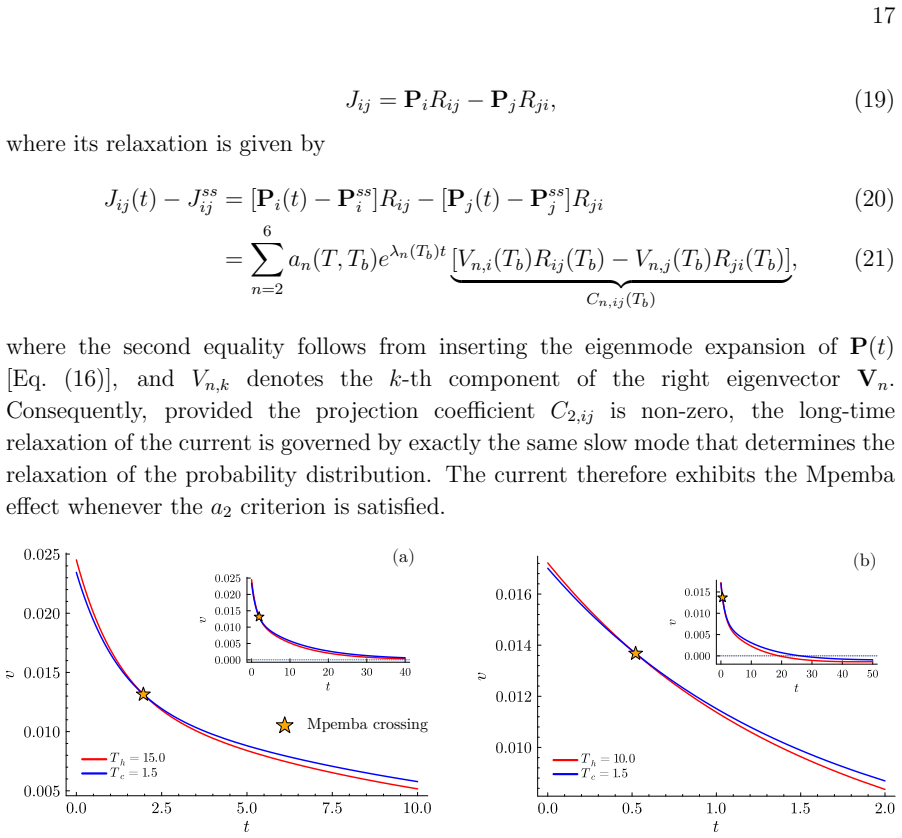
In the six-state chemomechanical kinesin model, the Mpemba effect occurs under chemical equilibrium, persists when detailed balance is broken by load or non-equilibrium ATP hydrolysis (which mainly reshape the Mpemba phase diagram), and is faithfully mirrored by the relaxation of the mechanical current, i.e., the motor velocity, whenever the slow-mode spectral criterion holds and that current projects onto the slowest mode.
What carries the argument
The spectral a2 criterion: after a quench, long-time relaxation is dominated by the slowest non-stationary eigenmode of the rate matrix; non-monotonic dependence of its amplitude a2 on the initial control parameter (temperature or force) is necessary and sufficient for Mpemba crossings in distance measures, and the same a2 multiplies the projection of that mode onto the mechanical current J25, so velocity inherits the anomalous relaxation.
Load-bearing premise
The model puts all load dependence on a single mechanical edge and chooses intrinsic rates to explore energy landscapes rather than lock them to a fully validated kinesin parameterization; if real force reshapes the whole landscape or rates differ qualitatively, the phase diagrams and velocity signature need not carry over.
What would settle it
In a single-molecule optical-trap quench of temperature or chemical conditions on kinesin, prepare two ensembles at different initial temperatures (or concentrations), quench to the same final bath, and test whether the hotter (or farther) ensemble’s step-averaged velocity reaches the final steady velocity before the cooler one whenever the model’s a2 criterion predicts a crossing.
If this is right
- Motor velocity alone can serve as an experimental readout of the Mpemba effect without reconstructing microscopic state occupations.
- Chemical and mechanical driving mainly move Mpemba phase boundaries rather than destroy the phenomenology in the explored kinesin regime.
- Force quenches, unlike temperature quenches, do not produce a Mpemba effect in this network over the parameters surveyed.
- The same spectral-plus-current logic suggests looking for velocity or flux Mpemba signatures in other finite-state motor and enzyme networks.
Where Pith is reading between the lines
- If velocity inherits a2 whenever the mechanical projection is nonzero, other routinely measured motor observables (run length, waiting-time statistics) may also display Mpemba crossings when they couple to the same slow mode.
- The reported absence of force-induced Mpemba may be specific to load acting only on one edge; full landscape force dependence could reopen a force-quench Mpemba window.
- Extending the protocol to dynein or myosin kinetic models would test whether anomalous relaxation is generic among processive motors or kinesin-specific.
Editorial analysis
A structured set of objections, weighed in public.
Referee Report
Summary. The manuscript studies anomalous relaxation (the Mpemba effect) in Lipowsky’s six-state chemomechanical Markov network for kinesin. Using the master equation, L1 distance, and the equilibrium spectral a2 criterion, the authors map Mpemba phases under chemical equilibrium as functions of bath temperature and concentration scale, interpret them via the free-energy landscape and metastability, and then show that mechanical load and chemical driving (parameter c) mainly stretch or compress those phases without destroying the phenomenology in the regimes explored. They further argue that the mechanical current J25 (motor velocity) inherits the slowest non-stationary mode whenever the projection C2,25 is nonzero, so velocity relaxation can exhibit Mpemba crossings and serve as an experimentally accessible signature. Force quenches are also examined and no force-induced Mpemba effect is reported.
Significance. The work is a clear first step in bringing the Mpemba effect into a standard, experimentally motivated biochemical network. The within-model spectral analysis is standard and correctly applied; the current expansion (Eqs. 19–21) cleanly shows why velocity can track a2; and the phase diagrams under equilibrium and broken detailed balance give a concrete baseline for anomalous relaxation in living systems. Identifying motor velocity as a probe is a useful, falsifiable experimental hook for single-molecule optical-trap work. Strengths include transparent use of literature Mpemba criteria (Lu–Raz, Klich et al.) and an honest separation of equilibrium intuition from non-equilibrium driving. The main scientific value is existence and phenomenology inside a consistent kinesin-type network, not a quantitative fit to a particular motor.
major comments (3)
- [Section 2; Section 5] Sec. 2 and Sec. 5: the free energies Ei and barrier heights Bij that define κ ij (Eq. 3) are never tabulated, nor is a complete numerical rate set provided. Phase diagrams (Figs. 5, 8, 10) and a2 curves are therefore not reproducible from the text alone. For a computational spectral study this is load-bearing: please supply a table (or SI) of all Ei, Bij (or all independent κ ij) used for the main figures, and state which quantities were held fixed when s, r, c, F, θ were varied.
- [Section 2, Eq. (4); Section 5.4] Sec. 2, Eq. (4) and Sec. 5.4: load dependence is restricted to the single mechanical edge (φ25=e^{-θF}, φ52=e^{(1-θ)F}, all other φij=1), and rates are chosen to explore landscapes rather than fixed to a validated kinesin parameterization. The algebra that velocity tracks a2 when C2,25 eq0 (Eqs. 20–21) is correct inside the model, but the claim that velocity is an “experimentally accessible signature” for real kinesin needs an explicit limitations paragraph: if force reshapes chemical barriers or empirical rates reorder λ2 / flip a2(T) / drive C2,25 through zero, the driven phases and the velocity probe need not transfer. Temper the abstract/conclusion wording from a general experimental route to a model-supported prediction under stated closures.
- [Section 5.4] Sec. 5.4: the statement that C2,25 “remains non-zero throughout the parameter ranges investigated” is central to the velocity–Mpemba link but is only asserted. Please add a brief systematic check (e.g., min |C2,25| on the same grids used for Figs. 5, 8, 10, or a supplementary plot) and note any loci where C2,25 is consistent with zero, where velocity would cease to report the slow mode.
minor comments (5)
- [Figure 3; Figure 4] Fig. 3 caption has a duplicated “(a)” label; panel (b) is mis-tagged. Clean up figure labels throughout (e.g., Fig. 4 “(b)(b)”).
- Typos: “sytems” (p. 2), “Mpema” (Fig. 6 caption), “nonethelss”, “Paramteres” (Fig. 9), “supresses” (Fig. 8). Standard copy-edit pass needed.
- [Section 3.1; Section 5.3] Sec. 3.1: condition (i) for non-temperature quenches is correctly flagged as not automatic; when discussing force quenches (Sec. 5.3), state explicitly whether L1(Fi) was verified monotonic in the plotted examples (Fig. 9b already shows a problematic case).
- [Section 5.1] Sec. 5.1: sampling a2 at 250 temperatures in (Tb+0.1, Tb+50) is reasonable; briefly note how non-monotonicity was decided (e.g., discrete derivative sign changes) to avoid false positives from numerical noise near a2=0 (strong Mpemba).
- [Section 1; Section 6] Introduction/conclusion cite a broad living-systems outlook (dynein, myosin, proofreading). One or two sentences on why the six-state kinesin topology is representative enough for that outlook—or that it is only a baseline—would tighten the framing.
Circularity Check
No significant circularity: Mpemba criteria and kinesin network are external; phase diagrams and velocity inheritance follow from spectral analysis of M, not from fitted or self-defined targets.
full rationale
The paper applies the standard Markovian Mpemba definition and a2 spectral criterion (Lu & Raz; Klich et al.) to Lipowsky’s established six-state kinesin network. Equilibrium and driven phase diagrams are obtained by sampling a2(T,Tb) from the master-equation generator M under author-chosen but explicitly stated energy-landscape and rate constructions; crossings are outputs of diagonalization, not inputs fitted to force crossings. The claim that motor velocity mirrors anomalous relaxation is a direct algebraic consequence of the eigenmode expansion of P(t) inserted into J25 (Eqs. 16, 20–21): long-time current tracks a2 whenever the projection C2,25 ≠ 0, which the authors report as nonzero on the grids checked. That is a legitimate spectral implication, not a definitional loop. Modeling closures (single-edge load factors ϕ25/ϕ52; hand-built Ei, Bij) limit experimental transfer but do not make any reported “prediction” reduce by construction to its inputs. Self-citations (e.g. related Pal/Biswas Mpemba work) are contextual, not load-bearing uniqueness theorems. No fitted-input-as-prediction, self-definitional, or ansatz-via-self-citation circularity is present.
Axiom & Free-Parameter Ledger
free parameters (5)
- State free energies Ei and barrier heights Bij (forward cycle)
- Concentration scale s and ATP/ADP ratio r =
example working points e.g. r=0.1, s in ~0.1–20
- Chemical drive c = [P]/[P]_eq factor
- Load F and load-sharing θ =
θ≈0.6 in several figures
- Bath temperature Tb and quench window for a2 sampling =
250 uniform T samples
axioms (7)
- domain assumption Continuous-time Markov master equation on a finite state space fully describes motor relaxation between transitions (separation of timescales / Kramers picture).
- standard math For detailed-balance generators, non-monotonic a2(T) is necessary and sufficient for Mpemba crossings in suitable distances (Lu–Raz spectral criterion).
- standard math L1 distance satisfies the three Lu–Raz axioms (ordering of initial distances, monotonicity, convexity), so crossings in L1 define the effect.
- domain assumption Biochemical constraints reduce the 9 nucleotide configurations to the six-state bicyclic network of Lipowsky et al., with one mechanical edge and forward/backward ATP-consuming cycles.
- ad hoc to paper External load modifies only the mechanical rates R25, R52 via exponential load-sharing factors; all chemical rates are force-independent.
- ad hoc to paper Backward-cycle intrinsic rate κ54 is fixed by enforcing detailed balance on the backward cycle given the forward landscape (Eq. 9).
- domain assumption Steady-state occupation is a practical proxy for metastability (deeper wells ↔ larger Pss), sufficient for qualitative landscape explanations of phase boundaries.
read the original abstract
The Mpemba effect, wherein a system prepared farther from equilibrium relaxes faster than one initially closer to equilibrium, has been extensively investigated in a wide range of physical systems. In contrast, its role in biologically relevant non-equilibrium processes remains largely unexplored. Here, we investigate anomalous relaxation in the six-state chemomechanical network model of the Kinesin molecular motor under both equilibrium and non-equilibrium conditions. We first establish the existence of the Mpemba effect in chemical equilibrium and show that many of its qualitative features can be understood from the underlying free-energy landscape. We then examine the effects of mechanical and chemical driving, showing that breaking detailed balance primarily reshapes the Mpemba phase diagram without qualitatively altering the relaxation phenomenology over the physically relevant parameter regime. Finally, we demonstrate that the relaxation of the motor velocity also mirrors the anomalous relaxation of the underlying stochastic dynamics, thereby identifying an experimentally accessible signature of the Mpemba effect. Our results establish molecular motors as a promising baseline for studying anomalous relaxation in living systems and suggest a broader framework for exploring the Mpemba effect in non-equilibrium biochemical networks.
Figures


Reference graph
Works this paper leans on
-
[1]
Mpemba, E. B. & Osborne, D. G. Cool?Physics Education4,172–175 (May 1969)
1969
-
[2]
Burridge, H. C. & Linden, P. F. Questioning the Mpemba Effect: Hot Water Does Not Cool More Quickly than Cold.Scientific Reports6,37665 (Nov. 24, 2016)
2016
-
[3]
& Raz, O
Lu, Z. & Raz, O. Nonequilibrium Thermodynamics of the Markovian Mpemba Effect and Its Inverse.Proceedings of the National Academy of Sciences114,5083– 5088 (May 16, 2017)
2017
-
[4]
& Pal, A
Biswas, A., Rajesh, R. & Pal, A. Mpemba Effect in a Langevin System: Population Statistics, Metastability, and Other Exact Results.The Journal of Chemical Physics159,044120 (July 28, 2023)
2023
-
[5]
V., Raz, O
Biswas, A., Prasad, V. V., Raz, O. & Rajesh, R. Mpemba Effect in Driven Granular Maxwell Gases.Physical Review E102,012906 (July 23, 2020)
2020
-
[6]
& Santos, A
Lasanta, A., Vega Reyes, F., Prados, A. & Santos, A. When the Hotter Cools More Quickly: Mpemba Effect in Granular Fluids.Physical Review Letters119,148001 (Oct. 4, 2017)
2017
-
[7]
& Prados, A
Santos, A. & Prados, A. Mpemba Effect in Molecular Gases under Nonlinear Drag. Physics of Fluids32,072010 (July 1, 2020)
2020
-
[8]
Torrente, A.et al.Large Mpemba-like Effect in a Gas of Inelastic Rough Hard Spheres.Physical Review E99,060901 (June 6, 2019)
2019
-
[9]
REFERENCES20
Baity-Jesi, M.et al.The Mpemba Effect in Spin Glasses Is a Persistent Memory Effect.Proceedings of the National Academy of Sciences116,15350–15355 (July 30, 2019). REFERENCES20
2019
-
[10]
Chatterjee, S.et al.Mpemba Effect in Pure Spin Systems : A Universal Picture of the Role of Spatial Correlations at Initial States.Physical Review E110,L012103 (July 25, 2024)
2024
-
[11]
& Das, S
Ghosh, S., Pathak, P., Chatterjee, S. & Das, S. K. Simulations of Mpemba Effect in Water and Lennard-Jones Models.Communications Physics8,359 (Aug. 29, 2025)
2025
-
[12]
Antonov, A. P. & L¨ owen, H. Temperature Overshooting in the Mpemba Effect of Frictional Active Matter.Physical Review E113,025407 (Feb. 4, 2026)
2026
-
[13]
Quantization of the Classical Mpemba Effectversion 1.https : //arxiv.org/abs/2607.06071(2026)
Melles, J.et al. Quantization of the Classical Mpemba Effectversion 1.https : //arxiv.org/abs/2607.06071(2026). Pre-published
Pith/arXiv arXiv 2026
-
[14]
& Godec, A
Lapolla, A. & Godec, A. Faster Uphill Relaxation in Thermodynamically Equidistant Temperature Quenches.Physical Review Letters125,110602 (Sept. 11, 2020)
2020
-
[15]
& Santos, A
Takada, S., Hayakawa, H. & Santos, A. Mpemba Effect in Inertial Suspensions. Physical Review E103,032901 (Mar. 8, 2021)
2021
-
[16]
Walker, M. R. & Vucelja, M. Anomalous Thermal Relaxation of Langevin Particles in a Piecewise-Constant Potential.Journal of Statistical Mechanics: Theory and Experiment2021,113105 (Nov. 1, 2021)
2021
-
[17]
& Rajesh, R
Biswas, A. & Rajesh, R. Mpemba Effect in the Relaxation of an Active Brownian Particle in a Trap without Metastable States.The Journal of Chemical Physics 162,034115 (Jan. 21, 2025)
2025
-
[18]
& Hayakawa, H.The Mpemba Effect Likes to Hit a Wallversion 3.https : / / arxiv
Liu, Y., Van Vu, T., Ch´ etrite, R., van Wijland, F. & Hayakawa, H.The Mpemba Effect Likes to Hit a Wallversion 3.https : / / arxiv . org / abs / 2604 . 01543 (2026). Pre-published
2026
-
[19]
Liu, Y., Van Vu, T., Ch´ etrite, R., van Wijland, F. & Hayakawa, H.Predicting the Conditions for Observing the Mpemba Effectversion 2.https://arxiv.org/abs/ 2606.03445(2026). Pre-published
Pith/arXiv arXiv 2026
-
[20]
& Pal, A
Biswas, A. & Pal, A. Mpemba Effect on Nonequilibrium Active Markov Chains. Physical Review E111,054136 (May 27, 2025)
2025
-
[21]
Hayakawa, H. & Takada, S.Mpemba Effect in a Two-Dimensional Bistable Potentialversion 3.https://arxiv.org/abs/2603.24148(2026). Pre-published
arXiv 2026
-
[22]
& Bechhoefer, J
Kumar, A. & Bechhoefer, J. Exponentially Faster Cooling in a Colloidal System. Nature584,64–68 (Aug. 6, 2020)
2020
-
[23]
& Bechhoefer, J
Kumar, A., Ch´ etrite, R. & Bechhoefer, J. Anomalous Heating in a Colloidal System.Proceedings of the National Academy of Sciences119,e2118484119 (Feb. 2022)
2022
-
[24]
& Ch´ etrite, R
Bechhoefer, J., Kumar, A. & Ch´ etrite, R. A Fresh Understanding of the Mpemba Effect.Nature Reviews Physics3,534–535 (June 23, 2021). REFERENCES21
2021
-
[25]
& Bechhoefer, J
Ch´ etrite, R., Kumar, A. & Bechhoefer, J. The Metastable Mpemba Effect Corresponds to a Non-monotonic Temperature Dependence of Extractable Work. Frontiers in Physics9,654271 (Mar. 30, 2021)
2021
-
[26]
& Vucelja, M
Teza, G., Bechhoefer, J., Lasanta, A., Raz, O. & Vucelja, M. Speedups in Nonequilibrium Thermal Relaxation: Mpemba and Related Effects.Physics Reports1164,1–97 (Mar. 2026)
2026
-
[27]
Mechanism and Regulation of Kinesin Motors.Nature Reviews Molecular Cell Biology26,86–103 (Feb
Yildiz, A. Mechanism and Regulation of Kinesin Motors.Nature Reviews Molecular Cell Biology26,86–103 (Feb. 2025)
2025
-
[28]
Howard, J.Mechanics of Motor Proteins and the Cytoskeleton(2024)
2024
-
[29]
& Niwa, S
Hirokawa, N., Noda, Y., Tanaka, Y. & Niwa, S. Kinesin Superfamily Motor Proteins and Intracellular Transport.Nature Reviews Molecular Cell Biology10,682–696 (Oct. 2009)
2009
-
[30]
& Liepelt, S
Lipowsky, R. & Liepelt, S. Chemomechanical Coupling of Molecular Motors: Thermodynamics, Network Representations, and Balance Conditions.Journal of Statistical Physics130,39–67 (Jan. 2008)
2008
-
[31]
& Lipowsky, R
Liepelt, S. & Lipowsky, R. Kinesin’s Network of Chemomechanical Motor Cycles. Physical Review Letters98,258102 (June 20, 2007)
2007
-
[32]
& Lipowsky, R
Liepelt, S. & Lipowsky, R. Steady-State Balance Conditions for Molecular Motor Cycles and Stochastic Nonequilibrium Processes.Europhysics Letters (EPL)77, 50002 (Mar. 2007)
2007
-
[33]
Carter, N. J. & Cross, R. A. Mechanics of the Kinesin Step.Nature435,308–312 (May 2005)
2005
-
[34]
& Hayakawa, H
Van Vu, T. & Hayakawa, H. Thermomajorization Mpemba Effect.Physical Review Letters134,107101 (Mar. 10, 2025)
2025
-
[35]
& Vucelja, M
Klich, I., Raz, O., Hirschberg, O. & Vucelja, M. Mpemba Index and Anomalous Relaxation.Physical Review X9,021060 (June 26, 2019)
2019
-
[36]
& Seifert, U
Deg¨ unther, J. & Seifert, U. Anomalous Relaxation from a Non-Equilibrium Steady State: An Isothermal Analog of the Mpemba Effect.Europhysics Letters139,41002 (Aug. 1, 2022)
2022
-
[37]
& Agarwalla, B
Bagui, P., Chatterjee, A. & Agarwalla, B. K. Detection of Mpemba Effect through Observables in Open Quantum Systems.Physical Review B114,014311 (July 17, 2026)
2026
-
[38]
M., Goldstein, L
Block, S. M., Goldstein, L. S. B. & Schnapp, B. J. Bead Movement by Single Kinesin Molecules Studied with Optical Tweezers.Nature348,348–352 (Nov. 1990)
1990
-
[39]
& Block, S
Svoboda, K. & Block, S. M. Force and Velocity Measured for Single Kinesin Molecules.Cell77,773–784 (June 1994)
1994
-
[40]
& Qian, H
Ge, H., Qian, M. & Qian, H. Stochastic Theory of Nonequilibrium Steady States. Part II: Applications in Chemical Biophysics.Physics Reports510,87–118 (Jan. 2012). REFERENCES22
2012
-
[41]
Kolomeisky, A. B. Motor Proteins and Molecular Motors: How to Operate Machines at the Nanoscale.Journal of Physics: Condensed Matter25,463101 (Nov. 20, 2013)
2013
-
[42]
Phosphorylation Energy Hypothesis: Open Chemical Systems and Their Biological Functions.Annual Review of Physical Chemistry58,113–142 (May 1, 2007)
Qian, H. Phosphorylation Energy Hypothesis: Open Chemical Systems and Their Biological Functions.Annual Review of Physical Chemistry58,113–142 (May 1, 2007)
2007
-
[43]
Beard, D. A. & Qian, H.Chemical Biophysics: Quantitative Analysis of Cellular Systems1st ed. (Cambridge University Press, May 29, 2008)
2008
-
[44]
& Block, S
Schnitzer, M. & Block, S. Statistical Kinetics of Processive Enzymes.Cold Spring Harbor Symposia on Quantitative Biology60,793–802 (Jan. 1, 1995)
1995
-
[45]
Hopfield, J. J. Kinetic Proofreading: A New Mechanism for Reducing Errors in Biosynthetic Processes Requiring High Specificity.Proceedings of the National Academy of Sciences71,4135–4139 (Oct. 1974)
1974
-
[46]
Kinetic Amplification of Enzyme Discrimination.Biochimie57,587–595 (July 1975)
Ninio, J. Kinetic Amplification of Enzyme Discrimination.Biochimie57,587–595 (July 1975)
1975
-
[47]
& Onuchic, J
Hyeon, C. & Onuchic, J. N. A Structural Perspective on the Dynamics of Kinesin Motors.Biophysical Journal101,2749–2759 (Dec. 2011)
2011
discussion (0)
Sign in with ORCID, Apple, or X to comment. Anyone can read and Pith papers without signing in.