REVIEW 4 major objections 5 minor 1 cited by
Quantization shifts Mpemba effect to ultra-cold temperatures
Reviewed by Pith at T0; open to challenge. T0 means a machine referee read the full paper against a public rubric. the ladder, T0–T4 →
T0 review · glm-5.2
2026-07-08 17:23 UTC pith:AZ4SEJOI
load-bearing objection Quantum Mpemba in the bistable potential: clean mechanism, schematic figures, load-bearing two-level approximation the 4 major comments →
Quantization of the classical Mpemba effect
The pith
A machine-rendered reading of the paper's core claim, the machinery that carries it, and where it could break.
Core claim
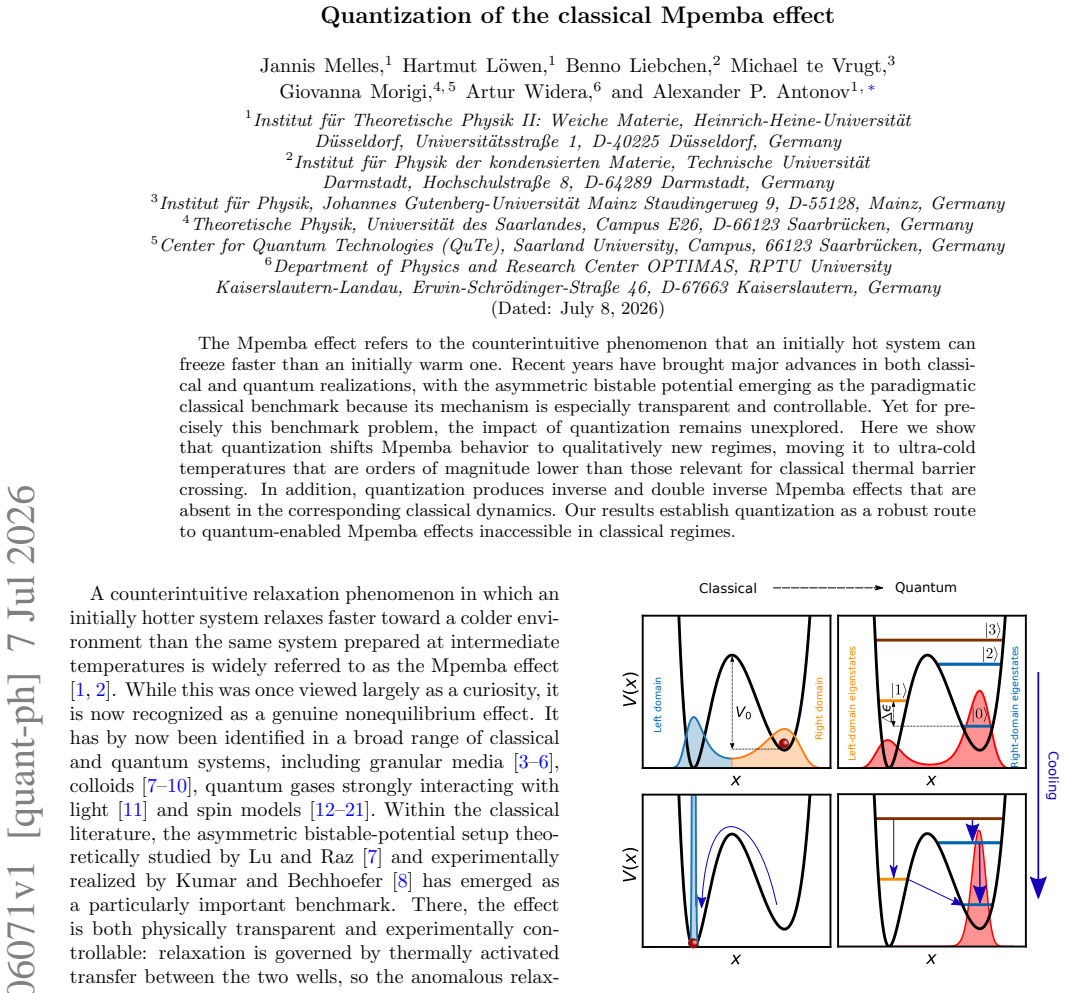
When the paradigmatic classical Mpemba benchmark—an asymmetric bistable potential—is quantized, the relaxation bottleneck changes from thermal barrier crossing (governed by barrier height V_0) to tunneling between discrete eigenstates (governed by energy splittings Δϵ ≪ V_0). This relocation of the bottleneck shifts anomalous relaxation to ultra-cold temperatures inaccessible classically and generates new Mpemba phenomena: an inverse Mpemba effect under heating and a double-inverse Mpemba effect with two distinct initial-temperature windows. The quantum Mpemba effect requires the existence of a weakly coupled eigenstate whose population P_1(T) is non-monotonic in temperature; when all eigen-
What carries the argument
The central object is the population of the first excited state P_1(T) = e^{-βϵ_1} / Σ_n e^{-βϵ_n}, which is non-monotonic in temperature (vanishing at both T→0 and T→∞) and controls the slowest Liouvillian relaxation mode. The prefactor |P_1(T_init) - P_1(T_fin)| in the exponential relaxation law determines whether anomalous relaxation occurs, analogous to the classical domain-occupation imbalance P_L(T) but operating on the quantum energy-splitting scale Δϵ rather than the barrier height V_0.
Load-bearing premise
The quantum Mpemba effect requires the existence of at least one eigenstate that is weakly coupled to the rest of the system, making it metastable and governing the slowest relaxation mode. If no such weakly coupled state exists—as can happen for certain potential shapes—the quantum Mpemba effect is suppressed even though the classical effect may persist.
What would settle it
If experiments in ultracold-atom double-well systems at temperatures below the barrier height fail to show anomalous relaxation tied to the population of a specific weakly coupled eigenstate, or if the relaxation time does not exhibit the predicted non-monotonic dependence on initial temperature, the central claim would be challenged.
If this is right
- Ultracold atoms in tailored optical double-well potentials could serve as experimental platforms for observing quantum Mpemba effects at nanokelvin temperatures, using existing trapping and thermalization techniques.
- The mechanism suggests a route to rapid quantum state preparation: by choosing initial temperatures where the population of the bottleneck eigenstate matches the target, one can bypass the slowest relaxation channel entirely.
- The double-inverse Mpemba effect under heating protocols indicates that quantum systems can exhibit multiple anomalous-relaxation windows, potentially enabling fine-grained temperature control strategies.
- The requirement of a weakly coupled eigenstate identifies a design principle for engineering or suppressing Mpemba behavior in quantum systems via spectral engineering of the potential landscape.
Where Pith is reading between the lines
- If the weakly coupled eigenstate is the load-bearing structure, then systems with controllable tunneling (e.g., optical lattices with tunable barrier heights) could switch Mpemba behavior on and off by tuning the coupling strength of specific eigenstates.
- The shift from barrier-height to energy-splitting scales suggests that the quantum Mpemba effect could persist in systems where classical barrier crossing is exponentially suppressed, making it relevant for low-temperature quantum annealing or adiabatic quantum computing where thermal activation is frozen out.
- The appearance of a double-inverse effect driven by two extrema in |P_1(T_init) - P_1(T_fin)| raises the question of whether higher-dimensional potentials with multiple weakly coupled states could produce triple or higher-order Mpemba effects.
Editorial analysis
A structured set of objections, weighed in public.
Referee Report
Summary. This letter investigates how quantization modifies the Mpemba effect in the paradigmatic asymmetric bistable potential. The authors show that, whereas the classical Mpemba effect is governed by thermal barrier crossing at temperatures comparable to the barrier height $V_0$, the quantum analog arises from non-monotonicity of the Boltzmann population $P_1(T)$ of a weakly-coupled metastable eigenstate, shifting the effect to ultra-cold temperatures set by the level splitting $k_B T ~ Δε ≪ V_0$. The paper further predicts an inverse and a double-inverse quantum Mpemba effect under heating protocols, which are absent in the classical counterpart. The analytical framework reduces both the classical (Eq. 2, Eq. 15) and quantum (Eq. 23) Mpemba effects to a non-monotonicity condition on a population probability, and the quantum derivation proceeds via a two-level truncation of the Liouvillian spectral decomposition.
Significance. The paper addresses a well-motivated gap: prior quantum Mpemba studies have focused on spin models and open quantum systems, while the classical bistable-potential benchmark—where the mechanism is most transparent—has not been quantized. The parameter-free derivation of the quantum Mpemba condition from the Boltzmann distribution over discrete eigenstates (Eq. 3) is a clean analytical result. The prediction of a double-inverse quantum Mpemba effect is novel and falsifiable. The connection to ultracold-atom experiments in optical double-well potentials is concrete and well-supported by realistic parameter estimates. These strengths are partly offset by the schematic nature of the figures and the reliance on approximations whose quantitative validation is deferred to the Supplemental Material.
major comments (4)
- End Matter, Eqs. (18)–(20): The reduction from the full spectral sum $c_1 = Σ_n α_n P_n(T_{init})$ (Eq. 18) to the two-level form $c_1 = (α_1 - α_0)[P_1(T_{init}) - P_1(T_{fin})]$ (Eq. 20) is the load-bearing step for the central analytical result (Eq. 23) and especially for the double-inverse Mpemba claim. The paper states that the dominant contribution arises from $α_1$ 'in agreement with numerical results' (deferred to SM) but does not quantify $|α_n|/|α_1|$ for $n ≥ 2$ in the main text. This matters acutely for the double-inverse claim: the number of extrema of $|P_1(T_{init}) - P_1(T_{fin})|$ (Fig. 4) determines whether a 'double' effect exists, but the full $c_1(T) = Σ_n α_n P_n(T)$ could have different extremal structure if multiple $P_n(T)$ contribute with comparable weights, since each $P_n(T)$ is individually non-monotonic. The main text should either (i) provide a quantitative
- bound on $|α_n|/|α_1|$ for $n ≥ 2$ demonstrating that the truncation is controlled, or (ii) show numerically that the full $c_1(T)$ and the truncated expression have the same number of extrema for the parameter regime of Fig. 3(b). Without this, the double-inverse Mpemba effect—a headline claim of the paper—is not rigorously established by the analytical argument presented.
- End Matter, Eqs. (16) and (23): The single-mode approximation for the Liouvillian dynamics requires a spectral gap $|Re(Λ_1)| ≪ |Re(Λ_2)|$ so that the slowest mode dominates at long times. This gap condition is not demonstrated in the main text. For the double-inverse effect, which involves two distinct initial-temperature windows where relaxation is anomalously fast, it is important to verify that the single-mode regime is reached within experimentally relevant timescales for both windows. The SM should be referenced explicitly for this verification, or a brief statement of the gap ratio should be included.
- Fig. 3 and Fig. 4: These figures are described as schematic/illustrative, but they are the primary evidence for the inverse and double-inverse Mpemba effects. Fig. 3(b) in particular shows the relaxation time with two extrema and distinct temperature windows, but no numerical data or parameter values are given. Since the double-inverse effect is a central novel claim, at least one panel with quantitative numerical results—showing the actual relaxation time $t_{relax}(T_{init})$ from the full Lindblad dynamics (not just the schematic of Fig. 3 or the population imbalance of Fig. 4)—should be included in the main text or explicitly cross-referenced to a specific SM figure.
minor comments (5)
- The notation $P_n(T)$ in Eq. (3) and the End Matter uses $P_1$ for both the population of state $|1⟩$ and the left-domain occupation probability $P_L$ in the classical case. While context disambiguates, a brief clarifying remark would help.
- Eq. (3): The expression $P_1(T) = e^{-βΔε} / (1 + Σ_{n≥1} e^{-β(ε_n - ε_0)})$ has a potential notational issue—the sum in the denominator starts at $n ≥ 1$ but the numerator already accounts for $n=1$. This should be $Σ_{n≥2}$ in the denominator, or the expression should be written as $e^{-β ε_1} / Σ_n e^{-β ε_n}$ as stated in the first equality.
- The potential $V(x)$ and its parameters (barrier height $V_0$, well-depth asymmetry $ΔV$, level splitting $Δε$) are introduced qualitatively but never specified explicitly. A figure or table with the concrete parameter values used for each panel of Fig. 3 would make the results reproducible.
- The reference to 'quantum active matter' [58–64] in the conclusion feels tangential to the main results. Consider trimming or motivating the connection more explicitly.
- Ref. [31] (Hayakawa and Takada, 'Quantum tunneling Mpemba effect') appears closely related to the present work and is cited only once in passing. The relationship between that work and the present results should be clarified to establish novelty.
Simulated Author's Rebuttal
We thank the referee for a careful and constructive reading of our manuscript. The referee correctly identifies the key analytical steps on which our central claims rest, and we agree that the main text should provide stronger quantitative support for these steps. Below we respond to each major comment in turn.
read point-by-point responses
-
Referee: End Matter, Eqs. (18)–(20): The reduction from the full spectral sum to the two-level form is the load-bearing step for the central analytical result (Eq. 23) and especially for the double-inverse Mpemba claim. The paper does not quantify |α_n|/|α_1| for n ≥ 2 in the main text. The full c_1(T) could have different extremal structure if multiple P_n(T) contribute with comparable weights.
Authors: The referee is correct that the truncation from Eq. (18) to Eq. (20) is the critical step, and we agree that the main text should justify it quantitatively rather than deferring entirely to the SM. We will address this in revision as follows. First, we will add to the main text a quantitative statement of the ratio |α_n|/|α_1| for n ≥ 2, computed from the Lindblad eigenvectors for the parameter regime of Fig. 3(b), demonstrating that the truncation is controlled (the metastable state |1⟩ is weakly coupled to the rest of the spectrum by construction, so α_1 dominates by orders of magnitude). Second, we will include a numerical comparison between the full c_1(T) = Σ_n α_n P_n(T) and the truncated expression (α_1 − α_0)[P_1(T_init) − P_1(T_fin)] over the relevant temperature range, showing that both exhibit the same number of extrema. This directly addresses the concern that higher-order terms could alter the extremal structure underlying the double-inverse claim. We note that the physical mechanism—non-monotonicity of a single weakly-coupled metastable state's Boltzmann population—makes it structurally unlikely that subleading terms would introduce additional extrema, but we agree this should be shown, not asserted. revision: yes
-
Referee: End Matter, Eqs. (16) and (23): The single-mode approximation requires a spectral gap |Re(Λ_1)| ≪ |Re(Λ_2)|. This gap condition is not demonstrated in the main text. For the double-inverse effect, it is important to verify that the single-mode regime is reached within experimentally relevant timescales for both temperature windows.
Authors: This is a fair point. The single-mode approximation is standard in the metastability literature (Refs. [46, 47] in our manuscript), but we agree that the gap ratio should be stated explicitly for the specific parameters used in Fig. 3(b). In the revised manuscript, we will include the numerical value of |Re(Λ_1)|/|Re(Λ_2)| for the relevant parameter regime and confirm that it is sufficiently small for both initial-temperature windows associated with the double-inverse effect. We will also add an explicit cross-reference to the SM figure where the full time-dependent relaxation is shown, so the reader can verify that the single-mode regime is reached on experimentally accessible timescales. If the SM does not currently contain this verification in sufficient detail, we will expand it accordingly. revision: yes
-
Referee: Fig. 3 and Fig. 4: These figures are described as schematic/illustrative, but they are the primary evidence for the inverse and double-inverse Mpemba effects. At least one panel with quantitative numerical results—showing the actual relaxation time t_relax(T_init) from the full Lindblad dynamics—should be included in the main text or explicitly cross-referenced to a specific SM figure.
Authors: We agree. The schematic figures serve to communicate the qualitative structure of the effect, but the double-inverse Mpemba effect is a central novel claim and should be backed by quantitative numerical evidence in the main text. In the revised version, we will add a panel showing t_relax(T_init) computed from the full Lindblad dynamics (not the truncated two-level model) for the parameter regime of Fig. 3(b), with explicit parameter values stated. This will directly demonstrate the two extrema and the two distinct temperature windows. We will also ensure that the SM figure containing the full numerical verification is explicitly referenced at the relevant location in the main text. revision: yes
Circularity Check
No significant circularity. The derivation is parameter-free and self-contained; self-citations are contextual rather than load-bearing.
full rationale
The paper's central result—that quantization shifts the Mpemba effect to ultra-cold temperatures and produces inverse/double-inverse variants—follows from the non-monotonicity of P₁(T) = e^{-βΔε}/(1 + Σ_{n≥1} e^{-β(ε_n−ε₀)}) (Eq. 3), which is a direct consequence of the Boltzmann distribution over discrete eigenstates. No parameter is fitted to Mpemba data and then presented as a prediction. The classical comparison uses the standard Arrhenius/Boltzmann result (Eq. 2). The analytical derivation (Eqs. 16→23) reduces the relaxation dynamics to |P₁(T_init)−P₁(T_fin)| via a two-level approximation (Eq. 19) and a single-mode approximation (Eq. 23), but these are stated as approximations validated by numerical results (deferred to SM), not as definitions that circularly produce the target result. The weakly-coupled eigenstate assumption is openly acknowledged as load-bearing (Fig. 3c shows the effect is suppressed without it), but this is a physical assumption about the system's spectral structure, not a circular definition. Self-citations (Refs. [6], [62], [69]) appear in the context of quantum active matter motivation and dissipative modeling, not as load-bearing premises for the Mpemba derivation itself. Refs. [46, 47] (Macieszczak et al.) are external citations for metastability theory. The derivation chain is: Boltzmann distribution → non-monotonic P₁(T) → non-monotonic prefactor in relaxation law → Mpemba effect. Each step is a genuine physical deduction, not a renaming or a fit repackaged as prediction. The two-level truncation (Eq. 18→19) and the claim that α₁ dominates are approximations whose validity is a correctness concern (noted by the skeptic), not a circularity concern. No step reduces to its own inputs by construction. Score 1 reflects minor self-citations that are contextual rather than load-bearing on the central claim.
Axiom & Free-Parameter Ledger
free parameters (3)
- Potential shape parameters (asymmetric double-well) =
Not specified in main text; deferred to SM
- Transition rates γ(ω) =
Not specified; dipole coupling assumed
- Tolerance distance ε0 =
Arbitrary small
axioms (4)
- domain assumption The quantum system exhibits metastability due to a weakly-coupled eigenstate (e.g., |1⟩).
- domain assumption The two-level approximation (involving only |0⟩ and |1⟩) is valid for the long-time dynamics.
- standard math The dissipative dynamics relaxes to a thermal stationary state.
- domain assumption The emergence of Mpemba effects is governed by spectral properties of the Liouvillian rather than microscopic details.
read the original abstract
The Mpemba effect refers to the counterintuitive phenomenon that an initially hot system can freeze faster than an initially warm one. Recent years have brought major advances in both classical and quantum realizations, with the asymmetric bistable potential emerging as the paradigmatic classical benchmark because its mechanism is especially transparent and controllable. Yet for precisely this benchmark problem, the impact of quantization remains unexplored. Here we show that quantization shifts Mpemba behavior to qualitatively new regimes, moving it to ultra-cold temperatures that are orders of magnitude lower than those relevant for classical thermal barrier crossing. In addition, quantization produces inverse and double inverse Mpemba effects that are absent in the corresponding classical dynamics. Our results establish quantization as a robust route to quantum-enabled Mpemba effects inaccessible in classical regimes.
Figures


Forward citations
Cited by 1 Pith paper
-
Mpemba effect in a chemomechanical model of the Kinesin molecular motor
The Mpemba effect appears in Lipowsky’s six-state kinesin network under equilibrium and driven conditions, and motor velocity relaxation reproduces the anomalous spectral relaxation.
Reference graph
Works this paper leans on
-
[1]
or ultracold Fermions [35], or the entanglement for- mation and interference of single atoms in quantized de- grees of freedom [36, 37]. An important difference to classical systems is the strong isolation of ultracold quantum gases, and relax- ation usually is absent on experimentally relevant time scales [38, 39]. In order to intentionally induce and co...
-
[2]
E. B. Mpemba and D. G. Osborne, Cool?, Phys. Educ. 4, 172 (1969)
work page 1969
-
[3]
G. Teza, J. Bechhoefer, A. Lasanta, O. Raz, and M. Vucelja, Speedups in nonequilibrium thermal relax- ation: Mpemba and related effects, Phys. Rep.1164, 1 (2025)
work page 2025
-
[4]
A. Lasanta, F. Vega Reyes, A. Prados, and A. Santos, When the hotter cools more quickly: Mpemba effect in granular fluids, Phys. Rev. Lett.119, 148001 (2017)
work page 2017
-
[5]
A. Meg´ ıas and A. Santos, Mpemba-like effect protocol for granular gases of inelastic and rough hard disks, Front. Phys.10, 971671 (2022)
work page 2022
- [6]
-
[7]
A. P. Antonov and H. L¨ owen, Temperature overshooting in the Mpemba effect of frictional active matter, Phys. Rev. E113, 025407 (2026)
work page 2026
- [8]
-
[9]
A. Kumar and J. Bechhoefer, Exponentially faster cool- ing in a colloidal system, Nature584, 64 (2020)
work page 2020
- [10]
-
[11]
I. Malhotra and H. L¨ owen, Double Mpemba effect in the cooling of trapped colloids, J. Chem. Phys.161, 164903 (2024)
work page 2024
- [12]
-
[13]
F. Carollo, A. Lasanta, and I. Lesanovsky, Exponentially accelerated approach to stationarity in markovian open quantum systems through the Mpemba effect, Phys. Rev. Lett.127, 060401 (2021)
work page 2021
-
[14]
A. K. Chatterjee, S. Takada, and H. Hayakawa, Quantum Mpemba effect in a quantum dot with reservoirs, Phys. Rev. Lett.131, 080402 (2023)
work page 2023
-
[15]
A. Nava and R. Egger, Mpemba effects in open nonequi- librium quantum systems, Phys. Rev. Lett.133, 136302 (2024)
work page 2024
-
[16]
L. K. Joshi, J. Franke, A. Rath, F. Ares, S. Murciano, F. Kranzl, R. Blatt, P. Zoller, B. Vermersch, P. Cal- abrese, C. F. Roos, and M. K. Joshi, Observing the quan- tum Mpemba effect in quantum simulations, Phys. Rev. Lett.133, 010402 (2024)
work page 2024
-
[17]
M. Moroder, O. Culhane, K. Zawadzki, and J. Goold, Thermodynamics of the quantum Mpemba effect, Phys. Rev. Lett.133, 140404 (2024)
work page 2024
-
[18]
Observation and Modulation of the Quantum Mpemba Effect on a Superconducting Quantum Processor
Y. Xu, C.-P. Fang, B.-J. Chen, M.-C. Wang, Z.-Y. Ge, Y.-H. Shi, Y. Liu, C.-L. Deng, K. Zhao, Z.-H. Liu,et al., Observation and modulation of the quantum Mpemba effect on a superconducting quantum processor, arXiv:2508.07707 (2025)
work page internal anchor Pith review Pith/arXiv arXiv 2025
- [19]
-
[20]
H.-Z. Li, C. H. Lee, S. Liu, S.-X. Zhang, and J.-X. Zhong, Quantum Mpemba effect in long-ranged u(1)-symmetric random circuits, Phys. Rev. B113, 134310 (2026)
work page 2026
- [21]
-
[22]
K. Blom, D. Benyamin, U. Thiele, O. Raz, and A. Godec, Strong Mpemba effect through a reentrant phase transi- tion, arXiv:2604.28117 (2026)
work page internal anchor Pith review Pith/arXiv arXiv 2026
-
[23]
H. Hayakawa and S. Takada, Mpemba effect in a two- dimensional bistable potential, arXiv:2603.24148 (2026)
-
[24]
H. Yu, S. Liu, and S.-X. Zhang, Quantum Mpemba ef- fects from symmetry perspectives, AAPPS Bulletin35, 17 (2025)
work page 2025
- [25]
-
[26]
F. Ares, V. Vitale, and S. Murciano, Quantum Mpemba effect in free-fermionic mixed states, Phys. Rev. B111, 104312 (2025)
work page 2025
-
[27]
D. C. Aly¨ ur¨ uk, M. H. Ye¸ siller, V. Vedral, and O. Pusuluk, Thermodynamic limits of the Mpemba effect: A unified resource theory analysis, arXiv:2502.00123 (2025)
work page internal anchor Pith review Pith/arXiv arXiv 2025
-
[28]
P. H¨ anggi, P. Talkner, and M. Borkovec, Reaction-rate theory: fifty years after Kramers, Rev. Mod. Phys.62, 251 (1990)
work page 1990
-
[29]
H.-P. Breuer and F. Petruccione,The theory of open quantum systems(OUP Oxford, 2007)
work page 2007
- [30]
-
[31]
H. Carmichael,An open systems approach to quantum optics: lectures presented at the Universit´ e Libre de Brux- elles October 28 to November 4, 1991(Springer, 1993)
work page 1991
-
[32]
Quantum tunneling Mpemba effect
H. Hayakawa and S. Takada, Quantum tunneling Mpemba effect, arXiv:2607.03845 (2026)
work page internal anchor Pith review Pith/arXiv arXiv 2026
- [33]
-
[34]
M. R. Andrews, C. G. Townsend, H.-J. Miesner, D. S. Durfee, D. M. Kurn, and W. Ketterle, Observation of interference between two bose condensates, Science275, 637 (1997)
work page 1997
- [35]
- [36]
-
[37]
A. M. Kaufman, B. J. Lester, C. M. Reynolds, M. L. Wall, M. Foss-Feig, K. R. A. Hazzard, A. M. Rey, and C. A. Regal, Two-particle quantum interference in tunnel-coupled optical tweezers, Science345, 306 (2014)
work page 2014
-
[38]
S. Murmann, A. Bergschneider, V. M. Klinkhamer, G. Z¨ urn, T. Lompe, and S. Jochim, Two fermions in a double well: Exploring a fundamental building block of 6 the hubbard model, Phys. Rev. Lett.114, 080402 (2015)
work page 2015
- [39]
-
[40]
Ueda, Quantum equilibration, thermalization and prethermalization in ultracold atoms, Nat
M. Ueda, Quantum equilibration, thermalization and prethermalization in ultracold atoms, Nat. Rev. Phys. 2, 669 (2020)
work page 2020
- [41]
-
[42]
N. Spethmann, F. Kindermann, S. John, C. Weber, D. Meschede, and A. Widera, Dynamics of single neu- tral impurity atoms immersed in an ultracold gas, Phys. Rev. Lett.109, 235301 (2012)
work page 2012
- [43]
- [44]
-
[45]
Y. Liu, T. V. Vu, R. Ch´ etrite, F. van Wijland, and H. Hayakawa, The Mpemba effect likes to hit a wall (2026)
work page 2026
-
[46]
Y. Liu, T. Van Vu, R. Ch´ etrite, F. van Wijland, and H. Hayakawa, Predicting the conditions for observing the Mpemba effect, arXiv:2606.03445 (2026)
work page internal anchor Pith review Pith/arXiv arXiv 2026
-
[47]
K. Macieszczak, D. C. Rose, I. Lesanovsky, and J. P. Gar- rahan, Theory of classical metastability in open quantum systems, Phys. Rev. Res.3, 033047 (2021)
work page 2021
-
[48]
K. Macieszczak, M. Gut ¸˘ a, I. Lesanovsky, and J. P. Garra- han, Towards a theory of metastability in open quantum dynamics, Phys. Rev. Lett.116, 240404 (2016)
work page 2016
-
[49]
Y. Shin, M. Saba, T. A. Pasquini, W. Ketterle, D. E. Pritchard, and A. E. Leanhardt, Atom interferometry with Bose-Einstein condensates in a double-well poten- tial, Phys. Rev. Lett.92, 050405 (2004)
work page 2004
-
[50]
T. Petrucciani, A. Santoni, C. Mazzinghi, D. Trypo- georgos, F. S. Cataliotti, M. Inguscio, G. Modugno, A. Smerzi, L. Pezz` e, and M. Fattori, Mach-Zehnder atom interferometry with non-interacting trapped Bose- Einstein condensates, Nat. Commun.17, 3948 (2026)
work page 2026
-
[51]
T. A. Savard, K. M. O’Hara, and J. E. Thomas, Laser- noise-induced heating in far-off resonance optical traps, Phys. Rev. A56, R1095 (1997)
work page 1997
-
[52]
C. Gross and I. Bloch, Quantum simulations with ultra- cold atoms in optical lattices, Science357, 995 (2017)
work page 2017
-
[53]
A. Browaeys and T. Lahaye, Many-body physics with individually controlled rydberg atoms, Nat. Phys.16, 132 (2020)
work page 2020
-
[54]
F. Sch¨ afer, T. Fukuhara, S. Sugawa, Y. Takasu, and Y. Takahashi, Tools for quantum simulation with ultra- cold atoms in optical lattices, Nat. Rev. Phys.2, 411 (2020)
work page 2020
- [55]
-
[56]
D. W. Berry, Y. Tong, T. Khattar, A. White, T. I. Kim, G. H. Low, S. Boixo, Z. Ding, L. Lin, S. Lee, G. K.- L. Chan, R. Babbush, and N. C. Rubin, Rapid Initial- State preparation for the quantum simulation of strongly correlated molecules, PRX Quantum6, 020327 (2025)
work page 2025
-
[57]
S. Fomichev, K. Hejazi, M. S. Zini, M. Kiser, J. Fraxanet, P. A. M. Casares, A. Delgado, J. Huh, A.-C. Voigt, J. E. Mueller, and J. M. Arrazola, Initial state preparation for quantum chemistry on quantum computers, PRX Quan- tum5, 040339 (2024)
work page 2024
-
[58]
Y. Zhan, Z. Ding, J. Huhn, J. Gray, J. Preskill, G. K.-L. Chan, and L. Lin, Rapid quantum ground state prepara- tion via dissipative dynamics, Phys. Rev. X16, 011004 (2025)
work page 2025
- [59]
-
[60]
R. Khasseh, S. Wald, R. Moessner, C. A. Weber, and M. Heyl, Active quantum flocks, Phys. Rev. Lett.135, 248302 (2023)
work page 2023
-
[61]
M. Yamagishi, N. Hatano, and H. Obuse, Proposal of a quantum version of active particles via a nonunitary quantum walk, Sci. Rep.14, 28648 (2024)
work page 2024
-
[62]
K. Takasan, K. Adachi, and K. Kawaguchi, Activity- induced ferromagnetism in one-dimensional quantum many-body systems, Phys. Rev. Res.6, 023096 (2024)
work page 2024
-
[63]
A. P. Antonov, Y. Zheng, B. Liebchen, and H. L¨ owen, Engineering active motion in quantum matter, Phys. Rev. Res.7, 033008 (2025)
work page 2025
-
[64]
T. Nadolny, C. Bruder, and M. Brunelli, Nonreciprocal synchronization of active quantum spins, Phys. Rev. X 15, 011010 (2025)
work page 2025
- [65]
-
[66]
Lindblad, On the generators of quantum dynamical semigroups, Commun
G. Lindblad, On the generators of quantum dynamical semigroups, Commun. Math. Phys.48, 119 (1976)
work page 1976
-
[67]
Risken,The Fokker-Planck Equation(Springer, 1984) p
H. Risken,The Fokker-Planck Equation(Springer, 1984) p. 63
work page 1984
-
[68]
N. G. van Kampen,Stochastic Processes in Physics and Chemistry, 3rd ed. (North-Holland, Amsterdam, 2007)
work page 2007
-
[69]
M. A. Nielsen and I. L. Chuang,Quantum computation and quantum information(Cambridge University Press, 2010)
work page 2010
-
[70]
A. P. Antonov, S. Lee, B. Liebchen, H. L¨ owen, J. Melles, G. Morigi, Y. Tuchkov, and M. te Vrugt, Modeling dis- sipation in quantum active matter, Phys. Rev. A114, 012201 (2026). END MA TTER Derivation of the relaxation dynamics– In both clas- sical and quantum systems, we consider the Liouvillian dynamics, with ∂tP=LP(4a) for the classical system, and ∂...
work page 2026
discussion (0)
Sign in with ORCID, Apple, or X to comment. Anyone can read and Pith papers without signing in.