REVIEW 3 major objections 5 minor 1 cited by
In an open double-well, a universal temperature peak in one spectral weight makes hotter quantum states tunnel-leak faster than colder ones, independent of system size.
Reviewed by Pith at T0; open to challenge. T0 means a machine referee read the full paper against a public rubric. the ladder, T0–T4 →
T0 review · grok-4.5
2026-07-11 23:32 UTC pith:JGLB2VGX
load-bearing objection Solid continuous CAP construction with a clean L-invariant peak proof for a2(Ti); the observable crossings are real under the rate-separation window the authors already flag. the 3 major comments →
Quantum tunneling Mpemba effect
The pith
A machine-rendered reading of the paper's core claim, the machinery that carries it, and where it could break.
Core claim
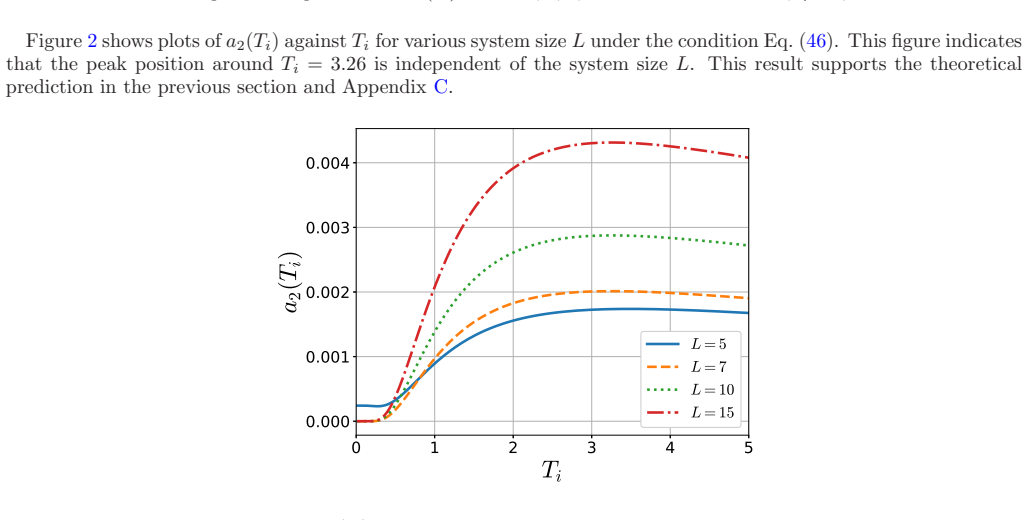
The coefficient a2(Ti) that multiplies the first non-trivial even-parity non-Hermitian mode has a non-monotonic intermediate peak with respect to preparation temperature Ti. The peak is a universal topological consequence of the Sturm-Liouville oscillation theorem together with the Boltzmann weights of the closed system; its location is rigorously independent of the global system size L. When the timescale separation Gamma2 much greater than Gamma0 and Gamma1 also holds, this peak produces anomalous crossings in the survival probability S(t,Ti) and the trace distance D(t,Ti).
What carries the argument
The biorthogonal spectral coefficient a2(Ti) obtained by projecting the initial thermal density matrix of the closed double well onto the second even-parity right eigenmode of the non-Hermitian effective Hamiltonian that includes complex absorbing potentials at the boundaries. Its non-monotonicity is proved by asymptotic limits plus a constructive intermediate overlap forced by nodal matching.
Load-bearing premise
Visible crossings in the actual survival and distance traces still require the over-barrier decay rate to be much larger than the slow rates of the deep-well tunneling doublet, plus weak enough absorption that the key overlap stays constructive.
What would settle it
Numerically or experimentally prepare the same continuous double-well with absorbing edges under conditions where Gamma2 is not much larger than Gamma0 and Gamma1, or where absorption is ultra-strong, and check whether the intermediate peak of a2 survives while the crossings in S(t) and D(t) disappear.
If this is right
- The optimal initial temperature that maximises the anomalous mode is fixed by the internal level spacing of the closed well and need not be re-tuned when the absorbing walls are moved farther away.
- Tailored complex absorbing layers can be used as a design element to accelerate preparation of low-lying coherent states without changing the core potential.
- The same nodal-matching argument continues to guarantee a peak even if the double well is made asymmetric, so the effect is topologically protected against detuning.
- Any monotone distance that inherits the same spectral weights will exhibit the same anomalous ordering once the timescale separation is satisfied.
Where Pith is reading between the lines
- Because the peak is size-independent while classical Mpemba peaks are not, continuous open quantum systems may furnish a cleaner platform for isolating purely topological contributions to anomalous relaxation.
- The same construction should apply to any one-dimensional potential whose low-lying even states have well-defined nodes that can align with a boundary-damped decay channel.
- If the CAP profile can be modulated in time, one could switch the anomalous channel on and off, offering an active control protocol for quantum state preparation.
Editorial analysis
A structured set of objections, weighed in public.
Referee Report
Summary. The manuscript formulates a continuous, real-space quantum tunneling Mpemba effect for a particle in a symmetric double-well potential subject to complex absorbing potentials (CAPs) at the outer boundaries. Using a non-Hermitian effective Hamiltonian and biorthogonal spectral decomposition, the authors prove that the first nontrivial even-parity spectral weight a2(Ti) is non-monotonic in the initial temperature Ti: it vanishes at Ti→0 and Ti→∞ and is strictly positive at an intermediate scale set by the second even level, by Sturm–Liouville nodal alignment (O22>0) under weak-to-moderate CAP. They further show that the location of this peak is asymptotically independent of system size L once core states are exponentially isolated from the boundaries (Appendix C), in contrast to classical boundary-driven Mpemba. Observation of anomalous crossings in the survival probability S(t,Ti) and the trace distance D(t,Ti) is stated to require the additional timescale separation Γ2≫Γ0,Γ1. Numerical diagonalization of a quartic double well (N=1200 grid) reproduces the peak, its L-independence, and crossings in S and D for a fixed CAP parameter set.
Significance. If the claims hold, the work supplies a concrete real-space bridge between classical boundary-driven Mpemba (hard/soft walls) and open quantum dynamics, without relying on abstract discrete quenches. The existence proof for a non-monotonic a2(Ti) via asymptotic thermal limits, Parseval boundedness, and Sturm–Liouville node counting is carefully written and largely parameter-free once O22>0 is granted; the asymptotic L-invariance argument in Appendix C is a clear conceptual distinction from the classical 1D case. Explicit numerical confirmation of the peak, L-independence, and S/D crossings, together with the stated rate-separation caveat, makes the central mechanism falsifiable and useful for engineering boundary-loss protocols. The continuous CAP–Lindblad mapping (Sec. II) is a solid technical contribution for the community.
major comments (3)
- Appendix A (esp. Eqs. A12–A23) and Sec. III C: the reduction of S(t,Ti) to a purely diagonal sum ∑k ak(Ti)e−Γkt rests on claiming Tr[|φk⟩⟨φj|]=⟨φj|φk⟩=0 for k≠j. The Wronskian argument yields vanishing of the complex-symmetric bilinear form ∫φj φk dx (no conjugation), which is the biorthogonal product, not the Hilbert-space inner product that appears in the ordinary trace. For genuinely complex CAP eigenfunctions these two forms differ. The manuscript should either (i) prove that the Hilbert-space overlaps that enter the trace vanish (or cancel by parity/phase) to the same order, or (ii) state clearly that the diagonal formula is an approximation controlled by max|W|/|Ej−Ek| and grid error, and quantify that error for the parameters of Sec. V. This is load-bearing for the claimed exact spectral expansion of S.
- Sec. V and abstract: the observation of crossings in S(t,Ti) and D(t,Ti) is conditioned on Γ2≫Γ0 and Γ2≫Γ1, yet the numerical section never reports the actual complex eigenvalues (or Γk) for the chosen (L,η,xabs) set. Without those rates it is impossible to verify that the displayed crossings (Figs. 3, 6) sit inside the claimed separation window rather than arising from higher-mode or coherence effects. Please add a table or inset of the lowest few Γk (and En) for the parameters of Eq. (46) and, ideally, a brief scan showing when the crossings disappear as the separation is reduced (e.g., by lowering the barrier or increasing η into the Zeno regime of Sec. III E).
- Sec. III D Lemma 3 / Sec. III E: the existence of the intermediate peak is conditional on O22>0, which the authors correctly restrict to weak-to-moderate CAP and a sufficiently deep well. The numerical demonstration uses a single quartic and a single CAP strength (η=5). To support the claim of a “universal topological property,” at least a short parameter check that O22 remains positive (and that a2 still peaks) for a second potential shape or a range of η below the Zeno threshold would substantially strengthen the result; otherwise the wording should be softened to “universal within the moderate-CAP, deep-well window.”
minor comments (5)
- Fig. 1–6 captions and Sec. V: units of Ti, t, and the potential coefficients are never stated (ℏ=m=kB=1?). A single sentence on units would help reproducibility.
- Eq. (4) and the text introduce a power n for the CAP profile, but the numerics never specify n; please state the value used.
- Sec. IV B: the discussion of “multiple quantum Mpemba crossings” in ΔD(t) ends by noting that monotonicity of D prevents oscillation, then suggests choosing “a proper variable.” Either define that variable or shorten the paragraph to avoid an unfinished claim.
- Typos / notation: “Tini” vs Ti (p. 3); “ak,j (Ti can be rewritten” missing parenthesis (Sec. IV); “¯Γ0,1” definition is clear but the approximation Γ0≈Γ1 should be checked against the numerics once Γk are reported.
- References: the classical boundary-driven papers [45–47] are central to the contrast; ensure the arXiv identifiers remain stable or update to published versions if available before final submission.
Circularity Check
No significant circularity: a2(Ti) peak existence and L-invariance follow from independent asymptotic limits, Parseval, and Sturm-Liouville nodal alignment; self-citations to classical work are contrast only.
specific steps
-
self citation load bearing
[Sec. III D final paragraph + Appendix C 4; also abstract and Sec. VI B]
"This is an interesting result because the result in a symmetric double-well potential in the classical Fokker-Planck equation strongly depends on the system size [46]. ... See Appendix C 4 for the physical origin of the difference between classical and quantum Mpemba effects. ... In the classical one-dimensional overdamped Langevin dynamics [45, 46], the Mpemba effect is entirely boundary-driven; it depends strictly on the system size L and vanishes completely as L → ∞"
The only self-citations that touch the central claim are the authors’ own classical Mpemba papers, invoked solely to highlight the contrast that the quantum peak is L-invariant while the classical one is not. They supply no algebraic premise, uniqueness theorem, or fitted input that forces the quantum a2 peak or its L-independence; the quantum proofs stand alone. This is therefore a minor, non-load-bearing self-citation (score contribution ~1).
full rationale
The central derivation (Sec. III D Lemmas 1–3 + Theorem) defines a2(Ti) via the biorthogonal overlaps Onm of the unperturbed thermal ensemble with the non-Hermitian modes, then proves a non-monotonic intermediate peak solely from lim Ti→0 a2=0 (localization mismatch O20≈0), lim Ti→∞ a2=0 (Parseval + Z→∞), and a2(T*)>0 at the nodal-matching temperature (Sturm-Liouville two-node topology preserved under weak CAP). Existence then follows by continuity + Extreme-Value/Rolle; nothing is defined in terms of a fitted peak temperature or Mpemba crossing. Appendix C shows asymptotic L-invariance of Topt from exponential isolation of bound states (κn L ≫1) plus Boltzmann suppression of continuum, again without circular input. Self-citations to the authors’ classical boundary-driven results [45–47] appear only for contrast (classical peak depends on L; quantum does not) and are not used as premises inside the quantum existence or invariance proofs. Numerical confirmation (Sec. V) simply evaluates the same independently defined coefficients for a concrete potential; no parameters are fitted to force the peak or the crossings. The timescale-separation caveat (Γ2 ≫ Γ0,1) required for observable S(t) and D(t) crossings is stated explicitly and does not enter the spectral-peak argument. The derivation chain is therefore self-contained against its own inputs.
Axiom & Free-Parameter Ledger
free parameters (4)
- absorption strength η
- absorption layer width xabs and power n
- system half-length L relative to core radius xc
- barrier height / potential scale Vb (quartic coefficients)
axioms (5)
- domain assumption Conditional no-jump GKSL dynamics with continuous position-local Lindblad operators is exactly equivalent to Schrödinger evolution under Heff = H0 − iW (CAP).
- standard math Sturm-Liouville oscillation theorem: the m-th even eigenfunction of a 1D regular Sturm-Liouville problem has exactly the nodal count that matches the open even mode φ2 under weak CAP.
- domain assumption Complex-symmetric biorthogonal normalization ∫[φn(x)]² dx = 1 with no conjugation, and Dirichlet walls at ±L.
- domain assumption Initial state is a thermal mixture of the closed Hermitian H0 eigenstates; environment is effectively Tfinal=0 (only absorption).
- ad hoc to paper Under weak-to-moderate CAP the leading perturbation of |φ2⟩ preserves two-node core topology so O22 remains strictly positive.
read the original abstract
The quantum tunneling Mpemba effect is investigated within a continuous one-dimensional symmetric double-well potential open to external environmental sinks at the boundaries ($x=\pm L$). Using a non-Hermitian spectral decomposition of the effective Hamiltonian, we characterize the open-system relaxation dynamics without relying on abstract state-space quenches. We mathematically prove that the non-monotonic behavior of the first non-trivial even-parity spectral coefficient, $a_{2}(T_{i})$, with respect to the initial preparation temperature $T_{i}$ is a universal topological property born from quantum statistical mechanics. Crucially, we demonstrate that this intermediate thermal peak is governed by the Sturm-Liouville oscillation theorem and remains completely invariant with respect to the global system size $L$, contrasting sharply with the boundary-driven classical Mpemba effect. This universal peak arises from the geometric and nodal alignment between highly localized unperturbed states and extended non-Hermitian decay channels. Furthermore, we clarify that while this mechanism is robust, the actual observation of anomalous crossings in the total survival probability trace $S(t,T_{i})$ and the trace distance $\mathcal{D}(t,T_i)$ demand a strict separation of timescales, requiring the over-barrier escape rate to vastly exceed the decay rate of the deep-well tunneling doublet ($\Gamma_{2}\gg \Gamma_{0}$ and $\Gamma_2\gg \Gamma_1$). Our continuous formulation successfully bridges real-space classical boundary-driven dissipation with open quantum dynamics, providing novel insights for engineering non-equilibrium states via tailored boundary loss.
Figures



Forward citations
Cited by 1 Pith paper
-
Quantization of the classical Mpemba effect
Quantization of the classical bistable-potential Mpemba effect shifts anomalous relaxation to ultra-cold temperatures and produces inverse and double-inverse Mpemba effects absent in classical dynamics.
Reference graph
Works this paper leans on
-
[1]
hot” system to reach the vacuum state faster than the “cold
with standard hard-wall Dirichlet boundary conditions at the absolute terminal gr id boundaries: φ n(±L) = 0. (14) The continuous right-eigenfunctions φ n(x) form a discrete but non-orthogonal set, which must be treated under the rules of non-Hermitian biorthogonal quantum mechanics. B. Initial Thermal Distribution and Mpemba Criterion We assume the syste...
-
[2]
Crucially, as an operator equation, it must strictly retain the off-diagonal coherence terms (k ̸= j)
represents the corrected long-time expansion of the density ma trix operator. Crucially, as an operator equation, it must strictly retain the off-diagonal coherence terms (k ̸= j). However, when evaluating the physical survival probability S(t,T i), the unperturbed closure relation ∑ n |n⟩⟨n| = ˆI combined with the spatial inversion symmetry of the absorpt...
-
[3]
Lemma 1: The Low-Temperature Asymptotic Limit In the deep low-temperature limit ( Ti → 0+), the thermal energy scale vanishes relative to the discrete level spacing of the double well (kBTi ≪ E2 − E0). The partition function is asymptotically dominated by the ground- state doublet: Z(Ti) = e− E0/k B Ti [ 1 +e− ∆ 0/k B Ti + O ( e− (E2− E0)/k B Ti )] , (27)...
-
[4]
Consequently, the Boltzmann factors approach unity uniformly across the spectrum: lim Ti→∞ e− Em/k B Ti = 1 ∀m ∈ N0
Lemma 2: The High-Temperature Asymptotic Limit In the limit of infinitely high preparation temperature ( Ti → ∞ ), the thermal energy scale diverges beyond all bound energy eigenvalues ( kBTi ≫ Em). Consequently, the Boltzmann factors approach unity uniformly across the spectrum: lim Ti→∞ e− Em/k B Ti = 1 ∀m ∈ N0. (30) Under this condition, the partition f...
-
[5]
Lemma 3: Intermediate Temperature Activation Let there exist an intermediate activation temperature T ∗ such that the thermal energy scale directly matches the unperturbed excitation energy of the second level, kBT ∗ := E2 − E0. At this specific thermodynamic point, the Boltzmann weight corresponding to the m = 2 unperturbed state is non-vanishing and macr...
-
[6]
Theorem: Existence of a Local Maximum The spectral coefficient a2(Ti) is a continuous and differentiable smooth function of Ti on the non-negative real domain Ti ∈ [0, ∞ ), as it is composed of a ratio of well-behaved exponential sums with a non-zero denominator (Z(Ti) ≥ 1). By combining Lemma 1, Lemma 2, and Lemma 3, we have shown that a2(Ti) originates at ...
-
[7]
To construct a well-defined spectral decomposition, we invoke the fr amework of biorthogonal quantum mechanics
Biorthogonal Quantum Framework Because the effective Hamiltonian ˆHeff = ˆH0 − i ˆW is non-Hermitian due to the complex absorbing potential (CAP) ˆW , its eigenvalues are complex, and its right-eigenstates are not ort hogonal to one another in the usual sense. To construct a well-defined spectral decomposition, we invoke the fr amework of biorthogonal quantu...
-
[8]
The conditional, non-unitary time-evolution operator is given by: ˆUeff (t) = e− i ˆHeff t/ ℏ
Time Evolution under the No-Jump Condition In an experiment where particles reaching the boundaries are perm anently absorbed, tracking the remaining pop- ulation in the core potential is mathematically equivalent to conditionin g the system’s density matrix ˆ ρ(t) on a sub-ensemble where zero quantum jumps have occurred up to time t. The conditional, non...
-
[9]
Let {|n⟩} be the orthonormal eigenstates of ˆH0
Initial Preparation and Mixed State Evolution The system is initially prepared at t = 0 in a canonical thermal equilibrium state governed by the closed, u nperturbed Hermitian Hamiltonian ˆH0. Let {|n⟩} be the orthonormal eigenstates of ˆH0. The initial density matrix is written as: ˆρ(0) = ∑ n Pn(Ti)|n⟩⟨n|, (A7) 17 where Pn(Ti) are the standard Boltzmann...
-
[10]
(A11) Taking the trace of Eq
Proof of Cross-Mode Elimination in the Survival Trace The total survival probability S(t,T i) is defined as the linear trace of the surviving density matrix within th e bounded domain: S(t,T i) := Tr[ ˆρ(t)]. (A11) Taking the trace of Eq. ( A10) and pulling out the scalar quantities yields: S(t,T i) = ∑ k,j e− i(λ k− λ ∗ j )t/ ℏ [ ∑ n Pn(Ti)⟨χ k|n⟩⟨n|χ j⟩ ...
-
[11]
Implicit Formulation of the Peak Extremum We begin by recalling the definition of the diagonal spectral coefficien t an(Ti) under the biorthogonal basis repre- sentation (see Eq. ( 23) for n = 2): an(Ti) = 1 Z(βi) ∑ m e− β iEm(L) |Onm(L)|2, (C1) where βi := 1/ (kBTi), Z(βi) = ∑ me− β iEm(L) is the unperturbed canonical partition function, and the structu ral...
-
[12]
By cross-multiplying the denominators from Eq
Asymptotic Sensitivity Analysis via Implicit Differenti ation We define the implicit scalar function F (βi,L ) := ⟨E⟩n,β i − ⟨ E⟩0,β i = 0. By cross-multiplying the denominators from Eq. ( C4), F (βi,L ) can be cast into the form: F (βi,L ) = ∑ m,k [Em(L) − Ek(L)]e− β i[Em(L)+Ek(L)] |Onm(L)|2 = 0. (C6) By virtue of the implicit function theorem, the variati...
-
[13]
Domain Decomposition and Boundary Suppression To analyze Eq. ( C8) when L ≫ xc, we segment the discrete energy spectrum into two decoupled phy sical sectors: the bound core state space ( Sbound, where Em < V(±L)) and the high-energy continuous scattering space ( Scont, where Em ≥ V (±L)). a. 1. The Bound State Sector ( n, k ∈ S bound) For deeply bound cor...
-
[14]
likes to hit a wall
Physical Contrast with the Classical Overdamped Case It is highly instructive to contrast this quantum asymptotic invarian ce with the classical Mpemba effect governed by the overdamped Fokker-Planck equation, where the optimal re laxation temperature exhibits a strong, explicit dependence on the system size L [45, 46]. In an overdamped classical system, k...
-
[15]
E. B. Mpemba and D. G. Osborne, Cool?, Phys. Educ. 4, 172 (1969)
1969
-
[16]
H. C. Burridge and P. F. Linden, Questioning the Mpemba eff ect: hot water does not cool more quickly than cold, Sci. Rep. 6, 37665 (2016)
2016
-
[17]
J. I. Katz, Reply to Burridge & Linden: Hot water may freez e sooner than cold, arXiv:1701.03219
-
[18]
G. Teza, J. Bechhoefer, A. Lasanta, O. Raz, and M. Vucelja , Speedups in nonequilibrium thermal relaxation: Mpemba and related effects, Phys. Rep. 1164, 1 (2026)
2026
-
[19]
Bechhoefer, A
J. Bechhoefer, A. Kumar, and R. Ch´ etrite, A fresh unders tanding of the mpemba effect, Nat. Rev. Phys. 3, 534 (2021)
2021
-
[20]
Lu and O
Z. Lu and O. Raz, Nonequilibrium Thermodynamics of the Ma rkovian Mpemba Effect and Its Inverse, Proc. Natl. Acad. Sci. U.S.A. 114, 5083 (2017)
2017
-
[21]
Klich, O
I. Klich, O. Raz, O. Hirschberg, and M. Vucelja, Mpemba In dex and Anomalous Relaxation, Phys. Rev. X 9, 021060 (2019)
2019
-
[22]
D. M. Busiello, D. Gupta, amd A. Maritan, Inducing and opt imizing Markovian Mpemba effect with stochastic reset, New J. Phys. 23, 103012 (2021)
2021
-
[23]
I. G. Pemartin, E. Momp´ o, A. Lasanta, V. Martin-Mayor, a nd J. Salas, Shortcuts of Freely Relaxing Systems Using Equilibrium Physical Observables, Phys. Rev. Lett. 132, 117102 (2024)
2024
-
[24]
Yang and J.-X
Z.-Y. Yang and J.-X. Hou, Non-Markovian Mpemba effect in mean-field systems, Phys. Rev. E 101, 052106 (2020)
2020
-
[25]
Baity-Jesi, E
M. Baity-Jesi, E. Calore, A. Cruz, L. A. Fernandez, J. M. Gil-Narvi´ on, A. Gordillo-Guerrero, D. I˜ niguez, A. Lasanta, A. Maiorano, E. Marinari, V. Martin-Mayor, J. Moreno-Gordo, A . Mu˜ noz Sudupe, D. Navarro, G. Parisi, S. Perez-Gaviro, F. Ricci-Tersenghi, J. J. Ruiz-Lorenzo, S. F. Schifano, B. Seo ane, A. Taranc´ on, R. Tripiccione, and D. Yllanes, T...
2010
-
[26]
Chatterjee, S
S. Chatterjee, S. Ghosh, N. Vadakkayi, Tanay Paul, S. K. Singha, and S. K. Das, Mpemba effect in pure spin systems : A universal picture of the role of spatial correlations at ini tial states, Phys. Rev. E 110, L012103 (2024)
2024
-
[27]
Lasanta, F
A. Lasanta, F. Vega Reyes, A. Prados, and A. Santos, When the Hotter Cools More Quickly: Mpemba Effect in Granular Fluids, Phys. Rev. Lett. 119, 148001 (2017)
2017
-
[28]
Torrente, M
A. Torrente, M. A. L´ opez-Casta˜ no, A. Lasanta, F. Vega Reyes, A. Prados, and A. Santos, Large Mpemba-like effect in a gas of inelastic rough hard spheres, Phys. Rev. E 99, 060901(R) (2019)
2019
-
[29]
Biswas, V
A. Biswas, V. V. Prasad, O. Raz, and R. Rajesh, Mpemba effe ct in driven granular gas, Phys. Rev. E 102, 012906 (2020)
2020
-
[30]
Biswas, V
A. Biswas, V. V. Prasad, and R. Rajesh, Mpemba effect in an anisotropically driven granular Maxwell gases, EPL 136, 46001 (2021)
2021
-
[31]
Momp´ o, M
E. Momp´ o, M. A. L´ opez Casta˜ no, A. Lasanta, F. Vega Rey es, and A. Torrente, Memory effects in a gas of viscoelastic particles, Phys. Fluids 33, 062005 (2021)
2021
-
[32]
Meg ´ ıas and A
A. Meg ´ ıas and A. Santos, Mpemba-like effect protocol fo r granular gases of inelastic and rough hard disks, Front. Phys. 10, 971671 (2022)
2022
-
[33]
Patr´ on, B
A. Patr´ on, B. S´ anchez-Rey, C. A. Plata, and A. Prados, Non-equilibrium memory effects: Granular fluids and beyond, EPL 143, 61002 (2023)
2023
-
[34]
Meg ´ ıas, A
A. Meg ´ ıas, A. Santos, and A. Prados, Thermal versus ent ropic Mpemba effect in molecular gases with nonlinear drag, Phys. Rev. E 105, 054140 (2022)
2022
-
[35]
Biswas, V
A. Biswas, V. V. Prasad, and R. Rajesh, Mpemba effect in dr iven granular gases: Role of distance measures, Phys. Rev. E 108, 024902 (2023)
2023
-
[36]
Santos and A
A. Santos and A. Prados, Mpemba effect in molecular gases under nonlinear drag, Phys. Fluids 32, 072010 (2020)
2020
-
[37]
Patr´ on, B
A. Patr´ on, B. S´ anchez-Rey, and A. Prados, Strong nonexponential relaxation and memory effects in a fluid with nonli near drag, Phys. Rev. E 104, 064127 (2021)
2021
-
[38]
Takada, H
S. Takada, H. Hayakawa, and A. Santos, Mpemba effect in in ertial suspensions, Phys. Rev. E 103, 032901 (2021)
2021
-
[39]
R. G. Gonz´ alez, N. Khalil, and V. Garz´ o, Mpemba-like e ffect in driven binary mixtures, Phys. Fluids 33, 053301 (2021)
2021
-
[40]
P. A. Greaney, G. Lani, G. Cicero, and J. C. Grossman, Mpe mba-Like Behavior in Carbon Nanotube Resonators, Metall. Mater. Trans. A 42, 3907 (2011)
2011
-
[41]
Gonz´ alez-Adalid Pemrt ´ ın, E
I. Gonz´ alez-Adalid Pemrt ´ ın, E. Momp´ o, A. Lasanta, V. Mart ´ ın-Mayor, and J. Salas, Slow growth of magnetic domai ns helps fast evolution routes for out-of-equilibrium dynami cs, Phys. Rev. E 104, 044114 (2021)
2021
-
[42]
Holtzman and O
R. Holtzman and O. Raz, Landau theory for the Mpemba effec t through phase transitions, Commun. Phys. 5, 280 (2022)
2022
-
[43]
J. Lin, K. Li, J. He, J. Ren, and J. Wang, Power statistics of Otto heat engines with the Mpemba effect, Phys. Rev. E 105, 014104 (2022)
2022
-
[44]
Santos, Mpemba meets Newton: Exploring the Mpemba an d Kovacs effects in the time-delayed cooling law, Phys
A. Santos, Mpemba meets Newton: Exploring the Mpemba an d Kovacs effects in the time-delayed cooling law, Phys. Rev. E 109, 044149 (2024)
2024
-
[45]
Biswas and A
A. Biswas and A. Pal, Mpemba effect on nonequilibrium act ive Markov chains, Phys. Rev. E 111, 054136 (2025)
2025
-
[46]
A. P. Antonov and H. L¨ owen, Temperature overshooting i n the Mpemba effect of frictional active matter, Phys. Rev. E 113, 025407 (2026) . 24
2026
-
[47]
Kumar and J
A. Kumar and J. Bechhoefer, Exponentially faster cooli ng in a colloidal system, Nature 584, 64 (2020)
2020
-
[48]
Kumar, Anomalous relaxation in colloidal systems, PhD thesis, Simon Fraser University, 2021
A. Kumar, Anomalous relaxation in colloidal systems, PhD thesis, Simon Fraser University, 2021
2021
-
[49]
Kumar, R
A. Kumar, R. Che´ etrite, and J. Bechhoefer, Anomalous h eating in a colloidal system, Proc. Natl. Acad. Sci. U.S.A. 119, e2118484119 (2022)
2022
-
[50]
Malhotra and H
I. Malhotra and H. L¨ owen, Double Mpemba effect in the coo ling of trapped colloids, J. Chem. Phys. 161, 164903 (2024)
2024
-
[51]
Y. Tian, Y. Zheng, L.-H. Liu, L. Wang, G.-C. Guo, and F.-W . Sun, Experimental study of Mpemba effect in an energy Langevin system, Phys. Rev. Res. 7, L042020 (2025)
2025
-
[52]
Biswas, R
A. Biswas, R. Rajesh and A. Pal, Mpemba effect in a Langevi n system: Population statistics, metastability, and other exact results, J. Chem. Phys. 159, 044120 (2023)
2023
-
[53]
Biswas, Mpemba effect in granular and Langevin system s, PhD thesis, The Institute of Mathematical Sciences, Chenna i, 2023
A. Biswas, Mpemba effect in granular and Langevin system s, PhD thesis, The Institute of Mathematical Sciences, Chenna i, 2023
2023
-
[54]
Ch´ etrite, A
R. Ch´ etrite, A. Kumar, and J. Bechhoefer, The Metastab le Mpemba Effect Corresponds to a Non-monotonic Temperature Dependence of Extractable Work, Front. Phys. 9, 654271 (2021)
2021
-
[55]
M. R. Walker and M. Vucelja, Anomalous thermal relaxati on of Langevin particles in a piecewise-constant potential , J. Stat. Mech.: Theory Exp. (2021) 113105
2021
-
[56]
Deg¨ unther and U
J. Deg¨ unther and U. Seifert, Anomalous relaxation fro m a non-equilibrium steady state: An isothermal analog of th e Mpemba effect, EPL 139, 41002 (2022)
2022
-
[57]
N. Ohga, H. Hayakawa, and S. Ito, Microscopic theory of M pemba effects and a no-Mpemba theorem for monotone many-body systems, arXiv:2410.06623
-
[58]
Van Vu and H
T. Van Vu and H. Hayakawa, Thermomajorization Mpemba Eff ect, Phys. Rev. Lett. 134, 107101 (2025)
2025
-
[59]
Y. Liu, T. Van Vu, R. Ch´ etrite, F. van Wijland, and H. Hay akawa, The Mpemba effect likes to hit a wall, arXiv:2604.01543
-
[60]
Y. Liu, Tan Van Vu, R. Ch´ etrite, F. van Wijland, and H. Ha yakawa, Predicting the conditions for observing the Mpemba effect, arXiv:2606.03445
-
[61]
H. Hayakawa and S. Takada, Mpemba effect in a two-dimensi onal bistable potential, arXiv:2603.24148
-
[62]
F. Ares, P. Calabrese, and S. Murciano, The quantum Mpem ba effects, Nat. Rev. Phys. 7, 451 (2025)
2025
-
[63]
T. Sagawa, Entropy, Divergence, and Majorization in Cl assical and Quantum Thermodynamics (Springer-Brief in Mat he- matical Physics, Springer, Singapore, 2022). See also arXiv:2007.09974
Pith/arXiv arXiv 2022
-
[64]
Nava and M
A. Nava and M. Fabrizio, Lindblad dissipative dynamics in the presence of phase coexistence, Phys. Rev. B. 100, 125102 (2019)
2019
-
[65]
Carollo, A
F. Carollo, A. Lasanta, and I. Lesanovsky, Exponential ly Accelerated Approach to Stationarity in Markovian Open Q uan- tum Systems through the Mpemba Effect, Phys. Rev. Lett. 127, 060401 (2021)
2021
-
[66]
S. K. Manikandan, Equidistant quenches in few-level qu antum systems, Phys. Rev. Res. 3, 043108 (2021)
2021
-
[67]
Ivander, N
F. Ivander, N. Anto-Sztrikacs, and D. Segal, Hyperacce leration of quantum thermalization dynamics by bypassing l ong- lived coherences: An analytical treatment, Phys. Rev. E 108, 014130 (2023)
2023
-
[68]
Moroder, O
M. Moroder, O. Culhane, K. Zawadzki, and J. Goold, Therm odynamics of the quantum Mpemba effect, Phys. Rev. Lett. 133, 140404 (2024)
2024
-
[69]
F. Ares, S. Murciano, and P. Calabrese, Entanglement as ymmetry as a probe of symmetry breaking, Nat. Commun. 14, 2036 (2023)
2036
-
[70]
L. K. Joshi, J. Franke, A. Rath, F. Ares, S. Murciano, F. K ranzl, R. Blatt, P. Zoller, B. Vermersch, P. Calabrese, C. F. Roos, and M. K. Joshi, Observing the quantum Mpemba effect in quantu m simulations, Phys. Rev. Lett. 133, 010402 (2024)
2024
-
[71]
Rylands, K
C. Rylands, K. Klobas, F. Ares, P. Calabrese, S. Murcian o, and B. Bertini, Microscopic Origin of the Quantum Mpemba Effect in Integrable Systems, Phys. Rev. Lett. 133, 010401 (2024)
2024
-
[72]
Chalas, F
K. Chalas, F. Ares, C. Rylands, and P. Calabrese, Multip le crossing during dynamical symmetry restoration and impl ica- tions for the quantum Mpemba effect, J. Stat. Mech. (2024) 103101
2024
-
[73]
F. Ares, V. Vitale, and Sara Murciano, The quantum Mpemb a effect in free-fermionic mixed states, Phys. Rev. B, 111, 104312 (2025)
2025
-
[74]
Yamashika, F
S. Yamashika, F. Ares, and P. Calabrese, Entanglement a symmetry and quantum Mpemba effect in two-dimensional free-fermion systems, Phys. Rev. B 110, 085126 (2024)
2024
-
[75]
Liu, H.-K
S. Liu, H.-K. Zhang, S. Yin, and S.-X. Zhang, Symmetry Re storation and Quantum Mpemba Effect in Symmetric Random Circuits, Phys. Rev. Lett. 133, 140405 (2024)
2024
-
[76]
Turkeshi, P
X. Turkeshi, P. Calabrese, and A. De Luca, Quantum Mpemb a Effect in Random Circuits, Phys. Rev. Lett. 135, 040403 (2025)
2025
-
[77]
Yamashika and F
S. Yamashika and F. Ares, Quantum Mpemba Effect in Long-R ange Spin Systems, Phys. Rev. Lett. 136, 090402 (2026)
2026
-
[78]
S. Yamashika and R. Hamazaki, Quantum Many-Body Mpemba Effect through Resonances, arXiv:2603.11788
-
[79]
Yang and J.-X
Z.-Y. Yang and J.-X. Hou, Non-Markovian Mpemba effect in mean-field systems, Phys. Rev. E 105, 014119 (2022)
2022
-
[80]
D. J. Strachan, A. Purkayastha, and S. R. Clark, Non-Mar kovian Quantum Mpemba Effect, Phys. Rev. Lett. 134, 220403 (2025)
2025
discussion (0)
Sign in with ORCID, Apple, or X to comment. Anyone can read and Pith papers without signing in.