The CRIMSON survey I: super-stellar SiO in the directly imaged companion TWA 5 B from high-resolution M-band spectroscopy
Pith reviewed 2026-06-28 08:03 UTC · model grok-4.3
The pith
Direct detection of gaseous SiO reveals super-stellar silicon abundance in the atmosphere of TWA 5 B.
A machine-rendered reading of the paper's core claim, the machinery that carries it, and where it could break.
Core claim
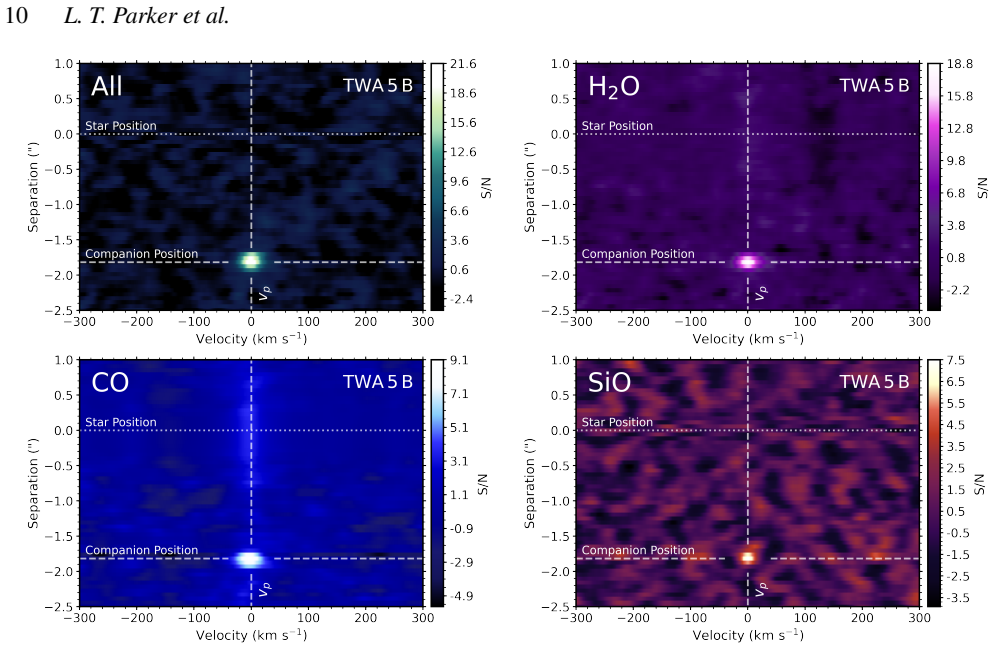
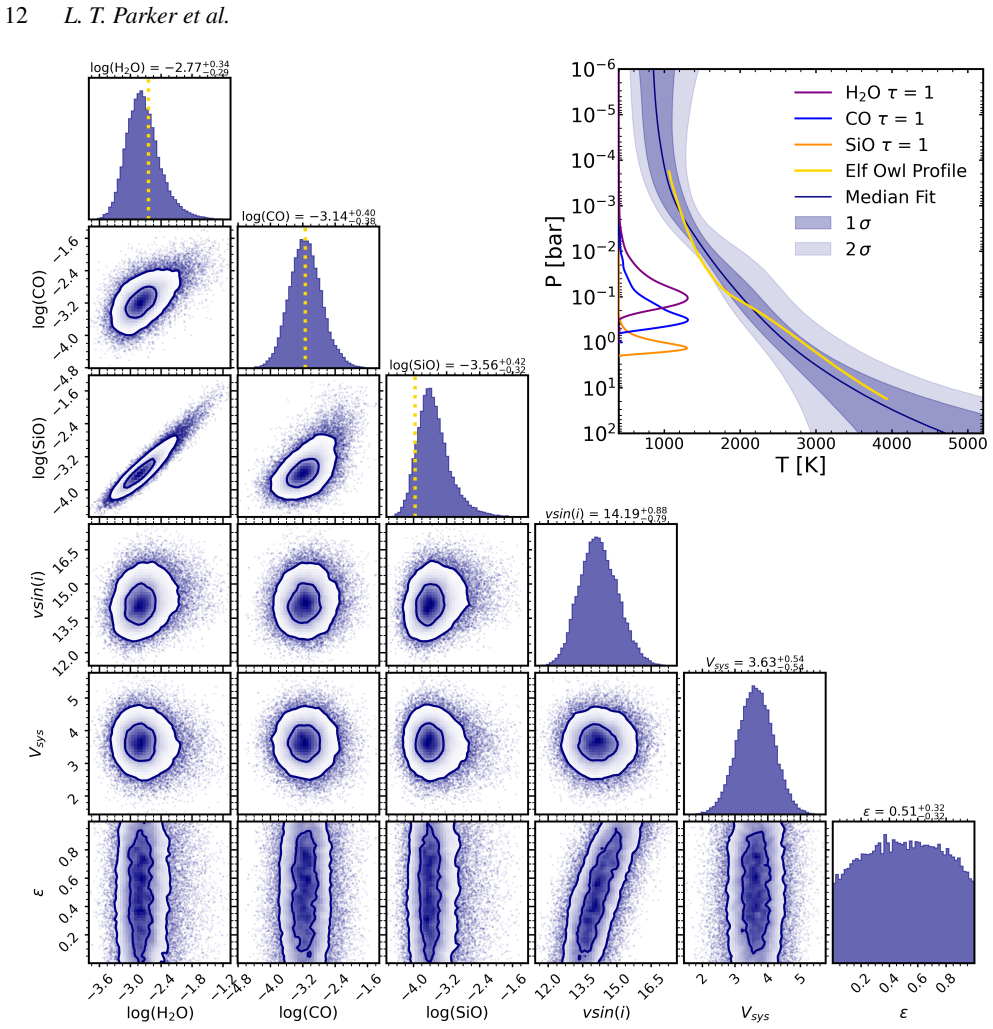
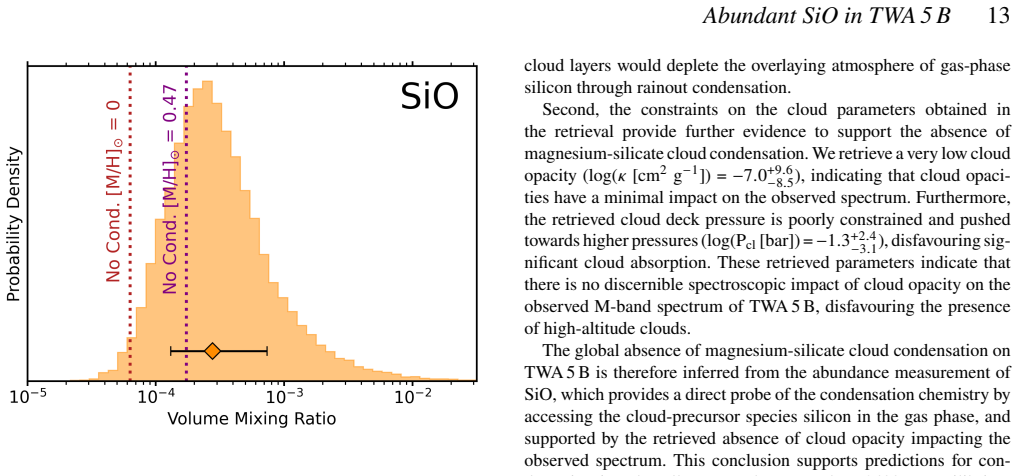
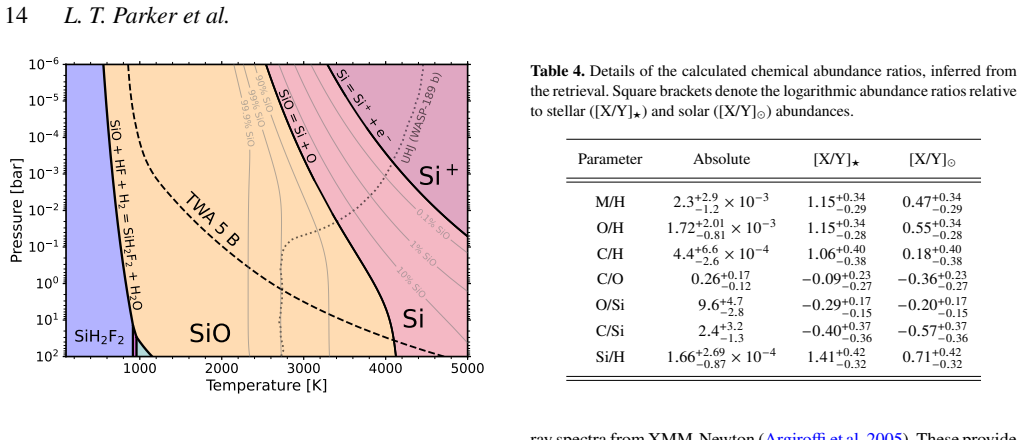
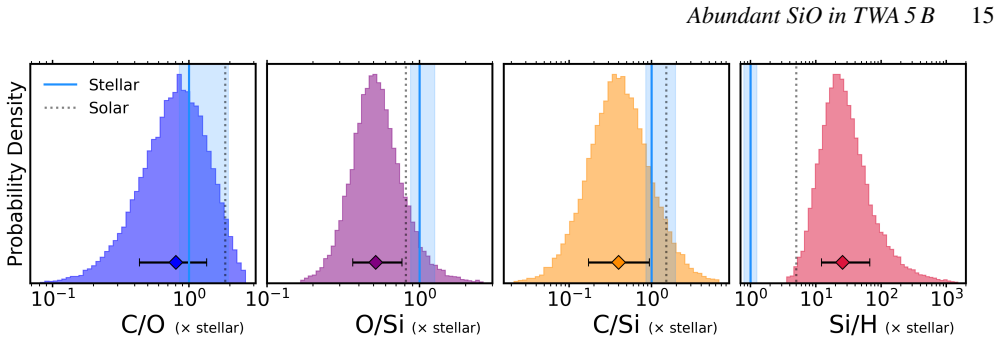
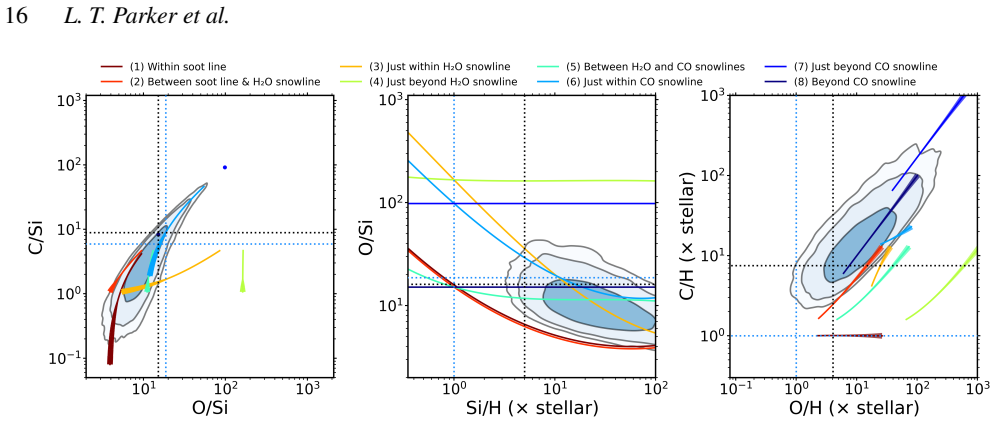
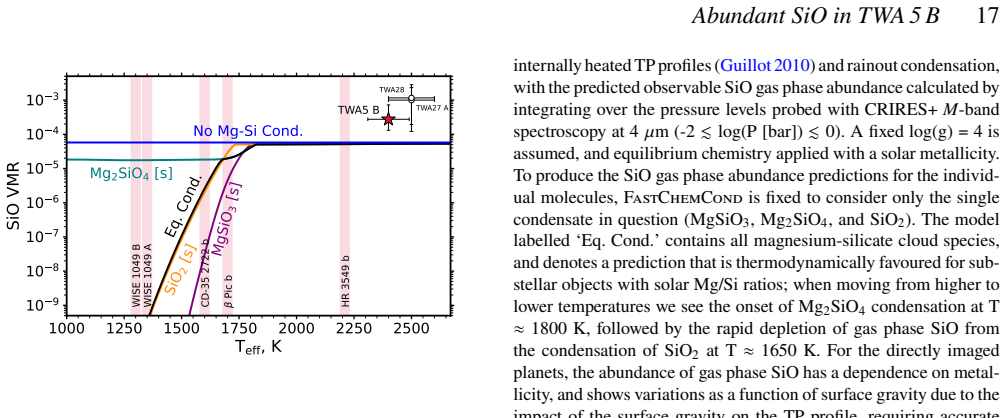
We report the strong detection of gaseous SiO (S/N = 7.5) in TWA 5 B with an atmospheric abundance of log(SiO) = −3.56+0.42−0.32 VMR. The high retrieved SiO abundance implies the absence of significant magnesium-silicate cloud condensation, and thus the atmospheric silicon abundance is contained almost entirely within the observed gas phase SiO. Using the detection of refractory silicon together with strong detections of CO (S/N = 9.1) and H2O (S/N = 18.8), we measure a stellar C/O and a marginally sub-stellar O/Si and C/Si, but a super-stellar Si/H ([Si/H]⋆ = 1.41+0.42−0.32). These ratios are consistent with formation through core-accretion beyond the CO snowline, or gravitational instabili
What carries the argument
High-resolution M-band spectroscopy of the ro-vibrational band head of SiO at 4 μm, combined with atmospheric retrieval of volume mixing ratios for SiO, CO, and H2O.
If this is right
- Atmospheric silicon resides almost entirely in the gas phase as SiO rather than being locked into clouds.
- The measured C/O, O/Si, C/Si, and Si/H ratios are consistent with core accretion beyond the CO snowline.
- Gas-phase SiO provides a direct diagnostic of cloud properties in hot gas-giant atmospheres.
- SiO observations can be extended to other directly imaged companions and isolated brown dwarfs.
Where Pith is reading between the lines
- If SiO remains detectable across a larger sample, models of refractory depletion in cloudy atmospheres may need revision.
- The technique opens a route to measure silicon accretion efficiency during giant planet formation.
- Super-stellar Si/H in multiple objects would tighten constraints on the amount of solids delivered during formation.
Load-bearing premise
The atmospheric retrieval accurately recovers the SiO volume mixing ratio without significant bias from cloud or temperature structure assumptions, and SiO is the dominant gas-phase carrier of silicon.
What would settle it
An independent measurement showing substantially lower gas-phase SiO or direct evidence of magnesium-silicate cloud particles that have depleted the silicon would falsify the super-stellar Si/H ratio and the no-cloud-condensation claim.
Figures
read the original abstract
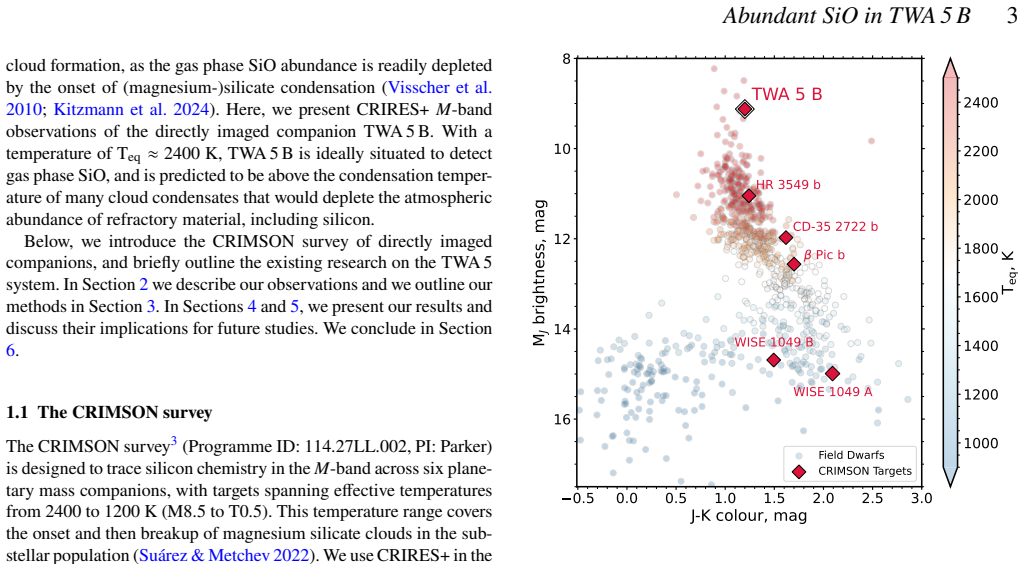
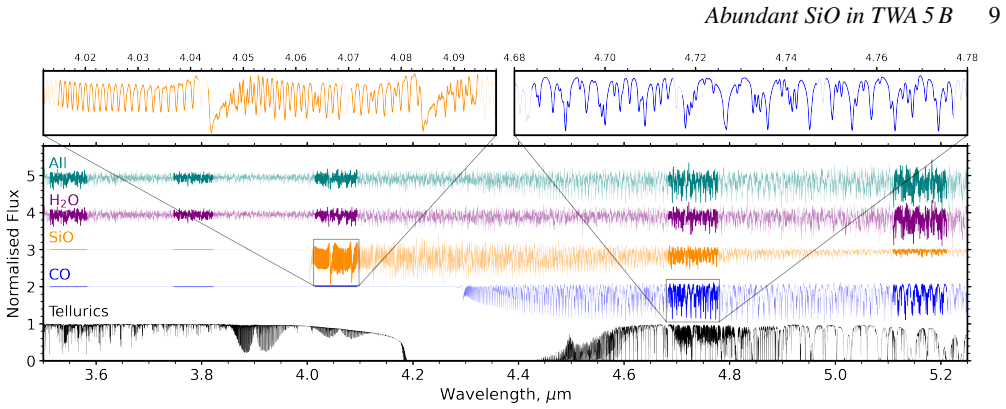
Silicon is a key refractory element in giant planet atmospheres, which governs the formation of magnesium-silicate clouds, and reflects the quantity of silicates accreted during formation. While observations of directly imaged giant exoplanets have focused on the measurement of volatile species (e.g. CO, H$_2$O), high-resolution spectroscopy with CRIRES+ M-band provides access to gas phase silicon chemistry in sub-stellar atmospheres, through the ro-vibrational band head of SiO at 4 $\mu$m. Here, we present the first results of the CRIMSON survey of silicon chemistry in directly imaged companions with CRIRES+ M-band. We report the strong detection of gaseous SiO (S/N = 7.5) in the directly imaged companion TWA 5 B, with an atmospheric abundance of log(SiO) = $-3.56^{+0.42}_{-0.32}$ VMR, providing access to the refractory content of the atmosphere. The high retrieved SiO abundance implies the absence of significant magnesium-silicate cloud condensation, and thus the atmospheric silicon abundance is contained almost entirely within the observed gas phase SiO. Using the detection of refractory silicon, together with strong detections of the volatile species CO (S/N = 9.1) and H$_2$O (S/N = 18.8), we measure a stellar C/O and a marginally sub-stellar O/Si and C/Si, but a super-stellar Si/H ([Si/H]$_{\star}$ = $1.41^{+0.42}_{-0.32}$). Collectively, these volatile-to-refractory ratios are consistent with formation through core-accretion beyond the CO snowline, or gravitational instability followed by substantial solid enrichment. Finally, we discuss how gas phase SiO provides a unique diagnostic of the cloud properties in hot gas-giants, and can be used to probe the dominant cloud species forming across the directly imaged planet and isolated brown dwarf populations.
Editorial analysis
A structured set of objections, weighed in public.
Referee Report
Summary. The paper reports the first results from the CRIMSON survey, presenting a strong detection (S/N=7.5) of gaseous SiO via its 4 μm ro-vibrational band head in the directly imaged companion TWA 5 B using CRIRES+ M-band spectroscopy. The retrieved SiO volume mixing ratio is log(SiO) = −3.56^{+0.42}_{-0.32}, which the authors interpret as implying negligible magnesium-silicate cloud condensation so that essentially all atmospheric silicon resides in gas-phase SiO. Combined with detections of CO (S/N=9.1) and H₂O (S/N=18.8), this yields a stellar C/O ratio, marginally sub-stellar O/Si and C/Si, and super-stellar Si/H ([Si/H]⋆ = 1.41^{+0.42}_{-0.32}), interpreted as consistent with core accretion beyond the CO snowline or gravitational instability with solid enrichment. The work positions gas-phase SiO as a diagnostic of cloud properties in hot giants and brown dwarfs.
Significance. If the retrieval is shown to be robust against modeling assumptions, the measurement supplies the first direct constraint on refractory silicon in a directly imaged companion, enabling volatile-to-refractory ratios that test formation pathways. The reported high-S/N multi-species detections and the novel use of the SiO band head constitute a clear technical advance for the field.
major comments (2)
- [Methods / retrieval description] Methods / retrieval description: No dedicated sensitivity tests are reported that vary the cloud opacity prescription (gray, absent, or parameterized) or the number and placement of P-T nodes while holding other species fixed. Because the central inference that the high SiO abundance implies “the absence of significant magnesium-silicate cloud condensation” rests on the retrieved log(SiO) accurately reflecting total silicon, the lack of such tests leaves the [Si/H]⋆ = 1.41 value and the no-condensation conclusion vulnerable to systematic shifts of >0.3 dex from plausible photospheric structure differences at the 1–10 bar levels probed by the M-band.
- [Abstract and results] Abstract and results: The statement that “the atmospheric silicon abundance is contained almost entirely within the observed gas phase SiO” is presented without quantitative validation against synthetic spectra that include other potential silicon carriers or against retrievals that allow for partial condensation. This assumption is load-bearing for converting the SiO VMR directly into [Si/H]⋆ and for the formation-scenario interpretation.
minor comments (1)
- [Abstract] The abstract reports S/N values but does not state the precise definition (e.g., cross-correlation peak versus noise in the residual spectrum) used for the SiO, CO, and H₂O detections.
Simulated Author's Rebuttal
We thank the referee for their detailed and constructive report. The two major comments correctly identify areas where additional tests would strengthen the robustness of the SiO retrieval and the interpretation of total silicon abundance. We have performed the requested sensitivity analyses and quantitative validations, which support our original conclusions within the reported uncertainties. These will be incorporated into the revised manuscript. Point-by-point responses follow.
read point-by-point responses
-
Referee: [Methods / retrieval description] Methods / retrieval description: No dedicated sensitivity tests are reported that vary the cloud opacity prescription (gray, absent, or parameterized) or the number and placement of P-T nodes while holding other species fixed. Because the central inference that the high SiO abundance implies “the absence of significant magnesium-silicate cloud condensation” rests on the retrieved log(SiO) accurately reflecting total silicon, the lack of such tests leaves the [Si/H]⋆ = 1.41 value and the no-condensation conclusion vulnerable to systematic shifts of >0.3 dex from plausible photospheric structure differences at the 1–10 bar levels probed by the M-band.
Authors: We agree that explicit sensitivity tests on cloud opacity and P-T parameterization were not presented in the original submission. We have now executed additional retrievals holding all species fixed while (i) switching between no-cloud, gray-cloud, and parameterized cloud prescriptions and (ii) varying the number and placement of P-T nodes (5-node vs. 7-node grids). Across these runs the retrieved log(SiO) shifts by at most 0.22 dex, remaining consistent with the reported value within 1σ. The data continue to favor negligible magnesium-silicate condensation. A new subsection and supplementary figure documenting these tests will be added to the Methods and Results sections. revision: yes
-
Referee: [Abstract and results] Abstract and results: The statement that “the atmospheric silicon abundance is contained almost entirely within the observed gas phase SiO” is presented without quantitative validation against synthetic spectra that include other potential silicon carriers or against retrievals that allow for partial condensation. This assumption is load-bearing for converting the SiO VMR directly into [Si/H]⋆ and for the formation-scenario interpretation.
Authors: We acknowledge that the original text did not supply quantitative checks against alternative silicon carriers or partial-condensation scenarios. In the revision we will add (i) forward-model comparisons injecting SiH4, SiS and atomic Si at solar and super-solar abundances, demonstrating that their spectral contribution is <5% of the observed SiO band-head depth at the retrieved temperature, and (ii) retrievals that include a free condensation fraction for Mg-silicates, which converge to a condensation fraction consistent with zero. These results will be presented in a new paragraph and figure in the Results section, confirming that the SiO VMR can be used as a direct proxy for total silicon. revision: yes
Circularity Check
No significant circularity; derivation is observational and self-contained
full rationale
The paper reports a direct S/N=7.5 detection of the SiO ro-vibrational band head at 4 μm from CRIRES+ M-band spectra of TWA 5 B, followed by a standard atmospheric retrieval that yields log(SiO) = −3.56+0.42−0.32 VMR. The inference that this high gas-phase abundance implies negligible magnesium-silicate condensation, and the subsequent calculation of [Si/H]⋆ = 1.41+0.42−0.32 together with C/O, O/Si and C/Si ratios, follows directly from comparing the retrieved VMRs to stellar reference values. No step reduces by construction to a fitted parameter renamed as a prediction, no self-citation supplies a uniqueness theorem or ansatz that is load-bearing, and the forward model (line-by-line radiative transfer) is an external tool whose assumptions are stated rather than derived from the target result. The derivation chain therefore remains independent of its own outputs.
Axiom & Free-Parameter Ledger
free parameters (1)
- log(SiO) VMR
axioms (1)
- domain assumption Local thermodynamic equilibrium and standard line lists apply to the M-band ro-vibrational SiO band head
Reference graph
Works this paper leans on
-
[1]
doi:10.1111/j.1365-2966.2009.16147.x , Eprint =
Monthly Notices of the Royal Astronomical Society , author =. 2009 , note =. doi:10.1111/j.1365-2966.2009.14548.x , abstract =
-
[2]
Astronomy & Astrophysics , author =
X-ray spectral modelling of the. Astronomy & Astrophysics , author =. 2014 , note =. doi:10.1051/0004-6361/201322971 , abstract =
-
[3]
The California-Kepler Survey. III. A Gap in the Radius Distribution of Small Planets. , keywords =. doi:10.3847/1538-3881/aa80eb , archivePrefix =. 1703.10375 , primaryClass =
work page internal anchor Pith review Pith/arXiv arXiv doi:10.3847/1538-3881/aa80eb
-
[4]
Seeing above the clouds with high-resolution spectroscopy. , keywords =. doi:10.1093/mnras/staa2424 , archivePrefix =. 2008.11464 , primaryClass =
-
[5]
Prospects for Characterizing the Haziest Sub-Neptune Exoplanets with High-resolution Spectroscopy. , keywords =. doi:10.3847/1538-3881/abb46b , archivePrefix =. 2008.11299 , primaryClass =
-
[6]
Clouds in the atmosphere of the super-Earth exoplanet GJ 1214b
Clouds in the atmosphere of the super-Earth exoplanet GJ1214b. , keywords =. doi:10.1038/nature12888 , archivePrefix =. 1401.0022 , primaryClass =
work page internal anchor Pith review Pith/arXiv arXiv doi:10.1038/nature12888
-
[7]
GJ 3090 b: one of the most favourable mini-Neptune for atmospheric characterisation. , keywords =. doi:10.1051/0004-6361/202243975 , archivePrefix =. 2207.14121 , primaryClass =
-
[8]
Carbon monoxide emission lines reveal an inverted atmosphere in the ultra hot Jupiter WASP-33 b consistent with an eastward hot spot. , keywords =. doi:10.1093/mnras/stad1103 , archivePrefix =. 2203.13234 , primaryClass =
-
[9]
1986, , 98, 609, 10.1086/131801
An optimal extraction algorithm for CCD spectroscopy. , keywords =. doi:10.1086/131801 , adsurl =
-
[10]
pycrires: Data reduction pipeline for VLT/CRIRES+
-
[11]
A blue-shifted tentative water signal constrains the presence of clouds
The hot Neptune WASP-166 b with ESPRESSO - III. A blue-shifted tentative water signal constrains the presence of clouds. , keywords =. doi:10.1093/mnras/stad480 , archivePrefix =. 2302.04794 , primaryClass =
-
[12]
VizieR Online Data Catalog: 2MASS All-Sky Catalog of Point Sources (Cutri+ 2003)
2003
-
[13]
Constraints on atmospheric water abundance and cloud deck pressure in the warm Neptune GJ 3470 b via CARMENES transmission spectroscopy. , keywords =. doi:10.1093/mnras/stae997 , archivePrefix =. 2404.06648 , primaryClass =
-
[14]
2023, ApJL, 956, L13, doi: 10.3847/2041-8213/acf577
Carbon-bearing Molecules in a Possible Hycean Atmosphere. , keywords =. doi:10.3847/2041-8213/acf577 , archivePrefix =. 2309.05566 , primaryClass =
-
[15]
Possible Hycean conditions in the sub-Neptune TOI-270 d. , keywords =. doi:10.1051/0004-6361/202348238 , archivePrefix =. 2403.03244 , primaryClass =
-
[16]
High-resolution Spectroscopic Reconnaissance of a Temperate Sub-Neptune. arXiv e-prints , keywords =. doi:10.48550/arXiv.2403.18891 , archivePrefix =. 2403.18891 , primaryClass =
-
[17]
JWST Reveals CH _4 , CO _2 , and H _2 O in a Metal-rich Miscible Atmosphere on a Two-Earth-Radius Exoplanet. arXiv e-prints , keywords =. doi:10.48550/arXiv.2403.03325 , archivePrefix =. 2403.03325 , primaryClass =
-
[18]
High-resolution Transmission Spectroscopy of the Terrestrial Exoplanet GJ 486b. , keywords =. doi:10.3847/1538-3881/acbd39 , archivePrefix =. 2212.11816 , primaryClass =
-
[19]
Search for water in a super-Earth atmosphere: High-resolution optical spectroscopy of 55 Cancri e
A Search for Water in a Super-Earth Atmosphere: High-resolution Optical Spectroscopy of 55Cancri e. , keywords =. doi:10.3847/1538-3881/aa7133 , archivePrefix =. 1705.03022 , primaryClass =
work page internal anchor Pith review Pith/arXiv arXiv doi:10.3847/1538-3881/aa7133
-
[20]
Characterization of the Atmosphere of Super-Earth 55 Cancri e Using High-resolution Ground-based Spectroscopy. , keywords =. doi:10.3847/1538-3881/aba1eb , archivePrefix =. 2007.03115 , primaryClass =
-
[21]
A Near-infrared Chemical Inventory of the Atmosphere of 55 Cancri e. , keywords =. doi:10.3847/1538-3881/abe768 , archivePrefix =. 2102.08965 , primaryClass =
-
[22]
No Escaping Helium from 55 Cnc e. , keywords =. doi:10.3847/1538-3881/abe382 , archivePrefix =. 2012.02198 , primaryClass =
-
[23]
The PEPSI exoplanet transit survey (PETS) I: investigating the presence of a silicate atmosphere on the super-earth 55 Cnc e. , keywords =. doi:10.1093/mnras/stac810 , archivePrefix =. 2203.16856 , primaryClass =
-
[24]
A reflective, metal-rich atmosphere for GJ 1214b from its JWST phase curve. , keywords =. doi:10.1038/s41586-023-06159-5 , archivePrefix =. 2305.06240 , primaryClass =
-
[25]
Atmospheric composition, spin rotation, and radial velocity
Pictoris b through the eyes of the upgraded CRIRES+. Atmospheric composition, spin rotation, and radial velocity. , keywords =. doi:10.1051/0004-6361/202347846 , archivePrefix =. 2311.13527 , primaryClass =
-
[26]
Feasibility of High-Resolution Transmission Spectroscopy for Low-Velocity Exoplanets. arXiv e-prints , keywords =. doi:10.48550/arXiv.2403.18894 , archivePrefix =. 2403.18894 , primaryClass =
-
[27]
High-resolution Spectroscopic Reconnaissance of a Temperate Sub-Neptune. , keywords =. doi:10.3847/2041-8213/ad3828 , archivePrefix =. 2403.18891 , primaryClass =
-
[28]
Optimising spectroscopic observations of transiting exoplanets. , keywords =. doi:10.1051/0004-6361/202347398 , archivePrefix =. 2312.08320 , primaryClass =
-
[29]
Atomic iron and titanium in the atmosphere of the exoplanet KELT-9b
Atomic iron and titanium in the atmosphere of the exoplanet KELT-9b. , keywords =. doi:10.1038/s41586-018-0401-y , archivePrefix =. 1808.05653 , primaryClass =
work page internal anchor Pith review Pith/arXiv arXiv doi:10.1038/s41586-018-0401-y
-
[30]
Fe II in MASCARA-2b and KELT-9b with FIES on the Nordic Optical Telescope
Exoplanet atmospheres at high resolution through a modest-size telescope. Fe II in MASCARA-2b and KELT-9b with FIES on the Nordic Optical Telescope. , keywords =. doi:10.1051/0004-6361/202142787 , archivePrefix =. 2203.04969 , primaryClass =
-
[31]
Detection of the resolved signatures of a supersonic equatorial jet and cool poles in a hot planet
CRIRES ^+ transmission spectroscopy of WASP-127b. Detection of the resolved signatures of a supersonic equatorial jet and cool poles in a hot planet. arXiv e-prints , keywords =. doi:10.48550/arXiv.2404.12363 , archivePrefix =. 2404.12363 , primaryClass =
-
[32]
2004, MNRAS, 348, 435, doi: 10.1111/j.1365-2966.2004.07180.x
Correcting systematic effects in a large set of photometric light curves. , keywords =. doi:10.1111/j.1365-2966.2004.08585.x , archivePrefix =. astro-ph/0502056 , primaryClass =
-
[33]
The Sys-Rem Detrending Algorithm: Implementation and Testing
The Sys-Rem Detrending Algorithm: Implementation and Testing. Transiting Extrapolar Planets Workshop , year = 2007, editor =. doi:10.48550/arXiv.astro-ph/0612418 , archivePrefix =. astro-ph/0612418 , primaryClass =
work page internal anchor Pith review Pith/arXiv arXiv doi:10.48550/arxiv.astro-ph/0612418 2007
-
[34]
Detection of water absorption in the day side atmosphere of HD 189733 b using ground-based high-resolution spectroscopy at 3.2 m. , keywords =. doi:10.1093/mnrasl/slt107 , archivePrefix =. 1307.1133 , primaryClass =
work page internal anchor Pith review Pith/arXiv arXiv doi:10.1093/mnrasl/slt107
-
[35]
Trends in Atmospheric Properties of Neptune-Size Exoplanets
Trends in Atmospheric Properties of Neptune-size Exoplanets. , keywords =. doi:10.3847/1538-3881/aa9279 , archivePrefix =. 1708.00016 , primaryClass =
work page internal anchor Pith review Pith/arXiv arXiv doi:10.3847/1538-3881/aa9279
-
[36]
Clouds and Clarity: Revisiting Atmospheric Feature Trends in Neptune-size Exoplanets. , keywords =. doi:10.3847/2041-8213/ad1b5c , archivePrefix =. 2310.07714 , primaryClass =
-
[37]
The Nature and Origins of Sub-Neptune Size Planets. Journal of Geophysical Research (Planets) , keywords =. doi:10.1029/2020JE006639 , archivePrefix =. 2010.11867 , primaryClass =
-
[38]
The California-Kepler Survey. VII. Precise Planet Radii Leveraging Gaia DR2 Reveal the Stellar Mass Dependence of the Planet Radius Gap. , keywords =. doi:10.3847/1538-3881/aae828 , archivePrefix =. 1805.01453 , primaryClass =
-
[39]
An asteroseismic view of the radius valley: stripped cores, not born rocky
An asteroseismic view of the radius valley: stripped cores, not born rocky. , keywords =. doi:10.1093/mnras/sty1783 , archivePrefix =. 1710.05398 , primaryClass =
work page internal anchor Pith review Pith/arXiv arXiv doi:10.1093/mnras/sty1783
-
[40]
Three Possible Origins for the Gas Layer on GJ 1214b
Three Possible Origins for the Gas Layer on GJ 1214b. , keywords =. doi:10.1088/0004-637X/716/2/1208 , archivePrefix =. 0912.3243 , primaryClass =
work page internal anchor Pith review Pith/arXiv arXiv doi:10.1088/0004-637x/716/2/1208
-
[41]
Density, not radius, separates rocky and water-rich small planets orbiting M dwarf stars. Science , keywords =. doi:10.1126/science.abl7164 , archivePrefix =. 2209.03871 , primaryClass =
-
[42]
A Framework for Characterizing the Atmospheres of Low-Mass Low-Density Transiting Planets
A Framework for Characterizing the Atmospheres of Low-mass Low-density Transiting Planets. , keywords =. doi:10.1088/0004-637X/775/1/80 , archivePrefix =. 1306.4329 , primaryClass =
work page internal anchor Pith review Pith/arXiv arXiv doi:10.1088/0004-637x/775/1/80
-
[43]
G., Welbanks, L., Schlawin, E., et al
Sulfur Dioxide and Other Molecular Species in the Atmosphere of the Sub-Neptune GJ 3470 b. , keywords =. doi:10.3847/2041-8213/ad55e9 , adsurl =
-
[44]
Exoplanet Atmospheres at High Spectral Resolution
Exoplanet Atmospheres at High Spectral Resolution. arXiv e-prints , keywords =. doi:10.48550/arXiv.1806.04617 , archivePrefix =. 1806.04617 , primaryClass =
work page internal anchor Pith review Pith/arXiv arXiv doi:10.48550/arxiv.1806.04617
-
[45]
Irradiated Ocean Planets Bridge Super-Earth and Sub-Neptune Populations. , keywords =. doi:10.3847/2041-8213/ab9530 , archivePrefix =. 2002.05243 , primaryClass =
-
[46]
Mass-Radius Relationships for Irradiated Ocean Planets. , keywords =. doi:10.3847/1538-4357/abfa99 , archivePrefix =. 2105.01102 , primaryClass =
-
[47]
The Runaway Greenhouse on Sub-Neptune Waterworlds. , keywords =. doi:10.3847/1538-4357/acafdf , archivePrefix =. 2212.02644 , primaryClass =
-
[48]
Evidence for the volatile-rich composition of a 1.5-Earth-radius planet. Nature Astronomy , keywords =. doi:10.1038/s41550-022-01835-4 , archivePrefix =. 2212.08477 , primaryClass =
-
[49]
Unveiling Shrouded Oceans on Temperate sub-Neptunes via Transit Signatures of Solubility Equilibria versus Gas Thermochemistry. , keywords =. doi:10.3847/2041-8213/ac1f92 , archivePrefix =. 2108.04745 , primaryClass =
-
[50]
Habitability and Biosignatures of Hycean Worlds. , keywords =. doi:10.3847/1538-4357/abfd9c , archivePrefix =. 2108.10888 , primaryClass =
-
[51]
S., Fegley, Jr., B., Schaefer, L., & Ford, E
Atmosphere Origins for Exoplanet Sub-Neptunes. , keywords =. doi:10.3847/1538-4357/ab6ffb , archivePrefix =. 2001.09269 , primaryClass =
-
[52]
Chemical Equilibrium between Cores, Mantles, and Atmospheres of Super-Earths and Sub-Neptunes and Implications for Their Compositions, Interiors, and Evolution. , keywords =. doi:10.3847/PSJ/ac68e6 , archivePrefix =. 2107.10405 , primaryClass =
-
[53]
Exploring the edge of the evaporation desert
Observability of silicates in volatile atmospheres of super-Earths and sub-Neptunes. Exploring the edge of the evaporation desert. , keywords =. doi:10.1051/0004-6361/202245521 , adsurl =
-
[54]
Distinguishing Oceans of Water from Magma on Mini-Neptune K2-18b. , keywords =. doi:10.3847/2041-8213/ad206e , archivePrefix =. 2401.05864 , primaryClass =
-
[55]
2024 , eprint=
New insights into the internal structure of GJ 1214 b informed by JWST , author=. 2024 , eprint=
2024
-
[56]
Water Vapor and Clouds on the Habitable-zone Sub-Neptune Exoplanet K2-18b. , keywords =. doi:10.3847/2041-8213/ab59dc , archivePrefix =. 1909.04642 , primaryClass =
-
[57]
Updated Parameters and a New Transmission Spectrum of HD 97658b. , keywords =. doi:10.3847/1538-3881/ab8815 , archivePrefix =. 2004.03601 , primaryClass =
-
[58]
Transmission Spectroscopy for the Warm Sub-Neptune HD 3167c: Evidence for Molecular Absorption and a Possible High-metallicity Atmosphere. , keywords =. doi:10.3847/1538-3881/abc874 , archivePrefix =. 2011.03470 , primaryClass =
-
[59]
Hubble Space Telescope Transmission Spectroscopy for the Temperate Sub-Neptune TOI-270 d: A Possible Hydrogen-rich Atmosphere Containing Water Vapor. , keywords =. doi:10.3847/1538-3881/aca90b , archivePrefix =. 2211.15576 , primaryClass =
-
[60]
Water Absorption in the Transmission Spectrum of the Water World Candidate GJ 9827 d. , keywords =. doi:10.3847/2041-8213/acebf0 , archivePrefix =. 2309.10845 , primaryClass =
-
[61]
The GAPS Programme at TNG. LV. Multiple molecular species in the atmosphere of HAT-P-11 b and review of the HAT-P-11 planetary system. , keywords =. doi:10.1051/0004-6361/202347659 , archivePrefix =. 2403.01527 , primaryClass =
-
[62]
A Framework for Prioritizing the TESS Planetary Candidates Most Amenable to Atmospheric Characterization. , keywords =. doi:10.1088/1538-3873/aadf6f , archivePrefix =. 1805.03671 , primaryClass =
work page internal anchor Pith review Pith/arXiv arXiv doi:10.1088/1538-3873/aadf6f
-
[63]
Peering above the clouds of the warm Neptune GJ 436b with CRIRES+. arXiv e-prints , keywords =. doi:10.48550/arXiv.2407.06707 , archivePrefix =. 2407.06707 , primaryClass =
-
[64]
Array programming with NumPy. , keywords =. doi:10.1038/s41586-020-2649-2 , archivePrefix =. 2006.10256 , primaryClass =
work page internal anchor Pith review Pith/arXiv arXiv doi:10.1038/s41586-020-2649-2 2006
-
[65]
Astropy: A Community Python Package for Astronomy
Astropy: A community Python package for astronomy. , keywords =. doi:10.1051/0004-6361/201322068 , archivePrefix =. 1307.6212 , primaryClass =
work page internal anchor Pith review Pith/arXiv arXiv doi:10.1051/0004-6361/201322068
-
[66]
The orbital motion, absolute mass, and high-altitude winds of exoplanet HD209458b
The orbital motion, absolute mass and high-altitude winds of exoplanet HD209458b. , keywords =. doi:10.1038/nature09111 , archivePrefix =. 1006.4364 , primaryClass =
work page internal anchor Pith review Pith/arXiv arXiv doi:10.1038/nature09111
-
[67]
Nightside condensation of iron in an ultrahot giant exoplanet. , keywords =. doi:10.1038/s41586-020-2107-1 , archivePrefix =. 2003.05528 , primaryClass =
-
[68]
Bioverse: A Comprehensive Assessment of the Capabilities of Extremely Large Telescopes to Probe Earth-like O _ 2 Levels in Nearby Transiting Habitable-zone Exoplanets. , keywords =. doi:10.3847/1538-3881/acd1ec , archivePrefix =. 2304.12490 , primaryClass =
-
[69]
A Unified Treatment of Kepler Occurrence to Trace Planet Evolution. II. The Radius Cliff Formed by Atmospheric Escape. , keywords =. doi:10.3847/1538-3881/ad434c , archivePrefix =. 2404.15172 , primaryClass =
-
[70]
Chemical mapping of temperate sub-Neptune atmospheres: Constraining the deep-interior H2O/H2 using the atmospheric CO2/CH4. arXiv e-prints , keywords =. doi:10.48550/arXiv.2406.01955 , archivePrefix =. 2406.01955 , primaryClass =
-
[71]
Quantitatively Assessing the Role of Clouds in the Transmission Spectrum of GJ 1214b
Quantitatively Assessing the Role of Clouds in the Transmission Spectrum of GJ 1214b. , keywords =. doi:10.1088/0004-637X/775/1/33 , archivePrefix =. 1305.4124 , primaryClass =
work page internal anchor Pith review Pith/arXiv arXiv doi:10.1088/0004-637x/775/1/33
-
[72]
Microphysical Modeling of Mineral Clouds in GJ1214 b and GJ436 b: Predicting Upper Limits on the Cloud-top Height. , keywords =. doi:10.3847/1538-4357/aabee3 , archivePrefix =. 1804.05708 , primaryClass =
work page internal anchor Pith review Pith/arXiv arXiv doi:10.3847/1538-4357/aabee3
-
[73]
Aggregate Hazes in Exoplanet Atmospheres
Aggregate Hazes in Exoplanet Atmospheres. , keywords =. doi:10.3847/1538-4357/ab074c , archivePrefix =. 1902.05231 , primaryClass =
work page internal anchor Pith review Pith/arXiv arXiv doi:10.3847/1538-4357/ab074c 1902
-
[74]
Rotation and winds of exoplanet HD 189733 b measured with high-dispersion transmission spectroscopy
Rotation and Winds of Exoplanet HD 189733 b Measured with High-dispersion Transmission Spectroscopy. , keywords =. doi:10.3847/0004-637X/817/2/106 , archivePrefix =. 1512.05175 , primaryClass =
work page internal anchor Pith review Pith/arXiv arXiv doi:10.3847/0004-637x/817/2/106
-
[75]
Search for water vapor in the high-resolution transmission spectrum of HD189733b in the visible
Search for water vapor in the high-resolution transmission spectrum of HD 189733b in the visible. , keywords =. doi:10.1051/0004-6361/201730814 , archivePrefix =. 1706.00027 , primaryClass =
work page internal anchor Pith review Pith/arXiv arXiv doi:10.1051/0004-6361/201730814
-
[76]
The ESO SupJup Survey II: The ^ 12 C/ ^ 13 C ratios of three young brown dwarfs with CRIRES ^+. arXiv e-prints , keywords =. doi:10.48550/arXiv.2407.07678 , archivePrefix =. 2407.07678 , primaryClass =
-
[77]
A rationale for the characterization of exoplanet atmospheres
Planet and star synergy at high-spectral resolution. A rationale for the characterization of exoplanet atmospheres. I. The infrared. , keywords =. doi:10.1051/0004-6361/201936566 , archivePrefix =. 1909.11807 , primaryClass =
-
[78]
The High-resolution Transmission Spectrum of HD 189733b Interpreted with Atmospheric Doppler Shifts from Three-dimensional General Circulation Models. , keywords =. doi:10.3847/1538-3881/ab164c , archivePrefix =. 1810.06099 , primaryClass =
work page internal anchor Pith review Pith/arXiv arXiv doi:10.3847/1538-3881/ab164c
-
[79]
Progress in Modeling Very Low Mass Stars, Brown Dwarfs, and Planetary Mass Objects
Progress in modeling very low mass stars, brown dwarfs, and planetary mass objects. Memorie della Societa Astronomica Italiana Supplementi , keywords =. doi:10.48550/arXiv.1302.6559 , archivePrefix =. 1302.6559 , primaryClass =
work page internal anchor Pith review Pith/arXiv arXiv doi:10.48550/arxiv.1302.6559
-
[80]
WOBBLE: A Data-driven Analysis Technique for Time-series Stellar Spectra. , keywords =. doi:10.3847/1538-3881/ab40a7 , archivePrefix =. 1901.00503 , primaryClass =
discussion (0)
Sign in with ORCID, Apple, or X to comment. Anyone can read and Pith papers without signing in.