The bulk spectral gap is semi-decidable: a convergent family of certified upper bounds
Pith reviewed 2026-06-28 09:41 UTC · model grok-4.3
The pith
The bulk spectral gap of quantum many-body systems is semi-decidable.
A machine-rendered reading of the paper's core claim, the machinery that carries it, and where it could break.
Core claim
A complete family of semidefinite programs produces certified upper bounds on the bulk spectral gap that converge to the true value from above; solving successively larger programs in the family therefore decides, to any desired precision, whether the infinite-volume gap is positive.
What carries the argument
A convergent hierarchy of semidefinite programs whose feasible sets encode certified upper bounds on the infinite-volume bulk spectral gap.
If this is right
- The bulk spectral gap can be approximated from above to arbitrary accuracy by solving a sequence of SDPs.
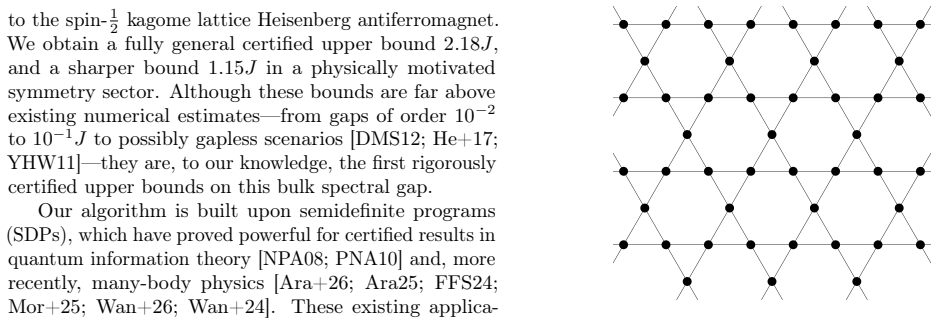
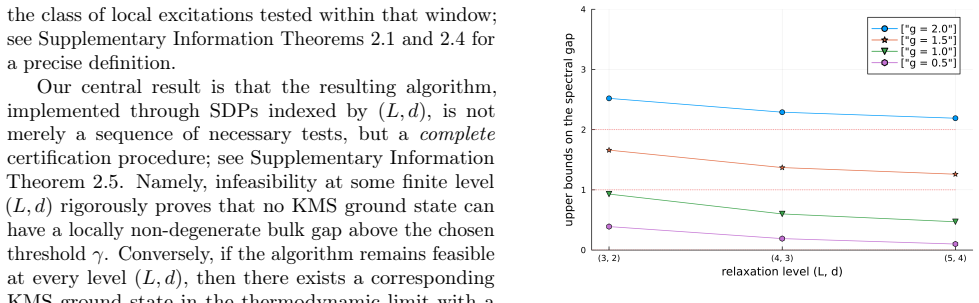
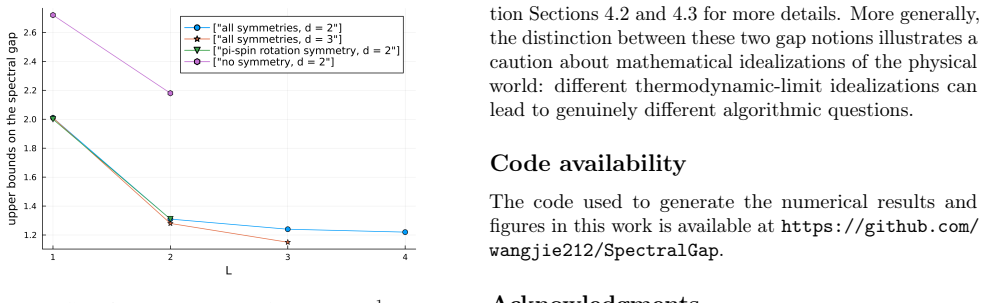
- The method supplies the first nontrivial certified upper bounds for the spin-1/2 kagome Heisenberg antiferromagnet.
- Semi-decidability holds without requiring special lattice symmetries or boundary conditions.
- Alternative gap notions based on finite systems with prescribed boundaries remain undecidable.
Where Pith is reading between the lines
- The hierarchy could be adapted to compute certified bounds on other bulk quantities such as correlation lengths or entanglement measures.
- Implementation on specific models may reveal whether the gap decision problem is decidable in practice for physically relevant Hamiltonians.
- The contrast with undecidable gap variants suggests that the choice of thermodynamic limit definition can determine computational tractability.
Load-bearing premise
The semidefinite programs are assumed to produce valid certified upper bounds on the infinite-volume bulk gap for arbitrary translation-invariant Hamiltonians.
What would settle it
A concrete translation-invariant Hamiltonian together with a numerical computation showing that the SDP bounds fail to approach the independently known bulk gap from above.
Figures
read the original abstract
Determining spectral gaps in the thermodynamic limit is a central challenge in quantum many-body physics. Existing rigorous methods are largely limited to special settings, while variational numerical approaches typically provide estimates rather than certified bounds. Here we introduce a complete family of certified upper bounds on the bulk spectral gap of quantum many-body systems. These upper bounds are obtained by solving a series of semidefinite programs and they become arbitrarily tight at the cost of more computational resources. This shows that the bulk spectral gap is semi-decidable, in contrast to undecidability results for alternative notions of spectral gap based on sequences of finite systems with prescribed boundary conditions. As a proof of principle, we apply our algorithm to the spin-$\frac{1}{2}$ kagome lattice Heisenberg antiferromagnet and obtain, to our knowledge, the first nontrivial certified upper bounds on its bulk spectral gap.
Editorial analysis
A structured set of objections, weighed in public.
Referee Report
Summary. The manuscript introduces a hierarchy of semidefinite programs (SDPs) whose optimal values furnish certified upper bounds on the bulk spectral gap of translation-invariant quantum many-body Hamiltonians. These bounds are proven to converge from above to the true infinite-volume gap as the hierarchy level increases, establishing semi-decidability of the bulk gap. This is contrasted with undecidability results that rely on sequences of finite systems with fixed boundary conditions. The approach is illustrated on the spin-1/2 kagome Heisenberg antiferromagnet, yielding the first nontrivial certified upper bounds for that model.
Significance. If the central claims hold, the work supplies a computationally grounded method for rigorous upper bounds on bulk gaps without requiring special structure or boundary conditions, which is a notable advance over purely variational estimates. The semi-decidability result clarifies the distinction between bulk and boundary-dependent gap notions. The SDP construction provides an explicit, convergent family of certificates, which strengthens the result beyond existence proofs.
minor comments (3)
- [§3] §3 (or the section defining the SDP hierarchy): the proof that the SDP value is a certified upper bound on the bulk gap should explicitly reference the translation-invariance assumption and how the local Hamiltonian terms are embedded; a short remark on why no boundary terms appear would aid clarity.
- [kagome application] Figure 1 (or the kagome application section): the reported numerical upper bounds lack an accompanying table of SDP sizes, solver tolerances, and duality gaps; without these, reproducibility of the 'first nontrivial' claim is harder to assess.
- Notation: the symbol for the bulk gap (likely Δ_bulk or similar) is introduced without an immediate comparison to the finite-system gap Δ_N; adding one sentence contrasting the two definitions would prevent reader confusion with existing undecidability literature.
Simulated Author's Rebuttal
We thank the referee for the positive summary, significance assessment, and recommendation of minor revision. The report does not contain any listed major comments, so there are no specific points requiring a point-by-point response.
Circularity Check
No significant circularity detected
full rationale
The paper constructs a hierarchy of semidefinite programs to generate certified upper bounds on the bulk spectral gap of translation-invariant Hamiltonians, with a proof that these bounds converge from above to the true gap. This construction relies on standard SDP duality and relaxation techniques from optimization theory rather than any self-referential definition, fitted parameter renamed as prediction, or load-bearing self-citation. The semi-decidability conclusion follows directly from the existence of this convergent hierarchy without reducing to the paper's own inputs. The distinction from undecidability results for finite-system gaps with fixed boundary conditions is preserved by the explicit definition of the bulk gap used. The derivation is self-contained against external benchmarks in convex optimization.
Axiom & Free-Parameter Ledger
Reference graph
Works this paper leans on
-
[1]
1987 , isbn =
Bratteli, Ola and Robinson, Derek W , title =. 1987 , isbn =
1987
-
[2]
1981 , isbn =
Bratteli, Ola and Robinson, Derek W , title =. 1981 , isbn =
1981
-
[3]
Volume II: Advanced Theory , author=
Fundamentals of the Theory of Operator Algebras. Volume II: Advanced Theory , author=. doi:10.1007/978-0-8218-0820-7 , year=
-
[4]
Operator Algebras: Theory of C*-Algebras and von Neumann Algebras , author=. 2006 , publisher=. doi:10.1007/978-3-540-28517-5 , series=
-
[6]
Optimization of Polynomials in Non-Commuting Variables , author=. 2016 , publisher=. doi:10.1007/978-3-319-33336-6 , series=
-
[7]
Completely Bounded Maps and Operator Algebras , author=. 2002 , publisher=. doi:10.1007/978-0-08-092496-0 , collection=
-
[8]
1979 , publisher=
Theory of operator algebras I , author=. 1979 , publisher=
1979
-
[9]
2002 , PAGES =
Takesaki, Masamichi , TITLE =. 2002 , PAGES =
2002
-
[10]
2004 , publisher=
Quantum entropy and its use , author=. 2004 , publisher=
2004
-
[11]
2010 , publisher=
Quantum computation and quantum information , author=. 2010 , publisher=
2010
-
[12]
2017 , publisher=
Foundations of quantum theory: From classical concepts to operator algebras , author=. 2017 , publisher=
2017
-
[13]
2008 , series=
Positive polynomials and sums of squares , author=. 2008 , series=
2008
-
[14]
Journal of Mathematical Physics , volume=
Radon--Nikodym derivatives of quantum operations , author=. Journal of Mathematical Physics , volume=. 2003 , publisher=
2003
-
[15]
New Journal of Physics , volume=
A convergent hierarchy of semidefinite programs characterizing the set of quantum correlations , author=. New Journal of Physics , volume=. 2008 , publisher=
2008
-
[16]
2006 , howpublished =
Tsirelson, Boris S , title =. 2006 , howpublished =
2006
-
[17]
Arveson, W. B. , title =. Acta Math. , issn =. 1969 , doi =
1969
-
[18]
2013 , publisher=
The symmetric group: representations, combinatorial algorithms, and symmetric functions , author=. 2013 , publisher=
2013
-
[19]
2007 , publisher=
Lie groups: an approach through invariants and representations , author=. 2007 , publisher=
2007
-
[20]
Physics Physique Fizika , volume=
On the Einstein Podolsky Rosen paradox , author=. Physics Physique Fizika , volume=. 1964 , publisher=
1964
-
[21]
Physical review letters , volume=
Proposed experiment to test local hidden-variable theories , author=. Physical review letters , volume=. 1969 , publisher=
1969
-
[22]
Reviews of modern physics , volume=
Bell nonlocality , author=. Reviews of modern physics , volume=. 2014 , publisher=
2014
-
[23]
Forum of Mathematics, Pi , volume=
The set of quantum correlations is not closed , author=. Forum of Mathematics, Pi , volume=. 2019 , organization=
2019
-
[24]
Communications of the ACM , volume=
Mip*= re , author=. Communications of the ACM , volume=. 2021 , publisher=
2021
-
[25]
Journal of Mathematical Physics , volume =
Appleby, Marcus , title =. Journal of Mathematical Physics , volume =. 2005 , month =. doi:10.1063/1.1896384 , url =
-
[26]
arXiv preprint arXiv:0812.4305 , year=
Tsirelson's problem , author=. arXiv preprint arXiv:0812.4305 , year=
-
[27]
doi:10.22331/q-2020-09-30-337 , url =
Self-testing of quantum systems: a review , author =. doi:10.22331/q-2020-09-30-337 , url =
-
[28]
Communications in Mathematical Physics , volume=
Integration with respect to the Haar measure on unitary, orthogonal and symplectic group , author=. Communications in Mathematical Physics , volume=. 2006 , publisher=
2006
-
[29]
SIAM Journal on Optimization , volume=
Convergent relaxations of polynomial optimization problems with noncommuting variables , author=. SIAM Journal on Optimization , volume=. 2010 , publisher=
2010
-
[30]
Japanese Journal of Mathematics , volume=
About the Connes embedding conjecture: algebraic approaches , author=. Japanese Journal of Mathematics , volume=. 2013 , publisher=
2013
-
[31]
Annals of Mathematics , volume=
Classification of injective factors cases II 1, II ^ , III , 1 , author=. Annals of Mathematics , volume=. 1976 , publisher=
1976
-
[32]
Inventiones mathematicae , volume=
On non-semisplit extensions, tensor products and exactness of group C*-algebras , author=. Inventiones mathematicae , volume=. 1993 , publisher=
1993
-
[33]
Undecidability of the spectral gap. Nature , keywords =. doi:10.1038/nature16059 , archivePrefix =. 1502.04573 , primaryClass =
-
[34]
Journal of Mathematical Physics , volume=
About the notion of eigenstates for C*-algebras and some application in quantum mechanics , author=. Journal of Mathematical Physics , volume=. 2023 , publisher=
2023
-
[35]
Mathematical Programming , volume=
State polynomials: positivity, optimization and nonlinear Bell inequalities , author=. Mathematical Programming , volume=. 2024 , publisher=
2024
-
[36]
Communications in mathematical physics , volume=
Finitely correlated states on quantum spin chains , author=. Communications in mathematical physics , volume=. 1992 , publisher=
1992
-
[37]
arXiv preprint arXiv:2210.09065 , year=
Two convergent NPA-like hierarchies for the quantum bilocal scenario , author=. arXiv preprint arXiv:2210.09065 , year=
-
[38]
International Congress of Mathematicians , pages=
Classification of gapped ground state phases in quantum spin systems , author=. International Congress of Mathematicians , pages=. 2023 , organization=
2023
-
[39]
Operator Algebras and Mathematical Physics , volume=
Classification of gapped Hamiltonians in quantum spin chains , author=. Operator Algebras and Mathematical Physics , volume=. 2019 , publisher=
2019
-
[40]
Annales Henri Poincar
Lieb--Robinson bounds, Arveson spectrum and Haag--Ruelle scattering theory for gapped quantum spin systems , author=. Annales Henri Poincar. 2016 , organization=
2016
-
[41]
Physical Review X , volume=
Undecidability of the spectral gap in one dimension , author=. Physical Review X , volume=. 2020 , publisher=
2020
-
[42]
Rai, Kshiti Sneh and Kull, Ilya and Emonts, Patrick and Tura, Jordi and Schuch, Norbert and Baccari, Flavio , journal =. A. doi:10.22331/q-2026-04-13-2065 , url =
-
[43]
Rigorous results on valence-bond ground states in antiferromagnets , author =. Phys. Rev. Lett. , volume =. 1987 , month = aug, publisher =. doi:10.1103/PhysRevLett.59.799 , url =
-
[44]
Letters in Mathematical Physics , volume=
Stability of the bulk gap for frustration-free topologically ordered quantum lattice systems , author=. Letters in Mathematical Physics , volume=. 2024 , publisher=
2024
-
[45]
Foundations of Computational Mathematics , year=
First-order optimality conditions for non-commutative optimization problems , author=. Foundations of Computational Mathematics , year=. 2311.18707 ,
-
[46]
Nature Communications , volume=
Certified algorithms for equilibrium states of local quantum Hamiltonians , author=. Nature Communications , volume=. 2024 , publisher=
2024
-
[47]
Reviews of modern physics , volume=
Colloquium: topological insulators , author=. Reviews of modern physics , volume=. 2010 , publisher=
2010
-
[48]
2023 , eprint=
Quantum Spin Systems , author=. 2023 , eprint=
2023
-
[49]
Field Theories of Condensed Matter Physics , publisher=
Fradkin, Eduardo , year=. Field Theories of Condensed Matter Physics , publisher=
-
[50]
1988 , eprint=
Applied Conformal Field Theory , author=. 1988 , eprint=
1988
-
[51]
Algebra Number Theory , volume=
An improved bound for the lengths of matrix algebras , author=. Algebra Number Theory , volume=
-
[52]
[CGI+18] Alessandro Cimatti, Alberto Griggio, Ahmed Irfan, Marco Roveri, and Roberto Sebastiani
Basu, Saugata and Pollack, Richard and Roy, Marie-Fran. Algorithms in Real Algebraic Geometry , edition =. 2006 , publisher =. doi:10.1007/3-540-33099-2 , isbn =
-
[53]
2012 , publisher=
Interacting electrons and quantum magnetism , author=. 2012 , publisher=
2012
-
[54]
Bulletin of the American Physical Society , volume=
Spectral gaps of AKLT Hamiltonians using Tensor Network methods , author=. Bulletin of the American Physical Society , volume=. 2014 , publisher=
2014
-
[55]
Comptes Rendus
Physics of integer-spin antiferromagnetic chains: Haldane gaps and edge states , author=. Comptes Rendus. Chimie , volume=
-
[56]
Quantum Frontiers , volume=
Quantum spin liquids in frustrated Kagome Heisenberg model , author=. Quantum Frontiers , volume=. 2025 , publisher=
2025
-
[57]
Science , volume=
Spin-liquid ground state of the S= 1/2 kagome Heisenberg antiferromagnet , author=. Science , volume=. 2011 , publisher=
2011
-
[58]
Physical review letters , volume=
Nature of the spin-liquid ground state of the S= 1/2 Heisenberg model on the kagome lattice , author=. Physical review letters , volume=. 2012 , publisher=
2012
-
[59]
Physical Review Letters , volume=
Density matrix renormalization group numerical study of the kagome antiferromagnet , author=. Physical Review Letters , volume=. 2008 , publisher=
2008
-
[60]
SciPost Physics , volume=
Competing Spin Liquid Phases in the S= 1/2 Heisenberg Model on the Kagome Lattice , author=. SciPost Physics , volume=
-
[61]
Physical review letters , volume=
Gapless spin-liquid ground state in the S= 1/2 kagome antiferromagnet , author=. Physical review letters , volume=. 2017 , publisher=
2017
-
[62]
S=1/2 kagome Heisenberg antiferromagnet revisited , author =. Phys. Rev. B , volume =. 2019 , month =. doi:10.1103/PhysRevB.100.155142 , url =
-
[63]
Physical Review X , volume=
Certifying ground-state properties of many-body systems , author=. Physical Review X , volume=. 2024 , publisher=
2024
-
[64]
arXiv preprint arXiv:2604.01555 , year=
Scalable Ground-State Certification of Quantum Spin Systems via Structured Noncommutative Polynomial Optimization , author=. arXiv preprint arXiv:2604.01555 , year=
-
[65]
Physical Review Research , volume=
Certifying steady-state properties of open quantum systems , author=. Physical Review Research , volume=. 2025 , publisher=
2025
-
[66]
2025 , eprint=
Non-commutative optimization problems with differential constraints , author=. 2025 , eprint=
2025
-
[67]
Available: https://doi.org/10.1016/j.aop.2010.09.012
Ulrich Schollwöck , abstract =. The density-matrix renormalization group in the age of matrix product states , journal =. 2011 , note =. doi:https://doi.org/10.1016/j.aop.2010.09.012 , url =
-
[68]
Román Orús , keywords =. A practical introduction to tensor networks: Matrix product states and projected entangled pair states , journal =. 2014 , issn =. doi:https://doi.org/10.1016/j.aop.2014.06.013 , url =
-
[69]
Physics world , volume=
Quantum phase transitions , author=. Physics world , volume=
-
[70]
Journal of Mathematical Physics , volume=
Topological quantum memory , author=. Journal of Mathematical Physics , volume=. 2002 , publisher=
2002
-
[71]
Journal of mathematical physics , volume=
Topological quantum order: stability under local perturbations , author=. Journal of mathematical physics , volume=. 2010 , publisher=
2010
-
[72]
2019 , eprint=
Finite-size criteria for spectral gaps in D -dimensional quantum spin systems , author=. 2019 , eprint=
2019
-
[73]
2006 , eprint=
Quantum Spin Systems after DLS1978 , author=. 2006 , eprint=
2006
-
[74]
Physical review b , volume=
Lieb-Schultz-Mattis in higher dimensions , author=. Physical review b , volume=. 2004 , publisher=
2004
-
[75]
Adiabatic quantum computation , author =. Rev. Mod. Phys. , volume =. 2018 , month =. doi:10.1103/RevModPhys.90.015002 , url =
-
[76]
Science , volume=
Solving the quantum many-body problem with artificial neural networks , author=. Science , volume=. 2017 , publisher=
2017
-
[77]
2017 , publisher=
Quantum Monte Carlo approaches for correlated systems , author=. 2017 , publisher=
2017
-
[78]
Communications in Mathematical Physics , volume=
A multi-dimensional Lieb-Schultz-Mattis theorem , author=. Communications in Mathematical Physics , volume=. 2007 , publisher=
2007
-
[79]
Journal of statistical physics , volume=
Energy gaps and elementary excitations for certain VBS-quantum antiferromagnets , author=. Journal of statistical physics , volume=. 1988 , publisher=
1988
-
[80]
Physical review letters , volume=
Extended Heisenberg models of antiferromagnetism: Analogies to the fractional quantum Hall effect , author=. Physical review letters , volume=. 1988 , publisher=
1988
-
[81]
Signatures of Dirac Cones in a DMRG Study of the Kagome Heisenberg Model , author =. Phys. Rev. X , volume =. 2017 , month =. doi:10.1103/PhysRevX.7.031020 , url =
discussion (0)
Sign in with ORCID, Apple, or X to comment. Anyone can read and Pith papers without signing in.