Generating quantum ensembles via reverse-time quantum diffusions
Pith reviewed 2026-06-28 09:40 UTC · model grok-4.3
The pith
Reverse-time dynamics for quantum diffusions allows generating complex quantum ensembles from simple distributions.
A machine-rendered reading of the paper's core claim, the machinery that carries it, and where it could break.
Core claim
The authors derive the exact reverse-time dynamics for quantum trajectories from the forward stochastic Schrödinger equation, proving that it coincides with the time-reversal of the original process. This denoising dynamics is shown to be a physically admissible quantum diffusion featuring the same measurement-induced noise accompanied by a state-dependent feedback Hamiltonian, which serves as the direct quantum analogue of the score function in classical generative diffusion models. Consequently, samples from a simple initial distribution can be transformed into samples from a more complex ensemble of quantum states through this learned reverse process.
What carries the argument
The state-dependent feedback Hamiltonian in the reverse stochastic Schrödinger equation, functioning as the quantum version of the classical score function to steer the denoising.
If this is right
- Samples from simple distributions can be converted into those of complex quantum ensembles via the denoising dynamics.
- The denoising dynamics can be learnt directly from forward trajectory data.
- Purification techniques can initialise the denoising process.
- The reverse process remains physically admissible with the original measurement noise.
Where Pith is reading between the lines
- This method could be applied to simulate or generate states in quantum many-body systems where direct sampling is hard.
- Efficient approximation of the feedback term might lead to scalable quantum generative algorithms.
- The framework suggests connections between continuous measurement theory and quantum machine learning for state preparation.
Load-bearing premise
An exact time-reversal of the forward noising stochastic Schrödinger equation exists and yields a physically valid quantum diffusion process.
What would settle it
Running the derived reverse dynamics on simulated forward trajectories of a two-level quantum system and checking whether the statistics of the generated states match those expected from time-reversed measurements.
Figures
read the original abstract
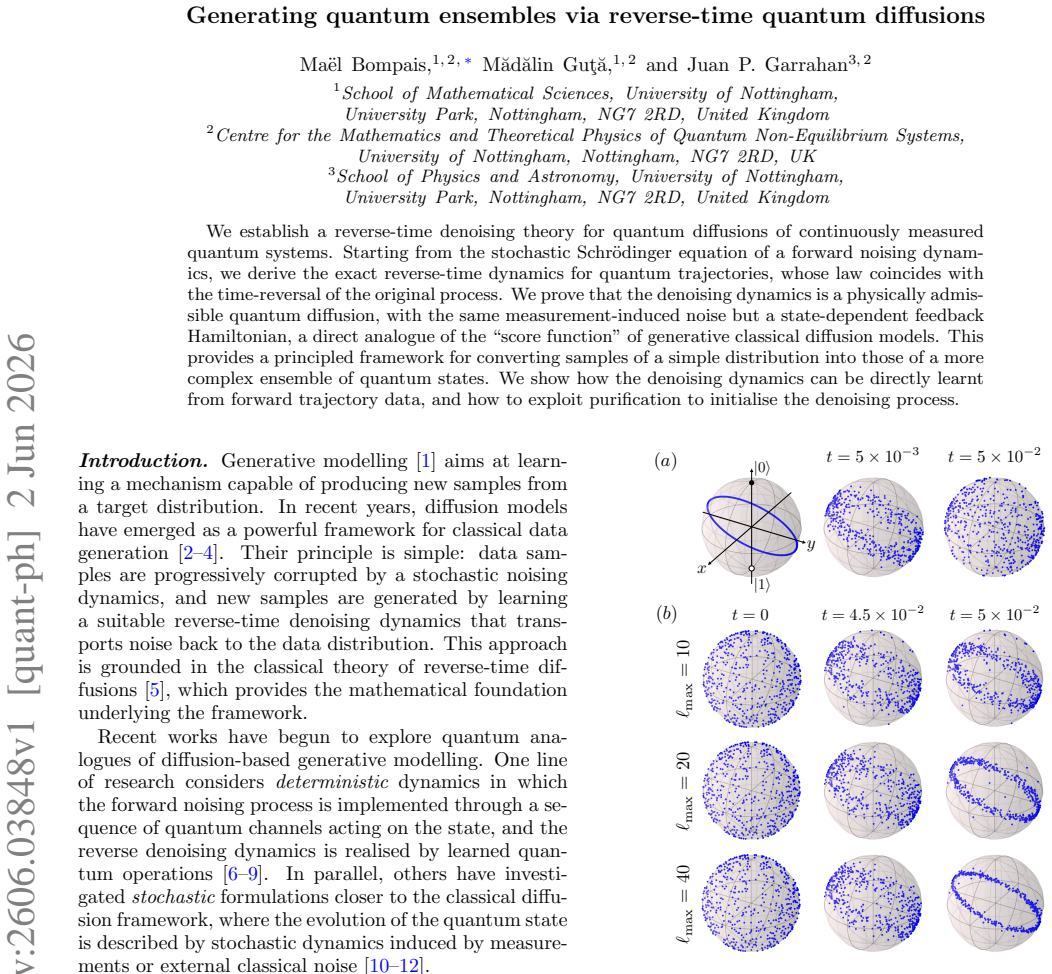
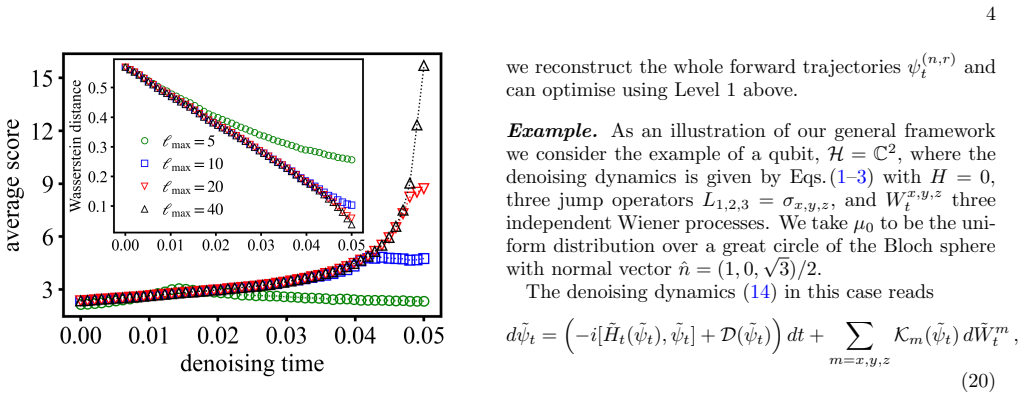
We establish a reverse-time denoising theory for quantum diffusions of continuously measured quantum systems. Starting from the stochastic Schr\"odinger equation of a forward noising dynamics, we derive the exact reverse-time dynamics for quantum trajectories, whose law coincides with the time-reversal of the original process. We prove that the denoising dynamics is a physically admissible quantum diffusion, with the same measurement-induced noise but a state-dependent feedback Hamiltonian, a direct analogue of the "score function" of generative classical diffusion models. This provides a principled framework for converting samples of a simple distribution into those of a more complex ensemble of quantum states. We show how the denoising dynamics can be directly learnt from forward trajectory data, and how to exploit purification to initialise the denoising process.
Editorial analysis
A structured set of objections, weighed in public.
Referee Report
Summary. The paper establishes a reverse-time denoising theory for quantum diffusions arising from continuously measured quantum systems. Starting from the forward stochastic Schrödinger equation, it derives the exact reverse-time dynamics whose law matches the time-reversal of the original process. It proves that this denoising dynamics is a physically admissible quantum diffusion (same measurement-induced noise, but with a state-dependent feedback Hamiltonian that plays the role of the classical score function). The work also addresses learning the reverse dynamics from forward trajectory data and using purification to initialize the denoising process, with the goal of converting samples from a simple distribution into samples from a more complex ensemble of quantum states.
Significance. If the central derivation and admissibility proof hold, the manuscript supplies a principled quantum counterpart to score-based generative diffusion models. This could enable new methods for sampling complex quantum state distributions without ad-hoc fitting, with potential applications in quantum state preparation and ensemble generation. The explicit time-reversal construction and the data-driven learning component are notable strengths.
minor comments (3)
- The abstract and introduction would benefit from a brief statement of the precise form of the forward stochastic Schrödinger equation (including the measurement operators and noise terms) to make the starting point fully explicit for readers.
- Notation for the state-dependent feedback Hamiltonian and the reverse-time process should be introduced with a clear comparison table or side-by-side equations against the classical score function to highlight the analogy.
- Section on learning the dynamics from data should specify the loss function or objective used for training and any regularization terms that ensure physical admissibility is preserved during learning.
Simulated Author's Rebuttal
We thank the referee for the positive summary, significance assessment, and recommendation of minor revision. The referee's description accurately captures the derivation of the reverse-time dynamics, the admissibility proof, the learning procedure, and the use of purification. No specific major comments were raised in the report.
Circularity Check
Derivation self-contained from forward stochastic Schrödinger equation
full rationale
The paper derives the reverse-time quantum diffusion directly from the forward stochastic Schrödinger equation of a continuously measured system, proving admissibility with the same noise and a state-dependent feedback term. No quoted steps reduce by definition, fit, or self-citation chain to the target result; the time-reversal construction is a standard mathematical operation on the given forward process and does not rely on fitted parameters renamed as predictions or uniqueness theorems imported from the authors' prior work. The analogy to classical score functions follows as a consequence rather than an assumption. This is the most common honest non-finding for a derivation paper.
Axiom & Free-Parameter Ledger
axioms (1)
- domain assumption Forward dynamics governed by the stochastic Schrödinger equation for continuously measured quantum systems.
invented entities (1)
-
state-dependent feedback Hamiltonian
no independent evidence
Reference graph
Works this paper leans on
-
[1]
Generating quantum ensembles via reverse-time quantum diffusions
for details. At long times the initialµ 0(ψ) is reconstructed, thus transforming noisy initial pure states to samples of the distribution of interest. terms of genuine quantum stochastic trajectories. Here we present a general framework that addresses all of these issues. We develop a reverse-time construction for quantum arXiv:2606.03848v1 [quant-ph] 2 J...
work page internal anchor Pith review Pith/arXiv arXiv 2026
-
[2]
Bond-Taylor, A
S. Bond-Taylor, A. Leach, Y. Long, and C. G. Will- cocks, Deep generative modelling: A comparative review of vaes, gans, normalizing flows, energy-based and au- toregressive models, IEEE transactions on pattern anal- ysis and machine intelligence44, 7327 (2021)
2021
-
[3]
Sohl-Dickstein, E
J. Sohl-Dickstein, E. Weiss, N. Maheswaranathan, and S. Ganguli, Deep Unsupervised Learning using Nonequi- librium Thermodynamics, inProceedings of the 3second International Conference on Mach. Learn., Proceedings of Mach. Learn. Research, Vol. 37, edited by F. Bach and D. Blei (Lille, France, 2015) pp. 2256–2265
2015
-
[4]
J. Ho, A. Jain, and P. Abbeel, Denoising Diffusion Prob- abilistic Models, arXiv:2006.11239 (2020)
work page internal anchor Pith review Pith/arXiv arXiv 2006
-
[5]
Y. Song, J. Sohl-Dickstein, D. P. Kingma, A. Ku- mar, S. Ermon, and B. Poole, Score-Based Genera- tive Modeling through Stochastic Differential Equations, arXiv:2011.13456 (2021)
work page internal anchor Pith review Pith/arXiv arXiv 2011
-
[6]
B. D. Anderson, Reverse-time diffusion equation models, Stochastic Processes Appl.12, 313 (1982)
1982
- [7]
-
[8]
G. Kwun, B. Zhang, and Q. Zhuang, Mixed-state quan- tum denoising diffusion probabilistic model, Physical Re- view A111, 032610 (2025)
2025
-
[9]
Parigi, S
M. Parigi, S. Martina, and F. Caruso, Quantum-noise- driven generative diffusion models, Advanced Quantum Technologies8, 2300401 (2025)
2025
-
[10]
R. Nasu, G. Tanaka, and A. Tsuchiya, Quantum re- versibility meets classical reverse diffusion, arXiv preprint arXiv:2510.18512 (2025)
work page internal anchor Pith review Pith/arXiv arXiv 2025
-
[11]
Zhang, P
B. Zhang, P. Xu, X. Chen, and Q. Zhuang, Generative quantum machine learning via denoising diffusion prob- abilistic models, Physical Review Letters132, 100602 (2024)
2024
-
[12]
X. Liu, J. Zhuang, W. Hou, and Y.-Z. You, Measurement-based quantum diffusion models, arXiv preprint arXiv:2508.08799 (2025)
work page internal anchor Pith review Pith/arXiv arXiv 2025
-
[13]
Stochastic Schr\"odinger Equations for Quantum Reverse Diffusion
E. Gabbassov, Exact stochastic differential equa- tions for quantum reverse diffusion, arXiv preprint arXiv:2511.15919 (2025)
work page internal anchor Pith review Pith/arXiv arXiv 2025
-
[14]
See Supplemental Material at [URL] for more details
-
[15]
Belavkin, A stochastic posterior Schr¨ odinger equation for counting nondemolition measurement, Lett
V. Belavkin, A stochastic posterior Schr¨ odinger equation for counting nondemolition measurement, Lett. Math. Phys.20, 85 (1990)
1990
-
[16]
Gardiner and P
C. Gardiner and P. Zoller,Quantum noise(Berlin, Hei- delberg, 2004)
2004
-
[17]
H. P. Breuer and F. Petruccione,The theory of open quantum systems(Great Clarendon Street, 2002)
2002
-
[18]
Lindblad, On the generators of quantum dynamical semigroups, Comm
G. Lindblad, On the generators of quantum dynamical semigroups, Comm. Math. Phys.48, 119 (1976)
1976
-
[19]
Gorini, A
V. Gorini, A. Kossakowski, and E. C. G. Sudarshan, Completely positive dynamical semigroups of N-level sys- tems, J. Math. Phys.17, 821 (1976)
1976
-
[20]
Benoist, M
T. Benoist, M. Fraas, Y. Pautrat, and C. Pellegrini, In- variant measure for stochastic schr¨ odinger equations, in Annales Henri Poincar´ e, Vol. 22 (Springer, 2021) pp. 347–374
2021
-
[21]
Carollo, J
F. Carollo, J. P. Garrahan, and R. L. Jack, Large Devia- tions at Level 2.5 for Markovian Open Quantum Systems: Quantum Jumps and Quantum State Diffusion, J. Stat. Phys.184, 13 (2021)
2021
-
[22]
H. Kwon, R. Mukherjee, and M. S. Kim, Reversing Lind- blad Dynamics via Continuous Petz Recovery Map, Phys. Rev. Lett.128, 020403 (2022)
2022
-
[23]
Petz, Sufficient subalgebras and the relative entropy of states of a von Neumann algebra, Comm
D. Petz, Sufficient subalgebras and the relative entropy of states of a von Neumann algebra, Comm. Math. Phys. 105, 123 (1986)
1986
-
[24]
A. J. Parzygnat and J. Fullwood, From time-reversal symmetry to quantum bayes’ rules, PRX Quantum4, 020334 (2023)
2023
- [25]
-
[26]
Maassen and B
H. Maassen and B. K¨ ummerer, Purification of quan- tum trajectories, IMS Lecture Notes Monogr. Ser. , 252 (2006)
2006
-
[27]
N. H. Amini, M. Bompais, and C. Pellegrini, On asymp- totic stability of quantum trajectories and their Cesaro 6 mean, J. Phys. A54, 385304 (2021)
2021
-
[28]
M. Bompais, N. H. Amini, J. P. Garrahan, and M. Gut ¸˘ a, The rate of purification of quantum trajecto- ries, arXiv:2601.14023 (2026)
-
[29]
Guilmin, P
P. Guilmin, P. Rouchon, and A. Tilloy, Correlation functions for realistic continuous quantum measurement, IFAC-PapersOnLine56, 5164 (2023)
2023
-
[30]
Grigoletto, C
T. Grigoletto, C. Pellegrini, and F. Ticozzi, Quantum model reduction for continuous-time quantum filters: T. grigoletto et al., inAnnales Henri Poincar´ e(Springer,
- [31]
-
[32]
Z. Kadkhodaie, F. Guth, E. P. Simoncelli, and S. Mallat, Generalization in diffusion models arises from geometry- adaptive harmonic representations, arXiv:2310.02557 (2024)
-
[33]
Memorisation, convergence and generalisation in generative models
A. Maillard and S. Goldt, Memorisation, convergence and generalisation in generative models, arXiv:2605.21402 (2026)
work page internal anchor Pith review Pith/arXiv arXiv 2026
-
[34]
Ikeda and S
N. Ikeda and S. Watanabe,Stochastic differential equa- tions and diffusion processes, Vol. 24 (Elsevier, 2014). 7 Supplementary Material for Generating quantum ensembles via reverse-time quantum diffusions I. GENERATOR OF THE FORWARD EVOLUTION The generator and adjoint generator of the quantum diffusion are the following (cf. [20]). For any scalar smooth ...
2014
-
[35]
Then the following are equivalent:
Characterisation of commutator directions Letψ=|ψ⟩⟨ψ|be a rank-one projector, so thatψ 2 =ψ, and letX(ψ)∈ B(H) be Hermitian. Then the following are equivalent:
-
[36]
Proof.(1)⇒(2)
There exists a Hermitian operatorH(ψ) such that X(ψ) =−i[H(ψ), ψ].(78) 2.X(ψ) satisfies ψX(ψ)ψ= 0,(1−ψ)X(ψ)(1−ψ) = 0.(79) a. Proof.(1)⇒(2). AssumeX(ψ) =−i[H(ψ), ψ]. Then ψX(ψ)ψ=−i ψ H(ψ)ψ−ψH(ψ) ψ(80) =−i ψH(ψ)ψ−ψH(ψ)ψ = 0,(81) where we usedψ 2 =ψ. Moreover, (1−ψ)X(ψ)(1−ψ) =−i(1−ψ) H(ψ)ψ−ψH(ψ) (1−ψ) (82) = 0,(83) since (1−ψ)ψ=ψ(1−ψ) = 0. (2)⇒(1). Assume ψX...
-
[37]
Verification of the conditionψX(ψ)ψ= 0 Recall that the backward drift has been written in the form D(ψ) +X(ψ),(97) with X(ψ) =i[H, ψ]−2D(ψ) + divD(ψ) +D(ψ)∇logµ T−t (ψ).(98) We now check that ψX(ψ)ψ= 0 (99) for every pure stateψ. Sinceψis a pure state, it is a rank-one orthogonal projection, so that ψ2 =ψ,tr(ψ) = 1, ψAψ= tr(Aψ)ψfor every operatorA.(100) W...
-
[38]
Verification of the condition(1−ψ)X(ψ)(1−ψ) = 0 We now verify the second condition (1−ψ)X(ψ)(1−ψ) = 0.(161) Recall that X(ψ) =i[H, ψ]−2D(ψ) + divD(ψ) +D(ψ)∇logµ T−t (ψ),(162) where D(ψ) = MX m=1 LmψL† m − 1 2 {L† mLm, ψ} ,(163) and D(ψ)∇logµ T−t (ψ) = MX m=1 Km(ψ)S m(ψ, t),(164) with Km(ψ) =L mψ+ψL † m −tr((L m +L † m)ψ)ψ.(165) For simplicity, let us set ...
discussion (0)
Sign in with ORCID, Apple, or X to comment. Anyone can read and Pith papers without signing in.