REVIEW 3 major objections 52 references
Reviewed by Pith at T0; open to challenge.
T0 means a machine referee read the full paper against a public rubric. The mark states how deep the mechanical check went, never who wrote it. the ladder, T0–T4 →
T0 review · grok-4.3
MLP-Splatting decomposes scenes into a handful of compact neural primitives that align with objects using only RGB supervision.
2026-06-28 11:09 UTC pith:3TL7FGSK
load-bearing objection MLP-Splatting swaps Gaussians for small independent MLPs with local support and claims RGB-only training produces object-aligned primitives, but that central claim rests on an unshown optimization preference. the 3 major comments →
MLP Splatting: Object-Centric Neural Fields
The pith
A machine-rendered reading of the paper's core claim, the machinery that carries it, and where it could break.
Core claim
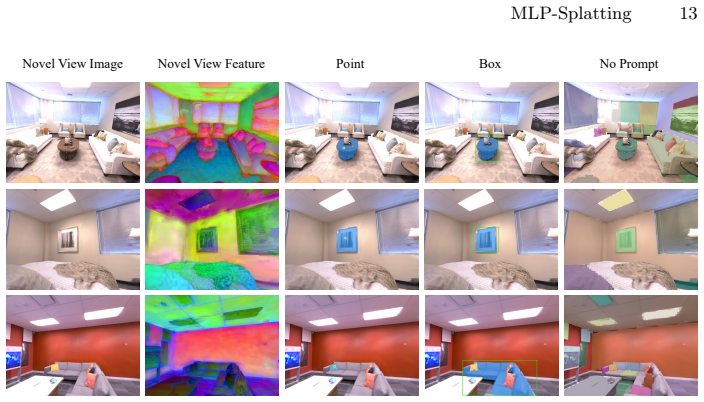
MLP-Splatting models each primitive as an independent compact MLP with localized spatial support that predicts radiance and opacity. Rendering is performed through efficient sparse volumetric compositing over ray-primitive interactions. Supervised using RGB supervision alone, the primitives represent local scene regions often corresponding to objects or object parts, enabling interactive object-level editing without segmentation masks by selecting a handful of primitives.
What carries the argument
Independent compact MLP with localized spatial support, rendered via sparse volumetric compositing over ray-primitive interactions.
Load-bearing premise
Independent compact MLPs with localized spatial support trained only on RGB images will naturally produce primitives that correspond to objects or object parts without extra regularization or post-processing.
What would settle it
Training the method on a scene containing clearly separable objects and then observing that most primitives each span multiple objects or that each object is split across dozens of primitives would falsify the emergence claim.
If this is right
- A scene can be decomposed into a small number of primitives that align with objects using RGB images alone.
- Object-level editing becomes possible by selecting and manipulating a few primitives without segmentation masks.
- Optional semantic feature distillation adds open-vocabulary querying and open-set instant segmentation.
- Memory usage drops to roughly 1/15 of semantic 3D Gaussian Splatting while rendering speed increases by a factor of about 3.
- Photorealistic novel-view synthesis is retained alongside the decomposition capability.
Where Pith is reading between the lines
- The localized support of each MLP could reduce blending artifacts across object boundaries compared with global radiance fields.
- If the primitives remain stable across time, the same representation might support object tracking or dynamic scene editing with minimal changes.
- Combining the method with sparse depth or instance cues might produce even tighter object boundaries when RGB alone is insufficient.
- The low primitive count suggests the approach could scale to large environments by adding new primitives on demand rather than retraining a single model.
Editorial analysis
A structured set of objections, weighed in public.
Referee Report
Summary. The paper introduces MLP-Splatting, a 3D scene representation that decomposes a scene into a small number of independent compact MLPs, each with localized spatial support, that predict radiance and opacity. These primitives are trained end-to-end using only RGB supervision and rendered via sparse volumetric compositing over ray-primitive intersections. The method claims that this architecture produces primitives that naturally align with objects or object parts, enabling interactive object-level editing without masks or additional losses; an optional semantic feature distillation variant further supports open-vocabulary interaction. Experiments are said to show 1/15× lower memory and 3× faster rendering than semantic 3D Gaussian Splatting baselines.
Significance. If the central claims hold after verification, the work would offer a meaningful step toward object-centric neural fields that combine photorealistic rendering with built-in decomposability, reducing reliance on post-hoc segmentation or grouping. The reported memory and speed advantages, if reproducible under controlled conditions, would also be practically relevant for interactive applications.
major comments (3)
- Abstract: performance claims of 1/15× memory reduction and 3× rendering speedup are stated without equations, training details, ablation studies, or verification that the gains persist after controlling for implementation differences; central claims rest on unshown experiments.
- Abstract and method description: the assertion that RGB-only supervision on independent compact MLPs with localized support yields primitives corresponding to objects or parts (without additional regularization, losses, or post-processing) lacks any derivation, initialization analysis, loss-term examination, or ablation demonstrating why the optimization landscape favors semantic partitions over arbitrary spatial ones.
- Abstract: the claim of object correspondence enabling editing by selecting a handful of primitives is presented as an emergent property, yet no quantitative metrics (e.g., correspondence accuracy, stability across seeds, or comparison to random decompositions) are referenced to substantiate it.
Simulated Author's Rebuttal
We thank the referee for the constructive feedback on our manuscript. We address each major comment below with clarifications drawn from the full paper and indicate planned revisions where appropriate.
read point-by-point responses
-
Referee: Abstract: performance claims of 1/15× memory reduction and 3× rendering speedup are stated without equations, training details, ablation studies, or verification that the gains persist after controlling for implementation differences; central claims rest on unshown experiments.
Authors: The performance numbers are substantiated by the controlled comparisons in Section 5 (Tables 2 and 3), which report memory footprints and rendering times against semantic 3DGS baselines using identical hardware and the same training protocol. We agree the abstract would be clearer with an explicit pointer to these results. In revision we will add a parenthetical reference to Section 5 and include a short implementation-control ablation in the supplementary material. revision: partial
-
Referee: Abstract and method description: the assertion that RGB-only supervision on independent compact MLPs with localized support yields primitives corresponding to objects or parts (without additional regularization, losses, or post-processing) lacks any derivation, initialization analysis, loss-term examination, or ablation demonstrating why the optimization landscape favors semantic partitions over arbitrary spatial ones.
Authors: The emergence of object-aligned primitives is presented as an empirical outcome supported by the visualizations and editing examples in Sections 4 and 5. The method section and supplementary material already contain the initialization procedure and loss-term breakdown; we will expand the main-text method description with a concise paragraph discussing the role of localized support and independent optimization in favoring coherent partitions. revision: yes
-
Referee: Abstract: the claim of object correspondence enabling editing by selecting a handful of primitives is presented as an emergent property, yet no quantitative metrics (e.g., correspondence accuracy, stability across seeds, or comparison to random decompositions) are referenced to substantiate it.
Authors: Editing results are demonstrated qualitatively in Section 5. We concur that quantitative measures would strengthen the claim and will add correspondence accuracy, seed-stability statistics, and a random-decomposition baseline in the revised experiments section. revision: yes
Circularity Check
No significant circularity; central claims are empirical modeling outcomes, not reductions by construction.
full rationale
The paper introduces MLP-Splatting as a new architecture of independent compact MLPs with localized support, rendered via sparse volumetric compositing, and asserts that RGB-only photometric supervision produces object-corresponding primitives. This is presented as an observed behavior of the method rather than a derived prediction from equations or fitted parameters. No self-citations are invoked as load-bearing uniqueness theorems, no ansatz is smuggled, and no quantity is renamed or fitted then called a prediction. The assumption that localization and independence will favor semantic partitions is a modeling hypothesis, not a tautological reduction of the result to its inputs. The derivation chain is self-contained against external benchmarks.
Axiom & Free-Parameter Ledger
axioms (1)
- domain assumption RGB supervision alone is sufficient to produce object-corresponding primitives
invented entities (1)
-
MLP primitive
no independent evidence
read the original abstract
3D representations are fundamental to scene rendering, understanding, and interaction. Recent approaches, such as 3D Gaussian Splatting and Neural Radiance Fields, achieve impressive photorealistic novel-view synthesis, but lack the ability to easily decompose scene elements into a few primitives, requiring additional segmentation or grouping for object-level manipulation. We present MLP-Splatting, a method that enables scene decomposition via a few expressive light-field primitives while providing photorealistic novel-view synthesis. MLP-Splatting models each primitive as an independent compact MLP with localized spatial support that predicts radiance and opacity. In contrast to low-level Gaussian primitives or a single global radiance field, our neural primitives provide greater expressive capacity while remaining spatially localized. Rendering is performed through efficient sparse volumetric compositing over ray-primitive interactions. Our primitives are supervised using RGB supervision alone, which yields primitives that represent local scene regions often corresponding to objects or object parts, enabling interactive object-level editing without segmentation masks by selecting a handful of primitives. Our method, augmented with optional semantic feature distillation, enables open-vocabulary scene interaction and open-set instant segmentation. Compared to state-of-the-art methods, we achieve substantially lower memory usage (1/15$\times$) and faster rendering (3$\times$), as we show in our experiments compared to semantic 3DGS methods. Project Page: https://shinjeongkim.com/mlp-splatting
Figures


Reference graph
Works this paper leans on
-
[1]
Barron, J.T., Mildenhall, B., Tancik, M., Hedman, P., Martin-Brualla, R., Srini- vasan, P.P.: Mip-nerf: A multiscale representation for anti-aliasing neural radiance fields. In: Int. Conf. Comput. Vis. pp. 5855–5864 (October 2021)
2021
-
[2]
In: IEEE Conf
Barron, J.T., Mildenhall, B., Verbin, D., Srinivasan, P.P., Hedman, P.: Mip-nerf 360: Unbounded anti-aliased neural radiance fields. In: IEEE Conf. Comput. Vis. Pattern Recog. pp. 5470–5479 (2022)
2022
-
[3]
Barron, J.T., Mildenhall, B., Verbin, D., Srinivasan, P.P., Hedman, P.: Zip-nerf: Anti-aliased grid-based neural radiance fields. In: Int. Conf. Comput. Vis. pp. 19697–19705 (2023)
2023
-
[4]
Cen, J., Zhou, X., Fang, J., Wen, C., Xie, L., Zhang, X., Shen, W., Tian, Q.: Tackling view-dependentsemantics in3d language gaussian splatting. In: Int. Conf. Mach. Learn. (2025)
2025
-
[5]
In: 2025 IEEE International Conference on Robotics and Automation (ICRA)
Cheng, Y., Jiao, J., Wang, Y., Kanoulas, D.: Logs: Visual localization via gaussian splatting with fewer training images. In: 2025 IEEE International Conference on Robotics and Automation (ICRA). pp. 15029–15036. IEEE (2025)
2025
-
[6]
Dai, A., Chang, A.X., Savva, M., Halber, M., Funkhouser, T., Nießner, M.: Scan- Net:Richly-annotated3dreconstructionsofindoorscenes.In:IEEEConf.Comput. Vis. Pattern Recog. (July 2017)
2017
-
[7]
Transactions of the American Mathematical So- ciety93(3), 418–491 (1959)
Federer, H.: Curvature measures. Transactions of the American Mathematical So- ciety93(3), 418–491 (1959)
1959
-
[8]
In: IEEE Conf
Fridovich-Keil, S., Yu, A., Tancik, M., Chen, Q., Recht, B., Kanazawa, A.: Plenox- els: Radiance fields without neural networks. In: IEEE Conf. Comput. Vis. Pattern Recog. pp. 5501–5510 (June 2022)
2022
-
[9]
Govindarajan, S., Rebain, D., Yi, K.M., Tagliasacchi, A.: Radiant foam: Real-time differentiable ray tracing. In: Int. Conf. Comput. Vis. pp. 4135–4145 (2025)
2025
-
[10]
Birkhäuser, 2 edn
Gray, A.: Tubes. Birkhäuser, 2 edn. (2004)
2004
-
[11]
Object-Centric Neural Scene Rendering
Guo, M., Fathi, A., Wu, J., Funkhouser, T.: Object-centric neural scene rendering. arXiv preprint arXiv:2012.08503 (2020)
-
[12]
In: ACM SIGGRAPH
Huang, B., Yu, Z., Chen, A., Geiger, A., Gao, S.: 2d gaussian splatting for geo- metrically accurate radiance fields. In: ACM SIGGRAPH. pp. 1–11 (2024)
2024
-
[13]
ACM Trans
Kerbl, B., Kopanas, G., Leimkühler, T., Drettakis, G., et al.: 3d gaussian splatting for real-time radiance field rendering. ACM Trans. Graph.42(4), 139–1 (2023)
2023
-
[14]
Kerr, J., Kim, C.M., Goldberg, K., Kanazawa, A., Tancik, M.: Lerf: Language embedded radiance fields. In: Int. Conf. Comput. Vis. pp. 19729–19739 (2023)
2023
-
[15]
In: IEEE Conf
Kim, C.M., Wu, M., Kerr, J., Goldberg, K., Tancik, M., Kanazawa, A.: Garfield: Group anything with radiance fields. In: IEEE Conf. Comput. Vis. Pattern Recog. pp. 21530–21539 (2024)
2024
-
[16]
Kirillov, A., Mintun, E., Ravi, N., Mao, H., Rolland, C., Gustafson, L., Xiao, T., Whitehead, S., Berg, A.C., Lo, W.Y., et al.: Segment anything. In: Int. Conf. Comput. Vis. pp. 4015–4026 (2023)
2023
-
[17]
Kobayashi, S., Matsumoto, E., Sitzmann, V.: Decomposing nerf for editing via featurefielddistillation.Adv.NeuralInform.Process.Syst.35,23311–23330(2022)
2022
-
[18]
In: IEEE Conf
Kong, X., Liu, S., Taher, M., Davison, A.J.: vmap: Vectorised object mapping for neural field slam. In: IEEE Conf. Comput. Vis. Pattern Recog. pp. 952–961 (2023)
2023
-
[19]
Birkhäuser, 2 edn
Krantz, S.G., Parks, H.R.: A Primer of Real Analytic Functions. Birkhäuser, 2 edn. (2002) MLP-Splatting 17
2002
-
[20]
In: IEEE Conf
Kundu, A., Genova, K., Yin, X., Fathi, A., Pantofaru, C., Guibas, L.J., Tagliasac- chi, A., Dellaert, F., Funkhouser, T.: Panoptic neural fields: A semantic object- aware neural scene representation. In: IEEE Conf. Comput. Vis. Pattern Recog. pp. 12871–12881 (2022)
2022
-
[21]
Liu, S., Zeng, Z., Ren, T., Li, F., Zhang, H., Yang, J., Jiang, Q., Li, C., Yang, J., Su, H., et al.: Grounding dino: Marrying dino with grounded pre-training for open-set object detection. In: Eur. Conf. Comput. Vis. pp. 38–55. Springer (2024)
2024
-
[22]
In: Seminal graphics: pioneering efforts that shaped the field, pp
Lorensen, W.E., Cline, H.E.: Marching cubes: A high resolution 3d surface con- struction algorithm. In: Seminal graphics: pioneering efforts that shaped the field, pp. 347–353. ACM New York, NY, USA (1998)
1998
-
[23]
In: IEEE Conf
Lüddecke, T., Ecker, A.: Image segmentation using text and image prompts. In: IEEE Conf. Comput. Vis. Pattern Recog. pp. 7086–7096 (2022)
2022
-
[24]
von Lützow, N., Nießner, M.: Linprim: Linear primitives for differentiable volu- metric rendering. In: Adv. Neural Inform. Process. Syst. (2025)
2025
-
[25]
Mai, A., Hedman, P., Kopanas, G., Verbin, D., Futschik, D., Xu, Q., Kuester, F., Barron, J.T., Zhang, Y.: Ever: Exact volumetric ellipsoid rendering for real-time view synthesis. In: Int. Conf. Comput. Vis. pp. 4930–4939 (2025)
2025
-
[26]
In: IEEE Conf
Martin-Brualla, R., Radwan, N., Sajjadi, M.S.M., Barron, J.T., Dosovitskiy, A., Duckworth, D.: Nerf in the wild: Neural radiance fields for unconstrained photo collections. In: IEEE Conf. Comput. Vis. Pattern Recog. pp. 7210–7219 (June 2021)
2021
-
[27]
Mildenhall, B., Srinivasan, P.P., Tancik, M., Barron, J.T., Ramamoorthi, R., Ng, R.: Nerf: Representing scenes as neural radiance fields for view synthesis. In: Eur. Conf. Comput. Vis. (2020)
2020
-
[28]
ACM Trans
Müller, T., Evans, A., Schied, C., Keller, A.: Instant neural graphics primitives with a multiresolution hash encoding. ACM Trans. Graph.41(4), 1–15 (2022)
2022
-
[29]
In: IEEE Conf
Niemeyer, M., Geiger, A.: Giraffe: Representing scenes as compositional generative neural feature fields. In: IEEE Conf. Comput. Vis. Pattern Recog. pp. 11453–11464 (June 2021)
2021
-
[30]
In: IEEE Conf
Peng, S., Genova, K., Jiang, C., Tagliasacchi, A., Pollefeys, M., Funkhouser, T., et al.: Openscene: 3d scene understanding with open vocabularies. In: IEEE Conf. Comput. Vis. Pattern Recog. pp. 815–824 (2023)
2023
-
[31]
Neural Networks108, 296–330 (2018)
Petersen, P., Voigtlaender, F.: Optimal approximation of piecewise smooth func- tions using deep ReLU neural networks. Neural Networks108, 296–330 (2018)
2018
-
[32]
In: IEEE Conf
Qin, M., Li, W., Zhou, J., Wang, H., Pfister, H.: Langsplat: 3d language gaussian splatting. In: IEEE Conf. Comput. Vis. Pattern Recog. pp. 20051–20060 (2024)
2024
-
[33]
Radford, A., Kim, J.W., Hallacy, C., Ramesh, A., Goh, G., Agarwal, S., Sastry, G., Askell, A., Mishkin, P., Clark, J., et al.: Learning transferable visual models from natural language supervision. In: Int. Conf. Mach. Learn. pp. 8748–8763. PmLR (2021)
2021
-
[34]
Reiser, C., Peng, S., Liao, Y., Geiger, A.: Kilonerf: Speeding up neural radiance fields with thousands of tiny mlps. In: Int. Conf. Comput. Vis. pp. 14335–14345 (October 2021)
2021
-
[35]
In: IEEE Conf
Schönberger, J.L., Frahm, J.M.: Structure-from-motion revisited. In: IEEE Conf. Comput. Vis. Pattern Recog. (2016)
2016
-
[36]
Foundations of Computational Mathematics 24(2), 481–537 (2024)
Siegel, J.W., Xu, J.: Sharp bounds on the approximation rates, metric entropy, and n-widths of shallow neural networks. Foundations of Computational Mathematics 24(2), 481–537 (2024)
2024
-
[37]
The Replica Dataset: A Digital Replica of Indoor Spaces
Straub, J., Whelan, T., Ma, L., Chen, Y., Wijmans, E., Green, S., Engel, J.J., Mur-Artal, R., Ren, C., Verma, S., et al.: The replica dataset: A digital replica of indoor spaces. arXiv preprint arXiv:1906.05797 (2019) 18 S. Kim et al
work page internal anchor Pith review Pith/arXiv arXiv 1906
-
[38]
In: IEEE Int
Taher, M., Alzugaray, I., Davison, A.J.: Fit-ngp: Fitting object models to neural graphics primitives. In: IEEE Int. Conf. Robot. Autom. pp. 18186–18192. IEEE (2024)
2024
-
[39]
Wu, Q., Wang, K., Li, K., Zheng, J., Cai, J.: Objectsdf++: Improved object- compositional neural implicit surfaces. In: Int. Conf. Comput. Vis. pp. 21764–21774 (October 2023)
2023
-
[40]
Yang, B., Zhang, Y., Xu, Y., Li, Y., Zhou, H., Bao, H., Zhang, G., Cui, Z.: Learning object-compositional neural radiance field for editable scene rendering. In: Int. Conf. Comput. Vis. pp. 13779–13788 (October 2021)
2021
-
[41]
Neural networks94, 103–114 (2017)
Yarotsky, D.: Error bounds for approximations with deep relu networks. Neural networks94, 103–114 (2017)
2017
-
[42]
Ye, M., Danelljan, M., Yu, F., Ke, L.: Gaussian grouping: Segment and edit any- thing in 3d scenes. In: Eur. Conf. Comput. Vis. pp. 162–179. Springer (2024)
2024
-
[43]
In: 2018 IEEE/ACM 26th international symposium on quality of service (IWQoS)
Zhang, Z.: Improved adam optimizer for deep neural networks. In: 2018 IEEE/ACM 26th international symposium on quality of service (IWQoS). pp. 1–2. Ieee (2018)
2018
-
[44]
Zhi, S., Laidlow, T., Leutenegger, S., Davison, A.J.: In-place scene labelling and understanding with implicit scene representation. In: Int. Conf. Comput. Vis. pp. 15838–15847 (2021)
2021
-
[45]
IEEE Robot
Zhi, S., Sucar, E., Mouton, A., Haughton, I., Laidlow, T., Davison, A.J.: ilabel: Revealing objects in neural fields. IEEE Robot. and Auto. Letters (RAL)8(2), 832–839 (2022)
2022
-
[46]
In: IEEE Conf
Zhou,S.,Chang,H.,Jiang,S.,Fan,Z.,Zhu,Z.,Xu,D.,Chari,P.,You,S.,Wang,Z., Kadambi, A.: Feature 3dgs: Supercharging 3d gaussian splatting to enable distilled feature fields. In: IEEE Conf. Comput. Vis. Pattern Recog. pp. 21676–21685 (2024)
2024
-
[47]
Zhou, X., Nguyen, B.H., Magne, L., Golyanik, V., Leimkühler, T., Theobalt, C.: Splat the net: Radiance fields with splattable neural primitives. In: Int. Conf. Learn. Represent. (2026) MLP-Splatting 19 A Ablation Study A.1 Novel-view Synthesis without Semantic Guidance T able 4:Effect of co-training on the Replica dataset. Replica PSNR ↑ SSIM ↑ LPIPS ↓ ML...
2026
-
[48]
eachU i lies entirely in one smooth regionΩℓ of Definition 3
-
[49]
the overlap multiplicity is uniformly bounded: sup x∈D #{i:x∈U i} ≤C
-
[50]
Proof.Start from a regular cubic grid of mesh size comparable tohon a box containingD
the number of patches satisfies N=Θ(h −3). Proof.Start from a regular cubic grid of mesh size comparable tohon a box containingD. For cubes that do not intersectΓ, keep them unchanged. For cubes intersectingΓ, use theC 2 regularity ofΓto split the cube along the interface into finitely many subpatches, each lying entirely on one side of the interface. The...
-
[51]
Gaussian splatting requires Ω(ε−2) parameters to achieve image errorε
-
[52]
In particular, fors≥2, ε−3/s ≤ε −3/2, which is asymptotically smaller than the Gaussian rateε−2
MLP-Splatting with fixed-size neural primitives requires Θ(ε−3/s) parameters to achieve image errorε. In particular, fors≥2, ε−3/s ≤ε −3/2, which is asymptotically smaller than the Gaussian rateε−2. Proof.The Gaussian statement follows immediately from Theorem 3: if CK −1/2 ≤ε, then necessarily K≥C ′ε−2. The MLP-Splatting statement follows from Theorem 4,...
discussion (0)
Sign in with ORCID, Apple, or X to comment. Anyone can read and Pith papers without signing in.