REVIEW 2 major objections 1 minor 38 references
A learnable JPEG color and quantization transform converts sensor autoencoder latents into standard JPEG files that improve perception accuracy at 200:1 compression.
Reviewed by Pith at T0; open to challenge. T0 means a machine referee read the full paper against a public rubric. the ladder, T0–T4 →
T0 review · grok-4.3
2026-06-28 07:56 UTC pith:66MZ5CWH
load-bearing objection SEAOTTER pairs a sensor autoencoder with a learnable transcode to standard JPEG for extreme compression in robotics, claiming speed and accuracy wins over AVIF, but the experimental details are missing. the 2 major comments →
SEAOTTER: Sensor Embedded Autoencoding with One-Time Transcode for Efficient Reconstruction
The pith
A machine-rendered reading of the paper's core claim, the machinery that carries it, and where it could break.
Core claim
SEAOTTER pairs a sensor-embedded autoencoder with a one-time transcode that uses a learnable JPEG color and quantization transform; when this transform is trained on a frozen encoder, the resulting standard JPEG files support both general-purpose and task-aware pipelines and deliver higher accuracy on global, dense, and vision-language perception tasks than direct use of newer codecs.
What carries the argument
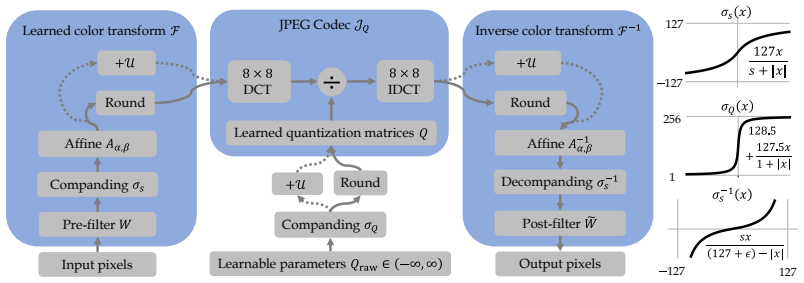
The learnable JPEG color and quantization transform, which adjusts the latent-to-JPEG mapping so that standard files preserve or improve downstream accuracy without any decoder changes.
Load-bearing premise
The learnable JPEG color and quantization transform can be trained on a frozen encoder such that the resulting standard JPEG files preserve or improve downstream perception accuracy without requiring changes to existing JPEG decoders or infrastructure.
What would settle it
Running the same ImageNet classification experiment with the transcoded JPEG files and finding that top-1 accuracy falls below the AVIF baseline.
If this is right
- Encoding becomes seven times faster than AVIF at a 200:1 compression ratio.
- Decoding becomes 3.5 times faster than AVIF at the same ratio.
- ImageNet top-1 accuracy rises by eight percent relative to AVIF.
- The output remains fully compatible with existing JPEG infrastructure.
- Both general-purpose and task-aware transcoding pipelines can be trained from the same frozen encoder.
Where Pith is reading between the lines
- The same learnable-transform idea could be applied to other legacy standards such as MPEG to gain similar speed and compatibility benefits in video pipelines.
- If the transform generalizes across datasets, it would let older cameras and storage systems adopt learned compression without any hardware replacement.
- Extending the method to task-specific perception heads beyond classification could show whether the accuracy gains hold for detection or segmentation.
- A natural next test would be to measure end-to-end latency in a full robotics loop that includes transmission and cloud inference.
Editorial analysis
A structured set of objections, weighed in public.
Referee Report
Summary. The manuscript proposes SEAOTTER, a compression framework for cloud robotics that pairs a sensor-embedded autoencoder (pre-trained and frozen) with a one-time learnable JPEG color-and-quantization transcode. The central empirical claim is that, at a 200:1 compression ratio, the resulting standard JPEG files yield 7× faster encoding and 3.5× faster decoding than AVIF while delivering +8% ImageNet top-1 accuracy, all while remaining compatible with unmodified JPEG decoders and infrastructure.
Significance. If the compatibility and accuracy claims hold, the work would provide a practical bridge between learned asymmetric compression and decades-old JPEG infrastructure, which is valuable for bandwidth-constrained robotics deployments. The public code release at https://github.com/UT-SysML/seaotter is a positive factor for reproducibility.
major comments (2)
- [Abstract] Abstract and method description: the headline performance numbers (+8% ImageNet top-1, 7× encoding, 3.5× decoding at 200:1 vs. AVIF) are presented without any visible derivation, dataset specification, training protocol, or error bars. This directly affects the ability to evaluate whether the gains are supported by the experiments.
- [Method] Method (learnable JPEG color/quantization transform): the load-bearing claim that the learned transform produces bit-exact standard JPEG files compatible with unmodified decoders is not supported by any parameterization details (fixed vs. learned 3×3 YCbCr matrix, quantization tables constrained to integers 1–255, Huffman tables, restart markers, etc.). Without these constraints, either compatibility with JPEG Part 1 fails or the reported accuracy gain cannot be realized inside the standard format.
minor comments (1)
- Notation for the transcode stage is introduced without an explicit equation or diagram showing how the frozen encoder output is mapped to JPEG DCT coefficients.
Simulated Author's Rebuttal
We thank the referee for the constructive feedback on the abstract and method sections. The comments identify areas where additional clarity will strengthen the manuscript. We respond to each major comment below.
read point-by-point responses
-
Referee: [Abstract] Abstract and method description: the headline performance numbers (+8% ImageNet top-1, 7× encoding, 3.5× decoding at 200:1 vs. AVIF) are presented without any visible derivation, dataset specification, training protocol, or error bars. This directly affects the ability to evaluate whether the gains are supported by the experiments.
Authors: We agree that the abstract would benefit from explicit references to the supporting experimental details. In the revision we will add a concise clause specifying that the reported figures are measured on the ImageNet validation set, that full training protocol and dataset information appear in Section 4, and that standard deviations across three independent runs are reported in the main results tables. This makes the headline claims directly traceable without lengthening the abstract beyond typical limits. revision: yes
-
Referee: [Method] Method (learnable JPEG color/quantization transform): the load-bearing claim that the learned transform produces bit-exact standard JPEG files compatible with unmodified decoders is not supported by any parameterization details (fixed vs. learned 3×3 YCbCr matrix, quantization tables constrained to integers 1–255, Huffman tables, restart markers, etc.). Without these constraints, either compatibility with JPEG Part 1 fails or the reported accuracy gain cannot be realized inside the standard format.
Authors: The current manuscript describes the learnable transform at a conceptual level but does not enumerate the exact constraints required for JPEG Part 1 compliance. We will therefore expand the method section with a dedicated paragraph that states: the 3×3 color-conversion matrix remains the fixed, standard JPEG matrix; learned quantization tables are constrained to integers in [1,255] and rounded at inference time; standard Huffman tables are retained; and restart markers are inserted per the JPEG specification. We will also add a short verification subsection confirming that files produced by the pipeline decode identically with unmodified libjpeg. These additions directly address the concern that compatibility or accuracy claims may not hold inside the standard format. revision: yes
Circularity Check
No circularity; claims rest on empirical training and external benchmarks
full rationale
The paper describes an empirical system: a frozen pre-trained encoder paired with a learnable color/quantization transcode that outputs standard JPEG files. Central performance numbers (7× encoding, 3.5× decoding, +8% ImageNet accuracy at 200:1 vs AVIF) are presented as measured outcomes of training and comparison, not as quantities derived from fitted constants or self-referential definitions. No equations, uniqueness theorems, or ansatzes are shown that reduce by construction to the inputs. No self-citations appear as load-bearing premises. The work is therefore self-contained against external references (AVIF, unmodified JPEG decoders) and receives the default non-finding.
Axiom & Free-Parameter Ledger
read the original abstract
In robotics systems, vast amounts of visual data are easily captured at high resolution using low-cost, low-power hardware. Yet, limited bandwidth and on-device compute resources prevent full utilization when transmitted via conventional codecs like JPEG/MPEG. Newer codecs, like AV1/AVIF, improve the rate-distortion trade-off, but demand far more resources for encoding, impractical without custom ASICs. Recent asymmetric autoencoders deliver high quality under extreme power and bandwidth constraints, but add prohibitive decoding cost and use bespoke formats that ignore decades of infrastructure built around standards like JPEG. To address these limitations, we introduce a compression framework for cloud robotics based on a Sensor Embedded Autoencoder paired with a One-Time Transcode for Efficient Reconstruction (SEAOTTER). Because the sensor, cloud, and consumer stages face very different power and bandwidth budgets, SEAOTTER combines the compactness of a learned latent with the broad usability of a standard JPEG file. Since naive transcoding degrades performance, we propose a learnable JPEG color and quantization transform that enables increased accuracy for global, dense, and vision-language-based perception. Using SEAOTTER, we train both general-purpose and task-aware transcoding pipelines for a pre-trained, frozen encoder. At a compression ratio of 200:1 and compared to AVIF, we observe 7 times faster encoding, 3.5 times faster decoding, and +8% ImageNet top-1 accuracy, while retaining compatibility with JPEG infrastructure. Our code is available at https://github.com/UT-SysML/seaotter .
Figures




Reference graph
Works this paper leans on
-
[1]
D. G. Chen, F. Tang, M.-K. Law, and A. Bermak. A 12 pj/pixel analog-to-information converter based 816×640 pixel cmos image sensor.IEEE Journal of Solid-State Circuits, 49(5):1210– 1222, 2014
2014
-
[2]
S. Kim, T. Kim, K. Seo, and G. Han. A fully digital time-mode CMOS image sensor with 22.9 pj/frame.pixel and 92db dynamic range. In2022 IEEE International Solid-State Circuits Conference (ISSCC), volume 65, pages 1–3. IEEE, 2022
2022
-
[3]
L. Beyer. On the speed of ViTs and CNNs.http://lb.eyer.be/a/vit-cnn-speed.html, 2024
2024
-
[4]
D. Jacobellis, M. Ulhaq, F. Racap´e, H. Choi, and N. J. Yadwadkar. Dedelayed: Deleting remote inference delay via on-device correction.arXiv preprint arXiv:2510.13714, 2025
-
[5]
Y . Kang, J. Hauswald, C. Gao, A. Rovinski, T. Mudge, J. Mars, and L. Tang. Neurosurgeon: Collaborative intelligence between the cloud and mobile edge.ACM SIGARCH Computer Architecture News, 45(1):615–629, 2017
2017
-
[6]
Matsubara, M
Y . Matsubara, M. Levorato, and F. Restuccia. Split computing and early exiting for deep learning applications: Survey and research challenges.ACM Computing Surveys, 55(5):1–30, 2022
2022
-
[7]
Y . Wang, C. Yang, S. Lan, L. Zhu, and Y . Zhang. End-edge-cloud collaborative computing for deep learning: A comprehensive survey.IEEE Communications Surveys & Tutorials, 26(4): 2647–2683, 2024
2024
-
[8]
C. Gao, Y . Ma, Q. Chen, Y . Xu, D. Liu, and W. Lin. Feature coding in the era of large mod- els: Dataset, test conditions, and benchmark. InProceedings of the IEEE/CVF International Conference on Computer Vision, pages 1068–1077, 2025
2025
-
[9]
Balasubramanian, A
N. Balasubramanian, A. Balasubramanian, and A. Venkataramani. Energy consumption in mo- bile phones: a measurement study and implications for network applications. InProceedings of the 9th ACM SIGCOMM Conference on Internet Measurement, pages 280–293, 2009
2009
-
[10]
Carroll and G
A. Carroll and G. Heiser. An analysis of power consumption in a smartphone. In2010 USENIX Annual Technical Conference (USENIX ATC 10), 2010
2010
-
[11]
Gupta, A
A. Gupta, A. Heidari, A. Kalipattapu, I. K. Jain, and D. Bharadia. 3 w’s of smartphone power consumption: Who, where and how much is draining my battery? InProceedings of the 30th Annual International Conference on Mobile Computing and Networking, pages 2248–2250, 2024
2024
-
[12]
J. Tosi, F. Taffoni, M. Santacatterina, R. Sannino, and D. Formica. Performance evaluation of bluetooth low energy: A systematic review.Sensors, 17(12):2898, 2017
2017
-
[13]
Jacobellis, D
D. Jacobellis, D. Cummings, and N. J. Yadwadkar. Machine perceptual quality: Evaluating the impact of severe lossy compression on audio and image models. InData Compression Conference. IEEE, 2024
2024
-
[14]
Yang and S
Y . Yang and S. Mandt. Computationally-efficient neural image compression with shallow decoders. InProceedings of the IEEE/CVF International Conference on Computer Vision, pages 530–540, 2023
2023
-
[15]
Hojjat, J
A. Hojjat, J. Haberer, and O. Landsiedel. MCUCoder: Adaptive bitrate learned video compres- sion for IoT devices. InDAGM German Conference on Pattern Recognition, pages 123–138. Springer, 2025. 9
2025
-
[16]
Jacobellis and N
D. Jacobellis and N. J. Yadwadkar. Learned compression for compressed learning. In2025 Data Compression Conference (DCC). IEEE, 2025
2025
-
[17]
Jacobellis and N
D. Jacobellis and N. J. Yadwadkar. LiVeAction: Lightweight, versatile, and asymmetric codec design for real-time operation. InIEEE Data Compression Conference (DCC), 2026. URL https://ut-sysml.github.io/liveaction. in press
2026
-
[18]
FRAPPE: Full Input, Residual Output Autoencoding with Projection Pursuit Encoder
D. Jacobellis and N. J. Yadwadkar. FRAPPE: Full input, Residual output Autoencoding with Projection Pursuit Encoder.arXiv preprint arXiv:2605.28992, 2026. URLhttps://github. com/UT-SysML/FRAPPE
work page internal anchor Pith review Pith/arXiv arXiv 2026
-
[19]
Ball ´e, D
J. Ball ´e, D. Minnen, S. Singh, S. J. Hwang, and N. Johnston. Variational image compression with a scale hyperprior. InICLR, 2018
2018
-
[20]
Minnen, J
D. Minnen, J. Ball ´e, and G. D. Toderici. Joint autoregressive and hierarchical priors for learned image compression. InNeurIPS, 2018
2018
-
[21]
Bossen, K
F. Bossen, K. S ¨uhring, A. Wieckowski, and S. Liu. VVC complexity and software imple- mentation analysis.IEEE Transactions on Circuits and Systems for Video Technology, 31(10): 3765–3778, 2021
2021
-
[22]
Gueguen, A
L. Gueguen, A. Sergeev, B. Kadlec, R. Liu, and J. Yosinski. Faster neural networks straight from JPEG. InNeurIPS, 2018
2018
-
[23]
Ehrlich and L
M. Ehrlich and L. S. Davis. Deep residual learning in the JPEG transform domain. InPro- ceedings of the IEEE/CVF International Conference on Computer Vision, pages 3484–3493, 2019
2019
-
[24]
M. J. Weinberger, G. Seroussi, and G. Sapiro. The LOCO-I lossless image compression algo- rithm: Principles and standardization into JPEG-LS.IEEE Transactions on Image Processing, 9(8):1309–1324, 2000
2000
-
[25]
O. G. Guleryuz, P. A. Chou, H. Hoppe, D. Tang, R. Du, P. Davidson, and S. Fanello. Sand- wiched image compression: wrapping neural networks around a standard codec. In2021 IEEE International Conference on Image Processing (ICIP), pages 3757–3761. IEEE, 2021
2021
- [26]
-
[27]
Ball ´e, V
J. Ball ´e, V . Laparra, and E. P. Simoncelli. End-to-end optimized image compression. InICLR, 2017
2017
-
[28]
Z. Wang, A. C. Bovik, H. R. Sheikh, and E. P. Simoncelli. Image quality assessment: from error visibility to structural similarity.IEEE Transactions on Image Processing, 13(4):600– 612, 2004
2004
-
[29]
Zhang, P
R. Zhang, P. Isola, A. A. Efros, E. Shechtman, and O. Wang. The unreasonable effectiveness of deep features as a perceptual metric. InCVPR, 2018
2018
-
[30]
K. Ding, K. Ma, S. Wang, and E. P. Simoncelli. Image quality assessment: Unifying structure and texture similarity.IEEE Transactions on Pattern Analysis and Machine Intelligence, 2020
2020
-
[31]
Y . Li, K. Zhang, J. Liang, J. Cao, C. Liu, R. Gong, Y . Zhang, H. Tang, Y . Liu, D. Demandolx, et al. LSDIR: A large scale dataset for image restoration. InProceedings of the IEEE/CVF Conference on Computer Vision and Pattern Recognition, pages 1775–1787, 2023
2023
-
[32]
ITU-T recommendation T.81: Information technology – Digital compression and cod- ing of continuous-tone still images – Requirements and guidelines, 1992
ITU-T. ITU-T recommendation T.81: Information technology – Digital compression and cod- ing of continuous-tone still images – Requirements and guidelines, 1992. 10
1992
-
[33]
J. Deng, W. Dong, R. Socher, L.-J. Li, K. Li, and L. Fei-Fei. ImageNet: A large-scale hierar- chical image database. InCVPR, 2009
2009
-
[34]
Z. Liu, H. Mao, C.-Y . Wu, C. Feichtenhofer, T. Darrell, and S. Xie. A ConvNet for the 2020s. InCVPR, 2022
2022
-
[35]
B. Zhou, H. Zhao, X. Puig, S. Fidler, A. Barriuso, and A. Torralba. Scene parsing through ADE20K dataset. InCVPR, 2017
2017
-
[36]
T. Xiao, Y . Liu, B. Zhou, Y . Jiang, and J. Sun. Unified perceptual parsing for scene understand- ing. InProceedings of the European Conference on Computer Vision (ECCV), pages 418–434, 2018
2018
-
[37]
M. Tschannen, A. Gritsenko, X. Wang, M. F. Naeem, I. Alabdulmohsin, N. Parthasarathy, T. Evans, L. Beyer, Y . Xia, B. Mustafa, et al. SigLIP 2: Multilingual vision-language en- coders with improved semantic understanding, localization, and dense features.arXiv preprint arXiv:2502.14786, 2025
work page internal anchor Pith review Pith/arXiv arXiv 2025
-
[38]
X. Xie, P. Zhou, H. Li, Z. Lin, and S. Yan. Adan: Adaptive nesterov momentum algorithm for faster optimizing deep models.IEEE Transactions on Pattern Analysis and Machine Intelli- gence, 46(12):9508–9520, 2024. 11 A Supplementary results and methodology A.1 Multi-axis performance summary Figure 5 condenses the per-axis results in this appendix into a sing...
discussion (0)
Sign in with ORCID, Apple, or X to comment. Anyone can read and Pith papers without signing in.