Think Fast and Far: Long-Horizon Online POMDP Planning via Rapid State Sampling
Reviewed by Pith T0 review T1 audit T2 compute T3 formal T4 kernel 2026-06-28 06:40 UTCgrok-4.3pith:XW2FJKVOrecord.jsonopen to challenge →
The pith
ROP-RAS3 solves long-horizon POMDPs by rapidly sampling macro actions online to bias belief-space sampling without exhaustive action enumeration.
A machine-rendered reading of the paper's core claim, the machinery that carries it, and where it could break.
Core claim
ROP-RAS3 uses novel extremely fast sampling-based motion planning techniques to sample the state space and generate a diverse set of macro actions online, which are then used to bias belief-space sampling and infer high-quality policies without requiring exhaustive enumeration of the action space. ROP-RAS3 converges to a near-optimal reference-based solution at a rate that depends on the number of sampled actions, rather than the size of the action space. Although the reference-based optimal solution may not be the same as the optimal POMDP solution, empirical results indicate that in all of these problems, in terms of success rate, ROP-RAS3 outperforms other state-of-the-art methods by up t
What carries the argument
Rapid state-space sampling that produces online macro actions to bias belief-space sampling and policy inference in long-horizon POMDPs.
If this is right
- Policy quality improves as more macro actions are sampled, independent of the underlying action-space cardinality.
- The solver remains applicable when state, action, and observation spaces are continuous, discrete, or mixed.
- Problems with up to 3000 lookahead steps and 35-dimensional states become tractable.
- Physical robot execution is feasible once the macro-action set is generated online.
Where Pith is reading between the lines
- If macro-action diversity is the main performance driver, then substituting a different sampling-based planner could further improve results without changing the POMDP solver.
- The separation between reference solution and true optimum may become visible on tasks where exhaustive search is still feasible, offering a direct way to quantify approximation error.
- The same sampling idea might transfer to other belief-space planners that currently rely on fixed or hand-designed action sets.
Load-bearing premise
The reference-based optimal solution obtained via sampled macro actions is a sufficiently close proxy to the true POMDP optimum for the target tasks.
What would settle it
A long-horizon POMDP instance where the macro actions sampled by the motion planner produce reference-based policies whose success rate falls below that of an exhaustive-enumeration baseline or other state-of-the-art solvers.
Figures


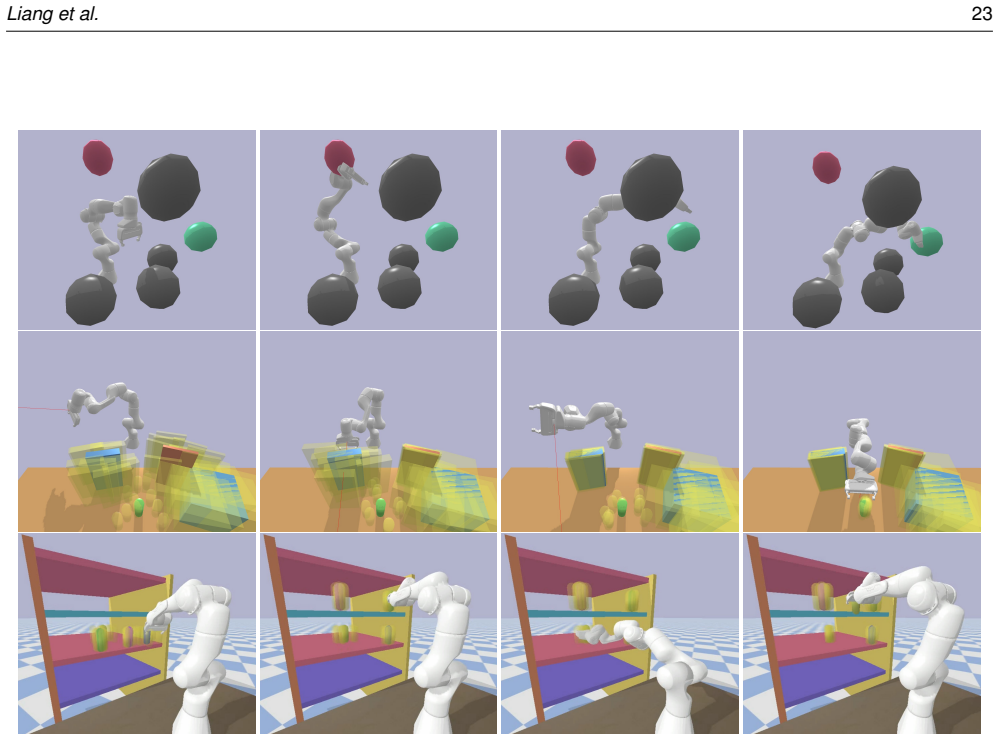

read the original abstract
Partially Observable Markov Decision Processes (POMDPs) are a general and principled framework for motion planning under uncertainty. Despite tremendous improvement in the scalability of POMDP solvers, long-horizon POMDPs remain difficult to solve. To alleviate the difficulty, this paper proposes a new approximate online POMDP solver, called Reference-Based Online POMDP Planning via Rapid State Space Sampling (ROP-RAS3). ROP-RAS3 uses novel extremely fast sampling-based motion planning techniques to sample the state space and generate a diverse set of macro actions online, which are then used to bias belief-space sampling and infer high-quality policies without requiring exhaustive enumeration of the action space -- a fundamental constraint for modern online POMDP solvers. ROP-RAS3 converges to a near-optimal reference-based solution at a rate that depends on the number of sampled actions, rather than the size of the action space. ROP-RAS3 is evaluated on various long-horizon POMDPs with up to 3000 lookahead steps and 35-dimensional state spaces, where the state, action and observation spaces can be continuous, discrete, or a hybrid of discrete and continuous. Although the reference-based optimal solution may not be the same as the optimal POMDP solution, empirical results indicate that in all of these problems, in terms of success rate, ROP-RAS3 outperforms other state-of-the-art methods by up to multiple folds. We also demonstrate the capability of our approach on a physical robot demonstration. This work extends the theory and empirical results of our ISRR24 paper. Code can be found at \texttt{https://github.com/RDLLab/ROPRAS3}.
Editorial analysis
A structured set of objections, weighed in public.
Referee Report
Summary. The manuscript proposes ROP-RAS3, an approximate online POMDP solver for long-horizon problems that uses extremely fast sampling-based motion planning to generate diverse macro actions online. These macro actions bias belief-space sampling to infer policies without exhaustive action enumeration. The central claims are that ROP-RAS3 converges to a near-optimal reference-based solution at a rate depending on the number of sampled actions (not |A|), and that it empirically outperforms state-of-the-art methods by up to multiple folds in success rate across tested domains with up to 3000 lookahead steps and 35D states (continuous, discrete, or hybrid). The work extends an ISRR24 paper, includes a physical robot demo, and provides open code.
Significance. If the convergence claim holds with supporting analysis, the decoupling from action-space size via macro-action sampling would be a meaningful advance for scalable long-horizon POMDP planning under uncertainty. The open code and robot demonstration are concrete strengths supporting reproducibility. The empirical gains, while post-hoc, span diverse domains and could indicate practical utility if baselines and reference optimality are clearly defined.
major comments (2)
- [Abstract] Abstract: The claim that 'ROP-RAS3 converges to a near-optimal reference-based solution at a rate that depends on the number of sampled actions, rather than the size of the action space' is presented without a derivation, error bounds, or formal definition of the reference-based optimality measure or how it is computed/measured in this manuscript.
- [Abstract] Abstract and evaluation sections: The empirical claim of outperformance 'by up to multiple folds' in success rate relies on post-hoc comparisons whose baseline implementations, reference-solution computation, and statistical controls are not detailed, making it difficult to assess whether the gains are load-bearing evidence for the method's advantage.
minor comments (1)
- [Abstract] The manuscript states it extends the theory of the ISRR24 paper but does not reproduce or cite specific equations from that work that establish the convergence rate, which reduces self-containment for readers.
Simulated Author's Rebuttal
We thank the referee for the detailed review and for highlighting the potential significance of the macro-action sampling approach. We address each major comment below with specific plans for revision where the manuscript can be strengthened without misrepresentation.
read point-by-point responses
-
Referee: [Abstract] Abstract: The claim that 'ROP-RAS3 converges to a near-optimal reference-based solution at a rate that depends on the number of sampled actions, rather than the size of the action space' is presented without a derivation, error bounds, or formal definition of the reference-based optimality measure or how it is computed/measured in this manuscript.
Authors: The manuscript defines reference-based optimality in Section 3.1 as the optimal policy under the sampled macro-action set (as opposed to the full action space) and provides a convergence argument in Section 3.2 showing that the value gap scales with the number of samples rather than |A|. This analysis is extended from the ISRR'24 precursor. The abstract condenses the result. To improve accessibility we will revise the abstract to briefly define the reference measure and add an explicit forward reference to Section 3.2. We note that the current analysis does not supply explicit finite-sample error bounds under general POMDP assumptions; adding such bounds would require additional technical development beyond the present scope. revision: partial
-
Referee: [Abstract] Abstract and evaluation sections: The empirical claim of outperformance 'by up to multiple folds' in success rate relies on post-hoc comparisons whose baseline implementations, reference-solution computation, and statistical controls are not detailed, making it difficult to assess whether the gains are load-bearing evidence for the method's advantage.
Authors: We agree that the evaluation section would benefit from greater transparency. In the revised manuscript we will expand the experimental setup subsection to document: (i) exact hyper-parameters and code versions used for each baseline, (ii) the procedure for obtaining reference solutions (long-horizon Monte-Carlo rollouts with the full macro-action set plus a high-fidelity simulator), and (iii) statistical controls including the number of independent trials, confidence intervals, and any hypothesis tests performed. These additions will be placed in both the main text and the supplementary material. revision: yes
Circularity Check
Minor self-citation to ISRR24; central claims on convergence and empirical gains remain independent
full rationale
The paper introduces ROP-RAS3, a new online POMDP solver using rapid state sampling for macro actions, and states convergence to a near-optimal reference-based solution at a rate depending on the number of sampled actions (not |A|). It explicitly caveats that the reference solution may differ from the true POMDP optimum. The sole self-reference is the closing sentence noting extension of ISRR24 theory/empirics; this is not load-bearing for the new convergence rate claim or the reported multi-fold success-rate gains, which are presented as observed across tested domains. No equations, fitted parameters, or derivation steps are shown that reduce the stated results to self-definitions or prior-work fits by construction. The derivation chain is therefore self-contained against external benchmarks.
Axiom & Free-Parameter Ledger
axioms (2)
- domain assumption POMDPs provide a general and principled framework for motion planning under uncertainty
- domain assumption Sampling-based motion planning techniques can be used to sample the state space and generate macro actions sufficiently fast and diverse for online use
Reference graph
Works this paper leans on
-
[1]
Artificial Intelligence , volume = 101, number =
Planning and acting in partially observable stochastic domains , author =. Artificial Intelligence , volume = 101, number =
-
[2]
Smallwood, R. D. and Sondik, E. J. , year = 1973, journal =
1973
-
[3]
and Kaelbling, L
Theocharous, G. and Kaelbling, L. , year = 2003, booktitle =. Approximate Planning in
2003
-
[4]
and Brunskill, E
He, R. and Brunskill, E. and Roy, N. , year = 2010, booktitle =
2010
-
[5]
International Journal of Robotics Research , volume = 30, number = 3, pages =
Motion planning under uncertainty for robotic tasks with long time horizons , author =. International Journal of Robotics Research , volume = 30, number = 3, pages =
-
[6]
and Fisher III, John W , year = 2020, journal =
Flaspohler, Genevieve and Roy, Nicholas A. and Fisher III, John W , year = 2020, journal =. Belief-Dependent Macro-Action Discovery in. Advances in Neural Information Processing Systems , publisher =
2020
-
[7]
Robotics: Science and Systems , address =
Yiyuan Lee AND Panpan Cai AND David Hsu , year = 2021, month =. Robotics: Science and Systems , address =
2021
-
[8]
Reference-Based
Edward Kim and Yohan Karunanayake and Hanna Kurniawati , year = 2023, booktitle =. Reference-Based
2023
-
[9]
International Conference on Artificial Intelligence and Statistics , volume = 15, pages =
Dynamic Policy Programming with Function Approximation , author =. International Conference on Artificial Intelligence and Statistics , volume = 15, pages =
-
[10]
Journal of Machine Learning Research , volume = 13, pages =
Dynamic Policy Programming , author =. Journal of Machine Learning Research , volume = 13, pages =
-
[11]
and Yadav, V
Kurniawati, H. and Yadav, V. , year = 2013, booktitle =
2013
-
[12]
Papadimitriou, C. H. and Tsitsiklis, J. N. , year = 1987, journal =
1987
-
[13]
What makes some
Lee, Wee and Rong, Nan and Hsu, David , year = 2007, journal =. What makes some. Advances in Neural Information Processing Systems , publisher =
2007
-
[14]
Nan Ye and Adhiraj Somani and David Hsu and Wee Sun Lee , year = 2017, journal =
2017
-
[15]
Advances in Neural Information Processing Systems , publisher =
David Silver and Joel Veness , year = 2010, journal =. Advances in Neural Information Processing Systems , publisher =
2010
-
[16]
Entropy-regularized Point-based Value Iteration , author =. 2402.09388 , archiveprefix =
-
[17]
Linearly-solvable
Todorov, Emanuel , year = 2006, booktitle =. Linearly-solvable
2006
-
[18]
Introductory Real Analysis , author =
-
[19]
Dynamic Programming and Optimal Control , author =
-
[20]
Information Theory, Inference, and Learning Algorithms , author =
-
[21]
Applied Probability Models with Optimization Applications , author =
-
[22]
Stochastic Processes , author =
-
[23]
Journal of the American Statistical Association , volume = 58, number = 301, pages =
Probability inequalities for sums of bounded random variables , author =. Journal of the American Statistical Association , volume = 58, number = 301, pages =
-
[24]
Prediction, Learning, and Games , author =
-
[25]
and Hsu, D
Kurniawati, H. and Hsu, D. and Lee, W. S. , year = 2008, booktitle =
2008
-
[26]
International Conference on Machine Learning , publisher =
An alternative softmax operator for reinforcement learning , author =. International Conference on Machine Learning , publisher =
-
[27]
Motions in Microseconds via Vectorized Sampling-Based Planning , author =
-
[28]
International Conference on Machine Learning , pages =
A generalized reinforcement-learning model: convergence and applications , author =. International Conference on Machine Learning , pages =
-
[29]
AAAI Conference on Artificial Intelligence , volume = 24, number = 1, pages =
He, Ruijie and Brunskill, Emma and Roy, Nicholas , year = 2010, month =. AAAI Conference on Artificial Intelligence , volume = 24, number = 1, pages =
2010
-
[30]
Yuanchu Liang and Hanna Kurniawati , year = 2023, booktitle =. Recurrent Macro Actions Generator for. doi:10.1109/IROS55552.2023.10341759 , timestamp =
-
[31]
, author =
Belief space planning assuming maximum likelihood observations. , author =
-
[32]
pomdp\_py: A Framework to Build and Solve
Zheng, Kaiyu and Tellex, Stefanie , year = 2020, booktitle =. pomdp\_py: A Framework to Build and Solve
2020
-
[33]
Panpan Cai and Yuanfu Luo and David Hsu and Wee Sun Lee , year = 2021, journal =
2021
-
[34]
IEEE Transactions on Robotics and Automation , publisher =
Probabilistic roadmaps for path planning in high-dimensional configuration spaces , author =. IEEE Transactions on Robotics and Automation , publisher =
-
[35]
and LaValle, Steven M
Kuffner, James J. and LaValle, Steven M. , year = 2000, booktitle =
2000
-
[36]
Planning Algorithms , author =
-
[37]
Sundaralingam, Balakumar and Hari, Siva Kumar Sastry and Fishman, Adam and Garrett, Caelan and Van Wyk, Karl and Blukis, Valts and Millane, Alexander and Oleynikova, Helen and Handa, Ankur and Ramos, Fabio and Ratliff, Nathan and Fox, Dieter , year = 2023, booktitle =
2023
-
[38]
International Journal of Robotics Research , publisher =
Planning under uncertainty for robotic tasks with mixed observability , author =. International Journal of Robotics Research , publisher =
-
[39]
Value-function approximations for partially observable
Hauskrecht, Milos , year = 2000, journal =. Value-function approximations for partially observable
2000
-
[40]
, year = 2022, journal =
Kurniawati, H. , year = 2022, journal =
2022
-
[41]
Anytime point-based approximations for large
Pineau, Joelle and Gordon, Geoffrey and Thrun, Sebastian , year = 2006, journal =. Anytime point-based approximations for large
2006
-
[42]
, year = 2005, booktitle =
Smith, Trey and Simmons, Reid G. , year = 2005, booktitle =. Point-Based
2005
-
[43]
Bai, Haoyu and Hsu, David and Lee, Wee Sun and Ngo, Vien A , year = 2011, booktitle =
2011
-
[44]
Online algorithms for
Sunberg, Zachary and Kochenderfer, Mykel , year = 2018, booktitle =. Online algorithms for
2018
-
[45]
Hoerger and H
M. Hoerger and H. Kurniawati and D. Kroese and N. Ye , year = 2023, journal =. Adaptive Discretization using Voronoi Trees for Continuous
2023
-
[46]
and Tomlin, Claire and Sunberg, Zachary N
Lim, Michael H. and Tomlin, Claire and Sunberg, Zachary N. , year = 2020, month = 7, booktitle =. Sparse Tree Search Optimality Guarantees in. doi:10.24963/ijcai.2020/572 , editor =
-
[47]
Optimality guarantees for particle belief approximation of
Lim, Michael H and Becker, Tyler J and Kochenderfer, Mykel J and Tomlin, Claire J and Sunberg, Zachary N , year = 2023, journal =. Optimality guarantees for particle belief approximation of
2023
-
[48]
Voronoi progressive widening: Efficient online solvers for continuous state, action, and observation
Lim, Michael H and Tomlin, Claire J and Sunberg, Zachary N , year = 2021, booktitle =. Voronoi progressive widening: Efficient online solvers for continuous state, action, and observation
2021
-
[49]
Conference on Learning Theory , pages =
Provably efficient reinforcement learning with linear function approximation , author =. Conference on Learning Theory , pages =
-
[50]
Bilinear classes: A structural framework for provable generalization in
Du, Simon and Kakade, Sham and Lee, Jason and Lovett, Shachar and Mahajan, Gaurav and Sun, Wen and Wang, Ruosong , year = 2021, booktitle =. Bilinear classes: A structural framework for provable generalization in
2021
-
[51]
Representation learning for online and offline
Uehara, Masatoshi and Zhang, Xuezhou and Sun, Wen , year = 2021, eprint =. Representation learning for online and offline
2021
-
[52]
Kavraki , year = 2024, booktitle =
Yuanchu Liang and Edward Kim and Wil Thomason and Zachary Kingston and Hanna Kurniawati and Lydia E. Kavraki , year = 2024, booktitle =. Scaling Long-Horizon Online
2024
-
[53]
Machine intelligence and pattern recognition , publisher =
Simulation approaches to general probabilistic inference on belief networks , author =. Machine intelligence and pattern recognition , publisher =
-
[54]
International Conference on Machine Learning , pages =
On nesting monte carlo estimators , author =. International Conference on Machine Learning , pages =
-
[55]
International Joint Conference on Artificial Intelligence , publisher =
Partially Observable Reference Policy Programming , author =. International Joint Conference on Artificial Intelligence , publisher =. doi:10.24963/ijcai.2025/949 , editor =
-
[56]
2016--2021 , howpublished =
PyBullet, a Python module for physics simulation for games, robotics and machine learning , author =. 2016--2021 , howpublished =
2016
discussion (0)
Sign in with ORCID, Apple, or X to comment. Anyone can read and Pith papers without signing in.