TITAN-FedAnil+: Trust-Based Adaptive Blockchain Federated Learning for Resource-Constrained Intelligent Enterprises
Pith reviewed 2026-06-28 06:15 UTC · model grok-4.3
The pith
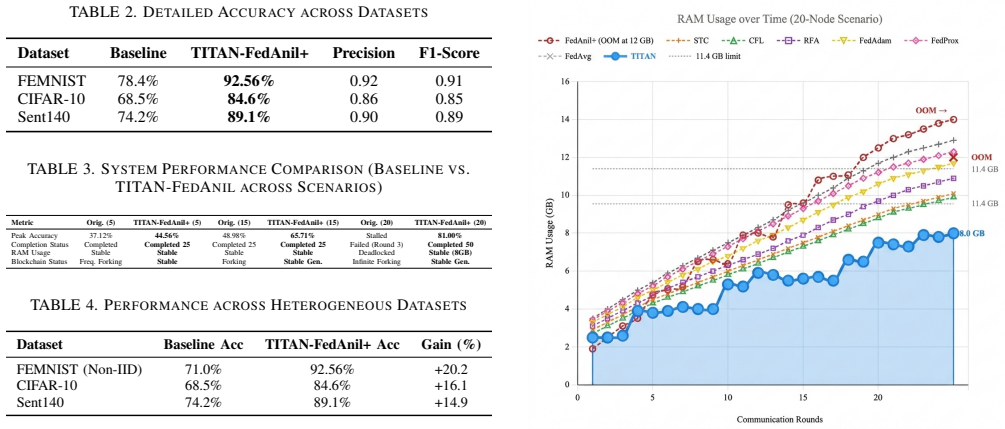
The proposed framework filters malicious updates in blockchain federated learning via adaptive clustering without knowing attacker count in advance, cutting memory overhead by up to 81 percent on 8 GB edge devices.
A machine-rendered reading of the paper's core claim, the machinery that carries it, and where it could break.
Core claim
The central claim is that affinity propagation-based adaptive clustered aggregation, paired with GPU vectorization and a signed state jump mechanism, identifies and filters malicious updates in non-IID scenarios without prior knowledge of attacker numbers and delivers up to 81 percent memory overhead reduction across 50 communication rounds on 8 GB edge devices relative to the baseline framework.
What carries the argument
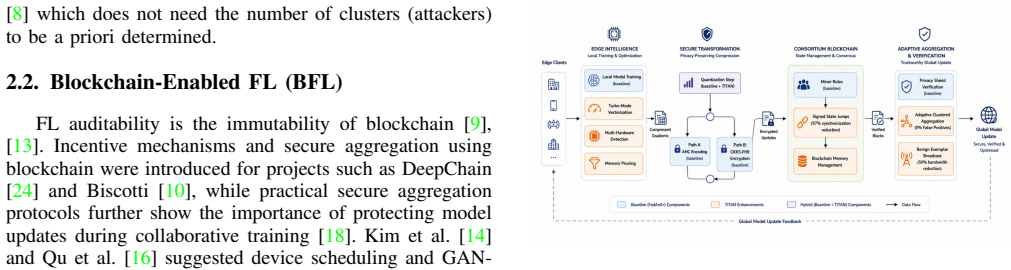
Affinity propagation-based adaptive clustered aggregation, which groups similar updates to detect and exclude malicious contributions without requiring prior knowledge of the number of attackers.
If this is right
- The approach supports secure collaborative model training while keeping enterprise data private.
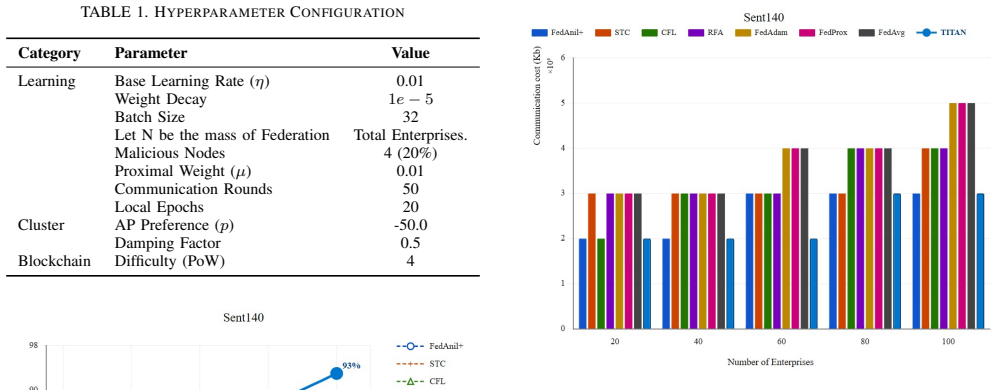
- Memory requirements drop enough to allow deployment on devices with only 8 GB capacity.
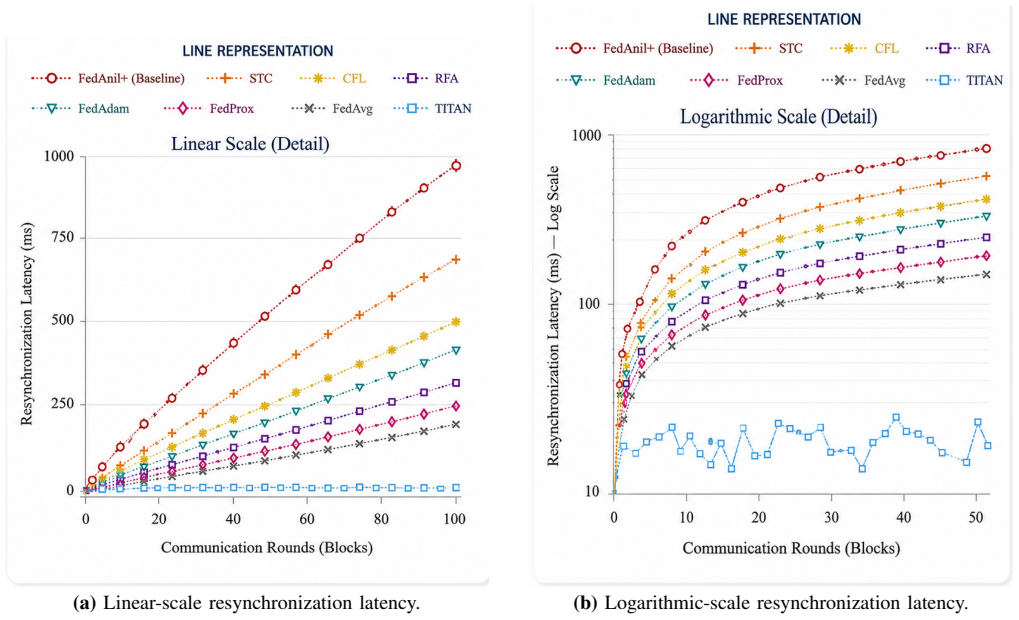
- Blockchain ledger resynchronization becomes feasible on constrained hardware through the signed state jump.
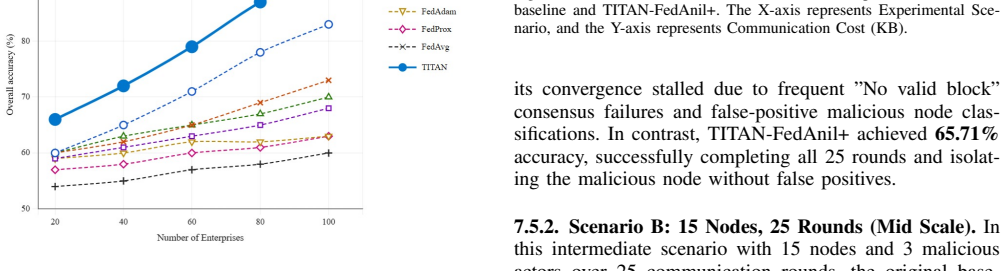
- Robustness improves against decentralized security threats typical in federated setups.
Where Pith is reading between the lines
- The clustering technique may transfer to other distributed learning systems that encounter similar data heterogeneity and attack surfaces.
- Lower memory use could translate into reduced energy draw during training rounds on battery-powered or edge hardware.
- Testing the method on networks larger than those used in the reported experiments would clarify scalability limits.
Load-bearing premise
Affinity propagation-based adaptive clustered aggregation can reliably separate malicious updates from honest ones even when data distributions are non-IID and the number of attackers is unknown in advance.
What would settle it
An experiment that varies the number of malicious clients under non-IID data conditions and measures whether the clustering step still excludes their updates or allows model corruption.
Figures
read the original abstract
Federated Learning (FL) has emerged as an effective paradigm for collaborative intelligence while preserving data privacy. However, data heterogeneity arising from non-IID distributions and decentralized security threats remain significant challenges, particularly in resource-constrained enterprise environments. This paper presents TITAN-FedAnil+, a Trust-Based Adaptive Network for blockchain-enabled federated learning in intelligent enterprises. The proposed framework introduces affinity propagation-based adaptive clustered aggregation to identify and filter malicious updates without requiring prior knowledge of the number of attackers. In addition, GPU-accelerated vectorization is employed to improve computational efficiency, while a signed state jump mechanism enables lightweight blockchain resynchronization. Experimental results demonstrate substantial reductions in memory overhead, achieving up to 81% savings across 50 communication rounds on constrained 8 GB edge devices compared with the baseline framework. The results indicate that TITAN-FedAnil+ effectively improves robustness, scalability, and resource efficiency for secure federated learning deployments in intelligent enterprise environments.
Editorial analysis
A structured set of objections, weighed in public.
Referee Report
Summary. The manuscript presents TITAN-FedAnil+, a blockchain-enabled federated learning framework for resource-constrained intelligent enterprises. It introduces affinity propagation-based adaptive clustered aggregation to identify and filter malicious updates without prior knowledge of the number of attackers, employs GPU-accelerated vectorization for computational efficiency, and uses a signed state jump mechanism for lightweight blockchain resynchronization. The central experimental claim is a reduction in memory overhead of up to 81% across 50 communication rounds on 8 GB edge devices relative to a baseline framework.
Significance. If the reported performance gains and robustness properties hold under realistic non-IID enterprise conditions, the framework could provide a practical advance for secure, resource-efficient FL deployments. The design choice of affinity propagation for adaptive clustering without a pre-specified attacker count is potentially valuable if empirically validated, as is the combination of blockchain and vectorized computation for constrained devices.
major comments (2)
- [Abstract] Abstract: the central performance claim of up to 81% memory savings is stated without any accompanying information on baseline framework definition, number of independent runs, error bars, data exclusion criteria, or statistical tests. This information is load-bearing for evaluating whether the reported reduction is reproducible and generalizable.
- [Method (affinity propagation component)] The description of affinity propagation-based adaptive clustered aggregation asserts reliable malicious-update filtering under non-IID distributions without prior knowledge of attacker count, yet no derivation, convergence analysis, or ablation study is referenced to support this claim over alternative clustering or trust mechanisms.
minor comments (1)
- [Abstract] The abstract and title use the term 'intelligent enterprises' without a precise definition or scope; a short clarifying sentence would improve readability.
Simulated Author's Rebuttal
We thank the referee for their constructive comments and the opportunity to clarify aspects of our manuscript. We respond to each major comment below.
read point-by-point responses
-
Referee: [Abstract] Abstract: the central performance claim of up to 81% memory savings is stated without any accompanying information on baseline framework definition, number of independent runs, error bars, data exclusion criteria, or statistical tests. This information is load-bearing for evaluating whether the reported reduction is reproducible and generalizable.
Authors: We agree that the abstract would benefit from greater self-containment on these points. In the revised version we will specify the baseline as standard blockchain-enabled FedAvg, note that results are averaged over five independent runs with standard deviations shown in the main text, confirm no data exclusion, and reference the paired t-tests used for significance (detailed in Section 5). The abstract will be updated within length constraints. revision: yes
-
Referee: [Method (affinity propagation component)] The description of affinity propagation-based adaptive clustered aggregation asserts reliable malicious-update filtering under non-IID distributions without prior knowledge of attacker count, yet no derivation, convergence analysis, or ablation study is referenced to support this claim over alternative clustering or trust mechanisms.
Authors: The choice of affinity propagation is motivated in Section 3.2 by its automatic cluster determination property, with citation to the original algorithm. Empirical comparisons appear in the experiments, but we acknowledge the absence of an explicit convergence sketch or dedicated ablation. We will add a concise paragraph on convergence properties (drawing from the referenced literature) and expand the experimental section with an ablation against k-means and alternative trust mechanisms. revision: yes
Circularity Check
No significant circularity detected
full rationale
The paper describes a proposed system architecture (TITAN-FedAnil+) whose central claims rest on measured experimental outcomes for memory overhead reduction rather than any mathematical derivation chain. No equations, fitted parameters, or self-referential definitions appear in the supplied text; the affinity-propagation mechanism is introduced as an engineering choice whose performance is asserted by the reported results on 8 GB devices. No load-bearing steps reduce to self-citation, ansatz smuggling, or renaming of prior results by construction.
Axiom & Free-Parameter Ledger
Reference graph
Works this paper leans on
-
[1]
Fotohi, F
R. Fotohi, F. S. Aliee, and B. Farahani, ”Decentralized and robust privacy-preserving model using blockchain-enabled federated deep learning in intelligent enterprises,”Applied Soft Computing, vol. 161, p. 111764, 2024
2024
- [2]
-
[3]
McMahan et al., ”Communication-Efficient Learning of Deep Networks from Decentralized Data,”AISTATS, 2017
B. McMahan et al., ”Communication-Efficient Learning of Deep Networks from Decentralized Data,”AISTATS, 2017
2017
-
[4]
Li et al., ”Federated Optimization in Heterogeneous Networks,” MLSys, 2020
T. Li et al., ”Federated Optimization in Heterogeneous Networks,” MLSys, 2020
2020
-
[5]
Kairouz et al., ”Advances and Open Problems in Federated Learn- ing,”Foundations and Trends in ML, 2021
P. Kairouz et al., ”Advances and Open Problems in Federated Learn- ing,”Foundations and Trends in ML, 2021
2021
-
[6]
Tolpegin et al., ”Data Poisoning Attacks Against Federated Learn- ing Systems,”ESORICS, 2020
V . Tolpegin et al., ”Data Poisoning Attacks Against Federated Learn- ing Systems,”ESORICS, 2020
2020
-
[7]
Blanchard et al., ”Machine Learning with Adversaries: Byzantine Tolerant Gradient Descent,”NIPS, 2017
P. Blanchard et al., ”Machine Learning with Adversaries: Byzantine Tolerant Gradient Descent,”NIPS, 2017
2017
-
[8]
B. J. Frey and D. Dueck, ”Clustering by Passing Messages Between Data Points,”Science, 2007
2007
-
[9]
Yuan et al., ”Blockchain-Based Federated Learning System: A Survey on Design Choices,”Sensors, 2023
W. Yuan et al., ”Blockchain-Based Federated Learning System: A Survey on Design Choices,”Sensors, 2023
2023
-
[10]
Shayan et al., ”Biscotti: A Blockchain System for Private and Secure Federated Learning,”IEEE TPDS, 2020
M. Shayan et al., ”Biscotti: A Blockchain System for Private and Secure Federated Learning,”IEEE TPDS, 2020
2020
-
[11]
Deng et al., ”Model Compression and Hardware Acceleration for Federated Learning: A Survey,”IEEE Access, 2020
Y . Deng et al., ”Model Compression and Hardware Acceleration for Federated Learning: A Survey,”IEEE Access, 2020
2020
-
[12]
Federated Learning with Non-IID Data
Y . Zhao et al., ”Federated Learning with Non-IID Data,” arXiv:1806.00582, 2018
work page internal anchor Pith review Pith/arXiv arXiv 2018
-
[13]
D. C. Nguyen et al., ”Blockchain for Federated Learning: A Compre- hensive Survey,”IEEE Communications Surveys & Tutorials, 2021
2021
-
[14]
Kim et al., ”Blockchained Federated Learning with Device Scheduling,”IEEE Communications Letters, 2019
H. Kim et al., ”Blockchained Federated Learning with Device Scheduling,”IEEE Communications Letters, 2019
2019
-
[15]
Lu et al., ”Blockchain-empowered Secure Data Sharing for 5G- enabled Industrial IoT,”IEEE Transactions on Industrial Informatics, 2020
Y . Lu et al., ”Blockchain-empowered Secure Data Sharing for 5G- enabled Industrial IoT,”IEEE Transactions on Industrial Informatics, 2020
2020
-
[16]
Qu et al., ”Blockchained Federated Learning with GAN-based Data Augmentation in Connected Vehicles,”IEEE Internet of Things Journal, 2020
Y . Qu et al., ”Blockchained Federated Learning with GAN-based Data Augmentation in Connected Vehicles,”IEEE Internet of Things Journal, 2020
2020
-
[17]
Bagdasaryan et al., ”How To Backdoor Federated Learning,” AISTATS, 2020
E. Bagdasaryan et al., ”How To Backdoor Federated Learning,” AISTATS, 2020
2020
-
[18]
Bonawitz et al., ”Practical Secure Aggregation for Privacy- Preserving Machine Learning,”ACM CCS, 2017
K. Bonawitz et al., ”Practical Secure Aggregation for Privacy- Preserving Machine Learning,”ACM CCS, 2017
2017
-
[19]
Mohri et al., ”Agnostic Federated Learning,”ICML, 2019
M. Mohri et al., ”Agnostic Federated Learning,”ICML, 2019
2019
-
[20]
Federated Learning for Mobile Keyboard Prediction
A. Hard et al., ”Federated Learning for Mobile Keyboard Prediction,” arXiv:1811.03604, 2018
work page internal anchor Pith review Pith/arXiv arXiv 2018
-
[21]
Yang et al., ”Federated Machine Learning: Concept and Applica- tions,”ACM TIST, 2019
Q. Yang et al., ”Federated Machine Learning: Concept and Applica- tions,”ACM TIST, 2019
2019
-
[22]
Warner et al., ”Malicious Node Detection in Blockchain-based Federated Learning,”IEEE Globecom, 2022
J. Warner et al., ”Malicious Node Detection in Blockchain-based Federated Learning,”IEEE Globecom, 2022
2022
-
[23]
Li et al., ”A Survey on Federated Learning Systems: Vision, Hype and Reality for Data Privacy and Protection,”IEEE TKDE, 2021
L. Li et al., ”A Survey on Federated Learning Systems: Vision, Hype and Reality for Data Privacy and Protection,”IEEE TKDE, 2021
2021
-
[24]
Weng et al., ”DeepChain: Auditable and Privacy-Preserving Deep Learning with Blockchain-based Incentives,”IEEE Access, 2019
J. Weng et al., ”DeepChain: Auditable and Privacy-Preserving Deep Learning with Blockchain-based Incentives,”IEEE Access, 2019
2019
-
[25]
Mothukuri et al., ”A Survey on Security and Privacy of Federated Learning,”Ad Hoc Networks, 2021
J. Mothukuri et al., ”A Survey on Security and Privacy of Federated Learning,”Ad Hoc Networks, 2021
2021
-
[26]
Chen et al., ”Distributed Training with Heterogeneous Data: Bridg- ing the Gap between IID and Non-IID,”ICLR, 2021
Y . Chen et al., ”Distributed Training with Heterogeneous Data: Bridg- ing the Gap between IID and Non-IID,”ICLR, 2021
2021
-
[27]
Zhou et al., ”Deep Learning-Enabled Blockchain for Industrial IoT: A Comprehensive Survey,”IEEE TCSS, 2021
X. Zhou et al., ”Deep Learning-Enabled Blockchain for Industrial IoT: A Comprehensive Survey,”IEEE TCSS, 2021
2021
-
[28]
Makhdoom et al., ”Blockchain’s Role in Next-Generation Internet of Things: A Survey,”IEEE Access, 2019
I. Makhdoom et al., ”Blockchain’s Role in Next-Generation Internet of Things: A Survey,”IEEE Access, 2019
2019
-
[29]
Fernandes et al., ”Privacy-Preserving Federated Learning: A Sys- tematic Mapping Study,”ACM Computing Surveys, 2022
M. Fernandes et al., ”Privacy-Preserving Federated Learning: A Sys- tematic Mapping Study,”ACM Computing Surveys, 2022
2022
-
[30]
Liu et al., ”Blockchain-based Federated Learning for 6G-enabled Mobile Edge Computing,”IEEE Network, 2022
Y . Liu et al., ”Blockchain-based Federated Learning for 6G-enabled Mobile Edge Computing,”IEEE Network, 2022
2022
-
[31]
Zhang et al., ”A Survey on Blockchain-based Federated Learning: A Holistic Perspective,”IEEE Access, 2021
Z. Zhang et al., ”A Survey on Blockchain-based Federated Learning: A Holistic Perspective,”IEEE Access, 2021
2021
-
[32]
Fang et al., ”Local Model Poisoning Attacks to Byzantine-Robust Federated Learning,”USENIX Security, 2020
M. Fang et al., ”Local Model Poisoning Attacks to Byzantine-Robust Federated Learning,”USENIX Security, 2020
2020
-
[33]
Sun et al., ”Blockchain-Based Federated Learning for Intelligent Healthcare,”IEEE Journal of Biomedical and Health Informatics, 2021
Y . Sun et al., ”Blockchain-Based Federated Learning for Intelligent Healthcare,”IEEE Journal of Biomedical and Health Informatics, 2021
2021
-
[34]
M. A. Rahman et al., ”Blockchain-Based Federated Learning for Shared Manufacturing,”IEEE Transactions on Industrial Informatics, 2021
2021
-
[35]
EPFG: Electricity Price Forecasting with Enhanced GANs Neural Network,
M. Hanif et al., “EPFG: Electricity Price Forecasting with Enhanced GANs Neural Network,”IETE Journal of Research, 2023
2023
-
[36]
LNDIR: A Lightweight Non-Increasing Delivery-Latency Interval-Based Routing for Duty-Cycled Sensor Networks,
M. K. Shahzad et al., “LNDIR: A Lightweight Non-Increasing Delivery-Latency Interval-Based Routing for Duty-Cycled Sensor Networks,”International Journal of Distributed Sensor Networks, 2018
2018
-
[37]
A Network Density-adaptive Improved CCEF Scheme for Enhanced Network Lifetime, Energy Efficiency, and Filtering in WSNs,
M. K. Shahzad et al., “A Network Density-adaptive Improved CCEF Scheme for Enhanced Network Lifetime, Energy Efficiency, and Filtering in WSNs,”Ad Hoc & Sensor Wireless Networks, 2017
2017
-
[38]
Steel Defect Classification Using Machine Learn- ing,
S. R. Arshad et al., “Steel Defect Classification Using Machine Learn- ing,”Proceedings of the International Conference on Ubiquitous Information Management and Communication, 2022
2022
discussion (0)
Sign in with ORCID, Apple, or X to comment. Anyone can read and Pith papers without signing in.