ParetoPilot: Zero-Surrogate Offline Multi-Objective Optimization via Infer-Perturb-Guide Diffusion
Pith reviewed 2026-06-28 07:08 UTC · model grok-4.3
The pith
ParetoPilot steers pre-trained diffusion models for offline multi-objective optimization without any surrogate training.
A machine-rendered reading of the paper's core claim, the machinery that carries it, and where it could break.
Core claim
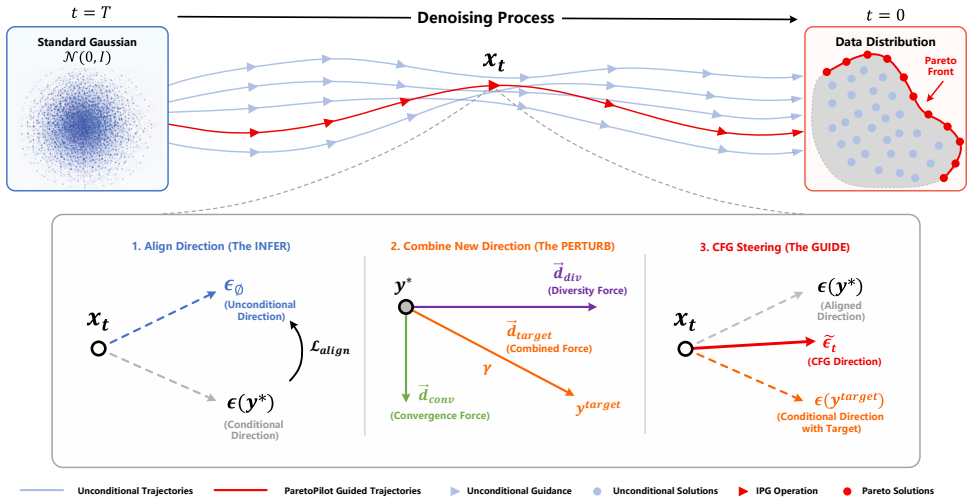
ParetoPilot is a zero-surrogate diffusion framework for offline MOO that interleaves the Infer-Perturb-Guide engine inside unconditional denoising steps. The engine first infers the instantaneous objective direction by matching conditional and unconditional noise predictions, then mathematically orthogonalizes a parallel gravity field for convergence together with an edgeness-aware repulsive force for diversity to form an annealed perturbation vector, and finally applies this vector through standard classifier-free guidance. Experiments on 51 tasks show the resulting method outperforms 14 surrogate-based and inverse generative baselines in hypervolume and Pareto front coverage while eliminat
What carries the argument
The Infer-Perturb-Guide (IPG) engine, which infers objective directions from noise prediction differences and constructs an orthogonal perturbation vector to steer the reverse diffusion process.
If this is right
- No separate surrogate model needs to be trained or queried, removing that source of overhead and potential evaluation error.
- Data privacy is preserved because the method never requires fitting an auxiliary model on the dataset.
- The generation process remains compatible with any pre-trained diffusion model that supports classifier-free guidance.
- The same IPG steps can be inserted into existing unconditional sampling loops without retraining the base model.
- Hypervolume gains and front coverage hold across the tested tasks when the perturbation is applied at each denoising step.
Where Pith is reading between the lines
- If the IPG engine works because diffusion models already encode rich conditional structure, the same pattern might transfer to other conditional generative models that expose both conditional and unconditional predictions.
- Removing the surrogate step could make the method easier to apply in domains where reliable objective models are expensive or impossible to fit.
- The orthogonalization step assumes that convergence and diversity directions can be cleanly separated; testing whether the method still works when objectives are strongly correlated would be a direct check.
- Because the approach relies on pre-trained models, performance may vary with the quality and coverage of the original training data for the diffusion model itself.
Load-bearing premise
The conditional priors already inside a standard pre-trained diffusion model are rich enough for the IPG engine to infer correct objective directions and produce effective convergence-plus-diversity perturbations without any external check.
What would settle it
A controlled run on one of the 51 tasks in which ParetoPilot produces lower hypervolume or visibly collapsed Pareto fronts than a well-tuned surrogate baseline on the same static dataset.
Figures

read the original abstract
Offline multi-objective optimization (Offline MOO) aims to discover novel Pareto-optimal designs based on static datasets without expensive environment interactions. While recent generative methods have achieved notable success, they predominantly rely on external surrogate models. This dependency introduces significant computational overhead, suffers from deceptive evaluations, and deviates from the prevailing paradigm of jointly training mainstream generative models with conditions. To address these bottlenecks, we propose ParetoPilot, a novel zero-surrogate diffusion framework for offline MOO. ParetoPilot fully leverages the conditional priors inherently embedded within pre-trained diffusion models. At its core, the framework introduces the Infer-Perturb-Guide (IPG) engine, which is seamlessly interleaved within the unconditional denoising steps of the reverse generation process. First, it implicitly infers the instantaneous objective direction by matching conditional and unconditional noise predictions. Next, it mathematically orthogonalizes a parallel gravity field for strict convergence and an edgeness-aware repulsive force for mutual diversity, creating a dynamically annealed perturbation vector. Finally, this perturbed target seamlessly steers the generation process via standard Classifier-Free Guidance (CFG). Extensive experiments across 51 tasks demonstrate that ParetoPilot outperforms 14 state-of-the-art surrogate-based and inverse generative baselines. By eliminating auxiliary proxy training, our approach preserves data privacy while achieving hypervolume improvement and robust Pareto front coverage.
Editorial analysis
A structured set of objections, weighed in public.
Referee Report
Summary. The paper proposes ParetoPilot, a zero-surrogate diffusion framework for offline multi-objective optimization. It introduces the Infer-Perturb-Guide (IPG) engine that infers instantaneous objective directions by matching conditional and unconditional noise predictions from pre-trained models, mathematically orthogonalizes a parallel gravity field and edgeness-aware repulsive force into an annealed perturbation vector, and applies this via classifier-free guidance during denoising. The central claim is that this eliminates auxiliary surrogate training while outperforming 14 state-of-the-art surrogate-based and inverse generative baselines across 51 tasks in hypervolume improvement and Pareto front coverage.
Significance. If the IPG mechanism is shown to reliably recover objective directions and produce effective perturbations without surrogates, the result would be significant: it removes computational overhead, deceptive evaluations, and privacy risks from proxy training while leveraging existing pre-trained diffusion priors. This aligns with the trend of conditioning generative models directly and could simplify offline MOO pipelines if the performance advantage is robust.
major comments (3)
- [§3.2] §3.2 (IPG engine description): the claim that matching conditional/unconditional noise predictions yields an accurate instantaneous objective direction lacks formal justification or validation; if this direction deviates from true objective gradients, the subsequent orthogonalization cannot guarantee convergence or diversity, directly undermining the zero-surrogate performance advantage.
- [§4] §4 (experimental results): aggregate outperformance is reported on 51 tasks, but no ablation isolating the infer/perturb/guide components or statistical significance tests (e.g., paired t-tests or confidence intervals on hypervolume) are provided, making it impossible to attribute gains specifically to the IPG construction rather than implementation details.
- [Eq. (orthogonalization step in IPG)] Eq. (orthogonalization step in IPG): the parallel gravity field and edgeness-aware repulsive force are asserted to be mathematically orthogonalized into a perturbation that preserves both convergence and diversity, but no proof or analysis addresses whether this holds exactly on the learned diffusion manifold (as opposed to in ambient space), risking approximate orthogonality that could collapse fronts.
minor comments (2)
- [Abstract] Abstract and §4: the 51 tasks are not broken down by domain or benchmark suite, hindering assessment of generalizability.
- [§4] Figure captions in §4: several Pareto front visualizations lack axis scales or reference to the specific objective dimensions used.
Simulated Author's Rebuttal
We thank the referee for the constructive feedback. Below we address each major comment point by point, providing clarifications on the IPG mechanism and committing to enhancements in the revised manuscript.
read point-by-point responses
-
Referee: [§3.2] §3.2 (IPG engine description): the claim that matching conditional/unconditional noise predictions yields an accurate instantaneous objective direction lacks formal justification or validation; if this direction deviates from true objective gradients, the subsequent orthogonalization cannot guarantee convergence or diversity, directly undermining the zero-surrogate performance advantage.
Authors: The difference between conditional and unconditional noise predictions is motivated by the score-function interpretation in classifier-free guidance, where it approximates the direction of increasing conditional likelihood. Appendix B of the manuscript sketches this connection under standard diffusion assumptions. We agree a more explicit derivation and direct validation against ground-truth gradients would strengthen the claim; we will expand the appendix with this derivation and add synthetic validation experiments in the revision. revision: yes
-
Referee: [§4] §4 (experimental results): aggregate outperformance is reported on 51 tasks, but no ablation isolating the infer/perturb/guide components or statistical significance tests (e.g., paired t-tests or confidence intervals on hypervolume) are provided, making it impossible to attribute gains specifically to the IPG construction rather than implementation details.
Authors: We concur that component ablations and statistical testing are necessary to isolate the contribution of the IPG engine. The revised manuscript will include ablations that disable infer, perturb, and guide stages individually, report mean hypervolume with standard deviations over multiple seeds, and apply paired t-tests with confidence intervals to quantify significance. revision: yes
-
Referee: [Eq. (orthogonalization step in IPG)] Eq. (orthogonalization step in IPG): the parallel gravity field and edgeness-aware repulsive force are asserted to be mathematically orthogonalized into a perturbation that preserves both convergence and diversity, but no proof or analysis addresses whether this holds exactly on the learned diffusion manifold (as opposed to in ambient space), risking approximate orthogonality that could collapse fronts.
Authors: Orthogonality is enforced exactly in the ambient perturbation vector by projecting the repulsive component perpendicular to the gravity field. Because each denoising step is incremental and the perturbation is annealed, the local effect on the diffusion trajectory remains approximately orthogonal. We will add a dedicated paragraph in §3.2 discussing the manifold approximation, its validity under small-step assumptions, and potential edge cases where front collapse could occur. revision: partial
Circularity Check
No significant circularity; derivation relies on external pre-trained diffusion priors treated as given
full rationale
The paper's core IPG construction (infer direction via conditional/unconditional noise difference, orthogonalize gravity/repulsive terms, steer via CFG) is presented as a novel interleaving within standard reverse diffusion steps. No equations reduce a claimed prediction to a fitted parameter or self-defined quantity by construction. No load-bearing self-citations or uniqueness theorems from the same authors are invoked in the provided text. The zero-surrogate claim rests on the external assumption that pre-trained conditional priors are sufficiently rich, which is an empirical premise rather than a definitional loop. The derivation chain is therefore self-contained against external benchmarks and does not exhibit any of the enumerated circularity patterns.
Axiom & Free-Parameter Ledger
Reference graph
Works this paper leans on
-
[1]
The Twelfth International Conference on Learning Representations , year=
Training-free multi-objective diffusion model for 3d molecule generation , author=. The Twelfth International Conference on Learning Representations , year=
-
[2]
International conference on machine learning , pages=
Equivariant diffusion for molecule generation in 3d , author=. International conference on machine learning , pages=. 2022 , organization=
2022
-
[3]
IEEE Transactions on Software Engineering , year=
S oap FL: A Standard Operating Procedure for LLM-based Method-Level Fault Localization , author=. IEEE Transactions on Software Engineering , year=
-
[4]
IEEE Open Journal of the Computer Society , year=
Large pretrained foundation model for key performance indicator multivariate time series anomaly detection , author=. IEEE Open Journal of the Computer Society , year=
-
[5]
arXiv preprint arXiv:2406.03722 , year=
Offline multi-objective optimization , author=. arXiv preprint arXiv:2406.03722 , year=
-
[6]
International Conference on Learning Representations , volume=
Paretoflow: Guided flows in multi-objective optimization , author=. International Conference on Learning Representations , volume=
-
[7]
npj Computational Materials , volume=
Active learning enables generation of molecules that advance the known Pareto front , author=. npj Computational Materials , volume=. 2026 , publisher=
2026
-
[8]
Advances in Neural Information Processing Systems , volume=
Preference-guided diffusion for multi-objective offline optimization , author=. Advances in Neural Information Processing Systems , volume=
-
[9]
IEEE transactions on evolutionary computation , volume=
Neural architecture search as multiobjective optimization benchmarks: Problem formulation and performance assessment , author=. IEEE transactions on evolutionary computation , volume=. 2023 , publisher=
2023
-
[10]
International Conference on Machine Learning , pages=
Geometric latent diffusion models for 3d molecule generation , author=. International Conference on Machine Learning , pages=. 2023 , organization=
2023
-
[11]
IEEE transactions on evolutionary computation , volume=
A fast and elitist multiobjective genetic algorithm: NSGA-II , author=. IEEE transactions on evolutionary computation , volume=. 2002 , publisher=
2002
-
[12]
Proceedings of the AAAI Conference on Artificial Intelligence , volume=
Bindgpt: A scalable framework for 3d molecular design via language modeling and reinforcement learning , author=. Proceedings of the AAAI Conference on Artificial Intelligence , volume=
-
[13]
2019 , issn =
A graph-based genetic algorithm and generative model/Monte Carlo tree search for the exploration of chemical space , journal =. 2019 , issn =
2019
-
[14]
npj Materials Degradation , volume=
Inhibitor\_Mol\_VAE: a variational autoencoder approach for generating corrosion inhibitor molecules , author=. npj Materials Degradation , volume=. 2024 , publisher=
2024
-
[15]
arXiv preprint arXiv:2406.16976 , year=
Efficient evolutionary search over chemical space with large language models , author=. arXiv preprint arXiv:2406.16976 , year=
-
[16]
ICML 2025 Generative AI and Biology (GenBio) Workshop , year=
Modeling Molecular Sequences with Learning-Order Autoregressive Models , author=. ICML 2025 Generative AI and Biology (GenBio) Workshop , year=
2025
-
[17]
arXiv preprint arXiv:2507.13762 , year=
MolPIF: A Parameter Interpolation Flow Model for Molecule Generation , author=. arXiv preprint arXiv:2507.13762 , year=
-
[18]
Communications Biology , volume=
Enabling target-aware molecule generation to follow multi objectives with Pareto MCTS , author=. Communications Biology , volume=. 2024 , publisher=
2024
-
[19]
The Journal of Physical Chemistry B , volume=
Toward the Evolutionary Optimisation of Small Molecules Within Coarse-Grained Simulations: Training Molecules to Hide Behind Lipid Head Groups , author=. The Journal of Physical Chemistry B , volume=. 2025 , publisher=
2025
-
[20]
npj Computational Materials , volume=
Deep reinforcement learning for inverse inorganic materials design , author=. npj Computational Materials , volume=. 2024 , publisher=
2024
-
[21]
IEEE Transactions on Evolutionary Computation , year=
A survey on evolutionary computation based drug discovery , author=. IEEE Transactions on Evolutionary Computation , year=
-
[22]
Physical review letters , volume=
Molecular geometry optimization with a genetic algorithm , author=. Physical review letters , volume=. 1995 , publisher=
1995
-
[23]
Journal of Chemical Information and Modeling , volume=
Evolutionary Multiobjective Molecule Optimization in an Implicit Chemical Space , author=. Journal of Chemical Information and Modeling , volume=. 2024 , publisher=
2024
-
[24]
arXiv preprint arXiv:1705.04612 , year=
Molecular generation with recurrent neural networks (RNNs) , author=. arXiv preprint arXiv:1705.04612 , year=
-
[25]
IEEE transactions on emerging topics in computational intelligence , volume=
Predicting side effect of drug molecules using recurrent neural networks , author=. IEEE transactions on emerging topics in computational intelligence , volume=. 2024 , publisher=
2024
-
[26]
Pocket-specific 3d molecule generation by fragment-based autoregressive diffusion models , author=
-
[27]
arXiv preprint arXiv:2401.05370 , year=
Autoregressive fragment-based diffusion for pocket-aware ligand design , author=. arXiv preprint arXiv:2401.05370 , year=
-
[28]
Scientific reports , volume=
Optimization of molecules via deep reinforcement learning , author=. Scientific reports , volume=. 2019 , publisher=
2019
-
[29]
Proceedings of the AAAI Conference on Artificial Intelligence , volume=
Text-guided molecule generation with diffusion language model , author=. Proceedings of the AAAI Conference on Artificial Intelligence , volume=
-
[30]
Briefings in Bioinformatics , volume=
GADIFF: a transferable graph attention diffusion model for generating molecular conformations , author=. Briefings in Bioinformatics , volume=. 2025 , publisher=
2025
-
[31]
Journal of chemical information and modeling , volume=
Three-dimensional convolutional neural networks and a cross-docked data set for structure-based drug design , author=. Journal of chemical information and modeling , volume=. 2020 , publisher=
2020
-
[32]
Patterns , volume=
Computer-aided multi-objective optimization in small molecule discovery , author=. Patterns , volume=. 2023 , publisher=
2023
-
[33]
Chemical Science. 2024. doi:10.1039/D3SC04185A
-
[34]
Proceedings of the AAAI conference on artificial intelligence , volume=
Diffusionedge: Diffusion probabilistic model for crisp edge detection , author=. Proceedings of the AAAI conference on artificial intelligence , volume=
-
[35]
arXiv preprint arXiv:2411.08063 , year=
MatPilot: an LLM-enabled AI Materials Scientist under the Framework of Human-Machine Collaboration , author=. arXiv preprint arXiv:2411.08063 , year=
-
[36]
Scientific reports , volume=
Protein-ligand blind docking using QuickVina-W with inter-process spatio-temporal integration , author=. Scientific reports , volume=. 2017 , publisher=
2017
-
[37]
Australasian joint conference on artificial intelligence , pages=
Constrained optimization by the constrained hybrid algorithm of particle swarm optimization and genetic algorithm , author=. Australasian joint conference on artificial intelligence , pages=. 2005 , organization=
2005
-
[38]
Advances in neural information processing systems , volume=
Diffusion models beat gans on image synthesis , author=. Advances in neural information processing systems , volume=
-
[39]
TIK report , volume=
SPEA2: Improving the strength Pareto evolutionary algorithm , author=. TIK report , volume=. 2001 , publisher=
2001
-
[40]
Nature Computational Science , volume=
Structure-based drug design with equivariant diffusion models , author=. Nature Computational Science , volume=. 2024 , publisher=
2024
-
[41]
Scientific Data , volume=
GEOM, energy-annotated molecular conformations for property prediction and molecular generation , author=. Scientific Data , volume=. 2022 , publisher=
2022
-
[42]
Scientific american , volume=
Genetic algorithms , author=. Scientific american , volume=. 1992 , publisher=
1992
-
[43]
arXiv preprint arXiv:2011.13456 , year=
Score-based generative modeling through stochastic differential equations , author=. arXiv preprint arXiv:2011.13456 , year=
Pith/arXiv arXiv 2011
-
[44]
arXiv preprint arXiv:2108.07258 , year=
On the opportunities and risks of foundation models , author=. arXiv preprint arXiv:2108.07258 , year=
-
[45]
Nature Machine Intelligence , volume=
Secure, privacy-preserving and federated machine learning in medical imaging , author=. Nature Machine Intelligence , volume=. 2020 , publisher=
2020
-
[46]
Advances in Neural Information Processing Systems , volume=
Tfg: Unified training-free guidance for diffusion models , author=. Advances in Neural Information Processing Systems , volume=
-
[47]
arXiv preprint arXiv:2207.12598 , year=
Classifier-free diffusion guidance , author=. arXiv preprint arXiv:2207.12598 , year=
-
[48]
Advances in neural information processing systems , volume=
Denoising diffusion probabilistic models , author=. Advances in neural information processing systems , volume=
-
[49]
arXiv preprint arXiv:1802.08219 , year=
Tensor field networks: Rotation-and translation-equivariant neural networks for 3d point clouds , author=. arXiv preprint arXiv:1802.08219 , year=
-
[50]
Communications Chemistry , volume=
Geometry-complete diffusion for 3D molecule generation and optimization , author=. Communications Chemistry , volume=. 2024 , publisher=
2024
-
[51]
arXiv preprint arXiv:2209.15408 , year=
Equivariant energy-guided sde for inverse molecular design , author=. arXiv preprint arXiv:2209.15408 , year=
-
[52]
Scientific data , volume=
Quantum chemistry structures and properties of 134 kilo molecules , author=. Scientific data , volume=. 2014 , publisher=
2014
-
[53]
Advances in Neural Information Processing Systems (NeurIPS) , volume=
Parallel Bayesian optimization of multiple noisy objectives with expected hypervolume improvement , author=. Advances in Neural Information Processing Systems (NeurIPS) , volume=
-
[54]
IEEE Transactions on Evolutionary Computation , volume=
ParEGO: A hybrid algorithm with on-line landscape approximation for expensive multiobjective optimization problems , author=. IEEE Transactions on Evolutionary Computation , volume=
-
[55]
Advances in Neural Information Processing Systems (NeurIPS) , volume=
Joint entropy search for maximally-informed Bayesian optimization , author=. Advances in Neural Information Processing Systems (NeurIPS) , volume=
-
[56]
IEEE Transactions on Evolutionary Computation , volume=
A fast and elitist multiobjective genetic algorithm: NSGA-II , author=. IEEE Transactions on Evolutionary Computation , volume=
-
[57]
International Conference on Machine Learning (ICML) , pages=
GradNorm: Gradient normalization for adaptive loss balancing in deep multitask networks , author=. International Conference on Machine Learning (ICML) , pages=
-
[58]
Advances in Neural Information Processing Systems (NeurIPS) , volume=
Gradient surgery for multi-task learning , author=. Advances in Neural Information Processing Systems (NeurIPS) , volume=
-
[59]
International Conference on Machine Learning (ICML) , pages=
Conservative objective models for effective offline model-based optimization , author=. International Conference on Machine Learning (ICML) , pages=
-
[60]
Advances in Neural Information Processing Systems (NeurIPS) , volume=
RoMA: Robust model adaptation for offline model-based optimization , author=. Advances in Neural Information Processing Systems (NeurIPS) , volume=
-
[61]
Advances in Neural Information Processing Systems (NeurIPS) , volume=
Data-driven offline decision-making via invariant representation learning , author=. Advances in Neural Information Processing Systems (NeurIPS) , volume=
-
[62]
Advances in Neural Information Processing Systems (NeurIPS) , volume=
Importance-aware co-teaching for offline model-based optimization , author=. Advances in Neural Information Processing Systems (NeurIPS) , volume=
-
[63]
Advances in Neural Information Processing Systems (NeurIPS) , volume=
Parallel-mentoring for offline model-based optimization , author=. Advances in Neural Information Processing Systems (NeurIPS) , volume=
discussion (0)
Sign in with ORCID, Apple, or X to comment. Anyone can read and Pith papers without signing in.