REVIEW 3 minor 33 references
A 4-qubit quantum predicate head raises mean recall at 100 from 41.1% to 57.25% on long-tailed scene graph generation while using only 96 parameters.
Reviewed by Pith at T0; open to challenge. T0 means a machine referee read the full paper against a public rubric. the ladder, T0–T4 →
T0 review · grok-4.3
2026-06-28 05:50 UTC pith:3AXZQ2N5
load-bearing objection A 4-qubit quantum head lifts mR@100 from 41.1% to 57.25% on long-tailed SGG predicates while using only 96 parameters, but the experimental controls are thin.
QPredSGG: Hybrid Quantum Predicate Learning for Long-Tailed Scene Graph Generation
The pith
A machine-rendered reading of the paper's core claim, the machinery that carries it, and where it could break.
Core claim
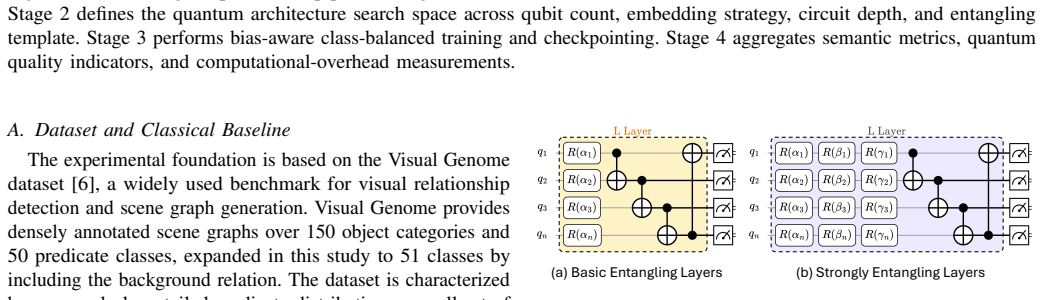
The central claim is that a compact 4-qubit Quantum Predicate Head using amplitude embedding and strongly entangling layers compresses 4096-dimensional pair features into a 16-dimensional quantum representation and achieves an mR@100 of 57.25 percent on Visual Genome 150, compared with 41.1 percent for the classical CFEN baseline, while requiring only 96 trainable quantum parameters.
What carries the argument
The Quantum Predicate Head, a variational quantum circuit that receives amplitude-embedded high-dimensional features and is trained with weighted cross-entropy to classify predicates.
Load-bearing premise
That amplitude embedding followed by a variational circuit preserves the semantic distinctions among rare predicates well enough for accurate classification without the full classical decision module.
What would settle it
A controlled test in which the quantum head is evaluated only on rare predicates whose feature distributions differ markedly from those seen in training; if its mR@100 falls below the classical 41.1 percent, the claim fails.
If this is right
- An 8-qubit version reaches 55.38 percent mR@100 with 384 quantum parameters.
- Increasing circuit depth trades higher expressibility against added runtime cost.
- The 256-fold feature compression enables parameter-efficient long-tail relational classification.
- The approach is presented as one of the first hybrid quantum evaluations for scene-graph predicate classification.
Where Pith is reading between the lines
- Similar quantum heads could be swapped into other vision pipelines that suffer from long-tailed label distributions.
- The observed compression ratio suggests the method may suit resource-constrained visual-reasoning devices.
- If quantum hardware improves, the same architecture could be run natively rather than simulated.
- The weighted cross-entropy training may need re-tuning when the quantum circuit is transferred to new datasets.
Editorial analysis
A structured set of objections, weighed in public.
Referee Report
Summary. The paper introduces QPredSGG, a hybrid quantum predicate learning approach for long-tailed scene graph generation. It replaces the classical predicate head of the Causal Feature Enhancement Network (CFEN) with a Quantum Predicate Head (QP-Head) implemented as a variational quantum circuit. The best configuration uses 4 qubits with amplitude embedding and strongly entangling layers to compress 4096-dimensional pair features into a 16-dimensional representation (256× reduction), trained via weighted cross-entropy. On Visual Genome 150, this yields mR@100 of 57.25% versus 41.1% for the classical CFEN baseline, using only 96 trainable quantum parameters. The work also reports results for 8 qubits (mR@100 55.38%, 384 parameters) and analyzes trade-offs with circuit depth.
Significance. If the reported performance gains hold under full experimental scrutiny, the result would be significant as an early demonstration of hybrid quantum circuits for relational reasoning in computer vision, specifically addressing long-tail predicate imbalance with extreme parameter reduction. The explicit study of qubit count, encoding strategy, entangling structure, and depth provides useful empirical guidance for quantum ML in structured prediction tasks.
minor comments (3)
- The abstract states the 4-qubit QP-Head 'compresses 4096-dimensional pair features into a 16-dimensional quantum-compatible representation'; the manuscript should explicitly define the classical feature extraction pipeline and confirm that the 4096-dim input is produced identically for both the quantum and classical heads to ensure a fair comparison.
- The depth analysis is mentioned but no quantitative runtime or expressibility metrics (e.g., circuit depth vs. training time or effective dimension) are provided in the abstract; these should be reported with error bars and statistical tests in the results section.
- The claim of being 'among the first studies' to evaluate hybrid quantum architectures for SGG on Visual Genome 150 should be supported by a brief related-work paragraph citing any contemporaneous quantum vision papers.
Simulated Author's Rebuttal
We thank the referee for the positive evaluation of our work and the recommendation for minor revision. We appreciate the recognition of the potential significance of hybrid quantum circuits for addressing long-tail predicate classification in scene graph generation.
Circularity Check
No significant circularity identified
full rationale
The provided abstract and reader's assessment contain no equations, derivations, or self-citations that reduce the central performance claim (mR@100 of 57.25% for the 4-qubit QP-Head) to its inputs by construction. The reported result is an empirical comparison against an external classical CFEN baseline using standard weighted cross-entropy training and mR@100 metrics on Visual Genome 150; the quantum circuit is described as a replacement module with parameter counts and embedding choices that do not presuppose the target metric. No load-bearing self-citation chains or fitted-input-as-prediction patterns are present in the given text.
Axiom & Free-Parameter Ledger
free parameters (3)
- qubit count
- encoding strategy
- entangling structure and depth
axioms (1)
- domain assumption Variational quantum circuits can be optimized via classical gradients on simulators to perform predicate classification
read the original abstract
Scene Graph Generation (SGG) requires relational reasoning over objects and their interactions, but performance is often limited by severe long-tail predicate imbalance. Classical SGG models frequently rely on dataset statistics, leading to biased predictions toward frequent relations rather than fine-grained semantic predicates. Although existing debiasing strategies improve mean recall, predicate classification in current frameworks still often depends on large classical decision modules with high parameter cost. This work introduces a hybrid quantum predicate classifier for SGG by replacing the classical predicate head in Causal Feature Enhancement Network (CFEN) with a Quantum Predicate Head (QP-Head) trained using weighted cross-entropy. To the best of our knowledge, this is among the first studies to evaluate a hybrid quantum architecture for scene graph predicate classification on Visual Genome 150. We study the effect of qubit count, encoding strategy, entangling structure, and circuit depth on relational prediction. The best 4-qubit QP-Head uses Amplitude Embedding and Strongly Entangling Layers to compress 4096-dimensional pair features into a 16-dimensional quantum-compatible representation, corresponding to a 256$\times$ reduction. It achieves an mR@100 of 57.25%, compared with 41.1% for the classical CFEN reference, while using only 96 trainable quantum parameters. Scaling to 8 qubits maintains strong long-tail performance, reaching an mR@100 of 55.38% with 384 quantum parameters, while the depth analysis shows a trade-off between expressibility and runtime overhead. These results suggest that compact hybrid quantum predicate heads can support parameter-efficient long-tail relational classification in complex visual reasoning tasks.
Figures




Reference graph
Works this paper leans on
-
[1]
Visual relationship detection with language priors,
C. Lu, R. Krishna, M. Bernstein, and L. Fei-Fei, “Visual relationship detection with language priors,” inProceedings of the European Conference on Computer Vision (ECCV). Springer, 2016, pp. 852– 869
2016
-
[2]
Generation of scene graph and semantic image: A review and challenge ahead,
S.-K. Hsieh and H.-I. Liu, “Generation of scene graph and semantic image: A review and challenge ahead,” in2025 International Conference on Artificial Intelligence in Information and Communication (ICAIIC). IEEE, 2025, pp. 0990–0997
2025
-
[3]
A comprehensive survey of scene graphs: Generation and application,
X. Chang, P. Ren, P. Xu, Z. Li, X. Chen, and A. Hauptmann, “A comprehensive survey of scene graphs: Generation and application,”IEEE Transactions on Pattern Analysis and Machine Intelligence, vol. 45, no. 1, pp. 1–26, 2021
2021
-
[4]
Bottom-up and top-down attention for image captioning and visual question answering,
P. Anderson, X. He, C. Buehler, D. Teney, M. Johnson, S. Gould, and L. Zhang, “Bottom-up and top-down attention for image captioning and visual question answering,” inProceedings of the IEEE/CVF Conference on Computer Vision and Pattern Recognition (CVPR), 2018, pp. 6077– 6086
2018
-
[5]
Image generation from scene graphs,
J. Johnson, A. Gupta, and L. Fei-Fei, “Image generation from scene graphs,” inProceedings of the IEEE/CVF Conference on Computer Vision and Pattern Recognition (CVPR), 2018, pp. 1219–1228
2018
-
[6]
Visual genome: Connecting language and vision using crowdsourced dense image annotations,
R. Krishna, Y . Zhu, O. Groth, J. Johnson, K. Hata, J. Kravitz, S. Chen, Y . Kalantidis, J.-L. Li, D. A. Shammaet al., “Visual genome: Connecting language and vision using crowdsourced dense image annotations,” International Journal of Computer Vision, vol. 123, no. 1, pp. 32–73, 2017
2017
-
[7]
Neural motifs: Scene graph parsing with global context,
R. Zellers, M. Yatskar, S. Thomson, and Y . Choi, “Neural motifs: Scene graph parsing with global context,” inProceedings of the IEEE/CVF Conference on Computer Vision and Pattern Recognition (CVPR), 2018, pp. 5831–5840
2018
-
[8]
Unbiased scene graph generation from biased training,
K. Tang, Y . Niu, J. Huang, J. Shi, and H. Zhang, “Unbiased scene graph generation from biased training,” inProceedings of the IEEE/CVF Conference on Computer Vision and Pattern Recognition (CVPR), 2020, pp. 3716–3725
2020
-
[9]
Exploring the essence of relation- ships for scene graph generation via causal features enhancement network,
H. Zhou, T. Luo, J. Yang, and L. Liu, “Exploring the essence of relation- ships for scene graph generation via causal features enhancement network,” IEEE Transactions on Pattern Analysis and Machine Intelligence, vol. PP, 2025
2025
-
[10]
Learning to compose dynamic tree structures for visual contexts,
K. Tang, H. Zhang, B. Wu, W. Luo, and W. Liu, “Learning to compose dynamic tree structures for visual contexts,” inProceedings of the IEEE/CVF Conference on Computer Vision and Pattern Recognition (CVPR), 2019, pp. 6619–6628
2019
-
[11]
Quantum machine learning,
J. Biamonte, P. Wittek, N. Pancotti, P. Rebentrost, N. Wiebe, and S. Lloyd, “Quantum machine learning,”Nature, vol. 549, no. 7671, pp. 195–202, 2017
2017
-
[12]
A primer on quantum machine learning,
S. Y . Chang and M. Cerezo, “A primer on quantum machine learning,” arXiv preprint arXiv:2511.15969, 2025
-
[13]
Quantum computing in the nisq era and beyond,
J. Preskill, “Quantum computing in the nisq era and beyond,”Quantum, vol. 2, p. 79, 2018
2018
-
[14]
Financial fraud detection using quantum graph neural networks,
N. Innan, A. Sawaika, A. Dhor, S. Dutta, S. Thota, H. Gokal, N. Patel, M. A.-Z. Khan, I. Theodonis, and M. Bennai, “Financial fraud detection using quantum graph neural networks,”Quantum Machine Intelligence, vol. 6, no. 1, p. 7, 2024
2024
-
[15]
Lep-qnn: Loan eligibility prediction using quantum neural networks,
N. Innan, A. Marchisio, M. Bennai, and M. Shafique, “Lep-qnn: Loan eligibility prediction using quantum neural networks,” in2025 IEEE International Conference on Quantum Computing and Engineering (QCE), vol. 1. IEEE, 2025, pp. 1864–1872
2025
-
[16]
P. K. Choudhary, N. Innan, M. Shafique, and R. Singh, “HQNN-FSP: A hybrid classical-quantum neural network for regression-based financial stock market prediction,”arXiv preprint arXiv:2503.15403, 2025
-
[17]
Quantum bayesian networks for machine learning in oil-spill detection,
O. I. Siddiqui, N. Innan, A. Marchisio, M. Bennai, and M. Shafique, “Quantum bayesian networks for machine learning in oil-spill detection,” in2025 International Joint Conference on Neural Networks (IJCNN). IEEE, 2025, pp. 1–8
2025
-
[18]
Sentiqnf: A novel approach to sentiment analysis using quantum algorithms and neuro-fuzzy systems,
K. Dave, N. Innan, B. K. Behera, Z. Mumtaz, S. Al-Kuwari, and A. Farouk, “Sentiqnf: A novel approach to sentiment analysis using quantum algorithms and neuro-fuzzy systems,”IEEE Transactions on Computational Social Systems, 2025
2025
-
[19]
Variational quantum algorithms,
M. Cerezo, A. Arrasmith, R. Babbush, S. C. Benjamin, S. Endo, K. Fujii, J. R. McClean, K. Mitarai, X. Yuan, L. Cincio, and P. J. Coles, “Variational quantum algorithms,”Nature Reviews Physics, vol. 3, no. 9, pp. 625–644, 2021
2021
-
[20]
Next- generation quantum neural networks: Enhancing efficiency, security, and privacy,
N. Innan, M. Kashif, A. Marchisio, M. Bennai, and M. Shafique, “Next- generation quantum neural networks: Enhancing efficiency, security, and privacy,” in2025 IEEE 31st International Symposium on On-Line Testing and Robust System Design (IOLTS). IEEE, 2025, pp. 1–4
2025
-
[21]
Supervised learning with quantum- enhanced feature spaces,
V . Havl’iˇcek, A. D. C’orcoles, K. Temme, A. W. Harrow, A. Kandala, J. M. Chow, and J. M. Gambetta, “Supervised learning with quantum- enhanced feature spaces,”Nature, vol. 567, no. 7747, pp. 209–212, 2019
2019
-
[22]
Quantum machine learning in feature hilbert spaces,
M. Schuld and N. Killoran, “Quantum machine learning in feature hilbert spaces,”Physical Review Letters, vol. 122, no. 4, p. 040504, 2019
2019
-
[23]
SPATE: Spiking-Phase Adaptive Temporal Encoding for Quantum Machine Learning
N. Innan, R. V . W. Putra, and M. Shafique, “Spate: Spiking-phase adaptive temporal encoding for quantum machine learning,”arXiv preprint arXiv:2604.11022, 2026
work page internal anchor Pith review Pith/arXiv arXiv 2026
-
[24]
Design Space Exploration of Hybrid Quantum Neural Networks for Chronic Kidney Disease
M. Kashif, H. M. Siraj, N. Innan, A. Marchisio, and M. Shafique, “Design space exploration of hybrid quantum neural networks for chronic kidney disease,”arXiv preprint arXiv:2604.13608, 2026
work page internal anchor Pith review Pith/arXiv arXiv 2026
-
[25]
Financial fraud detection: a comparative study of quantum machine learning models,
N. Innan, M. A.-Z. Khan, and M. Bennai, “Financial fraud detection: a comparative study of quantum machine learning models,”International Journal of Quantum Information, vol. 22, no. 02, p. 2350044, 2024
2024
-
[26]
Comparative performance analysis of quantum machine learning architectures for credit card fraud detection,
M. El Alami, N. Innan, M. Shafique, and M. Bennai, “Comparative performance analysis of quantum machine learning architectures for credit card fraud detection,”Applied Intelligence, vol. 56, no. 3, p. 83, 2026
2026
-
[27]
Expressibility and entangling capability of parameterized quantum circuits for hybrid quantum-classical algorithms,
S. Sim, P. D. Johnson, and A. Aspuru-Guzik, “Expressibility and entangling capability of parameterized quantum circuits for hybrid quantum-classical algorithms,”Advanced Quantum Technologies, vol. 2, no. 12, p. 1900070, 2019
2019
-
[28]
Scaling Laws for Hybrid Quantum Neural Networks: Depth, Width, and Quantum-Centric Diagnostics
D. Vyskubov, K. Vyskubov, N. Innan, and M. Shafique, “Scaling laws for hybrid quantum neural networks: Depth, width, and quantum-centric diagnostics,”arXiv preprint arXiv:2604.06007, 2026
work page internal anchor Pith review Pith/arXiv arXiv 2026
-
[29]
Barren plateaus in quantum neural network training landscapes,
J. R. McClean, S. Boixo, V . N. Smelyanskiy, R. Babbush, and H. Neven, “Barren plateaus in quantum neural network training landscapes,”Nature Communications, vol. 9, no. 1, p. 4812, 2018
2018
-
[30]
Advances in quantum machine learning and deep learning for image classification: A survey,
R. Kharsa, A. Bouridane, and A. Amira, “Advances in quantum machine learning and deep learning for image classification: A survey,” Neurocomputing, vol. 560, p. 126843, 2023
2023
-
[31]
Quantum machine learning for image classification,
A. Senokosov, A. Sedykh, A. Sagingalieva, B. Kyriacou, and A. Melnikov, “Quantum machine learning for image classification,”Machine Learning: Science and Technology, vol. 5, no. 1, p. 015040, 2024
2024
-
[32]
Quiet- sr: Quantum image enhancement transformer for single image super- resolution,
S. Dutta, N. Innan, K. Najafi, S. B. Yahia, and M. Shafique, “Quiet- sr: Quantum image enhancement transformer for single image super- resolution,”arXiv preprint arXiv:2503.08759, 2025
-
[33]
Qnn-vrcs: A quantum neural network for vehicle road cooperation systems,
N. Innan, B. K. Behera, S. Al-Kuwari, and A. Farouk, “Qnn-vrcs: A quantum neural network for vehicle road cooperation systems,”IEEE Transactions on Intelligent Transportation Systems, 2025
2025
discussion (0)
Sign in with ORCID, Apple, or X to comment. Anyone can read and Pith papers without signing in.