Resource-efficient energy-based operator selection in fermionic ADAPT-VQE via exact Hamiltonian transformation
Pith reviewed 2026-06-28 06:10 UTC · model grok-4.3
The pith
Exact Hamiltonian transformation halves the cost of energy-based operator selection in fermionic ADAPT-VQE while remaining mathematically identical to standard Rotoselect.
A machine-rendered reading of the paper's core claim, the machinery that carries it, and where it could break.
Core claim
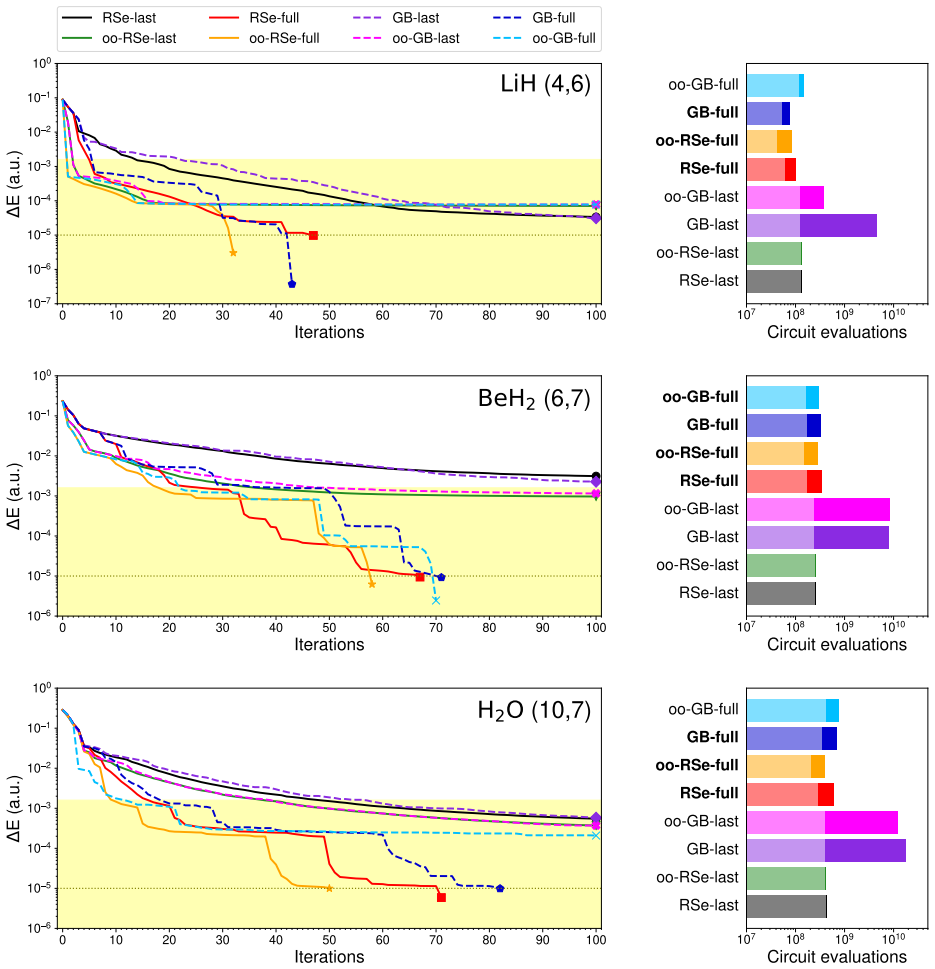
An exact Hamiltonian transformation produces a generator-dependent fragmentation of the transformed operator that allows the one-parameter energy landscape to be reconstructed at roughly half the measurement cost of the standard fermionic Rotoselect procedure. The resulting selection decisions remain identical to those of the untransformed method. Benchmarks on small molecules show that this cost reduction brings energy-based selection close in resource demand to gradient-based ADAPT-VQE, while the relative importance of re-optimization strategy and orbital treatment increases with electron correlation.
What carries the argument
Exact Hamiltonian transformation that reformulates the one-parameter energy landscape via generator-dependent fragmentation of the transformed Hamiltonian.
If this is right
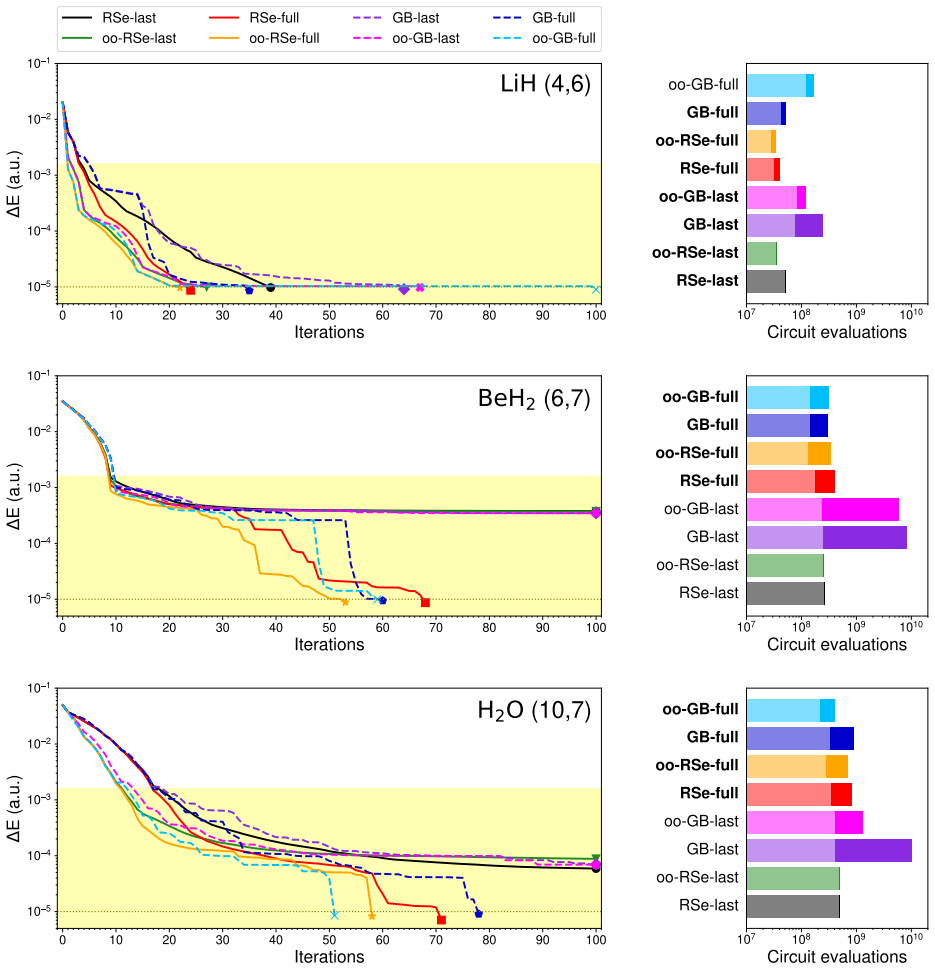
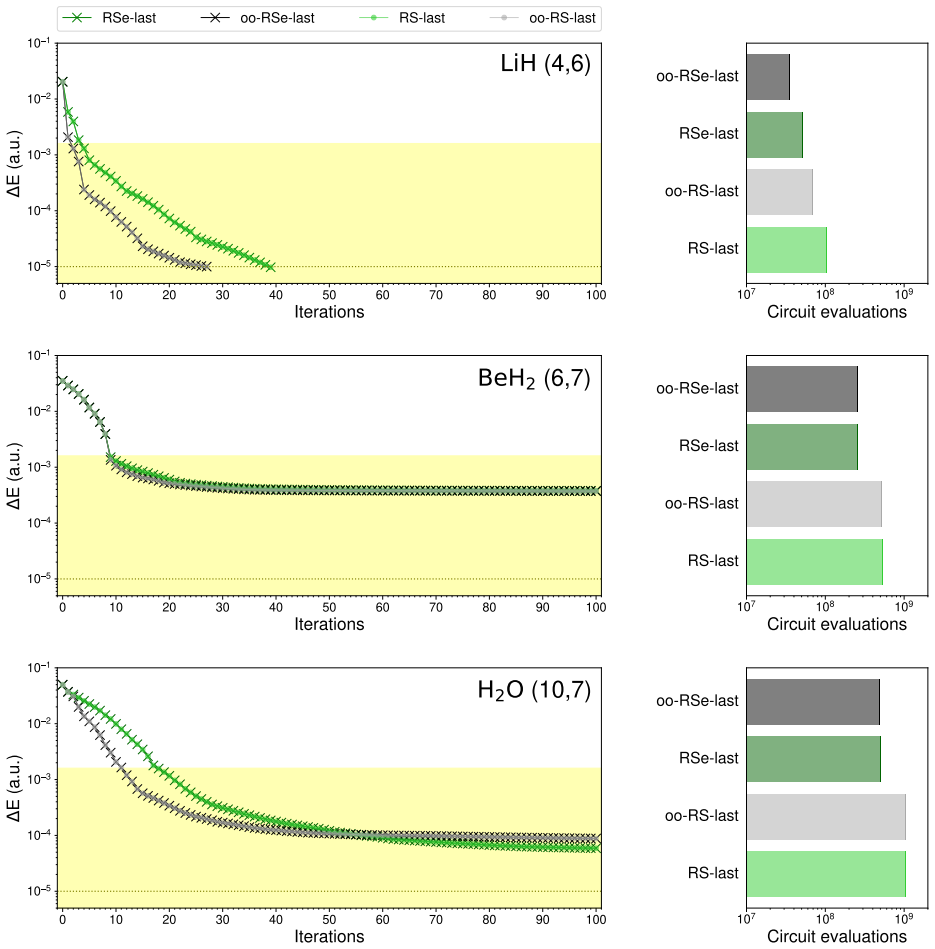
- In the most weakly correlated regime, energy-based selection paired with last-operator optimization constructs an accurate ansatz without any VQE optimization.
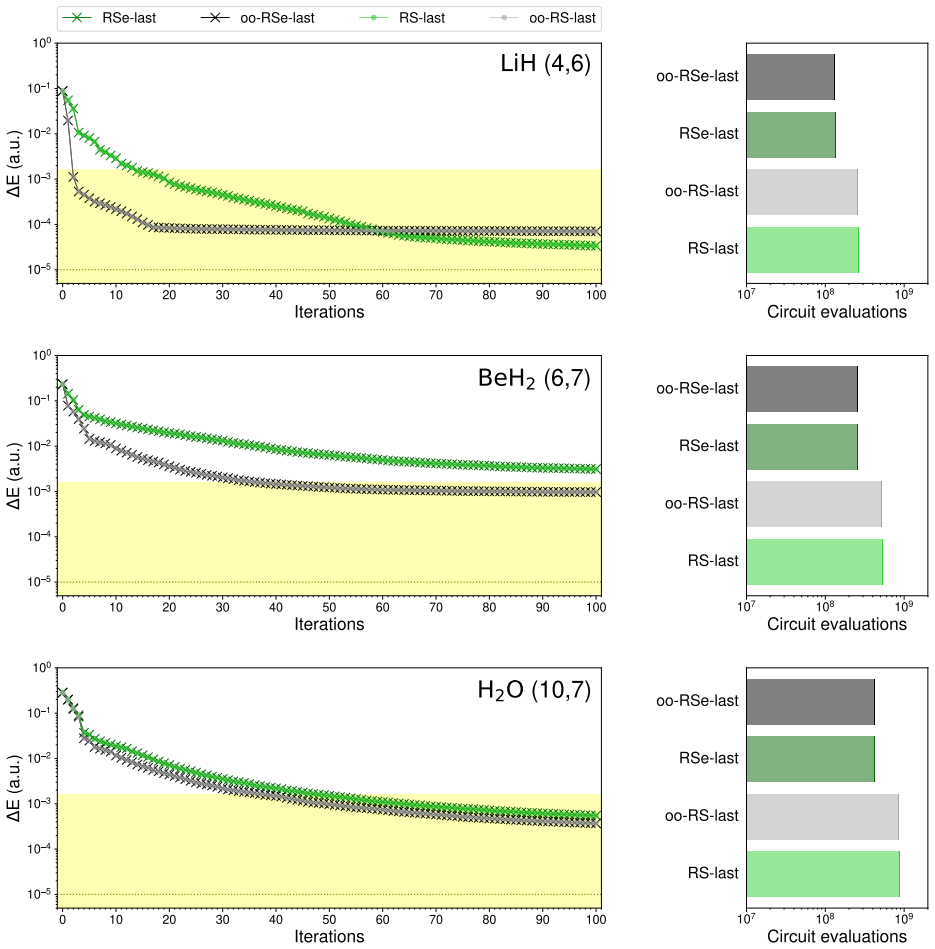
- With rising correlation, full ansatz re-optimization and orbital optimization become the dominant factors controlling both convergence speed and total resource cost.
- The same transformation technique supplies a general route to lowering measurement overhead whenever fermionic energy-based operator selection is used inside ADAPT-VQE.
- Benchmarks clarify that operator-scoring method, re-optimization strategy, and orbital treatment each play distinct roles whose relative weight shifts with molecular correlation strength.
Where Pith is reading between the lines
- The cost reduction may allow energy-based selection to remain practical on systems larger than those tested here, where measurement budgets are tighter.
- Because the transformation is exact, it could be combined with other variational algorithms that already employ similar one-parameter energy scans.
- The observation that last-only optimization suffices at equilibrium suggests a possible two-stage workflow: use energy-based last optimization first, then switch to full re-optimization only when correlation diagnostics indicate necessity.
Load-bearing premise
The generator-dependent fragmentation of the transformed Hamiltonian can be performed exactly and without introducing new measurement or classical overhead that would offset the claimed factor-of-two reduction.
What would settle it
A direct count of total Pauli measurements required for energy-landscape reconstruction on H2O at stretched geometry that shows the fragmentation step adds enough extra terms to cancel or exceed the reported factor-of-two saving.
Figures
read the original abstract
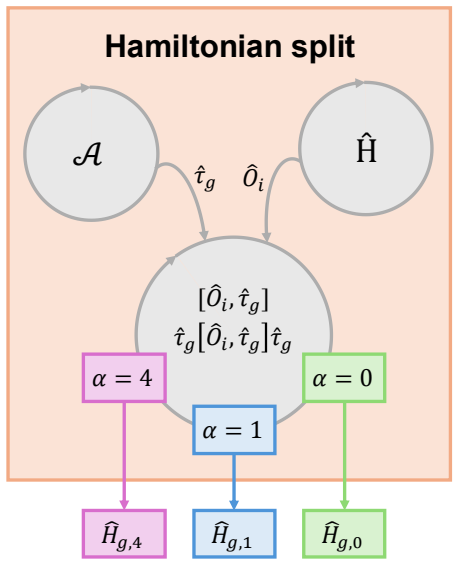
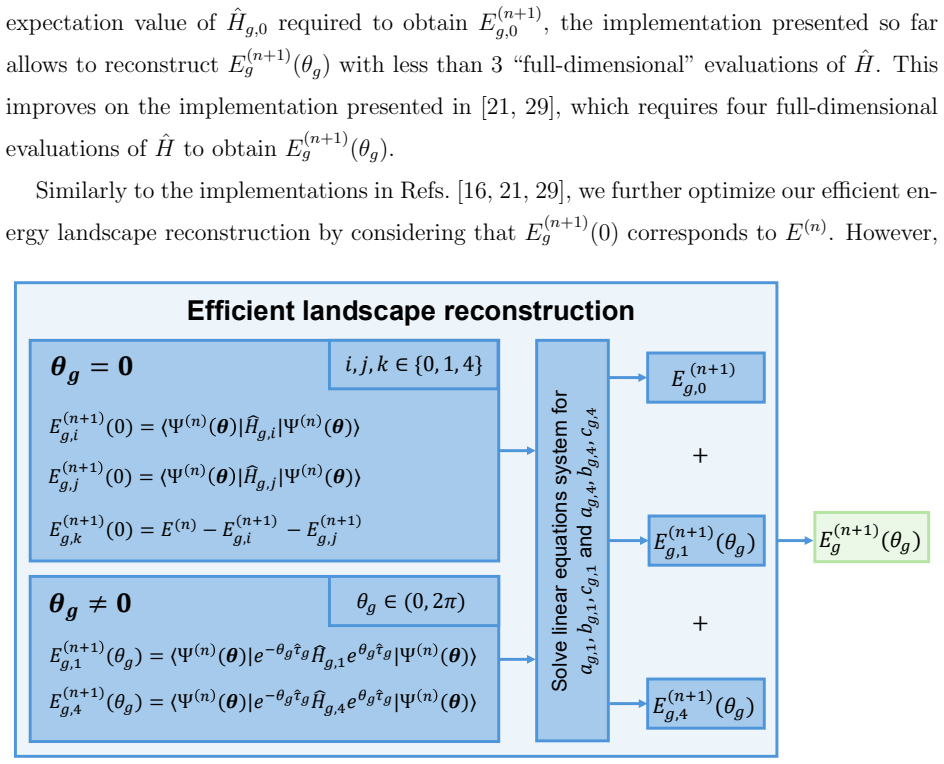
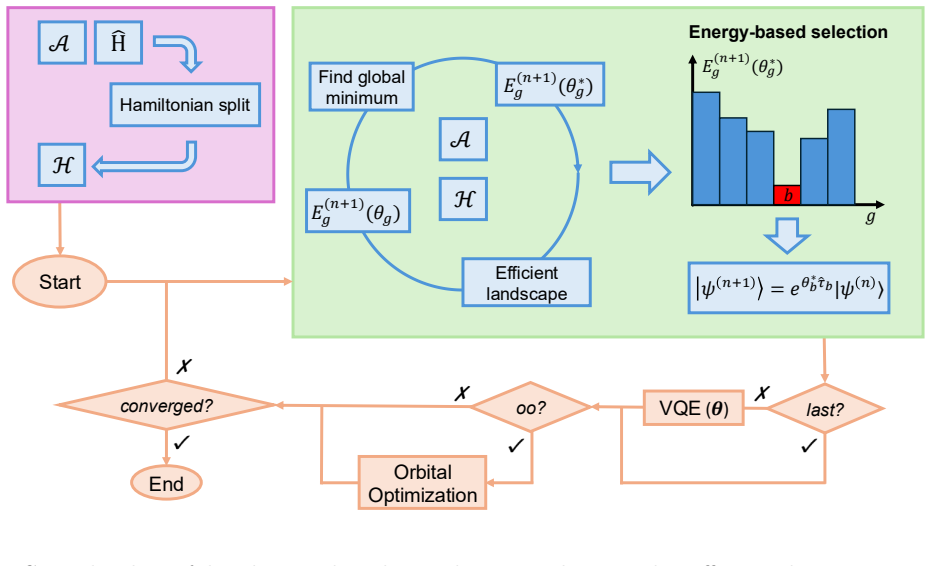
The energy-based approach to operator selection in ADAPT-VQE relies on reconstructing the one-parameter energy landscape for each operator in the pool. In fermionic implementations, the cost of reconstructing this energy landscape often becomes a bottleneck. We address this issue through an exact Hamiltonian transformation that reformulates the one-parameter energy landscape according to a generator-dependent fragmentation of the transformed Hamiltonian. While our method is mathematically identical to standard fermionic Rotoselect, it effectively reduces its cost by about a factor of two, bringing it close to that of gradient-based ADAPT-VQE. We use this formulation to benchmark the gradient-based and energy-based selection approaches in combination with two ansatz-optimization strategies -- "last", where only the appended operator is optimized, and "full", where the full ansatz is re-optimized -- and with both fixed-orbital and orbital-optimized formulations. The benchmark comprises $\text{LiH}$, $\text{BeH}_2$, and $\text{H}_2\text{O}$ at both equilibrium and stretched geometries. In the most weakly correlated system, pairing energy-based selection with "last" optimization enables the efficient construction of an accurate ansatz, which avoids any VQE optimization. As correlation increases, full ansatz re-optimization and orbital optimization become the main factors governing convergence and overall resource cost. This study shows how exact Hamiltonian transformations provide an effective route to reducing the measurement overhead of fermionic energy-based ADAPT-VQE. Moreover, the benchmark clarifies the relative role of operator scoring approach, re-optimization strategy, and orbital treatment in the performance of ADAPT-VQE.
Editorial analysis
A structured set of objections, weighed in public.
Referee Report
Summary. The manuscript proposes an exact Hamiltonian transformation that reformulates the one-parameter energy landscape for operator selection in fermionic ADAPT-VQE through generator-dependent fragmentation of the transformed Hamiltonian. It asserts that this approach is mathematically identical to standard fermionic Rotoselect while reducing its measurement cost by approximately a factor of two, bringing it close to gradient-based ADAPT-VQE. The work benchmarks energy-based versus gradient-based selection combined with 'last' versus 'full' ansatz optimization and fixed-orbital versus orbital-optimized formulations on LiH, BeH2, and H2O at equilibrium and stretched geometries.
Significance. If the claimed exact equivalence and cost reduction hold without offsetting overhead, the method would make energy-based operator selection in fermionic ADAPT-VQE substantially more resource-efficient, potentially enabling accurate ansatz construction without VQE optimization in weakly correlated regimes and clarifying the interplay between scoring, re-optimization, and orbital treatment.
major comments (2)
- [Abstract] Abstract: the central claim that the method is 'mathematically identical to standard fermionic Rotoselect' yet 'reduces its cost by about a factor of two' is asserted without derivation or explicit measurement-count comparison; the load-bearing step is the generator-dependent fragmentation, which must be shown to introduce no new measurement or classical overhead.
- [Abstract / Methods] The weakest assumption—that generator-dependent fragmentation remains exact and cost-neutral—requires explicit verification (e.g., measurement counts before/after transformation and classical post-processing cost) to substantiate the factor-of-two reduction; without this, the resource-efficiency claim cannot be assessed.
minor comments (2)
- [Results] The benchmark description references results on LiH, BeH2, and H2O but does not specify the operator pool size, convergence thresholds, or exact measurement-shot allocation used for the energy-landscape reconstructions.
- [Methods] Notation for the transformed Hamiltonian fragments and the one-parameter energy landscape should be introduced with explicit equations early in the methods section for clarity.
Simulated Author's Rebuttal
We thank the referee for their careful reading of the manuscript and for highlighting the need for greater explicitness around the central claims. We address the two major comments point by point below and indicate the revisions that will be incorporated.
read point-by-point responses
-
Referee: [Abstract] Abstract: the central claim that the method is 'mathematically identical to standard fermionic Rotoselect' yet 'reduces its cost by about a factor of two' is asserted without derivation or explicit measurement-count comparison; the load-bearing step is the generator-dependent fragmentation, which must be shown to introduce no new measurement or classical overhead.
Authors: The abstract is intentionally concise. The mathematical equivalence to standard fermionic Rotoselect, the exactness of the generator-dependent fragmentation, and the explicit reduction in measurement count (approximately a factor of two with no additional classical overhead) are derived in the Methods section. We will revise the abstract to include a short parenthetical reference to this derivation and the supporting measurement-count comparison so that the central claim is no longer presented without context. revision: yes
-
Referee: [Abstract / Methods] The weakest assumption—that generator-dependent fragmentation remains exact and cost-neutral—requires explicit verification (e.g., measurement counts before/after transformation and classical post-processing cost) to substantiate the factor-of-two reduction; without this, the resource-efficiency claim cannot be assessed.
Authors: We agree that an explicit before/after measurement-count comparison and a statement on classical post-processing cost would strengthen the presentation. In the revised manuscript we will add a short table (or inline counts) in the Methods section that reports the number of Pauli terms required for the one-parameter energy landscape before and after the transformation for representative pool operators, together with a brief argument confirming that the fragmentation is performed analytically and introduces no extra classical overhead. revision: yes
Circularity Check
No significant circularity; exact reformulation presented as identity with independent cost reduction
full rationale
The paper's central claim is an exact Hamiltonian transformation that is mathematically identical to standard fermionic Rotoselect while reducing measurement cost by a factor of two. This is framed as a direct algebraic identity rather than a derivation that reduces to fitted parameters, self-citations, or self-definitional loops. No load-bearing self-citation chains, uniqueness theorems from prior author work, or ansatzes smuggled via citation are referenced in the abstract or description. The benchmark results on LiH, BeH2, and H2O are presented as external validation of the cost savings under the stated exactness assumption, keeping the derivation self-contained against external benchmarks.
Axiom & Free-Parameter Ledger
axioms (1)
- domain assumption Fermionic operators and Hamiltonians permit exact transformations that fragment the energy landscape according to the generator.
Reference graph
Works this paper leans on
-
[1]
The parameterθ (n+1) is initialized to 0 and brought to its optimal value by the subsequent VQE optimization procedure
Gradient-based selection The gradient-based criterion, introduced by the original fermionic ADAPT-VQE algo- rithm [3], is based on the gradient ∂E (n) ∂θg θg=0 =⟨Ψ (n)(θ)|[ ˆH,ˆτg]|Ψ (n)(θ)⟩.(14) 6 The selection procedure uses the absolute value of the gradient to score and rank the gen- erators in the pool; the generator associated with the largest gradi...
-
[2]
full-dimensional
Energy-based selection The energy-based criterion scores the generators according to the energy reduction they bring about when the corresponding unitary is appended to the UPS ansatz. In particular, the score assigned to each generator ˆτg corresponds to the minimum of the 1D energy cost function E(n+1) g (θg) =⟨Ψ (n)(θ)|e −θg ˆτg ˆHe θg ˆτg |Ψ(n)(θ)⟩,(1...
-
[3]
The notation (n e,n o) is used throughout to specify the number of electronsn e and number of spatial orbitalsn o for each system
for the electronic integrals composing the Hamiltonian. The notation (n e,n o) is used throughout to specify the number of electronsn e and number of spatial orbitalsn o for each system. All calculations consider the complete active space spanned by the STO-3G basis. For the three benchmark molecules at their equilibrium geometries, we adopted the followi...
2099
-
[4]
Peruzzo, J
A. Peruzzo, J. McClean, P. Shadbolt, M.-H. Yung, X.-Q. Zhou, P. J. Love, A. Aspuru-Guzik, and J. L. O’Brien, A variational eigenvalue solver on a photonic quantum processor, Nat. Commun.5, 4213 (2014)
2014
-
[5]
Y. Cao, J. Romero, J. P. Olson, M. Degroote, P. D. Johnson, M. Kieferov´ a, I. D. Kivlichan, T. Menke, B. Peropadre, N. P. D. Sawaya, S. Sim, L. Veis, and A. Aspuru-Guzik, Quantum chemistry in the age of quantum computing, Chem. Rev.119, 10856 (2019)
2019
-
[6]
H. R. Grimsley, S. E. Economou, E. Barnes, and N. J. Mayhall, An adaptive variational algorithm for exact molecular simulations on a quantum computer, Nat. Commun.10, 3007 (2019)
2019
-
[7]
H. R. Grimsley, G. S. Barron, E. Barnes, S. E. Economou, and N. J. Mayhall, Adaptive, problem-tailored variational quantum eigensolver mitigates rough parameter landscapes and barren plateaus, npj Quantum Inf.9, 19 (2023)
2023
-
[8]
H. L. Tang, V. Shkolnikov, G. S. Barron, H. R. Grimsley, N. J. Mayhall, E. Barnes, and S. E. Economou, Qubit-adapt-vqe: An adaptive algorithm for constructing hardware-efficient ans¨ atze on a quantum processor, PRX Quantum2, 020310 (2021)
2021
-
[9]
Y. S. Yordanov, V. Armaos, C. H. W. Barnes, and D. R. M. Arvidsson-Shukur, Qubit- excitation-based adaptive variational quantum eigensolver, Commun. Phys.4, 228 (2021)
2021
-
[10]
Ramˆ oa, P
M. Ramˆ oa, P. G. Anastasiou, L. P. Santos, N. J. Mayhall, E. Barnes, and S. E. Economou, Reducing the resources required by ADAPT-VQE using coupled exchange operators and im- proved subroutines, npj Quantum Inf.11, 86 (2025)
2025
-
[11]
P. G. Anastasiou, Y. Chen, N. J. Mayhall, E. Barnes, and S. E. Economou, Tetris-adapt-vqe: An adaptive algorithm that yields shallower, denser circuit ans¨ atze, Physical Review Research 6, 013254 (2024)
2024
-
[12]
Nyk¨ anen, M
A. Nyk¨ anen, M. A. C. Rossi, E.-M. Borrelli, S. Maniscalco, G. Garc´ ıa-P´ erez, and A. Glos, Mitigating the measurement overhead of adapt-vqe with optimized informationally complete generalized measurements, Phys. Rev. Research7, 043114 (2025)
2025
-
[13]
P. G. Anastasiou, N. J. Mayhall, E. Barnes, and S. E. Economou, How to really measure operator gradients in ADAPT-VQE (2023), arXiv:2306.03227. 23
Pith/arXiv arXiv 2023
-
[14]
V. O. Shkolnikov, N. J. Mayhall, S. E. Economou, and E. Barnes, Avoiding symmetry road- blocks and minimizing the measurement overhead of adaptive variational quantum eigen- solvers, Quantum7, 1040 (2023)
2023
-
[15]
J. Stadelmann, J. ¨Ubelher, M. Ramˆ oa, B. Sambasivam, E. Barnes, and S. E. Economou, Strate- gies for overcoming gradient troughs in the adapt-vqe algorithm (2025), arXiv:2512.25004
arXiv 2025
-
[16]
H. G. A. Burton, D. Marti-Dafcik, D. P. Tew, and D. J. Wales, Exact electronic states with shallow quantum circuits from global optimisation, npj Quantum Information9, 75 (2023)
2023
-
[17]
Lan and W
Z. Lan and W. Liang, Amplitude reordering accelerates the adaptive variational quantum eigensolver algorithms, J. Chem. Theory Comput.18, 5267–5275 (2022)
2022
-
[18]
Vaquero-Sabater, A
N. Vaquero-Sabater, A. Carreras, and D. Casanova, Pruned-ADAPT-VQE: Compacting Molecular Ans¨ atze by Removing Irrelevant Operators, J. Chem. Theory Comput.21, 8720–8728 (2025)
2025
-
[19]
Ostaszewski, E
M. Ostaszewski, E. Grant, and M. Benedetti, Structure optimization for parameterized quan- tum circuits, Quantum5, 391 (2021)
2021
-
[20]
J. G. Vidal and D. O. Theis, Calculus on parameterized quantum circuits (2018), arXiv:1812.06323
Pith/arXiv arXiv 2018
-
[21]
R. M. Parrish, J. T. Iosue, A. Ozaeta, and P. L. McMahon, A Jacobi Diagonalization and An- derson Acceleration Algorithm For Variational Quantum Algorithm Parameter Optimization (2019), arXiv:1904.03206
Pith/arXiv arXiv 2019
-
[22]
K. M. Nakanishi, K. Fujii, and S. Todo, Sequential minimal optimization for quantum-classical hybrid algorithms, Phys. Rev. Res.2, 043158 (2020)
2020
-
[23]
Wierichs, J
D. Wierichs, J. Izaac, C. Wang, and C. Y.-Y. Lin, General parameter-shift rules for quantum gradients, Quantum6, 677 (2022)
2022
-
[24]
J¨ ager, T
J. J¨ ager, T. N. Kaldenbach, M. Haas, and E. Schultheis, Fast gradient-free optimization of excitations in variational quantum eigensolvers, Commun Phys8, 418 (2025)
2025
-
[25]
F. A. Evangelista and I. Magoulas, Exact closed-form unitary transformations of fermionic operators, Phys. Rev. A111, 042825 (2025)
2025
-
[26]
I. O. Sokolov, P. K. Barkoutsos, P. J. Ollitrault, D. Greenberg, J. Rice, M. Pistoia, and I. Tavernelli, Quantum orbital-optimized unitary coupled cluster methods in the strongly correlated regime: Can quantum algorithms outperform their classical equivalents?, J. Chem. Phys.152, 124107 (2020). 24
2020
-
[27]
Mizukami, K
W. Mizukami, K. Mitarai, Y. O. Nakagawa, T. Yamamoto, T. Yan, and Y.-y. Ohnishi, Orbital optimized unitary coupled cluster theory for quantum computer, Phys. Rev. Res.2, 033421 (2020)
2020
-
[28]
Fitzpatrick, A
A. Fitzpatrick, A. Nyk¨ anen, N. W. Talarico, A. Lunghi, S. Maniscalco, G. Garc´ ıa-P´ erez, and S. Knecht, Self-consistent field approach for the variational quantum eigensolver: Orbital optimization goes adaptive, J. Phys. Chem. A128, 2843 (2024)
2024
-
[29]
Helgaker, P
T. Helgaker, P. Jørgensen, and J. Olsen,Molecular Electronic-Structure Theory(John Wiley & Sons, Ltd, 2000)
2000
-
[30]
F. A. Evangelista, G. K.-L. Chan, and G. E. Scuseria, Exact parameterization of fermionic wave functions via unitary coupled cluster theory, J. Chem. Phys.151, 244112 (2019)
2019
-
[31]
H. R. Grimsley, D. Claudino, S. E. Economou, E. Barnes, and N. J. Mayhall, Is the trotterized uccsd ansatz chemically well-defined?, J. Chem. Theory Comput.16, 1–6 (2020)
2020
-
[33]
A. F. Izmaylov, R. A. Lang, and T.-C. Yen, Analytic gradients in variational quantum algo- rithms: Algebraic extensions of the parameter-shift rule to general unitary transformations, Phys. Rev. A104, 062443 (2021)
2021
-
[34]
J. S. Kottmann, A. Anand, and A. Aspuru-Guzik, A feasible approach for automatically dif- ferentiable unitary coupled-cluster on quantum computers, Chem. Sci.12, 3497–3508 (2021)
2021
-
[35]
Jayakumar, T
P. Jayakumar, T. Zeng, and A. F. Izmaylov, On the feasibility of exact unitary transformations for many-body hamiltonians, J. Chem. Theory Comput.22, 3916–3926 (2026)
2026
-
[36]
Kjellgren and K
E. Kjellgren and K. M. Ziems, Slowquant: A molecular quantum chemistry program (2024)
2024
-
[37]
Q. Sun, X. Zhang, S. Banerjee, P. Bao, M. Barbry, N. S. Blunt, N. A. Bogdanov, G. H. Booth, J. Chen, Z.-H. Cui, J. J. Eriksen, Y. Gao, S. Guo, J. Hermann, M. R. Hermes, K. Koh, P. Ko- val, S. Lehtola, Z. Li, J. Liu, N. Mardirossian, J. D. McClain, M. Motta, B. Mussard, H. Q. Pham, A. Pulkin, W. Purwanto, P. J. Robinson, E. Ronca, E. R. Sayfutyarova, M. Sc...
2020
-
[38]
Virtanen, R
P. Virtanen, R. Gommers, T. E. Oliphant, M. Haberland, T. Reddy, D. Cournapeau, E. Burovski, P. Peterson, W. Weckesser, J. Bright, S. J. van der Walt, M. Brett, J. Wilson, K. J. Millman, N. Mayorov, A. R. J. Nelson, E. Jones, R. Kern, E. Larson, C. J. Carey, ˙I. Po- lat, Y. Feng, E. W. Moore, J. VanderPlas, D. Laxalde, J. Perktold, R. Cimrman, I. Henrikse...
2020
-
[39]
Jordan and E
P. Jordan and E. Wigner, ¨Uber das Paulische ¨Aquivalenzverbot, Zeitschrift f¨ ur Physik47, 631 (1928)
1928
-
[40]
Magoulas, M
I. Magoulas, M. Zhang, and F. A. Evangelista, Symmetry dilemmas in quantum computing for chemistry: A comprehensive analysis, J. Chem. Phys.164, 144113 (2026). 26 Supplemental Material for: Resource-efficient energy-based operator selection in fermionic ADAPT-VQE via exact Hamiltonian transformations Emanuele Rossi, 1,∗ Erik Rosendahl Kjellgren, 2 Artur F...
2026
-
[41]
Feniou, M
C. Feniou, M. Hassan, B. Claudon, A. Courtat, O. Adjoua, Y. Maday, and J.-P. Piquemal, Greedy gradient-free adaptive variational quantum algorithms on a noisy intermediate scale quantum computer, Sci. Rep.15, 18689 (2025)
2025
-
[42]
J¨ ager, T
J. J¨ ager, T. N. Kaldenbach, M. Haas, and E. Schultheis, Fast gradient-free optimization of excitations in variational quantum eigensolvers, Commun Phys8, 418 (2025). 6
2025
discussion (0)
Sign in with ORCID, Apple, or X to comment. Anyone can read and Pith papers without signing in.