Cooler Phases of the Circumgalactic Medium Are More Centrally Concentrated: Constraints from Multiphase Absorption Lines
Pith reviewed 2026-06-28 05:30 UTC · model grok-4.3
The pith
Cooler circumgalactic gas concentrates closer to galaxies than warmer gas.
A machine-rendered reading of the paper's core claim, the machinery that carries it, and where it could break.
Core claim
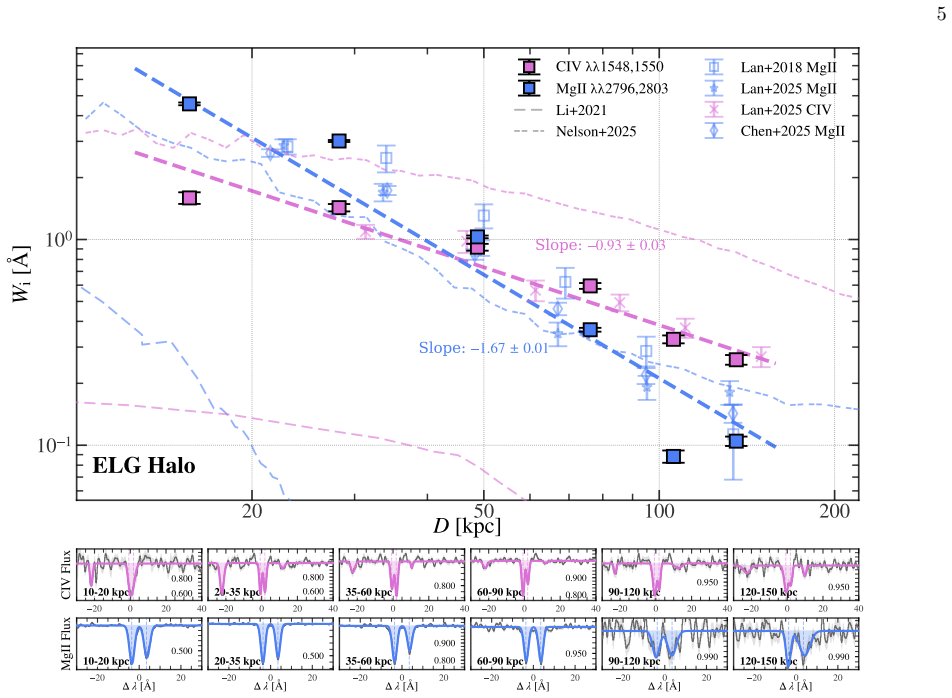
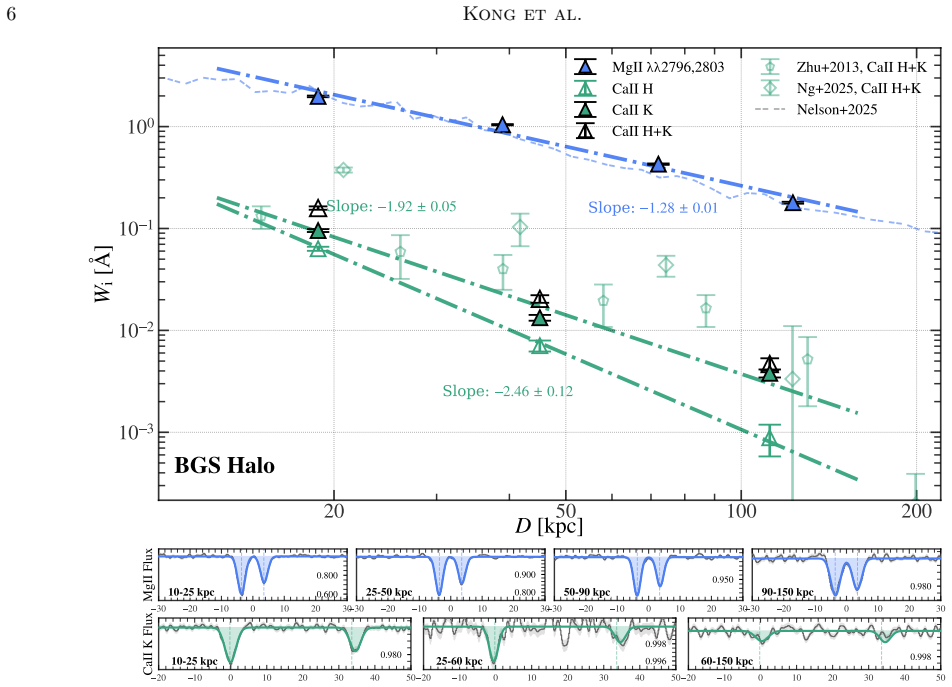
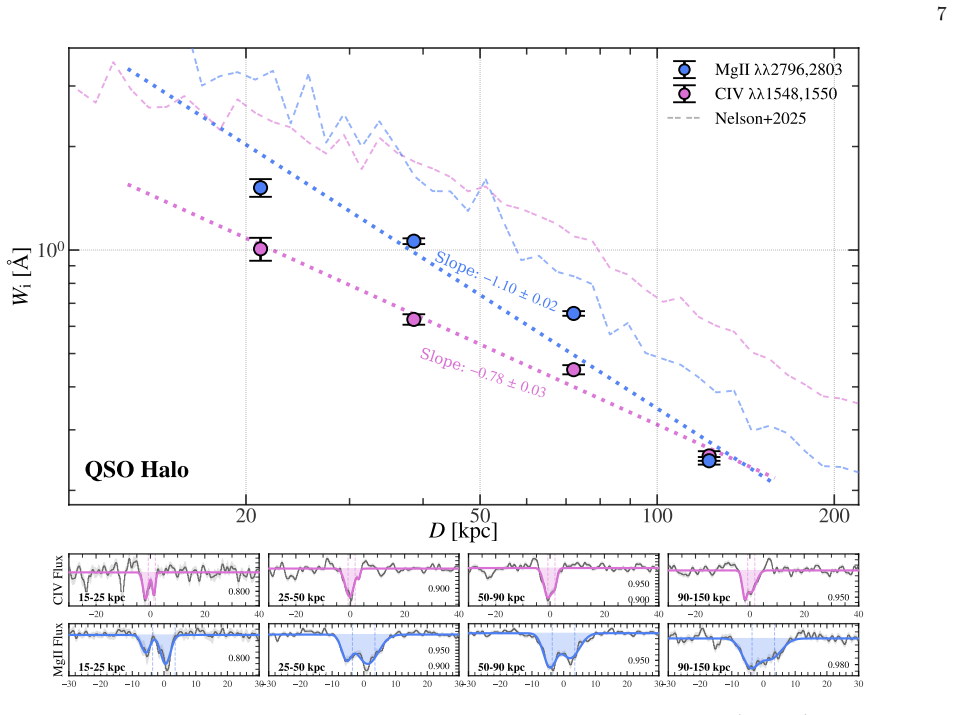
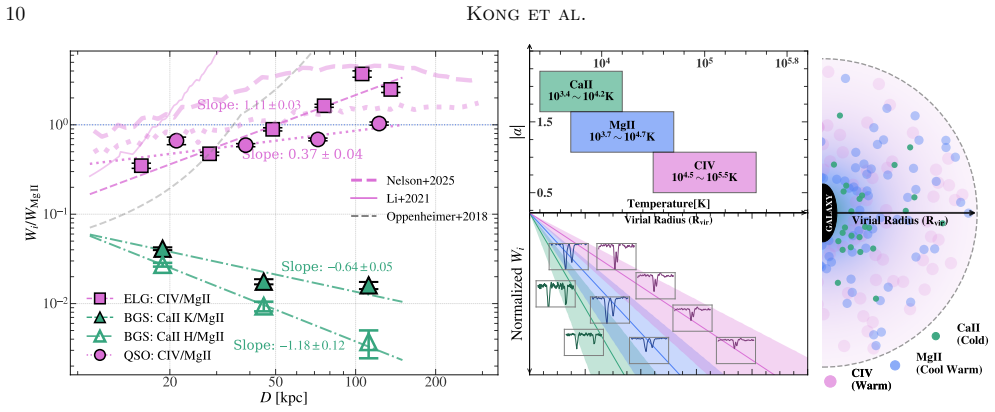
Equivalent width profiles traced by ions that probe progressively cooler gas become increasingly steep with radius, establishing that cooler phases of the circumgalactic medium are more centrally concentrated than warmer phases, with the structure varying by central object type and host mass.
What carries the argument
Stacking technique applied to multiple absorption doublets to extract radial equivalent width profiles across temperature phases.
If this is right
- Emission-line galaxy halos display a sharp radial transition from cool to warm gas.
- Quasar halos maintain a more uniform mix of phases, consistent with regulation by AGN feedback.
- Cold gas traced by Ca II remains tightly confined to the inner halo in low-redshift systems.
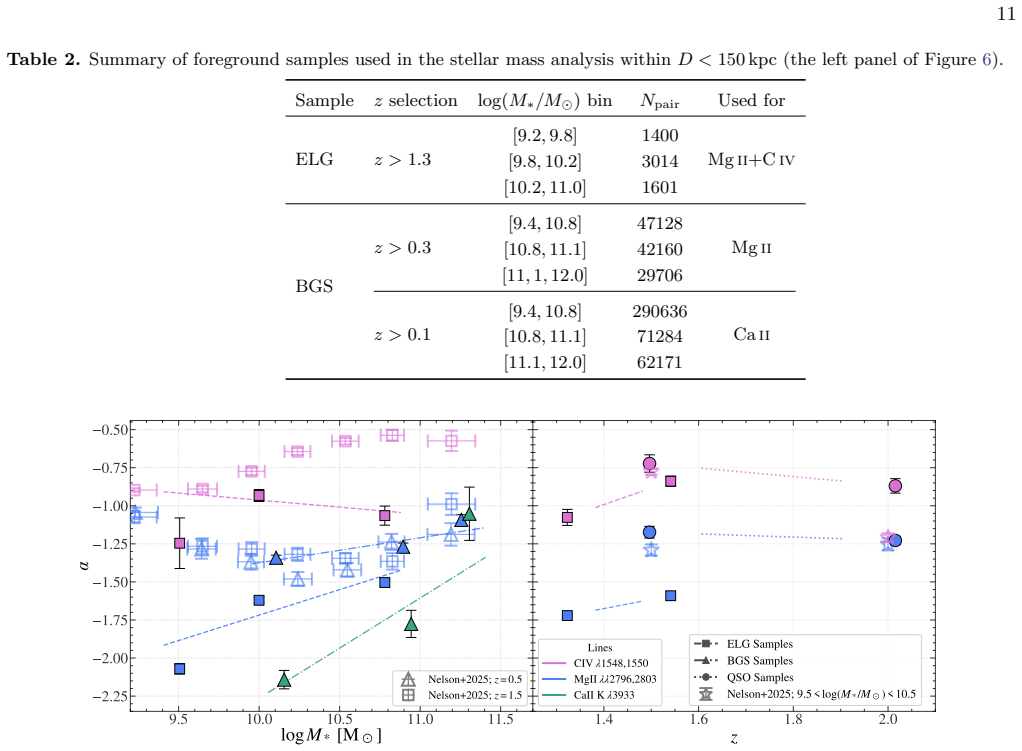
- The radial scaling of absorption strength for cool gas is set mainly by host stellar mass.
Where Pith is reading between the lines
- The observed mass dependence implies that heating becomes more efficient inside massive halos, reducing the amount of cool gas available at larger radii.
- If the stratification persists across cosmic time, it would affect how quickly galaxies can accrete fresh material from the surrounding reservoir.
- Higher-resolution spectra could separate velocity components and test whether the radial trends arise from distinct kinematic structures.
Load-bearing premise
The ions cleanly mark distinct temperature phases whose ionization states and covering fractions stay constant enough with radius that they do not create the observed profile differences on their own.
What would settle it
A measurement in which the radial equivalent width slopes are statistically identical for Ca II, Mg II, and C IV regardless of the temperature each ion is expected to trace.
Figures
read the original abstract
We present a systematic study of the multiphase circumgalactic medium (CGM) around galaxies and quasars, traced by Ca II $\lambda\lambda3934,3969$, Mg II $\lambda\lambda2796,2803$, and C IV $\lambda\lambda1548,1550$, using the Year 1 dataset from the Dark Energy Spectroscopic Instrument. These three doublets trace CGM gas across a range of temperatures, from cold to warm phases, and we employ a stacking technique to measure the corresponding absorption signals using background sources. We show that CGM structure is strongly phase-dependent: ions tracing progressively cooler gas exhibit increasingly steep radial profiles in equivalent width ($W_i$). These trends are broadly consistent with predictions from cosmological simulations, supporting a phase-stratified CGM in which cooler gas is more centrally concentrated. Specifically, halos of emission-line galaxies exhibit a strong radial transition from cool to warm gas, whereas halos of quasars show a more uniform distribution, likely regulated by active galactic nuclei feedback; in contrast, the cold gas traced by Ca II in low-redshift galaxies is tightly confined to inner regions. We further demonstrate that the radial scaling $W_i \propto D^{\alpha}$ is primarily set by host stellar mass, particularly for the cool-phase medium, suggesting efficient heating processes in massive halos. By jointly leveraging multiple absorption tracers from observations and simulations, we map the CGM from cold to warm phases and place new constraints on the baryon cycle governing galaxy evolution.
Editorial analysis
A structured set of objections, weighed in public.
Referee Report
Summary. The paper claims that stacked equivalent-width radial profiles (W_i) from Ca II, Mg II, and C IV absorption in DESI Year 1 data around emission-line galaxies and quasars become progressively steeper for ions tracing cooler gas. These trends are reported as consistent with cosmological simulations and interpreted as evidence for a phase-stratified CGM in which cooler phases are more centrally concentrated, with additional dependence on host type (ELG vs. quasar) and stellar mass.
Significance. If the central mapping from observed W_i(D) slopes to phase-dependent concentration holds after controlling for ionization and covering-fraction effects, the result would supply one of the first large-sample, multi-ion observational constraints on radial phase structure in the CGM, directly testable against simulations and relevant to baryon-cycle models.
major comments (1)
- Abstract and central claim: the inference that steeper W_i profiles for Ca II/Mg II versus C IV demonstrate that cooler gas is more centrally concentrated rests on the assumption that each ion’s ionization fraction and the absorber covering fraction remain sufficiently constant (or vary in a non-degenerate way) across the sampled impact-parameter range. No test that isolates this degeneracy—e.g., by holding total hydrogen column fixed while varying only the ionization parameter—is described, leaving open the possibility that radial gradients in density, temperature, or UV field alone could produce the observed slopes without requiring phase-dependent spatial distributions.
Simulated Author's Rebuttal
We thank the referee for their constructive comments on our manuscript. We address the major comment below and indicate where we will revise the text.
read point-by-point responses
-
Referee: Abstract and central claim: the inference that steeper W_i profiles for Ca II/Mg II versus C IV demonstrate that cooler gas is more centrally concentrated rests on the assumption that each ion’s ionization fraction and the absorber covering fraction remain sufficiently constant (or vary in a non-degenerate way) across the sampled impact-parameter range. No test that isolates this degeneracy—e.g., by holding total hydrogen column fixed while varying only the ionization parameter—is described, leaving open the possibility that radial gradients in density, temperature, or UV field alone could produce the observed slopes without requiring phase-dependent spatial distributions.
Authors: We acknowledge that the interpretation of steeper W_i profiles for cooler ions as evidence of central concentration assumes that ionization fractions and covering fractions do not introduce a dominant degeneracy. Our analysis relies on the differential behavior across ions with distinct ionization potentials, combined with direct comparison to cosmological simulations that self-consistently compute ionization states from local gas properties and the UV background. These simulations produce analogous radial trends driven by phase-dependent spatial distributions rather than ionization gradients alone. We did not include an explicit test holding total hydrogen column fixed (as stacked equivalent widths do not yield per-absorber N_H), but we will add a dedicated paragraph in the discussion section quantifying the potential contribution of radial ionization variations using the simulation outputs. This will make the assumptions and their robustness more explicit. revision: partial
Circularity Check
No circularity: direct observational stacking compared to external simulations
full rationale
The paper measures equivalent widths via stacking of DESI spectra for Ca II, Mg II, and C IV, reports radial trends W_i(D), and notes consistency with external cosmological simulations. No derivation step reduces by construction to a fitted parameter within the paper, no self-citation is load-bearing for the central claim, and no ansatz or uniqueness theorem is imported from the authors' prior work. The mapping from ion to phase is presented as an interpretive assumption rather than a mathematical identity, and the radial profiles are reported as measured quantities, not predictions derived from the same data.
Axiom & Free-Parameter Ledger
Reference graph
Works this paper leans on
-
[1]
Aird, J., & Coil, A. L. 2021, MNRAS, 502, 5962, doi: 10.1093/mnras/stab312
-
[2]
2021, MNRAS, 504, 65, doi: 10.1093/mnras/stab871
Anand, A., Nelson, D., & Kauffmann, G. 2021, MNRAS, 504, 65, doi: 10.1093/mnras/stab871
-
[3]
Anand, A., Guy, J., Bailey, S., et al. 2024, AJ, 168, 124, doi: 10.3847/1538-3881/ad60c2 Angl´ es-Alc´ azar, D., Faucher-Gigu` ere, C.-A., Kereˇ s, D., et al. 2017, MNRAS, 470, 4698, doi: 10.1093/mnras/stx1517
-
[4]
1986, A&A, 169, 1
Bergeron, J., & Stasi´ nska, G. 1986, A&A, 169, 1
1986
-
[5]
2019, A&A, 622, A103, doi: 10.1051/0004-6361/201834156 24
Boquien, M., Burgarella, D., Roehlly, Y., et al. 2019, A&A, 622, A103, doi: 10.1051/0004-6361/201834156
work page internal anchor Pith review doi:10.1051/0004-6361/201834156 2019
-
[6]
Bordoloi, R., Tumlinson, J., Werk, J. K., et al. 2014, ApJ, 796, 136, doi: 10.1088/0004-637X/796/2/136
-
[7]
Bower, R. G., Benson, A. J., Malbon, R., et al. 2006, MNRAS, 370, 645, doi: 10.1111/j.1365-2966.2006.10519.x
-
[8]
Bryan, G. L., & Norman, M. L. 1998, ApJ, 495, 80, doi: 10.1086/305262
work page internal anchor Pith review doi:10.1086/305262 1998
-
[9]
2012, Advances in Astronomy, 2012, 853701, doi: 10.1155/2012/853701
Cappelluti, N., Allevato, V., & Finoguenov, A. 2012, Advances in Astronomy, 2012, 853701, doi: 10.1155/2012/853701
-
[10]
Chaussidon, E., Y` eche, C., Palanque-Delabrouille, N., et al. 2023, ApJ, 944, 107, doi: 10.3847/1538-4357/acb3c2
-
[11]
Chen, Y., Mo, H., & Wang, H. 2025a, arXiv e-prints, arXiv:2509.03283, doi: 10.48550/arXiv.2509.03283
work page internal anchor Pith review Pith/arXiv arXiv doi:10.48550/arxiv.2509.03283
-
[12]
2025b, ApJL, 988, L39, doi: 10.3847/2041-8213/ade545 —
Chen, Z., Wang, E., Zou, H., et al. 2025b, ApJL, 988, L39, doi: 10.3847/2041-8213/ade545 —. 2025c, ApJ, 981, 81, doi: 10.3847/1538-4357/ada942
-
[13]
Cook, A. W. S., van de Voort, F., Pakmor, R., & Grand, R. J. J. 2025, MNRAS, 543, 1224, doi: 10.1093/mnras/staf1537
-
[14]
Croton, D. J., Springel, V., White, S. D. M., et al. 2006, MNRAS, 365, 11, doi: 10.1111/j.1365-2966.2005.09675.x
-
[15]
Dawson, K. S., Schlegel, D. J., Ahn, C. P., et al. 2013, AJ, 145, 10, doi: 10.1088/0004-6256/145/1/10
work page internal anchor Pith review doi:10.1088/0004-6256/145/1/10 2013
-
[16]
arXiv , author =:2102.08383 , journal =
DeFelippis, D., Bouch´ e, N. F., Genel, S., et al. 2021, ApJ, 923, 56, doi: 10.3847/1538-4357/ac2cbf
-
[17]
Dekel, A., & Birnboim, Y. 2006, MNRAS, 368, 2, doi: 10.1111/j.1365-2966.2006.10145.x
-
[18]
Data Release 1 of the Dark Energy Spectroscopic Instrument
Dekel, A., Birnboim, Y., Engel, G., et al. 2009, Nature, 457, 451, doi: 10.1038/nature07648 DESI Collaboration, Adame, A. G., Aguilar, J., et al. 2024, AJ, 168, 58, doi: 10.3847/1538-3881/ad3217 DESI Collaboration, Karim, M. A., Adame, A. G., et al. 2025, arXiv e-prints, arXiv:2503.14745, doi: 10.48550/arXiv.2503.14745
work page internal anchor Pith review Pith/arXiv arXiv doi:10.1038/nature07648 2009
-
[19]
Dutta, A., Bisht, M. S., Sharma, P., et al. 2024, MNRAS, 531, 5117, doi: 10.1093/mnras/stae977
-
[20]
Dutta, R., Fumagalli, M., Fossati, M., et al. 2021, MNRAS, 508, 4573, doi: 10.1093/mnras/stab2752 Euclid Collaboration, Scaramella, R., Amiaux, J., et al. 2022, A&A, 662, A112, doi: 10.1051/0004-6361/202141938 Euclid Collaboration, Mellier, Y., Abdurro’uf, et al. 2024, arXiv e-prints, arXiv:2405.13491, doi: 10.48550/arXiv.2405.13491 Faucher-Gigu` ere, C.-...
-
[21]
Ford, A. B., Oppenheimer, B. D., Dav´ e, R., et al. 2013, MNRAS, 432, 89, doi: 10.1093/mnras/stt393
-
[22]
Ford, A. B., Werk, J. K., Dav´ e, R., et al. 2016, MNRAS, 459, 1745, doi: 10.1093/mnras/stw595
-
[23]
Foreman-Mackey, D., Hogg, D. W., Lang, D., & Goodman, J. 2013, PASP, 125, 306, doi: 10.1086/670067
-
[24]
2023, MNRAS, 524, 3474, doi: 10.1093/mnras/stad2087 16Kong et al
Galbiati, M., Fumagalli, M., Fossati, M., et al. 2023, MNRAS, 524, 3474, doi: 10.1093/mnras/stad2087 16Kong et al. 9.5 10.0 10.5 11.0 11.5 logM* [M ] 2.25 2.00 1.75 1.50 1.25 1.00 0.75 0.50 D/Rvir-based D-based 1.4 1.6 1.8 2.0 z Figure B.The same as Figure 6, but additionally showingαobtained usingD/R vir binning (open symbols). The halo-scaled radial bin...
-
[25]
Garza, S. L., Werk, J. K., Berg, T. A. M., et al. 2025, ApJL, 978, L12, doi: 10.3847/2041-8213/ad9c69
-
[26]
2012, ApJ, 746, 94, doi: 10.1088/0004-637X/746/1/94
Gaspari, M., Ruszkowski, M., & Sharma, P. 2012, ApJ, 746, 94, doi: 10.1088/0004-637X/746/1/94
-
[27]
Green, J. C., Froning, C. S., Osterman, S., et al. 2012, ApJ, 744, 60, doi: 10.1088/0004-637X/744/1/6010.1086/141956
-
[28]
2018, PyQSOFit: Python code to fit the spectrum of quasars, Astrophysics Source Code Library, record ascl:1809.008
Guo, H., Shen, Y., & Wang, S. 2018, PyQSOFit: Python code to fit the spectrum of quasars, Astrophysics Source Code Library, record ascl:1809.008. http://ascl.net/1809.008
2018
-
[29]
2020, MNRAS, 494, 3581, doi: 10.1093/mnras/staa902
Hafen, Z., Faucher-Gigu` ere, C.-A., Angl´ es-Alc´ azar, D., et al. 2020, MNRAS, 494, 3581, doi: 10.1093/mnras/staa902
-
[30]
2022, MNRAS, 514, 5056, doi: 10.1093/mnras/stac1603
Hafen, Z., Stern, J., Bullock, J., et al. 2022, MNRAS, 514, 5056, doi: 10.1093/mnras/stac1603
-
[31]
Hahn, C., Wilson, M. J., Ruiz-Macias, O., et al. 2023, AJ, 165, 253, doi: 10.3847/1538-3881/accff8
-
[32]
2026, ApJ, 998, 261, doi: 10.3847/1538-4357/ae1b88
Stern, J. 2026, ApJ, 998, 261, doi: 10.3847/1538-4357/ae1b88
-
[33]
2025, ApJL, 986, L24, doi: 10.3847/2041-8213/addfd9
Jia, C., Wang, E., Lyu, C., et al. 2025, ApJL, 986, L24, doi: 10.3847/2041-8213/addfd9
-
[34]
2025, ApJ, 994, 220, doi: 10.3847/1538-4357/ae17c1
Jiang, H., Wang, E., Wang, K., Ma, C., & Kong, X. 2025, ApJ, 994, 220, doi: 10.3847/1538-4357/ae17c1
-
[35]
Kacprzak, G. G., Muzahid, S., Churchill, C. W., Nielsen, N. M., & Charlton, J. C. 2015, ApJ, 815, 22, doi: 10.1088/0004-637X/815/1/22
-
[36]
G., Oppenheimer, B., Nielsen, N., et al
Kacprzak, G. G., Oppenheimer, B., Nielsen, N., et al. 2025, PASA, 42, e128, doi: 10.1017/pasa.2025.10091
-
[37]
2024, NIST Atomic Spectra Database (version 5.12), Online, doi: 10.18434/T4W30F
Kramida, A., Ralchenko, Y., Reader, J., et al. 2024, NIST Atomic Spectra Database (version 5.12), Online, doi: 10.18434/T4W30F
-
[38]
2020, ApJ, 897, 97, doi: 10.3847/1538-4357/ab989a
Lan, T.-W. 2020, ApJ, 897, 97, doi: 10.3847/1538-4357/ab989a
-
[39]
2017, ApJ, 850, 156, doi: 10.3847/1538-4357/aa93eb
Lan, T.-W., & Fukugita, M. 2017, ApJ, 850, 156, doi: 10.3847/1538-4357/aa93eb
-
[40]
2018, ApJ, 866, 36, doi: 10.3847/1538-4357/aadc08
Lan, T.-W., & Mo, H. 2018, ApJ, 866, 36, doi: 10.3847/1538-4357/aadc08
-
[41]
Lan, T.-W., Prochaska, J. X., Aguilar, J., et al. 2025, arXiv e-prints, arXiv:2511.03195, doi: 10.48550/arXiv.2511.03195
-
[42]
W., & Mykytyn, D
Lang, D., Hogg, D. W., & Mykytyn, D. 2016, The Tractor: Probabilistic astronomical source detection and measurement, Astrophysics Source Code Library, record ascl:1604.008
2016
-
[43]
The Dark Energy Spectroscopic Instrument (DESI)
Levi, M., Allen, L. E., Raichoor, A., et al. 2019, in Bulletin of the American Astronomical Society, Vol. 51, 57, doi: 10.48550/arXiv.1907.10688
work page internal anchor Pith review Pith/arXiv arXiv doi:10.48550/arxiv.1907.10688 2019
-
[44]
2021, MNRAS, 500, 1038, doi: 10.1093/mnras/staa3322
Li, F., Rahman, M., Murray, N., et al. 2021, MNRAS, 500, 1038, doi: 10.1093/mnras/staa3322
-
[45]
2025, MNRAS, 543, 1878, doi: 10.1093/mnras/staf1594
Li, H., Chen, Y., Wang, H., & Mo, H. 2025, MNRAS, 543, 1878, doi: 10.1093/mnras/staf1594
-
[46]
Liang, C. J., Kravtsov, A. V., & Agertz, O. 2016, MNRAS, 458, 1164, doi: 10.1093/mnras/stw375
-
[47]
Liang, C. J., & Remming, I. 2020, MNRAS, 491, 5056, doi: 10.1093/mnras/stz3403
-
[48]
2019, ApJ, 877, 4, doi: 10.3847/1538-4357/ab184e
Schaye, J. 2019, ApJ, 877, 4, doi: 10.3847/1538-4357/ab184e
-
[49]
2025, ApJL, 981, L6, doi: 10.3847/2041-8213/adb4ed
Lyu, C., Wang, E., Zhang, H., et al. 2025, ApJL, 981, L6, doi: 10.3847/2041-8213/adb4ed
-
[50]
2026, ApJL, 1000, L3, doi: 10.3847/2041-8213/ae48ee
Lyu, C., Yu, H., Wang, E., et al. 2026, ApJL, 1000, L3, doi: 10.3847/2041-8213/ae48ee
-
[51]
2024, ApJL, 971, L14, doi: 10.3847/2041-8213/ad675f
Ma, C., Wang, K., Wang, E., et al. 2024, ApJL, 971, L14, doi: 10.3847/2041-8213/ad675f
-
[52]
P., O’Leary, R., & Madigan, A.-M
McCourt, M., Oh, S. P., O’Leary, R., & Madigan, A.-M. 2018, MNRAS, 473, 5407, doi: 10.1093/mnras/stx2687 17 M´ enard, B., Wild, V., Nestor, D., et al. 2011, Monthly Notices of the Royal Astronomical Society, 417, 801
-
[53]
Miller, T. N., Doel, P., Gutierrez, G., et al. 2024, AJ, 168, 95, doi: 10.3847/1538-3881/ad45fe
-
[54]
2024, MNRAS, 532, 3808, doi: 10.1093/mnras/stae1727
Mo, H., Chen, Y., & Wang, H. 2024, MNRAS, 532, 3808, doi: 10.1093/mnras/stae1727
-
[55]
2024, MNRAS, 532, 32, doi: 10.1093/mnras/stae1418
Blomqvist, M. 2024, MNRAS, 532, 32, doi: 10.1093/mnras/stae1418
-
[56]
Moster, B. P., Naab, T., & White, S. D. M. 2013, MNRAS, 428, 3121, doi: 10.1093/mnras/sts261
work page internal anchor Pith review doi:10.1093/mnras/sts261 2013
-
[57]
Myers, A. D., Moustakas, J., Bailey, S., et al. 2023, AJ, 165, 50, doi: 10.3847/1538-3881/aca5f9
-
[58]
Napolitano, L., Pandey, A., Myers, A. D., et al. 2023, AJ, 166, 99, doi: 10.3847/1538-3881/ace62c
-
[59]
doi:10.1093/mnras/staa2419 , eprint =
Nelson, D., Sharma, P., Pillepich, A., et al. 2020, MNRAS, 498, 2391, doi: 10.1093/mnras/staa2419
-
[60]
The Synthetic Absorption Line Spectral Almanac (SALSA)
Nelson, D., Peroux, C., Richter, P., et al. 2025, arXiv e-prints, arXiv:2510.19904, doi: 10.48550/arXiv.2510.19904
work page internal anchor Pith review Pith/arXiv arXiv doi:10.48550/arxiv.2510.19904 2025
-
[61]
Ng, Y. V., Lan, T.-W., Prochaska, J. X., et al. 2025, ApJ, 993, 92, doi: 10.3847/1538-4357/ae0613
-
[62]
Olivares, V., Salom´ e, P., Hamer, S. L., et al. 2022, A&A, 666, A94, doi: 10.1051/0004-6361/202142475
-
[63]
Oppenheimer, B. D., & Dav´ e, R. 2006, MNRAS, 373, 1265, doi: 10.1111/j.1365-2966.2006.10989.x
-
[64]
Oppenheimer, B. D., Schaye, J., Crain, R. A., Werk, J. K., & Richings, A. J. 2018, MNRAS, 481, 835, doi: 10.1093/mnras/sty2281
-
[65]
Peroux, C., & Nelson, D. 2024, arXiv e-prints, arXiv:2411.07988, doi: 10.48550/arXiv.2411.07988 P´ eroux, C., Nelson, D., van de Voort, F., et al. 2020, MNRAS, 499, 2462, doi: 10.1093/mnras/staa2888
-
[66]
Pieri, M. M., Mortonson, M. J., Frank, S., et al. 2014, MNRAS, 441, 1718, doi: 10.1093/mnras/stu577
-
[67]
Pillepich, A., Nelson, D., Springel, V., et al. 2019, MNRAS, 490, 3196, doi: 10.1093/mnras/stz2338 Planck Collaboration, Ade, P. A. R., Aghanim, N., et al. 2016, A&A, 594, A13, doi: 10.1051/0004-6361/201525830
-
[68]
Poppett, C., Tyas, L., Aguilar, J., et al. 2024, AJ, 168, 245, doi: 10.3847/1538-3881/ad76a4
-
[69]
Research Notes of the American Astronomical Society , keywords =
Raichoor, A., Eisenstein, D. J., Karim, T., et al. 2020, Research Notes of the American Astronomical Society, 4, 180, doi: 10.3847/2515-5172/abc078
-
[70]
Raichoor, A., Moustakas, J., Newman, J. A., et al. 2023, AJ, 165, 126, doi: 10.3847/1538-3881/acb213
-
[71]
Rees, M. J., & Ostriker, J. P. 1977, MNRAS, 179, 541, doi: 10.1093/mnras/179.4.541
-
[72]
Murphy, M. T. 2011, A&A, 528, A12, doi: 10.1051/0004-6361/201015566
-
[73]
Research Notes of the American Astronomical Society , keywords =
Ruiz-Macias, O., Zarrouk, P., Cole, S., et al. 2020, Research Notes of the American Astronomical Society, 4, 187, doi: 10.3847/2515-5172/abc25a
-
[74]
Saeedzadeh, V., Jung, S. L., Rennehan, D., et al. 2023, MNRAS, 525, 5677, doi: 10.1093/mnras/stad2637
-
[75]
Sameer, Charlton, J. C., Wakker, B. P., et al. 2024, MNRAS, 530, 3827, doi: 10.1093/mnras/stae962
-
[76]
Sanchez, N. N., Werk, J. K., Tremmel, M., et al. 2019, ApJ, 882, 8, doi: 10.3847/1538-4357/ab3045
-
[77]
Schaye, J., Crain, R. A., Bower, R. G., et al. 2015, MNRAS, 446, 521, doi: 10.1093/mnras/stu2058
-
[78]
Schlafly, E. F., Kirkby, D., Schlegel, D. J., et al. 2023, AJ, 166, 259, doi: 10.3847/1538-3881/ad0832
-
[79]
J., Ferraro, S., Aldering, G., et al
Schlegel, D. J., Ferraro, S., Aldering, G., et al. 2022, arXiv e-prints, arXiv:2209.03585, doi: 10.48550/arXiv.2209.03585
-
[80]
2025, MNRAS, 541, 2471, doi: 10.1093/mnras/staf1066
Shah, H., van de Voort, F., Seta, A., & Federrath, C. 2025, MNRAS, 541, 2471, doi: 10.1093/mnras/staf1066
discussion (0)
Sign in with ORCID, Apple, or X to comment. Anyone can read and Pith papers without signing in.