Barrier-channel intermixing and 2-dimensional electron gas degradation in Al-rich Al(Ga)N/AlGaN high electron mobility transistor heterostructures
Pith reviewed 2026-06-28 05:20 UTC · model grok-4.3
The pith
High growth temperatures in AlGaN HEMTs cause barrier-channel intermixing that degrades the 2DEG, but XRD analysis detects this non-destructively and optimized growth restores sheet resistivities near 2500 Ω/□.
A machine-rendered reading of the paper's core claim, the machinery that carries it, and where it could break.
Core claim
High growth temperatures needed for MOVPE growth of high-crystal-quality AlGaN cause alloy intermixing between barrier and channel layers in Al-rich Al(Ga)N/AlGaN heterostructures. This intermixing smoothens the polarization contrast and degrades the 2DEG. XRD analysis serves as a non-destructive method to evaluate interface sharpness, while improved growth schemes achieve high-quality 2DEG with sheet resistivities around 2500 Ω/□ for AlN/Al0.75Ga0.25N.
What carries the argument
X-ray diffraction (XRD) analysis to assess barrier-channel interface sharpness non-destructively in AlGaN heterostructures.
If this is right
- Improved growth schemes can produce high-quality 2DEG in high-aluminium-content AlGaN heterostructures.
- XRD provides a practical non-destructive check for interface quality during process development.
- Sheet resistivities around 2500 Ω/□ are achievable for AlN/Al0.75Ga0.25N structures, matching top literature results.
- Contactless resistivity measurements can confirm 2DEG quality without device fabrication.
Where Pith is reading between the lines
- Routine XRD checks during growth could shorten the iteration cycle for developing sharp-interface AlGaN devices.
- The same intermixing problem may limit 2DEG formation in other high-temperature-grown polarization heterostructures.
- Maintaining sharp interfaces at high Al fractions supports the design of transistors that combine high electron density with high breakdown voltage.
Load-bearing premise
The primary cause of 2DEG degradation is alloy intermixing driven by high growth temperature rather than other unexamined factors such as defects or doping changes.
What would settle it
Growing a sample at standard high temperature that shows no intermixing signature in XRD yet still exhibits degraded 2DEG resistivity, or achieving low resistivity with visible intermixing in XRD.
Figures
read the original abstract
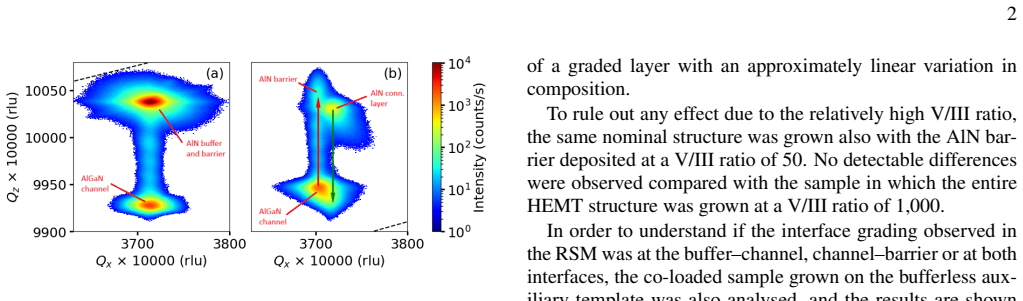
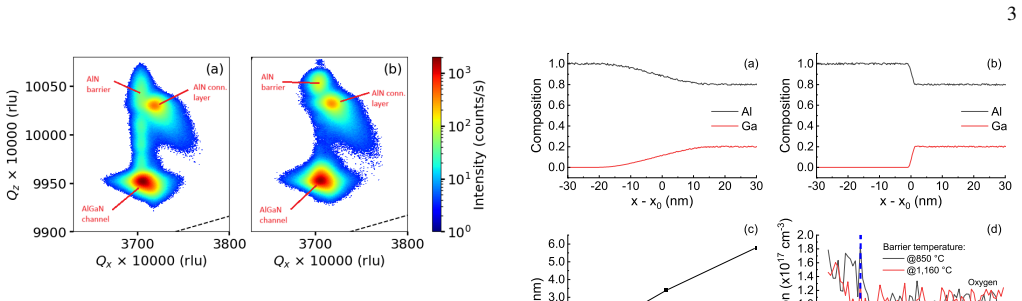
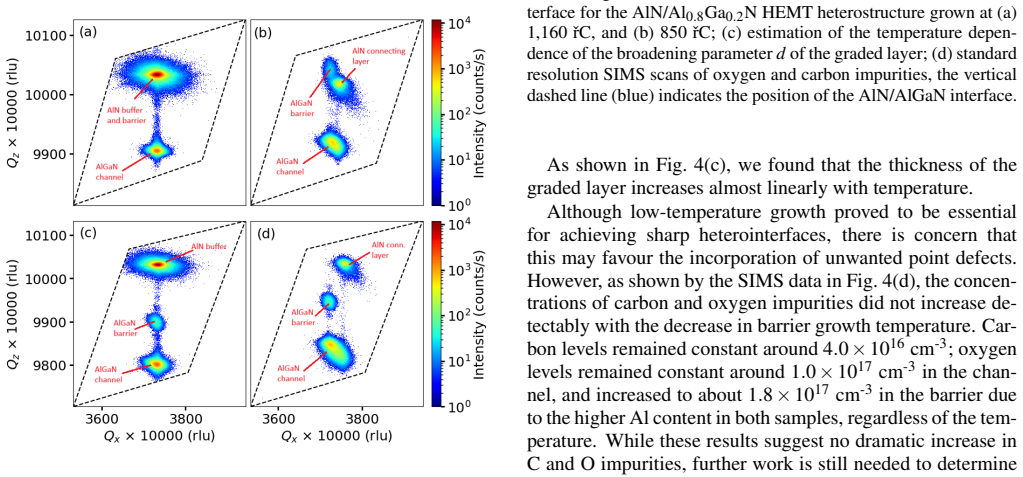
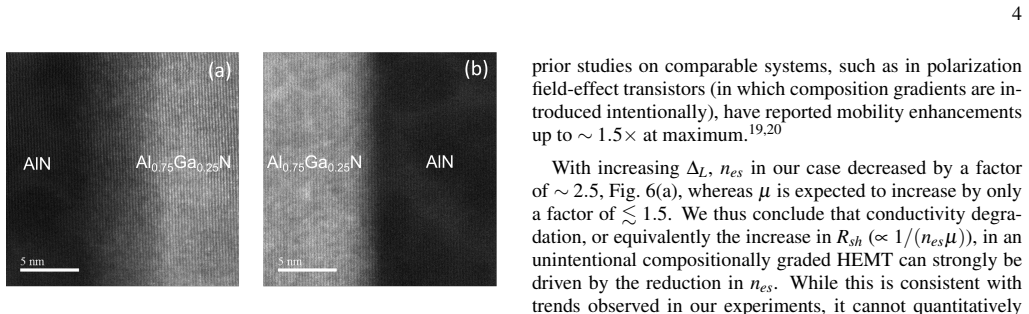
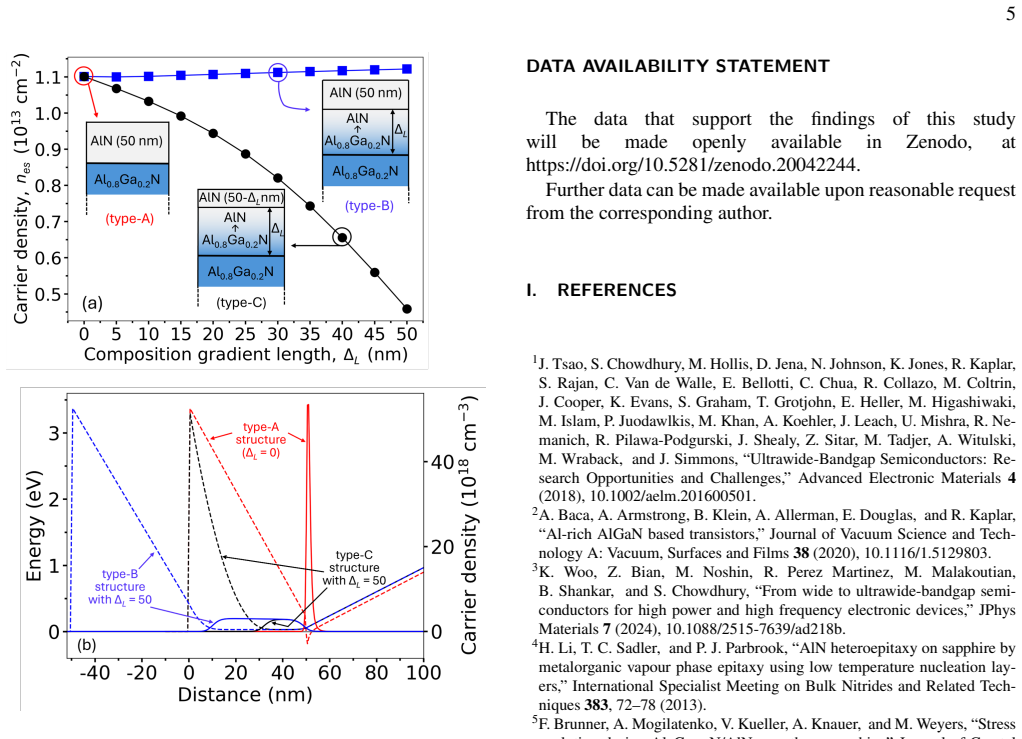
In this work, we report on recent results in understanding and addressing the issue of interface smearing in high-aluminium content AlGaN/AlGaN heterostructures. On the one hand, the growth of high-crystal quality AlGaN by metal-organic vapour phase epitaxy (MOVPE) requires the use of high temperatures, but on the other hand this may lead to alloy intermixing between barrier and channel layers, which smoothens out the polarization contrast and severely degrades or even completely destroys the 2-dimensional electron gas (2DEG). We show that X-Ray Diffraction (XRD) analysis can be used as a non-destructive way to assess the sharpness of the interface, and that improved growth schemes can be successfully used to achieve high-quality 2DEG, as confirmed by contactless resistivity measurements. In particular, sheet resistivities around 2,500 $\Omega/\Box$ were demonstrated for AlN/Al$_{0.75}$Ga$_{0.25}$N, consistent with the best-reported values in the literature.
Editorial analysis
A structured set of objections, weighed in public.
Referee Report
Summary. The paper reports on interface smearing in high-Al-content AlGaN/AlGaN HEMT heterostructures grown by MOVPE. It claims that high growth temperatures cause alloy intermixing between barrier and channel layers, smoothing polarization contrast and degrading the 2DEG; that XRD provides a non-destructive assessment of interface sharpness; and that modified growth schemes yield high-quality 2DEGs with sheet resistivities of ~2500 Ω/□ for AlN/Al0.75Ga0.25N, matching best-reported literature values, as confirmed by contactless resistivity measurements.
Significance. If the claimed link between XRD-assessed interface sharpness and 2DEG performance holds with quantitative controls, the work would supply a practical non-destructive characterization route for optimizing Al-rich HEMTs relevant to high-power electronics. The reported resistivity values are competitive, but current evidential gaps limit the immediate impact.
major comments (3)
- [Abstract/Results] Abstract and Results: The central claim that reduced intermixing (assessed via XRD) directly causes the drop to ~2500 Ω/□ resistivity is not supported by quantitative XRD metrics (e.g., fitted interface roughness, peak broadening parameters, or error bars on resistivity) or by explicit comparison to control samples; the abstract states outcomes without these data.
- [Results/Discussion] Results/Discussion: No experiments are described that hold doping, defect density, strain, or other growth variables fixed while varying only the intermixing extent (via temperature or scheme); the attribution of 2DEG improvement specifically to sharper interfaces therefore remains correlative.
- [Methods] Methods: The manuscript supplies no details on how XRD simulations or rocking-curve analysis were performed to extract quantitative intermixing parameters, nor on the number of samples, reproducibility, or statistical uncertainty in the resistivity measurements.
minor comments (2)
- [Abstract] Ensure consistent use of Ω/□ (or Ω/□) notation throughout; the abstract uses Ω/□ while literature often employs Ω/□.
- [Discussion] Add explicit references to the specific literature values cited for the 'best-reported' resistivities to allow direct comparison.
Simulated Author's Rebuttal
We thank the referee for the detailed and constructive report. We address each major comment below and have revised the manuscript to incorporate additional quantitative details, expanded methods, and discussion of limitations where appropriate.
read point-by-point responses
-
Referee: [Abstract/Results] Abstract and Results: The central claim that reduced intermixing (assessed via XRD) directly causes the drop to ~2500 Ω/□ resistivity is not supported by quantitative XRD metrics (e.g., fitted interface roughness, peak broadening parameters, or error bars on resistivity) or by explicit comparison to control samples; the abstract states outcomes without these data.
Authors: We agree that the original abstract and results would be strengthened by explicit quantitative XRD metrics and error bars. The manuscript already contained rocking-curve data and resistivity values, but we have revised the abstract, results, and added a new supplementary figure showing fitted interface roughness parameters (extracted via simulation), peak broadening values, and resistivity error bars from multiple wafers. We also include direct comparison to control samples grown at standard temperatures, which exhibited higher resistivity and broader XRD features. revision: yes
-
Referee: [Results/Discussion] Results/Discussion: No experiments are described that hold doping, defect density, strain, or other growth variables fixed while varying only the intermixing extent (via temperature or scheme); the attribution of 2DEG improvement specifically to sharper interfaces therefore remains correlative.
Authors: We acknowledge that a perfectly isolated experiment varying only intermixing is difficult in MOVPE because temperature and precursor schemes affect multiple parameters simultaneously. Our growth schemes were chosen to primarily suppress intermixing while keeping nominal barrier thickness, Al composition, and doping targets fixed; strain and defect density were monitored via additional XRD and AFM on the same samples. We have added a paragraph in the discussion explicitly stating the correlative nature of the evidence, the controls employed, and the remaining uncertainties, rather than claiming direct causation. revision: partial
-
Referee: [Methods] Methods: The manuscript supplies no details on how XRD simulations or rocking-curve analysis were performed to extract quantitative intermixing parameters, nor on the number of samples, reproducibility, or statistical uncertainty in the resistivity measurements.
Authors: We accept this criticism. The methods section has been substantially expanded to describe the XRD simulation software and fitting procedure (including interface roughness and intermixing parameters), the number of samples per growth condition (minimum of three), run-to-run reproducibility, and the statistical treatment of contactless resistivity data (standard deviation from 5–9 measurement points per wafer). revision: yes
Circularity Check
No circularity: purely experimental observations with no derivations or fitted predictions
full rationale
The manuscript reports MOVPE growth experiments, XRD interface characterization, and contactless resistivity measurements on AlN/AlGaN heterostructures. No equations, models, parameter fits, or predictions appear; the central result (sheet resistivity ~2500 Ω/□ achieved via modified growth) is presented as a direct experimental outcome compared to literature values. No self-citations are invoked to justify uniqueness theorems or ansatzes, and no step reduces a claimed prediction to its own input by construction. The work is therefore self-contained as an empirical report.
Axiom & Free-Parameter Ledger
Reference graph
Works this paper leans on
-
[1]
Electron mobility in polarization-doped Al0-0.2GaN with a low concentration near 1017 cm−3 , volume =
Mingda Zhu and Meng Qi and Kazuki Nomoto and Zongyang Hu and Bo Song and Ming Pan and Xiang Gao and Debdeep Jena and Huili Grace Xing , doi =. Electron mobility in polarization-doped Al0-0.2GaN with a low concentration near 1017 cm−3 , volume =. Applied Physics Letters , month =
-
[2]
APL Electronic Devices , volume =
Mondal, Badal and Pampili, Pietro and Mukherjee, Jayjit and Moran, David and Parbrook, Peter James and Schulz, Stefan , title =. APL Electronic Devices , volume =. 2025 , doi =
2025
-
[3]
Hahn, Herwig and Reuters, Ben and Kalisch, Holger and Vescan, Andrei , number =. 2013 , journal =. doi:10.1088/0268-1242/28/7/074017 , issn =
-
[4]
Vurgaftman, I. and Meyer, J. R. and Ram-Mohan, L. R. , number =. 2001 , journal =. doi:10.1063/1.1368156 , issn =
-
[5]
Vurgaftman, I. and Meyer, J. R. , number =. 2003 , journal =. doi:10.1063/1.1600519 , issn =
-
[6]
Wei, Su-Huai and Zunger, Alex , number =. 1998 , journal =. doi:10.1063/1.121249 , issn =
-
[7]
Qiao, D. and Yu, L. S. and Lau, S. S. and Redwing, J. M. and Lin, J. Y. and Jiang, H. X. , number =. 2000 , journal =. doi:10.1063/1.371944 , issn =
-
[8]
Arehart, A. R. and Moran, B. and Speck, J. S. and Mishra, U. K. and DenBaars, S. P. and Ringel, S. A. , number =. 2006 , journal =. doi:10.1063/1.2219985 , issn =
-
[9]
Armstrong, Andrew M. and Allerman, Andrew A. , number =. 2016 , journal =. doi:10.1063/1.4969062 , issn =
-
[11]
Armstrong and Andrew A
Andrew M. Armstrong and Andrew A. Allerman , doi =. Polarization-induced electrical conductivity in ultra-wide band gap. Applied Physics Letters , month =. 2016 , doi =
2016
-
[12]
Tsai, Chin-Yi and Chen, Chih-Hsiung and Sung, Tien-Li and Tsai, Chin-Yao and Rorison, Judy M. , title =. Journal of Applied Physics , volume =. 1999 , month =. doi:10.1063/1.369277 , url =
-
[13]
Fonoberov, Vladimir A. and Balandin, Alexander A. , title =. Journal of Applied Physics , volume =. 2003 , month =. doi:10.1063/1.1623330 , url =
-
[14]
Jogai, B. , number =. 2003 , journal =. doi:10.1063/1.1530729 , issn =
-
[15]
Speck and Umesh K
Debdeep Jena and Sten Heikman and Daniel Green and Dario Buttari and Robert Coffie and Huili Xing and Stacia Keller and Steve DenBaars and James S. Speck and Umesh K. Mishra and Ioulia Smorchkova , doi =. Applied Physics Letters , keywords =
-
[16]
Armstrong and Brianna A
Andrew M. Armstrong and Brianna A. Klein and Albert G. Baca and Andrew A. Allerman and Erica A. Douglas and Albert Colon and Vincent M. Abate and Torben R. Fortune , doi =. Applied Physics Letters , month =
-
[17]
Baca, A.G. and Armstrong, A.M. and Klein, B.A. and Allerman, A.A. and Douglas, E.A. and Kaplar, R.J. , year =. Al-Rich. Journal of Vacuum Science and Technology A: Vacuum, Surfaces and Films , volume =. doi:10.1116/1.5129803 , abstract =
-
[18]
Brunner, F. and Mogilatenko, A. and Kueller, V. and Knauer, A. and Weyers, M. , year =. Stress Evolution during. Journal of Crystal Growth , volume =. doi:10.1016/j.jcrysgro.2013.04.023 , abstract =
-
[19]
Kangawa, Yoshihiro and Kusaba, Akira and Kawamura, Takahiro and Kempisty, Pawel and Ishisone, Kana and Boero, Mauro , year =. Influence of. Crystal Growth & Design , volume =. doi:10.1021/acs.cgd.4c01542 , urldate =
-
[20]
Li, H. and Sadler, T. C. and Parbrook, P. J. , year =. International Specialist Meeting on Bulk Nitrides and Related Techniques , volume =. doi:10.1016/j.jcrysgro.2013.08.024 , abstract =
-
[21]
Mass Transport Analysis of a Showerhead
Li, Hui , year =. Mass Transport Analysis of a Showerhead. Journal of Semiconductors , volume =. doi:10.1088/1674-4926/32/3/033006 , urldate =
-
[22]
Interplay of Carrier Density and Mobility in
Mondal, Badal and Pampili, Pietro and Mukherjee, Jayjit and Moran, David and Parbrook, Peter James and Schulz, Stefan , year =. Interplay of Carrier Density and Mobility in. APL Electronic Devices , volume =
-
[23]
Moram, M. A. and Vickers, M. E. , year =. X-Ray Diffraction of. Reports on Progress in Physics , volume =. doi:10.1088/0034-4885/72/3/036502 , abstract =
-
[24]
Papamichail, A. and Persson, A. R. and Richter, S. and Stanishev, V. and Armakavicius, N. and K. Impact of. 2024 , month = sep, journal =. doi:10.1063/5.0218911 , urldate =
-
[25]
Rajan, S. and Xing, H. and DenBaars, S. and Mishra, U.K. and Jena, D. , year =. Applied Physics Letters , volume =. doi:10.1063/1.1652254 , abstract =
-
[26]
Crystal Truncation Rods and Surface Roughness , author =. 1986 , month = mar, journal =. doi:10.1103/PhysRevB.33.3830 , urldate =
-
[27]
Stress Relaxation in Mismatched Layers Due to Threading Dislocation Inclination , author =. 2003 , journal =. doi:10.1063/1.1613360 , abstract =
-
[28]
Saito, T. and Miyake, R. and Yamada, R. and Imoto, Y. and Maruyama, S. and Sasaki, Y. and Karino, S. and Iwayama, S. and Miyake, H. and Naniwae, K. and Kamiyama, S. and Takeuchi, T. and Iwaya, M. , year =. Impact of Growth Temperature on Heterostructure Interface Steepness in Ultraviolet-. Applied Physics Letters , volume =. doi:10.1063/5.0242536 , abstract =
-
[29]
Singh, S.M. and Zubialevich, V.Z. and Parbrook, P.J. , year =. Surface. Physica Status Solidi (B) Basic Research , volume =. doi:10.1002/pssb.202300471 , abstract =
-
[30]
Sung Park, P. and Nath, D.N. and Krishnamoorthy, S. and Rajan, S. , year =. Electron Gas Dimensionality Engineering in. Applied Physics Letters , volume =. doi:10.1063/1.3685483 , abstract =
-
[31]
Tsao, J.Y. and Chowdhury, S. and Hollis, M.A. and Jena, D. and Johnson, N.M. and Jones, K.A. and Kaplar, R.J. and Rajan, S. and. Ultrawide-. 2018 , journal =. doi:10.1002/aelm.201600501 , abstract =
-
[32]
From Wide to Ultrawide-Bandgap Semiconductors for High Power and High Frequency Electronic Devices , author =. 2024 , journal =. doi:10.1088/2515-7639/ad218b , abstract =
-
[33]
Yoshikawa, A. and Zhang, Z. and Kushimoto, M. and Aoto, K. and Sasaoka, C. and Amano, H. , year =. Using Low-Temperature Growth to Resolve the Composition Pulling Effect of. Applied Physics Letters , volume =. doi:10.1063/5.0183320 , abstract =
-
[34]
doi:10.5281/zenodo.18498887 , url =
Mondal, Badal and Pampili, Pietro , title =. doi:10.5281/zenodo.18498887 , url =
-
[35]
Birner, S. and Zibold, T. and Andlauer, T. and Kubis, T. and Sabathil, M. and Trellakis, A. and Vogl, P. , number =. 2007 , journal =. doi:10.1109/TED.2007.902871 , issn =
-
[36]
Kent and Morschl, Richard and Vogl, Peter , number =
Trellakis, Alex and Zibold, Tobias and Andlauer, Till and Birner, Stefan and Smith, R. Kent and Morschl, Richard and Vogl, Peter , number =. 2006 , journal =. doi:10.1007/s10825-006-0005-x , issn =
-
[37]
Consistent set of band parameters for the group-III nitrides AlN, GaN, and InN , author =. Phys. Rev. B , volume =. 2008 , month =. doi:10.1103/PhysRevB.77.075202 , url =
-
[38]
Chuang, S. L. and Chang, C. S. , journal =. k. 1996 , month =. doi:10.1103/PhysRevB.54.2491 , url =
discussion (0)
Sign in with ORCID, Apple, or X to comment. Anyone can read and Pith papers without signing in.