When Evidence is Sparse: Weakly Supervised Early Failure Alerting in Dialogs and LLM-Agent Trajectories
Reviewed by Pith T0 review T1 audit T2 compute T3 formal T4 kernel 2026-06-28 05:59 UTCgrok-4.3pith:73W27Q72record.jsonopen to challenge →
The pith
An attention mechanism trained on trajectory-level labels extracts sparse turn-level failure signals to enable early alerting in dialogs and agent trajectories.
A machine-rendered reading of the paper's core claim, the machinery that carries it, and where it could break.
Core claim
The central claim is that an attention-based failure predictor can learn sparse turn-level failure evidence directly from trajectory-level labels, and that these risk estimates, when combined with a single preference-conditioned stopping policy, produce better early-alerting operating points at substantially lower training cost than methods that train separate triggers for each preference or that assign terminal labels to every prefix.
What carries the argument
The attention-based failure predictor that extracts sparse turn-level failure evidence from trajectory-level supervision, paired with the α-STOP preference-conditioned stopping policy.
If this is right
- High-relevance failure evidence occupies only 4.7-11.3% of turns and first appears after 59.0-83.6% of trajectories on average across the benchmarks.
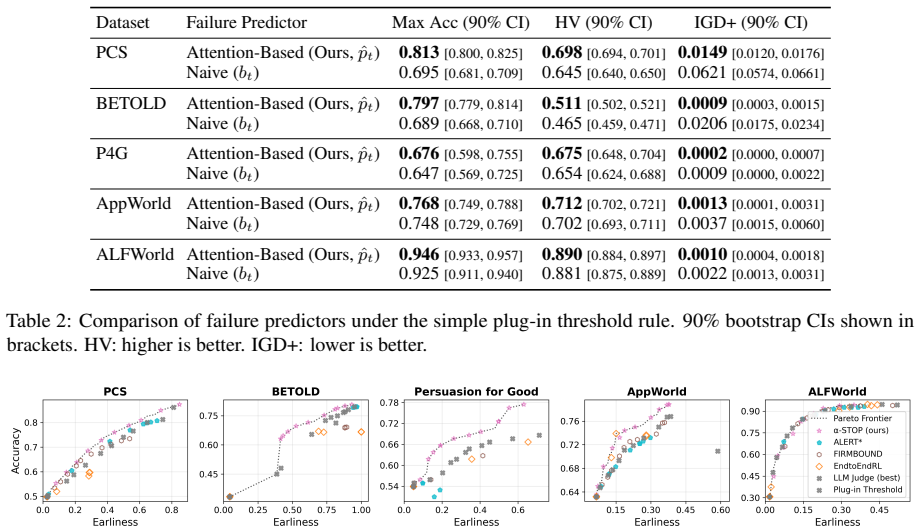
- The attention predictor improves Pareto-frontier quality by 1-10% over naive prefix supervision.
- The full system improves frontier quality by 3-42% over state-of-the-art trigger policies.
- Training cost per operating point drops by 1-3 orders of magnitude because a single policy replaces one trained trigger per preference.
- The same two-stage structure applies across customer support, task-oriented dialog, persuasion, tool use, and planning tasks.
Where Pith is reading between the lines
- The same attention-based weak supervision could be tested on other delayed-label problems such as long-horizon planning traces or multi-step reasoning chains where only final success is observed.
- A single preference-conditioned policy may reduce retraining overhead in any early-decision setting that currently trains separate classifiers for different accuracy-cost targets.
- One could measure whether the learned attention weights correlate with human judgments of which turns first signal likely failure.
Load-bearing premise
Failure evidence in multi-turn language interactions is sparse and delayed enough that an attention model trained only on final trajectory labels can still identify the relevant turns and generalize the risk estimate to unfinished trajectories.
What would settle it
A dataset in which human annotators mark the specific turns that first indicate eventual failure; if the model's attention weights do not concentrate on those turns at rates well above chance when trained only on trajectory labels, the extraction claim is falsified.
Figures






read the original abstract
Early failure alerting requires deciding, while a dialog or agent trajectory is still unfolding, whether to flag it as likely to fail. This is challenging because supervision is typically available only as a trajectory-level success/failure label while alerts must be raised from partial interactions. Prior early-classification methods often bridge this gap by assigning the terminal label to every prefix, treating every turn as failure evidence. We hypothesize that this prefix-label assumption is poorly matched to multi-turn language interactions, where evidence of eventual failure is sparse and often delayed. In this paper, we introduce a two-stage approach that learns from this sparse evidence structure and uses the resulting risk estimates for controllable early alerting. Specifically, our attention-based failure predictor learns sparse turn-level failure evidence from trajectory labels and uses it to estimate failure risk from partial histories. We then pair this predictor with $\alpha$-STOP, a single preference-conditioned stopping policy that selects an accuracy-earliness operating point at inference time rather than training a separate trigger for each preference. Across five benchmarks spanning customer support, task-oriented dialog, persuasion, tool use, and planning, we first show that high-relevance failure evidence occupies only 4.7-11.3% of turns and first appears after 59.0-83.6\% of trajectories on average. We further show that the attention-based predictor improves Pareto-frontier quality (hypervolume) by 1-10\% over naive prefix supervision, and that the full system improves frontier quality by 3-42\% over state-of-the-art trigger policies while reducing training cost per operating point by 1-3 orders of magnitude.
Editorial analysis
A structured set of objections, weighed in public.
Referee Report
Summary. The paper claims that failure evidence in multi-turn dialogs and LLM-agent trajectories is sparse and delayed (occupying 4.7-11.3% of turns and first appearing after 59.0-83.6% of the trajectory on average), so that an attention-based predictor trained only on trajectory-level success/failure labels can extract turn-level risk signals. These signals are then used with the single-parameter α-STOP policy to select accuracy-earliness operating points at inference time. Across five benchmarks the method is reported to improve Pareto-frontier hypervolume by 1-10% over naive prefix labeling and by 3-42% over prior trigger policies while cutting training cost per operating point by 1-3 orders of magnitude.
Significance. If the attention mechanism reliably isolates causally relevant sparse failure evidence rather than recency or label-propagation artifacts, the two-stage approach would materially reduce the engineering cost of deploying controllable early-warning systems for LLM agents. The explicit separation of evidence extraction from preference-conditioned stopping is a clean architectural contribution that could be reused beyond the reported domains.
major comments (3)
- [Abstract] Abstract: the reported 4.7-11.3% occupancy and 59.0-83.6% first-appearance statistics are presented as direct evidence for the sparse-evidence hypothesis, yet the manuscript supplies no description of the attention-thresholding procedure, no statistical test against a null model of uniform or recency-biased attention, and no ablation that removes the attention layer. Without these, the percentages cannot be shown to reflect the hypothesized structure rather than model architecture.
- [Abstract] Abstract and experimental section: the 1-10% hypervolume gain over naive prefix supervision and the 3-42% gain over SOTA triggers are attributed to the sparse-evidence modeling, but no independent validation (human annotation of first-failure turns, synthetic trajectories with injected failure points, or attention-map inspection) is described. The central claim that the predictor generalizes to partial histories therefore rests on the untested assumption that high-attention turns are causally linked to eventual failure.
- [Abstract] Abstract: the claim that α-STOP reduces training cost by 1-3 orders of magnitude per operating point is load-bearing for the practical contribution, yet no table or section enumerates the number of models trained, the exact training regimes of the baselines, or wall-clock / GPU-hour measurements that would allow the cost reduction to be verified.
minor comments (1)
- [Abstract] The abstract states concrete numeric ranges (1-10%, 3-42%, 4.7-11.3%) without accompanying standard deviations, number of runs, or statistical significance tests; these should be added for reproducibility.
Simulated Author's Rebuttal
We thank the referee for the constructive and detailed feedback. The comments correctly identify gaps in methodological transparency and validation that weaken the support for the paper's central claims. We address each point below and will make the corresponding revisions to strengthen the manuscript.
read point-by-point responses
-
Referee: [Abstract] Abstract: the reported 4.7-11.3% occupancy and 59.0-83.6% first-appearance statistics are presented as direct evidence for the sparse-evidence hypothesis, yet the manuscript supplies no description of the attention-thresholding procedure, no statistical test against a null model of uniform or recency-biased attention, and no ablation that removes the attention layer. Without these, the percentages cannot be shown to reflect the hypothesized structure rather than model architecture.
Authors: The referee is correct that the current manuscript does not supply an explicit description of the attention-thresholding procedure, a statistical test against a null model, or an ablation removing the attention layer. These omissions leave the sparse-evidence statistics insufficiently supported. In the revision we will add (1) a precise description of the thresholding rule (attention weight above the 90th percentile within each trajectory), (2) a permutation test against uniform attention (reported p-value), and (3) an ablation study in the appendix that removes the attention layer and shows degraded hypervolume. These additions will be placed in a new subsection of Section 4. revision: yes
-
Referee: [Abstract] Abstract and experimental section: the 1-10% hypervolume gain over naive prefix supervision and the 3-42% gain over SOTA triggers are attributed to the sparse-evidence modeling, but no independent validation (human annotation of first-failure turns, synthetic trajectories with injected failure points, or attention-map inspection) is described. The central claim that the predictor generalizes to partial histories therefore rests on the untested assumption that high-attention turns are causally linked to eventual failure.
Authors: We agree that the manuscript provides no independent validation (human annotation, synthetic trajectories, or attention-map inspection) and therefore leaves the causal link between high-attention turns and failure untested. The present evidence is limited to downstream Pareto-frontier improvements. In the revision we will add (a) qualitative attention-map examples for sampled trajectories and (b) a controlled experiment on synthetic trajectories with injected failure points, measuring alignment between high-attention turns and the injected failure locations. These results will be reported in a new subsection of the experimental section. revision: yes
-
Referee: [Abstract] Abstract: the claim that α-STOP reduces training cost by 1-3 orders of magnitude per operating point is load-bearing for the practical contribution, yet no table or section enumerates the number of models trained, the exact training regimes of the baselines, or wall-clock / GPU-hour measurements that would allow the cost reduction to be verified.
Authors: The referee correctly observes that the manuscript contains no enumeration of models trained, training regimes, or GPU-hour measurements to substantiate the cost claim. We will add a new table (Table 5) and accompanying text that lists, for each benchmark and method: number of models trained, training regime details, and approximate GPU-hours. This table will make the claimed reduction verifiable. revision: yes
Circularity Check
No circularity: empirical gains measured on external benchmarks against baselines
full rationale
The paper presents a two-stage empirical method (attention predictor trained on trajectory-level labels, paired with a preference-conditioned stopping policy) and reports performance via direct comparisons on five independent benchmarks. No equations, self-definitional reductions, or load-bearing self-citations are present in the provided text that would make reported Pareto improvements or sparsity statistics equivalent to fitted inputs by construction. The claims rest on standard weakly-supervised training and external evaluation rather than tautological renaming or imported uniqueness theorems.
Axiom & Free-Parameter Ledger
free parameters (1)
- preference parameter alpha
axioms (1)
- domain assumption Trajectory-level success/failure labels contain sufficient signal to train an attention model that identifies sparse turn-level failure evidence
Forward citations
Cited by 1 Pith paper
-
Doomed from the Start: Early Abort of LLM Agent Episodes via a Recall-Controlled Probe Cascade
A cascade of recall-calibrated gates on LLM agent hidden states aborts doomed episodes early, saving up to 47% compute at a 90% global success-recall target.
Reference graph
Works this paper leans on
-
[1]
Provable benefit of orthogonal initializa- tion in optimizing deep linear networks.Preprint, arXiv:2001.05992. Shengyi Huang, Rousslan Fernand Julien Dossa, Chang Ye, Jeff Braga, Dipam Chakraborty, Kinal Mehta, and João G.M. Araújo. 2022. Cleanrl: High-quality single-file implementations of deep reinforcement learning algorithms.Journal of Machine Learnin...
-
[2]
InProceedings of the 35th International Confer- ence on Machine Learning (ICML), volume 80, pages 2127–2136
Attention-based deep multiple instance learn- ing. InProceedings of the 35th International Confer- ence on Machine Learning (ICML), volume 80, pages 2127–2136. PMLR. Hisao Ishibuchi, Hiroyuki Masuda, Yuki Tanigaki, and Yusuke Nojima. 2015. Modified distance calcula- tion in generational distance and inverted genera- tional distance. InInternational confer...
2015
-
[3]
Aviral Kumar, Xue Bin Peng, and Sergey Levine
Hypervolume subset selection in two dimen- sions: Formulations and algorithms.Evolutionary Computation, 24(3):411–425. Aviral Kumar, Xue Bin Peng, and Sergey Levine
-
[4]
Reward-conditioned policies.arXiv preprint arXiv:1912.13465, 2019
Reward-conditioned policies.arXiv preprint arXiv:1912.13465. Hunter Lightman, Vineet Kosaraju, Yuri Burda, Harri- son Edwards, Bowen Baker, Teddy Lee, Jan Leike, John Schulman, Ilya Sutskever, and Karl Cobbe. 2023. Let’s verify step by step. InThe Twelfth International Conference on Learning Representations. David E. Losada, Fabio Crestani, and Javier Parapar
-
[5]
Overview of erisk 2020: Early risk prediction on the internet. InExperimental IR Meets Multi- linguality, Multimodality, and Interaction, volume 12260 ofLecture Notes in Computer Science, pages 272–287. Springer, Cham. Joana Mendonça, Pedro Pereira, Miguel Menezes, Vera Cabarrão, Ana Cláudia Farinha, Helena Mo- niz, João Paulo Carvalho, Alon Lavie, and Is...
-
[6]
InProceedings of the Second Workshop on When Creative AI Meets Conversational AI, pages 23–34
BETOLD: A task-oriented dialog dataset for breakdown detection. InProceedings of the Second Workshop on When Creative AI Meets Conversational AI, pages 23–34. Harsh Trivedi, Tushar Khot, Mareike Hartmann, Ruskin Manku, Vinty Dong, Edward Li, Shashank Gupta, Ashish Sabharwal, and Niranjan Balasubramanian
-
[7]
arXiv preprint arXiv:2407.18901 , year=
Appworld: A controllable world of apps and people for benchmarking interactive coding agents. Preprint, arXiv:2407.18901. Matthias V ogt, Ulf Leser, and Alan Akbik. 2021. Early detection of sexual predators in chats. InProceedings of the 59th Annual Meeting of the Association for Computational Linguistics and the 11th International Joint Conference on Nat...
-
[8]
Figure 3: Accuracy-earliness curve for failure predictors under the same Plug-in Threshold rule
Performance assessment of multiobjective op- timizers: An analysis and review.IEEE Transactions on Evolutionary Computation, 7(2):117–132. Figure 3: Accuracy-earliness curve for failure predictors under the same Plug-in Threshold rule. 20 operating points are shown per method, subsampled using HSSP for good Pareto front coverage. The dotted line shows the...
2060
-
[9]
Monotone stop payoff: Ut(p) is nondecreasing in p
-
[10]
MLR-preserving belief dynamics:the belief dy- namics underCONTpreserve the monotone likeli- hood ratio (MLR) order on beliefs
-
[11]
not LUHF
Stochastic monotonicity: Qt(· |p) is stochasti- cally nondecreasing in p: for every bounded non- decreasingφ, p1 ≤p 2 ⇒E[φ(p ′)|p 1]≤E[φ(p ′)|p 2], p′ ∼Q t(· |p). Theorem A.2(Threshold optimality in finite-horizon stopping POMDPs).Under Assumption A.1, for each time t and delay weight λ, the stopping region is an upper interval: there exists a threshold θ...
2016
-
[12]
What distinguishes good customer support from poor support
-
[14]
system" represents the dialog system/assistant -
Common failure patterns (dismissing concerns, misunderstandings, poor communication, etc.) After studying the examples, you will rate each turn in a NEW dialog on a scale of 1-5: 1 = No contribution (routine/neutral exchange, no impact on failure) 2 = Minor contribution (slight signal toward failure) 3 = Moderate contribution (noticeable impact towards fa...
-
[15]
What distinguishes successful task completion from dialog breakdown
-
[17]
persuader
Common failure patterns (misunderstanding intents, slot confusion, loops, wrong responses, etc.) After studying the examples, you will rate each turn in a NEW dialog on a scale of 1-5: 1 = No contribution (routine/neutral exchange, no impact on failure) Table 12: Percentage of low-rated turns (mean rating ≤2 ) under the same mean-aggregation as the main-b...
-
[18]
What persuasion strategies lead to donation vs refusal
-
[20]
agent" represents the AI agent's reasoning and actions -
Common failure patterns (pushy behavior, guilt-tripping, refusals, etc.) After studying the examples, you will rate each turn in a NEW dialog on a scale of 1-5: 1 = No contribution (routine/neutral exchange, no impact on failure) 2 = Minor contribution (slight signal toward failure) 3 = Moderate contribution (noticeable impact towards failure) 4 = Signifi...
-
[21]
What distinguishes successful agent behavior from failed behavior
-
[23]
think" represents the agent's reasoning and planning -
Common failure patterns (wrong API calls, format errors, logic mistakes, etc.) Table 14: Robustness check: leave-one-judge-out. Each cell shows the [min, max] of the metric across the three two-judge mean variants (dropping GPT-5.2, Gemini 3 Pro, or Claude Opus 4.5 in turn). Tight intervals indicate that the qualitative claim is not driven by any single j...
1977
-
[24]
What distinguishes successful task completion from failure
-
[25]
What types of turns tend to be critical vs routine
-
[26]
system" represents the customer support agent -
Common failure patterns (wrong objects, incorrect actions, etc.) After studying the examples, you will rate each turn in a NEW dialog on a scale of 1-5: 1 = No contribution (routine/neutral action, no impact on failure) 2 = Minor contribution (slight signal toward failure) 3 = Moderate contribution (noticeable impact towards failure) 4 = Significant contr...
2025
-
[27]
Collect the union of all evaluated operating points (a, e)across all compared methods
-
[28]
Filter the union to its non-dominated subset under the dominance definition above, yieldingP ref
-
[29]
Transform Pref into minimization form Pmin ref = {(−a, e) : (a, e)∈ P ref }. IGD+ for a method is then computed as the distance from that method’s point set (in minimization form) to Pmin ref , where lower values indicate closer approximation to the pooled non-dominated trade-off frontier. F.5 HSSP Subsampling To ensure fair comparison when methods produc...
2016
-
[30]
Collect all operating points (a, e) (accuracy a∈ [0,1], earlinesse∈[0,1])
-
[31]
Filter to the non-dominated subset under our domi- nance definition
-
[32]
• While |A|< K and candidates remain, add the point p⋆ that maximizes the hypervolume gainHV(A ∪ {p})
SelectKpoints via greedy HSSP: • InitializeA ← ∅. • While |A|< K and candidates remain, add the point p⋆ that maximizes the hypervolume gainHV(A ∪ {p}). We compute HV on the selected set in a minimization space (we minimize (−a, e)) using reference point r= (0,1). For IGD+, we compute distances from each method’s selected set to a common reference front c...
discussion (0)
Sign in with ORCID, Apple, or X to comment. Anyone can read and Pith papers without signing in.