Ultraviolet-Driven Atmospheric Degeneracies Challenge Conventional Biosignature Frameworks for Terrestrial Planets with Ultracool M Dwarf Hosts: An Archean-Analog TRAPPIST-1 e Case Study
Pith reviewed 2026-06-28 03:40 UTC · model grok-4.3
The pith
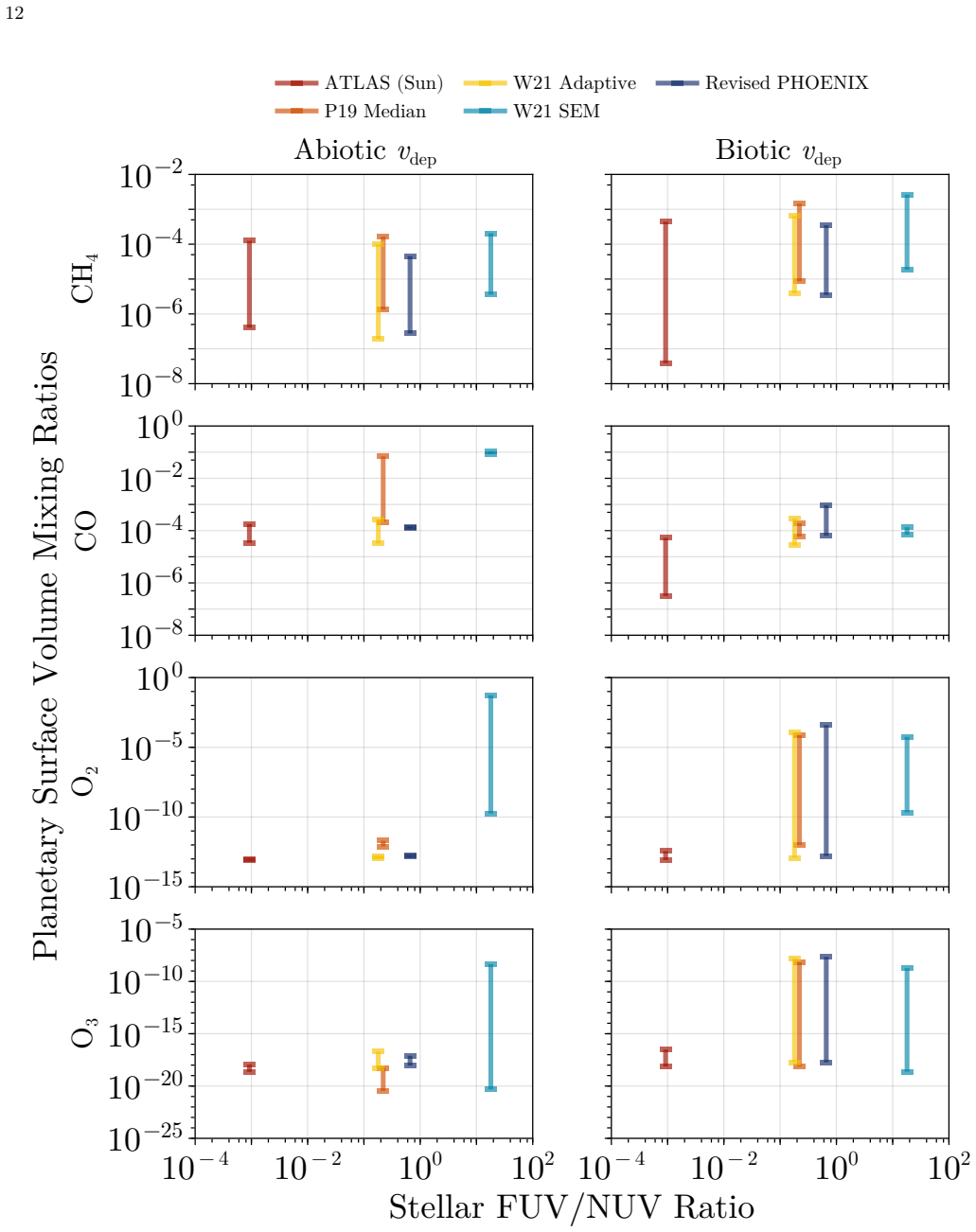
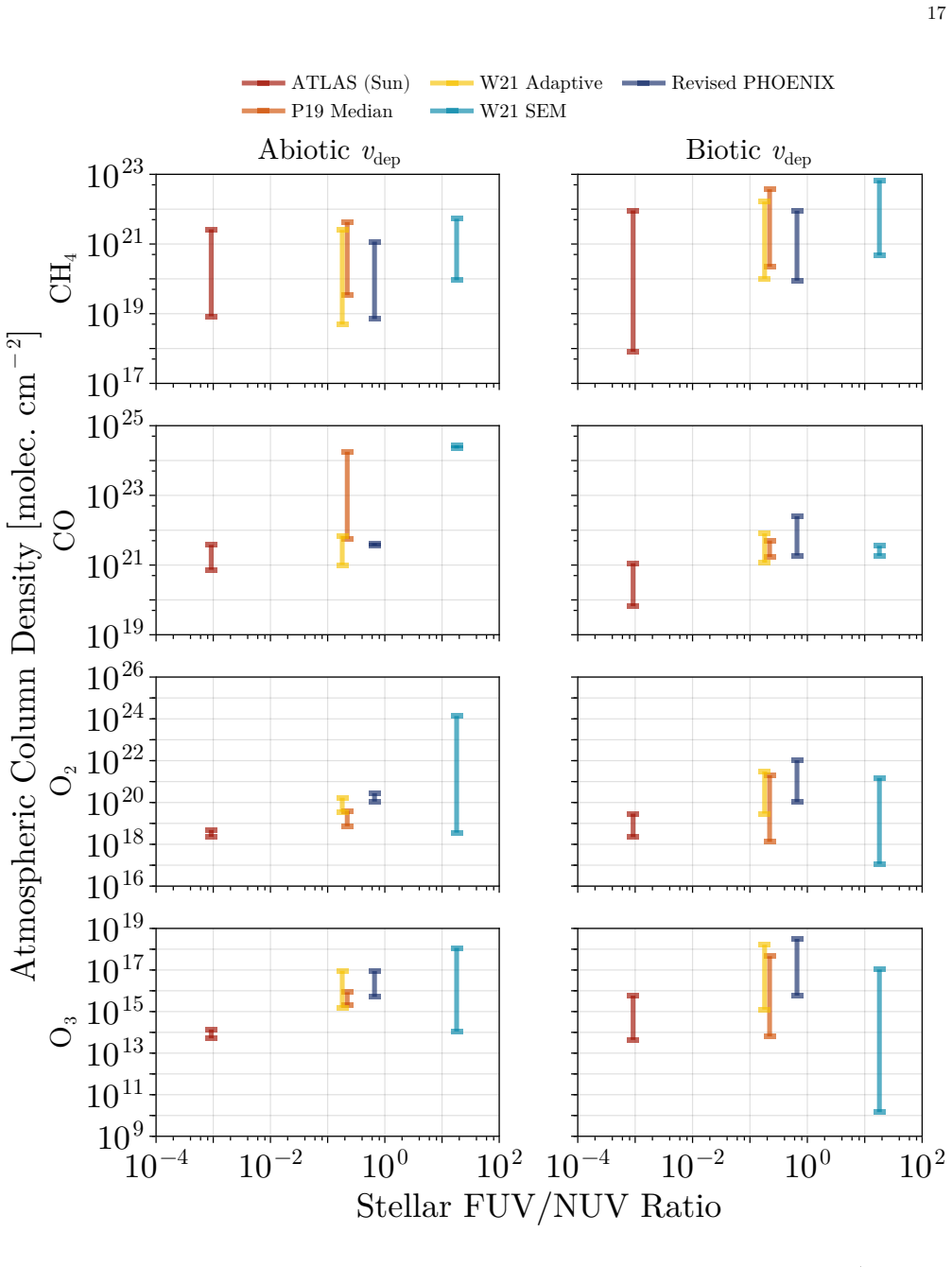
Uncertainties in TRAPPIST-1's ultraviolet spectrum produce order-of-magnitude variations in atmospheric CH4, CO, O2, and O3 on an Archean-like TRAPPIST-1 e, creating photochemical degeneracies for biosignature interpretation.
A machine-rendered reading of the paper's core claim, the machinery that carries it, and where it could break.
Core claim
Different stellar spectra produce order-of-magnitude variations in the predicted abundances of CH4, CO, O2, and O3, thereby generating photochemical degeneracies that complicate the interpretation of potential biosignatures. For one TRAPPIST-1 UV reconstruction, a modeled atmosphere with abiotic deposition velocities and volcanic CH4 input can sustain simultaneous spectrally discernible CH4 and O3, yielding a potential false-positive disequilibrium biosignature. For all SEDs tested, surface deposition consistent with microbially-mediated CO consumption allows substantial O2 and O3 accumulation even without oxygenic photosynthesis. Across the models, CO remains a powerful discriminator betwee
What carries the argument
A one-dimensional photochemical model driven by alternate published UV spectral energy distributions for TRAPPIST-1, applied to Archean Earth-like atmospheres with fixed volcanic inputs and varying surface deposition velocities.
If this is right
- One published UV reconstruction permits an abiotic atmosphere to produce both CH4 and O3 at detectable levels, creating a false-positive disequilibrium pair.
- Microbially-mediated CO deposition permits O2 and O3 buildup on all tested SEDs even in the absence of oxygenic photosynthesis.
- CO abundance distinguishes abiotic from biotic surface assumptions across all models.
- The co-occurring abundances of CH4, CO, and O3 can differ by orders of magnitude solely due to the choice of UV SED.
Where Pith is reading between the lines
- Similar UV-driven degeneracies are likely to affect photochemical models of other temperate planets around ultracool M dwarfs.
- Priority should be given to UV spectroscopy of TRAPPIST-1 before interpreting future transmission or emission spectra of its planets for biosignatures.
- Models that incorporate a wider range of surface boundary conditions may reveal additional pathways to oxygen-rich states without biological oxygen production.
Load-bearing premise
The Archean Earth-like atmospheric setup with specified surface deposition velocities, volcanic CH4 input, and microbially-mediated CO consumption accurately represents possible states on TRAPPIST-1 e.
What would settle it
Direct measurement of TRAPPIST-1's UV flux at the wavelengths that control O3 photolysis and CH4 destruction, or spectroscopic detection on TRAPPIST-1 e of CH4-CO-O3 combinations that fall outside the range spanned by the tested SEDs.
Figures
read the original abstract
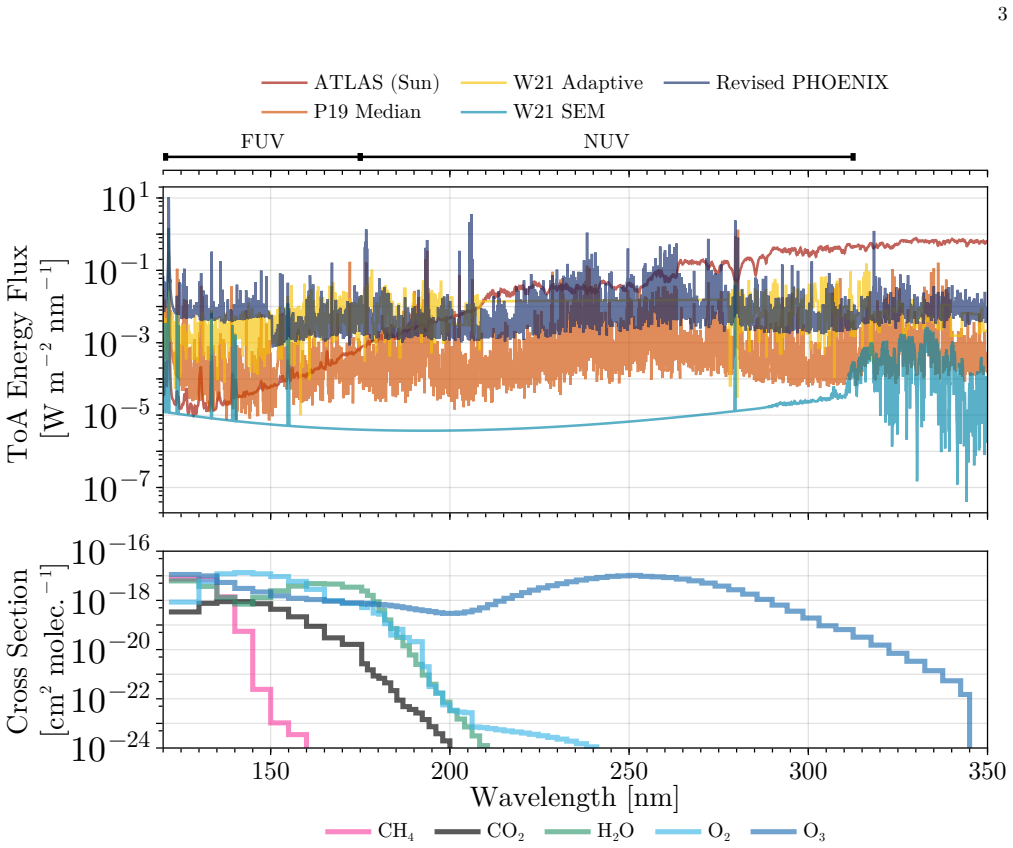
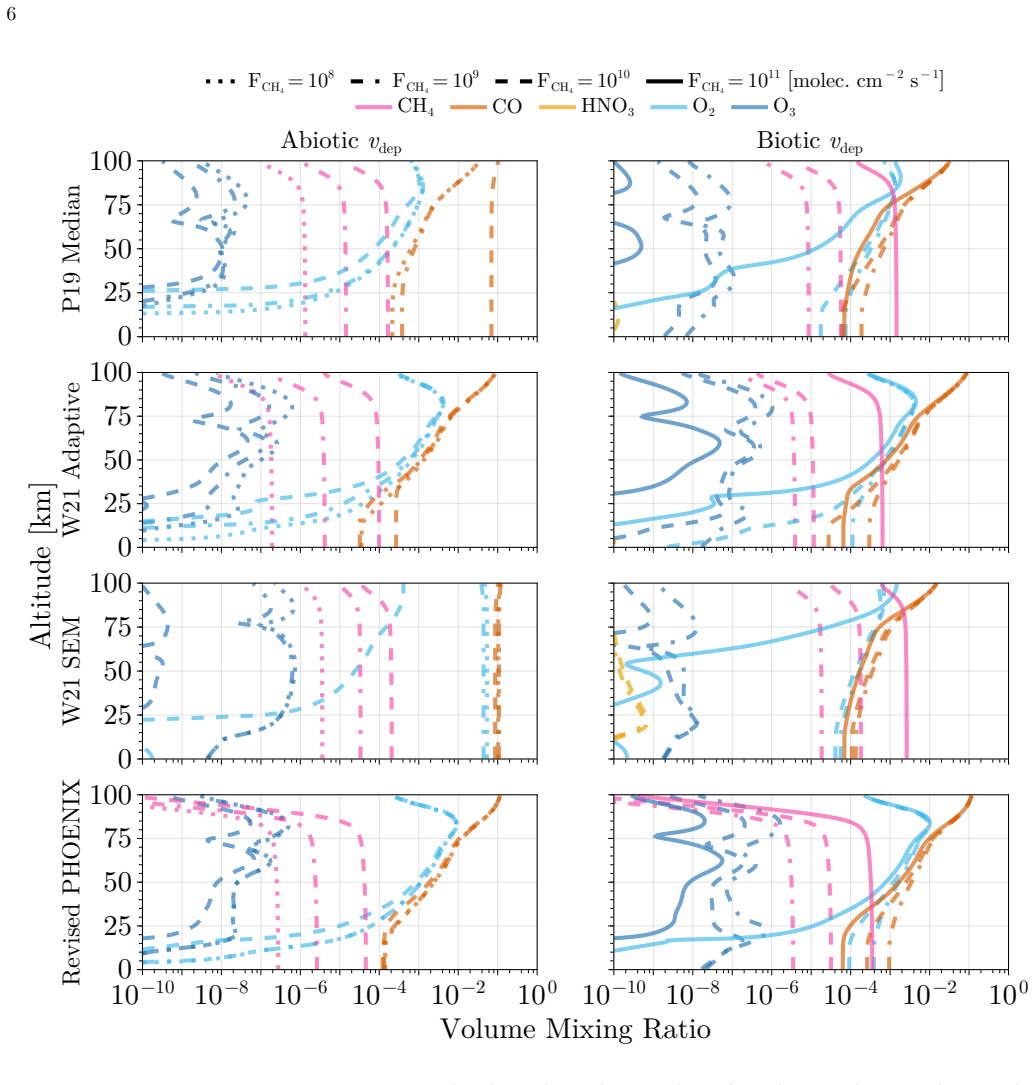
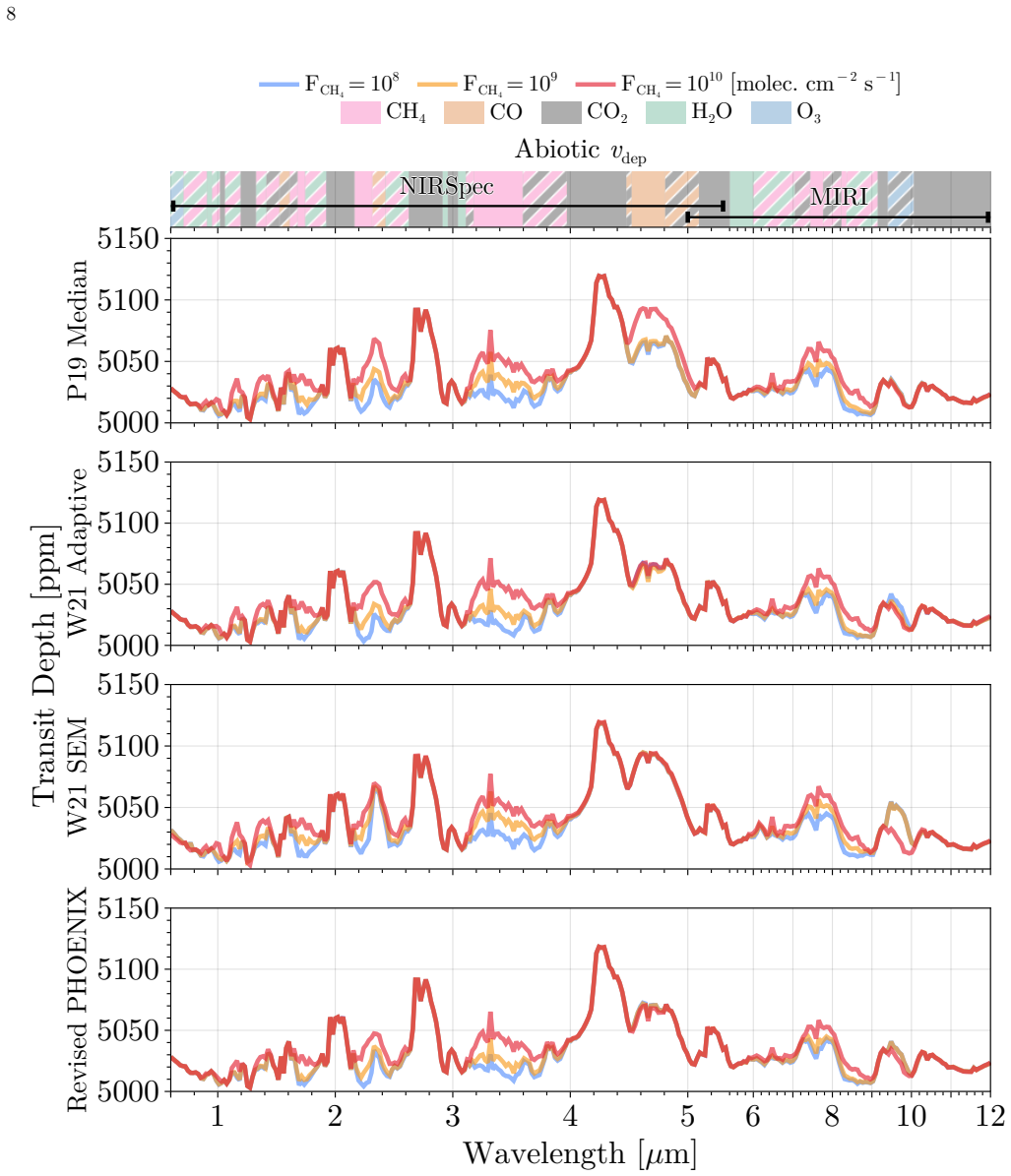
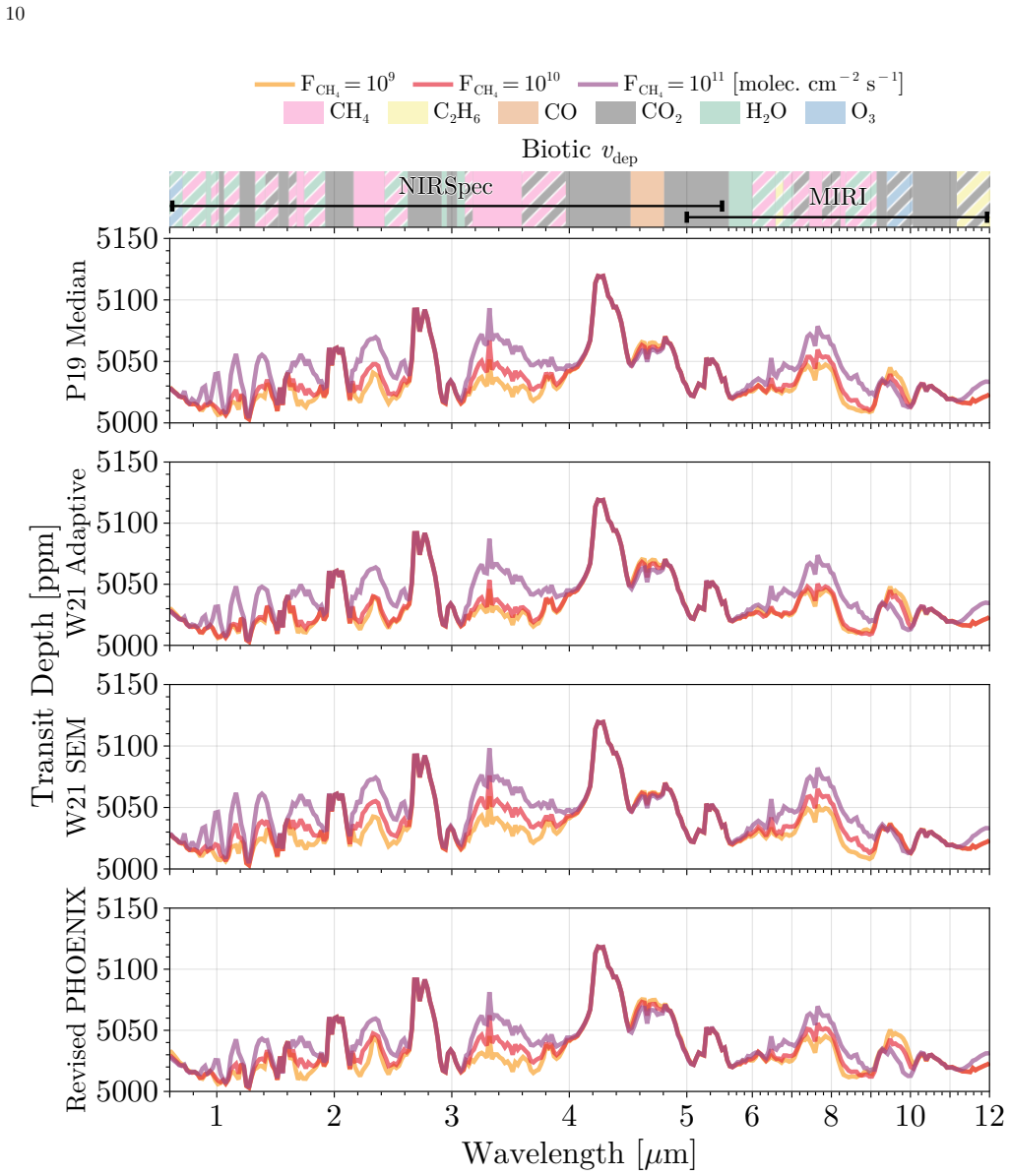
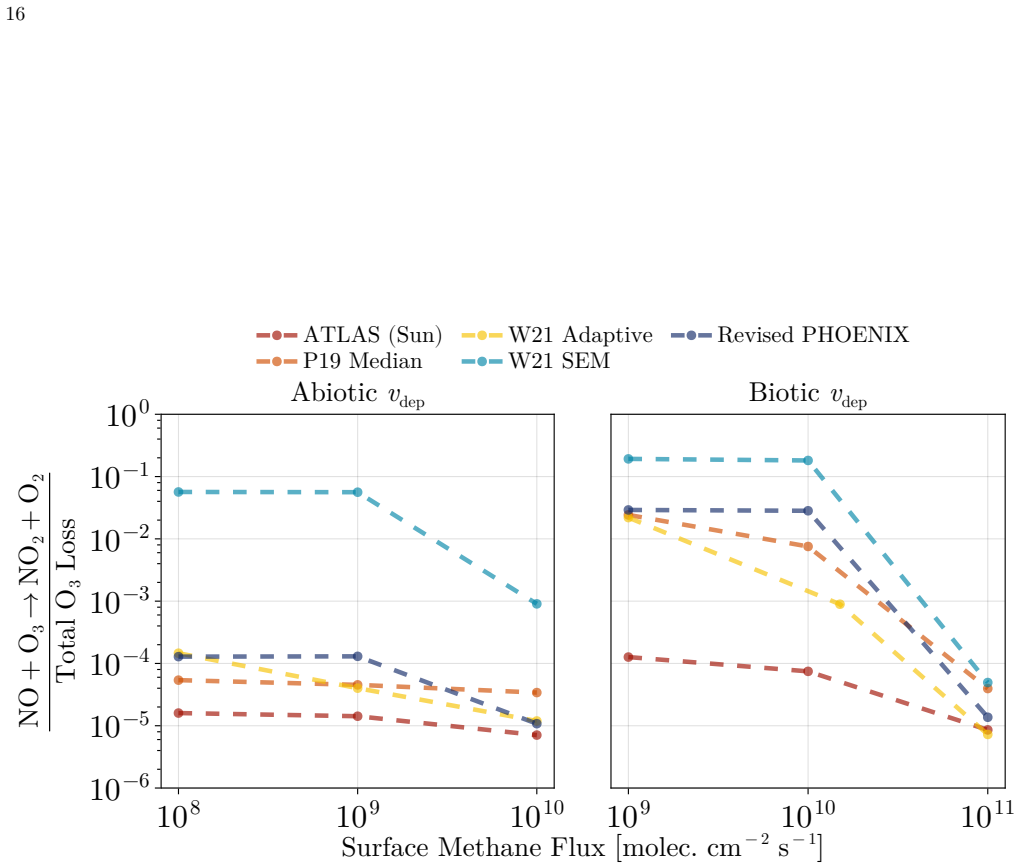
The ultraviolet (UV) spectrum of a host star strongly shapes the atmospheric composition and potential biosignatures of its planets. This relationship may be especially important for the planets orbiting TRAPPIST-1, an M8V star with substantially different published UV spectral energy distributions (SEDs). Using a one-dimensional photochemical model, we quantify how these SED uncertainties affect Archean Earth-like atmospheric analogs on TRAPPIST-1 e with and without biospheres. We emphasize Earth's Archean epoch because it represents a planet in transition from primarily abiotic to biotic controls on atmospheric composition. Different stellar spectra produce order-of-magnitude variations in the predicted abundances of CH4, CO, O2, and O3, thereby generating photochemical degeneracies that complicate the interpretation of potential biosignatures. For one TRAPPIST-1 UV reconstruction, a modeled atmosphere with abiotic deposition velocities and volcanic CH4 input can sustain simultaneous spectrally discernible CH4 and O3, yielding a potential false-positive disequilibrium biosignature. For all SEDs tested, surface deposition consistent with microbially-mediated CO consumption allows substantial O2 and O3 accumulation even without oxygenic photosynthesis, implying that oxygen-rich atmospheres around ultracool M dwarfs may not uniquely trace oxygenic ecosystems. Across our models, CO remains a powerful discriminator between abiotic and biotic surface boundary assumptions. Overall, we show that the abundances of co-occurring CH4, CO, and O3 can vary by orders of magnitude, depending on the assumed UV SED, creating ambiguities in interpreting atmospheric biosignatures, though observability may be challenging with current capabilities. Reducing UV spectral uncertainties is therefore essential for assessing surface-to-atmosphere interactions of temperate exoplanets around ultracool M dwarfs.
Editorial analysis
A structured set of objections, weighed in public.
Referee Report
Summary. The paper employs a one-dimensional photochemical model of Archean Earth-like atmospheres on TRAPPIST-1 e (with and without biospheres) to demonstrate that different published TRAPPIST-1 UV SEDs drive order-of-magnitude variations in CH4, CO, O2, and O3 abundances. These variations create photochemical degeneracies that complicate biosignature interpretation, including a potential abiotic false-positive CH4+O3 disequilibrium for one SED and abiotic O2/O3 accumulation under microbial CO deposition for all SEDs; CO is identified as a robust discriminator.
Significance. If the central result holds after addressing normalization and boundary-condition issues, the work provides a concrete demonstration that UV SED uncertainties can produce ambiguous atmospheric states around ultracool M dwarfs, reinforcing the need for precise stellar UV data when assessing surface-atmosphere interactions and potential biosignatures. The systematic exploration of multiple published SEDs and surface boundary conditions is a strength of the forward-modeling approach.
major comments (3)
- [Abstract / model boundary conditions] Abstract and model-boundary-conditions paragraph: the paper does not state whether the different published TRAPPIST-1 UV SEDs are scaled to the same integrated flux (particularly in the <200 nm dissociation bands) or ingested at their published absolute values. Without this normalization step the reported order-of-magnitude abundance shifts in CH4, CO, O2, and O3 cannot be unambiguously attributed to spectral shape rather than total photon count, which is load-bearing for the central claim.
- [Model boundary conditions] Model-boundary-conditions paragraph: the Archean-Earth surface deposition velocities, volcanic CH4 input rate, and microbially-mediated CO consumption are adopted without sensitivity tests or justification for their applicability to TRAPPIST-1 e. Because these free parameters directly control the reported false-positive and abiotic-O2 scenarios, their representativeness must be demonstrated for the conclusions to be robust.
- [Results] Results section (implied by abstract outcomes): no benchmark validation, error bars, or uncertainty ranges are reported for the predicted mixing ratios. This absence makes it impossible to evaluate whether the claimed order-of-magnitude variations exceed numerical or input uncertainties.
minor comments (2)
- [Abstract] The abstract would benefit from explicitly naming the photochemical code and stating how many SEDs were tested.
- A supplementary table listing the integrated fluxes of each SED in key wavelength bands would improve reproducibility and allow readers to assess the normalization issue directly.
Simulated Author's Rebuttal
We thank the referee for their constructive comments, which help clarify key aspects of our modeling approach. We address each major comment below and indicate the revisions planned.
read point-by-point responses
-
Referee: [Abstract / model boundary conditions] Abstract and model-boundary-conditions paragraph: the paper does not state whether the different published TRAPPIST-1 UV SEDs are scaled to the same integrated flux (particularly in the <200 nm dissociation bands) or ingested at their published absolute values. Without this normalization step the reported order-of-magnitude abundance shifts in CH4, CO, O2, and O3 cannot be unambiguously attributed to spectral shape rather than total photon count, which is load-bearing for the central claim.
Authors: The SEDs were ingested at their published absolute values without rescaling to a common integrated flux. This choice reflects the actual published uncertainties in the literature, which include both shape and normalization differences. We will revise the model-boundary-conditions paragraph to state this explicitly and add a sentence noting that the reported variations therefore encompass both factors. This approach is appropriate for demonstrating the impact of current UV data limitations and does not alter the central claim. revision: yes
-
Referee: [Model boundary conditions] Model-boundary-conditions paragraph: the Archean-Earth surface deposition velocities, volcanic CH4 input rate, and microbially-mediated CO consumption are adopted without sensitivity tests or justification for their applicability to TRAPPIST-1 e. Because these free parameters directly control the reported false-positive and abiotic-O2 scenarios, their representativeness must be demonstrated for the conclusions to be robust.
Authors: These values are taken from standard Archean Earth photochemical models as the nearest analog for a terrestrial planet with microbial activity but lacking oxygenic photosynthesis. We will expand the paragraph with additional references and justification for their applicability to TRAPPIST-1 e. We will also add a brief discussion of robustness to moderate variations in these parameters, drawing on the behavior across the SED cases already modeled. A full suite of sensitivity tests lies beyond the present scope but can be noted as future work. revision: partial
-
Referee: [Results] Results section (implied by abstract outcomes): no benchmark validation, error bars, or uncertainty ranges are reported for the predicted mixing ratios. This absence makes it impossible to evaluate whether the claimed order-of-magnitude variations exceed numerical or input uncertainties.
Authors: The 1D photochemical model is a standard code previously validated in the literature against Earth and exoplanet cases. We will add a methods subsection with references to these benchmarks and comparisons to Archean Earth simulations. We will also include a qualitative discussion of uncertainties in the results, emphasizing that the order-of-magnitude differences substantially exceed typical numerical or input variations. Quantitative error bars via Monte Carlo sampling are noted as a limitation and potential extension. revision: yes
Circularity Check
No circularity: forward modeling with external SED inputs
full rationale
The paper performs forward 1D photochemical modeling of Archean-like atmospheres on TRAPPIST-1 e using several published external UV SEDs as inputs, along with fixed surface boundary conditions (deposition velocities, volcanic fluxes). Abundances of CH4, CO, O2, and O3 emerge directly from the model's wavelength-dependent photochemistry and transport equations applied to those inputs. No parameters are fitted to the output abundances, no self-citation chain supplies a load-bearing uniqueness theorem or ansatz, and no claimed prediction reduces by construction to a quantity already present in the model's own equations or boundary conditions. The reported order-of-magnitude variations are therefore independent results of the chosen external SEDs rather than tautological outputs.
Axiom & Free-Parameter Ledger
free parameters (2)
- surface deposition velocities
- volcanic CH4 input rate
axioms (2)
- domain assumption The 1D photochemical model captures the dominant chemical pathways under the tested UV SEDs.
- domain assumption Published UV SED reconstructions for TRAPPIST-1 span the relevant uncertainty range.
Reference graph
Works this paper leans on
-
[1]
L., et al
Agol, E., Dorn, C., Grimm, S. L., et al. 2021, Refining the Transit-timing and Photometric Analysis of TRAPPIST-1: Masses, Radii, Densities, Dynamics, and
2021
-
[2]
Ephemerides, The Planetary Science Journal, 2, 1, doi: 10.3847/PSJ/abd022
-
[3]
Allwood, A. C., Walter, M. R., Kamber, B. S., Marshall, C. P., & Burch, I. W. 2006, Stromatolite Reef from the Early Archaean Era of Australia, Nature, 441, 714, doi: 10.1038/nature04764
-
[4]
Arney, G., Domagal-Goldman, S. D., Meadows, V. S., et al. 2016, The Pale Orange Dot: The Spectrum and Habitability of Hazy Archean Earth, Astrobiology, 16, 873, doi: 10.1089/ast.2015.1422
-
[5]
N., Meadows, V
Arney, G. N., Meadows, V. S., Domagal-Goldman, S. D., et al. 2017, Pale Orange Dots: The Impact of Organic Haze on the Habitability and Detectability of Earthlike
2017
-
[6]
Exoplanets, The Astrophysical Journal, 836, 49, doi: 10.3847/1538-4357/836/1/49
-
[7]
Auclair-Desrotour, P., & Heng, K. 2020, Atmospheric Stability and Collapse on Tidally Locked Rocky Planets, Astronomy & Astrophysics, 638, A77, doi: 10.1051/0004-6361/202037513
-
[8]
E., Helling, C., Schwieterman, E
Barth, P., St¨ ueken, E. E., Helling, C., Schwieterman, E. W., & Telling, J. 2024, The Effect of Lightning on the Atmospheric Chemistry of Exoplanets and Potential
2024
-
[9]
Biosignatures, Astronomy & Astrophysics, 686, A58, doi: 10.1051/0004-6361/202347286
-
[10]
2018, The Origins Space Telescope, Nature Astronomy, 2, 596, doi: 10.1038/s41550-018-0540-y
Battersby, C., Armus, L., Bergin, E., et al. 2018, The Origins Space Telescope, Nature Astronomy, 2, 596, doi: 10.1038/s41550-018-0540-y
-
[11]
Bezanson, J., Edelman, A., Karpinski, S., & Shah, V. B. 2017, Julia: A Fresh Approach to Numerical Computing, SIAM Review, 59, 65, doi: 10.1137/141000671
-
[12]
Bourrier, V., Ehrenreich, D., Wheatley, P. J., et al. 2017, Reconnaissance of the TRAPPIST-1 Exoplanet System in the Lyman-αLine, Astronomy & Astrophysics, 599, L3, doi: 10.1051/0004-6361/201630238
-
[13]
Broussard, W., Schwieterman, E. W., Ranjan, S., et al. 2024, The Impact of Extended H2O Cross Sections on Temperate Anoxic Planet Atmospheres: Implications for Spectral Characterization of Habitable Worlds, The Astrophysical Journal, 967, 114, doi: 10.3847/1538-4357/ad3a65
-
[14]
Broussard, W., Schwieterman, E. W., Sousa-Silva, C., et al. 2025, The Impact of Extended CO2 Cross Sections on Temperate Anoxic Planet Atmospheres, The Astrophysical Journal, 980, 198, doi: 10.3847/1538-4357/adaaf0
-
[15]
Carnall, A. C. 2017, SpectRes: A Fast Spectral Resampling Tool in Python, arXiv, doi: 10.48550/arXiv.1705.05165
work page internal anchor Pith review Pith/arXiv arXiv doi:10.48550/arxiv.1705.05165 2017
-
[16]
Catling, D. C., & Kasting, J. F. 2017a, The Prebiotic and Early Postbiotic Atmosphere, in Atmospheric Evolution on Inhabited and Lifeless Worlds (Cambridge: Cambridge University Press), 231–256, doi: 10.1017/9781139020558.010
-
[17]
Catling, D. C., & Kasting, J. F. 2017b, The Rise of Oxygen and Ozone in Earth’s Atmosphere, in Atmospheric Evolution on Inhabited and Lifeless Worlds (Cambridge: Cambridge University Press), 257–298, doi: 10.1017/9781139020558.011
-
[18]
C., & Zahnle, K
Catling, D. C., & Zahnle, K. J. 2020, The Archean
2020
-
[19]
Atmosphere, Science Advances, 6, eaax1420, doi: 10.1126/sciadv.aax1420
-
[20]
Cavalazzi, B., Lemelle, L., Simionovici, A., et al. 2021, Cellular Remains in a ˜3.42-Billion-Year-Old Subseafloor Hydrothermal Environment, Science Advances, 7, eabf3963, doi: 10.1126/sciadv.abf3963
-
[21]
Chen, D., & Catling, D. C. 2026, New Empirical Kinetics of Iron Oxidation by CO2 Applied to Micrometeorites Imply a CO2-rich Archean Atmosphere, Geochimica et Cosmochimica Acta, 416, 183, doi: 10.1016/j.gca.2026.01.020
-
[22]
Collaboration, T. A., Price-Whelan, A. M., Sip˝ ocz, B. M., et al. 2018, The Astropy Project: Building an Open-science Project and Status of the v2.0 Core Package*, The Astronomical Journal, 156, 123, doi: 10.3847/1538-3881/aabc4f
-
[23]
Collaboration, T. A., Price-Whelan, A. M., Lim, P. L., et al. 2022, The Astropy Project: Sustaining and Growing a Community-oriented Open-source Project and the Latest Major Release (v5.0) of the Core Package*, The Astrophysical Journal, 935, 167, doi: 10.3847/1538-4357/ac7c74
work page internal anchor Pith review doi:10.3847/1538-4357/ac7c74 2022
-
[24]
Cooke, G. J., Marsh, D. R., Walsh, C., & Youngblood, A. 2023, Degenerate Interpretations of O3 Spectral Features in Exoplanet Atmosphere Observations Due to Stellar UV Uncertainties: A 3D Case Study with TRAPPIST-1 e, The Astrophysical Journal, 959, 45, doi: 10.3847/1538-4357/ad0381
-
[25]
Crisp, D. 1997, Absorption of Sunlight by Water Vapor in Cloudy Conditions: A Partial Explanation for the Cloud Absorption Anomaly, Geophysical Research Letters, 24, 571, doi: 10.1029/97GL50245 20
-
[26]
H., Meadows, V
Currie, M. H., Meadows, V. S., & Rasmussen, K. C. 2023, There’s More to Life than O2: Simulating the Detectability of a Range of Molecules for Ground-based, High-resolution Spectroscopy of Transiting Terrestrial
2023
-
[27]
Exoplanets, The Planetary Science Journal, 4, 83, doi: 10.3847/PSJ/accf86
-
[28]
Danisch, S., & Krumbiegel, J. 2021, Makie.Jl: Flexible High-Performance Data Visualization for Julia, Journal of Open Source Software, 6, 3349, doi: 10.21105/joss.03349 de Wit, J., Wakeford, H. R., Gillon, M., et al. 2016, A Combined Transmission Spectrum of the Earth-sized Exoplanets TRAPPIST-1 b and c, Nature, 537, 69, doi: 10.1038/nature18641 de Wit, J...
-
[29]
Atmospheres, The Astrophysical Journal, 928, 12, doi: 10.3847/1538-4357/ac53af
-
[30]
Robinson, T. D., & Meadows, V. S. 2014, Abiotic Ozone and Oxygen in Atmospheres Similar to Prebiotic Earth, The Astrophysical Journal, 792, 90, doi: 10.1088/0004-637X/792/2/90
-
[31]
Ducrot, E., Gillon, M., Delrez, L., et al. 2020, TRAPPIST-1: Global Results of the Spitzer Exploration Science Program Red Worlds, Astronomy & Astrophysics, 640, A112, doi: 10.1051/0004-6361/201937392
-
[32]
Eager-Nash, J. K., Daines, S. J., McDermott, J. W., et al. 2024, Simulating Biosignatures from Pre-Oxygen Photosynthesizing Life on TRAPPIST-1e, Monthly Notices of the Royal Astronomical Society, 531, 468, doi: 10.1093/mnras/stae1142
-
[33]
Espinoza, N., Allen, N. H., Glidden, A., et al. 2025, JWST-TST DREAMS: NIRSpec/PRISM Transmission Spectroscopy of the Habitable Zone Planet TRAPPIST-1 e, The Astrophysical Journal, 990, L52, doi: 10.3847/2041-8213/adf42e
-
[34]
Fauchez, T. J., Turbet, M., Villanueva, G. L., et al. 2019, Impact of Clouds and Hazes on the Simulated JWST Transmission Spectra of Habitable Zone Planets in the TRAPPIST-1 System, The Astrophysical Journal, 887, 194, doi: 10.3847/1538-4357/ab5862
-
[35]
France, K., Loyd, R. O. P., Youngblood, A., et al. 2016, THE MUSCLES TREASURY SURVEY. I. MOTIVATION AND OVERVIEW*, The Astrophysical Journal, 820, 89, doi: 10.3847/0004-637X/820/2/89
-
[36]
Gebauer, S., Grenfell, J., Lehmann, R., & Rauer, H. 2018, Evolution of Earth-like Planetary Atmospheres around M Dwarf Stars: Assessing the Atmospheres and Biospheres with a Coupled Atmosphere Biogeochemical Model, Astrobiology, 18, 856, doi: 10.1089/ast.2017.1723
-
[37]
M., et al
Gillon, M., Jehin, E., Lederer, S. M., et al. 2016, Temperate Earth-sized Planets Transiting a Nearby Ultracool Dwarf
2016
-
[38]
Star, Nature, 533, 221, doi: 10.1038/nature17448
-
[39]
Gillon, M., Triaud, A. H. M. J., Demory, B.-O., et al. 2017, Seven Temperate Terrestrial Planets around the Nearby Ultracool Dwarf Star TRAPPIST-1, Nature, 542, 456, doi: 10.1038/nature21360
-
[40]
Gillon, M., Ducrot, E., Bell, T. J., et al. 2026, No Thick Atmosphere around TRAPPIST-1 b and c from JWST Thermal Phase Curves, Nature Astronomy, 1, doi: 10.1038/s41550-026-02806-9
-
[41]
Glidden, A., Ranjan, S., Seager, S., et al. 2025, JWST-TST DREAMS: Secondary Atmosphere Constraints for the Habitable Zone Planet TRAPPIST-1 e, The Astrophysical Journal Letters, 990, L53, doi: 10.3847/2041-8213/adf62e
-
[42]
E., Rothman, L
Gordon, I. E., Rothman, L. S., Hargreaves, R. J., et al. 2022, The HITRAN2020 Molecular Spectroscopic
2022
-
[43]
Database, Journal of Quantitative Spectroscopy and Radiative Transfer, 277, 107949, doi: 10.1016/j.jqsrt.2021.107949
-
[44]
Greene, T. P., Bell, T. J., Ducrot, E., et al. 2023, Thermal Emission from the Earth-sized Exoplanet TRAPPIST-1 b Using JWST, Nature, 618, 39, doi: 10.1038/s41586-023-05951-7
-
[45]
Rauer, H. 2014, Sensitivity of Biosignatures on Earth-like Planets Orbiting in the Habitable Zone of Cool M-dwarf Stars to Varying Stellar UV Radiation and Surface Biomass Emissions, Planetary and Space Science, 98, 66, doi: 10.1016/j.pss.2013.10.006
-
[46]
Pascucci, I., & L´ opez-Morales, M. 2023, Bioverse: A Comprehensive Assessment of the Capabilities of Extremely Large Telescopes to Probe Earth-like O2 Levels in Nearby Transiting Habitable-zone Exoplanets, The Astronomical Journal, 165, 267, doi: 10.3847/1538-3881/acd1ec 21
-
[47]
Harman, C. E., Felton, R., Hu, R., et al. 2018, Abiotic O2 Levels on Planets around F, G, K, and M Stars: Effects of Lightning-produced Catalysts in Eliminating Oxygen False Positives, The Astrophysical Journal, 866, 56, doi: 10.3847/1538-4357/aadd9b
-
[48]
Harman, C. E., Schwieterman, E. W., Schottelkotte, J. C., & Kasting, J. F. 2015, Abiotic O2 Levels on Planets around F, G, K, and M Stars: Possible False Positives for Life? The Astrophysical Journal, 812, 137, doi: 10.1088/0004-637X/812/2/137
-
[49]
Harris, C. R., Millman, K. J., van der Walt, S. J., et al. 2020, Array Programming with NumPy, Nature, 585, 357, doi: 10.1038/s41586-020-2649-2
-
[50]
Lyons, T. W. 2025, Evolution of Earth’s Atmosphere, in Encyclopedia of Atmospheric Sciences, Third edition edn., ed. W. A. Robinson & P. Yang (Academic Press), 790–803, doi: 10.1016/B978-0-323-96026-7.00226-5
-
[51]
Kasting, J. F., Liu, S. C., & Donahue, T. M. 1979, Oxygen Levels in the Prebiological Atmosphere, Journal of Geophysical Research: Oceans, 84, 3097, doi: 10.1029/JC084iC06p03097
-
[52]
F., Zahnle, K
Kasting, J. F., Zahnle, K. J., & Walker, J. C. G. 1983, Photochemistry of Methane in the Earth’s Early
1983
-
[53]
Atmosphere, Precambrian Research, 20, 121, doi: 10.1016/0301-9268(83)90069-4
-
[54]
2005, A Coupled Atmosphere–Ecosystem Model of the Early Archean
Kharecha, P., Kasting, J., & Siefert, J. 2005, A Coupled Atmosphere–Ecosystem Model of the Early Archean
2005
-
[55]
Earth, Geobiology, 3, 53, doi: 10.1111/j.1472-4669.2005.00049.x
-
[56]
K., Ramirez, R., Kasting, J
Kopparapu, R. K., Ramirez, R., Kasting, J. F., et al. 2013, Habitable Zones around Main-Sequence Stars: New
2013
-
[57]
Estimates, The Astrophysical Journal, 765, 131, doi: 10.1088/0004-637X/765/2/131
-
[58]
Kozakis, T., Mendon¸ ca, J. M., & Buchhave, L. A. 2022, Is Ozone a Reliable Proxy for Molecular Oxygen? - I. The O2–O3 Relationship for Earth-like Atmospheres, Astronomy & Astrophysics, 665, A156, doi: 10.1051/0004-6361/202244164
-
[59]
Krissansen-Totton, J. 2023, Implications of Atmospheric Nondetections for Trappist-1 Inner Planets on Atmospheric Retention Prospects for Outer Planets, The Astrophysical Journal Letters, 951, L39, doi: 10.3847/2041-8213/acdc26
-
[60]
Krissansen-Totton, J., Garland, R., Irwin, P., & Catling, D. C. 2018a, Detectability of Biosignatures in Anoxic Atmospheres with the James Webb Space Telescope: A TRAPPIST-1e Case Study, The Astronomical Journal, 156, 114, doi: 10.3847/1538-3881/aad564
-
[61]
Krissansen-Totton, J., Olson, S., & Catling, D. C. 2018b, Disequilibrium Biosignatures over Earth History and Implications for Detecting Exoplanet Life, Science Advances, 4, eaao5747, doi: 10.1126/sciadv.aao5747
-
[62]
Leisawitz, D. T., Amatucci, E. G., Allen, L. N., et al. 2021, Origins Space Telescope: Baseline Mission Concept, Journal of Astronomical Telescopes, Instruments, and Systems, 7, 011002, doi: 10.1117/1.JATIS.7.1.011002
-
[63]
J., Kaltenegger, L., & Wilson, D
Lin, Z., MacDonald, R. J., Kaltenegger, L., & Wilson, D. J. 2021, Differentiating Modern and Prebiotic Earth Scenarios for TRAPPIST-1e: High-Resolution Transmission Spectra and Predictions for JWST, Monthly Notices of the Royal Astronomical Society, 505, 3562, doi: 10.1093/mnras/stab1486
-
[64]
Lincowski, A. P., Meadows, V. S., Crisp, D., et al. 2018, Evolved Climates and Observational Discriminants for the TRAPPIST-1 Planetary System, The Astrophysical Journal, 867, 76, doi: 10.3847/1538-4357/aae36a
-
[65]
W., Reinhard, C
Lyons, T. W., Reinhard, C. T., & Planavsky, N. J. 2014, The Rise of Oxygen in Earth’s Early Ocean and
2014
-
[66]
Atmosphere, Nature, 506, 307, doi: 10.1038/nature13068
-
[67]
Mak, M. T., Sergeev, D. E., Mayne, N., et al. 2024, 3D Simulations of TRAPPIST-1e with Varying CO2, CH4, and Haze Profiles, Monthly Notices of the Royal Astronomical Society, 529, 3971, doi: 10.1093/mnras/stae741
-
[68]
Meadows, V. S. 2017, Reflections on O2 as a Biosignature in Exoplanetary Atmospheres, Astrobiology, 17, 1022, doi: 10.1089/ast.2016.1578
-
[69]
S., & Crisp, D
Meadows, V. S., & Crisp, D. 1996, Ground-Based near-Infrared Observations of the Venus Nightside: The Thermal Structure and Water Abundance near the
1996
-
[70]
Surface, Journal of Geophysical Research: Planets, 101, 4595, doi: 10.1029/95JE03567
-
[71]
Meadows, V. S., Lincowski, A. P., & Lustig-Yaeger, J. 2023, The Feasibility of Detecting Biosignatures in the TRAPPIST-1 Planetary System with JWST, The Planetary Science Journal, 4, 192, doi: 10.3847/PSJ/acf488
-
[72]
Meadows, V. S., Reinhard, C. T., Arney, G. N., et al. 2018, Exoplanet Biosignatures: Understanding Oxygen as a Biosignature in the Context of Its Environment, Astrobiology, 18, 630, doi: 10.1089/ast.2017.1727
-
[73]
2019, Origins Space Telescope Mission Concept Study Report,, https://arxiv.org/abs/1912.06213v2 22
Meixner, M., Cooray, A., Leisawitz, D., et al. 2019, Origins Space Telescope Mission Concept Study Report,, https://arxiv.org/abs/1912.06213v2 22
arXiv 2019
-
[74]
Miranda-Rosete, A., Segura, A., & Schwieterman, E. W. 2025, Biosignature False Positives in Potentially Habitable Planets around M Dwarfs: The Effect of UV Radiation from One Flare, The Astrophysical Journal, 989, 34, doi: 10.3847/1538-4357/acebec
-
[75]
Molina, V., Aguilar, P., Dorador, C., et al. 2026, Exploring Extremophile Gas Production as a Biomarker for Early Earth Atmospheres, International Journal of Astrobiology, 25, e4, doi: 10.1017/S1473550425100268
-
[76]
Noffke, N., Christian, D., Wacey, D., & Hazen, R. M. 2013, Microbially Induced Sedimentary Structures Recording an Ancient Ecosystem in the ca. 3.48 Billion-Year-Old Dresser Formation, Pilbara, Western Australia, Astrobiology, 13, 1103, doi: 10.1089/ast.2013.1030 O’Malley-James, J. T., & Kaltenegger, L. 2017, UV Surface Habitability of the TRAPPIST-1 Syst...
-
[77]
K., Charbonneau, D., & Vanderburg, A
Pass, E. K., Charbonneau, D., & Vanderburg, A. 2025, The Receding Cosmic Shoreline of Mid-to-late M Dwarfs: Measurements of Active Lifetimes Worsen Challenges for Atmosphere Retention by Rocky Exoplanets, The Astrophysical Journal Letters, 986, L3, doi: 10.3847/2041-8213/adda39
-
[78]
Pavlov, A. A., Brown, L. L., & Kasting, J. F. 2001, UV Shielding of NH3 and O2 by Organic Hazes in the Archean Atmosphere, Journal of Geophysical Research: Planets, 106, 23267, doi: 10.1029/2000JE001448
-
[79]
Peacock, S., Barman, T., Shkolnik, E. L., Hauschildt, P. H., & Baron, E. 2019, Predicting the Extreme Ultraviolet Radiation Environment of Exoplanets around Low-mass Stars: The TRAPPIST-1 System, The Astrophysical Journal, 871, 235, doi: 10.3847/1538-4357/aaf891
-
[80]
Piaulet-Ghorayeb, C., Benneke, B., Turbet, M., et al. 2025, Strict Limits on Potential Secondary Atmospheres on the Temperate Rocky Exo-Earth TRAPPIST-1 d, The Astrophysical Journal, 989, 181, doi: 10.3847/1538-4357/adf207
discussion (0)
Sign in with ORCID, Apple, or X to comment. Anyone can read and Pith papers without signing in.