REVIEW 4 major objections 5 minor
Running three fine-tuned summarizers and picking the best by averaged metrics yields stronger news summaries than any one model alone.
Reviewed by Pith at T0; open to challenge. T0 means a machine referee read the full paper against a public rubric. the ladder, T0–T4 →
T0 review · grok-4.5
2026-07-14 18:25 UTC pith:UPYHCTT2
load-bearing objection Clear empirical lift from three fine-tuned transformers plus simple selection on CNN/DM, but the article-side scoring proxy is unvalidated and the idea is standard ensemble work. the 4 major comments →
A Multi-Model Metric-based Selection Framework for Abstractive Text summarization
The pith
A machine-rendered reading of the paper's core claim, the machinery that carries it, and where it could break.
Core claim
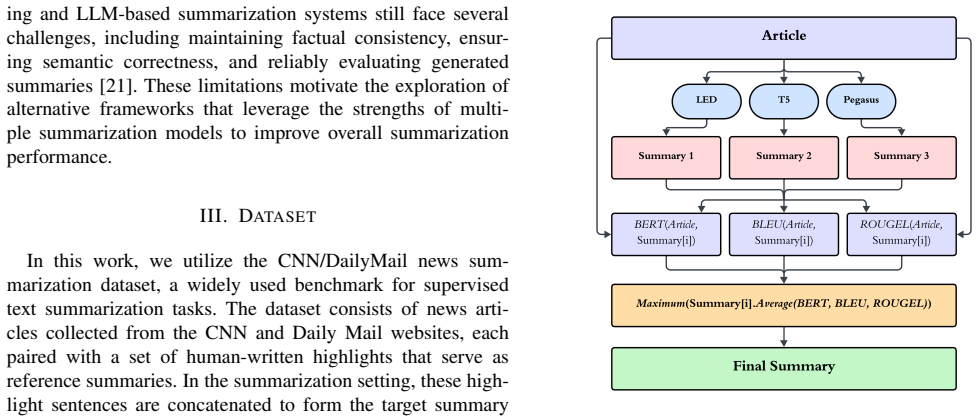
After fine-tuning T5-small, PEGASUS-xsum and LED-base on CNN/DailyMail, the multi-model adaptive selection framework (MASF) that averages ROUGE-L, BLEU and BERTScore against the article and then keeps the highest-scoring candidate achieves a BERTScore of 88.63 % and an overall average of 45.80 %, outperforming every individual model in the ensemble and several larger LLMs the authors place on the same table.
What carries the argument
The adaptive selection step: each of the three models produces a candidate summary S_i; Score(S_i) is defined as the arithmetic mean of ROUGE-L, BLEU and BERTScore of that summary against the source article; the final output is simply the argmax of those three scores.
Load-bearing premise
The claim rests on the premise that averaging ROUGE-L, BLEU and BERTScore against the raw article (not a human reference) correctly ranks which of the three machine summaries is best.
What would settle it
On a held-out CNN/DailyMail sample, collect human preference rankings of the three candidate summaries and check whether the automatic argmax still matches the human-preferred summary more often than chance or than any single model baseline.
If this is right
- News summarizers can raise consistency across diverse articles by generating a few cheap candidates and letting an automatic score pick, rather than relying on one fixed architecture.
- Parameter-efficient fine-tuning of one long-document model (LED with LoRA) can be mixed with full fine-tuning of smaller models without forcing a single training recipe.
- Reference-free lexical-plus-semantic scoring becomes a practical routing signal at inference time, not only a post-hoc evaluation tool.
- Systems that already report ROUGE, BLEU and BERTScore can reuse those numbers for selection with almost no extra compute.
Where Pith is reading between the lines
- If the same selection logic were applied to a larger, more diverse pool of candidates (including zero-shot LLMs), the gains might continue to scale until the automatic metrics themselves saturate.
- Because the score is computed against the source rather than a gold summary, the method could be ported to domains where human references are scarce, such as long-form reports or multi-document digests.
- A natural next measurement would be whether the selected summaries also reduce known factual-consistency failures relative to the individual models.
Editorial analysis
A structured set of objections, weighed in public.
Referee Report
Summary. The paper proposes MASF, a multi-model adaptive summarization framework that fine-tunes three transformer models (T5-small, PEGASUS-xsum, LED-base with LoRA) on CNN/DailyMail, generates three candidate summaries per article, scores each with the arithmetic mean of ROUGE-L, BLEU and BERTScore computed against the source article (Eqs. 6–7), and emits the highest-scoring candidate. On the fine-tuned setting the selected outputs reach BERTScore 88.63, ROUGE-L 32.75 and BLEU 16.00 (average 45.80), exceeding the three individual models (Table IV) and several reported LLM baselines (Table II). The authors conclude that metric-based selection among complementary models yields more robust abstractive news summaries than any single model.
Significance. If the selection step is shown to be the causal driver of the gains, the work supplies a lightweight, reference-free ensemble recipe that lets three modest fine-tuned models surpass several larger LLMs on standard automatic metrics. The experimental tables are transparent, the fine-tuning protocol (including LoRA for LED) is reproducible in principle, and the comparison set includes recent systems. These elements would make the paper a useful practical contribution to multi-model summarization; without validation of the article-side ranking function, however, the claimed advance remains unproven.
major comments (4)
- [Methodology §§D–E, Eqs. (6)–(7)] Methodology §§D–E and Eqs. (6)–(7) define the selection score exclusively against the source article, yet all reported numbers in Tables II–IV are the conventional reference-based metrics. No correlation, Kendall-τ ranking agreement, or per-article win-rate between the article-side Score and the reference-side metrics (or human judgments) is supplied. Without this evidence it is impossible to know whether argmax Score(Si) systematically prefers the summaries that later appear superior in Table IV, or whether the observed gains are coincidental.
- [Abstract, §V, Table II] The abstract and §V repeatedly claim that MASF obtains “the highest BERTScore among all compared methods” (88.63 %). Table II, however, lists DAMB at 88.70 %. The numerical contradiction directly falsifies the central comparative claim and must be resolved (either by correcting the text or by removing/re-evaluating the DAMB entry).
- [Table IV, §V] Table IV shows MASF outperforming its three constituents, yet the paper contains no ablation that isolates the contribution of the adaptive selector (oracle selection upper bound, random selection baseline, always-best-single-model, or leave-one-model-out). Consequently the reader cannot determine how much of the 3-point average-score lift is produced by the selection mechanism versus simply having three independently fine-tuned models available.
- [Eq. (6)] The equal-weight average in Eq. (6) is introduced without justification or sensitivity analysis. Because ROUGE-L/BLEU against the article strongly favour high-copy/extractive candidates while BERTScore is more semantic, an unweighted mean can systematically bias selection; a short ablation over alternative weightings (or a learned ranker) is required to support the claim that this particular Score is a reliable proxy.
minor comments (5)
- [Title / Abstract] Title, abstract and body use three slightly different names (“Multi-Model Metric-based Selection Framework”, “Multi-Model Adaptive Summarization Framework”, “MASF”). Standardise on one acronym and expand it consistently.
- [Table I] Table I caption and body text contain repeated typos (“Firoentina”, “Atletico Paranaense”). Proof-read the example.
- [Figs. 2–3] Figures 2–3 are described as “bar charts” but no axis scales, error bars or exact numeric labels are visible in the manuscript text; ensure the camera-ready versions are self-contained.
- [Table II] Several BLEU values reported for external LLMs (e.g., falcon-7b 9.47×10^{-230}) appear numerically implausible or mis-scaled; verify the source numbers or add a clarifying footnote.
- [§IV-C] The maximum generation length of 128 tokens is stated once but never justified relative to the typical highlight length of CNN/DailyMail; a brief sensitivity note would help.
Circularity Check
AverageScore outperformance is largely by construction from argmax selection on the identical composite metric; BERTScore gains and external LLM comparisons are not forced.
specific steps
-
self definitional
[Methodology §§D–E, Eqs. (6)–(7); Results §V, Table IV]
"A combined evaluation score is computed as Score(S_i) = R(S_i) + BL(S_i) + BS(S_i)/3 ... S^* = arg max_{S_i ∈ S} Score(S_i). ... MASF achieves ... a ROUGE-L score of 32.75, and a BLEU score of 16.00 %, resulting in the highest average score of 45.80 %."
S^* is defined to be the candidate that maximises the identical composite that is later reported as AverageScore. Consequently the test-set mean of Score(S^*) is ≥ the mean Score of every individual model by the definition of max; the claim that MASF attains the highest AverageScore follows immediately from the selection rule rather than from an independent measurement of quality.
full rationale
This is an empirical systems paper, not a first-principles derivation, so strong circularity is not expected and is not present. The sole mild circularity is that MASF is defined (Eqs. 6–7) to emit the candidate maximizing the equal-weight average of ROUGE-L + BLEU + BERTScore; therefore its mean AverageScore on any test set is definitionally ≥ that of every constituent model. Reporting “highest average score of 45.80 %” (Table IV) is consequently not an independent experimental discovery. The same three metrics appear both as the selection objective and as the success criterion, and the equal-weight average is never validated against human judgments or an external quality signal. However, the highest-BERTScore claim is not forced (selection maximizes the average, not BERTScore alone), the baseline table shows a small reversal that already breaks pure tautology, and comparisons to published LLM numbers supply an external benchmark. No load-bearing self-citation, uniqueness theorem, or smuggled ansatz appears. Score 3 reflects only this limited self-definitional step around AverageScore; the rest of the experimental narrative is self-contained.
Axiom & Free-Parameter Ledger
free parameters (3)
- equal weights (1/3) in Score = (R + BL + BS)/3
- maximum generation length 128 tokens
- choice of the three base models (T5-small, PEGASUS-xsum, LED-base) and LoRA configuration
axioms (3)
- ad hoc to paper The arithmetic mean of ROUGE-L, BLEU and BERTScore computed against the source article is a reliable ranking function for summary quality.
- domain assumption The three chosen transformer architectures produce complementary errors that selection can exploit.
- domain assumption Standard sequence-to-sequence fine-tuning (and LoRA for LED) on CNN/DailyMail yields models whose outputs are meaningfully comparable under the chosen metrics.
invented entities (1)
-
MASF (Multi-Model Adaptive Summarization Framework)
no independent evidence
read the original abstract
Automatic text summarization has become increasingly important due to the rapid growth of digital textual information. This paper presents a Multi-Model Summarization Framework designed to improve the robustness and quality of abstractive text summarization. Relying on a single model often leads to inconsistent summarization quality across articles with varying structures and topics. To address this limitation, the proposed framework integrates multiple fine-tuned transformer-based summarization models and introduces a metric-based selection mechanism. In this framework, each model independently generates a candidate summary for the same input article. The generated summaries are then evaluated using automatic evaluation metrics that capture both lexical similarity and semantic relevance. Based on these scores, the framework selects the highest-quality summary as the final output. The models are fine-tuned and evaluated on the widely used CNN/DailyMail news summarization dataset. Experimental results demonstrate that the proposed framework achieves the highest BERTScore among all compared methods with a score of 88.63%. It also outperforms several LLMs such as GPT3-D2, Falcon-7b, and Mpt-7b, highlighting its effectiveness and robustness. These findings highlight the effectiveness of leveraging multiple transformer-based models within a metric-based selection strategy to improve the quality and robustness of automatic text summarization systems.
Figures


discussion (0)
Sign in with ORCID, Apple, or X to comment. Anyone can read and Pith papers without signing in.