Metastability in Emergent Dark Energy: A New Framework Confronting Cosmological Observations
Pith reviewed 2026-06-28 00:19 UTC · model grok-4.3
The pith
The Metastable Emergent Dark Energy model is preferred over Lambda-CDM by combined Planck, DESI, and supernova observations.
A machine-rendered reading of the paper's core claim, the machinery that carries it, and where it could break.
Core claim
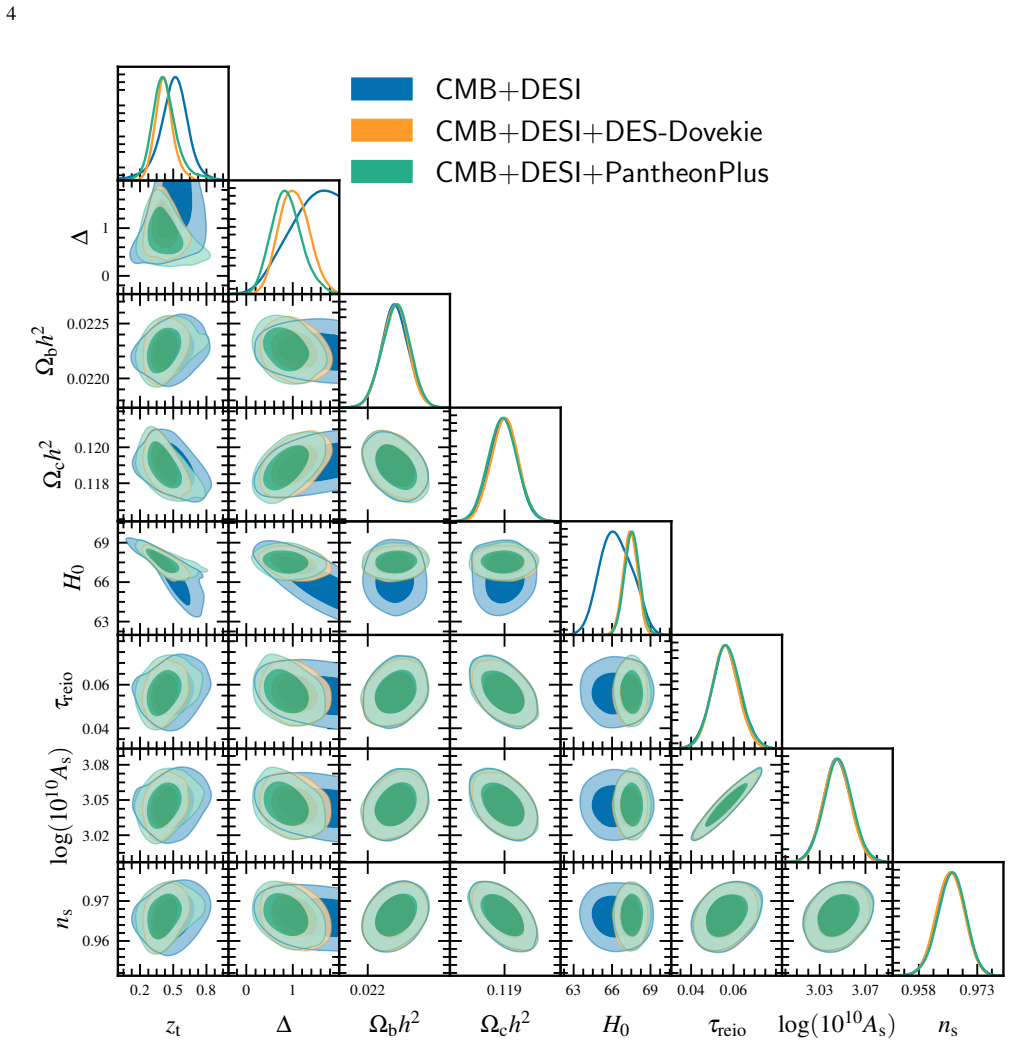
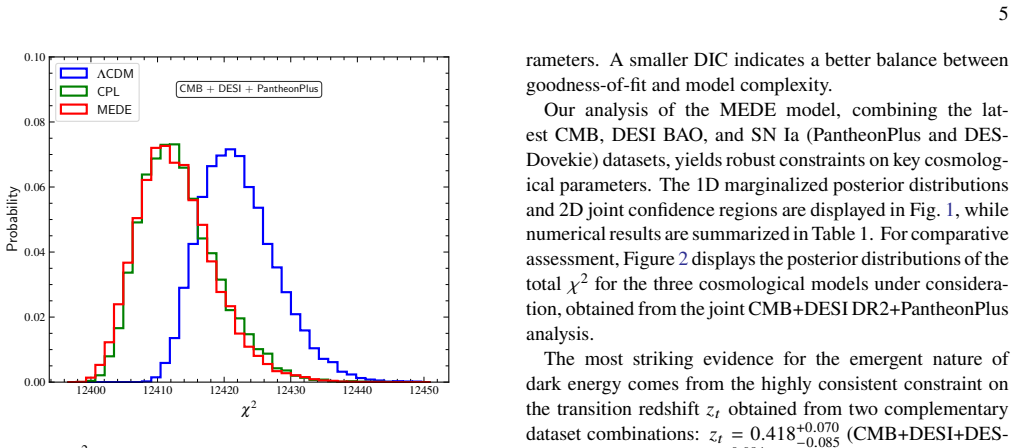
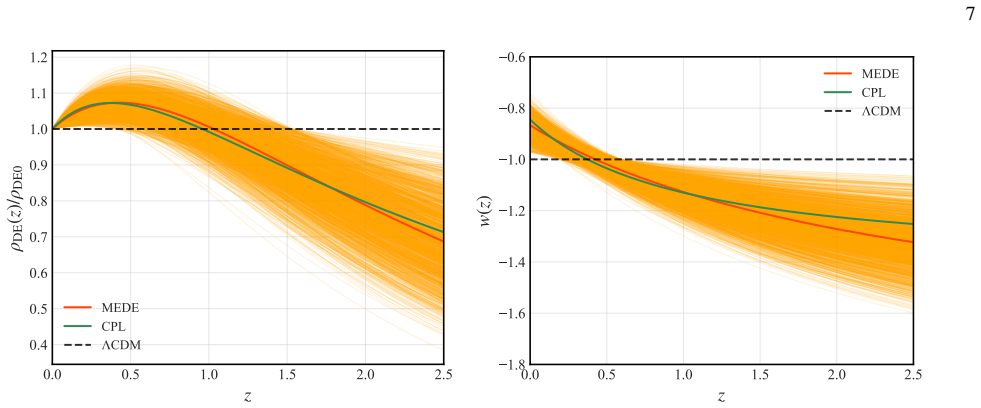
The MEDE model is defined by the dark energy equation of state w(z)=-1-Δ tanh[log10((1+z)/(1+zt))], introducing only the transition redshift zt and amplitude Δ. Constraints from the combined dataset give zt=0.425+0.084-0.120 and Δ=0.87+0.29-0.35, indicating statistically significant deviation from a cosmological constant. The model is preferred over ΛCDM with ΔDIC_MEDE-ΛCDM=-9.29 and performs comparably to the CPL parametrization, while preserving early-universe physics and accommodating phantom-crossing signatures from low-redshift data.
What carries the argument
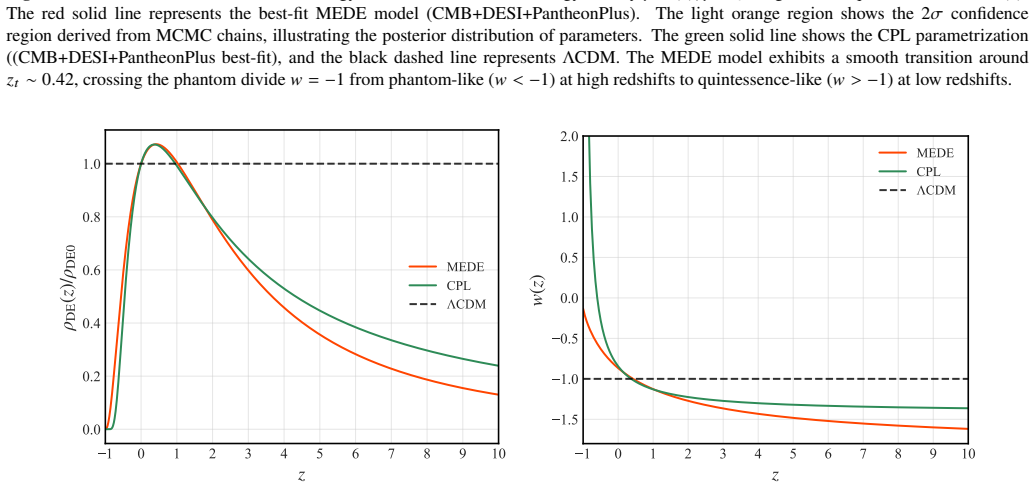
The hyperbolic tangent form of the dark energy equation of state w(z)=-1-Δ tanh[log10((1+z)/(1+zt))], which encodes both the late-time emergence and future vanishing of dark energy through the parameters zt and Δ.
If this is right
- The model permits a smooth crossing of the phantom divide in the dark energy equation of state.
- Early-universe physics remains consistent with the success of the standard cosmological constant model.
- MEDE performs statistically similarly to the CPL dynamical dark energy parametrization on current data.
- Dark energy density approaches zero in the distant future rather than remaining constant.
Where Pith is reading between the lines
- The transition at z approximately 0.4 could be tested by future low-redshift surveys with higher precision on the expansion history.
- If the form holds, it may point toward theoretical constructions in which dark energy arises as a transient metastable phenomenon.
- The two-parameter structure offers a simpler alternative to more flexible parametrizations when only phantom-crossing behavior is required.
Load-bearing premise
The hyperbolic tangent parametrization is an adequate phenomenological description of dark energy evolution.
What would settle it
A new combination of CMB, BAO, and supernova data that yields ΔDIC_MEDE-ΛCDM greater than zero or constrains Δ consistent with zero would remove the statistical preference for the MEDE model.
Figures
read the original abstract
We propose the Metastable Emergent Dark Energy (MEDE) model, a novel phenomenological extension of the Phenomenological (PEDE) and Generalized (GEDE) Emergent Dark Energy frameworks, in which dark energy exhibits a transitionary behavior, appearing at late times and vanishing toward the future. This model naturally enables a smooth crossing of the phantom divide line in the dark energy equation of state, as hinted at by recent observations. The MEDE model is defined by a hyperbolic tangent dark energy equation of state $w(z)=-1-\Delta\tanh[\log_{10}((1+z)/(1+z_t))]$, introducing only two free parameters, the transition redshift $z_t$ and the variation amplitude $\Delta$, allowing both the emergent and transitionary behavior of dark energy. We constrain the MEDE model using a combined dataset of Planck CMB, DESI DR2 BAO, and different compilations of Type Ia supernovae, obtaining $z_t=0.425^{+0.084}_{-0.120}$ and $\Delta =0.87^{+0.29}_{-0.35}$ (for CMB+DESI+PantheonPlus), indicating a statistically significant deviation from the cosmological constant. Statistical comparisons show that the MEDE model is preferred over $\Lambda$CDM by the combined dataset, with $\Delta \rm DIC_{ MEDE-\Lambda CDM}= -9.29$. The MEDE model performs comparably to the CPL dynamical dark energy parametrization ($\Delta \rm DIC_{MEDE-CPL} = 0.74$), with no strong statistical distinction from CPL using current data. Notably, MEDE preserves the success of $\Lambda$CDM in describing early-universe physics and naturally accommodates the phantom-crossing signature indicated by the latest low-redshift observations. The MEDE scenario provides a compelling dark energy phenomenology that may guide us toward interesting theoretical implications.
Editorial analysis
A structured set of objections, weighed in public.
Referee Report
Summary. The manuscript proposes the Metastable Emergent Dark Energy (MEDE) model as a two-parameter phenomenological extension of prior PEDE and GEDE frameworks. Dark energy is defined via the equation of state w(z) = -1 - Δ tanh[log₁₀((1+z)/(1+z_t))], which is constructed to produce late-time emergence, vanishing in the future, and phantom crossing at z_t. Constraints from Planck CMB, DESI DR2 BAO, and PantheonPlus (plus other SNIa compilations) yield z_t = 0.425^{+0.084}_{-0.120} and Δ = 0.87^{+0.29}_{-0.35} for the primary dataset combination, with ΔDIC_MEDE-ΛCDM = -9.29 indicating preference over ΛCDM while remaining statistically comparable to CPL (ΔDIC_MEDE-CPL = 0.74). The model is claimed to preserve early-universe physics and accommodate low-redshift phantom-crossing hints.
Significance. If the reported DIC preference is robust to the specific functional choice, the MEDE model supplies a compact parametrization that simultaneously encodes late-time dark-energy emergence and phantom crossing while remaining consistent with CMB constraints. This could serve as a useful phenomenological benchmark for future data releases and theoretical model-building aimed at metastable dark-energy scenarios. The two-parameter count and explicit preservation of early-universe success are positive features relative to more flexible dynamical dark-energy models.
major comments (2)
- [Model definition, w(z) equation] Model definition (w(z) equation as stated in the abstract and §2): The specific hyperbolic-tangent form is introduced directly as the model definition with no derivation from a fundamental mechanism or metastability condition. Because the reported ΔDIC = -9.29 is obtained by fitting precisely these two parameters to the same Planck+DESI+PantheonPlus data that exhibit the phantom-crossing signature, the improvement is realized by construction for this functional choice; no alternative parametrizations that produce comparable late-time emergence and crossing are tested to establish that the preference is not an artifact of the chosen flexibility.
- [§4, DIC comparison] Statistical comparison (§4 and associated tables): The central claim that MEDE is preferred over ΛCDM rests on ΔDIC = -9.29, yet the manuscript does not demonstrate that this improvement survives replacement of the tanh form by other two-parameter functions engineered to produce the same high-z suppression and low-z phantom crossing. Without such a robustness check, the DIC gain cannot be unambiguously attributed to the metastable-emergent scenario rather than to the particular functional freedom introduced.
minor comments (1)
- [Data section / Table of constraints] The abstract states that multiple SNIa compilations are used, but the main text and result tables should explicitly list which compilations enter each row of the constraint table to allow direct reproduction.
Simulated Author's Rebuttal
We thank the referee for the constructive comments on our manuscript. We address each major comment point by point below.
read point-by-point responses
-
Referee: Model definition (w(z) equation as stated in the abstract and §2): The specific hyperbolic-tangent form is introduced directly as the model definition with no derivation from a fundamental mechanism or metastability condition. Because the reported ΔDIC = -9.29 is obtained by fitting precisely these two parameters to the same Planck+DESI+PantheonPlus data that exhibit the phantom-crossing signature, the improvement is realized by construction for this functional choice; no alternative parametrizations that produce comparable late-time emergence and crossing are tested to establish that the preference is not an artifact of the chosen flexibility.
Authors: The MEDE model is presented as a phenomenological extension of the prior PEDE and GEDE frameworks. The tanh form is deliberately selected to enforce the targeted behaviors with two parameters: w(z) → -1 at high z (preserving early-universe success of ΛCDM), a smooth phantom crossing at z_t, and w(z) > -1 at low z consistent with late-time emergence and vanishing toward the future. This is analogous to other phenomenological parametrizations such as CPL. No fundamental derivation is claimed or provided, as the construction is phenomenological by design. The reported DIC improvement is indeed specific to this functional choice and the data features it accommodates. revision: no
-
Referee: Statistical comparison (§4 and associated tables): The central claim that MEDE is preferred over ΛCDM rests on ΔDIC = -9.29, yet the manuscript does not demonstrate that this improvement survives replacement of the tanh form by other two-parameter functions engineered to produce the same high-z suppression and low-z phantom crossing. Without such a robustness check, the DIC gain cannot be unambiguously attributed to the metastable-emergent scenario rather than to the particular functional freedom introduced.
Authors: We agree that an explicit robustness test against other two-parameter forms engineered for the same qualitative behaviors would strengthen the attribution. The manuscript instead introduces and constrains this specific parametrization as a compact benchmark, showing ΔDIC = -9.29 versus ΛCDM and comparable performance to CPL (ΔDIC = 0.74). The physical motivations (high-z suppression, phantom crossing at z_t, future vanishing) distinguish the model from generic flexibility, but we do not claim the numerical preference is independent of the chosen functional form. revision: no
- Robustness of the reported ΔDIC preference to alternative two-parameter functional forms for w(z) that produce comparable high-z suppression and low-z phantom crossing.
Circularity Check
No significant circularity; standard phenomenological model comparison
full rationale
The paper explicitly introduces MEDE as a phenomenological extension defined by the ansatz w(z)=-1-Δ tanh[log10((1+z)/(1+zt))], with z_t and Δ as free parameters. It then constrains these parameters via standard MCMC fitting to Planck+DESI+PantheonPlus data and reports ΔDIC=-9.29 versus ΛCDM. This is ordinary model selection on an assumed functional form; the DIC improvement is not forced by construction (data could have failed to prefer the extra flexibility) and no first-principles derivation is claimed. No self-citation chains, self-definitional reductions, or imported uniqueness theorems appear in the abstract or model definition. The analysis is self-contained against external data benchmarks.
Axiom & Free-Parameter Ledger
free parameters (2)
- zt =
0.425
- Δ =
0.87
axioms (1)
- domain assumption Standard FLRW cosmology and early-universe physics remain unchanged
Reference graph
Works this paper leans on
-
[1]
Abdalla, E., et al. 2022, JHEAp, 34, 49, doi: 10.1016/j.jheap.2022.04.002 Abdul Karim, M., et al
work page internal anchor Pith review doi:10.1016/j.jheap.2022.04.002 2022
-
[2]
DESI DR2 Results II: Measurements of Baryon Acoustic Oscillations and Cosmological Constraints
https://arxiv.org/abs/2503.14738 Aghanim, N., et al. 2020, Astron. Astrophys., 641, A6, doi: 10.1051/0004-6361/201833910 Bayat, Z., & Hertzberg, M. P. 2025, JCAP, 08, 065, doi: 10.1088/1475-7516/2025/08/065 Braglia, M., Chen, X., & Loeb, A
work page internal anchor Pith review Pith/arXiv arXiv doi:10.1051/0004-6361/201833910 2020
-
[3]
2022, JCAP, 09, 039, doi: 10.1088/1475-7516/2022/09/039
https://arxiv.org/abs/2507.13925 Carron, J., Mirmelstein, M., & Lewis, A. 2022, JCAP, 2022, 039, doi: 10.1088/1475-7516/2022/09/039 Cheng, H., Di Valentino, E., Escamilla, L. A., Sen, A. A., & Visinelli, L. 2025a, JCAP, 09, 031, doi: 10.1088/1475-7516/2025/09/031 Cheng, H., Pan, S., & Di Valentino, E. 2025b. https://arxiv.org/abs/2512.09866 Chevallier, M....
-
[4]
https://arxiv.org/abs/2602.03110 Du, G.-H., Li, T.-N., Wu, P.-J., Zhang, J.-F., & Zhang, X
-
[5]
https://arxiv.org/abs/2507.16589 Fazzari, E., Giarè, W., & Di Valentino, E. 2026, Astrophys. J. Lett., 996, L5, doi: 10.3847/2041-8213/ae2917 Gelman, A., & Rubin, D. B. 1992, Statistical Science, 7, 457, doi: 10.1214/ss/1177011136 Giarè,W.2025,Phys.Rev.D,112,023508,doi:10.1103/ss37-cxhn Giarè, W., Najafi, M., Pan, S., Di Valentino, E., & Firouzjaee, J. T....
work page internal anchor Pith review Pith/arXiv arXiv doi:10.3847/2041-8213/ae2917 2026
-
[6]
https://arxiv.org/abs/2506.19053 Paliathanasis, A
- [7]
-
[8]
Doobservationspreferthawingquintessence?
https://arxiv.org/abs/2504.00994 Payeur, G., McDonough, E., & Brandenberger, R. 2025, Phys. Rev. D, 111, 123541, doi: 10.1103/bggr-61nr Pedrotti, D., Escamilla, L. A., Marra, V., Perivolaropoulos, L., & Vagnozzi, S. 2025, doi: 10.1103/pn9j-8whx Popovic, B., et al
-
[9]
https://arxiv.org/abs/2511.07517 Qu, F. J., Sherwin, B. D., Madhavacheril, M. S., et al. 2024, ApJ, 962, 112, doi: 10.3847/1538-4357/acfe06 Roy Choudhury, S., Okumura, T., & Umetsu, K. 2025, Astrophys. J. Lett., 994, L26, doi: 10.3847/2041-8213/ae1a64 Scolnic, D., Brout, D., Carr, A., et al. 2022, ApJ, 938, 113, doi: 10.3847/1538-4357/ac8b7a Shafieloo, A....
work page internal anchor Pith review Pith/arXiv arXiv doi:10.3847/1538-4357/acfe06 2024
-
[10]
https://arxiv.org/abs/2601.06656 Wolf, W. J., & Ferreira, P. G. 2023, Phys. Rev. D, 108, 103519, doi: 10.1103/PhysRevD.108.103519 Wolf, W. J., Ferreira, P. G., & García-García, C. 2026, Phys. Rev. D, 113, 023551, doi: 10.1103/bxvj-bsv1 Wolf, W. J., García-García, C., Anton, T., & Ferreira, P. G. 2025a, Phys. Rev. Lett., 135, 081001, doi: 10.1103/jysf-k72m...
-
[11]
https://arxiv.org/abs/2508.19109 Zhang, Y.-M., Li, T.-N., Du, G.-H., et al
-
[12]
https://arxiv.org/abs/2510.12627 Zhou, S.-H., Li, T.-N., Du, G.-H., et al. 2025, Phys. Rev. D, 112, 123532, doi: 10.1103/mtdg-hbqt
work page internal anchor Pith review Pith/arXiv arXiv doi:10.1103/mtdg-hbqt 2025
discussion (0)
Sign in with ORCID, Apple, or X to comment. Anyone can read and Pith papers without signing in.