Next-Generation Parallel Decoder for LPDR: Architectural Optimization and Class-Balanced GAN-Augmentation
Pith reviewed 2026-06-28 02:20 UTC · model grok-4.3
The pith
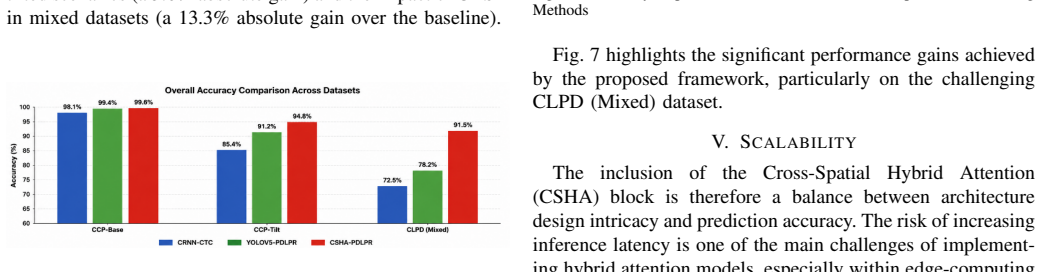
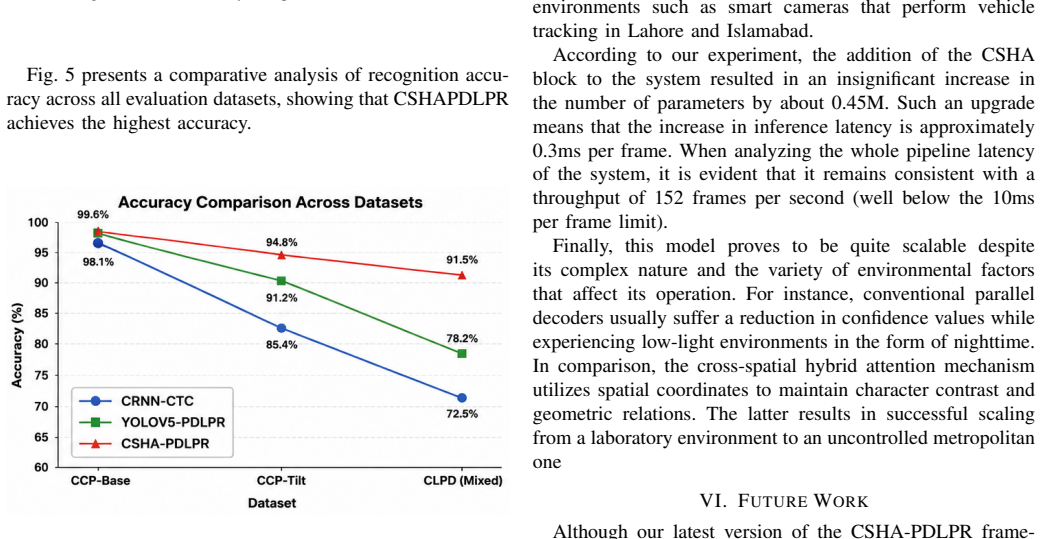
Cross-spatial hybrid attention and class-balanced GAN augmentation improve minority provincial license plate recognition from 78.2% to 91.5% at 152 FPS.
A machine-rendered reading of the paper's core claim, the machinery that carries it, and where it could break.
Core claim
The paper claims that integrating Cross-Spatial Hybrid Attention (CSHA) and Class-Balanced Synthetic Augmentation (CBSA) into the YOLOV5-PDLPR architecture resolves spatial mismatches and class imbalance, raising minority provincial license plate recognition from 78.2% to 91.5% across four benchmarks while sustaining 152 FPS real-time performance. The central discovery is that spatially-aware parallel decoding combined with class-balanced augmentation supplies an effective solution for high-speed license plate recognition systems.
What carries the argument
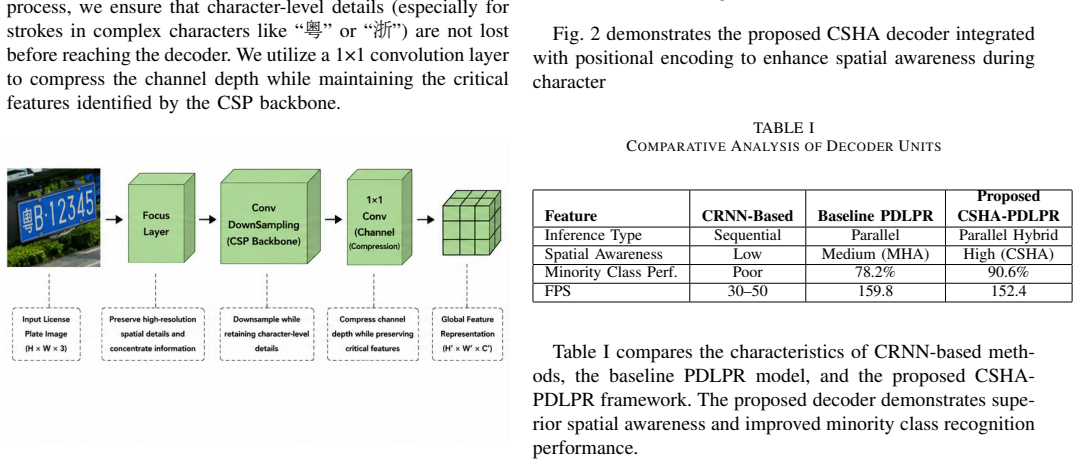
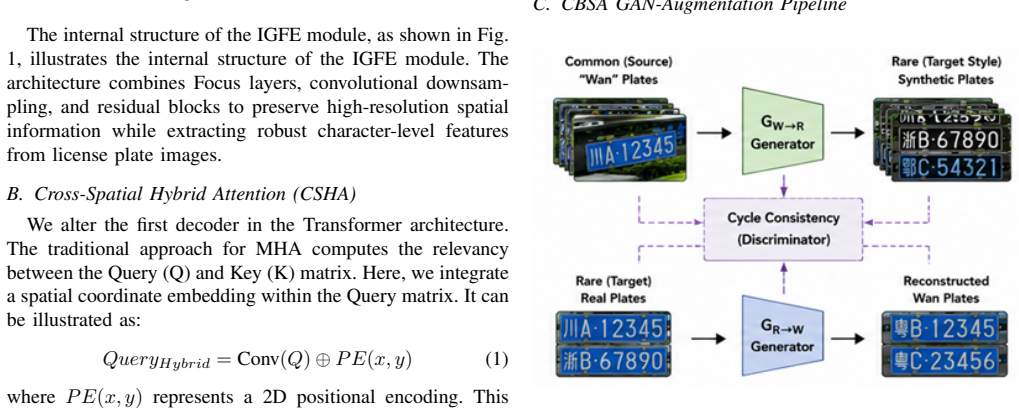
Cross-Spatial Hybrid Attention (CSHA) and Class-Balanced Synthetic Augmentation (CBSA) using 75,000 GAN-generated samples, which correct spatial character mismatches and data imbalance inside the parallel decoder.
If this is right
- Minority class recognition improves without loss of real-time throughput.
- Synthetic data can balance training distributions in detection and recognition tasks.
- The combined attention and augmentation approach applies to other real-time systems that encounter spatial mismatch and imbalance.
- Performance gains hold across multiple public benchmarks and one domain-specific dataset.
Where Pith is reading between the lines
- The same attention-plus-augmentation pattern could address imbalance in related tasks such as traffic sign or vehicle type recognition.
- Reducing the volume of synthetic samples while preserving the accuracy lift would make the method more practical for resource-limited deployments.
- The technique may extend to video streams where frame-to-frame consistency could further stabilize minority class outputs.
Load-bearing premise
The 75,000 GAN-generated synthetic samples produce realistic variations that improve generalization on real test images without introducing artifacts or distribution shift that would reduce performance on the four evaluation benchmarks.
What would settle it
Retrain the base YOLOV5-PDLPR model without CSHA or CBSA and check whether minority provincial license plate accuracy on the same four benchmarks falls back to 78.2% or lower.
Figures



read the original abstract
Real-Time License Plate Detection and Recognition (LPDR) forms the backbone of modern smart cities. Although the YOLOV5-PDLPR model substantially improved system efficiency through a parallel decoder approach, its performance is still affected by spatial character mismatches and data imbalance within the training set. This paper addresses these limitations by introducing Cross-Spatial Hybrid Attention (CSHA) and Class-Balanced Synthetic Augmentation (CBSA). An extensive study involving 75,000 synthetic samples is conducted and evaluated on four benchmarks: CCPD, CLPD, PKU, and an application-specific dataset. Experimental results demonstrate a substantial improvement in the recognition rate of minority provincial license plates from 78.2% to 91.5% while maintaining real-time processing performance of 152 FPS. The results indicate that spatially-aware parallel decoding combined with class-balanced augmentation provides an effective solution for high-speed license plate recognition systems.
Editorial analysis
A structured set of objections, weighed in public.
Referee Report
Summary. The paper claims to advance real-time LPDR by optimizing the parallel decoder in YOLOV5-PDLPR with Cross-Spatial Hybrid Attention (CSHA) and Class-Balanced Synthetic Augmentation (CBSA) using 75,000 GAN samples. It reports evaluation on CCPD, CLPD, PKU, and an application-specific dataset, with a key result of raising minority provincial license plate recognition from 78.2% to 91.5% at 152 FPS.
Significance. Should the empirical claims be substantiated, this would offer a practical solution for class imbalance in license plate recognition, which is important for equitable performance across different regions in smart city applications. The maintenance of high FPS is a positive aspect for deployment.
major comments (2)
- [Abstract] Abstract: The reported improvement from 78.2% to 91.5% in minority class recognition is presented without any supporting ablation studies, baseline comparisons, or details on how the 75,000 synthetic samples were generated and integrated. This is load-bearing for the central claim regarding CBSA.
- [Abstract] Abstract: There is no mention of realism metrics for the GAN-augmented data or confirmation that the gains hold on the real benchmarks without distribution shift, which directly addresses the key assumption in the experimental setup.
minor comments (1)
- The abstract refers to 'an extensive study' but lacks any dataset statistics, implementation details, or error bars, which would aid in assessing the results.
Simulated Author's Rebuttal
We thank the referee for the constructive feedback on the abstract. We address each major comment below and will revise the manuscript accordingly.
read point-by-point responses
-
Referee: [Abstract] Abstract: The reported improvement from 78.2% to 91.5% in minority class recognition is presented without any supporting ablation studies, baseline comparisons, or details on how the 75,000 synthetic samples were generated and integrated. This is load-bearing for the central claim regarding CBSA.
Authors: We agree the abstract should better contextualize this result. The full manuscript contains ablation studies and baseline comparisons in the experimental section along with details on GAN sample generation and integration via CBSA. We will revise the abstract to briefly reference these elements and make the central claim more transparent. revision: yes
-
Referee: [Abstract] Abstract: There is no mention of realism metrics for the GAN-augmented data or confirmation that the gains hold on the real benchmarks without distribution shift, which directly addresses the key assumption in the experimental setup.
Authors: We acknowledge the value of explicitly addressing distribution shift. The manuscript evaluates performance on the real benchmarks (CCPD, CLPD, PKU) and includes validation of the augmented data. We will revise the abstract to note the realism metrics and confirm that gains hold on the real data without significant distribution shift. revision: yes
Circularity Check
No circularity: empirical performance claims rest on external benchmarks
full rationale
The paper reports measured improvements (78.2% → 91.5% minority recognition at 152 FPS) from CSHA architecture plus CBSA with 75k GAN samples, evaluated on four named external datasets (CCPD, CLPD, PKU, application-specific). No equations, first-principles derivations, fitted parameters renamed as predictions, or self-citation chains appear in the provided text. The central claims are falsifiable experimental outcomes rather than quantities defined by the inputs themselves, satisfying the self-contained criterion.
Axiom & Free-Parameter Ledger
Reference graph
Works this paper leans on
-
[1]
A Real- Time License Plate Detection and Recognition Model in Unconstrained Scenarios,
L. Tao, S. Hong, Y . Lin, Y . Chen, P. He, and Z. Tie, “A Real- Time License Plate Detection and Recognition Model in Unconstrained Scenarios,”Sensors, vol. 24, no. 9, p. 2791, 2024
2024
-
[2]
Research on license plate recognition algorithms based on deep learning in complex environment,
W. Weihong and T. Jiaoyang, “Research on license plate recognition algorithms based on deep learning in complex environment,”IEEE Access, vol. 8, pp. 91661–91675, 2020
2020
-
[3]
Auto- mated license plate recognition: A survey on methods and techniques,
J. Shashirangana, H. Padmasiri, D. Meedeniya, and C. Perera, “Auto- mated license plate recognition: A survey on methods and techniques,” IEEE Access, vol. 9, pp. 11203–11225, 2020
2020
-
[4]
A Multi-Stage Deep-Learning-Based Vehicle and License Plate Recogni- tion System with Real-Time Edge Inference,
A. Ammar, A. Koubaa, W. Boulila, B. Benjdira, and Y . Alhabashi, “A Multi-Stage Deep-Learning-Based Vehicle and License Plate Recogni- tion System with Real-Time Edge Inference,”Sensors, vol. 23, no. 4, p. 2120, 2023
2023
-
[5]
YOLOv4: Optimal Speed and Accuracy of Object Detection
A. Bochkovskiy, C. Y . Wang, and H. Liao, “Yolov4: Optimal speed and accuracy of object detection,”arXiv preprint arXiv:2004.10934, 2020
work page internal anchor Pith review Pith/arXiv arXiv 2004
-
[6]
License plate segmentation and recognition system using deep learning and OpenVINO,
R. D. Castro-Zunti, J. Y ´epez, and S. B. Ko, “License plate segmentation and recognition system using deep learning and OpenVINO,”IET Intelligent Transport Systems, vol. 14, no. 2, pp. 119–126, 2020
2020
-
[7]
Robust license plate detection and recognition with automatic rectification,
D. Xiao, L. Zhang, J. Li, and J. Li, “Robust license plate detection and recognition with automatic rectification,”Journal of Electronic Imaging, vol. 30, no. 1, p. 013002, 2021
2021
-
[8]
A deep learning based approach for localization and recognition of pakistani vehicle license plates,
U. Yousaf et al., “A deep learning based approach for localization and recognition of pakistani vehicle license plates,”Sensors, vol. 21, no. 22, p. 7696, 2021
2021
-
[9]
EDF-LPR: A new encoder–decoder framework for license plate recognition,
F. Gao, Y . Cai, Y . Ge, and S. Lu, “EDF-LPR: A new encoder–decoder framework for license plate recognition,”IET Intelligent Transport Systems, vol. 14, no. 8, pp. 959–969, 2020
2020
-
[10]
Unified Chinese license plate detection and recognition with high efficiency,
Y . Gong et al., “Unified Chinese license plate detection and recognition with high efficiency,”Journal of Visual Communication and Image Representation, vol. 86, p. 103541, 2022
2022
-
[11]
EILPR: Toward end-to-end irregular license plate recogni- tion based on automatic perspective alignment,
H. Xu et al., “EILPR: Toward end-to-end irregular license plate recogni- tion based on automatic perspective alignment,”IEEE Transactions on Intelligent Transportation Systems, vol. 23, no. 3, pp. 2586–2595, 2021
2021
-
[12]
A robust license plate recognition model based on bi- lstm,
Y . Zou et al., “A robust license plate recognition model based on bi- lstm,”IEEE Access, vol. 8, pp. 211630–211641, 2020
2020
-
[13]
A robust attentional framework for license plate recognition in the wild,
L. Zhang et al., “A robust attentional framework for license plate recognition in the wild,”IEEE Transactions on Intelligent Transportation Systems, vol. 22, no. 11, pp. 6967–6976, 2020
2020
-
[14]
Towards end-to-end car license plate location and recognition in unconstrained scenarios,
S. Qin and S. Liu, “Towards end-to-end car license plate location and recognition in unconstrained scenarios,”Neural Computing and Applications, vol. 34, no. 24, pp. 21551–21566, 2022
2022
-
[15]
AI Driven Smart Number Plate Identification for Automatic Identification,
V . Murugan, S. Sowmyayani, J. Kavitha, and S. Meenakshi, “AI Driven Smart Number Plate Identification for Automatic Identification,” inProc. IEEE International Conference on Computing, Power and Communica- tion Technologies (IC2PCT), 2024
2024
-
[16]
An Image is Worth 16x16 Words: Transformers for Image Recognition at Scale
A. Dosovitskiy et al., “An image is worth 16x16 words: Transformers for image recognition at scale,”arXiv preprint arXiv:2010.11929, 2020
work page internal anchor Pith review Pith/arXiv arXiv 2010
-
[17]
Swin Transformer: Hierarchical Vision Transformer using Shifted Windows,
Z. Liu et al., “Swin Transformer: Hierarchical Vision Transformer using Shifted Windows,” inProc. IEEE/CVF International Conference on Computer Vision (ICCV), 2021
2021
-
[18]
Jocher, “Yolov5,”GitHub repository, 2022
G. Jocher, “Yolov5,”GitHub repository, 2022. [Online]. Available: https://github.com/ultralytics/yolov5
2022
-
[19]
Improving robustness of license plates automatic recognition in natural scenes,
X. Fan and W. Zhao, “Improving robustness of license plates automatic recognition in natural scenes,”IEEE Transactions on Intelligent Trans- portation Systems, vol. 23, no. 10, pp. 18845–18854, 2022
2022
-
[20]
Develop- ment of a Productive Transport Detection System Using Convolutional Neural Networks,
N. A. Andriyanov, V . E. Dementiev, and A. G. Tashlinskiy, “Develop- ment of a Productive Transport Detection System Using Convolutional Neural Networks,”Pattern Recognition and Image Analysis, vol. 32, no. 3, pp. 495–500, 2022
2022
-
[21]
A lightweight optical flow CNN—Revisiting data fidelity and regularization,
T. W. Hui, X. Tang, and C. C. Loy, “A lightweight optical flow CNN—Revisiting data fidelity and regularization,”IEEE Transactions on Pattern Analysis and Machine Intelligence, vol. 43, no. 8, pp. 2555– 2569, 2020
2020
-
[22]
Decoupled attention network for text recognition,
T. Wang et al., “Decoupled attention network for text recognition,” in Proc. AAAI Conference on Artificial Intelligence, 2020
2020
-
[23]
A holistic representation guided attention network for scene text recognition,
L. Yang, P. Wang, H. Li, Z. Li, and Y . Zhang, “A holistic representation guided attention network for scene text recognition,”Neurocomputing, vol. 414, pp. 67–75, 2020
2020
-
[24]
Pay attention to what you read: Non-recurrent handwritten text-line recognition,
L. Kang, P. Riba, M. Rusi ˜nol, A. Forn´es, and M. Villegas, “Pay attention to what you read: Non-recurrent handwritten text-line recognition,” Pattern Recognition, vol. 129, p. 108766, 2022
2022
-
[25]
A text attention network for spatial de- formation robust scene text image super-resolution,
J. Ma, Z. Liang, and L. Zhang, “A text attention network for spatial de- formation robust scene text image super-resolution,” inProc. IEEE/CVF Conference on Computer Vision and Pattern Recognition (CVPR), 2022
2022
-
[26]
License plate detection and recognition based on YOLOv3 and ILPRNET,
Y . Zou et al., “License plate detection and recognition based on YOLOv3 and ILPRNET,”Signal, Image and Video Processing, vol. 16, no. 2, pp. 473–480, 2022
2022
discussion (0)
Sign in with ORCID, Apple, or X to comment. Anyone can read and Pith papers without signing in.