AttackPathGNN: Cross-function vulnerability detection in smart contracts using state interference graphs and conjunction pooling
Pith reviewed 2026-06-28 00:46 UTC · model grok-4.3
The pith
Smart-contract vulnerability detection improves when models reason over relationships between functions instead of isolated code patterns.
A machine-rendered reading of the paper's core claim, the machinery that carries it, and where it could break.
Core claim
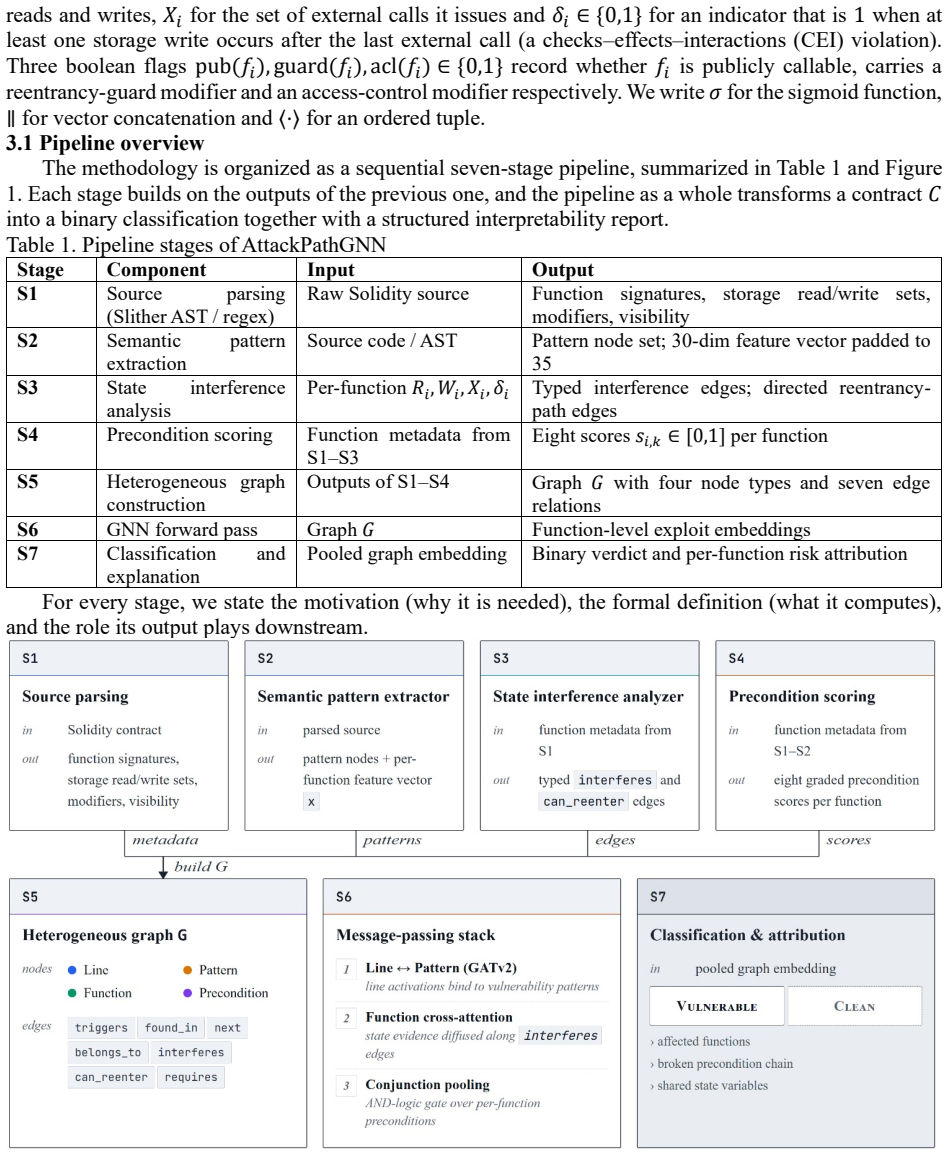
AttackPathGNN reframes detection as reasoning over explicit attack paths in a State Interference Graph that links every pair of functions sharing mutable storage through typed, weighted edges and through directed reentrancy-path edges defined by an explicit five-condition predicate, together with conjunction pooling, a differentiable AND-aggregator over eight named exploit preconditions whose log-sigmoid form causes the per-function exploit score to collapse whenever any single mitigation is in place.
What carries the argument
The State Interference Graph that connects functions sharing mutable storage via typed edges and reentrancy paths via a five-condition predicate, paired with conjunction pooling as a differentiable AND over eight exploit preconditions.
If this is right
- The model attains 92.3 % F1 on the SmartBugs Wild held-out partition.
- False-negative rate stays at 4.3 % while detection rate on the human-labelled SmartBugs Curated benchmark reaches 90.8 %.
- Six of the ten DASP10 categories are recovered at 100 % on every training seed.
- Reentrancy detection reaches 98.7 % across seeds.
- Each positive verdict is emitted with a structured, function-level remediation report.
Where Pith is reading between the lines
- The same graph-construction and conjunction-pooling pattern could be applied to other languages that expose shared mutable state across modules.
- The explicit precondition list may serve as a checklist for manual auditors even when the neural model is not used.
- Because the pooling operation is differentiable, the architecture could be inserted into larger end-to-end training pipelines that jointly optimize detection and repair suggestions.
- Testing the five-condition reentrancy predicate on contracts written after the introduction of newer Solidity features would reveal whether the predicate needs updating.
Load-bearing premise
The State Interference Graph that links every pair of functions sharing mutable storage through typed edges and through directed reentrancy paths defined by the five-condition predicate correctly captures the relationships that make attacks feasible.
What would settle it
Running the model on a fresh collection of contracts whose only vulnerabilities are known cross-function attacks and finding that its F1 score is statistically indistinguishable from single-function baselines would falsify the central claim.
Figures
read the original abstract
Existing learning-based detectors for Solidity smart-contracts reduce vulnerability detection to syntactic pattern matching within single functions, yet many of the most consequential exploits (The DAO, Cream Finance) exist not in any individual function but in the relationship between functions and in the combination of conditions that made the attack feasible. Thus, we propose AttackPathGNN, a graph neural network (GNN) that reframes detection as reasoning over explicit attack paths. Two architectural choices distinguish it from prior GNN-based detectors: (1)a State Interference Graph that links every pair of functions sharing mutable storage through typed, weighted edges and through directed reentrancy-path edges defined by an explicit five-condition predicate; (2)conjunction pooling, a differentiable AND-aggregator over eight named exploit preconditions whose log-sigmoid form causes the per-function exploit score to collapse whenever any single mitigation (a reentrancy guard, an access-control modifier or SafeMath) is in place. Across five independent training runs, AttackPathGNN attains 92.3+/-0.2% F1 on the SmartBugs Wild held-out test partition (4.3+/-0.3% false-negative rate, 90.8+/-2.5% detection rate on the independently human-labelled SmartBugs Curated benchmark), recovering 6/10 DASP10 categories at 100% on every seed and Reentrancy at 98.7+/-1.8%. Each prediction is emitted with a structured remediation report, turning each verdict into an actionable, function-level audit finding.
Editorial analysis
A structured set of objections, weighed in public.
Referee Report
Summary. The paper introduces AttackPathGNN, a GNN-based detector for Solidity smart-contract vulnerabilities that reframes the task as reasoning over explicit cross-function attack paths. It constructs a State Interference Graph connecting functions via typed weighted edges for shared mutable storage and directed reentrancy-path edges generated by an explicit five-condition predicate, then applies conjunction pooling (a differentiable AND aggregator over eight exploit preconditions) so that the per-function score collapses in the presence of any mitigation. On the SmartBugs Wild held-out partition the model reports 92.3±0.2% F1 (4.3±0.3% FNR) across five seeds and 90.8±2.5% detection on the human-labelled SmartBugs Curated set, recovering six of ten DASP10 categories at 100% and Reentrancy at 98.7±1.8%, while also emitting structured remediation reports.
Significance. If the State Interference Graph and conjunction pooling genuinely allow the model to reason over feasible attack paths rather than surface syntax, the work would constitute a substantive advance over prior single-function or purely syntactic detectors for multi-function exploits. The consistent reporting of means and standard deviations across five independent training runs is a methodological strength. However, the performance numbers rest on the unvalidated premise that the five-condition predicate correctly encodes real attack feasibility; absent that link, the architectural claims cannot be credited for the observed gains.
major comments (2)
- [Abstract / Graph Construction] Abstract (and the description of the State Interference Graph): the five-condition predicate that produces directed reentrancy-path edges is introduced without any independent validation against documented exploits (e.g., The DAO or Cream Finance). If the predicate omits real attack paths or adds spurious ones, the central claim that performance derives from explicit attack-path reasoning collapses.
- [Experimental Evaluation] Experimental section (implied by the reported metrics): no information is supplied on train/test splits, feature-construction details, hyper-parameter search procedure, or whether the five-condition predicate itself was tuned with knowledge of the test distribution. These omissions make it impossible to assess whether the 92.3±0.2% F1 and the per-category 100% recoveries are attributable to the proposed architecture or to experimental leakage.
minor comments (1)
- [Abstract] Abstract contains minor formatting issues (missing spaces after numbered items, e.g., “(1)a State Interference Graph”).
Simulated Author's Rebuttal
Thank you for the constructive review. We address each major comment below, indicating where revisions will strengthen the manuscript and where we provide clarification.
read point-by-point responses
-
Referee: [Abstract / Graph Construction] Abstract (and the description of the State Interference Graph): the five-condition predicate that produces directed reentrancy-path edges is introduced without any independent validation against documented exploits (e.g., The DAO or Cream Finance). If the predicate omits real attack paths or adds spurious ones, the central claim that performance derives from explicit attack-path reasoning collapses.
Authors: We agree that independent validation of the five-condition predicate is required to support the claim that performance gains stem from explicit attack-path reasoning rather than incidental pattern matching. In the revised manuscript we will insert a dedicated subsection (in the graph-construction section) that maps each of the five conditions to the concrete exploit traces of The DAO and Cream Finance, showing which conditions are satisfied and which are not. We will also note any potential spurious edges and their measured effect on false-positive rate. revision: yes
-
Referee: [Experimental Evaluation] Experimental section (implied by the reported metrics): no information is supplied on train/test splits, feature-construction details, hyper-parameter search procedure, or whether the five-condition predicate itself was tuned with knowledge of the test distribution. These omissions make it impossible to assess whether the 92.3±0.2% F1 and the per-category 100% recoveries are attributable to the proposed architecture or to experimental leakage.
Authors: We acknowledge the current manuscript does not supply the requested experimental details. The revision will expand the Experimental Setup section with: (i) the precise construction of the SmartBugs Wild held-out partition and the train/validation/test ratios, (ii) the full feature-construction pipeline, (iii) the hyper-parameter search ranges, budget, and selection criterion, and (iv) an explicit statement that the five-condition predicate was derived from the literature prior to any test-set inspection and was never tuned on the test distribution. These additions will allow independent assessment of leakage risk. revision: yes
Circularity Check
No circularity; standard supervised GNN training and held-out evaluation
full rationale
The paper explicitly defines the State Interference Graph (typed weighted edges plus five-condition reentrancy predicate) and conjunction pooling as architectural choices, trains the model on labeled data, and evaluates F1, false-negative rate, and per-category detection on independent held-out partitions (SmartBugs Wild test and Curated benchmark). No equations, parameters, or claims reduce the reported metrics to inputs by construction, and no self-citation chains or uniqueness theorems are invoked. The derivation chain is therefore self-contained against external benchmarks.
Axiom & Free-Parameter Ledger
free parameters (1)
- GNN model weights
axioms (2)
- domain assumption The explicit five-condition predicate correctly identifies directed reentrancy paths between functions.
- domain assumption Conjunction pooling via log-sigmoid over eight preconditions collapses the exploit score exactly when any mitigation is present.
invented entities (1)
-
State Interference Graph
no independent evidence
Reference graph
Works this paper leans on
-
[1]
Smashing Ethereum Smart Contracts for Fun and Real Profit
B. Mueller, “Smashing Ethereum Smart Contracts for Fun and Real Profit.” [Online]. Available: https://github.com/muellerberndt/smashing-smart-contracts/blob/master/smashing-smart-contracts- 1of1.pdf
-
[2]
Securify: Practical security analysis of smart contracts,
P. Tsankov, A. Dan, D. Drachsler-Cohen, A. Gervais, F. Bünzli, and M. Vechev, “Securify: Practical security analysis of smart contracts,” in Proceedings of the ACM Conference on Computer and Communications Security, 2018. doi: 10.1145/3243734.3243780
-
[3]
SmartCheck: Static analysis of ethereum smart contracts,
S. Tikhomirov, E. Voskresenskaya, I. Ivanitskiy, R. Takhaviev, E. Marchenko, and Y. Alexandrov, “SmartCheck: Static analysis of ethereum smart contracts,” in Proceedings - International Conference on Software Engineering, 2018. doi: 10.1145/3194113.3194115
-
[4]
In: POST (2017).https://doi.org/10.1007/978-3-662-54455-6_8
N. Atzei, M. Bartoletti, and T. Cimoli, “A survey of attacks on Ethereum smart contracts (SoK),” in Lecture Notes in Computer Science (including subseries Lecture Notes in Artificial Intelligence and Lecture Notes in Bioinformatics), 2017. doi: 10.1007/978-3-662-54455-6_8
-
[5]
In: IEEE S&P (2023).https://doi.org/10.1109/SP46215.2023.10179435
L. Zhou et al., “SoK: Decentralized Finance (DeFi) Attacks,” in Proceedings - IEEE Symposium on Security and Privacy, 2023. doi: 10.1109/SP46215.2023.10179435
-
[6]
Empirical review of automated analysis tools on 47,587 ethereum smart contracts,
T. Durieux, J. F. Ferreira, R. Abreu, and P. Cruz, “Empirical review of automated analysis tools on 47,587 ethereum smart contracts,” in Proceedings - International Conference on Software Engineering, 2020. doi: 10.1145/3377811.3380364
-
[7]
Combining Graph Neural Networks with Expert Knowledge for Smart Contract Vulnerability Detection,
Z. Liu, P. Qian, X. Wang, Y. Zhuang, L. Qiu, and X. Wang, “Combining Graph Neural Networks with Expert Knowledge for Smart Contract Vulnerability Detection,” IEEE Trans. Knowl. Data Eng., 2023, doi: 10.1109/TKDE.2021.3095196
-
[8]
H. Wu et al., “Peculiar: Smart Contract Vulnerability Detection Based on Crucial Data Flow Graph and Pre-training Techniques,” in Proceedings - International Symposium on Software Reliability Engineering, ISSRE, 2021. doi: 10.1109/ISSRE52982.2021.00047
-
[9]
S. Chaliasos et al., “Smart Contract and DeFi Security Tools: Do They Meet the Needs of Practitioners?,” in Proceedings - International Conference on Software Engineering, 2024. doi: 10.1145/3597503.3623302
-
[10]
Sereum: Protecting Existing Smart Contracts Against Re-Entrancy Attacks,
M. Rodler, W. Li, G. O. Karame, and L. Davi, “Sereum: Protecting Existing Smart Contracts Against Re-Entrancy Attacks,” in 26th Annual Network and Distributed System Security Symposium, NDSS 2019, 2019. doi: 10.14722/ndss.2019.23413
-
[11]
J. Ye, M. Ma, Y. Lin, Y. Sui, and Y. Xue, “Clairvoyance: Cross-contract Static Analysis for Detecting Practical Reentrancy Vulnerabilities in Smart Contracts,” in Proceedings - 2020 ACM/IEEE 42nd International Conference on Software Engineering: Companion, ICSE- Companion 2020, 2020. doi: 10.1145/3377812.3390908
-
[12]
P. Bose, D. Das, Y. Chen, Y. Feng, C. Kruegel, and G. Vigna, “SAILFISH: Vetting Smart Contract State-Inconsistency Bugs in Seconds,” in Proceedings - IEEE Symposium on Security and Privacy, 2022. doi: 10.1109/SP46214.2022.9833721
-
[13]
Finding the greedy, prodigal, and suicidal contracts at scale,
I. Nikolić, A. Kolluri, I. Sergey, P. Saxena, and A. Hobor, “Finding the greedy, prodigal, and suicidal contracts at scale,” in ACM International Conference Proceeding Series, 2018. doi: 10.1145/3274694.3274743
-
[14]
Smart contract vulnerabilities: Vulnerable does not imply exploited,
D. Perez and B. Livshits, “Smart contract vulnerabilities: Vulnerable does not imply exploited,” in Proceedings of the 30th USENIX Security Symposium, 2021
2021
-
[15]
ETainter: Detecting gas-related vulnerabilities in smart contracts,
A. Ghaleb, J. Rubin, and K. Pattabiraman, “ETainter: Detecting gas-related vulnerabilities in smart contracts,” in ISSTA 2022 - Proceedings of the 31st ACM SIGSOFT International Symposium on Software Testing and Analysis, 2022. doi: 10.1145/3533767.3534378
-
[16]
Smart contract vulnerability detection using graph neural networks,
Y. Zhuang, Z. Liu, P. Qian, Q. Liu, X. Wang, and Q. He, “Smart contract vulnerability detection using graph neural networks,” in IJCAI International Joint Conference on Artificial Intelligence,
-
[17]
doi: 10.24963/ijcai.2020/454
-
[18]
Z. Zhen, X. Zhao, J. Zhang, Y. Wang, and H. Chen, “DA-GNN: A smart contract vulnerability detection method based on Dual Attention Graph Neural Network,” Comput. Networks, 2024, doi: 10.1016/j.comnet.2024.110238
-
[19]
HGAT: smart contract vulnerability detection method based on hierarchical graph attention network,
C. Ma, S. Liu, and G. Xu, “HGAT: smart contract vulnerability detection method based on hierarchical graph attention network,” J. Cloud Comput., 2023, doi: 10.1186/s13677-023-00459-x
-
[20]
Spectral clustering with graph neural networks for graph pooling,
F. M. Bianchi, D. Grattarola, and C. Alippi, “Spectral clustering with graph neural networks for graph pooling,” in 37th International Conference on Machine Learning, ICML 2020, 2020
2020
-
[21]
Explainable expected goal models for performance analysis in football analytics , url =
H. H. Nguyen et al., “MANDO: Multi-Level Heterogeneous Graph Embeddings for Fine-Grained Detection of Smart Contract Vulnerabilities,” in Proceedings - 2022 IEEE 9th International Conference on Data Science and Advanced Analytics, DSAA 2022, 2022. doi: 10.1109/DSAA54385.2022.10032337
-
[22]
MANDO- GURU: vulnerability detection for smart contract source code by heterogeneous graph embeddings,
H. H. Nguyen, N. M. Nguyen, H. P. Doan, Z. Ahmadi, T. N. Doan, and L. Jiang, “MANDO- GURU: vulnerability detection for smart contract source code by heterogeneous graph embeddings,” in ESEC/FSE 2022 - Proceedings of the 30th ACM Joint Meeting European Software Engineering Conference and Symposium on the Foundations of Software Engineering,
2022
-
[23]
doi: 10.1145/3540250.3558927
-
[24]
C. Xu, H. Xu, L. Zhu, X. Shen, and K. Sharif, “Enhanced Smart Contract Vulnerability Detection via Graph Neural Networks: Achieving High Accuracy and Efficiency,” IEEE Trans. Softw. Eng., 2025, doi: 10.1109/TSE.2025.3570421
-
[25]
X. Huanliang, W. Canghai, C. JiaXin, W. Yinglong, and Z. yulin, “A smart contract vulnerability line detection method based on graph neural network and fusion of multidimensional code representation,” Appl. Soft Comput., 2025, doi: 10.1016/j.asoc.2025.113435
-
[26]
GNNExplainer: Generating explanations for graph neural networks,
R. Ying, D. Bourgeois, J. You, M. Zitnik, and J. Leskovec, “GNNExplainer: Generating explanations for graph neural networks,” in Advances in Neural Information Processing Systems, 2019
2019
-
[27]
On Explainability of Graph Neural Networks via Subgraph Explorations,
H. Yuan, H. Yu, J. Wang, K. Li, and S. Ji, “On Explainability of Graph Neural Networks via Subgraph Explorations,” in Proceedings of Machine Learning Research, 2021
2021
-
[28]
Graph-based explainable vulnerability prediction,
H. Q. Nguyen, T. Hoang, H. K. Dam, and A. Ghose, “Graph-based explainable vulnerability prediction,” Inf. Softw. Technol., 2025, doi: 10.1016/j.infsof.2024.107566
-
[29]
Logic tensor networks for semantic image interpretation,
I. Donadello, L. Serafini, and A. D’Avila Garcez, “Logic tensor networks for semantic image interpretation,” in IJCAI International Joint Conference on Artificial Intelligence, 2017. doi: 10.24963/ijcai.2017/221
-
[30]
Neural probabilistic logic programming in DeepProbLog,
R. Manhaeve, S. Dumančić, A. Kimmig, T. Demeester, and L. De Raedt, “Neural probabilistic logic programming in DeepProbLog,” Artif. Intell., 2021, doi: 10.1016/j.artint.2021.103504
-
[31]
R. Riegel et al., “Logical Neural Networks,” 2020. [Online]. Available: https://arxiv.org/abs/2006.13155
arXiv 2020
-
[32]
Analyzing Differentiable Fuzzy Logic Operators,
E. van Krieken, E. Acar, and F. van Harmelen, “Analyzing Differentiable Fuzzy Logic Operators,” Artif. Intell., 2022, doi: 10.1016/j.artint.2021.103602
-
[33]
Automated Vulnerability Detection in Source Code Using Deep Representation Learning,
C. Seas, G. Fitzpatrick, J. A. Hamilton, and M. C. Carlisle, “Automated Vulnerability Detection in Source Code Using Deep Representation Learning,” in 2024 IEEE 14th Annual Computing and Communication Workshop and Conference, CCWC 2024, 2024. doi: 10.1109/CCWC60891.2024.10427574
-
[34]
Devign: Effective vulnerability identification by learning comprehensive program semantics via graph neural networks,
Y. Zhou, S. Liu, J. Siow, X. Du, and Y. Liu, “Devign: Effective vulnerability identification by learning comprehensive program semantics via graph neural networks,” in Advances in Neural Information Processing Systems, 2019
2019
-
[35]
LineVul: A Transformer-based Line-Level Vulnerability Prediction,
M. Fu and C. Tantithamthavorn, “LineVul: A Transformer-based Line-Level Vulnerability Prediction,” in Proceedings - 2022 Mining Software Repositories Conference, MSR 2022, 2022. doi: 10.1145/3524842.3528452
-
[36]
HOW ATTENTIVE ARE GRAPH ATTENTION NETWORKS?,
S. Brody, U. Alon, and E. Yahav, “HOW ATTENTIVE ARE GRAPH ATTENTION NETWORKS?,” in ICLR 2022 - 10th International Conference on Learning Representations, 2022
2022
-
[37]
Semi-supervised classification with graph convolutional networks,
T. N. Kipf and M. Welling, “Semi-supervised classification with graph convolutional networks,” in 5th International Conference on Learning Representations, ICLR 2017 - Conference Track Proceedings, 2017
2017
-
[38]
Decoupled weight decay regularization,
I. Loshchilov and F. Hutter, “Decoupled weight decay regularization,” in 7th International Conference on Learning Representations, ICLR 2019, 2019
2019
discussion (0)
Sign in with ORCID, Apple, or X to comment. Anyone can read and Pith papers without signing in.