Reactive Flux Matching: Mechanism Discovery and Adaptive Sampling of Rare Events
Pith reviewed 2026-06-28 02:27 UTC · model grok-4.3
The pith
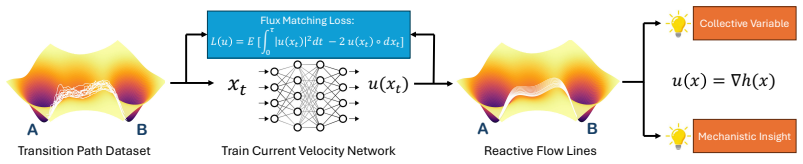
Flux Matching learns a current velocity and scalar potential directly from reactive trajectory data to trace pathways and serve as reaction coordinates.
A machine-rendered reading of the paper's core claim, the machinery that carries it, and where it could break.
Core claim
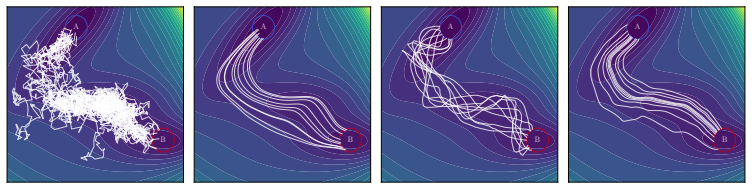
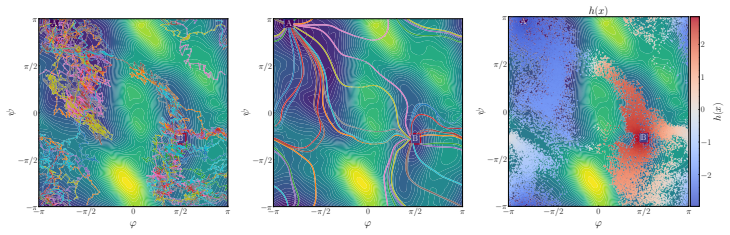
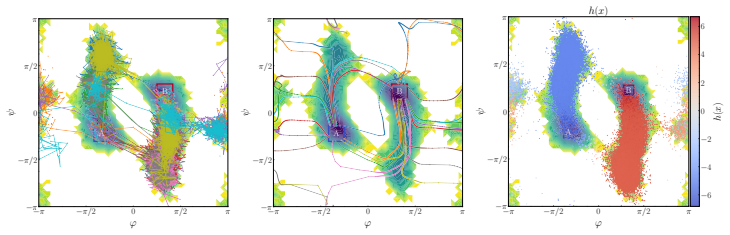
Flux Matching learns two complementary objects directly from reactive trajectory data: a current velocity u(z), whose streamlines trace the dominant reaction pathways, and a scalar potential h(z), obtained from a weighted Helmholtz-Hodge decomposition of the reactive current, that serves as a data-driven reaction coordinate. Both minimize quadratic functionals over the reactive path ensemble and require no knowledge of the underlying dynamics or stationary distribution. Unlike committor-based methods, u and h remain well-defined under projection onto non-Markovian collective variables, and their level sets in turn provide adaptive interfaces for improved sampling with enhanced sampling metho
What carries the argument
Current velocity u(z) and scalar potential h(z) from weighted Helmholtz-Hodge decomposition of the reactive current, both minimizing quadratic functionals over the reactive path ensemble.
If this is right
- Streamlines of the learned velocity field trace dominant reaction pathways.
- Level sets of the scalar potential provide adaptive interfaces for enhanced sampling methods.
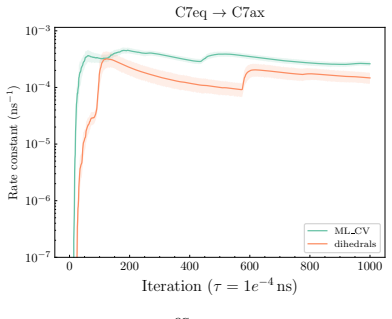
- Rate constant calculations can be performed using the learned objects on molecular systems.
- Generation of current velocity trajectories is enabled directly from the data.
Where Pith is reading between the lines
- The approach may generalize to other systems exhibiting rare transitions between states without requiring full knowledge of the energy landscape.
- By avoiding reliance on Markovian assumptions, it could facilitate analysis of complex biomolecular processes where projections are common.
- Integration with generative modeling techniques might allow scaling to higher-dimensional collective variable spaces.
Load-bearing premise
The ensemble of reactive trajectories alone is sufficient to define well-behaved velocity and potential fields that remain valid under projection onto non-Markovian collective variables without any access to the underlying dynamics or stationary distribution.
What would settle it
If the velocity field and potential computed solely from reactive trajectories produce streamlines or interfaces that differ substantially from those obtained with full access to the dynamics, or fail to enhance sampling efficiency in rate constant calculations.
Figures
read the original abstract
Path sampling methods generate ensembles of reactive trajectories connecting metastable states, but extracting mechanistic insight from these data remains nontrivial. We introduce Flux Matching, a framework that learns two complementary objects directly from reactive trajectory data: a current velocity $u(z)$, whose streamlines trace the dominant reaction pathways, and a scalar potential $h(z)$, obtained from a weighted Helmholtz-Hodge decomposition of the reactive current, that serves as a data-driven reaction coordinate. Both minimize quadratic functionals over the reactive path ensemble, analogous to the flow matching loss in generative modeling, and require no knowledge of the underlying dynamics or stationary distribution. Unlike committor-based methods, $u$ and $h$ remain well-defined under projection onto non-Markovian collective variables, and their level sets in turn provide adaptive interfaces for improved sampling with enhanced sampling methods. Flux Matching is validated through the generation of current velocity trajectories and rate constant calculations on molecular systems.
Editorial analysis
A structured set of objections, weighed in public.
Referee Report
Summary. The paper introduces Flux Matching, a framework that learns a current velocity u(z) and scalar potential h(z) directly from reactive trajectory data by minimizing quadratic functionals over the reactive path ensemble. These objects are positioned as tracing dominant reaction pathways and serving as data-driven reaction coordinates, respectively, via a weighted Helmholtz-Hodge decomposition of the reactive current. The method requires no knowledge of the underlying dynamics or stationary distribution, is claimed to remain well-defined under projection onto non-Markovian collective variables (unlike committor methods), and is validated via generation of current velocity trajectories and rate constant calculations on molecular systems.
Significance. If the central claims hold, particularly the validity of the learned fields under non-Markovian projections, the work would offer a useful data-driven alternative for mechanism discovery and adaptive interface generation in rare-event sampling, complementing existing path-sampling techniques without requiring full dynamical information.
major comments (2)
- [Abstract] Abstract: the claim that 'u and h remain well-defined under projection onto non-Markovian collective variables' is load-bearing for the contrast with committor methods, yet no derivation is supplied showing why quadratic minimization of the current velocity plus weighted Helmholtz-Hodge decomposition evades history dependence in the projected paths; the full text must provide this justification or a concrete counter-example test.
- [Validation on molecular systems] The validation section on molecular systems reports rate constant calculations but supplies no error analysis, comparison baselines, or details on how the learned h(z) level sets were used as adaptive interfaces; this weakens the claim that the objects 'serve as adaptive interfaces for improved sampling'.
minor comments (2)
- Notation for the weighted Helmholtz-Hodge decomposition should be introduced with an explicit equation rather than described only in prose.
- The analogy to flow matching losses is mentioned but would benefit from a side-by-side equation comparison to clarify the precise functional being minimized.
Simulated Author's Rebuttal
We thank the referee for the constructive comments, which help clarify the presentation of our claims. We address each major point below and will revise the manuscript to incorporate the requested justifications and details.
read point-by-point responses
-
Referee: [Abstract] Abstract: the claim that 'u and h remain well-defined under projection onto non-Markovian collective variables' is load-bearing for the contrast with committor methods, yet no derivation is supplied showing why quadratic minimization of the current velocity plus weighted Helmholtz-Hodge decomposition evades history dependence in the projected paths; the full text must provide this justification or a concrete counter-example test.
Authors: We agree that an explicit derivation is required to substantiate the claim. The quadratic loss for u(z) is minimized directly over the measure induced by the projected reactive trajectories and does not invoke the backward Kolmogorov equation or any time-derivative operator that would require the Markov property. The weighted Helmholtz-Hodge decomposition is likewise performed on the projected current. We will add a new subsection in the Methods section that derives this invariance under projection and includes a simple non-Markovian toy model as a concrete illustration. revision: yes
-
Referee: [Validation on molecular systems] The validation section on molecular systems reports rate constant calculations but supplies no error analysis, comparison baselines, or details on how the learned h(z) level sets were used as adaptive interfaces; this weakens the claim that the objects 'serve as adaptive interfaces for improved sampling'.
Authors: We acknowledge the need for greater rigor in the validation. The revised manuscript will report standard errors on the computed rate constants obtained from independent replica runs, provide baseline comparisons against committor-based interface sampling where feasible, and include a detailed description of how the level sets of the learned h(z) were extracted and employed as adaptive interfaces, specifying the enhanced sampling algorithm and the selection criterion for the interfaces. revision: yes
Circularity Check
No circularity: objects defined by explicit quadratic minimization over external trajectory data
full rationale
The derivation constructs u(z) and h(z) by direct minimization of quadratic functionals over the supplied reactive path ensemble, with no reduction of the claimed outputs back to the inputs by definition, no fitted parameters renamed as predictions, and no load-bearing self-citations or imported uniqueness theorems. The framework is explicitly positioned as independent of the underlying dynamics and stationary measure, and the non-Markovian projection claim is asserted as a property of the construction rather than derived from a prior self-referential result. This is the normal case of a data-driven extraction method whose central objects are not tautological.
Axiom & Free-Parameter Ledger
Reference graph
Works this paper leans on
-
[1]
Taming the complexity of protein folding.Current opinion in structural biology, 21(1):4–11, 2011
Gregory R Bowman, Vincent A V oelz, and Vijay S Pande. Taming the complexity of protein folding.Current opinion in structural biology, 21(1):4–11, 2011
2011
-
[2]
The protein-folding problem, 50 years on.science, 338 (6110):1042–1046, 2012
Ken A Dill and Justin L MacCallum. The protein-folding problem, 50 years on.science, 338 (6110):1042–1046, 2012
2012
-
[3]
Brute-force nucleation rates of hard spheres compared with rare-event methods and classical nucleation theory.The Journal of chemical physics, 159 (8), 2023
Willem Gispen and Marjolein Dijkstra. Brute-force nucleation rates of hard spheres compared with rare-event methods and classical nucleation theory.The Journal of chemical physics, 159 (8), 2023
2023
-
[4]
More intense, more frequent, and longer lasting heat waves in the 21st century.Science, 305(5686):994–997, 2004
Gerald A Meehl and Claudia Tebaldi. More intense, more frequent, and longer lasting heat waves in the 21st century.Science, 305(5686):994–997, 2004. Highly cited: >3600 citations
2004
-
[5]
Human contribution to the European heatwave of 2003.Nature, 432(7017):610–614, 2004
Peter A Stott, D A Stone, and M R Allen. Human contribution to the European heatwave of 2003.Nature, 432(7017):610–614, 2004. Landmark paper on extreme event attribution
2003
-
[6]
Stratospheric harbingers of anomalous weather regimes.Science, 294(5542):581–584, 2001
Mark P Baldwin and Timothy J Dunkerton. Stratospheric harbingers of anomalous weather regimes.Science, 294(5542):581–584, 2001. Highly cited: >1500 citations
2001
-
[7]
Increasing frequency of extreme El Niño events due to greenhouse warming.Nature Climate Change, 4(2):111–116, 2014
Wenju Cai, Simon Borlace, Matthieu Lengaigne, Peter Van Rensch, Mat Collins, Gabriel Vecchi, Axel Timmermann, Agus Santoso, Michael J McPhaden, Lixin Wu, et al. Increasing frequency of extreme El Niño events due to greenhouse warming.Nature Climate Change, 4(2):111–116, 2014
2014
-
[8]
Transition path sampling: Throwing ropes over rough mountain passes, in the dark.Annual Review of Physical Chemistry, 53(1):291–318, 2002
Peter G Bolhuis, David Chandler, Christoph Dellago, and Phillip L Geissler. Transition path sampling: Throwing ropes over rough mountain passes, in the dark.Annual Review of Physical Chemistry, 53(1):291–318, 2002
2002
-
[9]
Elaborating transition interface sampling methods.Journal of Computational Physics, 205(1):157–181, 2005
Titus S van Erp and Peter G Bolhuis. Elaborating transition interface sampling methods.Journal of Computational Physics, 205(1):157–181, 2005
2005
-
[10]
Forward flux sampling for rare event simulations.Journal of Physics: Condensed Matter, 21(46):463102, 2009
Rosalind J Allen, Chantal Valeriani, and Pieter Rein ten Wolde. Forward flux sampling for rare event simulations.Journal of Physics: Condensed Matter, 21(46):463102, 2009
2009
-
[11]
Weighted-ensemble Brownian dynamics simulations for protein association reactions.Biophysical Journal, 70(1):97–110, 1996
Gary A Huber and Sangtae Kim. Weighted-ensemble Brownian dynamics simulations for protein association reactions.Biophysical Journal, 70(1):97–110, 1996
1996
-
[12]
Analysis of the weighted ensemble algorithm.Electronic Journal of Probability, 21:1–32, 2016
David Aristoff, Tony Lelièvre, and Gideon Simpson. Analysis of the weighted ensemble algorithm.Electronic Journal of Probability, 21:1–32, 2016. 10
2016
-
[13]
Towards a theory of transition paths.Journal of Statistical Physics, 123(3):503–523, 2006
Weinan E and Eric Vanden-Eijnden. Towards a theory of transition paths.Journal of Statistical Physics, 123(3):503–523, 2006
2006
-
[14]
Transition path theory.Computer Simulations in Condensed Matter Systems: From Materials to Chemical Biology Volume 1, pages 453–493, 2006
Eric Vanden-Eijnden. Transition path theory.Computer Simulations in Condensed Matter Systems: From Materials to Chemical Biology Volume 1, pages 453–493, 2006
2006
-
[15]
From transition paths to transition states and rate coefficients.The Journal of Chemical Physics, 120(2):516–523, 2004
Gerhard Hummer. From transition paths to transition states and rate coefficients.The Journal of Chemical Physics, 120(2):516–523, 2004
2004
-
[16]
Reaction coordinates and rates from transition paths
Robert B Best and Gerhard Hummer. Reaction coordinates and rates from transition paths. Proceedings of the National Academy of Sciences, 102(19):6732–6737, 2005
2005
-
[17]
Flow matching for generative modeling.arXiv preprint arXiv:2210.02747, 2022
Yaron Lipman, Ricky TQ Chen, Heli Ben-Hoch, Maximilian Nickel, and Matt Le. Flow matching for generative modeling.arXiv preprint arXiv:2210.02747, 2022
Pith/arXiv arXiv 2022
-
[18]
Xingchao Liu, Chengyue Gong, and Qiang Liu. Flow straight and fast: Learning to generate and transfer data with rectified flow.arXiv preprint arXiv:2209.03003, 2022
Pith/arXiv arXiv 2022
-
[19]
Albergo, Nicholas M
Michael S. Albergo, Nicholas M. Boffi, and Eric Vanden-Eijnden. Stochastic interpolants: A unifying framework for flows and diffusions, 2023. URL https://arxiv.org/abs/2303. 08797
2023
-
[20]
Computing time scales from reaction coordinates by milestoning.The Journal of Chemical Physics, 120(23):10880–10889, 2004
Anton K Faradjian and Ron Elber. Computing time scales from reaction coordinates by milestoning.The Journal of Chemical Physics, 120(23):10880–10889, 2004
2004
-
[21]
Adaptive multilevel splitting for rare event analysis
Frédéric Cérou and Arnaud Guyader. Adaptive multilevel splitting for rare event analysis. Stochastic Analysis and Applications, 25(2):417–443, 2007
2007
-
[22]
Charles-Edouard Bréhier and Tony Lelièvre. On a new class of score functions to estimate tail probabilities of some stochastic processes with adaptive multilevel splitting.Chaos: An Interdisciplinary Journal of Nonlinear Science, 29(3):033126, 2019
2019
-
[23]
Computation of extreme heat waves in climate models using a large deviation algorithm.Proceedings of the National Academy of Sciences, 115(1):24–29, 2018
Francesco Ragone, Jeroen Wouters, and Freddy Bouchet. Computation of extreme heat waves in climate models using a large deviation algorithm.Proceedings of the National Academy of Sciences, 115(1):24–29, 2018
2018
-
[24]
Coupling rare event algorithms with data-based learned committor functions using the analogue Markov chain
Dario Lucente, Joran Rolland, Corentin Herbert, and Freddy Bouchet. Coupling rare event algorithms with data-based learned committor functions using the analogue Markov chain. Journal of Statistical Mechanics: Theory and Experiment, 2022(8):083201, 2022
2022
-
[25]
Imperial College Press, 2010
Tony Lelièvre, Mathias Rousset, and Gabriel Stoltz.Free Energy Computations: A Mathematical Perspective. Imperial College Press, 2010
2010
-
[26]
Enhanced sampling methods for molecular dynamics simulations.Living Journal of Computational Molecular Science, 4(1):1583, 2022
Jérôme Hénin, Tony Lelièvre, Michael R Shirts, Omar Valsson, and Lucie Delemotte. Enhanced sampling methods for molecular dynamics simulations.Living Journal of Computational Molecular Science, 4(1):1583, 2022
2022
-
[27]
Yaron Lipman, Ricky T. Q. Chen, Heli Ben-Hamu, Maximilian Nickel, and Matthew Le. Flow matching for generative modeling. InThe Eleventh International Conference on Learning Representations, 2023. URLhttps://openreview.net/forum?id=PqvMRDCJT9t
2023
-
[28]
Albergo and Eric Vanden-Eijnden
Michael S. Albergo and Eric Vanden-Eijnden. Building normalizing flows with stochastic interpolants, 2023. URLhttps://arxiv.org/abs/2209.15571
Pith/arXiv arXiv 2023
-
[29]
Flow straight and fast: Learning to generate and transfer data with rectified flow
Xingchao Liu, Chengyue Gong, and Qiang Liu. Flow straight and fast: Learning to generate and transfer data with rectified flow. InThe Eleventh International Conference on Learning Representations, 2023. URLhttps://openreview.net/forum?id=XVjTT1nw5z
2023
-
[30]
Deep learning probability flows and entropy production rates in active matter.Proceedings of the National Academy of Sciences, 121(25): e2318106121, 2024
Nicholas M Boffi and Eric Vanden-Eijnden. Deep learning probability flows and entropy production rates in active matter.Proceedings of the National Academy of Sciences, 121(25): e2318106121, 2024
2024
-
[31]
Nicholas M Boffi and Eric Vanden-Eijnden. Model-free learning of probability flows: Eluci- dating the nonequilibrium dynamics of flocking.Physical Review Letters, 133, 2025. DOI: 10.1103/1zqs-nbt7. 11
-
[32]
Suryanarayana Maddu, Victor Chardès, and Michael J Shelley. Learning stochastic processes with intrinsic noise from cross-sectional biological data.Proceedings of the National Academy of Sciences, 122(37):e2420621122, 2025. doi: 10.1073/pnas.2420621122
-
[33]
Transition path theory for Markov jump processes.Multiscale Modeling & Simulation, 7(3):1192–1219, 2009
Philipp Metzner, Christof Schütte, and Eric Vanden-Eijnden. Transition path theory for Markov jump processes.Multiscale Modeling & Simulation, 7(3):1192–1219, 2009
2009
-
[34]
Con- structing the equilibrium ensemble of folding pathways from short off-equilibrium simulations
Frank Noé, Christof Schütte, Eric Vanden-Eijnden, Lothar Reich, and Thomas R Weikl. Con- structing the equilibrium ensemble of folding pathways from short off-equilibrium simulations. Proceedings of the National Academy of Sciences, 106(45):19011–19016, 2009
2009
-
[35]
Single-molecule test for Markovianity of the dynamics along a reaction coordinate.The Journal of Physical Chemistry Letters, 10(10): 2512–2517, 2019
Alexander M Berezhkovskii and Dmitrii E Makarov. Single-molecule test for Markovianity of the dynamics along a reaction coordinate.The Journal of Physical Chemistry Letters, 10(10): 2512–2517, 2019
2019
-
[36]
Obtaining reaction coordinates by likelihood maximization
Baron Peters and Bernhardt L Trout. Obtaining reaction coordinates by likelihood maximization. The Journal of Chemical Physics, 125(5):054108, 2006
2006
-
[37]
Automatic method for identifying reaction coordinates in complex systems.The Journal of Physical Chemistry B, 109(14):6769–6779, 2005
Ao Ma and Aaron R Dinner. Automatic method for identifying reaction coordinates in complex systems.The Journal of Physical Chemistry B, 109(14):6769–6779, 2005
2005
-
[38]
Computing committor functions for the study of rare events using deep learning.The Journal of Chemical Physics, 151(5):054112, 2019
Qianxiao Li, Bo Lin, and Weiqing Ren. Computing committor functions for the study of rare events using deep learning.The Journal of Chemical Physics, 151(5):054112, 2019
2019
-
[39]
Solving for high-dimensional committor functions using artificial neural networks.Research in the Mathematical Sciences, 6(1):1–13, 2019
Yuehaw Khoo, Jianfeng Lu, and Lexing Ying. Solving for high-dimensional committor functions using artificial neural networks.Research in the Mathematical Sciences, 6(1):1–13, 2019
2019
-
[40]
Active importance sampling for variational objectives dominated by rare events: Consequences for optimization and general- ization
Grant M Rotskoff, Andrew R Mitchell, and Eric Vanden-Eijnden. Active importance sampling for variational objectives dominated by rare events: Consequences for optimization and general- ization. InProceedings of the 2nd Mathematical and Scientific Machine Learning Conference, volume 145 ofProceedings of Machine Learning Research, pages 757–780. PMLR, 2022
2022
-
[41]
Committor guided estimates of molecular transition rates.Journal of Chemical Theory and Computation, 20(21):9378–9393, 2024
Andrew R Mitchell and Grant M Rotskoff. Committor guided estimates of molecular transition rates.Journal of Chemical Theory and Computation, 20(21):9378–9393, 2024
2024
-
[42]
Bo Lin and Weiqing Ren. Deep learning method for computing committor functions with adaptive sampling.arXiv preprint arXiv:2404.06206, 2024
arXiv 2024
-
[43]
Reaction coordinates of biomolecular isomerization.Proceedings of the National Academy of Sciences, 97(11):5877–5882, 2000
Peter G Bolhuis, Christoph Dellago, and David Chandler. Reaction coordinates of biomolecular isomerization.Proceedings of the National Academy of Sciences, 97(11):5877–5882, 2000
2000
-
[44]
Transition pathways in complex systems: Application of the finite-temperature string method to the alanine dipeptide
Weiqing Ren, Eric Vanden-Eijnden, Paul Maragakis, and Weinan E. Transition pathways in complex systems: Application of the finite-temperature string method to the alanine dipeptide. The Journal of Chemical Physics, 123(13):134109, 2005
2005
-
[45]
G. N. Ramachandran, C. Ramakrishnan, and V . Sasisekharan. Stereochemistry of polypeptide chain configurations.Journal of Molecular Biology, 7(1):95–99, 1963
1963
-
[46]
Molecular dynamics simulations of a protein in the canonical ensemble.The Journal of Chemical Physics, 97(16):12959–12966, 1992
Douglas J Tobias and Charles L Brooks III. Molecular dynamics simulations of a protein in the canonical ensemble.The Journal of Chemical Physics, 97(16):12959–12966, 1992
1992
-
[47]
The stochastic dynamics of alanine dipeptide.The Journal of Chemical Physics, 111(12):5568–5579, 1999
Paul E Smith. The stochastic dynamics of alanine dipeptide.The Journal of Chemical Physics, 111(12):5568–5579, 1999
1999
-
[48]
David W. H. Swenson, Jan-Hendrik Prinz, Frank Noé, John D. Chodera, and Peter G. Bolhuis. Openpathsampling: A flexible, open framework for path sampling simulations. 1. basics.Journal of Chemical Theory and Computation, 15(2):813–836, 2019. doi: 10.1021/acs.jctc.8b00626
-
[49]
David W. H. Swenson, Jan-Hendrik Prinz, Frank Noé, John D. Chodera, and Peter G. Bolhuis. Openpathsampling: A flexible, open framework for path sampling simulations. 2. building and customizing path ensembles and sample schemes.Journal of Chemical Theory and Computation, 15(2):837–856, 2019. doi: 10.1021/acs.jctc.8b00627. 12
-
[50]
Openmm 8: molecular dynamics simulation with machine learning potentials.The Journal of Physical Chemistry B, 128(1):109–116, 2023
Peter Eastman, Raimondas Galvelis, Raúl P Peláez, Charlles RA Abreu, Stephen E Farr, Emilio Gallicchio, Anton Gorenko, Michael M Henry, Frank Hu, Jing Huang, et al. Openmm 8: molecular dynamics simulation with machine learning potentials.The Journal of Physical Chemistry B, 128(1):109–116, 2023
2023
-
[51]
A twist in the road less traveled: The amber ff15ipq-m force field for protein mimetics.The Journal of chemical physics, 153(6), 2020
Anthony T Bogetti, Hannah E Piston, Jeremy MG Leung, Chino C Cabalteja, Darian T Yang, Alex J DeGrave, Karl T Debiec, David S Cerutti, David A Case, W Seth Horne, et al. A twist in the road less traveled: The amber ff15ipq-m force field for protein mimetics.The Journal of chemical physics, 153(6), 2020
2020
-
[52]
Benchmarking graphormer on large-scale molecular modeling datasets
Yu Shi, Shuxin Zheng, Guolin Ke, Yifei Shen, Jiacheng You, Jiyan He, Shengjie Luo, Chang Liu, Di He, and Tie-Yan Liu. Benchmarking graphormer on large-scale molecular modeling datasets. arXiv preprint arXiv:2203.04810, 2022. URLhttps://arxiv.org/abs/2203.04810
arXiv 2022
-
[53]
Pot: Python optimal transport.Journal of Machine Learning Research, 22(78):1–8, 2021
Rémi Flamary, Nicolas Courty, Alexandre Gramfort, Mokhtar Z Alaya, Aurélie Boisbunon, Stanislas Chambon, Laetitia Chapel, Adrien Corenflos, Kilian Fatras, Nemo Fournier, et al. Pot: Python optimal transport.Journal of Machine Learning Research, 22(78):1–8, 2021
2021
-
[54]
Weighted ensemble simulation: review of method- ology, applications, and software.Annual review of biophysics, 46:43–57, 2017
Daniel M Zuckerman and Lillian T Chong. Weighted ensemble simulation: review of method- ology, applications, and software.Annual review of biophysics, 46:43–57, 2017
2017
-
[55]
John D Russo, She Zhang, Jeremy MG Leung, Anthony T Bogetti, Jeff P Thompson, Alex J DeGrave, Paul A Torrillo, AJ Pratt, Kim F Wong, Junchao Xia, et al. Westpa 2.0: High- performance upgrades for weighted ensemble simulations and analysis of longer-timescale applications.Journal of Chemical Theory and Computation, 18(2):638–649, 2022
2022
-
[56]
Paul A Torrillo, Anthony T Bogetti, and Lillian T Chong. A minimal, adaptive binning scheme for weighted ensemble simulations.The Journal of Physical Chemistry A, 125(7):1642–1649, 2021. 13 A Connection to Transition Path Theory In this appendix, we show that when the dynamics is Markovian, our framework recovers the objects from transition path theory (T...
arXiv 2021
discussion (0)
Sign in with ORCID, Apple, or X to comment. Anyone can read and Pith papers without signing in.